Copyright © 2016 (Jaeho Cho, Saifuddin Ahmed, Jung Won Park, & Heejo Keum). Licensed under the Creative Commons Attribution Non-commercial No Derivatives (by-nc-nd). Available at http://ijoc.org.
Value Framing Effects on the Decision-Making Process:
Ethical and Material Frames and Opinions About
North Korean Nuclear Development
JAEHO CHO
1SAIFUDDIN AHMED
University of California, Davis, USA
JUNG WON PARK
HEEJO KEUM
Sungkyunkwan University, Korea
Drawing on value frames frequently used in the current political discourse on North Korean nuclear aspirations, this study investigates how value framing affects people’s policy preference. News stories were manipulated by highlighting either the ethical or material dangers of the North’s nuclear armament. Findings indicate that value framing did not directly shape opinion about government policy on North Korea. However, news framing produced a more subtle set of effects on the way people make decisions. Participants’ opinions about how to respond to the nuclear crisis were closely aligned with their general political attitudes. As hypothesized, this pattern was more pronounced when participants were exposed to the ethical frame. Implications for understanding of value framing and public opinion are discussed.
Keywords: value framing, framing effects, decision making, North Korean nuclear crisis, anti-Americanism
North Korea’s quest for nuclear weapons has long been an issue for countries close to the Korean peninsula. South Korea, the U.S., China, Japan, Russia, and other involved countries have made many efforts over the last decades to diffuse the threat. Yet despite international efforts, North Korea has continued to develop nuclear weapons, furthering political conflicts and military tensions on the peninsula (Moore, 2014). Being a primary target of the North’s nuclear threat has divided South Korea’s internal
Jaeho Cho: [email protected]
Saifuddin Ahmed: [email protected] Jung Won Park: [email protected] Heejo Keum: [email protected] Date submitted: 2015–12–01
1 We gratefully acknowledge the editor and the two anonymous reviewers for their constructive comments
politics. Although there is a general consensus among South Koreans that North Korea must not be allowed to attain nuclear weapons, the question of how to stop the North’s nuclear development has been controversial. One view is that, as long as North Korea pursues nuclear weapons, high levels of economic sanctions and military/diplomatic pressure should be instituted. In this view, containment through pressure is considered a practical strategy leading to the North renouncing its nuclear plans (Park, 2013). On the other hand, some advocate the so-called sunshine policy, which suggests that strict sanctions and pressure would only aggravate the nuclear crisis (Son, 2006). Rather, aids and exchanges in both the public and private sectors would lessen the tension on the peninsula and eventually bring about North Korean denuclearization. The hardline policy supported by the U.S. has a longer history in South Korean politics (Scobell, 2002). Based on the principle of reciprocity, the baseline in the South Korean policy on the North was to keep exchanges and cooperation limited until North Korea fulfilled its pledge to abandon its nuclear program. Yet the Kim administration (1998–2002) reversed this tough stance, pursuing instead a “sunshine” policy with more aid and investments. This policy continued through the Roh administration (2003–2007). However, North Korea’s continued pursuit of nuclear weapons resulted in a return to a tough stance in the Lee (2008–2012) and Park (2013–present) administrations.
Given how controversial the effectiveness of the hardline policy has been in the last two decades of South Korean politics, it is important to understand how South Koreans form their opinions about the handling of the North’s nuclear weapon development. As with other typical cases of national security (e.g., terrorism, war), the issue of the nuclear crisis is both salient and uncertain in nature (Bennett, 2007). Even though the North’s nuclear threat concerns people, the public primarily learns about it through the news media. There is little chance for people to have first-hand experience or even alternative sources of information. The complications developing in the past decades have further heightened people’s uncertainty about how to stop the North’s nuclear aspirations. This combination of high involvement and low information gives news accounts more power in shaping public opinion than is usual (Entman, 2004). Recognizing this, our study investigates how value framing in news affects people’s opinions about the nuclear crisis. More specifically, with a focus on the types of value frames used in current political discourse about the North’s nuclear aspirations, our experiment is designed to manipulate news stories by highlighting either the ethical or material dangers of the North’s nuclear armament. We then examine whether and how exposure to the news frames alters individuals’ information processing and interacts with their deep-seated political sentiments and opinions.
situations such as this, it is more realistic for scholarship to test whether news frames, as external stimuli, can interact with existing political dispositions to influence decisions than it is to see whether they can change long-held, politically entrenched opinions. Though subtle, the nuance required in this unique political environment has the potential to broaden our theoretical understanding of the role of news frames.
The North Korean Nuclear Crisis, the 1990s–Present
Although North Korea’s nuclear development program can be traced back to the 1950s, it did not begin to draw international attention until the 1990s, when the North Korean (NK) regime began an aggressive campaign to develop nuclear weapons. The first nuclear crisis emerged in 1993 when North Korea announced their withdrawal from the Treaty on the Non-Proliferation of Nuclear Weapons and forced IAEA inspectors to leave the country. The crisis was settled in 1994 when the U.S. and North Korea signed an agreement saying that NK would freeze and eventually shut down its nuclear program in return for two light water reactors and a gradual normalization of U.S.–NK political and economic relations (Sigal, 2010a).
The agreement broke down in 2002 when North Korea was discovered to be surreptitiously pursuing a uranium enrichment program for nuclear weapons (Sigal, 2010b). In response, the Bush Administration declared North Korea one of three countries on the “axis of evil” and, jointly with international organizations, imposed hard sanctions. This conflict, known as the second crisis, was resolved through six-party talks involving North Korea, South Korea, the U.S., China, Japan, and Russia. After multiple rounds of talks, an agreement was reached in 2005, in which North Korea agreed to abandon all existing nuclear programs while the U.S. government agreed to remove North Korea from the State Sponsors of Terrorism list and lift economic sanctions (Sigal, 2010b).
Despite the 2005 Joint Statement, North Korea has continued to pursue nuclear armaments. In 2009, North Korea declared withdrawal from the six-party talks and conducted a nuclear test and multiple ballistic missile tests, beginning the third, and ongoing, crisis. The nuclear threat has recently escalated with the leadership transition in North Korea. NK’s new leader Kim Jong-un—a son of the deceased former leader Kim Jong-il—has shown more aggressive and unpredictable leadership (Oh, 2014). Ignoring international disapproval and criticism, North Korea now claims it is their right to possess nuclear weapons and demands recognition as a nuclear power.
News Frames—Ways to See the Nuclear Crisis
peninsula. On the other hand, the North’s nuclear development has also been discussed in terms of its economic consequences. This perspective frames the North’s nuclear development as a significant harm to and a huge burden on the South Korean economy, causing financial market instability and increasing military spending (Lee & Son, 2011). In sum, both approaches oppose the North’s nuclear development, but the rationale for doing so is based on different value considerations.
These divergent value perspectives are not unique to the North Korean nuclear crisis. The two news frames are well nested inside a larger framework of value-based political discourse (Luker, 1984). Political elites and journalists often anchor their messages around norms and values widely accepted in society, such as human rights, individual freedom, world peace, and economic prosperity. This is in part because messages built in such hard-to-dispute values easily gain legitimacy and appeal to the masses (Rokeach, 1973). Pointing out the tendency toward value-based political discourse, Shah, Domke, and Wackman (1996) delineate two highly visible value frames in political communication—ethical and material frames. Ethical frames concern the moral values of an issue, appealing to the sense of right and wrong, while material frames center on more tangible values that are “grounded in economics, expedience, and practicality” (Shah et al., 1996, p. 516). The duality of ethical and material values in issue framing is what underlies the two different viewpoints on the North Korean nuclear crisis. By placing an emphasis on one value consideration over the other, the news media prioritize one of two values (i.e., peace vs. economic security) threatened by the North’s nuclear programs and define the nature of the issue.
Ethical and Material Frames in Decision Making
The framing effects literature has long suggested that the news media exert an influence on audience opinion about issues by selectively highlighting and elaborating on certain aspects of the issues at hand (Entman, 2004). Going beyond opinion per se, some work has focused on whether and how news frames lead to different decision-making processes and influence how individuals form their opinions. Shah and colleagues (1996), for example, propose that two value frames (i.e., ethical and material) are associated with different decision-making processes. They posit that a frame highlighting the ethical concerns surrounding an issue activates a highly accessible and functional moral and ethical schema. This activation may lead the individual to interpret the issue through an ethical lens, thereby engaging in noncompensatory decision-making strategies. On the other hand, if the issue is framed through material concerns, the individual is more likely to employ economic and practical criteria and move toward compensatory decision-making strategies. Thus, ethical and material frames activate a corresponding mindset, which in turn functions as an overarching interpretive framework used for decision making (Domke, Shah, & Wackman, 1998; Shah et al., 1996).
Bettman, & Johnson, 1992, p. 92). However, this strategy usually requires higher cognitive effort and the ability to process complex information (Myrtek & Spital, 1986). As such, noncompensatory strategies are more common than compensatory strategies in one’s everyday decisions (Payne et al., 1992). Given the option, individuals usually use the less effortful, noncompensatory decision-making strategies to minimize their cognitive effort. Consistent with the notion of bounded rationality (Simon, 1990), the noncompensatory model assumes that, under some circumstances, individuals use simple decision rules by placing greater emphasis on a few dominant considerations (Kahneman & Frederick, 2002).
The available research suggests that ethical framing leads to noncompensatory decision making because normative claims based on morals and ethics activate concepts of rightness or goodness. This, in turn, leads to simplified reasoning. Given that moral values are strongly tied to self-concept for most, if not all, members of society, they are highly accessible and self-evident in people’s minds. Thus, once activated, the moral consideration likely functions as an evaluative heuristic, making thoughtful deliberation less necessary. In contrast, material frames are less likely than ethical frames to induce noncompensatory decision making because material concerns are not linked as strongly to the sense of normative self as ethics or morals (Shah et al., 1996, p. 518; Domke et al., 1998). Rather, when material considerations are activated, individuals engage in more compensatory decision making, which appears to be a better fit for how people approach and conceive of practical or economic concerns. Although plausible, the possibility that material frames lead to compensatory thinking has not yet been empirically tested. Overall, past studies have provided evidence that ethical frames are more likely than material frames to precipitate a frugal and simplified noncompensatory decision-making strategy (Domke et al., 1998; Shah, 2001; Shah et al., 1996).
Hypotheses
Sources of Opinion on the North’s Nuclear Crisis
Research on public opinion suggests that specific policy preference is better understood in its relationship to general beliefs or postures (Hurwitz & Peffley, 1987). Although political attitudes might be formed from a variety of policy domain criteria, political belief structures generally consist of vertical links between specific and general ideas, where the former are constrained by the latter. This hierarchical reasoning is most likely when the target of attitude or opinion is complicated, as with foreign policy. The increased likelihood of this reasoning strategy is due to difficulties in understanding complex political issues, which lead to a reliance on broad, existing attitudes in opinion formation. In light of this research, it is reasonable to understand South Koreans’ opinion about the handling of the North Korean nuclear crisis in terms of how generic, yet relevant, political beliefs and attitudes constrain specific policy preference.
administration, North Korea, and the United States might have. Given the current Park administration’s hawkishness toward North Korea (Kim, 2014) and the literature on attitude consistency (Heider, 1958), it is reasonable to surmise that an individual’s approval of the president would also signal approval of the government’s approach to the crisis. In the same vein, South Koreans’ sentiments toward North Korea also factor into their opinions. Despite continuous nuclear threats, North Korea has criticized South Korea’s hardline policy as unfair and bellicose (Rich, 2014). Thus, it is plausible to expect people to align their opinions of the South’s tough policy with their sentiments toward the North. People who are unsympathetic toward North Korea likely support the tough approach while those sympathetic likely oppose (or are at least lukewarm about) it. Likewise, South Koreans’ attitudes toward the U.S. are expected to play a role in shaping opinions on the issue. The U.S.—one of the countries openly targeted by the North’s nuclear threat—has long supported a tough policy under the principle of reciprocity (Scobell, 2002). As such, people’s sentiments about the U.S. likely guide their opinions on the handling of the nuclear crisis; South Koreans who have an anti-American attitude likely oppose the hardline policy toward North, while those with a pro-American attitude likely support it. In sum, attitudes toward the current president, North Korea, and the U.S. are expected to serve as a framework through which individuals judge and form opinions on the nuclear crisis. Drawing on this reasoning, we propose the following hypotheses:
H1a: Individuals who approve of the Park administration will be more likely to support a tough approach to North Korea’s nuclear weapon development.
H1b: Individuals who have anti–North Korean sentiment will be more likely to support a tough approach to North Korea’s nuclear weapon development.
H1c: Individuals who have anti-American sentiment will be less likely to support a tough approach on North Korea’s nuclear weapon development.
A Framing Effect
As discussed earlier, research suggests that an ethical frame motivates people to think in a noncompensatory, heuristic manner (Shah et al., 1996). When exposed to messages emphasizing the moral and ethical dimensions of an issue, people’s reasoning and decisions tend to be driven by relatively simplistic appraisals based on dominant criteria rather than a search for information and scrutiny of the various dimensions of the issue. How a subset of dimensions overrides the decision process appears similar to how various types of heuristics or common mental shortcuts guide message processing and related decisions. Central to both noncompensatory and heuristic decision-making processes is the tendency to take, under some circumstances, a simplified route of making inferences and decisions. Work by Shah and colleagues (1996) suggests that ethical frames function as an external cue that amplifies an individual’s reliance on simplification.
(Osgood & Tannenbaum, 1955), dissonance theory (Festinger, 1957), and others—all posit that people prefer attitude consistency and mend their attitudes, whenever necessary, to maintain internal consistency. Stated in terms of the balance theory (Heider, 1958), opinions are formed so as to make them consistent with the evaluative implications of related attitudes. If an ethical frame activates a simplified decision-making strategy, individuals exposed to news focusing on the ethics of North’s nuclear threat are more likely to align their opinions with their more fundamental political attitudes. This is not to suggest that individuals exposed to news with an emphasis on the material dimension of the crisis cannot link their issue preference to existing, more general political attitudes. However, because ethical frames are more closely associated with noncompensatory thinking, simplified political reasoning based on balance heuristics is more likely after exposure to ethical frames. In sum, by integrating research on value framing and decision making, the hierarchical model of political reasoning, and the balance theory, this study hypothesizes a framing effect such that ethical news frames encourage the audience to employ evaluative consistency criteria as a simple heuristic rule of thumb to arrive at an opinion. Based on this, we propose the following hypotheses:
H2a: The positive relationship between approval of the Park administration and support for a tough approach on North Korea’s nuclear weapon development will become stronger after exposure to an ethical frame than after a material frame.
H2b: The positive relationship between anti–North Korean sentiment and support for a tough approach on North Korea’s nuclear weapon development will become stronger after exposure to an ethical frame than after a material frame.
H2c: The negative relationship between anti-American sentiment and support for a tough approach on North Korea’s nuclear weapon development will become stronger after exposure to an ethical frame than after a material frame.
subsequent information processing and decision-making processes. Rather, material framing likely motivates more in-depth thinking and allows people to consider multiple alternatives and criteria.
It is plausible that these distinct modes of information processing underlie the effects value framing exerts on decision-making strategies. That is, the heuristic mode of information processing induced by ethical framing leads to noncompensatory decisions whereas material framing prompts a more effortful processing that in turn accounts for compensatory decisions. Although theoretically plausible, we do not test whether information-processing modes operate as an underpinning mechanism in the relationship between value framing and decision making. This decision is driven by the fact that we indirectly test value-framing-driven decision-making strategies by examining the degree of alignment between a specific issue opinion and general political attitudes, with a strong alignment as an indication of noncompensatory decision making. Nonetheless, it is of theoretical importance to test whether the parallel effects of value framing apply to information processing modes because it not only identifies a new context for framing effects research but also provides additional evidence of framing effects on decision-making processes. Accordingly, drawing on past research on ethical framing and noncompensatory decisions, we propose the following hypothesis:
H3: Participants in the ethical framing condition are more likely to engage in a heuristic mode of information processing than those in the material framing condition.
Method
Participants, Procedure, and Stimulus Material
A total of 174 students, 76 men and 98 women, enrolled in communication courses at a large university in Seoul, Korea, participated in an experiment in exchange for course extra credit. Participants’ ages ranged from 19 to 31 years, with a mean of 22.9 (SD = 2.05). They visited a research lab and participated in the study in paper-and-pencil mode. Upon agreeing to take part in the study, they received a booklet that contained a premanipulation questionnaire, a news article manipulated either with an ethical or a material frame, and a postmanipulation questionnaire. Participants first completed the premanipulation questionnaire designed to measure basic sociodemographic variables, issue knowledge, and political ideology.
were edited in a format modeled on ordinary newspaper coverage.2 No information other than the
manipulated story was presented. One of the two articles was inserted after the premanipulation questionnaire in the study booklet.
After reading the news story, participants completed a postmanipulation questionnaire that assessed recognition of the manipulated frame (i.e., manipulation check measures), general political attitudes (i.e., presidential approval and sentiments toward North Korea and the United States), opinions about how to deal with the development of nuclear weapons by North Korea, and information processing tendencies. Most participants took 30 to 45 minutes to complete the whole session. On completion of the study, participants were debriefed and dismissed.
Measures
Policy preference. To measure opinion about South Korea's handling of the North’s nuclear weapon development, participants were asked to assess how strongly they agreed or disagreed with the following two statements: “The Korean government should adopt a hardline policy toward North Korea regarding the issue of nuclear weapons development” and “The Korean government should exert diplomatic and political pressure on North Korea regarding the issue of nuclear weapons development.”3
These were measured on a 10-point scale, with 1 being strongly disagree and 10 being strongly agree, and averaged to create an index (Pearson’s r =.85, M = 6.94, SD = 2.06).4 On average, participants
favored a hardline approach.
Political attitudes. We hypothesized that the participants’ general political attitudes in three domains (i.e., presidential approval, attitude toward North Korea, and attitude toward the United States)
2 The news manipulation materials are available from the authors upon request.
3 Our decision to measure policy preference in terms of the strength of opinion about the hardline policy
on the North was driven by South Korean public sentiment toward the North Korean nuclear development. Military tension and instability on the peninsula have ratcheted up over the past few years, at least partly because of the sudden transition of North Korean leadership and the increasing nuclear threat posed by the North. Given these circumstances, North Korea is widely seen as a serious security threat in many South Koreans’ minds. Thus, the “sunshine” approach the South Korean government pursued in the early 2000s has lost ground, at least temporarily, to the tough approach (Asan Report, 2015). In the same vein, a recent study confirms that the public’s attitude is far more conservative than it has ever been, especially among young South Koreans (Denney, 2016). Our own data from this experiment also speak to this trend, as respondents, all of whom were college students, were more likely to favor a hardline approach. Considering the changes and skewed public sentiment over the past years, we decided to measure policy preference in terms of how much participants agree with the tough approach held by the recent administrations in South Korea. We believe this measurement approach is a better alternative to taking sides between the permissive and hardline policies, allowing more variability in the measurement.
4 The decision to use a 10-point scale was based on past research suggesting that the numbering system
would constrain their specific policy preference concerning the North Korean nuclear issue. First, presidential approval was measured by asking participants a question: “Thinking beyond your own political position, do you approve or disapprove of the way President Park is handling her job as President?” This item was measured on a 10-point scale, from strongly disapprove (1) to strongly approve (10) (M = 4.84, SD = 2.14). Second, attitude toward North Korea was measured by asking participants how strongly they agreed or disagreed with the two statements that gauged affective state: “North Korea makes me feel angry” and “North Korea makes me feel disgusted.” Participants’ responses were recorded on a 10-point scale, with 1 being strongly disagree and 10 being strongly agree, and averaged to create an index of anti–North Korean sentiment (Pearson’s r = .79, M = 5.61, SD = 2.26). Last, attitude toward the United States was measured in the same way as attitude toward North Korea. Participants answered two questions: “The United States makes me feel angry” and “The United States makes me feel disgusted” on a 10-point scale, with 1 being strongly disagree and 10 strongly agree. The two measures were then averaged to create an index of anti-American sentiment (Pearson’s r = .80, M = 3.01, SD = 1.69).
Information processing. To measure information processing modes associated with ethical and material framing, we modified a 9-item index from Eveland, Shah, and Kwak (2003) to fit the context of this study. Sample items included: “While reading the article, I barely gave a thought to the issue of North Korean nuclear weapon development,” “I just skimmed through the article,” and “After reading the article, I wanted to take time to think about the issue discussed in the article [Reversed].” These were measured on a 10-point scale, with 1 being not at all and 10 being very much. The responses were averaged to create an index of heuristic information processing (Cronbach’s α = .70, M = 4.49, SD = 1.06).
Covariates. To ensure that other variables did not confound the observed findings in the experiment, two variables—individuals’ ideology and knowledge of the North Korean nuclear issue—were considered as covariates. Although participants in the experiment were randomly assigned, we included the blocking variables because individual differences in ideology and information might influence participants’ general political attitudes and their perceptions of and decisions about the North Korean nuclear issue. This was an important consideration because our hypotheses (H2a through H2c) examine between-group differences in the relationships of key variables, not differences in the mean values of the key variables. We first tested the hypotheses without the covariates and then retested them with the covariates to see the pattern of relationships still held in the hypothesized manner. Political ideology was measured with two questions asking participants to indicate how liberal or conservative they were regarding social and economic issues, respectively. Responses were recorded on a 10-point scale, with 1 being very conservative and 10 being very liberal, and averaged to create an index of ideology (Pearson’s r = .78, M = 5.64, SD = 1.84). Issue-relevant knowledge was measured by four factual questions about the North Korean nuclear crisis. Exact question wording is available from the authors upon request. Scores were summed to range from zero to four (Cronbach’s α = .80, M = 2.41, SD = 1.55).
Results
Manipulation Check
10 = strongly agree): “The article you just read focuses on the ethical aspects of North Korean nuclear crisis” and “The article you just read focuses on the financial aspects of North Korean nuclear crisis.” A paired samples t test for each experimental condition reveals that participants recognized the manipulated news frame as intended by the experiment. That is, participants in the ethical frame condition perceived the news article to place more emphasis on ethical aspects (M = 6.63, SD = 1.75) than on financial aspects (M = 4.00, SD = 1.72) (t = 10.50, df = 85, p < .001). Likewise, those in the material frame condition reported that the news article stressed the financial aspects (M = 7.77, SD = 1.59) more than the ethical aspects of the issue (M = 3.82, SD = 1.76) (t = 12.51, df = 86, p < .001). With this empirical confirmation, we assumed that the manipulation of news frame was successfully implemented.
Hypotheses Testing
[image:11.612.90.520.364.605.2]Before hypothesis testing, we performed a t test to detect whether the experimental manipulations created any significant mean differences in the dependent variable—opinion about South Korea’s handling of the North’s nuclear weapon development. Results indicate no significant differences, suggesting that the manipulations, ethical (M = 7.08, SD = 2.07) versus material (M = 6.80, SD = 2.06), did not sway participants’ policy preference (t = .881, df = 171, p = .380).
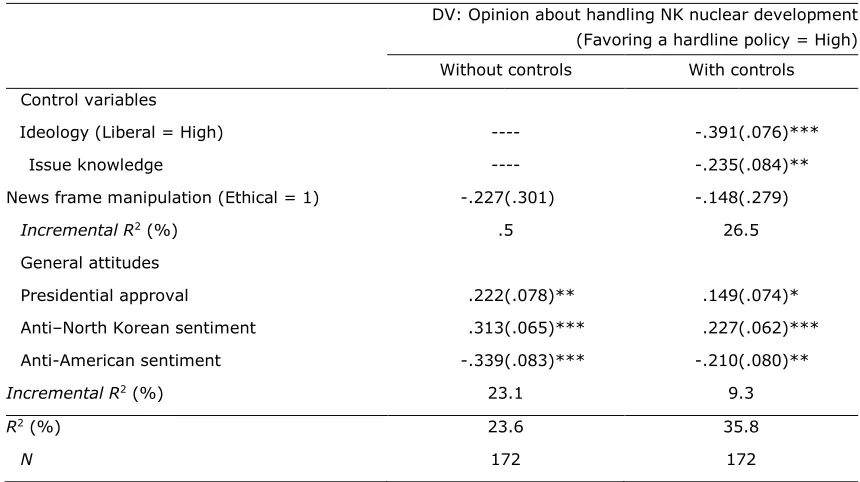
Table 1. Effects of General Political Attitudes on Policy Preference.
DV: Opinion about handling NK nuclear development (Favoring a hardline policy = High) Without controls With controls
Control variables
Ideology (Liberal = High) ---- -.391 (.076)***
Issue knowledge ---- -.235 (.084)**
News frame manipulation (Ethical = 1) -.227 (.301) -.148 (.279)
Incremental R2 (%) .5 26.5
General attitudes
Presidential approval .222 (.078)** .149 (.074)*
Anti–North Korean sentiment .313 (.065)*** .227 (.062)***
Anti-American sentiment -.339 (.083)*** -.210 (.080)**
Incremental R2 (%) 23.1 9.3
R2 (%) 23.6 35.8
N 172 172
For H1a through H1c, we examined whether a specific policy preference was related to general political attitudes. To test the baseline relationships, a regression equation was specified in which opinion about the South Korean government’s hardline policy on North Korea was regressed on presidential approval, attitude toward North Korea, attitude toward the United States, and control variables.
The regression analysis supported the hypotheses, revealing that participant policy preference was associated with all of the political attitudes considered (b = .149, SE = .074, p < .05 for presidential approval; b = .227, SE = .062, p < .001 for anti–North Korean sentiment; b = -.210, SE = .080, p < .01 for anti-American sentiment). As shown in Table 1, this pattern of relationships holds regardless of the inclusion of control variables. The only difference is that the strength of the relationships increases without controls.
Another point worth noting is that two control variables were significant factors in predicting policy preference on North Korea. It was found that participants with liberal ideology (b = -.391, SE = .076, p < .001) and relevant information (b = -.235, SE = .084, p < .01) tend to be less supportive of the hardline policy toward North Korea. Yet, consistent with the preliminary t-test result, the multivariate analysis further confirms that news frame manipulations did not produce any significant difference in policy preference.
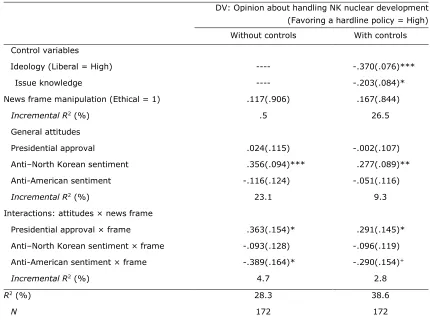
The next set of hypotheses (H2a through H2c) investigates whether the ethical frame, as compared with the material frame, amplifies the relationships between policy preference and the three general political attitudes. To test the hypotheses, we included interaction terms between news frame manipulations and each of the attitude variables in predicting policy preference. Given that the news frame variable is a dummy (ethical = 1/material = 0), coefficients for interaction terms quantify the changes (or differences) in the strength of the baseline relationships between policy preference and political attitudes as the news frame is shifted from material to ethical. A significant and positive coefficient is evidence for supporting H2a and H2b whereas a significant and negative coefficient is interpreted as supporting H2c.
Table 2. Interactive Effects of News Frames on Policy Preference.
DV: Opinion about handling NK nuclear development (Favoring a hardline policy = High) Without controls With controls
Control variables
Ideology (Liberal = High) ---- -.370 (.076)***
Issue knowledge ---- -.203 (.084)*
News frame manipulation (Ethical = 1) .117 (.906) .167 (.844)
Incremental R2 (%) .5 26.5
General attitudes
Presidential approval .024 (.115) -.002 (.107)
Anti–North Korean sentiment .356 (.094)*** .277 (.089)**
Anti-American sentiment -.116 (.124) -.051 (.116)
Incremental R2 (%) 23.1 9.3
Interactions: attitudes × news frame
Presidential approval × frame .363 (.154)* .291 (.145)*
Anti–North Korean sentiment × frame -.093 (.128) -.096 (.119)
Anti-American sentiment × frame -.389 (.164)* -.290 (.154)+
Incremental R2 (%) 4.7 2.8
R2 (%) 28.3 38.6
N 172 172
Note. Entries are unstandardized coefficients with standard errors in parentheses.
+p< .10. *p < .05. **p < .01. ***p < .001.
It is also noteworthy that there was no significant interaction between news frame and anti– North Korean sentiment. The difference in the baseline relationship (between opinion about handling North’s nuclear development and anti–North Korean attitude) across the material frame and ethical frame conditions was too small (.096) to be statistically meaningful. This null finding might indicate the robustness of the link between how people feel about North Korea and how they feel about hardline policy toward the North. Because of the ongoing nuclear threat posed by North Korea, the attitudinal consistency in people’s mind regarding the sentiment toward North Korea and the opinion about a tough approach toward the North seems to be stable enough to remain unchanged regardless of how the nuclear crisis is discussed.
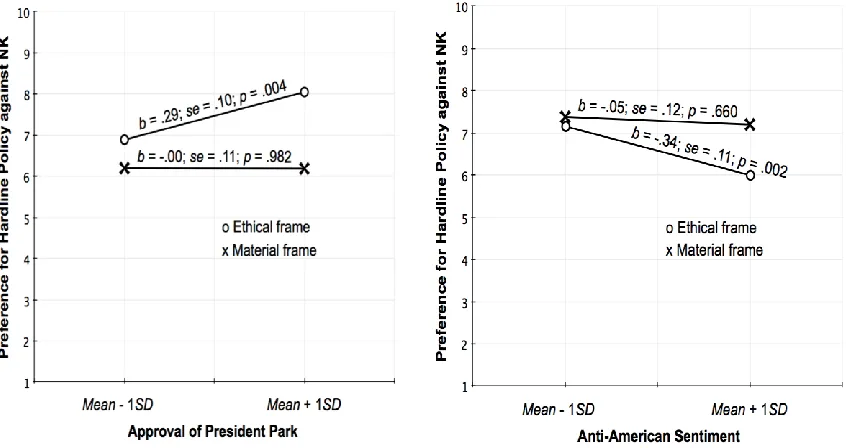
ethical framing was approval of President Park significantly and positively associated with a preference for a hardline policy on North Korea (b = .29, SE = .10, p < .01). The relationship was not significant with material framing (b = -.00, SE = .11, p = ns). In addition, although not shown in Figure 1, the conditional effects of news framing on policy preference for both high and low presidential approval (one standard deviation above or below the sample mean) were also estimated. The results suggest that a framing effect was observed only when approval of President Park was high. That is, for participants who reported a high level of approval of President Park, exposure to ethical framing, as compared to exposure to material framing, significantly increased support for a hardline policy on North Korea (b = 1.85, SE = .93, p < .05). No such effect was observed for participants whose rating of the president was low (b = .68, SE = .78, p = ns).
Figure 1. Interactions between general political attitudes and news frames.
The last hypothesis (H3) investigates whether the ethical frame, as opposed to the material frame, encourages a heuristic information processing mode. To test the hypothesis, an independent-samples t test was performed, with news frame conditions (the ethical frame = 1; the material frame = 0) being the independent variable and postexposure measures of information processing the dependent variable. The result of the t test shows a significant mean difference between the ethical frame and material frame (t = -1.759, df = 172, p < .05, one-tailed), confirming our theoretical rationale. That is, those exposed to the ethical frame (M = 4.63, SD = 1.14) exhibited a higher level of simplified processing regarding the manipulated news story than those exposed to the material frame (M = 4.35, SD = .96). This result is consistent with the previous literature and reinforces our conjecture that ethical framing is more likely to invoke simplified reasoning as compared with material framing. Taken all together, the results of the information processing as an outcome of framing effects and the interaction tests convincingly suggest that ethical framing guides people toward a simplified train of thought and encourages them to see a current issue in terms of their preexisting, broader political views.
Discussion
This experiment set out to investigate how value frames in news accounts of the North’s nuclear threat affect public opinion. Our results show that value framing did not directly shape opinion about government policy on North Korea. That is, participants’ opinions were not swayed by the frame, either ethical or material, to which they were exposed. However, news framing produced a more subtle set of effects on the way people make decisions. As hypothesized, it was found that participants’ opinions about how to respond to the nuclear crisis were closely aligned with their general political attitudes. This pattern was more pronounced when participants were exposed to the ethical frame than when exposed to the material frame.
The finding that opinion about a specific issue is bound by more general attitudes is consistent with past studies. Work by Hurwitz and Peffley (1987), for example, found that specific policy preferences are derived from a set of political postures and core values (see also Holsti, 1996). This general-to-specific reasoning is often observed when issues under consideration are complicated by nature (e.g., foreign policies) and/or individuals do not have enough processing resources (e.g., information, motivation) to interpret specific issues. That is, when facing uncertainty, people “behave as cognitive misers by using old, generic knowledge to interpret new, specific information” (Hurwitz & Peffley, 1987, p. 1104). Extending this research, the results of our experiment show that, as an external factor, a certain way of policy discussion (i.e., ethical framing) can also induce simplified reasoning that is guided by already-established, generic attitudes. This finding suggests a range of important implications for the broader literature of news framing and political communication.
does not fully assess the impact framing may have on the individual. By shifting the focus from whether ethical framing promotes ethical thinking to whether it induces judgmental simplification, this study sheds light on more nuanced, subtle effects of framing.
Second, although subtle, the changes in the decision-making mode induced by news framing might be consequential for the dynamics of public opinion and policy stability. Because of its persuasive and mobilizing power, ethical framing is widely used in public debates for controversial issues. The North Korean nuclear crisis is no exception. News media and political elites in South Korea have long framed the North’s nuclear aspirations as an irresponsible violation of the norm of nonproliferation and an evil threat to the peace of the innocent people on the peninsula (Dai & Hyun, 2010). This normative, accusatory framing might be successful in increasing public awareness and mobilizing people against the North’s nuclear development.
However, the findings of our experiment suggest that, when thinking about the nuclear crisis, such normative discussions encourage people to rely on their general political attitudes, such as their evaluation of the president and their sentiments about the U.S. That is, under the ethical frame, people’s opinions about the nuclear crisis do not appear to be an outcome of a thoughtful deliberation of the issue itself but a product of “political” considerations, depending on one’s attitudes toward the current president and the U.S. Thus, if this is the case, ethical reasoning on the nuclear crisis likely destabilizes public opinion on the issue, fluctuating as public opinion on the current president and the U.S. changes. Under some circumstances, the “top-down” processing guided by general beliefs represents efficient judgments (Sniderman, Brody, & Tetlock, 1993). However, when it comes to issues of national concern such as the nuclear crisis, making decisions by drawing on general political attitudes is less desirable. Furthermore, according to our data, ethical framing amplifies the link between political beliefs and opinions about the hardline policy on the North. This suggests that ethical reasoning creates an opinion gap between those with favorable attitudes toward the current South Korean government and the U.S. and those with unfavorable attitudes. Opinion polarization based on general political beliefs may create unnecessary conflict in South Korean politics and impede public debate about how to handle the North’s nuclear threat.
Given that ethical framing is one of the common frames in the news coverage of this issue, our data suggest that journalists should exercise caution in how they cover the nuclear crisis. Although ethical reasoning might make news stories appealing and easy to follow, an unintended consequence of it could be less deliberative and more polarized public opinion. In a similar vein, for reasons of persuasion and mobilization, politicians and elites are tempted to craft their messages based on indisputable moral values. Like framing in news reports, normative claims in political rhetoric would also be implicated in facile public opinion. Although observed in the context of news accounts, the results of our experiment suggest that political elites should also be aware of the downside of ethical reasoning in defining public issues.
material framing drives people to engage in a more deliberative, compensatory decision-making process, considering the overall worth of different alternatives. One way to test this possibility is to expose participants to material framing and then to ask them both their position on the handling of the nuclear crisis and their rationale for this position. This would allow for assessment of the depth of their reasoning.
Finally, we must acknowledge a limitation in the present study that deserves special mention. We tested the effects of value framing in the context of the North Korean nuclear crisis and found that exposure to a single news story with a different value frame, either ethical or material, made a difference. However, caution should be exercised when extrapolating the effects of value framing to other contexts. As discussed earlier, the nuclear crisis has been a central issue in South Korean politics for decades. Through different phases of the crisis, people were already well aware of the issue and the various frames used to define the issue. Thus, because the nuclear issue is a chronically accessible concept in most Koreans’ schema, single exposure could be enough to activate related thoughts in participants’ minds. Because framing effects were only tested with the nuclear issue, there still remains a possibility that a high level of awareness might be a necessary condition for the framing effect observed in this study to occur. Furthermore, the nuclear crisis in South Korea is a typical example of low information availability in a high public involvement setting. Psychologically, the South Korean public is deeply involved in the issue but, because the political sensitivity of the subject, much of the information is state controlled. Situations such as this often lead the public to almost completely rely on news for relevant information. The high reliance on and perhaps trust in news may amplify the impact of news frames and thus may influence the pattern of findings as observed in this study. Future studies should test framing effects on the modes of information processing and decision making within different issue contexts for the sake of a more general conclusion.
References
Asan Report. (2015, January). South Korean attitudes toward North Korea and reunification. The Asian Institute of Policy Studies. Retrieved from http://en.asaninst.org/contents/south-korean-attitudes-toward-north-korea-and-reunification/
Bennett, W. L. (2007). News: The politics of illusion (7th ed.). New York, NY: Longman.
Chiozza, G., & Choi, A. (2012). Going the American way: The surprising case of Korean pro-Americanism. Pacific Review, 25, 269–292. doi:10.1080/09512748.2012.658846
Dai, J., & Hyun, K. (2010). Global risk, domestic framing: Coverage of the North Korean nuclear test by US, Chinese, and South Korean news agencies. Asian Journal of Communication, 20, 299–317. doi:10.1080/01292981003802184
Domke, D., Shah, D. V., & Wackman, D. B. (1998). Media priming effects: Accessibility, association, and activation. International Journal of Public Opinion Research, 10, 51–74.
doi:10.1093/ijpor/10.1.51
Entman, R. M. (2004). Projections of power: Framing news, public opinion, and U.S. foreign policy. Chicago, IL: University of Chicago Press.
Eveland, W. P., Jr., Shah, D. V., & Kwak, N. (2003). Assessing causality in the cognitive mediation model: A panel study of motivations, information processing, and learning during campaign
2000. Communication Research, 30, 359–386. doi:10.1177/0093650203253369
Festinger, L. (1957). A theory of cognitive dissonance. Stanford, CA: Stanford University Press.
Gollob, H. F. (1974). The subject-verb-object approach to social cognition. Psychological Review, 81, 286– 321. doi:10.1037/h0036591
Heider, F. (1958). The psychology of personal relations. New York, NY: EUA Wiley.
Holsti, O. R. (1996). Public opinion and American foreign policy. Ann Arbor: University of Michigan Press.
Hurwitz, J., & Peffley, M. (1987). How are foreign policy attitudes structured? A hierarchical model. American Political Science Review, 81, 1099–1120. doi:10.2307/1962580
Jang, W. Y. (2013). News as propaganda: A comparative analysis of US and Korean press coverage of the Six-Party Talks, 2003–2007. International Communication Gazette, 75, 188–204.
doi:10.1177/1748048512465555
Kahneman, D., & Frederick, S. (2002). Representativeness revisited: Attribute substitution in intuitive judgment. In T. Gilovich, D. Griffin, & D. Kahneman (Eds.), Heuristic and biases: The psychology of intuitive judgment (pp. 49–81). New York, NY: Cambridge University Press.
Kim, Y. C. (2014). Inter-Korean relations: What accounts for Kim Jong Un’s changing attitudes? Global Asia, 9, 22–29.
Lee, W. S., & Son, Y. J. (2011). The media’s agenda setting on the nuclear test of North Korea. Korean Journal of Communication & Information Studies, 56, 175–193.
Luker, K. (1984). Abortion and the politics of motherhood. Berkeley, CA: University of California Press.
Myrtek, M., & Spital, S. (1986). Psychophysiological response patterns to single, double, and triple stressors. Psychophysiology, 23(6), 663–671.
Nunnally, J. C. (1970). Introduction to psychological measurement. New York, NY: McGraw-Hill.
Oh, J. H. (2014). Security agencies of North Korea under the Kim Jong Un regime. Korean Journal of Defense Analysis, 26, 117–131.
Osgood, C. E., & Tannenbaum, P. H. (1955). The principle of congruity in the prediction of attitude change. Psychological Review, 62(1), 42–55.
Park, Y. H. (2013). South Korea’s perception on and responses to North Korea’s nuclear weapons development after its third nuclear test. Journal of Peace and Unification Studies, 5, 3–38.
Payne, J. W., Bettman, J. R., & Johnson, E. J. (1992). Behavioral decision research. Annual Review of Psychology, 43, 87–131.
Preston, C. C., & Colman, A. M. (2000). Optimal number of response categories in rating scales:
Reliability, validity, discriminating power, and respondent preferences. Acta Psychologica, 104(1), 1–15.
Rich, T. (2014). Propaganda with purpose: Uncovering patterns in North Korean nuclear coverage, 1997– 2012. International Relations of the Asia-Pacific, 14, 427–453. doi:10.1093/irap/lcu011
Rokeach, M. (1973). The nature of human values. New York, NY: Free Press.
Scobell, A. (2002). Crouching Korea, hidden China: Bush Administration policy toward Pyongyang and Beijing. Asian Survey, 42, 343–368. doi:10.1525/as.2002.42.2.343
Shah, D. V. (2001). The collision of convictions: Value framing and value judgments. In R. P. Hart & D. Shaw (Eds.), Communication and U.S. elections: New agendas (pp. 55–74). Lanham, MD: Rowman and Littlefield.
Shah, D. V., Domke, D., & Wackman, D. B. (1996). “To thine own self be true”: Values, framing, and voter decision-making strategies. Communication Research, 23, 509–560.
doi:10.1177/009365096023005001
Sigal, L. V. (2010a). Can Washington and Seoul try dealing with Pyongyang for a change? Arms Control Today, 40(9), 16–21.
Sigal, L. V. (2010b). Primer—North Korea, South Korea, and the United States: Reading between the lines of the Cheonan attack. Bulletin of the Atomic Scientists, 66(5), 35–44.
Simon, H. A. (1990). Invariants of human behavior. Annual Review of Psychology, 41, 1–20. doi:10.1146/annurev.ps.41.020190.000245
Sniderman, P. M., Brody, R. A., & Tetlock, P. E. (1993). Reasoning and choice: Explorations in political psychology. New York, NY: Cambridge University Press.