R E S E A R C H
Open Access
Scattering from metamaterial coated
nihility sphere
A. Ghaffar
1*, M. M. Hussan
1, Majeed A. S. Alkanhal
2and Sajjad ur Rehman
2Abstract
Background:To show the Back-Scattering efficiencies of nihility sphere become non-zero, scattering from metamaterial coated nihility sphere has been carried out in the presented work.
Methods:The field phasors are expanded in terms of spherical wave vector function along with assumed
scattering coefficients. Boundaries conditions are applied at each interface, i.e., free space- metamaterial coating and metamaterial coating-nihility sphere core.
Results:Scattering coefficients are obtained by using boundary conditions at each interface. The scattering efficiencies are obtained in graphical form by varying both permittivity and permeability of metamaterial using MATHEMATICA software. Under some special conditions obtained results are compared with already published literature to show the correctness of present formulations.
Conclusion:It is observed that Back-Scattering efficiencies of nihility sphere becomes non-zero when we introduce a metamaterial coating layer on it. It is also noticed that the scattering efficiencies are dependent on coating thickness as well as permittivity and permeability of metamaterials.
Keywords:Nihility, Sphere, Metamaterial, Scattering, Forward-scattering efficiency, Back-scattering and Extinction efficiency
Background
A lot of engineers, researchers and professional’s belonging to optical society pay a vital consideration towards those materials which were artificially designed, which we often call as metamaterial. Because metamaterials are tremen-dously good to tune and control the electromagnetic prop-erties at vide range of frequencies which is not possible for naturally occurring materials. Many researchers used meta-materials as filters, phase shifters, perfect reflectors, electro-magnetic invisibility cloak, and wave guiders [1–5]. Some characteristic metamaterials which were being considered widely in already published work are plasma, Perfect Elec-tromagnetic Conductor(PEMC), chiral [6], chiral nihility and split ring resonator (SRR) [7–9]. The nihility medium was considered as “the electromagnetically nilpotent” and has the most surprising impression in the field of electro-magnetics and optics, in this material the relative perme-ability and relative permittivity both have zero magnitude.
Nihility material introduced by Lakhtakia [10, 11] attracted many researchers because wave cannot propagate in nihility medium. Lakhtakia postulated that nihility medium is a medium whose permittivity and permeability both are null valued [10–13]. Due to null valued permittivity and perme-ability this medium does not allow the wave to propagate. Maxwell equation under nihility conditions reduced into below form
∇E¼0 ð1Þ
∇H ¼0 ð2Þ
Many researchers used nihility material and performed many experiments regarding nihility waveguides, electro-magnetic/plane wave scattering from different objects made up of nihility material [11, 12, 14–18]. Lakhtakia derived the mathematical solutions for scattering of electromag-netic wave from sphere made up of nihility and concluded that its Back-Scattering efficiency is exactly zero, he also re-ported that both Forward-scattering and Extinction effi-ciencies of nihility sphere showed larger magnitude than perfect electric and perfect magnetic conductors [12]. In
* Correspondence:[email protected]
1Department of Physics, University of Agriculture, Faisalabad, Pakistan
Full list of author information is available at the end of the article
addition Lakhtakia and Geddes proposed the analytical so-lution of plane wave scattering from infinite long nihility cylinder [11]. Ahmad et al., analytically solved the plane wave scattering by considering infinite long nihility cylinder coated with metamaterials and deduced that metamaterial layer can tune the scattering efficiencies [19]. The scattering characteristics of plane wave scattering from infinite cylin-der made up of nihility covered with chiral layer also has been studied by Ahmed and Naqvi [20]. Sobiaet al., analyt-ically formulated the scattering of the electromagnetic wave from chiral coated nihility cylinder embedded in chiral media [21]. Yaqoob et al., used anisotropic plasma as a coating material and solved the scattering problem from nihility cylinder placed in chiral medium, and deduced that chiral and anisotropic plasma parameters can be used to tune the scattering efficiencies [22].
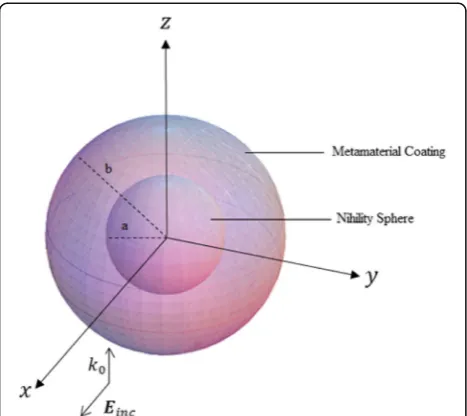
In the present paper, the problem of electromagnetic wave scattering from nihility sphere coated with metama-terial, i.e., Double Positive (DPS), Double Negative (DNG), Epsilon Negative (EMG) and Mu negative (MNG) are formulated mathematically and computationally. For the simplicity of mathematical formulations coating layer has been considered of uniform thickness. In order to expand the incident, the scattered and the transmitted electromag-netic field, spherical wave vector function are used. For mathematical solutions, the proposed geometry of sub-jected problem was sliced into three regions free space as region 0, metamaterial coating as region 1 and Nihility sphere as region 2, shown in the Fig. 1. By applying the boundaries conditions at each interface a set of eight equa-tions are obtained which are used to find the scattering co-efficients. These obtained scattering coefficients are used to calculate the scattering efficiencies, which were then
compared with already published literature to show the accuracy of present formulation. In this paper the time dependencee−jωtwas considered throughout the mathem-atical formulation.
Analytical Formulations and Method
The propose geometry of the presented problem of plane wave scattering from nihility sphere coated with DPS, DNG, MNG or ENG material is depicted in Fig. 1. Wherebandarepresents the radius of sphere with coat-ing and without coatcoat-ing respectively. The outer medium i.e.
ρ≥b is free space having wave number k0¼ω ffiffiffiffiffiffiffiffiffi0μ0
p is represented by region 0. The coating mediuma<ρ<bwith wave number k1¼ω ffiffiffiffiffiffiffiffiffi1μ1
p
is termed as region 1. Region
ρ<awith wavenumberk2¼ω ffiffiffiffiffiffiffiffiffi2μ2
p
is represented by re-gion 2.
In spherical coordinate system (r,θ,φ) the spherical wave vector functions are given as.
Mð Þl
σmnγ¼∇ rYσmnðθ;φÞRln kγr
ð3Þ
Nð Þl
σmnγ¼
1
kγ ∇M
l ð Þ
σmnγ
h i
ð4Þ
Where Yσmn(θ,φ) represents spherical harmonic, the
most significant property of spherical harmonics is its par-ity. Here σ represents the parity of spherical harmonics, which is even whenσ=eand odd whenσ=o. The radial functionRlnkγrtransform to the spherical BesselJn(kγr), Spherical Neumann functionnn(kγr) and spherical Hankel
function hn(kγr) corresponding to l= 1, 2, 3 respectively.
Where subscriptγrepresents the appropriate wave num-ber i.e., γ= 0, 1, 2 Represents the region 0 (free space) wave number and region 1 wave numberk1and so on.
A Plane wave traveling in +zdirection with its electric field polarized in the positive x direction is incident on metamaterial coated nihility sphere. The incident elec-tromagnetic field in terms of spherical vector wave func-tions is given as.
Eincð Þ ¼r E0
X∞
n¼1i
nð2nþ1Þ
n nð þ1Þ M
1 ð Þ oln−iN
1 ð Þ eln
ð5Þ
Hincð Þ ¼r −
k0 ωμ0
E0
X∞
n¼1i
nð2nþ1Þ
n nð þ1Þ M
1 ð Þ elnþiN
1 ð Þ oln
ð6Þ
Where k0and μ0is the wavenumber and permeability of free space.
The scattered field can be written as
Escð Þ ¼r E0
X∞
n¼1i
nð2nþ1Þ
n nð þ1Þ ianN
3 ð Þ eln−bnM
3 ð Þ oln
Hscð Þ ¼r
k0 ωμ0
E0
X∞
n¼1i
nð2nþ1Þ
n nð þ1Þ ibnN
3 ð Þ
olnþanMð Þeln3
ð8Þ
Electromagnetic field that transmitted in region 1 can be represented as
EIð Þ ¼r E0 X∞
n¼1i
nð2nþ1Þ n nð þ1Þ cnM
1 ð Þ olnþdnM
2 ð Þ oln−ienN
1 ð Þ eln
−ifnNð Þeln2
ð9Þ
HIð Þ ¼r ωμ−k1 1
E0 X∞
n¼1i
nð2nþ1Þ n nð þ1Þ enM
1 ð Þ elnþfnM
2 ð Þ eln−icnNð Þoln1
−idnNð Þoln2
ð10Þ
Here k1represents the wavenumber in region 1 having
μ1its permeability. Electromagnetic Field present in re-gion 2 is
EIIð Þ ¼r E0
X∞
n¼1i
nð2nþ1Þ
n nð þ1Þ gnM
1 ð Þ
oln−ihnNð Þeln1
h i
ð11Þ
HIIð Þ ¼r − k2 ωμ2E0
X∞
n¼1i
nð2nþ1Þ
n nð þ1Þ lnM
1 ð Þ
elnþilnN1 ð Þ oln
h i
ð12Þ
The analytically solved boundary conditions at both interface are listed below
Eincθ þEscatθ ¼ EIθ ρ ¼ b
Hincθ þ Hscatθ ¼ HIθ ρ ¼ b
EIθ ¼ EIIθ ρ¼ a
HIθ ¼ HθII ρ¼ a
g
ð13Þ
By using field Eqs. 5, 6, 7, 8, 9, 10, 11 and 12 in the Eq. 13 set of eight equations are obtained in terms of scattering coefficients.
hnð Þr0 bnþjnð Þr1 cnþnnð Þr1 dn¼jnð Þr0 ð14Þ
r1½r0hnð Þr0 ′anþr0 r1jnð Þr1
′
enþr0½r1nnð Þr1 ′fn
¼r1 r0jnð Þr0
′
ð15Þ
η−1
0 hnð Þr0 anþη1−1jnð Þr1 enþη1−1nnð Þr1 fn
¼η0−1jnð Þr0 ð16Þ
η−1
0 r1½r0hnð Þr0 ′bn−η1−1r0 r1jnð Þr1
′
cn−η1−1r0½r1nnð Þr1 ′dn ¼η0−1r1 r0jnð Þr0
′
ð17Þ
jnð Þr2 cnþnnð Þr2 dn−jnð Þr3 gn¼0 ð18Þ
r3 r2jnð Þr2
′
enþr3½r2nnð Þr2 ′fn−r2 r3jnð Þr3
′
hn¼0
ð19Þ
η−1
1 jnð Þr2 enþη1−1nnð Þr2 fn−η2−1jnð Þr3 hn¼0 ð20Þ
η−1
1 r3 r2jnð Þr2
′
cnþη1−1r3½r2nnð Þr2 ′dn−η2−1r2 r3jnð Þr3
′
gn¼0 ð21Þ
Where the impedance is defined as ηn¼ ffiffiffiffiμn n q
. These
equations are solved for scattering coefficients an and
bn which are then used to solve the scattering
effi-ciency, Forward-scattering effieffi-ciency, Back-scattering and Extinction efficiency as given below where k0b= r0,k1b=r1,k1a=r2 ,k2a=r3
The energy flow (Poynting vector) was obtained by implementing the scattered field solution and can be written as [23]
Si¼ 1
2Re EiH i
Ss¼ 1
2Re EsH s
Sext¼ 1 2Re EiH
s−EsHi
WhereSiandSsare the corresponding Poynting
vec-tor associated with incident and scattered field respect-ively, whileSextrepresents the Poynting vector induced
due to interaction between incident and scattered
electromagnetic waves. By following standard Mie the-ory, if we integrate the above equation over a large sphere, various scattering efficiencies can be obtained [24]. This yields the extinction efficiency and scattering efficiencies (forward scattered and backscattered) [23, 24] as presented in Eqs. 22, 23 and 24.
Qext¼ 2 r02
X∞
n¼1
2nþ1
ð ÞℜðanþbnÞ ð22Þ
Qforward ¼ 1 r02
X∞
n¼1
2nþ1
ð ÞðanþbnÞ2
2
ð23Þ
Qbackward ¼ 1 r02
X∞
n¼1
−1
ð Þnð2nþ1Þb n−an
ð Þ2
2
ð24Þ
By using values of scattering coefficients an and bn in
above equation nihility condition is applied i.e., ϵ2= 0 andμ2= 0, and results are obtained.
Results and discussions
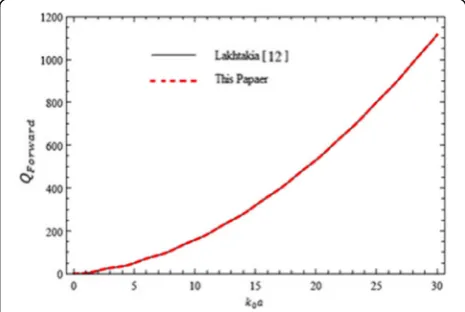
In the previous section, mathematical formulations of plane wave scattering from nihility sphere coated with metama-terial have been calculated. In order to gain the more detail of the presented work and also to check the correctness of mathematical formulations Forward-scattering and Extinc-tion efficiencies are plotted under some special condiExtinc-tions. The obtained results are then compared with already pub-lished literature [12] which depicted the accuracy of the presented formulation. When we removed the coating layer
by consideringb=a,ϵ2=ϵ1,μ2=μ1and by applying nihility boundary conditions i.e., ϵ1→0, μ1→0 the presented problem reduced to electromagnetic wave scattering from nihility sphere. Then by using these specified con-ditions Forward-scattering and Extinction efficiencies are plotted by using MATHEMATICA software and com-pared with already published work which are in great agreement as shown in Figs. 2 and 3.
To compare the obtained results of nihility core coated with metamaterial with PEC and PMC sphere coated with metamaterial conversion conditions presented in Table 1 were enforced.
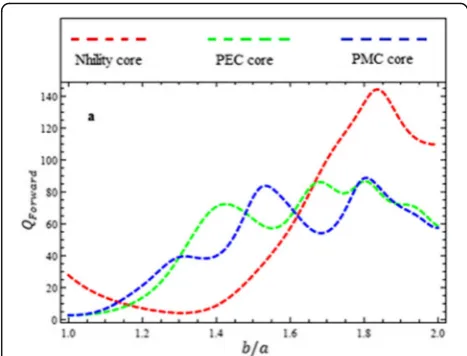
Fig. 4Forward-scattering efficiency of nihility, PEC and PMC sphere as a function of b/a whenϵ1= 2.54, μ1= 1, a = 0.5 ×λ, f = 1GHz.
Fig. 5Back-scattering efficiency of nihility, PEC and PMC sphere as a function of b/a whenϵ1= 2.54, μ1= 1, a = 0.5 ×λ, f = 1GHz
Table 1Material conversion values
Material ϵ1 μ1
Nihility ≈0 ≈0
PEC ≈ ∞ ≈0
PMC ≈0 ≈ ∞
DPS Coating
Figure 4 represents the comparison between Forward-Scattering efficiencies of nihility, PEC and PMC sphere when coated with DPS metamaterial as a function of coating layer thickness with following parameters ϵ1= 2.54, μ1= 1, a= 0.5 ×λ, f= 1GHz. By analyzing Fig. 4 we deduced that the Forward-scattering efficiency of nihility sphere is higher than that of PEC sphere and PMC sphere at higher values of coating thickness and lower at lower values of coating thickness. Figure 5 shows the compared results of Back-Scattering efficiencies versus coating layer thickness when nihility, PEC and PMC sphere covered with layer of DPS metamaterial by insert-ing followinsert-ing parametersϵ1= 2.54, μ1= 1, a= 0.5 ×λ, f= 1GHz. Figure 5 reflects that the Back-Scattering efficiency of nihility sphere is lower (but not zero as in uncoated
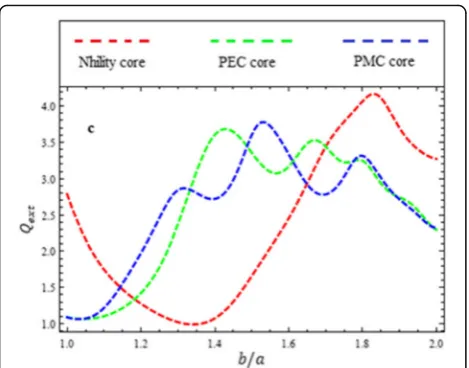
case [12]) than PEC sphere and PMC sphere when coated with DPS metamaterial layer. In Fig. 6 the Extinction efficiencies of different sphere core i.e., nihility, PEC and PMC are coated with DPS metamaterial and are comparatively plotted against the coating thickness by considering the same parameters as that used in Figs. 4 and 5. By analyzing Fig. 6, we reported that the extinc-tion efficiency of nihility sphere is higher as compared to PEC and PMC cases at higher values of coating thickness and vice versa.
DNG Coating
Forward-scattering, Back-scattering and Extinction effi-ciencies of nihility sphere are plotted along with PEC and PMC sphere when coated with DNG metamaterial whenϵ1=−2.54, μ1=−1, a= 0.5 ×λ, f= 1GHzas shown Fig. 8Back-scattering efficiency of nihility, PEC and PMC sphere as a function of b/a whenϵ1=−2.54, μ1=−1, a = 0.5 ×λ, f = 1GHz
Fig. 9Extinction efficiency of nihility, PEC and PMC sphere as a function of b/a whenϵ1=−2.54, μ1=−1, a = 0.5 ×λ, f = 1GHz
Fig. 7Forward-scattering efficiency of nihility, PEC and PMC sphere as a function of b/a whenϵ1=−2.54, μ1=−1, a = 0.5 ×λ, f = 1GHz
in Figs. 7, 8 and 9 respectively. From Figs. 7, 8 and 9 we concluded that when the nihility sphere is coated with DNG metamaterial the behavior of Forward-scattering, Back-scattering and Extinction efficiencies are more sensitive than DPS coated nihility sphere and Forward-Scattering, Back-scattering and Extinction efficiencies depict higher magnitude then PEC and PMC at lower values of coating thickness and vice versa.
ENG and MNG Coating
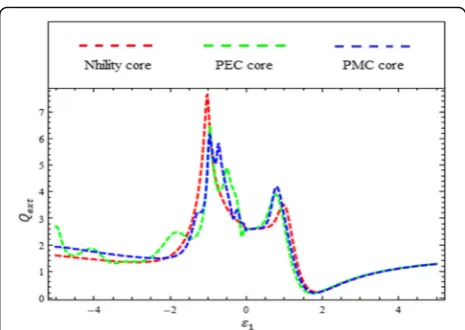
Forward-scattering, Back-Scattering and Extinction effi-ciencies of nihility sphere when coated with metamaterial by substituting following parameters: μ1=−1, a= 0.4 ×λ, b= 1.5 ×a, f= 1GHz were compared with PEC and PMC sphere as shown in Figs. 10, 11 and 12. From Fig. 10 we
concluded that the both Forward-scattering and Extinction efficiencies of nihility core depict lower magnitude than PEC and PMC sphere when we considered only MNG (ϵ1= 0to5) coating while, show higher magnitude than PEC and PMC when coating has been considered of DNG (ϵ1 −2 to−1). It was further deduced that the Back-scattering efficiency of nihility is lower than PEC and PMC, which can be confirmed from Fig. 11.
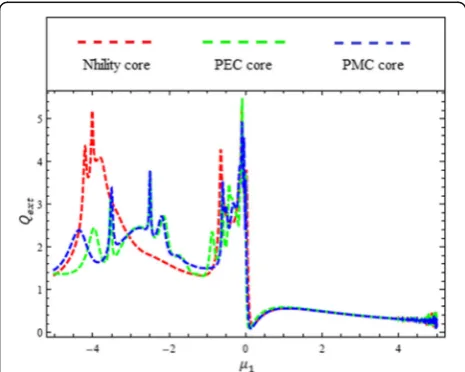
Forward-scattering, Back-Scattering and Extinction ef-ficiencies of nihility sphere as a function of μ1 when coated with metamaterial by considering following pa-rametersϵ1=−2.54, a= 0.4 ×λ, b= 1.5 ×a, f= 1GHzare compared with PEC and PMC sphere as shown in Figs. 13, 14 and 15 respectively. By analyzing Figs. 13 and 15 it is reported that the magnitude of both Forward-Scattering and Extinction efficiencies correspond-ing to nihility sphere depicts higher magnitude than PEC
Fig. 12Comparison between Extinction efficiencies of nihility, PEC and PMC sphere as a function ofϵ1whenμ1=−1, a = 0.4 ×λ, b = 1.5 × a, f = 1GHz
Fig. 13Comparison between Forward-Scattering efficiencies of nihility, PEC and PMC sphere as a function ofμ1whenϵ1=−2.54, a= 0.4 ×λ,b= 1.5 ×a,f= 1GHz
Fig. 11Comparison between Back-Scattering efficiencies of nihility, PEC and PMC sphere as a function ofϵ1whenμ1=−1, a = 0.4 ×λ, b = 1.5 × a, f = 1GHz
and PMC sphere only when the value ofμ1ranging be-tween -5 to -4, while show lower magnitude value as compared to PEC and PMC when μ1 = -4 to 0. The Back-Scattering efficiency of nihility sphere recorded maximum whenμ1= -4, and minimum as compared to PEC and PMC at other values ofμ1, which can be veri-fied from Fig. 14. From these Figs, it was deduced that Forward-scattering and Extinction efficiencies of nihility de-pict higher magnitude than PEC and PMC in MNG coating case (at some specific values of permeability) and lower in ENG coating case as shown in Figs. 13, 14 and 15.
Conclusions
The problem of electromagnetic wave scattering from metamaterial coated nihility sphere by using extended classical wave theory have been mathematically formu-lated and analyzed. It is observed that the Forward-Scattering, Back-scattering and Extinction efficiencies strongly depend on coating thickness. When we con-sider the DPS coating, these efficiencies depict higher magnitude than PEC and PMC sphere at higher values of coating thickness, while in DNG case scattering effi-ciencies following increasing pattern at lower values of coating thickness. It is furthermore reported that in DNG coating case, we observed that lower scattering efficiencies magnitude of Nihility sphere as compared to PEC and PMC at higher values of coating thickness. Based on the obtained results, we predicted that, scatter-ing efficiencies can be controlled and tuned more effect-ively by producing metamaterial coating layer. These results may be very helpful in the defense technologies and optical illusion devices.
Abbreviations
DNG:Double Negative; DPS: Double Positive; EMG: Epsilon Negative; MNG: Mu negative; PEC: Perfect Electric Conductor; PMC: Perfect Magnetic Conductor; SRR: Split Ring Resonator
Funding
Deanship of Scientific Research (DSR) at King Saud University for its funding of this research through the Research Group no RG-1436-001.
Availability of data and materials
Detail about data has been provided in the article.
Authors’contributions
All authors contributed equally in all the sections of this work. All authors read and approved the final manuscript.
Competing interests
The authors declare that they have no competing interests.
Author details 1
Department of Physics, University of Agriculture, Faisalabad, Pakistan.
2Department of Electrical Engineering, King Saud University, Riyadh, Saudi
Arabia.
Received: 3 December 2016 Accepted: 15 February 2017
References
1. Capolino, F: Applications of metamaterials. CRC press, USA (2009) 2. Engheta, N, and Ziolkowski, RW: Metamaterials: physics and engineering
explorations. John Wiley & Sons, USA (2006)
3. Gil, M., Bonache, J., Martin, F.: Metamaterial filters: A review. Metamaterials
2(4), 186–197 (2008)
4. Ding, F, and Yang, H: EM scattering by objects coated with DNM. In: Microwave, Antenna, Propagation and EMC Technologies for Wireless Communications (MAPE), 2013 IEEE 5th International Symposium on. IEEE, USA (2013)
5. Geng, Y-L: Mie Scattering by a Conducting Sphere Coated Uniaxial Single-Negative Medium. Int J Antennas Propagation.2012(856476), 1–6 (2012) 6. Zhang, S., et al.: Negative refractive index in chiral metamaterials. Phys Rev
Lett102(2), 023901 (2009)
7. Afzaal, M., et al.: Scattering of electromagnetic plane wave by an impedance strip embedded in homogeneous isotropic chiral medium. Opt Commun
342, 115–124 (2015) Fig. 15Comparison between Extinction efficiencies of nihility, PEC
and PMC sphere as a function ofμ1whenϵ1=−2.54,a= 0.4 ×λ, b= 1.5 ×a,f= 1GHz
8. Ghaffar, A., Alkanhal, M.A.: Electromagnetic waves in parallel plate uniaxial anisotropic chiral waveguides. Opt Mater Express4(9), 1756–1761 (2014) 9. Sihvola, A.: Metamaterials in electromagnetics. Metamaterials1(1), 2–11 (2007) 10. Lakhtakia, A: An electromagnetic trinity from“negative permittivity”and
“negative permeability”. arXiv preprint physics/0112003. Int J Infrared Millimeter Waves22(12), 1731–1734 (2001)
11. Lakhtakia, A., Geddes Iii, J.B.: Scattering by a nihility cylinder. AEU-Int J Electron Commun61(1), 62–65 (2007)
12. Lakhtakia, A.: Scattering by a nihility sphere. Microwave Opt Technol Lett
48(5), 895–896 (2006)
13. Lakhtakia, A.: Radiation pressure efficiencies of spheres made of isotropic, achiral, passive, homogeneous, negative-phase-velocity materials. Electromagnetics28(5), 346–353 (2008)
14. Capretti, A., et al.: Comparative study of second-harmonic generation from epsilon-near-zero indium tin oxide and titanium nitride nanolayers excited in the near-infrared spectral range. ACS Photonics2(11), 1584–1591 (2015) 15. Liberal, I., Engheta, N.: Nonradiating and radiating modes excited by quantum
emitters in open epsilon-near-zero cavities. Sci Adv2(10), e1600987 (2016) 16. Liberal, I, and Engheta, N: Selected features of metamaterials with near-zero
parameters. In: Electromagnetic Theory (EMTS), 2016 URSI International Symposium on. IEEE, USA (2016)
17. Liberal, I., Engheta, N.: Zero-Index Platforms: where light defies geometry. Opt Photonic News27(7), 26–33 (2016)
18. Dong, J.-F., Li, J.: Characteristics of guided modes in uniaxial chiral circular waveguides. Prog Electromagnetics Res124, 331–345 (2012)
19. Ahmed, S., Naqvi, Q.A.: Scattering of electromagnetic waves by a coated nihility cylinder. J Infrared Millimeter Terahertz Waves30(10), 1044–1052 (2009) 20. Ahmed, S., Naqvi, Q.A.: Electromagnetic scattering from a chiral-coated
nihility cylinder. Prog Electromagnetics Res Lett18, 41–50 (2010)
21. Shoukat, S., et al.: Scattering from a coated nihility circular cylinder placed in chiral metamaterial. Optik-Int J Light Electron Opt125(15), 3886–3890 (2014) 22. Yaqoob, M., et al.: Scattering of electromagnetic waves from a chiral coated
nihility cylinder hosted by isotropic plasma medium. Opt Mater Express
5(5), 1224–1229 (2015)
23. Bohren, CF, and Huffman, DR: Absorption and Scattering of Light by Small Particle, John Wiley & Sons, USA (1983)
24. Stratton, J: Electromagnetic Theory, McGrow-Hill, New-York. London (1941)
Submit your manuscript to a
journal and benefi t from:
7Convenient online submission
7Rigorous peer review
7Immediate publication on acceptance
7Open access: articles freely available online
7High visibility within the fi eld
7Retaining the copyright to your article