R E S E A R C H
Open Access
Use of programme theory to understand
the differential effects of interventions
across socio-economic groups in systematic
reviews
—
a systematic methodology review
Michelle Maden
1*, Alex Cunliffe
1, Naoimh McMahon
2, Andrew Booth
3, Gina Michelle Carey
4, Suzy Paisley
5,
Rumona Dickson
1and Mark Gabbay
6Abstract
Background:Systematic review guidance recommends the use of programme theory to inform considerations ofif
andhowhealthcare interventions may work differently across socio-economic status (SES) groups. This study aimed to address the lack of detail onhowreviewers operationalise this in practice.
Methods:A methodological systematic review was undertaken to assess if, how and the extent to which systematic reviewers operationalise the guidance on the use of programme theory in considerations of socio-economic inequalities in health. Multiple databases were searched from January 2013 to May 2016. Studies were included if they were systematic reviews assessing the effectiveness of an intervention and included data on SES. Two reviewers independently screened all studies, undertook quality assessment and extracted data. A narrative approach to synthesis was adopted. Results:A total of 37 systematic reviews were included, 10 of which were explicit in the use of terminology for
‘programme theory’. Twenty-nine studies used programme theory to inform both their a priori assumptions and explain their review findings. Of these, 22 incorporated considerations of bothwhatandhowinterventions do/do not work in SES groups to both predict and explain their review findings. Thirteen studies acknowledged 24 unique theoretical references to support their assumptions of what or how interventions may have different effects in SES groups. Most reviewers used supplementary evidence to support their considerations of differential effectiveness. The majority of authors outlined a programme theory in the“Introduction”and“Discussion”sections of the review to inform their assumptions or provide explanations ofwhatorhowinterventions may result in differential effects within or across SES groups. About a third of reviews used programme theory to inform the review analysis and/or synthesis. Few authors used programme theory to inform their inclusion criteria, data extraction or quality assessment. Twenty-one studies tested their a priori programme theory.
Conclusions:The use of programme theory to inform considerations ofif,whatandhowinterventions lead to differential effects on health in different SES groups in the systematic review process is not yet widely adopted, is used implicitly, is often fragmented and is not implemented in a systematic way.
Keywords:Systematic review, Equity, Methodology, Theory, Programme theory
* Correspondence:[email protected]
1Liverpool Reviews and Implementation Group (LRIG), Department of Health
Services Research, University of Liverpool, Second Floor, Whelan Building, The Quadrangle, Brownlow Hill, Liverpool L69 3GB, UK
Full list of author information is available at the end of the article
© The Author(s). 2017Open AccessThis article is distributed under the terms of the Creative Commons Attribution 4.0
Background
A key challenge facing systematic reviewers when com-plying with recent guidance [1–6] on incorporating considerations of socio-economic health inequalities, is to determine not only if but alsohow the interventions being reviewed may work differently across socio-economic status (SES) groups. An understanding of how socio-economic health inequalities may impact on inter-vention effectiveness can help reviewers to decide whether interventions are likely to have either a positive or negative effect on the health inequality gap [7]. This may then influence their decision on whether or not to include considerations of socio-economic health in-equalities in the review.
Guidance on incorporating considerations of health inequalities in systematic reviews recognises the limita-tions of using traditional approaches to formulate review questions [5]. While the traditional ‘PICO’ (population, intervention, comparison and outcome) framework, and subsequent derivatives [8], can help reviewers to clarify the specific components under review, they are not de-signed to help to identify explanatory relationships forif and how interventions may have differential effects on health across different SES groups [9]. For example, when defining the ‘P’ in PICO (i.e. population group), the emphasis is on describing what population charac-teristics are under review (e.g. condition, age), rather than the way different people experience the healthcare system within which an intervention is delivered.
As a consequence, equity review guidance recom-mends using additional methods such as programme theory, logic models or theories of change to understand the assumptions behindifandhowthe intervention may work differently across SES groups [1, 5]. When consid-ering the need to incorporate health inequalities in systematic reviews, therefore, reviewers need to know if, what and how interventions designed to improve the health of a population may have differential effects across different SES groups. Little is known, however, on if and how reviewers operationalise the equity review guidance when deciding whether or not to incorporate considerations of socio-economic health inequalities in systematic reviews.
Defining programme theory
Programme theory is the overarching theory or model of how an intervention is expected to work [10]. There is, however, a lack of consistency in the way in which the terms relating to programme theory are applied in the literature, with some authors using them synonymously. Others note that while an overlap between the terms ex-ists, a distinction can nevertheless be made between them [11, 12] (see Table 1).
The use of programme theory in guiding the conduct of systematic reviews is not new [13–15]. New theory-informed approaches to systematic reviews (e.g. realist reviews, ‘best fit’ framework synthesis) have increased awareness of the use of theory within the systematic re-view process [16]. More recently, programme theory has been advocated as a tool to help reviewers of complex interventions to better understand‘what works, for whom and under what circumstance’[9, 17]. The Cochrane Col-laboration have recently published guidance on the choice and use of theory in complex intervention reviews [16].
Limitations of the systematic review guidance in helping reviews to operationalise a programme theory
While current equity guidance clearly presents the ra-tionale for incorporating considerations of health in-equalities in systematic reviews, it offers little practical guidance on how to operationalise a programme theory to inform an understanding of if, what and how inter-ventions work for different SES groups [18].
A study of systematic review guidance for incorporat-ing health inequalities [18] found that of 20 guidance documents, only one [6] looked at how reviewers were operationalising such decisions. Although data were col-lected on whether reviewers operationalised their deci-sions by using theory, empirical evidence or personal experience, no information was sought on which theor-ies or evidence was used, or how these were used to in-form the review process.
Much of the guidance on incorporating considerations of health inequalities in systematic reviews is written ei-ther from the perspective that health inequalities have already been identified as the focus of the review or writ-ten with an underlying assumption that reviewers already have a good understanding of health inequalities and how theycouldimpact on their review findings [18]. Furthermore, the use of terms, such as‘programme the-ory’,‘logic model’, etc., may neither be widely accepted nor understood by reviewers [1, 19]. These challenges make operationalising the guidance difficult for both
Table 1Defining programme theory
Programme theory: A programme theory is the overarching theory or
model of how an intervention is expected to work. The‘theory’in a
programme theory“can be an articulation of practice wisdom or of tacit
assumptions–that is, not only a formal, research-based theory”([11], p.
33). A programme theory is made up of two components, a theory of change and a theory of action.
Theory of change: A theory of change explains the causal processes or
hypothesised mechanisms that lead from activities to outcomes [12].
Theory of action: A theory of action details what the programme or
intervention will do in order to activate the change theory [11].
Logic model: A logic model is a graphical representation of a
expert and novice reviewers who either do not have a health inequality background or are unfamiliar with the use of programme theory to inform systematic reviews.
Perceived value of programme theory use in systematic reviews
The perceived value of using programme theory to inform systematic reviews is well documented in the literature (see Table 2). From an implementation perspective, programme theory may help to identify the elements of an intervention that may be more effective for given popula-tions, therefore increasing the applicability and usefulness in translating the review findings into practice.
This is particularly important for considerations of health inequalities. Given the diverse nature of health problems and the necessary interactions required be-tween what are often complex interventions and indi-viduals, it is likely that the underlying mechanisms supporting or undermining the effectiveness of interven-tions will vary and be context dependent [20]. In the event of a deficiency or absence of evidence from review findings, programme theory can help reviewers to make assumptions about whether and how the intervention may indirectly result in differential effectiveness, which can then better inform the direction of future health in-equalities research [21].
Operationalising programme theory in systematic reviews Few empirical papers examine how reviewers utilise programme theory. A recent study by Kneale et al. [12] on the use of programme theory found that only five Cochrane Reviews published between September 2013 and September 2014, and 13 reviews published in the 3ie (International Initiative for Impact Evaluation) data-base of systematic reviews in 2013, mentioned use of ei-ther a logic model or theory of change. All of the reviews included in the Kneale et al. [12] study used programme theory to describe how the intervention might work a priori, but relatively few used it to in-form other elements of the review process such as guiding selection criteria or to structure the synthesis. The study authors identified a need to develop good practice on how to use programme theory, logic
models and theory of change in systematic reviews to avoid their use becoming merely a ‘tick-box exercise’. The conclusions of their study also support calls made elsewhere for researchers to develop a better understanding of the use and value of theory within the systematic review process [16].
However, the Kneale et al. review [12] offers only lim-ited assistance to reviewers who seek to operationalise the use of programme theory, being based upon a rela-tively small sample of Cochrane and 3ie reviews and relying upon the included reviews explicitly articulating the terms‘logic model’or‘theory of change’. Programme theory may be invoked either explicitly or implicitly without the use of such terms [10].
Using programme theory to guide action on health inequalities
One example of how programme theory can be ope-rationalised to guide research on health inequalities is the typology of actions to tackle social inequalities in health [22]. Acknowledging the lack of evidence in primary re-search on the differential effects of interventions on health across SES groups, Whitehead [22] calls for it to be‘ abso-lutely imperative’that a theory-based approach is adopted to guide actions on reducing health inequalities.
In particular, Whitehead ([22], p. 476) calls for the best use of ‘intervention programme theories, to come up with plausible mechanisms for bringing about the de-sired change’. Using programme theory to understand how interventions may work to bring about an improve-ment in health across disadvantaged populations, White-head [22] suggests four levels of action in tackling the underlying causes of health inequalities (see Table 3).
Even though health inequalities research includes ex-amples of the use of programme theory, there has been no exploration, to date, of its use in informing consider-ations of socio-economic inequalities in health in sys-tematic reviews.
Aim
The purpose of this study is to assessif, howand the ex-tent to which systematic reviewers operationalise the guidance on the use of programme theory in consider-ations of socio-economic inequalities in health.
The objectives are as follows:
i) To identify the extent to which reviewers operationalise the equity guidance in articulating considerations of whether and how differences in intervention effectiveness on health may be expected across SES groups
ii) To identify how reviewers rationalise an
understanding of what and how interventions have differential effects in or across SES populations (e.g.
Table 2Perceived value of programme theory to inform
systematic reviews [9, 12, 16, 19–21, 76]
•Provide a theoretical basis for the review
•Aid reviewers in thinking conceptually to gain an initial understanding
of the way in which the intervention is likely to work
•Assist in refining the review question and defining the scope of the
review
•Identify points of uncertainty and provide the rationale for data
collection and approach to synthesis
use of programme theory terminology and tools, authority for their decision based on theory, empirical evidence, personal experience)
iii) To identify the extent to which reviewers are using programme theory to inform the review process (e.g. to predict or explain a change in health status, to inform the approach to the methods).
Methods
A systematic methodology review was undertaken. A meth-odology review is defined by the Cochrane Methmeth-odology Reviews Group [23] as ‘examining the evidence on meth-odological aspects of systematic reviews, randomised trials and other evaluations of health and social care’. The PRISMA guidance for the conduct and reporting of system-atic reviews was adhered to during the review process [24].
Inclusion criteria
Table 4 outlines the inclusion and exclusion criteria.
Search strategy
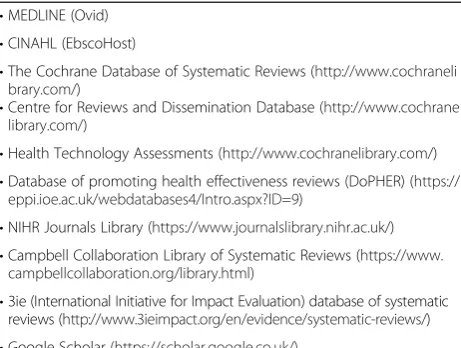
A systematic methodology review requires a different approach to the identification of the literature compared with conventional systematic reviews of empirical search [25]. Methods for undertaking methodological re-views are undefined, but the focus of the search should aim for a systematic rather than exhaustive approach [26]. Databases and websites searched were selected for their potential relevance in indexing records that were relevant to the review aims and objectives (see Table 5).
The search strategy was developed by one author (MM) with expertise in information retrieval in Ovid MEDLINE and adapted for other electronic databases. A second information scientist reviewed the search strat-egy. Full-text searches were undertaken in Google Scholar (Additional file 1).
Data collection and analysis
Study selection
A two-stage process to filter studies was undertaken. Stage one involved an initial screening of titles and ab-stracts against the inclusion criteria. Studies were then categorised into (1) ‘probable’ studies that appeared to meet the inclusion criteria; (2)‘possible’studies that may be eligible but further information was required; and (3) excluded studies. Studies in the first two categories were taken forward to stage two where the full text of the study was retrieved and assessed for eligibility. Any stud-ies not meeting the inclusion criteria after stage two were excluded with reasons noted. At least two re-viewers (MM, NM, GC) independently screened all
stud-ies. Disagreements were resolved by discussion.
Covidence.org was used to screen the studies. Multiple publications were analysed as one study.
Quality assessment
The approach to quality assessment was guided by the aims of the review and follows the advice of Snilstveit ([27], p. 400) that ‘authors should systematically assess the quality of all studies included in their review,
Table 3Typology of actions to reduce health inequalities with underlying programme theory ([22], pp. 474–475)
Level of actiona Underlying cause of heath inequality Underlying programme theory
1) Strengthening individuals (using person-based strategies to improve the health of the most disadvantaged)
A perceived personal deficit, e.g. lack of knowledge, skills, beliefs, self-esteem
Actions that acknowledge positive strengths (i.e. assets and capabilities disadvantaged individuals possess) and remove barriers to achieving them will allow individuals to act in ways that improve their health
2) Strengthening communities (building social cohesion and mutual support to improve the health of disadvantaged communities)
Greater social exclusion, isolation or powerlessness in disadvantaged communities
Fostering social interactions between members of the same community (horizontal interventions) could influence their local environment leading to healthier neighbourhoods. Improving social interactions across society (vertical interventions) produces a less divided society, builds inclusiveness and increases equitable access to resources for health
3) Improving living and working conditions (improving infrastructure and access to services)
Greater exposure to health-damaging living and working environments with declining social position and poorer access to essential goods and services
Improving the physical environment and addressing psychosocial health hazards have the potential to improve the health of the whole population especially that of people living in the poorest conditions, thereby reducing the gradient in health
4) Promoting healthy macro policies (making structural alterations to economic, cultural and environmental conditions to influence the standard of living of the whole population)
The standard of living, income, unemployment, job security, etc., are linked to wider macro-economic , cultural and environment conditions
Universal actions that aim to alter the macro-environment or cultural macro-environment to reduce poverty span several sectors and work across the whole population. These actions are potentially more efficient in reducing poverty and tackling the socio-economic gradient
a
adopting criteria that are sensible for the question it is being used to answer’. No formal criteria exist to assess the use of programme theory in systematic reviews; therefore, all included studies were assessed against PRISMA Equity Extension criteria [1, 5] for reporting use of programme theory (see Table 6).
Data extraction and synthesis
Two review authors (MM, AC) extracted data independ-ently from the included studies using pre-determined
criteria. The data extraction form was piloted.
Disagreements were resolved by discussion. Study char-acteristics extracted included author, year of publication, review topic, type of synthesis, types of studies included in the reviews, whether the study had an SES focus (where the primary aim related to effects within or across SES groups) or SES was accounted for (e.g. SES data were collected, subgroup analysis was undertaken on SES characteristics), intervention type, population, outcomes (relevant to SES), programme theory termin-ology used in the review, and use of programme theory to inform the review process. A template, adapted from that of Kneale et al. [12], was used to extract data on the use of programme theory. As this study is an exploration of the use of programme theory, a narrative approach to synthesis was undertaken.
Table 5Databases and websites searched
•MEDLINE (Ovid)
•CINAHL (EbscoHost)
•The Cochrane Database of Systematic Reviews (http://www.cochraneli
brary.com/)
•Centre for Reviews and Dissemination Database (http://www.cochrane
library.com/)
•Health Technology Assessments (http://www.cochranelibrary.com/)
•Database of promoting health effectiveness reviews (DoPHER) (https://
eppi.ioe.ac.uk/webdatabases4/Intro.aspx?ID=9)
•NIHR Journals Library (https://www.journalslibrary.nihr.ac.uk/)
•Campbell Collaboration Library of Systematic Reviews (https://www.
campbellcollaboration.org/library.html)
•3ie (International Initiative for Impact Evaluation) database of systematic
reviews (http://www.3ieimpact.org/en/evidence/systematic-reviews/)
•Google Scholar (https://scholar.google.co.uk/)
Table 6Quality assessment criteria based on the PRISMA Equity
Extension checklist reporting on programme theory [1, 5]
1. PRISMA rationale (item 3): Describe assumptions about mechanism(s) by which the intervention is assumed to have an impact on health equity. The review should describe a priori how and why interventions are expected to work and the influence of factors such as setting and participant and programme characteristics
2. Rationale (item 3A): Provide the logic model/analytical framework, if done, to show the pathways through which the intervention is assumed to affect health equity and how it was developed
3. Discussion/conclusions (item 26): Present extent and limits of applicability (what does/does not work) to disadvantaged populations of interest and describe the evidence and logic (how/why) underlying those judgements
Table 4Inclusion and exclusion criteria
Inclusion criteria Further explanation
Published systematic reviews With or without meta-analysis
Assessed the effects of a non-pharmacological intervention on health behaviour or health outcome as primary outcome
Health behaviour is defined broadly as‘any behaviour that may affect
an individual’s physical health or any behaviour that an individual
believes may affect their physical health’([78], p. 94)
Measured or collected data on the effects of SES on the intervention SES is defined as incorporating a measure of one or more of the
following: income, education or occupation
Reported either differential effects relating to SES (universal) or targeted low SES populations (targeted)
Published between January 2013 and May 2016 The date period is selected to acknowledge the publication in 2012
of the Reporting Guidelines for Systematic Reviews with a Focus on
Health Equity [1]
Exclusion criteria Further explanation
Included a primary outcome relating to a context other than health or health behaviour
Did not separate SES data from other equity considerations For example, if it was not possible to separate data on ethnicity, age,
or SES
Did not examine the effectiveness of an intervention
Measured the effectiveness of pharmacological interventions
Protocols or primary study designs
Published in a language other than English
Full text was not available at the time of data collection and analysis
Results
Search results
A total of 5058 references were identified from the lit-erature search. One hundred and eight references incor-porated considerations of SES, either by collecting data relating to SES variables or by undertaking data analysis on SES variables. Forty references [20, 28–66] reporting on 37 studies (40%) articulated considerations ofif,what orhowinterventions designed to improve the health of a population may have differential effects across different SES groups in systematic reviews and were included in this study (Fig. 1).
Included study characteristics
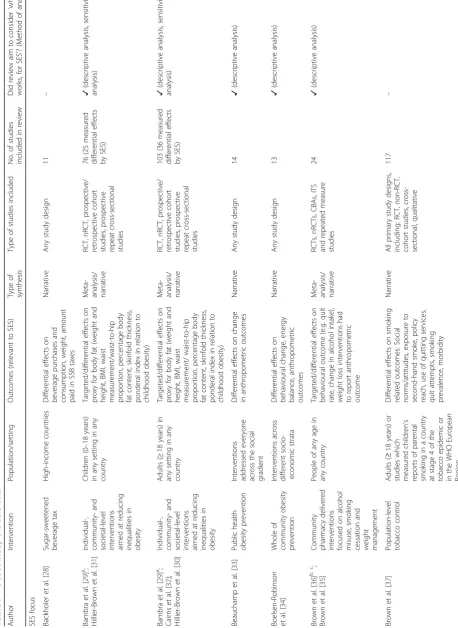
Table 7 highlights the characteristics of the included studies. The most reviewed topics were obesity- and diet-related issues. Twenty-eight reviews had an SES focus, whereby the aim or an objective of the review re-lated to assessing either differential effectiveness of inter-ventions across SES populations, or the effectiveness of
interventions within a targeted group of
socio-economically disadvantaged populations. Nine reviews
accounted for effectiveness targeted at, or across, socio-economically disadvantaged populations (e.g. using sub-group analysis) but did not report it as being a specific aim or objective of the review.
Moving beyond simply aiming to measure the effect-iveness of an intervention, 18 studies specifically aimed to examinewhichcharacteristics relating to the interven-tion may have different effects in and across SES popula-tions. The majority of reviews undertook a narrative synthesis (n= 18) with the number of studies included in the reviews ranging from 5 to 463.
Despite articulating a programme theory on how they expected the intervention to work differently for SES pop-ulations, three reviews [58, 59, 61] reported only that data were collected on SES characteristics and did not offer any analysis of data by SES. Five reviews [36, 45, 64–66] reported either a lack of data on differential effects by SES within the included studies in the review or a lack of avail-ability of studies for inclusion in the review.
Quality assessment
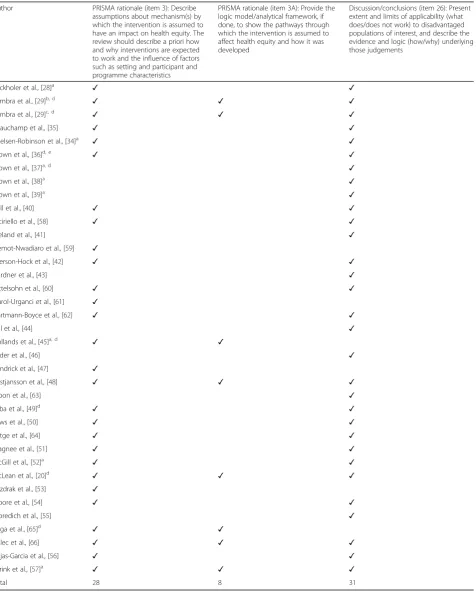
Table 8 presents the results of the quality assessment. Only six reviews met all three quality criteria. One re-view [37] reported using a logic model but did not in-clude it in the review. Of the eight reviews that reported adhering to the PRISMA Equity Extension guidance [1], only one [57] met all three criteria.
How reviewers rationalise an understanding of if, what and how/why interventions have differential effects in or across socio-economic populations
Defining programme theory terminology
Ten studies were explicit in the use of terminology for
‘programme theory’; however, not a single review men-tioned the term‘programme theory’. Two reviews [37, 66] referred to a ‘logic model’, three describe a conceptual model [45, 48, 65], while others referred to a logic path-way [57], conceptual framework [20], casual modelling framework [36] or, simply, framework ([29], child and adult reviews). The remaining studies were implicit, rather than explicit in their use of programme theory, describing their assumptions aboutwhatandhowinterventions may work differently for different SES populations without la-belling it as‘programme theory’.
‘If’interventions work/do not work for different socio-economic groups
With the exception of three studies [53, 58, 63], all stu-dies considered whether it was likely that interventions may have differential effects in health within or across SES populations a priori in the “Introduction” section. Such a verdict was largely made on the basis of the burden of disease in different SES groups. For example, the risk or prevalence of the disease was greater for lower SES
Table 7 Included study char acteristics Author Intervention Population/setting Outcomes (relevant to SES) Type of synthesis Type of studies included No. of studies included in review Did review aim to consider ‘ what works, for SES ’ ? (Method of analysis) SES focus Backholer et al. [ 28 ] Sugar-sweetened beverage tax High-income countries Differential effects on beverage purchases and consumption, weight, amount paid in SSB taxes Narrative Any study design 11 – Bambra et al. [ 29 ] a ; Hillier-Brown et al. [ 31 ] Individual-, community-and
societal-level interventions aimed
at reducing inequalities in obesity Children (0 – 18 years) in any setting in any country Targeted/differential effects on proxy for body fat (weight and height, BMI, waist measurement/waist-to-hip proportion, percentage body fat content, skinfold thickness, ponderal index in relation to childhood obesity)
Meta- analysis/ narrative
RCT, nRCT, prospective/ retrospective cohort studies, prospective repeat cross-sectional studies 76 (25 measured differential effects by SES) ✓ (descriptive analysis, sensitivity analysis) Bambra et al. [ 29 ] a ; Cairns et al. [ 32 ]; Hillier-Brown et al. [ 30 ] Individual-, community-and
societal-level interventions aimed
at reducing inequalities in obesity Adults ( ≥ 18 years) in any setting in any country Targeted/differential effects on proxy for body fat (weight and height, BMI, waist measurement/ waist-to-hip proportion, percentage body fat content, skinfold thickness, ponderal index in relation to childhood obesity)
Meta- analysis/ narrative
RCT, nRCT, prospective/ retrospective cohort studies, prospective repeat cross-sectional studies 103 (36 measured differential effects by SES) ✓ (descriptive analysis, sensitivity analysis) Beauchamp et al. [ 33 ] Public health obesity prevention Interventions addressed everyone across the social gradient Differential effects on change in anthropometric outcomes Narrative Any study design 14 ✓ (descriptive analysis) Boelsen-Robinson et al. [ 34 ] Whole of community obesity prevention Interventions across different socio-economic strata Differential effects on behavioural change, energy balance, anthropometric outcomes Narrative Any study design 13 ✓ (descriptive analysis) Brown et al. [ 36 ] b, c; Brown et al. [ 35 ] Community pharmacy delivered interventions focused on alcohol misuse, smoking cessation and weight management People of any age in any country Targeted/differential effects on behavioural outcome (e.g. quit rate, change in alcohol intake), weight loss interventions had to report anthropometric outcome
Meta- analysis/ narrative
Table 7 Included study characteristics (Co ntinued) Author Intervention Population/setting Outcomes (relevant to SES) Type of synthesis Type of studies included No. of studies included in review Did review aim to consider ‘ what works, for SES ’ ? (Method of analysis) Brown et al. [ 38 ] Individual-level smoking cessation interventions undertaken in Europe since 1995 Adults ( ≥ 18 years) based in a WHO European Region country Differential effects on smoking cessation Narrative All primary research designs, including RCT, non-RCT, cohort studies, cross-sectional, qualitative 29 – Brown et al. [ 39 ]
Population-level interventions/policy- and
individual-level cessation support Participants (birth – 25 years) in a country in the WHO European Region or non-European country at stage 4 of the tobacco epidemic Differential effects on smoking-related outcomes: Intentions/ attitudes/perceptions, exposure to second-hand smoke, smoking behaviour, sensitivity to price, initiation, relapse, cessation rates, smoking prevalence, morbidity Narrative All primary research designs, including RCT, non-RCT, cohort studies, cross-sectional, qualitative 38 – Bull et al. [ 40 ] Interventions targeting a change in smoking, eating and/or physical activity behaviours Adults ( ≥ 18 years) of low income and from the general population Behavioural outcomes relevant to smoking cessation, healthy eating and physical activity Meta- analysis RCTs and cluster RCTs 35 – Cleland et al. [ 41 ] Any intervention focused on increasing physical activity
Community-dwelling socio-economically disadvantaged
women (19 – 64 years) Physical activity outcome, or closely related (e.g. cardiorespiratory fitness) Meta- analysis RCTs, nRCTs 19 ✓ (subgroup-analysis, meta-regression) Everson-Hock et al. [ 42 ] Community-based physical activity and dietary Adults (18 – 74 years) from a low SES group within the UK Effectiveness, acceptability
Narrative (mixed- methods)
Quantitative intervention studies, qualitative evaluations of interventions, qualitative studies assessing beliefs and perceptions of physical activity 35 – Gardner, et al. [ 43 ] Interventions that aimed to increase mammography use Asymptomatic low-income women Uptake of mammography Meta- analysis RCT 21 ✓ (subgroup and meta-regression) Hill et al. [ 44 ] Tobacco control Adults ( ≥ 18 years) in countries at an advanced stage of the tobacco epidemic Targeted/differential effects on smoking related outcomes Narrative Reviews and primary research 84 – Hollands et al. [ 45 ] c Portion, package or tableware size Adults and children directly engaged with manipulated products Differential effects on behavioural outcomes (consumption or selection of food, alcohol, or tobacco products)
Meta- analysis/ narrative
Table 7 Included study characteristics (Co ntinued) Author Intervention Population/setting Outcomes (relevant to SES) Type of synthesis Type of studies included No. of studies included in review Did review aim to consider ‘ what works, for SES ’ ? (Method of analysis) Kendrick et al. [ 47 ] Home safety interventions Children and young people ( ≤ 19 years) and their families Differential effects on self-reported or medically attended injury in children/young people
Meta- analysis (IPD)/ narrative
RCTs, nRCTs, CBA 98 – Kristjansson et al. [ 48 ] Supplementary feeding Children (3 months – 5 years) from socio-economically disadvantaged groups or all socio-economic groups with results stratified by SES Targeted/differential effects on physical (growth), psychosocial health in children
Meta- analysis/ narrative
Table 7 Included study characteristics (Continued) Author Intervention Population/setting Outcomes (relevant to SES) Type of synthesis Type of studies included No. of studies included in review Did review aim to consider ‘ what works, for SES ’ ? (Method of analysis) Mizdrak et al. [ 53 ] Food/beverage price change NR Differential response in purchase of targeted foods Narrative Controlled experimental study 8 ✓ (descriptive analysis) Moore et al. [ 54 ] Universal school-based health behaviour School children (4 – 18 years) Differential effects on diet, physical activity, smoking, alcohol Narrative RCTs, quasi-experimental studies 20 ✓ (content analysis) Moredich et al. [ 55 ] Physical activity and weight loss Low-income adult women Change in weight Integrative Intervention studies 7 ✓ (descriptive analysis) Rojas-Garcia et al. [ 56 ] Healthcare interventions to treat depressive disorders Socially disadvantaged patients with depressive disorders Reduction of depressive symptoms
Meta- analysis/ narrative
Controlled trials including RCTs & quasi-experimental studies 15 ✓ (meta-regression) Sarink et al. [ 57 ] Menu labelling Adolescents or adults of a low SEP population or analysis stratified by a measure of SEP Targeted/differential effects on awareness of exposure, understanding, food or energy purchased or consumed, body mass index Narrative Quantitative and qualitative 18 – SES accounted for Ciciriello et al. [ 58 ] e Multimedia-based patient education about prescribed or over the counter medications People of all ages prescribed a particular medication or medication regimen or who had obtained an over-the-counter medication Patient or carer knowledge about the medication, any measure of skill acquisition related to the medication
Meta- analysis/ narrative
RCTs, quasi-RCTs 24 – Ejemot-Nwadiaro et al. [ 59 ] e Hand-washing promotion Adults and children in day care centres or schools, patients in hospitals, communities or households Episodes of diarrhoea
Meta- analysis/ narrative
RCTs, cluster RCTs 22 – Gittelsohn et al. [ 60 ] Community-based prepared food sources NR Access to and consumption of healthful foods (psychosocial factors (awareness, knowledge, acceptability), behaviour, frequency of use, frequency of purchase, increase in healthful food sales) Narrative Some form of written documentation that included a description of the intervention and evaluation 19 – Gurol-Urganci et al. [ 61 ] e Mobile phone messaging reminders All study participants, regardless of age, gender, ethnicity Rate of attendance at healthcare appointments Meta- analysis RCTs 8 – Hartmann-Boyce et al. [ 62 ] Self-help Adults ( ≥ 18 years) with body mass index ≥ 25 kg/m 2 Targeted/differential effects on change in weight
Meta- analysis/ narrative
RCTs
23
✓
Table 7 Included study characteristics (Co ntinued) Author Intervention Population/setting Outcomes (relevant to SES) Type of synthesis Type of studies included No. of studies included in review Did review aim to consider ‘ what works, for SES ’ ? (Method of analysis) Kroon et al. [ 63 ] Structured
self-management education programmes
for osteoarthritis (OA) People diagnosed with OA Self-management of OA, participant ’ s positive and active engagement in life, pain, global OA scores, self-reported function, quality of life, withdrawals Meta- analysis RCTs, quasi-RCTs 29 – Lutge et al. [ 64 ] c Any material inducement to return for TB test results or adhere to or complete anti-TB preventive or curative treatment People receiving curative treatment for active TB, people receiving preventive therapy for latent TB or people suspected of TB undergoing, and collecting results of, diagnostic tests Cure or completion of treatment, cases of active TB; completion of prophylactic treatment, number returning to collect test results within the appropriate time frame for that test.
Meta- analysis/ narrative
RCTs 12 – Pega et al. [ 65 ] c In-work tax credits Working age adults (18 – 64 years) Self-rated general health, mental health or physical distress, mental illness, overweight and obesity, alcohol use, tobacco use Narrative CBA, ITS 5 – Polec et al. [ 66 ] c Interventions that aimed to increase the ownership and appropriate use of insecticide-treated bednets (ITN) Children and adults with permanent residence in malarial areas ITN ownership, appropriate ITN use
Meta- analysis/ narrative
Table 8Quality assessment
Author PRISMA rationale (item 3): Describe
assumptions about mechanism(s) by which the intervention is assumed to have an impact on health equity. The review should describe a priori how and why interventions are expected to work and the influence of factors such as setting and participant and programme characteristics
PRISMA rationale (item 3A): Provide the logic model/analytical framework, if done, to show the pathways through which the intervention is assumed to affect health equity and how it was developed
Discussion/conclusions (item 26): Present extent and limits of applicability (what does/does not work) to disadvantaged populations of interest, and describe the evidence and logic (how/why) underlying those judgements
Backholer et al., [28]a ✓ ✓
Bambra et al., [29]b, d ✓ ✓ ✓
Bambra et al., [29]c, d ✓ ✓ ✓
Beauchamp et al., [35] ✓ ✓
Boelsen-Robinson et al., [34]a ✓ ✓
Brown et al., [36]d, e ✓ ✓
Brown et al., [37]a, d ✓
Brown et al., [38]a ✓
Brown et al., [39]a ✓
Bull et al., [40] ✓ ✓
Ciciriello et al., [58] ✓ ✓
Cleland et al., [41] ✓
Ejemot-Nwadiaro et al., [59] ✓
Everson-Hock et al., [42] ✓ ✓
Gardner et al., [43] ✓
Gittelsohn et al., [60] ✓ ✓
Gurol-Urganci et al., [61] ✓
Hartmann-Boyce et al., [62] ✓ ✓
Hill et al., [44] ✓
Hollands et al., [45]a, d ✓ ✓
Kader et al., [46] ✓
Kendrick et al., [47] ✓
Kristjansson et al., [48] ✓ ✓ ✓
Kroon et al., [63] ✓
Laba et al., [49]d ✓ ✓
Laws et al., [50] ✓ ✓
Lutge et al., [64] ✓ ✓
Magnee et al., [51] ✓ ✓
McGill et al., [52]a ✓ ✓
McLean et al., [20]d ✓ ✓ ✓
Mizdrak et al., [53] ✓
Moore et al., [54] ✓ ✓
Moredich et al., [55] ✓
Pega et al., [65]d ✓ ✓
Polec et al., [66] ✓ ✓ ✓
Rojas-Garcia et al., [56] ✓ ✓
Sarink et al., [57]a ✓ ✓ ✓
Total 28 8 31
a
Study reports use of PRISMA Equity Extension [1]
bStudy 1 review in child population [32,34]
c
Study 2 review in adult population [32,33,35]
dRefer to conceptual/casual modelling/behavioural frameworks rather than analytical framework/logic models
populations compared with higher SES populations [33]. Others described the burden in terms of higher rates of unhealthy behaviours, such as cigarette consumption [39], or lower rates of healthy behaviours, such as adherence to medications, among lower SES groups [49].
‘What’interventions work/do not work for different
socio-economic groups
All included studies considered what types of inter-ventions are likely to work or not work for different SES groups. For example, Bambra et al. [29] suggest that tailored weight-loss interventions worked equally well or better in children in low SES groups. In a re-view of interventions to improve medication adher-ence, Laba et al. [49] found that physician- and patient-targeted interventions were most effective in socioeconomically disadvantaged populations. This was in contrast to a previous systematic review [67] which found larger improvements in medication ad-herence among the general population in physician only-targeted interventions.
Three of these studies [45, 59, 61] incorporated these considerations to inform only their a priori assumptions of what works for different SES groups, and five studies [37, 39, 46, 55, 63] incorporated these considerations only to explain what interventions work based on their review findings. The remaining 29 studies considered what types of interventions work or do not work both in their a priori assumptions and in explaining their review findings. Studies used programme theory to inform con-siderations ofwhat works, as well aswhat does not work.
‘How’interventions work/do not work for different
socio-economic groups
All included studies also consideredhowinterventions may or may not work for different SES groups. Of these, six re-views [45, 47, 53, 59, 61, 65] incorporated such consider-ations only a priori, and nine [37–39, 41, 43, 44, 46, 55, 63] discussed how interventions may have differential effects only to explain their review findings.
Twenty-two studies considered how interventions work or do not work both in their a priori assump-tions and in their explanaassump-tions of the review findings. For example, Laba et al. [49] suggest that differences in adherence behaviour between social groups can help explain why interventions which target both pa-tient and physician are more effective for lower SES groups. Whereas in a systematic review of obesity-related lifestyle interventions, Magnee et al. [51] sug-gest that greater effects may be seen in higher SES groups because lower SES groups participate less. They go on to say that lower participation rates in lower SES groups may be due to either intervention design (e.g. recruitment strategies not reaching lower
SES groups) or participant response (e.g. lower SES groups may not prioritise participating in interven-tions if they are experiencing other material and psy-chosocial problems).Overall, 22 studies incorporated considerations of both what and how interventions work or do not work in and across SES groups to both predict and explain their review findings.
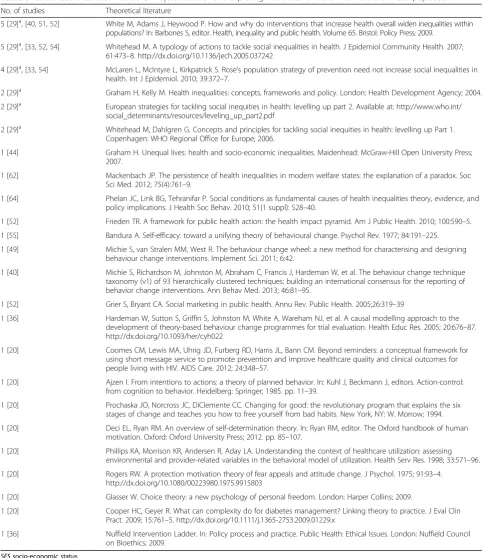
Legitimisation of programme theory in systematic reviews Thirteen studies (see Table 9) referenced the theoretical lit-erature to inform an understanding of what or how/why interventions may lead to differential effectiveness within or across SES groups. One study mentioned the Oxford Food and Activity Behaviours taxonomy but did not pro-vide a reference [62]. The theoretical literature was used to inform both a priori assumptions (n= 10) ([20, 29] (child and adult reviews), [33, 36, 40, 49, 52, 54, 62]) and explana-tions of review findings (n= 7) [33, 40, 44, 51, 52, 54, 55]. In four studies [33, 40, 52, 54], the theoretical literature informed both a priori assumptions and explanations of review findings.
Collectively, the included studies acknowledged 24 unique theoretical references to support a priori as-sumptions and explanations of the review findings of what or how/why interventions may have different ef-fects within and across SES groups (see Table 9). The most referenced were intervention theories: ‘How and why do interventions that increase health overall widen inequalities within populations?’ [68] and‘A typology of actions to tackle social inequalities in health’[22].
The majority of the included studies (n= 36) used sup-plementary evidence to support their considerations of differential effectiveness. Supplementary evidence in-cluded empirical (qualitative or quantitative), descriptive, or policy-related evidence. Of note here is the use of
supplementary evidence to examine
intervention-generated inequalities (e.g. [69, 70]). In 32 of the in-cluded studies, the authors’review findings were used to inform explanations of the review findings of differential effectiveness. Only two studies [20, 66] mentioned the involvement of other stakeholders in developing their logic models or programme theory. In some studies, only partial support for the programme theory was de-rived either from the literature or from the review findings.
Extent of use of programme theory to inform the review process
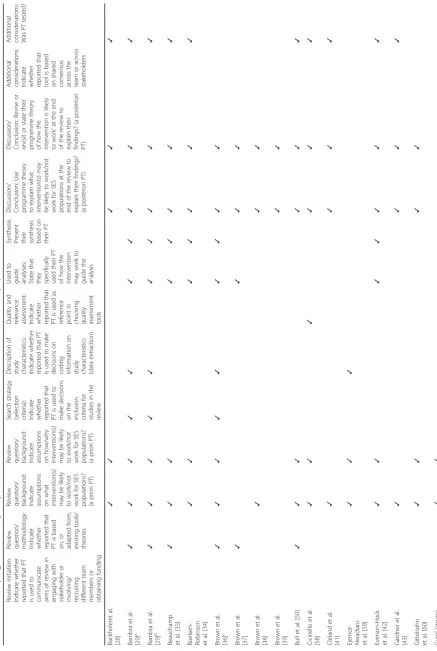
may result in differential effects within or across SES groups. Despite not always being explicit in their use of programme theory, 29 review teams used this approach to inform both their a priori assumptions and explanations of review findings.
Twenty-one studies (see Table 10) tested their a priori programme theory of how they expected interventions to have different effects on health within or across SES populations and revisited or revised their programme theory to explain their review findings.
Table 9Referenced theoretical literature in systematic reviews exploring the effectiveness of interventions in SES populations
No. of studies Theoretical literature
5 [29]a, [40,51,52] White M, Adams J, Heywood P. How and why do interventions that increase health overall widen inequalities within
populations? In: Barbones S, editor. Health, inequality and public health. Volume 65. Bristol: Policy Press; 2009.
5 [29]a, [33,52,54] Whitehead M. A typology of actions to tackle social inequalities in health. J Epidemiol Community Health. 2007;
61:473–8. http://dx.doi.org/10.1136/jech.2005.037242
4 [29]a, [33,54] McLaren L, McIntyre L, Kirkpatrick S. Rose’s population strategy of prevention need not increase social inequalities in
health. Int J Epidemiol. 2010; 39:372–7.
2 [29]a Graham H, Kelly M. Health inequalities: concepts, frameworks and policy. London: Health Development Agency; 2004.
2 [29]a European strategies for tackling social inequities in health: levelling up part 2. Available at: http://www.who.int/
social_determinants/resources/leveling_up_part2.pdf
2 [29]a Whitehead M, Dahlgren G. Concepts and principles for tackling social inequities in health: levelling up Part 1.
Copenhagen: WHO Regional Office for Europe; 2006.
1 [44] Graham H. Unequal lives: health and socio-economic inequalities. Maidenhead: McGraw-Hill Open University Press;
2007.
1 [62] Mackenbach JP. The persistence of health inequalities in modern welfare states: the explanation of a paradox. Soc
Sci Med. 2012; 75(4):761–9.
1 [64] Phelan JC, Link BG, Tehranifar P. Social conditions as fundamental causes of health inequalities theory, evidence, and
policy implications. J Health Soc Behav. 2010; 51(1 suppl): S28–40.
1 [52] Frieden TR. A framework for public health action: the health impact pyramid. Am J Public Health. 2010; 100:590–5.
1 [55] Bandura A. Self-efficacy: toward a unifying theory of behavioural change. Psychol Rev. 1977; 84:191–225.
1 [49] Michie S, van Stralen MM, West R. The behaviour change wheel: a new method for characterising and designing
behaviour change interventions. Implement Sci. 2011; 6:42.
1 [40] Michie S, Richardson M, Johnston M, Abraham C, Francis J, Hardeman W, et al. The behaviour change technique
taxonomy (v1) of 93 hierarchically clustered techniques: building an international consensus for the reporting of
behavior change interventions. Ann Behav Med. 2013; 46:81–95.
1 [52] Grier S, Bryant CA. Social marketing in public health. Annu Rev. Public Health. 2005;26:319–39
1 [36] Hardeman W, Sutton S, Griffin S, Johnston M, White A, Wareham NJ, et al. A causal modelling approach to the
development of theory-based behaviour change programmes for trial evaluation. Health Educ Res. 2005; 20:676–87.
http://dx.doi.org/10.1093/her/cyh022
1 [20] Coomes CM, Lewis MA, Uhrig JD, Furberg RD, Harris JL, Bann CM. Beyond reminders: a conceptual framework for
using short message service to promote prevention and improve healthcare quality and clinical outcomes for
people living with HIV. AIDS Care. 2012; 24:348–57.
1 [20] Ajzen I. From intentions to actions: a theory of planned behavior. In: Kuhl J, Beckmann J, editors. Action-control:
from cognition to behavior. Heidelberg: Springer; 1985. pp. 11–39.
1 [20] Prochaska JO, Norcross JC, DiClemente CC. Changing for good: the revolutionary program that explains the six
stages of change and teaches you how to free yourself from bad habits. New York, NY: W. Morrow; 1994.
1 [20] Deci EL, Ryan RM. An overview of self-determination theory. In: Ryan RM, editor. The Oxford handbook of human
motivation. Oxford: Oxford University Press; 2012. pp. 85–107.
1 [20] Phillips KA, Morrison KR, Andersen R, Aday LA. Understanding the context of healthcare utilization: assessing
environmental and provider-related variables in the behavioral model of utilization. Health Serv Res. 1998; 33:571–96.
1 [20] Rogers RW. A protection motivation theory of fear appeals and attitude change. J Psychol. 1975; 91:93–4.
http://dx.doi.org/10.1080/00223980.1975.9915803
1 [20] Glasser W. Choice theory: a new psychology of personal freedom. London: Harper Collins; 2009.
1 [20] Cooper HC, Geyer R. What can complexity do for diabetes management? Linking theory to practice. J Eval Clin
Pract. 2009; 15:761–5. http://dx.doi.org/10.1111/j.1365-2753.2009.01229.x
1 [36] Nuffield Intervention Ladder. In: Policy process and practice. Public Health: Ethical Issues. London: Nuffield Council
on Bioethics; 2009.
SESsocio-economic status
a
Table 10 Use of programme theory in systematic reviews of effectiveness of interventions in SES populations Review initiat ion: Indicate whether reported that PT is used to commu nicate aims of review in engaging with stakeholde r or involvin g/ recruitin g different team members or obtaining funding
Review question/ methodology: Indicate whether reported
that PT is based on, or adapted from, existing tools/ theories
Review question/ background: Indicate assumptions on
what intervention(s) may be likely to work/not work for SES populations? (a priori PT)
Review question/ background: Indicate assumptions on
how/why interven tion(s) may be likely to work/not work for SES populations ? (a priori PT) Search strategy (select ion crite ria):
Indicate whether reported
that PT is used to make decisions on the inclusio n crite ria for studie s in the review D escription of stu dy ch aracteristics: Indica te whether reporte d that PT is used to make de cisions on co ding infor mation on stu dy ch aracteristics (data extract ion) Quality and relevance assessmen t: Indica te whether reporte d that PT is used as reference po int in choosing qual ity assessmen t tools Used to
guide analyses: State
that they specifica lly used their PT of how the interven tion may work to guide the analysis
Synthesis: Present their synthesi
s based on their PT Discuss ion/ Conclu sion: Use progr amme theory to exp lain what interve ntion(s) may be likely to work/not work for SES popula tions at the end of the review to explain their findings ? (a posteriori PT) Discussion/ Conclusion: Revise or revisit or state their programme theory of how the intervention is likely to work ’ at the end of the review to explain their findings? (a posterior i PT) Additional consider ations:
Indicate whether reported
that tool is based on shared consensu s across the team or across stakeholde rs
Additional considerations: Was
PT tested? Backholeret al. [ 28 ] ✓✓ ✓✓ ✓ Bambra et al. [ 29 ] a ✓ ✓✓✓ ✓ ✓ ✓ ✓ ✓ ✓ Bambra et al. [ 29 ] b ✓ ✓✓✓ ✓ ✓ ✓ ✓ ✓ ✓ Beauchamp et al. [ 33 ] ✓✓ ✓ ✓ ✓ ✓ ✓ ✓
Boelsen- Robinson et
al. [ 34 ] ✓✓ ✓ ✓ ✓ ✓ ✓ Brown et al. [ 36 ] c ✓ ✓✓✓ ✓ ✓ ✓ ✓ ✓ Brown et al. [ 37 ] ✓ ✓✓ ✓ Brown et al. [ 38 ] ✓ ✓✓ Brown et al. [ 39 ] ✓✓ Bull et al. [ 50 ] ✓✓ ✓ ✓✓ ✓ Ciciriello et al. [ 58 ] ✓✓ ✓ ✓ ✓ ✓ Cleland et al. [ 41 ] ✓ ✓✓ ✓
Ejemot- Nwadiaro et
Table 10 Use of programme theory in systematic reviews of effectiveness of interventions in SES populations (Continued) Review initiat ion: Indicate whether reported that PT is used to commu nicate aims of review in engaging with stakeholde r or involvin g/ recruitin g different team members or obtaining funding
Review question/ methodology: Indicate whether reported
that PT is based on, or adapted from, existing tools/ theories
Review question/ background: Indicate assumptions on
what intervention(s) may be likely to work/not work for SES populations? (a priori PT)
Review question/ background: Indicate assumptions on
how/why interven tion(s) may be likely to work/not work for SES populations ? (a priori PT) Search strategy (select ion crite ria):
Indicate whether reported
that PT is used to make decisions on the inclusio n crite ria for studie s in the review D escription of stu dy ch aracteristics: Indica te whether reporte d that PT is used to make de cisions on co ding infor mation on stu dy ch aracteristics (data extract ion) Quality and relevance assessmen t: Indica te whether reporte d that PT is used as reference po int in choosing qual ity assessmen t tools Used to
guide analyses: State
that they specifica lly used their PT of how the interven tion may work to guide the analysis
Synthesis: Present their synthesi
s based on their PT Discuss ion/ Conclu sion: Use progr amme theory to exp lain what interve ntion(s) may be likely to work/not work for SES popula tions at the end of the review to explain their findings ? (a posteriori PT) Discussion/ Conclusion: Revise or revisit or state their programme theory of how the intervention is likely to work ’ at the end of the review to explain their findings? (a posterior i PT) Additional consider ations:
Indicate whether reported
that tool is based on shared consensu s across the team or across stakeholde rs
Additional considerations: Was
Table 10 Use of programme theory in systematic reviews of effectiveness of interventions in SES populations (Continued) Review initiat ion: Indicate whether reported that PT is used to commu nicate aims of review in engaging with stakeholde r or involvin g/ recruitin g different team members or obtaining funding
Review question/ methodology: Indicate whether reported
that PT is based on, or adapted from, existing tools/ theories
Review question/ background: Indicate assumptions on
what intervention(s) may be likely to work/not work for SES populations? (a priori PT)
Review question/ background: Indicate assumptions on
how/why interven tion(s) may be likely to work/not work for SES populations ? (a priori PT) Search strategy (select ion crite ria):
Indicate whether reported
that PT is used to make decisions on the inclusio n crite ria for studie s in the review D escription of stu dy ch aracteristics: Indica te whether reporte d that PT is used to make de cisions on co ding infor mation on stu dy ch aracteristics (data extract ion) Quality and relevance assessmen t: Indica te whether reporte d that PT is used as reference po int in choosing qual ity assessmen t tools Used to
guide analyses: State
that they specifica lly used their PT of how the interven tion may work to guide the analysis
Synthesis: Present their synthesi
s based on their PT Discuss ion/ Conclu sion: Use progr amme theory to exp lain what interve ntion(s) may be likely to work/not work for SES popula tions at the end of the review to explain their findings ? (a posteriori PT) Discussion/ Conclusion: Revise or revisit or state their programme theory of how the intervention is likely to work ’ at the end of the review to explain their findings? (a posterior i PT) Additional consider ations:
Indicate whether reported
that tool is based on shared consensu s across the team or across stakeholde rs
Additional considerations: Was
Discussion
Interest in the use of programme theory to inform sys-tematic reviews is increasing. In an attempt to enhance the applicability of review findings, reviewers are being encouraged to extend consideration beyond whether an intervention is effective or not, towards examining‘what interventions work, for whom, and how’[71].
While the relatively small proportion of systematic reviews (n= 108) incorporating considerations of socio-economic inequalities in health is in line with that re-ported elsewhere [72], it is clear that the push to move systematic reviews away from only considering if an intervention works towards a better understanding of what works andhow, is slowly starting to emerge in the literature (see Table 10).
The lack of reference to the equity guidance within systematic reviews incorporating considerations of socio-economic inequalities in health may reflect the short interval between the publication of the guidance and the systematic reviews included in this study. How-ever, given that eight studies in this sample did reference the PRISMA Equity guidance between 2013 and 2016, it may also suggest a lack of awareness of the guidance, or consideration of its relevance and importance, not only among systematic reviewers, but also among journal edi-tors and peer reviewers. Therefore, to deliver better evi-dence on equity within research syntheses and systematic reviews, not only does the health research community need to increase awareness of equity guidance, but journal editors and peer reviewers also need to be proactive in en-couraging reviewers to adopt the equity guidance when undertaking and reporting such reviews [1].
Alternatively, a lack of reference to the equity gui-dance in the reviews may indicate that reviewers are un-sure about how to operationalise the guidance with respect on how the intervention may be expected to work within or across SES populations. Little empirical research has been undertaken on reviewers’ understan-ding of how to operationalise equity guidance for sys-tematic reviews.
In studies that do use programme theory terminology (e.g., logic model, conceptual framework), the findings here agree with commentators who note that these terms are often inconsistently applied in the literature [16, 18]. No studies explicitly applied the term‘programme theory’ to describe their assumptions. This supports assertions made elsewhere [16] that the use of theory to inform sys-tematic reviews may not be explicitly articulated.
While it may not necessarily matter whether or not re-viewers explicitly label a‘programme theory’to describe their understanding of how interventions may or may not work,notexplicitly labelling it makes it harder to as-certain the extent to which reviewers are either con-sciously or unconcon-sciously using programme theory to
inform systematic reviews. The majority of the reviews in-cluded in this study described their programme theory in the narrative of the review without explicitly labelling it as a theory or using more graphical representations such as logic models or analytical frameworks. If reviewers are ei-ther considering this detail irrelevant to the methods sec-tion of their reports, or unconsciously using programme theory, then there is a need for greater clarity on opera-tionalising the use of theory in systematic reviews.
In most of the included studies, programme theory was informed by low-level theory (i.e. assumptions based on supplementary evidence, e.g. empirical or policy). This is consistent with the findings of a previous study on the use of theory in systematic reviews [16]. The lack of reference to more formal theory (e.g. intervention theories such as Whitehead’s [22] typology of policies and interventions, and behaviour change theories such as the Theory of Planned Behavior [73]) to inform re-viewers’ assumptions or explanations of whether and how interventions may have differential effects may sug-gest that reviewers are using programme theory uncon-sciously. Among the included reviews that used formal theory, the most popular were intervention theories based on the target of the intervention (e.g. individual, community, societal).
While this study set out neither to examine the quality or richness of the programme theory used in systematic reviews nor to establish the fidelity or utility of use of theory, analysing interventions based only on the target of the intervention (i.e. universal versus individual) may not offer sufficient explanation of which components of the intervention process may work better for different SES groups and why.
Using only supplementary evidence toexplainhow in-terventions may work differently across SES populations may weaken the applicability of the review, especially given that it was often unclear as to how the supplemen-tary evidence was identified. This is not limited to sys-tematic reviews with a socio-economic health inequality focus. MacLure [74] observes that there is a strict inclu-sion and excluinclu-sion process set up for the main body of the review, only for other evidence to be brought into play in the discussion in an unsystematic way to inter-pret the findings.
The results of this study demonstrate that the use of programme theory to inform socio-economic health in-equality considerations in the systematic review process remains in its infancy, is used implicitly, is often fragmen-ted and is not implemenfragmen-ted in a systematic way. The PRISMA Equity Extension explanation and elaboration document ([5],‘Item 3: rationale’) highlights that the expli-cit reporting of programme theory can guide the reviewer in the choice of methods and synthesis. However, the fin-dings of this study agree with Kneale et al. [12], in suggest-ing that programme theory is not yet seen as a tool that is integral to the whole review process.
Instead, reviewers are more likely to use programme theory in an ad hoc way at the start (a priori) and end of the review using supplementary evidence rather than to use formal theory or to test their assumptions or expla-nations of how interventions may or may not work for different SES groups. This may be due to the fact that many reviewers are using programme theory implicitly and therefore are unaware of its potential value in guid-ing the whole review process.
Using programme theory to inform only an a priori understanding of how reviewers expect the intervention to work across SES populations allows reviewers to‘tick a box’ in the PRISMA Equity Extension guidance [1]. However, integration of programme theory within the whole review process would provide a more systematic
‘uncovering’of possible explanations that emerge a pos-teriori from the review findings for how interventions may work differently for different populations.
Establishing review intentions a priori has always been the approach in clinical effectiveness reviews in order to minimise bias [75]. However, a priori assumptions of how an intervention may work may not necessarily be supported by the review findings. This may lead to an uninformed interpretation of the problem being imposed at the outset of the review. Furthermore, reviewers may not necessarily identify all the issues relating to howan intervention is expected to work a priori, and therefore, a revision of the programme theory may be required [76].
In avoiding the use of programme theory simply be-coming what Kneale et al. [12] have described as a‘ tick-box’ exercise in demonstrating compliance with the PRISMA Equity Extension criteria, reviewers need to understand how programme theory can help in moving beyond simply basing their systematic reviews on theory towards securing a theoretical underpinning of the re-view analysis and synthesis.
The value of a programme theory approach lies in its ability to allow an acceptable, systematic, tested and re-fined a posteriori reasoning rather than post hoc
as-sumption of how interventions may work. Twenty-one
reviews in this study tested their programme theories; in doing so, they present review findings that are tested
interpretations or explanations, rather than unbiased ob-servations, thus strengthening the validity and applic-ability of the review findings.
Using programme theory to articulate considerations ofif,whatandhowinterventions work for different pop-ulations will require reviewers to include more diverse forms of evidence beyond randomised controlled trials. Only 12 reviews in this study included evidence other than quantitative research to support their programme theory, largely using a narrative synthesis approach.
If reviewers of effectiveness studies are to be encour-aged to consider health inequalities in systematic re-views, this will require a paradigm shift: they will need to move from a positivist stance in considering only ‘if and what works’towards a more realist informed way of thinking to consider ‘what works, for whom, and under what circumstance’. It requires a different approach to analysis moving away from a purely observational ap-proach (i.e. how often, how much) to one that incorpo-rates a more interpretive approach. This shift is hugely challenging, requiring skills in understanding theoretical sensitivity and in being able to generate, test and refine possible explanations.
While there is a greater need to understand the advan-tages and disadvanadvan-tages of different synthesis ap-proaches, the decision on what synthesis approach to undertake and whether to conduct separate parallel views has to be balanced with considerations of time, re-sources and the skills and expertise within the review team [9]. Given that it is unrealistic to expect all re-viewers to accompany each systematic review with a par-allel realist review, the challenge is how reviewers of effectiveness studies can incorporate realist principles within reviews of effectiveness to inform considerations of what and how interventions may work differently across SES populations within a single review.
Establishing an a priori programme theory of if, what andhowan intervention is expected to work across differ-ent SES groups, testing and refining it based on the review findings may offer reviewers a way forward. Further re-search is currently underway by the author (MM) on a theory-led meta-framework of factors associated with dif-ferential effects of interventions across SES groups.
A further strength was to include studies that were ei-ther explicit or implicit in their consideration of what and how interventions may have different effects within and across SES populations. This extends a previous study on the use of programme theory [12] and recog-nises that the articulation of what works, for whom and under what circumstance may not necessarily be recog-nised as ‘programme theory’ or labelled as a ‘logic model’ or ‘conceptual framework’. Indeed, as this study demonstrates, reviewers rarely identify with these labels even when outlining a programme theory. The involve-ment of two reviewers to independently extract the data on programme theory aimed to reduce the chances of missing relevant information.
Only systematic reviews published since the introduc-tion of the PRISMA Equity Guidance [1] were included in this study. The short interval between the publication of the guidance and the systematic reviews included in this study may result in a more modest indication of the extent to which reviewers are operationalising the PRISMA guidance in exploring how interventions may result in differential effectiveness within or across SES populations. Studies in which it was not possible to sep-arate out the analysis for SES were excluded; therefore, it may be that other theories relating to what works and how/why they work may have been missed.
Unless explicitly stated in the included studies, this study was unable to assess the way in which different members of the review team or stakeholders contributed to the programme theory. Furthermore, this study only assessed the extent of use of programme theory if re-viewers were explicit in reporting their use of it to in-form their review processes.
This study did not set out to examine the fidelity, utility or richness of the programme theory. For example, Mag-nee et al. ([51], e62) described why they assume that dif-ferential effectiveness across SES populations may arise, because “more highly educated people may be better equipped to benefit from interventions”, yet they failed to explain in what way or why highly educated people are
‘better equipped’. In another example, Mizdrak et al., ([53], Introduction) stated that they expected differential effectiveness to occur because “low income purchasers may react differently to changes in food price than high income purchasers”but it is not clear in what way or why low income purchasers ‘may react differently’. Therefore, the use of the PRISMA Equity Extension criteria [1] in the quality assessment only allows for an assessment of the quality of thereportingof programme theory.
Conclusions
Given the lack of evidence in primary research on the dif-ferential effects of interventions on health across SES groups, Whitehead [22] considers it‘absolutely imperative’
that a theory-based approach is adopted to guide actions on reducing health inequalities. Despite the PRISMA Equity Extension guidance recommending the use of programme theory, this study demonstrates that use of the guidance to inform considerations ofif,whatandhow interventions lead to differential effects on health within and across SES groups in the systematic review process is not yet widely adopted and is fragmented.
Encouraging reviewers of effectiveness studies to con-sider health inequalities in systematic reviews requires a paradigm shift in thinking, from a positivist (i.e.‘if, and what works’), towards a realist informed way of thinking (i.e. ‘what works, for whom, and under what circum-stance’). The fact that reviewers are more likely to use programme theory implicitly, in an ad hoc descriptive way, and use supplementary evidence to support their assumptions of how interventions work rather than use more ‘formal’ theories, suggests that reviewers are un-consciously using programme theory and are not fully exploiting its potential in informing the review process.
Additional file
Additional file 1:Search strategy. (DOCX 15 kb)
Abbreviations
3ie:International Initiative for Impact Evaluation database; PICO: Population, intervention, comparator and outcome; PRISMA: Preferred Reporting Items for Systematic Reviews and Meta-Analysis; SES: Socio-economic status
Acknowledgements
Thanks to Eleanor Kotas, Information Scientist, Liverpool Reviews and Implementation Group, University of Liverpool, for reviewing the search strategy.
Funding
This review was undertaken as part of a wider PhD (MM) examining the incorporation of health inequalities in evidence synthesis funded by The National Institute for Health Research Collaboration for Leadership in Applied Health Research and Care North West Coast (NIHR CLAHRC NWC). NMcM is a PhD student funded by The NIHR CLAHRC NWC. AB is funded by the University of Sheffield to collaborate via the Translating Knowledge into Action (TK2A) theme, NIHR CLAHRC Yorkshire and Humber. MG and RD are part funded by The NIHR CLAHRC NWC.
Availability of data and materials
Not applicable.
Authors’contributions
MM was responsible for the overall design of the study, designed and conducted the search, designed the data collection and quality assessment forms, extracted the data, undertook the quality assessment, synthesised the data in the tables and wrote the first draft and final draft of this paper. AC independently extracted the data and undertook the quality assessment. NMcM independently screened the titles/abstracts and full text of studies. GC independently screened the titles/abstracts. AB, RD, MG and SP provided comments and feedback on the methodology and final draft of the study. All authors read and approved the final manuscript.
Ethics approval and consent to participate
![Table 3 Typology of actions to reduce health inequalities with underlying programme theory ([22], pp](https://thumb-us.123doks.com/thumbv2/123dok_us/9560960.1939094/4.595.60.538.96.347/table-typology-actions-reduce-health-inequalities-underlying-programme.webp)