RESEARCH REPOSITORY
Authors Version
Al Sawalqa, F., Holloway, D.A. and Alam, M. (2011) Scope and aims of
performance measurement practices: Evidence from Jordan. In: British
Accounting and Finance Association (BAFA), 12 - 14 April, Birmingham, UK.
http://researchrepository.murdoch.edu.au/39600/
Scope and Aims of Performance Measurement Practices: Evidence
from Jordan
Fawzi Al Sawalqa
David A. Holloway*
Manzurul Alam
Murdoch Business School
Murdoch University
Western Australia
*Presenting author: [email protected]
Abstract
This study provides empirical evidence on performance measures practices in Jordanian industrial companies. It identifies the type and extent of usage of a broad set of financial and non-financial measures. The results indicate that Jordanian companies place more emphasis currently on non-financial measures such as customer response time, on-time delivery, customer retention, employee training, number of new product launches and defect rates. Although Jordanian companies place more emphasis on the use of performance measures to evaluate organisational and managerial performance, they also use them for other reasons. The results also indicate that Jordanian industrial companies still operate under significant institutional and government controls.
Scope and Aims of Performance Measurement Practices: Evidence
from Jordan
Introduction
Performance measurement is an important management control tool for business firms
in the currently competitive environment. It is directly related to the formation of a
firm’s core competency and has a significant impact on the firm’s growth (Xiong, Su &
Lin, 2008). Different definitions for performance measurement system (hereafter PMS)
exist. Neely (1994) defines PMS as the set of metrics used to quantify both the
efficiency and effectiveness of actions (cited in Neely, Gregory & Platts, 200, p. 1229).
In respect to performance measurement, Marshall, Wray, Epstein and Grifel (1999)
define performance measurement as a development of indicators and collection of data
to describe and analyse performance. To be more precise, performance measurement
refers to the use of a multi-dimensional set of performance measures. This set of
measures is multi-dimensional if it includes both financial and non-financial
performance measures. Both internal and external measures of performance are
included and both measures quantify what has been achieved. These measures are used
to help predict the future (Bourne, Neely, Mills & Platts, 2003, p. 3). However, Neely et
al (2005, p. 1229) define performance measures as a metric used to quantify the
efficiency and/or effectiveness of an action.
The usage of performance measures has two dimensions: the level of use or the
frequency of use—that is the focus of this study—and the manner of use. The level and
manner of performance measurement use relate respectively to an organisation’s
quantity and quality of application of the measures (Braam & Nijssen, 2004). Improving
the PMS is one of management accounting’s major roles. However, an effective PMS
senior management and also the tactical-performance measures that are used in
evaluating a firm’s current level of performance (Chen, 2008).
Most of the empirical research that has focused on issues related to these measurements
has overlooked the use of a non-financial dimension of PMS. In this context, Stivers,
Covin, Hall and Smalt (1998) argued that although we know much about the use of
financial measures, our knowledge of non-financial performance measures is limited.
Performance measures usage differs from one managerial purpose to another (Ittner,
Larcker & Randallb, 2003). Veen-Dirks (2010) argued that performance measurement
literature pays little attention to the purposes for using performance measures. Thus,
Franco-Santos et al. (2007) emphasised the importance of researches clarifying the
different roles that performance measures play in the firms they were investigating.
Franco-Santos (2007) argued that the importance of the relative benefits that firms
obtain through using financial and non-financial performance measures has been of
particular interest in management accounting research.
The role of management accounting in Jordanian companies has become increasingly
important and critical in providing management with appropriate information for
decision-making. Knowledge about how Jordanian companies design and use
accounting systems is limited. This is because previous accounting research “…has
focused on developed countries particularly Europe and northern America, while Jordan
(and the Middle Eastern region) has been neglected despite recent changes in its
economic and accounting regulatory environments” (Al-Akra, Ali & Marashdeh, 2009,
p. 164). Therefore, Jordan and other developing countries in the Middle East are in need
of further studies to examine accounting systems such as PMS. However, previous
research conducted in Jordan (Zuriekat, 2007; Hawamdah, 2006; Hutaibat, 2005)
indicated that Jordanian companies do use multiple performance measures both
performance measurement instruments or measures in the context of Jordan or other
developing countries. This paper extends previous research by building an appropriate
multiple performance measurement instrument relevant to the Jordanian business
environment.
All the above arguments justify the need for this study which seeks to contribute to the
development of knowledge in the field of PMS in Jordan as a developing country and to
set out the basis for establishing key performance measures (Ahmad & Dhafr, 2002) in
Jordanian industrial companies and to encourage further research in the area. This study
extends the previous performance measurement literature by investigating three issues
related to performance measurement, namely, extent of use, and the purposes of use.
Thus, two primary research questions are investigated:
1. What is the extent of usage of financial and non-financial performance among
Jordanian industrial companies?
2. What are the main purposes for using performance measures among Jordanian
industrial companies?
The paper is constructed as follows. The next section reviews the related literature.
The following part then outlines the research methodology utilised in this study. The
empirical results are then reported and analysed followed by the overall conclusion.
Performance evaluation practices
Traditional financial measures have many criticisms: the changing nature of work;
increasing competition; specific improvement initiatives; national and international
quality awards; changing organizational roles; changing external demands; and, the
power of information technology (Hyvönen, 2005; Neely, 1999; Chenhall &
Langfield-Smith, 1998). To overcome the limitations of traditional financial measures, many
researchers have suggested that for businesses to survive in a competitive market place
a new set of operational performance measures should be used (Burgess et al, 2007).
information that is necessary for daily decision-making. These measures should be
flexible, primarily non-financial and able to be changed as needed (Ghalayini & Noble,
1996; Kaplan & Norton, 1992). Therefore, the proponents of strategic performance
measurement (hereafter SPM) advocate two general approaches for developing SPM
systems. The simplest approach calls for companies to measure and use a diverse set of
financial and non-financial performance measures (i.e. performance measurement
diversity) (Ittner et al, 2003). This approach emphasises the importance of using a
combination of financial and non-financial measures. This is because such a
combination is argued to be more effective for performance measurement (White, 2008;
Xiong et al, 2008; Brignall, 2007; Chenhall & Langfiels-Smith, 2007; Chow & Van der
Stede, 2006; Van der Stede, Chow & Lin, 2006; Dunk, 2005; Lau & Sholihin, 2005;
Hussain & Gunasekaran, 2002; Hoque, Mia & Alam, 2001; Fisher, 1998; Hertenstein
& Plat, 1998; Atkinson et al, 1997; Kaplan & Norton, 1996a, 1996b, 1996c 1993, 1992;
Abernethy & Lillis, 1995; Fisher, 1995; Govindarajan, 1988). Performance
measurement diversity is a simple approach and refers specifically to the extent to
which a company measures and uses information related to a broad set of financial and
non-financial measures (Henri, 2006; Ittner et al, 2003). Thus, measurement diversity
emphasizes the multiplicity and variety of performance measures that can be grouped
into financial performance and non-financial performance to develop a more
comprehensive PMS (Hall, 2008). However, previous research (Van der Stede et al,
2006; Moers, 2005) defined performance measurement diversity as the use of multiple
performance measures, including the use of subjective performance measures. Thus,
measurement diversity approach focuses mainly on using a broad set of non-financial
performance measures. Consequently, more attention has been given to non-financial
Non-financial performance measures are defined as measures that provide performance
information in non-monetary terms such as customer satisfaction and employee
satisfaction (Verbeeten & Boons, 2009). In this context, Moers (2006) defines two
types of non-financial measures. First, the internal non-financial performance measures
which consist of non-financial measures that are directly related to the tasks performed
such as productivity and efficiency. Second, the external non-financial performance
measures which reflect performance in the market such as customer satisfaction and
market share. Non-financial performance measures cover many aspects in organisations.
These include for example: customers; employees; innovation; quality; community; and,
environment. Non-financial measures are broad and varied (Lau & Sholihin, 2005).
Empirically, several studies have focussed on performance measurement practices in
different types of organisations in different countries. To determine the scope of current
financial practices in USA and Canada, Stivers et al (1998) grouped 21
non-financial performance measures in the following five categories: customer service,
market performance, innovation, goal achievement and employee involvement. The
results of the study indicated that customer service measures are perceived to be the
most important measure, market performance and goal achievement were also perceived
to be highly important categories, whereas, innovation and employee involvement
categories were perceived to be less important. Chenhall and Langfield-Smith (1998)
found that Australian manufacturing companies use a broad set of non-financial
measures such as customer satisfaction, employee attitudes, team performance,
qualitative measures and ongoing supplier evaluations. In his study, Hyvönen (2005)
found that Finish manufacturing companies put greater emphasis on recently developed
non-financial measures of performance than the Australian companies reported by
Chenhall and Langfield-Smith (1998). Hyvönen (2005) justifies his findings in that the
results were in 1998 and the development of these latest techniques has been quite
recent. In addition, the organisations presented in Hyvönen’s study are leading
companies in their field in the world and use the most advanced techniques. Hyvönen
(2005) also argued that joining the European Union in 1995 changed the accounting
legislation in Finland. Gosselin (2005) developed a questionnaire including a list of 73
financial and non-financial performance measures to measure the extent of their usage
among Canadian manufacturing companies. Study findings indicated that despite all the
recommendations to put more emphasis on non-financial measures, management in
Canadian manufacturing companies is still giving much more weight in the PMS to
financial measures. Widener (2006) surveyed 107 USA firms and found that top
managers of these companies place more emphasis on non-financial measures related to
employees (employee satisfaction and employee skill development), operational (cycle
or lead time and sales from new products or services) and productivity.
Findings of previous research conducted in the UK (Abdel-Maksoud, Dugdale &
Luther, 2005; Bhimani, 1994; Drury, Braund, Osborne & Tayles, 1993) provided
confirmation that UK manufacturing companies are now reporting using a broad set of
non-financial performance measures such as customer measures, quality measures,
efficiency and utilisation measures and employee measures. Gomes, Yasin and Lisboa
(2007) findings indicated the significance of non-financial measures among Portuguese
manufacturing companies especially those related to customer and quality. Verbeeten
and Boons (2009) findings indicated that Dutch firms use non-financial measures of
performance (i.e. employee measures, customer measures, process measures, quality
measures) to a larger extent.
In respect to other countries, Ismail (2007) found that Egyptians private companies rely
on both financial and non-financial measures of performance evaluation. The profit
Customer satisfaction is the most commonly used non-financial measure of performance
evaluation. In China, Xiong et al (2008) conducted a survey of senior executive and
senior financial officers of large or mid-size firms. The purpose of the study was to
determine the current usage of nine performance measurement criteria among Chinese
firms and to analyse the importance of these measures across twelve different uses. The
results of the study show that most Chinese firms currently use both financial and
non-financial measures in their PMS. In particular, the top three performance measurement
criteria used are strategy related measures (66.5%), financial measures (63.8%) and
objective and subjective measures (62.7%). The bottom three performance measurement
criteria are customer oriented measures (49.8%), internal process measures (49.3%) and
learning and innovation measures (30.8%). Jusoh, Ibrahim and Zainuddin (2008) found
that non-financial measures are used among Malaysian manufacturing companies to a
greater extent. For example, the use of customer measures such as on-time delivery,
customer response time, number of customer complaints and surveys of customer
satisfaction are high among Malaysian manufacturing companies. Furthermore, the
study found that Malaysian manufacturing companies place a major weight on the use
of internal business process measures but innovation measures do not seem to be widely
used.
In the context of Jordan, few studies have investigated non-financial performance
practices. The limitations of these studies are that they take the performance measures in
aggregate form (Said, HassabElnaby & Wier, 2003). Zwelef and Nour (2005) found that
Jordanian banks use both financial and non-financial measures to evaluate their
performance. In particular, the study findings indicated that Jordanian banks use
financial measures, customer measures, internal business process measures and learning
and growth measures. Additionally, Hawamdah (2006) found that Jordanian listed
Zuriekat (2007) surveyed Jordanian listed manufacturing companies and found that the
operational and customer category is used to a larger extent. The results also indicated
that innovation, employee, supplier and quality categories are used to a moderate extent
but the environment category tends not to be used by Jordanian manufacturing
companies. In respect to the Jordanian public sector, Ababneh (2008) found that the
customs department pays more attention to the growth and learning dimension of
balanced scorecard approach followed by internal process and then customer
satisfaction.
This study, however, extends previous research concerning the usage and practices of
performance measures by investigating the extent of the use of thirty financial and
non-financial measures across six categories including non-financial, internal business process,
innovation and learning, customer, community and environment.
Importance of performance measures usage
Effective performance measurement allows a firm to implement sound strategy, guide
employee behaviour, assess managerial effectiveness, and provide the basis for
employee rewards (Malina & Selto, 2004). The selection of performance measures
which are appropriate to a particular company ought to be made in the light of the
company’s strategic priorities which will have been formed to suit the competitive
environment in which it operates and the nature of its business. In choosing an
appropriate range of performance measures, it will be necessary to balance them, to
make sure that one measure or set of measures of performance is not emphasised to the
detriment of others. In this context, Maltz, Shenhar and Reilly (2003, p.199) argued that
any prescription for performance measurements should be simple, dynamic, and flexible
over time, foster improvement, and be linked to the company’s strategy and objectives.
Notably, Franco-Santos et al (2007) and Neely, Mills, Platts, Gregory & Richard (1994)
reality. Franco-Santos et al (2007, pp. 796-797) argued that there are many
measurement systems within businesses that have only operational goals, which may or
may not be linked to strategy.
However, Kim, Park and Yoon (1997) argued that a performance measurement should
provide timely, accurate feedback on the efficiency and effectiveness of an activity
operation in any environment. In this context, Malina and Selto (2004) argued that
performance measurement should improve decision-making, reflect system causality,
and facilitate communication, learning and creation of new knowledge. Similarly,
Hwang, Lee, Liu and Ouyang (2009) argued that PMS play a critical role in evaluating
the achievement of firm goals, compensating managers, and developing strategies. The
essential function of a PMS is to assess how well the activities within a process, or the
outputs of a process, achieve specified goals. This includes a comparison of actual
results with a planned goal and an assessment of the extent of any deviation from the
standard goal ( Chen, 2008; Ahmad & Dhafr, 2002;).
Empirically, Stivers et al. (1998) examined the importance of 21 non-financial measures
in setting company goals in USA and Canada. The study findings indicated that of the
253 responding firms, 235 (92.9%) rated customer satisfaction and delivery
performance/customer service as highly important. Product/process quality was rated as
highly important by 206 (81.4%) of the responding firms and service quality by 205
(81.0%) of the 253 firms. Thus, customer service measures are perceived to be the most
important measures. Market performance and goal achievement also are perceived to be
highly important categories. Market share in the market performance categories was
rated highly important by 200 (79.1%) of the responding firms. Productivity in the goal
achievement category was rated highly important by 211 (83.4%) of the 253 firms.
Factors in the innovation and employee involvement categories were perceived to be
involvement category was rated as highly important by only 122 (48.2%) of the 253
firms. However, in this paper an individual measure was identified as highly important
if it received a rating of four or greater on the five-point scale of importance.
Xiong et al (2008) conducted a survey of senior executive and senior financial officers
of large or mid-size firms. The purpose of the study is to determine the current extent of
usage of nine performance measures among Chinese firms and to analyse the
importance of these measures across twelve different uses. Findings of the study show
that the top four performance measurement effects with a high important score are profit
increase (59.5%), motivating employees (54.7%), cost reduction (51.6%) and helping
employees understanding enterprise strategy (48.1%). In their study to investigate
whether the strategic priorities of an organization are associated with the use and
effectiveness of specific performance measures, Verbeeten and Boons (2009) included
an additional question on the importance of the performance measures for several goals.
Their findings indicated that the PMS is important or very important for: operational
decisions (85%), strategic decisions (80%), evaluating economic performance (71%),
evaluating managerial performance (70%), rewarding employees (68%) and
communication of strategy (50%). In addition, Verbeeten and Boons (2009) investigated
whether specific measures are used for specific purposes. Their results indicated that
financial and non-financial measures are used more frequently for operational and
strategic decisions. On the other hand, budget, return on total capital (ROTC), process
and innovation measures are used to a larger extent for incentive purposes. Finally,
non-financial measures of customer and innovation are more important for the
communication of strategy. Veen-Dirks (2010) examined how the importance that is
attributed to a variety of financial and non-financial performance measures depends on
the following two purposes: periodic evaluation of performance and determination of
companies located in the Netherlands. Multiple interviews were conducted with both
production managers and management accountants. The study provides evidence of a
higher importance attached to both financial and non-financial performance measures in
the periodic evaluation than in the determination of rewards. The results of the studies
above indicate that PMS is used for many purposes other than evaluating and rewarding
managers (Verbeeten & Boons, 2009).
Methodology
A questionnaire survey was used to determine the performance measurement practices
among Jordanian companies and to identify the main purposes of using performance
measures. Using the number of workers per establishment for the definition of medium
and large enterprises1, this study focuses on medium and large industrial companies.
Thus, the sample frame includes those industrial companies with 50 employees and
above to ensure that the sample companies have a formal PMS (see Hutaibat, 2005;
Perera et al, 1997; Van der Stede et al, 2006). The proposed sampling frame consisted
of 372 industrial companies. The questionnaires were conducted using financial
managers or those in a similar position such as the head of the accounting department,
assistant financial manager or management accountant.
Each company was contacted by telephone before sending out the questionnaire to give
them some idea of the study's objectives, to invite them to participate in the study and to
check the accuracy of postal address details. Based on the results of the telephone calls,
the questionnaires were then sent to respondents who agreed to participate in the study
by post with a covering letter and a prepaid self-addressed return envelope. Only 27
companies refused to participate in the study. The main reasons cited for not
participating were: management policy of non-participation and the lack of time.
numbers were disconnected and they ceased service with the Jordanian
Telecommunication Company. Thus, the questionnaire was sent out to 339 companies.
The questionnaires were left with the respondent for about ten days to enable
completion. Follow-up telephone calls were made. A total of 179 questionnaires were
returned including 168 usable questionnaires with a response rate of 49.9%. Details
about the number of employees, sales turnover and sector classification are presented in
Table 1 (see list of tables at the end of the paper).
The questionnaire was pre-tested based on a pilot study with 15 academics and financial
managers of industrial companies in Jordan. The first two sections of the questionnaire
include some demographic questions about the organization itself and the respondent.
The third section of the questionnaire covered the extent of usage of a diverse set of
financial and non-financial measures of performance by Jordanian industrial companies.
This section of the questionnaire investigated the extent (i.e. frequency) of usage of a
broad set of financial and non-financial measures across six categories including thirty
measures drawn from the literature (Jusoh et al, 2008; Lau & Moser, 2008; Iselin, Mia
& Sands, 2008; Franco-Santos, 2007; Gomes et al., 2007; Leung, Lam & Cao, 2006;
Henri, 2006; Widener, 2006; Ittner et al, 2003; Maltz et al, 2003; Sohn, You, Lee &
Lee, 2003; Hoque et al, 2001; Hoque & James, 2000). The choice of these measures
was dependent on the criteria of the King Abdullah II award for excellence in private
sector (King Abdullah II Center for Excellence, 2009). Furthermore, the choice of these
measures was revised as a result of a pilot study. The respondents in the pilot study
were given the opportunity to omit and suggest these measures depending on their
actual usage. Furthermore, to cover all the measures that an organisation uses, this
section also included spaces for participants to list and rate other measures that they use
but were not included in the questionnaire (Iselin et al., 2008; Widener, 2006).
four includes ten potential uses for performance measures adapted from the previous
literature (Verbeeten & Boons, 2009; Franco-Santos, 2007; Malina & Selto, 2004).
Finally, the five-point Likert scale was used in formatting the questionnaire.
Insert Table 1 here
Results and discussion
Performance Measures Practices
When all 30 performance measures were ranked in terms of their frequency and mean
usage2 , Table 2 (see list of tables at the end of the paper) shows that Jordanian
industrial companies are using both financial and non-financial measures. This result is
consistent with the findings of previous studies conducted among Jordanian industrial
and manufacturing companies (Zuriekat, 2007; Hawamdah, 2006; Hutaibat, 2005)
which indicated that Jordanian companies use multiple measures of performance
(financial and non-financial). The result is also consistent with the finding of Zwelef
and Nour (2005) which was conducted in the Jordanian bank sector. Further, the result
is consistent with the findings of previous research (Jusoh et al, 2008; Gomes et al.,
2007; Ismail, 2007; Gosselin, 2005). The results presented in the table show that four
out of seven financial measures were ranked as “used to a great extent” or “used to a
very great extent” by more than 70% of the respondent companies with means ranging
from 3.98 to 4.19. These measures include cost per unit produced (79.7%) sales growth
(76.2%) operating income (77.4%) and return on investment (70.2). These results are
also consistent with that of Joshi (2001) who surveyed large and medium-sized Indian
manufacturing and found a high rate usage for financial measures. In addition, ROE and
budget variances were ranked as “used to a great extent” or “used to a very great extent”
by more than 60% of the respondent companies with means of 3.79 and 3.76
respectively. Consistent with the findings of Jusoh et al (2008), EVA is the only
financial measure that seems to be used to a small moderate extent among Jordanian
industrial companies as it ranked as “used to a great extent” or “used to a very great
extent” by only 26.8% with a mean of 2.69. However, previous research has criticised
EVA in that it is complex and difficult to use (for example. Jusoh et al, 2008; Ittner &
Larcker, 1998;), costly (for example Lovata & Costigan, 2002) and not superior to
traditional accounting measures (for example Jusoh et al, 2008; Yeniyurt, 2003). These
reasons may also justify the low usage of this measure among Jordanian industrial
companies.
Contrary to the findings of Joshi (2001), the results show that Jordanian industrial
companies put more emphasis currently on non-financial measures. This result is also
consistent with that of previous research (for example Verbeeten & Boons, 2009; Jusoh
et al, 2008; Gomes et al., 2007; Widener, 2006; Hyvönen, 2005; Abdel-Maksoud,
Dugdale & Luther, 2005; Chenhall & Langfield-Smith, 1998; Bhimani, 1994; Drury et
al, 1993). The use of customer measures is high among Jordanian industrial companies.
Table 2 shows that customer response time, on-time delivery, customer retention and
survey of customer satisfaction are ranked at the top of the list since they were ranked as
“used to a great extent” or “used to a very great extent” by 81.5%, 79.7%, 79.2% and
76.8% respectively with means ranging from 4.06 to 4.10. This result is consistent with
Jusoh et al (2008) who found that the use of customer measures such as on-time
delivery, customer response time, number of customer complaints and survey of
customer satisfaction was high among Malaysian manufacturing companies. Similar
results were found in studies by Hoque et al (2001) and Stivers et al (1998).
Most of the innovation and learning measures are also common among Jordanian
industrial companies especially those measures that focus on employees. Three of the
extent” by more than 60% of the respondent companies with a mean ranging from 3.73
and 3.89. In particular, the findings indicated that 69.1% of the respondent companies
use employee training measure, 61.3% use employee safety measure and 60.7% use
employee skill development measure. On the other hand, employee authorisation
measure tends to be used to a moderate extent with a mean of 3.01. The number of new
product launches is also a common innovation measure among Jordanian industrial
companies. It was ranked as “used to a great extent” or “used to a very great extent” by
55.3% of the respondent companies with a mean of 3.54. Time-to-market new products
tends to be used to a moderate extent. It was ranked as “used to a great extent” or “used
to a very great extent” by 46.4% of the respondent companies with a mean of 3.29.
Consistent with the findings of previous research (Jusoh et al, 2008; Hoque et al, 2001;
Hoque & James, 2000), the number of new patents was ranked as “used to a great
extent” or “used to a very great extent” at the bottom of the list as nominated by 24.4%
of the respondents.
The results showed that two of the internal business process measures are commonly
used among Jordanian industrial companies. These measures were ranked as “used to a
great extent” or “used to a very great extent” by more than 65% of the respondent
companies. These measures include labour efficiency variance (70.3%) and defect rates
(67.9%). Rate of material scrap loss and manufacturing lead time seems to be used to a
moderate extent as they ranked as “used to a great extent” or “used to a very great
extent” by 51.8% and 44.0% of the respondent companies respectively.
Jordanian industrial companies place greater emphasis on the use of environment
measures. Environmental compliance measure seems to be significantly used by
Jordanian industrial companies. This measure was ranked as “used to a great extent” or
4.05. Reducing wastes and emissions and environmental certification were also ranked
by 57.2% and 53.0% of the respondents respectively.
Finally, the results indicate that community measures are the lesser used measures
among Jordanian industrial companies. Public image was ranked the first among the
community measures being reported by 57.1% of respondents as “used to a great
extent” or “used to a very great extent” with a mean of 3.54. Community involvement
was used only to a moderate extent with 37.5% participants ranking it as “used to a
great extent” or “used to a very great extent”. Support of charity projects, support of
social activities and participation in training and education tend to be ranked at the
bottom of the list and used to a small moderate extent as they were ranked as “used to a
great extent” or “used to a very great extent” by only 27.3%, 26.2% and 23.2%
respectively.
Insert Table 2 here
To identify the perspectives of performance measures, factor analysis with varimax
rotation was used. Three items (EVA, Labour efficiency variance and public image)
were deleted from the analysis. EVA was deleted due to insignificant factor loading,
while labour efficiency variance and public image were deleted due to cross loading
(Jusoh et al, 2008; Lau & Sholihin, 2005). From factor analysis, seven component
factors were extracted with eigenvalues exceeding 1, explaining a total of 69.32 per cent
of the variance. All the Cronbach alpha values are above the 60.0% and ranged from
69.8% to 89.0% (Henri et al, 2006). This result indicated that all the measures were
reliable. These results were expected, as all the measures used in the research were
based on well- developed questionnaire with high reliability scores from previous
studies (for example Jusoh et al, 2008; Maiga & Jacobs, 2003; Hoque & James, 2000).
Consistent with the previous research in the field (for example Iselin et al, 2008; Lau &
first component factor was named financial, the second component factor was named
community, the third component factor was named customer, the fourth component
factor was named employee, the fifth component factor was named environment, the
sixth component factor was named innovation and the seventh component factor was
named internal business process.
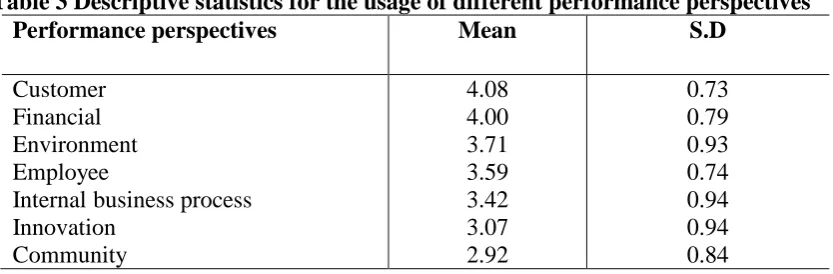
After factor analysis, descriptive statistics on the seven perspectives are displayed in
Table 3. The table shows that responding companies place a major weight on the use of
customer measures with a mean of 4.08 followed by financial perspective (4.00),
environment perspective (3.71), employee perspective (3.59), internal business process
perspective (3.42), innovation perspective (3.07) and community perspective (2.92).
Insert Table 3 here
To understand better the usage of financial and non-financial measures among
Jordanian industrial companies, Table 4 shows that, in general, Jordanian companies put
more emphasis on the use of financial measures with a mean of 4.00. The table also
shows that Jordanian companies use non-financial measures to a considerable extent
with a mean of 3.47. Finally, the table shows that Jordanian companies use a diverse set
of financial and non-financial measures with a mean of (3.54). This result is consistent
with the findings of previous research (Jusoh et al, 2008; Gomes et al, 2007; Ismail,
2007; Gosselin, 2005).
Insert Table 4 here
Aims of Performance Measures Usage
It has been argued that it is important that researches clarify in their studies the different
roles that the performance measures play in the firms they are investigating
(Franco-Santos, 2007). Previous research has determined that there are many uses for
performance measures for evaluation purposes, monetary compensation and non-
monetary rewards. Ittner et al (2003) examined a broad set of performance measures
use, which include goal setting, capital investment decisions, problem identification,
performance evaluation and external disclosure. Henri and Journeault (2008) examined
the importance of measurement and use of environmental performance indicators
(hereafter EPIs) within Canadian manufacturing firms. In particular, the study examines
four uses for EPIs, namely to monitor compliance with environmental policies and
regulation, to motivate continuous improvement, to provide data for internal
decision-making and to provide data for external reporting.
As shown in Table 5 most of the listed purposes of Jordanian industrial companies were
ranked as "to a great extent" or " to a very great extent" by more than 50% of the
respondent companies with a mean ranging from 3.49 to 4.29. These aims were: comply
with legal requirements (85.7%), evaluate organisational performance (88.7%),
supervise managers' productivity (78.6%), evaluate managerial performance (75.0%),
encourage improvement of business processes (69.6%), reward employees (61.3%),
manage operations processes (60.7%) and provide better understanding of the
cause-effect relationship (51.2%). Informed decision-making and communicate strategy were
ranked at the bottom of the list by 50% or less of respondents.
Although Jordanian companies place more emphasis on the use of performance
measures to evaluate organisational and managerial performance, they also use them for
other reasons. This finding is consistent with the argument of Verbeeten and Boons
(2009) in that the PMS is used for many purposes other than solely evaluating and
rewarding managers. The findings indicate that about 85.7% of Jordanian industrial
companies use performance measures mainly to comply with legal requirements. This
result indicates that Jordanian industrial companies still operate under significant
Hoque, 2002). There is an opportunity as a result to investigate the effect of some
institutional factors on the extent of use of performance measures in Jordan in future
research.
The findings also indicate that Jordanian industrial companies put less emphasis on the
role of performance measures in providing a better understanding of the cause-effect
relationship, informing decision making and communicating strategy as these aims were
ranked at the bottom of the list as shown in Table 5. This result indicates that Jordanian
companies use a diversity of financial and non-financial performance measures as an
improved PMS and not as a strategic PMS (Malmi, 2001). This is because these three
aims were identified as important attributes of performance measures in previous
research (Hwang et al, 2009; Franco-Santos et al, 2007; Malina & Selto, 2004; Kim et
al, 1997). Thus, Jordanian companies should direct their attention to these three aims in
future.
In summary, the study findings indicate that Jordanian industrial companies use
performance measures primarily to evaluate managerial and organisational
performance. They also use performance measures to a significant extent to comply
with legal requirements. The results also indicate that Jordanian companies pay less
attention to communicating strategic decisions and cause-effect relationship in using
these measures.
Insert Table 5 here
Conclusion
Our knowledge about how Jordanian companies use and design performance
measurements is very limited. Thus, this study is a preliminary attempt to cover the
following two related issues: the extent of performance measures usage and the
these phenomena. The survey findings indicated that Jordanian industrial companies use
multiple performance measures in terms of financial and non-financial in their
performance measurement systems.
The study findings also indicated that Jordanian industrial companies use performance
measurements primarily to evaluate managerial and organizational performance. They
also use performance measurement largely to comply with legal requirements. The
results also indicated that Jordanian companies pay less attention to the communication
of strategic decisions and cause-effect relationship in using these measurements.
Consequently, three outcomes can be drawn from these results:
Although Jordanian companies place more emphasis on the use of performance
measures to evaluate organisational and managerial performance, they also use them for
other reasons. This result supports the idea that the PMS is used for many purposes
other than solely evaluating and rewarding managers (Verbeeten & Boons, 2009).
The results indicate that Jordanian industrial companies still operate under significant
institutional and government controls since they put more emphasis on using such
measures to comply with legal requirements (Hussain & Gunasekaran, 2002; Hussain &
Hoque, 2002).
The findings indicate that Jordanian industrial companies put less emphasis on the role
of performance measures in providing a better understanding of the cause-effect
relationship, informing decision making and communicating strategy in comparison
with other purposes. This indicates that some Jordanian companies use measurement
Tables
Table 1 Profile of the responding firms
Frequency % Industry classification
Textile, clothing and footwear 12 7.1 Electrical appliances 7 4.2 Plastic and rubber products 18 10.7 Food products 27 16.1 Typing, paper and packing 11 6.5 Furniture and wooden products 13 7.7 Oil and gas industry 1 0.6 Chemical/pharmaceutical industry 24 14.3 Mining and quarrying 4 2.4 Tobacco and cigarettes 3 1.8 Iron, steel and aluminium industry 20 11.9 Building materials and construction 16 9.5 Others include IT products, automotive products… 12 7.1
Total 168
Total number of employees
50-149 70 41.7 150-249 35 20.8 250-499 41 24.4 500-999 15 8.9 1000 or grater 7 4.2
Total 168
Annual sales (in million JOD)
Less than 1 million 23 13.7 1-less than10 millions 51 30.3 10 – less than 20 millions 23 13.7 20 – less than30 millions 24 14.3 30 – less than 40 millions 10 6.0 40 – less than 80 millions 18 10.7 80 - less than160 millions 9 5.3 160–lessthan320 millions 4 2.4 320 – less than 640 millions 1 0.6 Above 640 millions 2 1.2 Unspecified 3 1.8
Table 2 Performance measures usage among Jordanian industrial companies
Code Performance measures % rating 1 % rating 2 % rating 3 % rating
4 or 5
Mean S.D
C5 Costs per unit
produced 3.0 0.6 16.7 79.7 4.19 0.94 C2
sales growth 1.2 4.8 17.9 76.2 4.15 0.96 C1
Operating income 1.8 2.4 18.5 77.4 4.13 0.92 C19 Customer response
time 1.2 1.8 15.5 81.5 4.10 0.81 C22
Customer retention 1.2 5.4 14.3 79.2 4.10 0.92 C21 Survey of customer
satisfaction 0.6 4.2 18.5 76.8 4.07 0.87 C20
On-time delivery 1.2 6.5 12.5 79.7 4.06 0.92 C28 Environmental
compliance 3.0 2.4 16.1 78.5 4.05 0.93 C3 Return on investment
(ROI) 2.4 4.8 22.6 70.2 3.98 1.00 C15
Employee training 1.2 6.0 23.8 69.1 3.89 0.93 C4 Return on Equity
(ROE) 2.4 8.3 27.4 61.9 3.79 1.04 C8
Defect rates 6.5 6.0 19.6 67.9 3.78 1.13 C6
Budget variances 3.6 7.1 25.0 64.3 3.76 1.03 C17
Employee Safety 1.8 5.4 31.5 61.3 3.73 0.91 C16 Employee skill
development 1.2 6.5 31.5 60.7 3.73 0.91 C11 Labour efficiency
variance 4.2 8.3 17.3 70.3 3.72 1.00 C30 Reducing wastes and
emissions 9.5 7.7 25.6 57.2 3.57 1.23 C23
Public image 4.2 5.4 33.3 57.1 3.54 0.91 C13 Number of new
product launches 8.3 5.4 31.0 55.3 3.54 1.13 C29 Environmental
certification 8.3 8.3 30.4 53.0 3.53 1.19 C10 Rate of material scrap
loss 8.9 13.1 26.2 51.8 3.36 1.15 C14 Time-to-market new
Continued Table 2 Performance measures usage among Jordanian industrial companies
Code Performance measures
% rating 1 % rating 2 % rating 3 % rating 4 or 5
Mean S.D
C24
Community involvement 7.7 11.9 42.9 37.5 3.15 0.96 C9
Manufacturing lead time 14.9 13.1 28.0 44.0 3.12 1.22 C18
Employee authorization 6.5 22.6 37.5 33.4 3.01 0.97 C26 Support of social
activities 8.3 26.8 38.7 26.2 2.88 1.01 C27 Support of charity
projects 11.3 25.6 35.7 27.3 2.86 1.08 C25 Participation in training
and education 9.5 26.8 40.5 23.2 2.81 0.98
C7 Economic value added
(EVA) 17.3 23.8 32.1 26.8 2.69 1.06 C12
Number of new patents 36.3 17.3 22.0 24.4 2.38 1.27
Table 3 Descriptive statistics for the usage of different performance perspectives
Performance perspectives Mean S.D
Customer Financial Environment Employee
Internal business process Innovation Community 4.08 4.00 3.71 3.59 3.42 3.07 2.92 0.73 0.79 0.93 0.74 0.94 0.94 0.84
Table 4 Descriptive statistics for the usage of financial measures, non-financial measures and all measures
Performance measures type Mean S.D
Financial measures Non-financial measures
Performance measurement diversity usage
Table 5 Specific aims of performance measurements
Code Purpose of usage % rating
1
% rating
2
% rating
3
% rating 4 or 5
Mean S.D
D9 Comply with legal
requirements 0.0 2.4 11.9 85.7 4.29 0.77
D1 Evaluate organisational performance
0.0 1.8 9.5 88.7 4.27 0.71
D10 Supervise managers’
productivity 0.6 3.0 17.9 78.6 4.04 0.80
D2 Evaluate managerial
performance 1.2 2.4 21.4 75.0 4.01 0.85
D6 Encourage improvement of business processes
0.0 5.4 25.0 69.6 3.89 0.84
D3 Reward employees
1.2 5.4 32.1 61.3 3.80 0.94
D4 Manage operations processes
1.2 6.5 31.5 60.7 3.67 0.86
D7 Provide better understanding of the cause-effect
relationship
1.2 16.7 31.0 51.2 3.49 1.00
D5 Inform decision
making 0.6 15.5 33.9 50.0 3.46 0.93
D8 Communicate strategy
References
Ababneh, R. (2008). A comprehensive performance evaluation of the Jordanian customs department using the balanced scorecard. Jordan Journal of Business Administration, 4(4), 463-484.
Abdel-Maksoud, A., Dugdale, D., & Luther, R. (2005). Non-financial performance measurement in manufacturing companies. The British Accounting Review, 37(3), 261-297.
Abernethy, M. A., & Lillis, A. M. (1995). The impact of manufacturing flexibility on management control system design. Accounting Organizations and Society, 20(4), 241-258.
Ahmad, M. M., & Dhafr, N. (2002). Establishing and improving manufacturing performance measures. Robotics and Computer-Integrated Manufacturing, 18(3-4), 171-176.
Al-Akra, M., Ali, M. J., & Marashdeh, O. (2009). Development of accounting regulation in Jordan. The International Journal of Accounting, 44, 163-186.
Al-khatatneh, W. R., & Al-Sa'aydeh, M. I. (2009). The level of awareness of Jordanian industrial public companies' managers of the significance of the non-financial perspectives (measures) of the balanced scorecard (BSC) in evaluating the performance of their companies. Jordan Journal of Business Administration, 5(1), 1-18.
Atkinson, A., Balakrisnan, R., Booth, P., Cote, J., Groot, T., Malmi, T.,… Wu, A. (1997). New Directions in Management Accounting Research. Journal of Management Accounting Research, 9, 79-108.
Bhimani, A. (1994). Monitoring performance measures in UK manufacturing companies.
Management Accounting, 72 (1), 34-36.
Bourne, M., Neely, A., Mills, J., & Platts, K. (2003). Implementing performance measurement systems: a literature review. International Journal of Business Performance Management, 5(1), 1-24.
Braam, G. J. M., & Nijssen, E. J. (2004). Performance effects of using the Balanced Scorecard: a note on the Dutch experience. Long Range Planning, 37, 335-349.
Brignall, S. (2007). A financial perspective on performance Management. The Irish Accounting Review, 14(1), 15-29.
Burgess, T. F., Ong, T. S., & Shaw, N. E. (2007). Traditional or contemporary? The prevalence of performance measurement system types. International Journal of Productivity and Performance Management, 56(7), 583-602.
Chen, C. C. (2008). An objective-oriented and product-line-based manufacturing performance measurement. International Journal of Production Economics, 112(1), 380-390.
Chenhall, R. H., & Langfield-Smith, K. (1998). Adoption and benefits of management accounting practices: an Australian study. Management Accounting Research, 9, 1-19. Chenhall, R. H., & Langfield-Smith, K. (2007). Multiple Perspectives of Performance
Measures. European Management Journal, 25(4), 266-282.
Chow, C. W., & Van der Stede, W. A. (2006). The Use and usefulness of Nonfinancial Performance Measures. Management Accounting Quarterly, 7(3), 1-8.
Drury, C., Braund, S., Osborne, P., & Tayles, M. (1993). A survey of management accounting practices in UK manufacturing companies. The Charted Association of Certified Accountants, Certified Research Report, 32, 1-83.
Dunk, A. S. (2005). Financial and non-financial performance: the influence of quality of information system information, corporate environmental integration, product innovation, and product quality. Advances in Management Accounting, 14, 91-114.
Fisher, J. (1995). Contingency-based research on management control systems: Categorization by level of complexity. Journal of Accounting Literature, 14, 24 - 53.
Franco-Santos, M. (2007). The Performance Impact of Using Measurement Diversity in Executives’ Annual Incentive Systems. Unpublished PhD thesis, Cranfield University, Cranfield, UK.
Franco-Santos, M., Kennerley, M., Micheli, P., Martinez, V., Mason, S., Marr, B.,… Neely, A. (2007). Towards a definition of a business performance measurement system.
International Journal of Operations & Production Management, 27(8), 784-801.
Ghalayini, A. M., & Noble, J. S. (1996). The changing basis of performance measurement.
International Journal of Operations & Production Management, 16(8), 63-80.
Gomes, C. F., Yasin, M. M., & Lisboa, J. V. (2007). An empirical investigation of manufacturing performance measures utilization: The perspectives of executives and financial analysts. International Journal of Productivity and Performance Management, 56(3), 187-204.
Gosselin, M. (2005). An empirical study of performance measurement in manufacturing firms.
International Journal of Productivity and Performance Management, 54(5/6), 419-437. Govindarajan, V. (1988). A contingency approach to strategy implementation at the
business-unit level: Integrating administrative mechanisms with strategy. Academy of Management Journal, 31(4), 828-853.
Hall, M. (2008). The effect of comprehensive performance measurement systems on role clarity, psychological empowerment and managerial performance. Accounting, Organizations and Society, 33, 141-163.
Hawamdah, M. ( 2006). Usage and utilization of the balanced scorecard. Empirical study on
Jordanian Industrial Companies. Unpublished Master Thesis, Yarmouk University,
Jordan.
Henri, J. F. (2006). Organizational culture and performance measurement systems. Accounting, Organizations and Society, 31, 77-103.
Henri, J. F., & Journeault, M. (2008). Environmental performance indicators: An empirical study of Canadian manufacturing firms. Journal of Environmental Management, 87(1), 165-176.
Hertenstein, J. H., & Plat, M., B. (1998). Why product development teams need management accountants. Management Accounting, 10, 50-55.
Hoque, Z., Mia, L., & Alam, M. (2001). Market competition, computer-aided manufacturing and use of multiple performance measures: an empirical study. The British Accounting Review, 33(1), 23-45.
Hoque, Z., & James, W. (2000). Linking balanced scorecard measures to size and market factors: Impact on Organizational Performance. Journal of Management Accounting Research, 12, 1-17.
Hussain, M., & Gunasekaran, A. (2002). Non-financial management accounting measures in Finnish financial institutions. European Business Review, 14(3), 210-229.
Hussain, M., & Hoque, Z. (2002). Understanding non-financial performance measurement practices in Japanese banks. A new institutional sociology perspective. Accounting, Auditing & Accountability Journal, 15(2), 162-183.
Hutaibat, K. A. (2005). Management Accounting practices in Jordan: a contingency approach.
Unpublished PhD Thesis, University of Bristol, Bristol, UK.
Hwang, D. Y., Lee, A. C., Liu, C. -C., & Ouyang, L. (2009). Balanced Performance Index and Its Implications: Evidence from Taiwan’s Commercial Banks. Review of Pacific Basin Financial Markets and Policies, 12(1), 27-62.
Hyvönen, J. (2005). Adoption and benefits of management accounting systems: Evidence from Finland and Australia. Advances in International Accounting, 18, 97-120.
Iselin, E. R., Mia, L., & Sands, J. (2008). The effects of the balanced scorecard on performance: The impact of the alignment of the strategic goals and performance reporting. Journal of General Management, 33(4), 71-85.
Ismail, T. H. (2007). Performance evaluation measures in the private sector: Egyptian practice.
Ittner, C. D., & Larcker, D. F. (1998). Innovations in performance measurement: Trends and research implications. Journal of Management Accounting Research, 10, 205-238. Ittner, C. D., Larcker, D. F., & Randallb, T. (2003). Performance implications of strategic
performance measurement in financial services firms. Accounting, Organizations and Society, 28, 715-741.
Jänkälä, S. (2007). Management control systems (MCS) in the small business context. Linking effects of contextual factors with MCS and financial performance of small firms.
Unpublished PhD Thesis, University of Oulu, Oulu, Finland.
Jusoh, R., Ibrahim, D. N., & Zainuddin, Y. (2008). The performance consequence of multiple performance measures usage: evidence from the Malaysian manufacturers.
International Journal of Productivity and Performance Management, 57(2), 119-136. Kald, M., & Nilsson, F. (2000). Performance measurement at Nordic companies. European
Management Journal, 18(1), 113-127.
Kaplan, R. S., & Norton, D. P. (1992). The balanced Scorecard-measures that drive performance. Harvard Business Review, 70(1), 71-79.
Kaplan, R S., & Norton, D. P. (1993). Putting the balanced scorecard to work.
Harvard Business Review, 71(5), 134-147.
Kaplan, R. S., & Norton, D. P. (1996a). The balanced scorecard: Translating strategy into action. Harvard Business School Press, Boston, MA.
Kaplan, R. S., & Norton, D. P. (1996b). Using the balanced scorecard as a strategic management system. Harvard Business Review, 74(1), 75-85.
Kaplan, R. S., & Norton, D. P. (1996c). Linking the balanced scorecard to strategy. California Management Review, 39(1), 53-79.
Kim, G., Park, C. S., & Yoon, K. P. (1997). Identifying investment opportunities for advanced manufacturing systems with comparative-integrated performance measurement.
International Journal of Production Economics, 50(1), 23-33.
King Abdullah II Center for Excellence. (2009). King Abdullah II Award for Excellence for the
private sector, Jordan. Retrieved May15, 2009, from
http://www.kaaps.jo/award-criteria-and-assessment-process
Lau, C. M., & Moser, A. (2008). Behavioral Effects of Nonfinancial Performance Measures: The Role of Procedural Fairness. Behavioral Research in Accounting, 20(2), 55-71. Lau, C. M., & Sholihin, M. (2005). Financial and nonfinancial performance measures: How do
they affect job satisfaction?. The British Accounting Review, 37, 389-413.
Leung, L., Lam, K., & Cao, D. (2006). Implementing the balanced scorecard using the analytic hierarchy process & the analytic network process. Journal of the Operational Research Society, 57, 682-691.
Lovata, L., & Costigan, M. (2002). Empirical analysis of adopters of economic value added.
Management Accounting Research, 13(2), 2 15-228.
Maiga, A. S., & Jacobs, F. A. (2003). Balanced scorecard, activity-based costing and company performance: An empirical analysis. Journal of Managerial Issues, 15(3), 283-301. Malina, M. A., & Selto, F. H. (2004). Choice and change of measures in performance
measurement models. Management Accounting Research, 15, 441-469.
Malmi, T. (2001). Balanced scorecards in Finnish companies: A research note. Management Accounting Research, 12, 207-220.
Maltz, A. C., Shenhar, A. J., & Reilly, R. R. (2003). Beyond the Balanced Scorecard: Refining the Search for Organizational Success Measures. Long Range Planning, 36, 187-204. Marshall, M., Wray, L., Epstein, P., & Grifel, S. (1999). 21st century community focus: better
results by linking citizens, government and performance measurement. Public Management, 81(10), 12-19.
Ministry of Industry and Trade. (2008). Realities of Industrial Sector in Jordan. Retrieved October19, 2009 from
Moers, F. (2005). Discretion and bias in performance evaluation: the impact of diversity and subjectivity. Accounting, Organizations and Society, 30, 67-80.
Moers, F. (2006). Performance Measure Properties and Delegation. The Accounting Review, 81(4), 897-924.
Neely, A. (1999). The performance measurement revolution: why now and what next?.
International Journal of Operations & Production Management, 19(2), 205-228.
Neely, A., Gregory, M., & Platts, K. (2005). Performance measurement system design: A literature review and research agenda. International Journal of Operations & Production Management, 25(12), 1228-1263.
Neely, A., Mills, J., Platts, K., Gregory, M., & Richard, A. (1994). Realising strategy through measurement. International Journal of Operations & Production Management, 14(3), 140-52.
Perera, S., Harrison, G., & Poole, M. (1997). Customer-focused manufacturing strategy and the use of operations-based non-financial performance measures: A research note.
Accounting, Organizations and Society, 22(6), 557-572.
Said, A. A., HassabElnaby, H. R., & Wier, B. (2003). An Empirical Investigation of the Performance Consequences of Nonfinancial Measures. Journal of Management Accounting Research, 15, 193-123.
Sohn, M. H., You, T., Lee, S. L., & Lee, H. (2003). Corporate strategies, environmental forces, and performance measures: a weighting decision support system using the k-nearest neighbour technique. Expert Systems with Applications, 25, 279-292.
Stivers, B. P., Covin, T. J., Hall, N. G., & Smalt, S. W. (1998). How nonfinancial performance measures are used. Management Accounting, 79(8), 44-49.
Van der Stede, W. A., Chow, C. W., & Lin, T. W. (2006). Strategy, Choice of Performance Measures, and Performance. Behavioural Research in Accounting, 18, 185-206.
Veen-Dirks, P. (2010). Different uses of performance measures: The evaluation versus reward of production managers. Accounting, Organizations and Society, 35, 141-164.
Verbeeten, F. H. M., & Boons, A. N. A. M. (2009). Strategic priorities, performance measures and performance: an empirical analysis in Dutch firms. European Management Journal, 27, 113-128.
Widener, S. (2006). Associations between strategic resource importance and performance measure use: The impact on firm performance. Management Accounting Research, 17, 433-457.
White, L. F. (2008). The use of performance measures and their Outcomes. Journal of American Academy of Business, 13(1), 133-136.
Xiong, Y., Su, W., & Lin, T. W. (2008). The use of financial and nonfinancial performance measures in Chinese firms. Cost Management, 22(5), 37-46.
Yeniyurt, S. (2003). A literature review and integrative performance measurement framework for multinational companies. Marketing Intelligence & Planning,21(3), 134-142. Zuriekat, M. (2007). Total Quality Management, Just in Time Production and Non-Financial
performance measures: An Empirical Investigation. The Scientific Journal of Faculty of Commerce, Assiut University Press, 42, 1-25.