Enhancing MSF for Mobile Ad Hoc Network Security Though Active
Handshaking & Multipath
Nitika Singh
PhD. Scholar Department of CSE
RKDF, Bhopal, India
Prof. Sharad Gangale
HOD Department of CSE
RKDF, Bhopal, India
Abstract:--An ad hoc network is an automatically
generated network of wireless links connecting mobile
nodes. The mobile nodes can communicate without an
infrastructure. They form a different topology, where the
nodes play the role of routers and are free to move in a
network. Ad hoc networks proved their efficiency being
used in different fields but they are highly vulnerable to
security attacks and dealing with this is one of the main
challenges of these networks. It seems to be more
challenging of in wireless networks. Existing research
carried out provides authentication, confidentiality,
availability, and secure routing and intrusion detection in
ad hoc networks. Ad hoc network characteristics should
be taken into consideration to design efficient data
security along its path of transmission. Recently, some
solutions are proposed to provide authentication,
confidentiality, availability, secure routing and intrusion
detection in ad hoc networks. Implementing security
through encryption algorithm applicable at every node in
such a dynamically changing network is a hard task. In
this study, we focus on improving point to point data
transfer using multipath routing, node to node security
through encryption and handshaking of nodes. Through
this process security is provided against eavesdropping,
active and passive security attack and jamming using
MSF (Multipath Security Framework). Indeed, we take
advantage of the existence of multiple paths between
nodes in an ad hoc network to increase the
confidentiality and robustness of transmitted data. In our
approach the original message is split into shares that are
encrypted and combined then transmitted along different
paths between sender and receiver. Even if an attacker
succeeds to obtain one or more transmitted shares, the
probability that the original message will be
reconstituted is very low.
Keywords:-MANET, MSF, DoS, SDMP.
I. INTRODUCTION
Mobile ad hoc networks (MANET) have been gaining
popularity because of availability of low cost mobile
devices and its ability to provide instant wireless
networking capabilities where implementation of wired
network is not possible or costly. MANET is a collection
of mobile node with routing capabilities and connected
with wireless link. Mobile node can directly
communicate to each other if they fall in the radio
coverage range of each other. In order to forward the
packet to the nodes which are beyond the coverage
range, MANET uses the concept of multi hop
communication. Nodes in the MANET are free to move,
which dynamically changes the topology of the network.
It does not require any expensive infrastructure to
support the mobility. Creating the Ad hoc networks is
possible where implementation of infrastructure is not
possible or expensive. In MANET, security depends on
several parameters (authentication, confidentiality,
integrity, non-repudiation and availability) [1]. Without
one of these parameters, security will not be complete.
240
node, thus being able to have unauthorized access to the
resources and to sensitive information. Confidentiality
ensures that exchanged information will not be consulted
by unauthorized nodes. Integrity means that information
can only be modified by nodes allowed to do it and by
their own willing. Non-repudiation permits obtaining a
proof that information are sent or received by someone.
Thus, a sender or a receiver cannot deny that he sent or
received the concerned information. And finally,
availability ensures that network services can survive
despite any attack. Ad hoc networks are exposed to
many possible attacks. We can classify these attacks into
two kinds: passive and active attacks. Other attacks are
Black hole attack, Routing Table overflow attack, Sleep
Derivation attack, Location disclosure attack and DOS
attack. In our work, we have proposed a new framework
named as MSF (Multipath Security Framework), it tries
to provide an effective solution to native security
problems of MANET such as jamming attack, malicious
node, active and passive attack and eavesdropping. In
MSF, data are divided into sub parts called packet.
Headers are added and then full packed is encrypted
before transmission. Each packet is transmitted across
different network paths which are dynamically selected.
There is handshaking between the nodes to provide
additional security. The motivation of proposed MSF in
multipath routing protocol is to divide the initial
message into parts then to encrypt and combine these
parts by pairs. Then use the characteristic of existence of
multiple paths between nodes in an ad hoc network to
increase the robustness of confidentiality. This is
achieved by sending encrypted combinations on the
different existing paths using MSF between the sender
and the receiver. In our solution, even if an attacker
succeeds to have one part or more of transmitted parts,
the probability that the original message can be
reconstructed is low.
II. LITERATURE SURVEY
A few research works have been done to address the
security issues in ad hoc networks. Security issues that
have been addressed particularly for ad hoc networks,
secure routing protocols [2], preventing traffic analysis,
and so on [3]. An important aspect of ad hoc network
security is routing security. The Secure Routing Protocol
(SRP) presented in [4, 5, 6, 7] counters malicious
behavior that targets the discovery of topological
information. SRP provides correct routing information
Multipath routing allows the establishment of multiple
paths between a single source and single destination
node. Multipath routing has I been explored in several
different contexts [12].Some of these schemes are
characterized by the existence of a central authority,
whereas others follow a self-organized approach. In this
context, either some [10] or all [11] network nodes take
part in issuing and verifying certificates. This is done to
strengthen the protocol’s resilience against attacks. A lot
of work in the field has been done in mobility-based
schemes that take advantage of nodes’ mobility to
facilitate the key exchange and trust establishment [12].
In these cases, two nodes establish security association
between each other by means of secure side channel
communication or physical contact. Multi-path routing
has been extensively studied in a wired network context
for aggregating bandwidth, reducing blocking
probability, and increasing the fault tolerance, etc.
[8].however, the shared wireless channel has a
significant impact on the performance of multi-path
routing [9].
III. Multipath Security Framework (MSF)
3.1 Multi-path Routing Topology
The originality of the proposed approach is that it does
not modify the existing lower layer protocols. The
`A' and the receiver `B' are authenticated, session key
and message key is used for the encryption/decryption of
frames at MAC layer and the authentication of the
terminals, a mechanism of discovering the topology of
the network is available, and the protocol uses a routing
protocol supporting multi-path routing and supports
MSF.
3.2 Multiple path message Transmission
With the knowledge of network topology the proposed
security model will use n routes (the message will be
divided into n-1 shares). One path is used for signaling, a
second one is used to transmit in plain text a key share
(randomly chosen) used to initiate the de-combination
process and the others (n -2 paths) are used to transmit
the different shares of the original message. Therefore
the proposed data security multi-path protocol should
have at least 4 links.
3.3 Algorithm for Multi-path message transmission
The expressions used to describe the multi-path parted
message transmission algorithm are described below:-
m: message to be sent securely between A and B using
multipath security framework . Dividing m into n - 1
parts gives: P (m) = {c1, c2… cn-1}. TP (ntwk):
Function invoked periodically to discover topology of
the ad hoc network. It returns true if modifications in
topology exists, otherwise it returns false. Frequency:
Represents the frequency of topology refreshing. N(A,
B): number of links between A and B in MSF n: is an
integer; 4<= 4 <= N(A, B). The original message m is
divided into (n - 1) shares; each of them has a unique
identifier. The protocol generates a path numbers of
appropriate message parts to be sent on the signaling
channel. The path numbers assigned for the message
parts are selected randomly and sent at appropriate paths
of multi-path routing protocol in MSF next message
transmission different paths are used for parted messages
which usually generated through pseudo random model.
The message share will be transmitted in plain text the
final part is sent in plain text on one of the n paths. It
will be the start point for receiver to find other parts.
Concerning the manner of dividing messages, a channel
coding approach called Diversity Coding is used to
recover from link failures. Finally combine, the n - 1
parts of m in pairs using pseudo random operation
related to final path. On the nth link, which is considered
as signaling channel, send values of pseudo random
number and number of path in which message parts are
transmitted.
3.4 Encryption of Messages in the multiple paths
The message parts on every data channel are sent
encrypted by WPA to reinforce confidentiality. The
chosen WPA for encryption in the proposed simulation
provides efficient security to be imbibed in the
multi-path routing protocol. This gives a two layer security to
the data confidentiality. Combination of SDMP with
WPA is performed to its perfection in terms of security
and transmission efficiency. Parts' identifiers are sent to
allow the receiver to reconstitute the original message in
the correct order. For fault tolerance problem, Diversity
Coding technique is used which is based on information
redundancy. Even if an attacker succeeds to obtain one
part or more of the transmitted message, the probability
of reconstructing the message is low. The attacker must
have all the parts. This means, that he/she has to
eavesdrop on all used paths, or should be near A or B.
Furthermore, he/she should be informed about our
combining function and be able to decrypt the WPA
encoding. SDMP is deployed in an ad hoc network by
introducing only software modifications.
3.5 Trust Establishment
When a node does not have valid security associations
242
with a period of TH seconds, in order to discover nodes
located within its transmission range. If neighbors are
detected, the trust establishment handshake is performed.
When the security association is established, it is tagged
with expiration time, after which it is considered invalid.
The lifetime TL of each trust relationship is fixed for
every node in the network. Every node maintains a list
of nodes that it trusts and the corresponding time limits
assigned to each trust relationship. During the neighbor
discovery mechanism, a node broadcasts a HELLO
message and waits for an acknowledgement
(ACK-HELLO) indicating the existence of a node in its
vicinity. None of these messages are encrypted, as they
do not contain any sensitive information. Every node can
reply to a HELLO message, even an adversary, but then
it will have to prove its security credentials during the
core trust establishment stage that begins upon the
reception of the first HELLO packet. Any
ACK-HELLO packets that may arrive later are discarded.
Having discovered a neighbor, the actual trust
establishment handshake between the two nodes is
performed. The node u initiating the whole trust
establishment process sends a JOIN packet containing its
public key to the node v encrypted with the
network-wide authority key that is preconfigured with. Node v
decrypts the message with the same authority key and
replies with a corresponding message encrypted by the
same authority key. We will refer to this reply message
as an ACCEPT message. In the ACCEPT message, node
v includes apart from its own public key the information
about the trust relationships with other nodes along with
their time limits and public keys. Thus node u by
establishing security association with node v, becomes
member of the general secure overlay network where
every node is trusted with all the others. The ACCEPT
packet is then broadcasted to all nodes in the secure
overlay network in a secure way since each transmission
is made between trust related nodes. At each
transmission between trusted nodes public key
cryptography is used. The network-wide authority key is
only used in the core trust establishment phase. In order
to avoid using any information from the routing layer, a
controlled flooding mechanism is performed ensuring,
by means of sequence numbers, that each node forwards
each ACCEPT packet only once. As a result, all nodes of
the secure overlay eventually share the same information
regarding which nodes and until when, can be trusted.
TABLE 1
3.6 Establishment of Multipath Routes in MSF
The success of multipath selection necessitates two
components, namely: 1) a metric that can accurately
reflect failure correlation between different paths, and 2)
a selection algorithm that can effectively leverage the
metric to rule out failure-correlated paths from being
selected together. We present a mechanism which can
not only evaluate individual path availability, but can
also derive a multipath availability metric even in the
presence of failure correlation between links. Then, we
sketch how our mechanism helps to select multiple paths
based on the derived availability metric. We use the
following standard notations: “˄” is the logical AND bit
-operation; “˅” stands for the logical OR bit -operation; “ǀXǀ” operation returns the cardinality of the set X; and “ǀǀXǀǀ” operation returns the norm of the vector X.
a) MSF History Vector (MHV)
Given the increasing possibility of cross-platform
interference and jamming in wireless networks, as well as
the overwhelming complexity of the wireless propagation
difficult (if not impossible) to precisely predict analyze
the correlation between different paths. To bypass such
complexity while still exploring the failure correlation
between different paths, we propose a mechanism called
an MHV [17], to record path availability histories, from
which the failure correlation between different paths can
be learned. We first define an MHV on a per-link basis,
from which path (multipath) availability can be then
easily derived. One natural metric to determine the
availability of a wireless link is the Packet Delivery Ratio
(PDR), i.e., the percentage of packets successfully
delivered over the link. Recording the PDR time series
directly requires at least 1 byte for each data point, and
calculating the aggregated PDR of a path requires
multiplication To store and compute availability history
efficiently, we utilize a binary vector for recording, and
bitwise operations for calculating path availability. In
particular, we map a PDR to a 0-1 value, where “1”
corresponds to the time instant when the link is available
(acceptable PDR), while “0” corresponds to the time
instant when the link is unavailable (unacceptable PDR).
A threshold γₒ is predefined to determine whether a PDR is acceptable, and γₒ should be sufficiently high to ensure
acceptable end-to-end PDRs. Furthermore, we divide
time into epochs with a fixed duration. At the lth epoch,
let PDRᶩᵢ_ be the average PDR between nodes ὶ and ϳ,
then the availability record of the link between nodes i
and j at the lth. epoch is rᶥᵢ_ =1 if { PDRᶥᵢ_ ≥ γₒ, otherwise:
0. The MHV of this link for e epochs is Aij=[r ¹ᵢ_; r²ᵢ_ . . .
rᵢ_]. To facilitate observation, we depict an MHV as a
continuous line and illustrate an example of converting
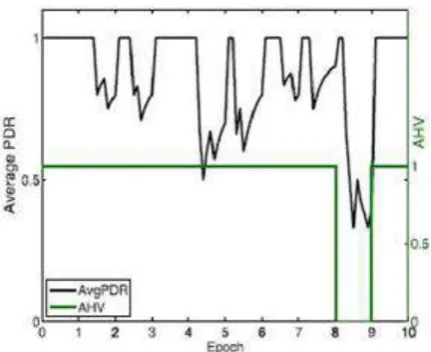
the PDR into the MHV with γₒ being 0.6 in Fig.1; except
for Epoch 9, the availability of other epochs is “1.” So far,
MHV is used to characterize individual links. Now, we
present how to derive an MHV for an entire path
consisting of concatenating links or sub paths, using the
following series combination operation.
b) MHV of one path
The MHV of a complete path is computed as the logical
bitwise AND of all MHVs of the links or sub paths. The
MHV of path pi can be formulated as
A=aI1I2˄aI2I3˄…˄aIqIq+1. Where Iq is the qth node ID on
the path pᵢ. For example, Path-1, shown in Fig. 2,
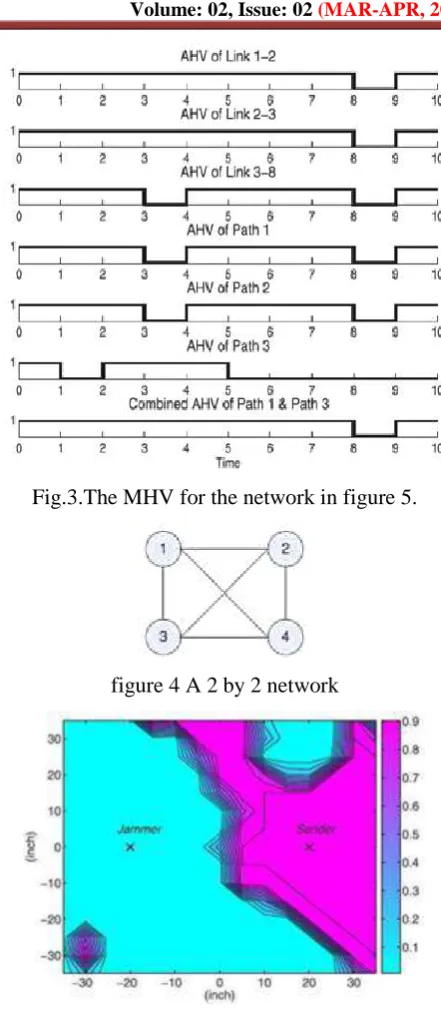
consists of links 1 ! 2 ! 3 ! 8. Fig. 5 illustrates the series
combination for calculating its MHV. The top three lines
present the MHVs of links 1 ! 2; 2 ! 3; and 3 ! 8, and the
fourth line is the MHV of Path-1, computed as the
bitwise AND of the first three MHVs.
Figure 1 an illustration of converting PDR to AHV for the link 1 to 2
c) MHV of multiple paths
Recall that in multipath routing, we aim at selecting
multiple paths that provide the highest multipath
availability; thus, we derive the AHV of a given set of k
paths using the following parallel combination
operation. Let M be the set of k paths between a
source-destination pair. The MHV of M is computed as the
logical bitwise OR of all MHVs of the paths, denoted as
AM=A1∨A2∨A3∨…∨Ak. Given example shows of the
MHVs of three paths along with the combined MHV of
Path-1 and Path-3, obtained by a logical bitwise OR of
the Path-1 and Path-3’s MHVs.
d)Multipath availability metric θ
244
infer that two paths are highly correlated if they tend to
fail at the same time, and vice-versa. To facilitate
selecting failure-independent routing paths, we define an
availability metric θ, which is computed as the number
of 1-epochs (i.e., availability bit equals “1” in that
epoch) in the MHV of multiple paths between a
source-destination pair. Specifically, the availability of a
multipath set M is θ(M)=||AM||. Consider the example
shown in Fig. 3, θ of the set of Path-1 and Path-2 is 8.
Figure 2 simplified topology of a wireless network with
three paths
3.7 Multipath Selection
The goal of our multipath selection scheme is to select k
MHVs that can produce the largest θ, to ensure that
failure correlated paths are bound to be less likely chosen
together. Formally, given the set H containing h
candidate paths, the multipath selection problem can be
defined as the following Definition 1: Maximize θ(M)
subject to |M|≤ k, M⊆H.
a)Multipath selection framework
Obtaining the optimal M in MSF containing k paths
encounters two challenges. First, the multipath selection
problem in Definition 1 is NP-complete, according to
our prior work [36]. Second, a huge number of possible
paths may exist between nodes in a multihop wireless
network. Consider a 2-by-2 grid network with each node
connected with the other three nodes, as shown in Fig. 6.
Five disjoint, loop-free paths exist from 1 to 4: 1 ! 4, 1 !
3 ! 4, 1 ! 2 ! 4, 1 ! 2 ! 3 ! 4, 1 ! 3 !2 ! 4. It is foreseeable
that as the number of nodes increases, the number of
paths will increase exponentially.
Fig.3.The MHV for the network in figure 5.
figure 4 A 2 by 2 network
Fig.5. PDR contours of a sender located at (20,0) in the
presence of a jammer located (-20,0 )To illustrate
irregularity of jam in the real system.
VI. CONCLUSION
In this paper, we have addressed the problem of
multipath selection with the goal of improving data
confidentiality jamming resilience, eavesdropping,
passive and active attack in wireless networks problem
by exploiting a very important ad hoc network
characteristic, which is the existence of multiple paths
paths Our protocol is strongly based on multipath
routing DSA and MSF characteristics of ad hoc
networks and uses a route selection based on security
costs. Using MSF that are unlikely to fail concurrently,
based on the knowledge of paths’ availability histories.
The availability histories of paths are efficiently
recorded and calculated via multipath history vectors.
REFERENCES
[1]. A. Boukerche, K. El-Khatib, L. Xu, L. Korba,
Secure ad hoc routing protocol, in: Fourth
International IEEE Workshop on Wireless Local
Networks. Tampa, Florida, É.-U. November 2004.
[2]. W. Lou, Y. Fang, “A survey of wireless security in
mobile ad hoc networks: challenges and available
solutions”, book chapter in Ad Hoc Wireless
Networking, Kluwer, May 2003.
[3]. W. Lou, Y. Fang, “Securing data delivery in ad hoc
networks”, International Workshop on Cryptology
and Network Security, Miami, FL, Sep 2003.
[4]. Yih-Chun Hu, A. Perring, A survey of secure
wireless ad hoc routing, IEEE Security and Privacy
2 (3) (2004).
[5]. Qing Li, Yih-Chun Hu, Meiyuan Zhao, Adrian
Perrig, Jesse Walker, Wade Trappe, SEAR: A secure
efficient ad hoc on demand routing protocol for
wireless networks, in: ACM Symposium on
Information, Computer and Communication
Security, ASIACCS 2008.
[6]. Jing Liu, Fei Fu, Junmo Xiao, Yang Lu, Secure
routing ad hoc networks, in: Software Engineering,
Artificial Intelligence, Networking and
Parallel/distributed Computing, 2007.
[7]. P. Papadimitratos, Z.J. Haas, Secure routing for
mobile ad hoc networks, in: SCS Comm. Networks
and Distributed Systems Modeling and Simulation,
CNDS 2002, San Antonio, TX, Jan. 27_31, 2002.
[8]. L. Buttya´n and I. Vajda, “Towards Provable
Security for Ad Hoc Routing Protocols,” Proc. ACM
Workshop Ad Hoc and Sensor
Networks(SASN ’04), 2004 .
[9]. Y.-C. Hu, D.B. Johnson, and A. Perrig, “SEAD:
Secure Efficient Distance Vector Routing for Mobile
Wireless Ad Hoc Networks,” Ad Hoc Networks,
vol. 1, no. 1, PP. 175-192, 2003 .
[10].Z. Zhou, Z.J. Haas, Securing ad hoc networks, IEEE
Network 13 (1999), no. 6, 24–30 .
[11].J. Kong, P. Zerfos, H. Luo, S. Lu, L. Zhang,
Providing robust and ubiquitous security support for
mobile ad-hoc networks, Int’l Conf. on Network
Protocols, pp. 251–260, 2001. 12.P. Papadimitratos
and Z. Haas, “Secure Routing for Mobile Ad Hoc Networks,” Proc. SCS Comm. Networks and
Distributed Systems Modeling and Simulation
Conference (CNDS ’02), 2002.
[12].13.S.Capkun, J.-P. HUbaux, L. Buttyan, Mobility
helps security in ad hoc networks, Proc. of the Int’l
Symposia on Mobile Ad Hoc Networking and
Computing, pp. 46–56, 2003.
[13].A. Khalili, J. Katz, W.A. Arbaugh, Toward secure
key distribution in truly ad-hoc networks,
Symposium On Applications and the Internet
Workshops, pp. 342–346, 2003.
[14].J. van der Merwe, D. Dawoud, S. McDonald, Fully
self-organized peer-to-peer key management for
mobile ad hoc networks, Proc. of the ACM
Workshop on Wireless Security, pp. 21–30, 2005.
[15].M. Cagalj, S. Capkun, J.-P. Hubaux, Key agreement
in peer-to-peer wireless networks, IEEE Special
Issues on Cryptography and Security, 2006 .
[16].X. Zhang and A. Perrig, “Correlation-Resilient Path
Selection for Multi-Path Routing,” Proc. IEEE