Events based Multimedia Indexing
and Retrieval
Kashif Ahmad
SUBMITTED TO THE DEPARTMENT OF
INFORMATION ENGINEERING AND COMPUTER SCIENCE (DISI)
IN THE PARTIAL FULFILMENT OF THE REQUIREMENTS FOR THE DEGREE OF
DOCTOR OF PHILOSOPHY
Advisor: Prof. Nicola Conci, Universit`a degli Studi di Trento, Italy
Examiners: Prof. Marco Carli, Universit`a degli Studi di Roma Tre, Italy
Prof. Pietro Zanuttigh, Universit`a degli Studi di Padova, Italy
Prof. Giulia Boato, Universit`a degli Studi di Trento, Italy
Event recognition is one of multimedia applications that has been
gain-ing ground recently. However, it has received scarce attention relatively
to other applications. The methodologies presented hereby are aimed at
event-based analysis of multimedia content, which is achieved from three
perspectives, namely (i) event recognition in single images, (ii) event
recog-nition in personal photo collections and (iii) fusion of social media
infor-mation and satellite imagery for natural disaster detection. A close look at
the relevant literature suggests that more attention has been paid to event
recognition in single images. Event recognition in personal photo
collec-tion has also received a number of interesting solucollec-tions. Natural disaster
detection in images from social media and satellite imagery, however, is
relatively new. As a matter of fact, many issues remain unsolved mostly
due to the heterogeneity, multi-modality and the unstructured nature of
the data.
In this dissertation, such open problems are presented and analyzed.
New perspectives and approaches are suggested, alongside a detailed
exper-imental validation and analysis. In details, our contribution is multi-fold.
On the one hand, we aim at demonstrating that the fusion of different
feature extraction and classification strategies can outperform the single
methods by jointly exploiting the learning capabilities of individual deep
models. On the other side, we analyze the importance of event-salient
ob-jects and local image regions in event recognition. We also present a novel
framework for event recognition in personal photo collections. Moreover,
we also present our system JORD, and our Convolutional Neural Networks
(CNNs) and Generative Adversarial Network (GAN) based fusion of social
media and satellite images for natural disaster detection. A thorough
ex-perimental analysis of each proposed solution is provided on benchmark
Multimedia Indexing, Multimedia Retrieval, Event Recognition, Event Saliency,
I would like to extend my profound thanks to my supervisor, Prof.
Nicola Conci, for his immense guidance and support through out my PhD.
I would also thank Prof. Francesco De Natale and Prof. Giulia Boato
for their support.
I would also like to thank our collaborators Mohammed Lamine Mekhalfi,
Michael Rieglar and Pogorelov Konstantin for their honest efforts to make
our collaborative research possible.
Last but not least, I would always be indebted to my family and friends
for their moral support through out my carrier.
Kashif Ahmad
Trento, Italy
Abstract i
Acknowledgements iii
List of Tables xi
List of Figures xvi
List of Acronyms xvii
1 Introduction 1
1.1 Context . . . 1
1.2 Problem Statement . . . 2
1.3 Research Contributions . . . 5
1.3.1 Event Recognition in Single Images . . . 5
1.3.2 Event Recognition in Personal Photo Collections . . 7
1.3.3 Natural Disasters Events . . . 7
1.4 Structure of the Thesis . . . 8
2 Events in Single Images 11 2.1 Introduction . . . 11
2.2 Related Work . . . 13
2.3 Solutions . . . 15
2.3.3 A Saliency-based Approach . . . 30
2.4 Datasets . . . 39
2.4.1 UNITN Social Event Dataset (USED) . . . 39
2.4.2 Social Event Detection Dataset (SED) . . . 43
2.4.3 EIMM . . . 43
2.4.4 Web Images Dataset for Event Recognition (WIDER) 44 2.4.5 UIUC Sports Event Dataset . . . 45
2.5 Experiments . . . 47
2.5.1 UNITN Social Event Dataset (Benchmark) . . . 47
2.5.2 Ensembles of Deep Models . . . 49
2.5.3 A Hierarchical Approach using MIL Framework . . 56
2.5.4 A Saliency-based Approach . . . 59
2.6 Summary . . . 66
3 Events in Photo Collections 67 3.1 Introduction . . . 67
3.2 Related Work . . . 68
3.3 Solutions . . . 69
3.3.1 MIL based Classification of Multiple Images . . . . 69
3.4 Experiments . . . 74
3.4.1 Datasets . . . 74
3.4.2 Experimental Settings . . . 74
3.4.3 Experimental Results . . . 76
3.5 Summary . . . 79
4 Disasters and Social Media 81 4.1 Introduction . . . 81
4.2 Related Work . . . 83
4.3 Solutions . . . 89
4.3.1 The JORD System . . . 89
4.3.2 Multimedia Satellite: A Benchmark Task . . . 105
4.4 Experiments . . . 108
4.4.1 JORD . . . 108
4.4.2 Multimedia Satellite: A Benchmark Task . . . 118
4.5 Summary . . . 122
5 Conclusions and Future Directions 125 Bibliography 129 A Publications 149 A.0.1 Journal Publications . . . 149
2.1 Summary of some relevant works in event recognition:
over-all objectives, features and dataset used for validation,
fu-sion schemes, and a brief description of the method. . . 16
2.2 Summary of the properties of the CNN models used in this
work . . . 19
2.3 Event classes covered in USED. . . 39
2.4 Details of the datasets for event recognition in single images 40
2.5 Details of EiMM Event Detection Dataset . . . 44
2.6 Events covered by WIDER dataset . . . 45
2.7 Details of UIUC Sports Dataset . . . 47
2.8 Confusion matrix of our network on the event-classes
be-longing to subset 1 (accuracy in percentage). . . 48
2.9 Confusion matrix of our network on the event-classes
be-longing to subset 2 (accuracy in percentage). . . 49
2.10 Performances of individual CNN models on WIDER (High
and low performing models are highlighted in bold) . . . . 51
2.11 Evaluations of different CNN models on WIDER using three
different methods for late fusion in the event recognition
context (Highest and low performing combinations are
late fusion on WIDER by combining more than 2 models
(Highest score is highlighted in bold) . . . 55
2.13 Impacts on the performance by swapping the weights learned
on two different datasets (WIDER and USED) . . . 55
2.14 Comparison against state-of-the-art on WIDER and UIUC
Datasets . . . 56
2.15 Comparison vs state-of-the-art on USED dataset . . . 57
2.16 Classification results in terms of accuracy per class on SED
Dataset . . . 63
2.17 Classification results on WIDER dataset [138] in terms of
accuracy per class . . . 64
2.18 Comparisons against state-of-the-art on SED2013. . . 65
2.19 Comparisons against state-of-the-art on WIDER [138]. . . 65
2.20 Comparison against state of the art on USED. . . 66
2.21 Comparisons against state of art on UIUC Sports Dataset
[70]. . . 66
3.1 Details of the dataset released in [19] . . . 75
3.2 Details of the proposed dataset. . . 75
3.3 Parameter analysis for reference and citer bags on the
vali-dation set . . . 75
3.4 Accuracy on the validation set with different number of
ran-domly selected images in training and test bags (in %) . . 76
3.5 Performance of our approach with different number of
pho-tos in test bags on the proposed dataset . . . 77
3.6 Comparisons against best method in state-of-the-art approaches,
the dataset[19] . . . 78
4.1 A list of examples for natural and technological disasters
retrieved by JORD. . . 93
4.2 Sample queries of events translated by JORD using the
Google Translate Api. . . 94
4.3 Top 5 Tweets retrieved with original English query and JORD
generated query in Arabic language . . . 95
4.4 Classification results of our content based analysis . . . 109
4.5 binary tweet-classification results with Naive Bayes and
De-cision Tree classifiers . . . 110
4.6 Multi-class classification with Decision Tree classifier . . . 110
4.7 Two-fold cross-validation results for the two presented
flood-ing detection approaches. The performance numbers of
ac-curacy (ACC), precision (PREC), sensitivity or recall (REC),
specificity (SPEC), F-Measure (F1) and Matthews
correla-tion coefficient (MCC) are presented in the original / flipped
order regarding to the original dataset [17] for the selected
values of the probability threshold value (THRESH). . . . 116
4.8 Evaluations of the proposed approach in terms of precision
at 480 and mean over average precision at different cutoffs
(50, 100, 250 and 480). . . 121
4.9 Evaluations of the proposed approach (team 2) in terms of
precision at 480 and mean over average precision at different
cutoffs (50, 100, 250 and 480). . . 121
4.10 Comparison against other participants on DIRSM task . . 122
4.11 Evaluations of the proposed approach for Floods Detection
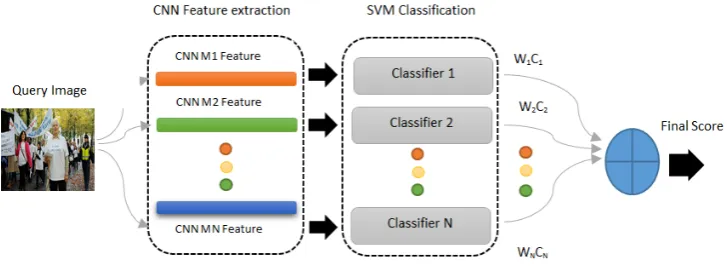
2.1 Block diagram of the proposed framework for Ensembles of
deep models. . . 18
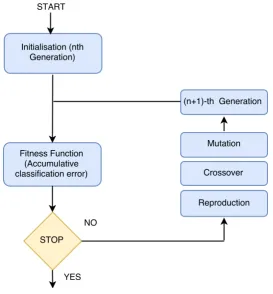
2.2 Block diagram of the Genetic Algorithm optimization scheme.
. . . 22
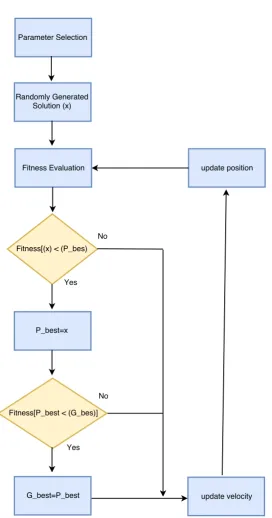
2.3 Block diagram of the PSO optimization scheme. . . 24
2.4 Hierarchical approach to event discovery in single images: in
the first phase full images are analyzed in Multiple-instance
learning framework for event detection. In the second phase
event-sailent details extracted as in [104] are exploaited for
the refinement of the classification. . . 26
2.5 Visual objects extraction: (a) and (d) represent original
images; (b) and (e) represent their corresponding
event-saliency maps; visual objects, extracted using event event-saliency
maps, are shown in (c) and (f). . . 27
2.6 Block diagram of the proposed event-salient regions-based
lection of the event salient regions for training samples. At
the top, an introduction to the task is provided with
de-tails of the proposed system. Then, regions extracted from
the event-related images are provided one by one to the
users involved in the crowd-sourcing activity for annotation
purposes. Two different questions are posed regarding the
shown regions: the first one asks to select the event class, the
second one is meant to receive a motivation for the selection. 34
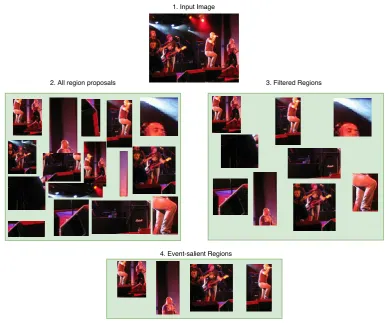
2.8 Region selection process: (1) represent an input image; (2)
shows sample region proposals; (3) provides some sample
re-gions after filtering phase while (4) represents sample
event-salient regions obtained through crowd-sourcing study from
the input image. . . 36
2.9 Sample images from the newly-collected dataset. . . 42
2.10 Sample images from WIDER dataset . . . 46
2.11 Sample images from UIUC Sports dataset . . . 46
2.12 Sample images from SED2013 dataset . . . 46
2.13 Sample images from USED dataset . . . 46
2.14 Sample images from all datasets . . . 46
2.15 Standard deviation of the performances of individual models per class on WIDER. . . 52
2.16 Comparison of event detection with full images, event-salient features and hierarchical approach on three different datasets. Test set 1 represents the test collection from [101] while test set 2 and test set 3 represent the test collection used in [104] from SED and EiMM datasets, respectively. . . 59
ference, protest and exhibition (top to down) during the
crowd-sourcing task. . . 62
2.19 Sample regions from concert, conference and sports images
(top to down) tagged as others by the volunteers. . . 62
3.1 Sample irrelevant images from the collections: images not
containing objects of interest (top) and images with face
close-ups (bottom) . . . 68
3.2 Block diagram of the proposed methodology for event
recog-nition in personal photo collections. . . 71
4.1 A satellite image of a sandstorm in the Sahara. Based on
the image, however, it is almost impossible to give a clear
statement about its impact on the environment and society
(image from NASA). . . 82
4.2 Block diagram of the proposed JORD system. . . 92
4.3 Sample Google Earth images before and after Haiti
earth-quake. . . 99
4.4 A sample output of JORD in terms of retrieved images (at
the top), Tweets, Videos and the satellite data. . . 100
4.5 Example of the converted image patch from the original
satellite imagery. . . 102
4.6 Block diagram of the proposed methodology for DIRSM task.108
4.7 Example of the correctly found flooded area. This example
shows that detection was performed better for combination
of RGB and IR channels. . . 112
4.8 Example of the correctly found flooded area. This example
shows that in some cases detection was performed better for
water in this image patch is ”legal” water in the irrigation
channels. To be able to deal with such cases the
compar-ative time-based analysis must be added to the detection
algorithm utilizing many satellite images of the same region
taken in different periods of time. . . 113
4.10 The comparison of the flooding detection performance in
terms of MCC measure computed with the different
prob-ability threshold values for three- and four-channel satellite
imagery data for the original and the flipped datasets. . . . 115
4.11 Sample images from the dataset for DIRSM task. . . 120
4.12 Sample images from the dataset for FDSI task. . . 120
CNNs Convolutional Neural Networks
SED Social Event Detection
WIDER Web Images Dataset for Event Recognition
LSCOM Large Scale Ontology for Multimedia
USED UNITN Social Events Dataset
IOWA Induced Ordered Weighting Average
PSO Particle Swarm Optimization
GA Genetic Algorithms
GANs Generative Adversarial Networks
PEC Personal Event Collections
HMMs Hidden Markov Models
MIL Multiple Instance Learning
CKNN Citation K-nearest Neighbours
SVM Support Vector Machine
RF Random Forest
LMT Logistic Model Tree
DIRSM Disaster Images Retrieval from Social Media
Introduction
1.1
Context
The habit of taking pictures of everyday life moments is more and more
spreading into the society, especially with the advent of cams and low
cost hand-held devices, together with the increasing popularity of social
networks, it has become easier to generate and share multimedia contents.
These phenomena have changed the way in which people consume and
communicate through social media, causing a huge number of images being
collected, stored, posted, and shared through the Internet. For instance,
according to a recent report1 based on an analysis conducted on Flickr,
in 2016, a total of 612 millions public pictures have been uploaded to the
platform at a rate of 1.68 millions photos per day, and these figures keep
increasing on a daily basis. As a consequence, there is an ever increasing
need for automatic tools able to suitably organize and retrieve image data
from large unstructured multimedia archives, relieving content owners from
the tedious task of manually arranging their media collections.
Although this domain has been widely investigated in the past [54], no
ultimate solution is still available. Looking at the problem from a user’s
perspective, multimedia collections often refer to personal experiences and
1
activities, which can be referred to as events. The assumption that
per-sonal media collections can be viewed as the visual facet of events [134]
opened new research directions in media indexing and retrieval, where the
personal experience plays a central role. Some interesting applications of
such concepts can be found in the area of event summarization and
event-based organization of personal photo collections [124].
1.2
Problem Statement
So far, various solutions have been proposed to address the issue of event
recognition in videos [58, 23], although event recognition from still pictures
remains a more challenging problem, due to the sparsity of data and the
absence of a coherent and contiguous information flow. The computer
vision literature suggests that conventional paradigms based upon shallow
handcrafted visual features are prone to failure, as they cannot fill the gap
between the spatial/chromatic content of an optical image and its semantic
attributes [32, 95].
Following their immense success in image classification, object
recog-nition and detection [90], Convolutional Neural Networks (CNNs) have
demonstrated to perform well also in event recognition tasks (e.g., [106,
131, 40, 93]). However, though very efficient, CNNs are known to require
large training sets in order to capture the undergoing spatial/chromatic
cues across the images at hand. This is a major problem in media event
recognition, as it is extremely difficult and time consuming to collect
suf-ficiently large and significant datasets to meet the training and validation
requirements on one side, and to avoid generalization problems on the
other. As an alternative, a common option is to fine-tune pre-trained (on
large-scale datasets) CNNs to tailor them to event classes [2, 131, 130].
and Places [144].
Another important aspect to be taken into account is the use of scene
and object-level information. The works proposed in [130, 93, 131]
demon-strated that appropriately blending these two levels of information can
pro-vide significant improvements in event recognition. Most approaches tend
however to fuse the two types of information (i.e., object-level and
scene-level) assigning them equal contributions (e.g., weights). In our view, this
is sub-optimal as images of events exhibit a diversified set of chromatic
and spatial contexts. Thus, some images may favor scene-level
informa-tion over object features and vice-versa. In this respect, we believe that,
in fusing various CNN models/architectures, personalized weights should
be allocated to each model, based on its capacity in representing specific
pieces of information and features that are characteristic of the underlying
event.
Moreover, little attention has been paid to understanding and analyzing
the key visual elements, which are more revealing for a human observer.
We think targeting such event salient objects can help in improving the
performances of event recognition algorithms.
Furthermore, it is important to note that most of the existing literature
on event recognition focuses on the analysis of single images while very few
attempts have been made for event recognition in personal photo
collec-tions [124, 28]. There are many factors that make event recognition from
personal photo albums a very challenging task. Indeed, they may
con-tain ambiguous or irrelevant pictures and are usually annotated at album
level. Such problems of the presence of irrelevant photos and the so called
weakly-labelled data (at album only) make event recognition in personal
photo collections a more challenging task. The existing approaches relying
on supervised learning can not cope with such issues.
about natural disasters available on the social network. To this aim, a
number of interesting solutions have been proposed to effectively utilize
social media for information collection and analyzing the impact of a
nat-ural disaster [69, 105, 7]. The literature reveals that Twitter has been
heavily exploited for inferring information about different types of events.
However, to the best of our knowledge, there is very limited prior work
which aims to collect information from multiple platforms for natural
dis-asters, simultaneously. Although collecting information about natural and
technological disasters from different platforms is a time consuming task,
the combination of different sources (text, images and videos) to one
sum-marized overview can be very useful for users to analyze the impact of a
disaster and be a good source of information.
In addition, satellite imagery of the effected area before and after a
disaster can be helpful to give a bird’s-eye view of the damage incurred. To
the best of our knowledge no prior efforts have been subjected by literature
to combine information from social media and satellite for event detection.
To sum up, five points are to be highlighted. First, a large scale
bench-marking image dataset for the evaluation and comparison of event discovery
algorithms from single images is still missing. Second, a thorough analysis
of the performances of existing deep models, particularly a proper
uti-lization of object and scene-level information for event recognition, is still
missing. Third is that, to the best of our awareness so far, event saliency
has been treated rather scarcely in the relevant literature. The fourth point
is that very few attempts have been made for event recognition in personal
photo collections. The final element regards a proper combination of
satel-lite data and social media information that to the best of our knowledge,
has not been properly investigated in prior works. This can help to tell a
1.3
Research Contributions
The main research goal of this thesis is to move forward the state-of-the-art
on event based analysis of multimedia contents for an efficient multimedia
indexing and retrieval. Here, we briefly discuss the main research
contri-butions of this work.
1.3.1 Event Recognition in Single Images
UNITN Social Event Dataset (USED)
There is an ongoing trend of image representation, which derives benefits
from deep neural architectures. However, the existing benchmark datasets
for event discovery in single images are not large enough to be used for
training deep learning algorithms. Therefore, it is essential to establish a
large-scale bench-mark dataset for the evaluation and comparison of event
discovery algorithms in single images. The key contributions in this regard
are:
• We provide a large collection (around 490,000 images) of annotated
event related images.
• Moreover, a deep learning based approach is introduced into event
discovery from single images as one of the potential applications of
this dataset and to set a benchmark.
Ensembles of Deep Models
As aforementioned, there is an ongoing trend to jointly utilize object and
scene-level information for event recognition. Existing approaches tend to
treat both types of information equally. In our view, this is not optimal as
fusing various CNN models/architectures, personalized weights should be
allocated to each model. Thus:
• Three efficient late fusion strategies are presented. We show in
par-ticular that an ad-hoc fusion of an ensemble of deep models can
out-perform, considerably, the use of each individual model.
• Stemming from the fact that deep learning is a staple ingredient in
many multimedia analysis and computer vision pipelines, we carry out
a thorough analysis of four well-known architectures, pre-trained on
object and places datasets, both individually and in different
combi-nations.
A Hierarchical Approach to Event Discovery
In event recognition, both object specific and background information play
an important role, depending on the nature of the underlying event. In
order to provide a detailed analysis of the importance of both earlier
com-ponents, we contribute with:
• We investigate full images, which usually contain contextual clues of
underlying event in the background, as well as event-salient objects to
uncover the event depicted in the image.
• We propose a two-step hierarchical approach where initially full
im-ages are utilized for event classification, and then event-salient features
are exploited to further refine the classification decision.
A Saliency based Approach to Event Recognition
Event-related images usually contain objects that are more revealing for a
help in improving the performances of event recognition algorithms. To
this aim in this work:
• We propose a novel framework exploiting event-salient regions.
• We propose and conduct a crowd-sourcing activity to extract
event-salient objects and regions.
1.3.2 Event Recognition in Personal Photo Collections
The conventional approaches relying on supervised learning methods lack
in dealing with non-relevant images in photo albums annotated at
album-level only. To this end, in this work:
• We propose a novel pipeline relying on MIL paradigm for event
recog-nition in personal photo collections.
• We provide a detailed analysis of the trade-off between classification
performance and computational cost.
• We also collect an image dataset containing a large number of photo
albums per event.
1.3.3 Natural Disasters Events
We believe that a proper fusion of social media and satellite imagery can
help to provide a more detailed story of a disaster. Key contributions in
this regard are:
JORD: A System for collecting Information and Monitoring Natural Disasters
• We present a system that is able to automatically collect information
and news items about natural disasters from social media, and links
• We also provide query refinement by automatically generating queries
in all local languages that are relevant to the position of a disaster.
• In addition, to ensure the quality of the retrieved multimedia data,
we propose a hierarchical content based filtering mechanism.
• It is equipped with a novel method for linking and retrieving satellite
imagery with the events by analyzing the tweets text to identify and
extract GPS coordinates of the areas struck by the disaster.
• JORD also consists of a novel framework for flood detection in satellite
images as a use-case of the disaster event detection in satellite imagery.
Medieval Bench-marking
• We propose Convolutional Neural Networks (CNNs) and Generative
Adversarial Networks (GANs) based satellite and social media fusion
for natural disasters detection.
1.4
Structure of the Thesis
This dissertation is organized as follows:
• Chapter 2 provides a detailed description of the event recognition in
single images, our proposed solutions along with conducted
experi-ments, the results achieved, and their description and comparisons
against the state-of-the-art.
• Chapter 3 is mainly devoted to event recognition in personal photo
collections. It provides the details of proposed solutions, conducted
experiments and experimental results. It also covers the details of
our newly collected dataset for event recognition in personal photo
• Chapter 4 shifts the analysis from daily life events to natural and
technological disaster events. It presents a detailed description of
our proposed system JORD and the approaches we proposed for a
benchmark competition in MediaEval 2017.
• Chapter 5 draws the conclusions of this research work and discusses
Events in Single Images
2.1
Introduction
In recent years, event based analysis of multimedia content got great
at-tention of the research community. To this aim, a number of interesting
solutions have been proposed for event recognition. The existing works on
the subject mostly focus on an efficient representation of multimedia
con-tents, and on strategies to exploit all of available information to achieve
better performance in event recognition. In this regard, metadata, such as
tags, title, and temporal and geo-location information, have been heavily
exploited. However, metadata is not always reliable [72] and the recent
trend is to shift towards the analysis of visual information.
The state-of-the-art in visual-based event detection has so far revealed
considerable uncertainties and poor classification performances. We believe
that such limitations can be mostly attributed to the selection of the visual
features used for classification. Recently Convolutional Neural Networks
(CNNs) have been proven efficient in various application domains (e.g.,
object recognition and remote sensing). Based on these considerations,
we believe that deep learning can prove to be a breakthrough also in this
research area, providing a more detailed and complete description of the
the performances of a human observer, who, in this area, still demonstrated
to outperform automatic systems. The main limitation of CNNs is their
requirement of a large number of annotated samples, which is the main
hurdle for its applicability in event discovery from single images. The
existing benchmark datasets for event discovery in single images are not
large enough to be used for training deep learning algorithms, in particular
convolutional neural networks.
Another important aspect to be taken into account is the proper use of
scene and object-level information. As demonstrated in [130, 93] a blend
of these two levels of information can provide significant improvements in
event recognition. However, most of the existing approaches tend to treat
the models for these different types of information equally by assigning
equal weights to each type of information. In our view, this is sub-optimal
as images of events exhibit a diversified set of chromatic and spatial
con-texts, then, some images may favor scene-level information over object
features and vice-versa. Thus, we believe that personalized weights should
be allocated to each model, based on its capacity in representing specific
pieces of information and features that are characteristic of the underlying
event.
Moreover, the current research in visual information-based approaches
to event recognition mostly focus on defining better representation and
classification schemes. However, no significant efforts have been made to
understand and analyze the event-salient visual elements in event-related
images. We believe, a proper use of such objects can help in improving the
performances of event recognition algorithms.
Based on these considerations, we proposed some solutions to mitigate
the limitations of state-of-the-art. The rest of the chapter presents our
2.2
Related Work
The mainstream of the literature on event analysis is largely developed
along two main streams: (i) evidencing the most adequate
representa-tions schemes [130, 49], and (ii) establishing discriminative classification
paradigms [124].
In this regard, numerous contributions suggest exploiting additional
in-formation associated to the multimedia data (e.g., [32, 95, 24, 92, 39]).
This additional information may include user-supplied tags, titles, owner
and upload information along with comments from users. Moreover,
geo-location and temporal references could play an important role in event
recognition. Though such additional data, manifested in the form of
meta-data, has proven to be effective in event recognition, they also come with
many practical limitations, which make their use questionable [124]. These
challenges include wrong or no settings of camera’s time zone, missing
time-stamps and modification of tags. Moreover, the ambiguous
mean-ing of user-supplied tags also affects the performance of event recognition
methods relying on metadata [72].
Considering these limitations of metadata, visual content can be
re-garded as a valuable information for event recognition [32, 42]. For
in-stance, Dao et al. [31] proposed an event-type specific representation for
event related images incorporating three different types of features, namely
GIST [89], time and visual salient features [51]. Similarly in [42], visual
in-formation are used for event detection in videos. However, most of the
ear-lier works in this domain rely on hand-crafted visual features, such as SIFT
[74] and SURF [?], which cannot cope with the gap between image features
and event semantics [124]. To cope with such issues, Tsampoulatidis et al.
[123] proposed a multi-concept detection approach that combines different
con-tents. A similar approach is used in [67], where a fusion strategy is adopted
to combine different types of handcrafted visual features for a better
rep-resentation of event-related multimedia contents. This joint approach of
multi-concept detection through handcrafted features, partially solves the
problem. However, the literature shows that considerable improvements
are still possible by attacking the problem from different viewpoints:
in-troducing more discriminative visual features, improving models, mixing
content and context [124, 82].
More recently, from the viewpoint of feature extraction tools, deep
neu-ral architectures demonstrated cutting-edge performance in the multimedia
analysis, and proved to be effective in a variety of application scenarios.
Similar to other computer vision applications [57], the mainstream
ap-proaches to event recognition tend to capitalize on CNN architectures,
ex-ploiting both their capability of offering significant and compact
representa-tions of data, and their superior classification performance [93, 106, 129].
Due to the unavailability of large scale event-related datasets, most of
the efforts that are being spent in this domain concerning the
optimiza-tion of fine-tuning strategies to be applied to existing pre-trained models
[2, 130]. For instance, in [2], a pre-trained model [66] is fine-tuned on a
newly collected dataset covering 14 different social events. In [130], three
different network architectures, namely AlexNet [66], VGGNet [110] and
bn-inception [56], have been exploited for event recognition.
An ongoing trend is to jointly utilize the prior models pre-trained on
Im-ageNet [33] and Places dataset [144] for event recognition. More in detail, a
network pre-trained on ImageNet is expected to focus on object-centric
in-formation, while a network pre-trained on the Places dataset shows a better
response to scene-level information. Interesting solutions have been
pro-posed to efficiently map CNN models pre-trained on ImageNet and Places
scene-level information are used for event recognition in a hierarchical way.
These approaches adopt simple fusion strategies relying on equal weights
for object and scene-level information, which may not be convenient in
general, as object cues may dominate over scene information and
vice-versa, depending on the dataset. This suggests that allocating optimized
weights, tailored to different deep models may significantly improve the
performance.
It is also to be noted that little attention has been paid to understand
which are the key-visual elements in an event-related media item that help
an observer recognizing the underlying multimedia event. An attempt in
this direction is made by Rosani et al. [104], where a gamification technique
is used to extract event salient objects from event related images. In the
paper, a limited number of event saliency samples (35 samples per class)
are collected for 14 classes of social events. It is important to mention
that the concept of event saliency is different from the conventional visual
saliency [77].
Table 2.1 summarizes the most relevant literature on event recognition,
reporting the features, the datasets and the fusion mechanisms adopted by
each approach.
2.3
Solutions
2.3.1 Ensembles of Deep Models
Overview
In this part of the work, we propose to fuse different CNN models
pre-trained on ImageNet [33] and Places [144] datasets, exploring the
capabili-ties of three late fusion strategies: (i) Induced Ordered Weighted Averaging
Optimiza-Table 2.1: Summary of some relevant works in event recognition: overall objectives, features and dataset used for validation, fusion schemes, and a brief description of the method.
Refs. Features Fusion Dataset Notes
[72] Meta-data and vi-sual features
Early MediaEvent [120]
Concatenates different types of information (meta-data and hand-crafted visual features) [104] SURF with BoW N/A SED2013
(Sub-set)
The concept of event saliency was introduced with some initial experiments. Provides very few event salient objects for 14 events, only [88] SIFT, BoW Early SED2013 [102] Low level features along with meta-data [20] Textual and
hand-crafted visual features
Hybrid Soccer and Con-certs Event [91]
Firstly, aggregates the textual features which are later used in combination with visual fea-tures in a hierarchical way
[49] CNNs features Late PEC [19] It uses object and scene-level information ob-tained via a single architecture in a hierar-chical way. It also relies on late fusion with equal weights for event recognition in personal photo collections
[100] CNNs features Late USED [2] and WIDER [138]
Equally treats object and scene-level informa-tion from two architectures
[130] CNNs features Late UIUC [70], Cultural Events [38] and WIDER
Focuses on other aspects of object and scene-level information obtained from deep and very deep architectures while simply adopting equal weights mechanism for fusion
[138] CNN features Early Cultural Events [38]
Fuses features extracted from different layers of a CNN
[4] CNN features N/A SED [102] Provides a hierarchical approach with event salient objects and full images. Does not di-vide the test image into regions
tion (PSO). Furthermore, with respect to the proposed fusion schemes, we
assess the impact of various combinations of ten different CNN models,
from four commonly used deep architectures. We also evaluate the
gener-alization capabilities of the proposed framework by testing a dataset with
the weights learned on the other. Finally, we exhaustively validate the
per-formance of a variety of deep models along with their respective per-class
rates. Such rigorous analysis will contribute to creating a benchmark for
future deep learning based event recognition research.
In summary, we can synthesize the main contributions of this work as:
(i) Through the introduction of three efficient late fusion strategies, we
demonstrate that the ad-hoc fusion of an ensemble of deep models can
considerably outperform each individual model.
(ii) Stemming from the fact that deep learning is a staple ingredient in
many multimedia analysis and computer vision pipelines, we carry out
a thorough analysis of four well-known architectures, pre-trained on
object and places datasets, both individually and in different
combi-nations.
(iii) We carry out thorough experiments on three challenging benchmark
datasets and show that better scores are achieved as compared to
recent literature.
Proposed Methodology for the Ensembles of Deep Models
Figure 2.1 displays the block diagram of the proposed framework. It is
essentially composed of two stages: (i) feature extraction and classification,
and (ii) score-level fusion. In the first stage, CNN features are extracted by
means of a bunch of pre-trained CNN models, and the extracted features
are fed into an ensemble of Support Vector Machines (SVM), which provide
the second stage, the obtained posterior probabilities are fused using the
proposed late fusion schemes. The first stage is rather standard, and we
mainly focus on the second part of the methodology. We opted for SVM
on the account of its proven efficiency in many applications, such as object
recognition [21] and remote sensing [16]. In the next subsections, a detailed
description of both stages is provided.
Figure 2.1: Block diagram of the proposed framework for Ensembles of deep models.
Feature Extraction and Classification
In order to conduct a thorough analysis and evaluation of deep
fea-tures for event recognition, we made reference to the four most commonly
used architectures in this domain, namely AlexNet [66], GoogleNet [114],
VGGNet [110], and ResNet [53]. Each network was pre-trained on both
object and Places datasets. AlexNet consists of 8 weighted layers, while
GoogleNet is composed of 22 layers. VGGNet and ResNet are available in
different configurations. In this study, we opted for both configurations of
VGGNet (VGGNet16 with 16 layers, and VGGNet19 with 19 layers), while
for ResNet we evaluated the configurations containing 50, 101 and 152
lay-ers. Table 2.2 summarizes some characteristics of these CNN architectures
while a detailed description is available in the literature [66, 114, 110, 53].
Table 2.2: Summary of the properties of the CNN models used in this work
CNN Model # Layers # Parameters Properties
AlexNet 8 60 M 5 convolutional and 3 fully con-nected layers. GPU-based imple-mentation of the convolution op-eration. Total of 1.5 billions of floating point operations per sec-ond (FLOPS)
GoogleNet 22 102 M network in a network policy, re-lies on the Hebbian principles and multi-scale processing
VGGNet-16 16 138 M Stack of convolutional layers are followed by 3 fully connected lay-ers, convolutional layers are com-posed of filters with small receptive fields, 19.6 billions of FLOPs
VGGNet-19 19 144 M More deeper than
VGGNet-16 with same configura-tions/techniques. 19.6 billions of FLOPs
ResNet-50 50 25.6 M Deeper models with less num-ber of parameters compared to other models. Avoids the vanish-ing/exploding gradients problem with residual learning framework, 3.8 billion FLOPS
ResNet-101 101 44.5 M More deeper model with same techniques. 7.6 billion FLOPs ResNet-152 152 60.2 M More deeper, more parameters and
made use of the Caffe toolbox1; for GoogleNet and ResNet we relied on
Vlfeat Matcovnet2. Overall, we extracted ten feature vectors through four
different architectures for each image. AlexNet and VGGNet returned a
feature vector of size 4096; GoogleNet and ResNet (all configurations)
pro-vided feature vectors of size 1024 and 2048, respectively. These features
are then used to train individual SVM classifiers, which provide the
clas-sification results in the form of posterior probabilities.
Fusion of CNN Models
Coming to the second stage of the methodology, to jointly utilize the
results achieved by the ten classifiers, we propose three different
mech-anisms for score-level fusion. These methods are based on Induced
Or-dered Weighted Averaging (IOWA) operators, Genetic Algorithms (GA),
and Particle Swarm Optimization (PSO). In the next subsections, we
de-scribe each method in detail.
Order-Induced Score Fusion
The proposed fusion strategy is learning-free, which entails that the
weights are inferred directly from the posterior classification probabilities.
It is inspired by Induced Ordered Weighted Averaging Operators (IOWA)
by Yager et al. [141]. The essence of the proposed fusion strategy emerges
from the fact that different CNN models yield different classification scores
for a given set of event images. Thus, it is convenient to fuse their outcomes
assigning higher weights to the models that show higher confidence.
Let us assume that N is the number of the adopted pre-trained models,
and that an SVM classifier is associated to each model. The total number
of event classes at hand is denoted by M. Therefore, an NxM matrix is
built, whose entries correspond to the posterior probabilities of an image
with respect to all classes. Suppose pi, i = 1,2,3, . . . , N, is the score array
pointed out by the ith classifier. The proposed IOWA fusion strategy aims
at gathering an ensemble of pairs [pi, oi]. Here pi is called the argument
value, while oi represents the corresponding order-inducing value, which
quantifies how confident the score pi produced by the ith classifier is (i.e.,
how correct the classification probabilities are). Hence, the IOWA
opera-tor, which represents the final decision as a weighted sum of the reordered
posterior probability vectors, is given by:
F(pi, oi) =
1
N N X
i=1
wisi (2.1)
where W = [wi, w2, . . . , wN] denotes the respective weights, and S =
[s1, s2, . . . , sN] denotes to reorderedP = [p1, p2, . . . , pN] in descending order
(i.e., posterior probability arrays are sorted according to their associated
inducing values oi).
Regarding the selection of the inducing value (i.e., oi), which gauges the
reliability of its corresponding argument value in the form of a probability
arraypi, we adopt the standard deviation of the highest values in the array
of posterior classification probabilities pi returned by the ith classifier in
order to address the uncertainties in the (e.g., five) highest scores. Thus,
the event class with the closest similarity corresponds to the most probable
outcome in F.
Genetic Modeling of Deep Features
The second fusion scheme is based on GAs [108]. A Genetic Algorithm is
an optimization strategy that seeks for an optimal value (or a set of values)
that contribute to the minimization of a given cost function. Differently
from the previous approach, GAs require a training procedure: to seek
the optimal solution, the algorithm iteratively minimizes the output of the
cost function as depicted in Figure 2.2. As can be seen, the process usually
starts with an initial randomly generated population. Subsequently, the
fitness function, and fit individuals are selected for the next generation with
modified genome, iteratively. The process terminates either by reaching to
maximum number of generations or achieving a sufficient level of fitness.
Moreover, the crossover and mutation are the basic operators of GAs to
discover local and better (global) minimum/maximum, respectively.
Figure 2.2: Block diagram of the Genetic Algorithm optimization scheme.
Two key components determine the performance of GAs: (i) the
defini-tion of a suitable fitness funcdefini-tion, and (ii) the structure of chromosomes. In
our case, the chromosomes denote the CNN models, while the fitness
func-tion aims at minimizing the accumulative classificafunc-tion error. Therefore,
we compute the posterior probabilities for each classifier on a validation
set in order to infer the weights. Given a test image, the obtained weights
are employed to linearly combine posterior probabilities as expressed in
probability vector pertaining to the nth model. P is the combined
valida-tion posterior probability.
p=w(1)∗p1+w(2)∗p2+...+w(n)∗pn (2.2)
Based on the combined validation posterior probabilities, we compute
the accumulative accuracy on the validation set denoted as Aacc. Next,
the accumulative classification error is computed according to Equation
2.3, with the goal of finding the combination of weights that minimize the
classification error.
Y = 1−Aacc (2.3)
The weights learned on the training set via cross validation, are then
mapped on the test set. Details on GAs parameter selection are provided
in the experimental section.
Particle Swarm Optimization
The third proposed fusion method is based on Particle Swarm
Opti-mization (PSO) [15, 43]. PSO, inspired by the social behaviour of birds
flocking, is a stochastic optimization technique. Despite the many
simi-larities with GAs, PSO does not involve any evolution operators, such as
crossover and mutation, in the optimization process. It rather solves the
optimization problem by iteratively trying to improve a candidate solution
(particle) with respect to a given criterion. Figure 2.3 shows a block
di-agram of our PSO-based optimization approach. In total, it is composed
of 9 different phases starting from parameter settings, which is followed
by a random selection of a candidate solution. In our case, each
com-bination of weights can be referred to as a candidate solution while the
fitness function uses the same concept of accumulative classification error
used in GAs (Equation 2.3) as a qualitative criteria for a candidate
solu-tion. The weight selection encompasses three main steps; (i) evaluation of
Figure 2.3: Block diagram of the PSO optimization scheme.
the individual best (Pbest) and global best (Gbest) fitness and positions by
comparing the new fitness output with the previous values; (iii) updating
velocity and position of each particle. The final step is mainly responsible
updated according to Equation 2.4.
vi(t+ 1) =w∗vi(t) +c1r1[x0i(t)−xi(t)] +c2r1[g(t)−xi(t)] (2.4)
Here, vi(t) and vi(t + 1) represent the velocity of the ith particle at
time t and t + 1, respectively. The position of the ith particle at time
t is represented as xi(t). Similarly, the best individual and global best
candidate solutions at timetare represented byx0i(t) andgi(t), respectively;
w, c1, and c2 are user-defined parameters; r1 (0 ≤ r1 ≤ 1) and r2 (0 ≤r2 ≤
1) are the randomly generated values for each velocity update.
Also in this case it is necessary to train the optimizer on a pre-defined
set of samples, and then transfer the calculated weights to the test set.
2.3.2 A Hierarchical Approach with MIL Framework
Overview
In this work, we provide a detailed analysis of multimedia contents in
the context of event recognition in single images focusing on key
visual-elements and background information. In details, we investigate full
im-ages, which usually contain contextual clues of underlying event in the
background, as well as event-salient details, i.e. visual objects critical to
understand the underlying event depicted in the image. In particular,
we propose a two-step hierarchical approach based on the MIL paradigm
where initially full images are utilized for event classification, and then
event-salient features are exploited to further refine the classification
de-cision. For event-salient features, event-saliency maps introduced in [104]
have been used. The refinement process will benefit from event specific
visual objects, which are common in all positive samples of an event.
In-deed MIL paradigm will focus only on such features/objects common in all
Figure 2.4: Hierarchical approach to event discovery in single images: in the first phase full images are analyzed in Multiple-instance learning framework for event detection. In the second phase event-sailent details extracted as in [104] are exploaited for the refinement of the classification.
Proposed Methodology
Figure 2.4 shows the block diagram of the proposed approach. As shown
in the block diagram, both phases (upper and lower rows) differ at the first
stage. In the first phase, Colour Structure Descriptor (CSD) [81] is used
for the representation of full images with background information while
in the second phase, first we used event-saliency maps [104] to extract
event-related visual objects. Subsequently, CSD descriptor is used for the
representation of these event-related visual objects that is then followed by
MIL based classification. To deal with multi-class classification problem, in
both phases we adopted one-against-one strategy where decision is made
on the basis of majority votes. All steps of the proposed approach are
discussed below.
Visual Cues Extraction
As aforesaid, in the refinement step of the proposed method, we
ex-ploit visual information not about the whole image but representing the
(a) (b) (c)
(d) (e) (f)
Figure 2.5: Visual objects extraction: (a) and (d) represent original images; (b) and (e) represent their corresponding event-saliency maps; visual objects, extracted using event saliency maps, are shown in (c) and (f).
in [104] that there exist special areas in event-related images which contain
key visual elements allowing human observer understanding the depicted
event. Such information is coded in event-saliency maps, as reported in the
two examples of Figure 2.5. An event saliency map, which is different from
the traditional concept of visual saliency [65], does not focus on perceptual
prominence but rather on event-related semantics of media. Event-saliency
maps have been created using crowd intelligence [104], where a
gamifica-tion technique with a large number of users has been proposed. In the
game, users are involved in competitive roles where one is asked to prevent
the other from recognizing the underlying event by hiding the key visual
el-ements, which help the human observer to recognize the underlying event.
Subsequently, binary maps are created of the images by highlighting the
parts containing event-salient information. Starting from these maps, we
can extract specific visual objects in images which contain important clues
for the detection of underlying event. In the refinement phase (second
phase), we used these event-related visual objects contained in the images
as instances of positive and negative bags for training purposes in the MIL
Image Representation
This step is common in both phases of the proposed hierarchical
ap-proach. To this aim, we use Color Structure Descriptor (CSD) [81]. We
use CSD because it encodes both information: about the spatial
struc-ture as well as colors occurrence frequencies in an image using strucstruc-ture
elements. The number of structure elements used in CSD is usually 64.
The biggest advantage of CSD descriptor is that it uses no more space than
ordinary color histogram with significant improvement in performance [81].
Classification with MIL
In this work, we treat event recognition as a multiple instance learning
problem. The basic motivation comes from the fact that an event-related
image may contain multiple event-salient objects, and we do not know
which of them is responsible for the label of the image. To this aim, we
rely on the Citation K-Nearest Neighbor (C-KNN) based implementation
[128] of the MIL paradigm.
In order to map our event recognition task into MIL paradigm, we collect
images/event salient objects into bags, where each image (in the case of
full images) or event salient objects (in the case of event salient features)
is considered as an instance of the bag. Moreover, label is assigned to
complete bag instead of individual instances. For the prediction of an
event class/bag b, both R-nearest references (bags in its neighborhood)
and C-nearest citers bags, which consider b as their own neighbor, are
considered. For reference bags simply the k-nearest samples are taken
into account while for the selection of citer bags a ranking mechanism
is adopted. Suppose n is the number of all samples in a database Bs,
represented as Bs = {b1, b2, b3....bn}. Then, for a test sample bi ∈ Bs, the
rest of the samples are ranked according to the similarity to the sample bi.
as Rank(bj, bi). Subsequently, the C-nearest citers are defined as:
Citers(bi, C) ={bj|Rank(bj, bi) ≤ C, bj ∈ Bs}. (2.5)
For the similarity measurement, a bag-level distance metric known as
Haus-dorff distance [128], which is the shortest distance between any two
in-stances from each bag, is used.
After the summation of R-nearest references and C-nearest citers in
terms of positive bags (denoted as bp) and negative bags (denoted as bn), a
majority voting approach is used for the prediction of a given test bag bi.
The bag bi is classified as positive if bp (# positive bags) > bn (# negative
bags), otherwise as negative as show in Equation 2.6.
bLabel=
(
1 ifbp> bn 0 otherwise
)
(2.6)
Finally, in order to deal with multi-class classification, we adopt the
one-against-one strategy where the final classification is made on the basis
of majority voting. It must be noted that the only difference between
classification with MIL framework in the first and second phase is the type
of information used in positive and negative bags. In the first phase full
images are used as instances of bags while in the second phase only the
event-related visual objects contained in the images are used as instances
of bags.
Decision Making Module
In the proposed hierarchical approach, the decision is taken as follows:
first, the analysis is done on the whole image where the background
MIL framework recognizes already a clear majority agreement among
bi-nary classifiers, then the decision is taken and the image is classified.
Oth-erwise, we proceed with the refinement step which takes into consideration
only event-salient visual objects in the image (i.e., bags of event-related
visual objects are provided as negative and positive samples to C-KNN)
and the final decision is made on the majority test. This way, we aim at
first recognizing events utilizing complete images. Since some events may
share very common backgrounds (e.g., concert and theater images usually
have similar backgrounds) so in such cases in the second step we exploit
the new concept of event-saliency to improve the classification based on
event-related visual clues (e.g., music instruments are better visual clues
for concert events).
2.3.3 A Saliency-based Approach
Overview
In this work, we aim to investigate how the objects that are more revealing
for a human observer can be utilized for an automatic event recognition
in single images? and how these objects can be extracted from
event-related images? To this aim, we propose a novel framework that exploits
event salient regions in a Multiple Instance Learning (MIL) paradigm. We
propose and conduct a crowd-sourcing activity for the selection of event
salient regions from a bundle of images for different types of events. The
ultimate goal is to choose a set of event salient regions for different events
that can be used to train a classifier. Our choice of choosing a
crowd-sourcing task is motivated by the need of finding out the most significant
image patches from a human perspective, being sufficiently generic also in
terms of cultural and societal background.
a Multiple Instance classification (MIL) framework is adopted for the
clas-sification of a test image at the hand on the basis of the extracted regions.
Multiple Instance Learning (MIL) and classification has proven to be very
effective in many applications [109], and well fits our needs for region-based
approach to event recognition.
Proposed Methodology
As can be seen in Figure 2.6, there are four different stages of the proposed
approach. We start by extracting regions from event-related images at
dif-ferent scales. Next, in order to select event salient regions from the difdif-ferent
region proposals extracted in the first stage, we conduct a crowd-sourcing
task. The crowd-sourcing activity is followed by feature extraction, where
we use a pre-trained network VGGNet16 [110] for a better representation of
the selected regions. Event-salient regions are then assembled into positive
and negative bags for bag-level classification of the regions obtained from
the test images. At the end, we adopt one-against-one strategy to deal
with multi-class classification, where the final decision is made on the
ba-sis of majority voting. In the following sub-sections, we provide a detailed
description of the each stage of the proposed approach.
Figure 2.6: Block diagram of the proposed event-salient regions-based methodology.
Region Extraction and Pre-filtering
Images often contain information provided by the presence of objects
or details that make them unique and give humans the capability of
contain musical instruments (e.g., microphones, guitars, etc.). Similarly,
birthday images are often characterized by the presence of a cake and
can-dles. A proper use of these event-salient regions may help improving the
performances in event recognition. Therefore, we propose to divide images
into different regions, and propose bag-level classification of the regions
in-stead of classifying the whole image. The basic motivation of this approach
is to target only the event related objects and regions in the classification.
As we do not have any information of the exact location and scale of
the salient regions for event recognition, following the data driven selective
search approach introduced in [125], we obtain a number of region proposals
at different scales by combining exhaustive search and segmentation from
an image at hand.
A detailed analysis of the region proposals shows that a significant
num-ber of the regions obtained through Selective Search [125] are irrelevant
with respect to certain events, as well as for the event classification
prob-lem itself (i.e., they are not enough discriminative). Moreover, processing
more regions per image requires more processing resources and time. To
this aim, we first introduce a filtering stage, to filter out the less
informa-tive region proposals on the basis of their size and width-height ratio; in
particular we propose to remove very small and thin regions, leading to a
reduced set of image regions (on the average 15 regions per image). The
pre-filtering phase helps to reduce the processing time by dropping the less
informative regions from both test and training samples. This assumption
is verified by our initial experiments on the validation set, which shows
that the initial filtering reduces the processing time considerably without
any significant impact on the classification results.
Salient Regions Selection via Crowd-sourcing
In the pre-filtering phase, we remove some regions based on the size
of regions which are either not enough discriminative or have strong visual
correlation with regions from other event classes. For example, concert and
theater images may have similar backgrounds. Similarly, fashion images,
although containing domain-specific objects, they usually contain elements
that have strong correlation with the images from other classes like
exhi-bition and conference. Moreover, event salient objects can be anywhere
in an image, and are very difficult to be identified automatically through
conventional visual saliency approaches [104]. To this aim, in order to
select more relevant image-regions for training purposes, we propose and
conduct a crowd-sourcing study where a large number of volunteers are
engaged. In order to reduce efforts in the crowd-sourcing task, we
ran-domly choose candidate regions from the pool of the extracted regions for
the crowd-sourcing study.
In the crowd-sourcing task, we ask the volunteers to give their opinion
about the candidate regions extracted after pre-filtering. In order to ensure
a correct outcome of the study, and according to the literature [103], we
tried to keep the task as simple as possible, making sure that most of the
answers can be considered reliable.
Figure 2.7 depicts the design of the proposed crowd-sourcing task. In
the proposed task, the extracted regions are presented to the users
inde-pendently and randomly (regions are randomly shuffled, thus users do not
know the order of appearance of the event classes). This strategy helps to
make sure that the volunteers make a decision on the basis of the current
region, only.
We asked the volunteers two different questions: (i) From these ”N”
possible events, which one do you think has been presented to you? In the
case of WIDER dataset, which contains 61 event classes, only a limited list
of possible classes is presented to the user, where the user has to choose
the name of ”Others” is included in the list, so users may select this option
in the case they are not sure about the region class.
The second question is an open question where the volunteers need to
briefly motivate their choice. This question aims to get feedback from the
users about the visual contents (i.e., objects and regions) that help humans
to perceive the underlying event in an event-related image. Moreover, a
selection of users’ answers has been inspected manually. This question has
been useful to evaluate the reliability of the volunteers’ answers
participat-ing in the study.
In Figure 2.8, we illustrate the whole process of region selection by
pro-viding a sample input image, sample region proposals and regions selected
after filtering phase along with sample event-salient regions.
Feature Extraction
The current literature in event recognition reveals that image
represen-tation schemes deriving benefits from deep neural architectures, namely
Convolutional Neural Networks (CNNs), has shown a significant
improve-ment over the conventional hand-crafted visual features. On this point,
there is an ongoing trend of utilizing existing deep models pre-trained
on object (ImageNet [33]) and places [144] datasets for the
representa-tion of event-related images. However, the earlier works in the domain
demonstrate better performance for deep learning models pre-trained on
ImageNet compared to the ones pre-trained on Places datasets [49, 131].
Moreover, in the proposed work we are mainly interested in event-specific
objects and regions instead of the complete scene. Therefore, we need an
image descriptor that can well represent such event specific objects in the
extracted image regions.
To this aim, for feature extraction, we opt for VGGNet16 [110]
pre-trained on ImageNet [33], which focuses on object centric information.
Figure 2.8: Region selection process: (1) represent an input image; (2) shows sample region proposals; (3) provides some sample regions after filtering phase while (4) represents sample event-salient regions obtained through crowd-sourcing study from the input image.
the network architecture, please refer to [110]. From each image region, we
extract a feature vector of size 4096.
Multiple Regions based Classification of an Image
As mentioned earlier, in the proposed approach, we divide the
train-ing as well as the test images into a number of regions of different sizes,
and then classify the image at hand on the basis of the extracted regions.
This problem can be easily mapped into a Multiple Instance Classification
(MIC) problem. Multiple instance learning and classification is a modified
version of supervised learning, where a classifier is trained on a set of bags