Experiences That Lead to Growth for Educators and Learners
Julian Kitchen
Editor
Brock University
When teachers are responsive to students and “the situations in which interaction takes place” (Dewey, 1938, p. 45), they foster “experiences that lead to growth” (Dewey, 1938, p. 40). Dewey’s words convey the essence of education as a discipline. The commonplace of education—teacher, learner, curriculum and milieu (Schwab, 1970)—exist in all schools, but the experience is educative only to the degree that these commonplaces interact to spark learning. The authors of the articles in this issue of Brock Education all puzzle over the experiences of teachers and/or learners. In each case, their aim is to improve practice and, through this, contribute to a better world.
Some focus on teachers (often themselves), while others centre their work on the learner. Sometimes there is consderable overlap between the two. The venues range from elementary classrooms to professional development to graduate school. Some are intimate studies—e.g., ethnographic, narrative inquiry, and self-study—while others stand back from the experience— e.g., questionnaires and interviews. All ask probing questions about the teaching and learning experience. All are worthy of your attention.
Tara-Lynn Scheffel, in “Individual Paths to Literacy Engagement: Three Portraits,” is interested in elementary school learners. In her ethnographic case study, she explores the literacy engagement of three very different second grade students. From these cases, she identifies four filters through which we can perceive individual literacy engagement. When educators better understand a range of student paths to literacy, they are more apt to engage each student.
While Jane P. Preston is very interested in the experiences of learners, her study begins with her belief that spirituality should have an important place in schooling. In “Fostering the Learner Spirituality of Students: A Teaching Narrative,” she explores how this was lived out in a middle school classroom. She shares with Scheffel a deep respect for students and the importance of inquiring into how they experience education.
Hilary Brown, like Preston, writes a very personal and personally revealing account of a teacher passionately committed to transforming the learning of her students. “In Order to Be You Have to Be: Modeling a Constructivist Approach for Teacher Candidates” makes explicit the challenges Brown faced while seeking to actively engage teacher candidates in constructivist learning. Through self-study, she honestly discusses struggle to maintain her approach despite a high level of resistance from her class. This is a powerful story of practicing what we preach!
Brock Education, Vol. 21, No. 2 Spring 2012, 2
from the learning strategy he studies. Even though this paper is less personal in tone, Campbell’s commitment to student learning shines through.
Ilana Margolin, in “A Coterminous Collaborative Learning Model: Interconnectivity of Leadership and Learning,” shares Campbell’s interest in collaborative learning across different groups of educators. Her study offers a range of perspectives, from novice teachers to superintendents, to a collaborative learning model. Like Scheffel, Margolin engages in an ethnographic study centred on the experiences of learners. Like Campbell, she stands back further from the research participants. Her study focuses on themes about learning in professional communities that emerged from asking people about their experiences in this learning activity.
The final article, “Rocky Road or Clear Sailing? Recent Graduates’ Recollections and Reflections of the Doctoral Journey,” has the largest group of participants (53) and the least personal form of inquiry (a questionnaire). Nonetheless, Jonathan G. Bayley, Jason Brent Ellis, Carla Reis Abreu-Ellis and E. Kathleen O’Reilly are centrally focussed on understanding learning. They use the survey to gain a thorough understanding of how graduate students experienced the doctoral journey. The answers, which are often quite personal, also convey patterns of experience across individuals and institutions. While there is great power in small-scale studies and personal stories, this article reminds us that large-small-scale studies can also say much about experience and offer insights into how institutions can contribute to making those experiences more educative.
It is my hope that reading these articles will contribute to your understanding of the teaching and learning experience. By better understanding experience, we become more effective as educators facilitating or constructing experiences for our students.
References
Dewey, J. (1938). Experience and education. New York: Collier Books.
3
Individual Paths to Literacy Engagement:
Three Portraits
Tara-Lynn Scheffel
Nipissing UniversityAbstract
This article examines conceptualizations of engagement during literacy learning within an ethnographic case study of a grade two classroom. Specifically, three student portraits are shared, revealing three unique journeys towards engagement. For Spike, it was a path of success where he often determined the direction. For Jasper, the path was bumpy and filled with
compliance rather than involvement. For Avery, the path was elusive and filled with struggle, though not for lack of desire. A framework for literacy engagement is presented that considers four filters through which we perceive and thereby recognize a space for individual paths.
Key Words: engagement, literacy, primary education, case study
Tara-Lynn Scheffel, Ph.D. is an Assistant Professor in Education (Language & Literacy) at Nipissing University. Her research interests are primarily literacy-related with a focus on student engagement during literacy
events. Through her research, she aims to give stronger voice to students and teachers in educational research.
Email: [email protected]
Introduction
In the light that beckons beyond an open door, three young children can be seen in the shadowed reflections. One child stands in the centre, body slightly turned towards the door but eyes facing forward. Another has walked through the door, only one hand remaining in connection with the doorframe. The third child is also turned sideways but is looking away from the door rather than towards it. (Personal reflection, 2005)
Questions of engagement began in my doctoral work as I found myself continually returning to the complexity of literacy and the ways in which educators work within this complexity to build literacy opportunities. It was in this search for understanding that I discovered the image described above, an image that continually gives me purpose. The description is of a painting by Brenda Joysmith titled Discovering Choices, the cover of a book called Engaging Children: Community and Chaos in the Lives of Young Literacy Learners (Allen, Michalove & Shockley, 1993). It beckoned me into the lives of these children: I wanted to know their names, their stories, their lived experiences. Engagement became more than a “popular catch phrase” (Butler-Kisber and Portelli, 2003) as I considered the ways in which these children were engaged in learning. The open doorway became a path to learning that was clearly defined for some while unreachable for others. I wanted to learn what drew some through the door but turned others away. I wondered how to make the door become permeable.
It was in this yearning that my own journey of discovery began, a journey I discuss in this article. I begin by outlining the key works that influenced this study as I sought to learn more about notions of engagement in order to identify theories, concepts, struggles and possibilities for further exploration. Next, I outline the research methods used as I joined a grade two classroom to learn about engagement. From these methods, I invite you to learn more about three students and their individual paths towards engagement. For, I discovered that there are students likened to the above image. Their names are Jasper, Spike and Avery. Their stories not only demonstrate the complexity of engagement but also highlight the role that perception plays in our understandings of engagement. In conclusion, I propose a framework for literacy engagement that builds from and works alongside the portraits, the goal to create a space for ongoing discussion about literacy engagement.
Literature on Engagement
Before introducing the portraits, this section first takes a broader look at school engagement to set the stage for a closer look at understandings of engagement that are more specific to reading and then, literacy.
School Engagement
Flanagan, 2005). Portelli and Vibert (2002) used the term “curriculum of life” to describe a school-based research project that took place as part of a pan-Canadian national study on student engagement. More than a simple student-centered notion of constructivism, “a curriculum of life centres on the possibilities for the co-construction and co-production of knowledge, rather than on knowledge as simply teacher transmitted or simply student created” (p. 39). As a result, the “hidden” curriculum is not so hidden, and controversial issues that affect the lives of students are taken seriously.
McMahon (2003) presented three conceptions of engagement: (a) teacher as the presenter of material, using interesting and various strategies; (b) teacher as facilitator of material, drawing upon students’ interests; and (c) teacher working with students to establish connections beyond the curriculum that relate to student’s lived experiences.
McMahon (2003) described this last conception as fitting with Portelli and Vibert’s (2002) “curriculum of life.” She further explained, “Engagement in this sense is not simply something that one group (educators) imposes on another (students)” (p. 26).
It may be this cyclical nature that led Cothran and Ennis (2000) to warn that “even a quality curriculum guided by a knowledgeable teacher will not result in student learning unless students first are engaged in the learning process” (p. 124). Cothran and Ennis demonstrated that through communication, care, active learning and respect, teachers can bridge the distance between student factors and school factors, helping students towards engagement.
McMahon and Portelli (2004) considered the work of Cothran and Ennis (2000) to be an important contribution to the field but critiqued its linear nature and focus on engagement as something that teachers “do to students” rather than something that is generated together (p. 66). They applauded the effort to capture students’ voices but suggested that a closer look at the purposes of engagement and the worthwhileness of the curriculum is needed. Next, I take a closer look at definitions of reading and literacy engagement.
Reading Engagement
Within the 2000 PISA survey, reading engagement is defined as “students’ motivation and interest in reading, and the time students spend reading for pleasure and reading diverse materials” (Willms, 2003, p.8). However, despite a more specific acknowledgement of engagement in relation to reading, the definition remains broad, mostly related to motivation and time-spent on task. Guthrie and Anderson (1999), however, offered a definition of engaged reading that included “…the joint functioning of motivation, conceptual knowledge, strategies, and social interactions during literacy activities” (p. 2). Doing so, they considered the role of instructional contexts in understanding what takes place in engagement. A similar understanding of reading engagement is presented in the 2009 PISA survey but with recognition that other studies, such as Guthrie & Wigfield (2000) had accounted for greater variance between reading engagement and achievement than the 2000 results found (OECD, 2010, p. 22).
occur. A focus on the broader context is diminished, as well as what happens if/when these principles do not work for a student. Guthrie (2001) himself, acknowledged the need for further investigations of these complex instructional practices.
Literacy Engagement
Crediting Smith (1983) with discovering the missing factor of engagement in the learning equation, Cambourne (1988) identified three main principles for engagement. The first involved learners seeing themselves as potential ‘doers’ of the activities being demonstrated. Second, the skills or knowledge being demonstrated furthered the purposes of the learners’ lives. The third principle considered the risk involved in attempting a demonstration and how opportunities for engagement were limited if viewed as unendurable or threatening. An additional fourth principle was that of a significant teacher-student bond.
These principles highlighted specific areas that Cambourne (1988) identified as unacknowledged by behavioural psychologists, who often failed to understand the concept of engagement by confusing it with motivation. As a result, Cambourne elaborated a sociocultural view of learning that emphasized setting the conditions that would increase learner’s decisions towards engagement (immersion, demonstration, use, response, expectation, responsibility and approximation). His principles differed from those of Baker et al. (2000) in that they were more than design principles to promote engaged reading. Instead, they offered foundational classroom practices that were conducive to encouraging engagement in literacy learning. The goal of achievement remained, but was results-based rather than focused on measurement.
Research Design
This research study draws upon the work of Cambourne (1988) and Guthrie (2004), taking a sociocultural, ethnographic approach to the study of engagement that moves beyond conceptual concerns to consider the absence of individual students’ experiences in the literature, in particular those of younger students (Scheffel, 2009). The voices I share here are those of grade two students, along with their teacher and parents. I asked, from the subjective viewpoints of teacher(s) and student(s), what constitutes engagement for primary-aged students in literacy learning?
Participants
Research Methods and Data Sources
Four complementary research methods were used in this study: (a) participant observation, (b)
informal conversational interviews and picture-talks, (c) formal teacher
interviews/questionnaires, and (d) journaling, both by students and parents. In total, 53 observations days occurred over a period of 3 ½ months. Data sources included: field notes, transcribed interviews of all audio taped discussions and interviews, artifacts of student work, photographs of students working, student journals, parent journals, demographic information, and curriculum materials. The focus of this data was first and foremost the literacy events (Dyson, 2003) that were observed during my time in the classroom. Specifically, I sought to understand what drew students to literacy or appeared to turn them away. I looked for signs of meaning-making and the reasons contributing to this (e.g., cultural knowledge, social relations, shared experiential history). As time and space permitted, I spoke with the students to better understand the reasons for their engagement or lack of engagement. This additional step of conversation acted as a cross-referencing technique, where I was able to see how my observations compared to those of the students.
Data Analysis
My initial observations maintained a broad view of each participating student within the classroom. The journals and field notes contributed to this first level of analysis by allowing for the formation of questions/topics arising as a way of exploring emerging hypotheses. I then identified a focal group of students for a more in-depth study based on these emerging hypotheses, the remaining students providing the backdrop.
The second level of analysis was threefold: first involving reading/rereading for overall understanding in order to share the story taking place within the classroom; second, the coding and development of themes or issues arising where I looked for points of agreement and contradiction with the current literature in order to contribute to evolving definitions of engagement, and; third, the identification of areas of proposed change in relation to building opportunities for greater engagement within literacy learning, as well as research with children.
Three Portraits
The portraits of Spike, Jasper and Avery offer insight into three unique journeys involving internal and external factors, as well as differing perceptions of achievement and participation. Space does not allow for each portrait to be shared in its entirety but here I offer an overview that I hope will serve as a reflective tool for further discussions about literacy engagement.
Portrait One – Spike
Despite this seeming lack of attention, he is often the first to raise his hand with an answer to a question and he is never shy to attempt an unknown word. He is the student most likely to question if something does not seem quite right. Whether you are in authority or not, he will tell you that you are not supposed to talk in the hallway, especially if he has just been told the same. He could be called Mr. Observant. For example, he knows that his teacher is the only left-handed person in the classroom.
Spike comes from a two-parent, middle-class family. He has one younger brother, in Kindergarten. According to his parents, “Spike loves to read. Since he was born, [he] grew up having 2 bedtime stor[ies] pretty much every night.” Some nights, however, he will decide to draw instead of read.
Topics written about in his journal range from popular culture (Pokémon, Neopets, popular movies) and video games (X-box, Game Boy and Tamagotchi – a digital pet), to interests related to books and drawing. Within his journal, there are several comments from his teacher cautioning him about a tendency to change topics too quickly. Though he is often one of the first to hand in his journal, the length is not always satisfactory to his teacher.
In September, Spike’s parents listed the following interests and goals:
Interests: Drawing, building with LEGO, playing hockey Goals: To have a fun time and learn new things
Spike’s Path To Engagement: Baker et al. (2000) describe the heart of engagement as “the desire to gain new knowledge of a topic, to follow the excitement of a narrative, to expand one’s experience through print” (p.2). This is Spike. Driven towards discovery, he found spaces within the school day and at home to follow self-initiated literacy activities and to build his literate lifestyle. He is the engaged reader that Baker et al. (2000) go on to describe as drawing “from previous experiences to construct new understandings…goals are met and interests are satisfied” (p. 2). The research process itself served to engage Spike as a co-researcher, sharing his growing understandings throughout the study (Scheffel, 2009). More than any other student in the class, it seemed that Spike set his own path to engagement.
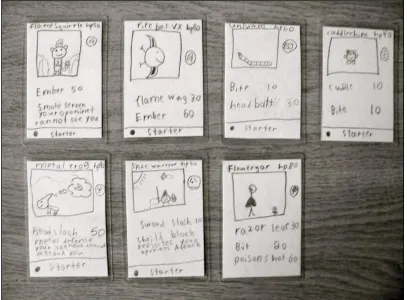
To offer an example, Spike continually expressed an interest in drawing during my visits. In his research journal, he made the following generational connection: “…because my gramie is an artist” (Observation Day 26). In particular, drawing became a venue for exploring the popular culture phenomenon of Pokémon. Not only did he draw favourite characters (Figure 1), but he had also begun the process of designing his own trading card series (Figure 2), which he hoped to market for profit in the future. Spike and his friends had even started a chapter story about the characters he created with the ultimate goal to have their story displayed in the school library.
Unlike Spike’s teacher, who often excluded Pokémon and other popular culture discussions, Spike’s mother encouraged this exploration. In the parent journal, she recognized this interest as something to be valued:
Figure 1. Examples ofSpike’s ‘Alien Pet’ characters.
While concerns over the influence of commercialism may stand out here, what is perhaps more important is the way Spike and his various groups of friends saw purpose in these literacy tasks. The ultimate purpose was one of recognition and success. Vasquez (2003) suggested, “…there is a lot we can learn about how to support literacy development by watching children closely as they engage with such texts” (p.125). Vasquez (2003) described the engagement of Pokémon-related texts by her nephew Curtis and his friends as an open pedagogy that does not privilege only print text. I see a similar pedagogy in Spike’s engagement with Pokémon, which may benefit other students if they are allowed to explore popular culture within the school curriculum. Alvermann & Xu (2003) provided an example of connecting popular culture with a language arts curriculum. They outlined four approaches to using everyday literacies, offering a place for teachers to begin when looking for practical ideas.
Dyson (2001) described a similar open-ended pedagogy in relation to writing. These open times for composing allow educators to, “learn about children’s cultural landscapes and the particular voices and kinds of voices that appeal to them.” (p. 431). Spike’s teacher, Kat, did provide open-ended times for journal writing. However, letting the students know they could write about popular culture interests and include images may have helped to make this time something they looked forward to exploring, rather than a regular, and sometimes mundane, routine.
Through our picture-talks, it was evident that when given ownership over tasks, Spike was most likely to feel engaged. Unlike Jasper and Avery, what stood out was the variety of ways in which Spike found engagement. By academic standards, Spike was the higher achiever of the three. Though his teacher sometimes had greater expectations for his work, knowing he was capable of writing more or going more in-depth, he achieved Grade 2 standards. For Spike, it was a question of effort. When engaged, his desire to participate was stronger. Regardless, he was still able to complete the work. Jasper and Avery’s portraits, on the other hand, provide a different consideration of the path to engagement.
Portrait Two – Jasper
Jasper’s tousled blonde hair is reminiscent of a product called Bed Head that allows you to twist your hair in various directions. Jasper too, has a habit of twisting his hair, especially the locks above his left eye.
There is a hoarseness to Jasper’s voice that makes it distinct from others. However, he rarely speaks, and when he does, it is often in a soft-spoken, almost whisper. Usually when he is called upon, he says nothing but looks at you. It is hard to know whether the words are there but he is too frightened to let them out, or if his look is a plea to leave him alone. Yet, he speaks to a trusted few classmates, and during these moments, the words seem to flow freely, even excitedly, as moments shared between friends.
When Jasper writes, his head is bent forward, his entire body seemingly placing pressure to the pencil. He is usually several steps behind his classmates when following instructions and maintaining routines. At the end of the day his desk is almost always cluttered with unfinished work or assignments he has forgotten to place inside the drawer.
him more anxious. They believe the origin of his concerns is more related to anxiety rather than attention.
Jasper comes from a two-parent, middle-class family and has a fraternal twin brother, James, who is also in his class. At home they will read together as a family, taking turns. They have also discovered an online book site that both boys love. Their mother concludes, “It seems with these guys at least that the work has to be hidden in play to work best.”
Throughout Jasper’s journal are many pages where the writing is unfinished or includes only the date and nothing more. It is for this reason, that his teacher finds it difficult to grade his work. Though she feels he is more capable than the lack of completed work suggests, she is torn in the assessment procedures that require her to give him a grade for the work completed.
In September, Jasper’s parents listed the following interests and goals:
Interests: bugs/animals, collecting “things” and toys and make-believe play Goals: improve attention, fine motor control, listening skills & independence
Jasper’s Path To Engagement: As I consider Jasper’s portrait, I cannot help but think of Cambourne’s notion of engagement and the idea of a safe space to take risks. For Jasper, it seems the safest places to speak at school are when he is with his friends. These are the times when he is playful and smiling. With adults however, and at times when he was put on the spot to share or speak, there was a hesitancy, which often resulted in silence. I remember being struck by his adamant words in his first research journal: “I don’t like to share my Jernel.” The reason why hit me even harder: “because I’m nervise to share it in front of the class” (Observation Day 27). While some students shared freely within the classroom, Jasper did not have this same sense of freedom.
The research journal offered a space where Jasper felt less inhibited: “cause I had nothing to write about in the journal but in this one I could just write about the classroom.” His parents shared a similar observation:
He also does not like to write (or at least begin) stories. Once he is into it, and writing about something that interests him, he is better…Jasper, in particular likes non-fiction books dealing with animals. He is very interested in this topic, and it is a great vehicle to get him going or hooked on his work or reading. (Observation Day 18)
Similar interests were noted on the Parent Information sheet in September and with this in mind, having access to books related to animals during journal time might have provided one way to increase his interest in journal writing.
From the perspective of Baker et al.’s (2000) description of engaged readers, Jasper’s path is a more perplexing one than Spike’s path. His literacy practices at home suggested time for reading books of personal significance with his brother and parents. His parent journal communicated:
There seemed an investment to participate that was very different from my observation of him at school. His teacher, Kat, was also frustrated by this disconnect, especially when having to evaluate incomplete work at school. She often suspected he was capable, but on a standards-based curriculum, she needed evidence of completed work during the school day.
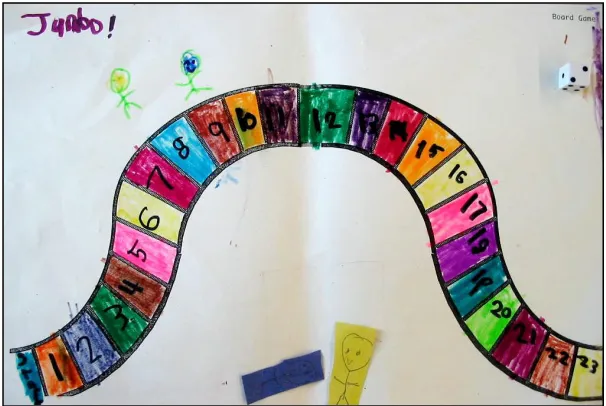
Observation Day 36, however, brought about an instance when Jasper overcame this disconnect. The task was to create a game board and while Jasper’s initial query to his teacher was an anxious, “Do you have to write anything?”, he went on to write a full set of instructions on the back of his game (Figures 3 & 4). Even Kat commented at the way in which Jasper was drawn into this activity. So, what was it that engaged Jasper? Is it “work hidden within fun” as his parents spoke about in the parent journal? Perhaps it was the interaction of sharing ideas with classmates or the choice of making a game with an open-ended template?
Figure 3. Jasper’s Game Jumbo
Our picture-talks reflected a similar sense of action along with a pronounced emphasis on demonstrating participation through focus or concentration, upright body language and raised hands. This is evidenced throughout Jasper’s portrait with continued attempts to “look the part.” For example one day as we worked together, he grabbed a pencil away from me when Kat walked by his desk. He knew what the expected image of working looked like, and perhaps that independent work held greater influence than shared work. It seemed that Jasper had discovered, as Maxine Greene did in The Dialectic of Freedom (1988), that “below the surfaces there is a whispered reminder that, if an individual plays the game, smiles, and works hard, he/she will be rewarded” (p.15). For Jasper was rewarded when he played the part, whether through stamps or free time privileges. However, though he may have thought he demonstrated work ethic, his paper output provided a different picture. According to Vibert and Shields (2003),
Student engagement is identified with both compliance and involvement. Hence if a child is following instructions, quietly completing a worksheet in math, (and especially if the child is attaining a high percent of correct answers), she or he is considered to be engaged. (p. 226)
What strikes me about Jasper is that he was compliant, just not involved. He did sit at his desk and he made attempts to work. While he did not attain a high percent of correct answers, he provided enough correct answers to demonstrate that he could do the work. His path was perhaps a bumpy one but he was not left behind. He did what was necessary to “get by”. For Avery, however, “getting by” was an attainment not easily within her grasp.
Portrait Three – Avery
Avery has long, blonde hair that occasionally has coloured streaks of dye running through it. Her pale face and slender body evoke the word “fragile.” During group activities, she often sits with her knees drawn to her chest with her arms wrapped around her legs. She tends to look downwards, though occasionally she glances up, raising her hand to offer a response. Sometimes she is correct, but more often than not, her teacher guides her to the correct answer. When a class response is called for, Avery waits until she hears her classmates speak collectively, and then joins in, loud and clear, at the end of words.
In writing, Avery seeks constant reassurance. Some of the pages are scribed, while others show assistance in the form of words spelled out at the top of the page. When sharing her work, her voice is quiet and her reading hesitant. She looks to her teacher to help her remember the words on the page but her teacher is not always sure what the words say either. A look at her teacher’s grade book reveals few recorded marks. At the beginning of the school year, her teacher requested a speech assessment, which took place late in the spring. As a result, Avery attends weekly sessions with a speech therapist.
When Avery arrives in the morning, she sometimes lays her head down on the desk, as if to suggest that she is not quite ready for the day to start. There are times though, when there is a bounce in her step as she walks. During Library, she bounces in anticipation of an exciting part in a story. When singing in music class, she smiles and bounces along to the beat of the song.
enough that it is the babysitter’s responsibility to brush her hair. On the days when her mom works an early morning shift, Avery stays over night at the babysitter’s, sleeping on the couch.
In September, Avery’s mom listed the following interests and goals:
Interests: skip and play with her friends; Goals: to learn to read and write better.
Avery’s Path to Engagement: Baker et al. (2000) suggest that, “Reading engagement is as much a goal for the child struggling to decode words as it is for the proficient reader seeking information for a class project” (p. 3). Avery struggled to decode words and perhaps this struggle makes her path unique from Spike and Jasper’s path. Intending to provide cues and support, Kat often centred Avery out publicly by offering verbal modifications that served to lessen or devalue her contributions. For example, Kat began a lesson by saying to another student, “…if you wrote the sentence, ‘I saw a black cat’, now that would be too easy for you wouldn’t it?” He nodded his head and Kat then turned her focus to Avery saying, “but Avery, ‘I saw a black cat’, or ‘I saw a little black cat’ would be a good sentence for you” (Observation Day 16). Unaware of these not-so-hidden messages, Kat also sometimes praised others for giving an answer that Avery did not provide when given the chance.
However, the notions of praise for a job well done did not always make Avery feel successful about her work. On Observation Day 9, Avery was upset to discover she still had corrections to make on a story after hearing her teacher say, “Isn’t that great. Way to go Avery”. Having worked with her the previous day, I had encouraged her to invent spell – that is, not always correcting every word to perfection. Avery then questioned me saying, “But you said it was right yesterday.” I realized that I, too, had begun to make these exceptions for Avery. Though Avery was most engaged when she was not held up by the spelling mistakes, the correction process seemed to cancel out her feelings of success, thereby making it a daunting task rather than an engaging one.
My picture-talk with Avery revealed few visual indicators of engagement, mostly looking to the internal indicators of ownership, challenge, and achievement. For example, Avery was the only student who saw herself as not engaged during a Morning Message activity. She explained why as: “Me, because I don’t know the sentence”. It is perhaps for this reason that visual indicators do not matter to Avery. Why worry about what it looks like to be engaged when engagement seems elusive in relation to achievement?
Vygotsky’s (1962/1986) zone of proximal development rings true here as I consider the notion of scaffolding literacy-learning opportunities for Avery. Avery wanted to feel like she was working on level with her class. To her, the learning process was a struggle, not through lack of desire, but because her position along the learning process continuum placed her at the bottom of Grade 2. Avery had already been standing out at this point as someone whose story needed to be shared but this moment solidified the decision for me.
Cothran and Ennis (2000) remind us that students must be engaged in the learning process in order to gain from a quality curriculum provided by a knowledgeable teacher. Likewise, Mighty (2007), in reference to the NSSE survey, describes the importance of focusing on the process of learning over a strict focus on the content to be taught. Inherent in the process is helping students to make connections to their lives, which allows students to gain mastery over their learning. Avery’s portrait reinforces this role of the personal when it comes to engagement. A poignant example took play on Observation Day 12 when Avery was asked to reflect on the people and items that made up her life. She hesitated, sharing “it’s only me and my mom.” Unknowingly, this activity had emphasized a difference from other students in the classroom, as well as the loss of her father in comparison to the families of her classmates.
Recognizing the bond that had formed between us, I was uncertain at the time if I had contributed to helping Avery find the door or if I had instead, turned her farther away from it. Seeing her growing literacy attempts, however, I knew that I did not turn her farther away. For, as Avery experienced both her best friend leaving and then my departure, she attempted to make sense of how she felt in both verbal and written form. Though her journal entries remained difficult to read at times, when asked, she could read back what she intended to say. There were no comparisons to others but just a need to write to express her thoughts.
Notably, I did not receive a parent journal from Avery’s mom and as a result, cannot provide any insight into Avery’s literate experiences at home. While some may suggest this is because there is a lack of interest and therefore probably a lack of participation by her mother, I caution that this would be an unfair summarization. I do not know why the journal was not returned. What I do know is that there is nothing to suggest any detriment on the part of Avery’s mom in relation to Avery’s academic achievement. As a teacher and researcher, the real question is how school can provide a space for literacy engagement.
A Framework for Literacy Engagement
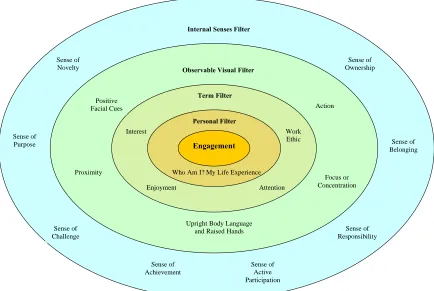
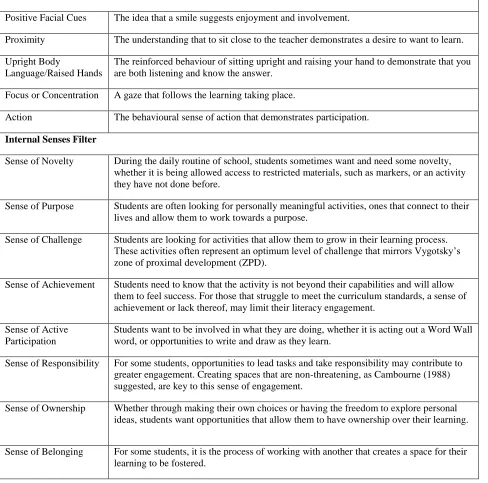
Through my analysis of these three portraits of Grade 2 students, I learned that perception has a great deal to do with how we as educators view engagement in our students. I propose a framework for literacy engagement (Figure 5) that considers four filters through which we perceive and thereby recognize a space for individual paths: personal, filter, observable visual, and internal senses. Table 1 provides a descriptor for the terms within the filters.
Like Cambourne’s (1988) conditions, I envision the framework and accompanying portraits as providing a reminder of the conditions needed for engagement. Teachers might use them as reflective tools for collaborative discussions, lesson planning, observations, and personal growth. Teachers might consider what path makes more sense to them as they reflect upon what they value most as a learner and a student. As a result, we can begin to look more closely at the question of what counts as engagement and by whom, in particular with younger students. Teachers might also use the framework to map the individual paths of their students in relation to their existing assessment procedures, pondering their students’ life experiences and funds of knowledge (Gonzalez, Moll & Amanti, 2005).
that started from a place of her strengths, rather than limitations. She required an understanding of her identity both within and outside of the classroom, as evidenced by the example of the activity that asked her to recall family and objects in her life, bringing the loss of her father to the forefront.
Thus, the framework can also provide a starting point for asking parents what it is that engages their children during literacy activities at home, moving beyond the parent information letters that teachers often send home at the beginning of the year but do not always investigate more closely as the year progresses. As Heath (1983), Purcell-Gates (1995), Gonzalez, Moll and Amanti (2005) and many others have demonstrated, there is a need to cross the divide between classroom walls and students’ homes/communities. Compton-Lilly (2009) conveyed well how this can lead teachers to rethink their assumptions and “listen to families” (p. 457).
For a teacher to be all these things is daunting, perhaps even overwhelming and frightening. Noddings (2005) writes of an ethic of care in relation to moral education and proposes an educational system that will allow care to thrive instead of become lost in a culture of achievement. This proposed system is designed around themes of care as opposed to traditional disciplines. While many educators and policy makers may find it hard to envision such a structure, Noddings (2005) challenges us to reconsider that which will enable care to flourish in an already demanding process of schooling.
Figure 5. A framework for literacy engagement.
Sense of Action Who Sense of Active Participation Engagement
Upright Body Language and Raised Hands Positive Facial Cues Sense of Ownership Sense of Novelty Sense of Belonging Sense of Purpose Focus or Concentration Sense of Challenge Proximity Sense of Achievement Sense of Responsibility Term Filter Personal Filter Observable Visual Filter
Internal Senses Filter
Action
Who Am I? My Life Experience
Enjoyment
Interest Work
Ethic
Table 1
Description of Terms
Observable Visual Filter
Positive Facial Cues The idea that a smile suggests enjoyment and involvement.
Proximity The understanding that to sit close to the teacher demonstrates a desire to want to learn.
Upright Body
Language/Raised Hands
The reinforced behaviour of sitting upright and raising your hand to demonstrate that you are both listening and know the answer.
Focus or Concentration A gaze that follows the learning taking place.
Action The behavioural sense of action that demonstrates participation.
Internal Senses Filter
Sense of Novelty During the daily routine of school, students sometimes want and need some novelty, whether it is being allowed access to restricted materials, such as markers, or an activity they have not done before.
Sense of Purpose Students are often looking for personally meaningful activities, ones that connect to their lives and allow them to work towards a purpose.
Sense of Challenge Students are looking for activities that allow them to grow in their learning process. These activities often represent an optimum level of challenge that mirrors Vygotsky’s zone of proximal development (ZPD).
Sense of Achievement Students need to know that the activity is not beyond their capabilities and will allow them to feel success. For those that struggle to meet the curriculum standards, a sense of achievement or lack thereof, may limit their literacy engagement.
Sense of Active Participation
Students want to be involved in what they are doing, whether it is acting out a Word Wall word, or opportunities to write and draw as they learn.
Sense of Responsibility For some students, opportunities to lead tasks and take responsibility may contribute to greater engagement. Creating spaces that are non-threatening, as Cambourne (1988) suggested, are key to this sense of engagement.
Sense of Ownership Whether through making their own choices or having the freedom to explore personal ideas, students want opportunities that allow them to have ownership over their learning.
Sense of Belonging For some students, it is the process of working with another that creates a space for their learning to be fostered.
(1992) and Helm and Katz (2000), influential researchers in the field of early childhood, offer concrete ways for teachers to build upon the strengths and interests of their students.
Students, too, can be involved in discussions about engagement. In these discussions with children, the term engagement need not be used. Rather, it is the idea of what leads students to engagement and what makes the learning process one that allows them to walk through the door. I invite researchers as well, to build beyond this work, to add new ideas and connections that highlight more individual stories, in particular those in relation to areas of social justice.
Final Thoughts
References
Allen, J., Michalove, B., Shockley, B. (1993). Engaging children: Community and chaos in the lives of young literacy learners. Portsmouth, NH: Heinemann Portsmouth.
Alvermann, D. & Xu, S. H. (2003). Children's everyday literacies: Intersections of popular culture and language arts instruction. Language Arts, 81 (2), 145-154.
Baker, L., Dreher, M. J., & Guthrie, J. T. (2000). Engaging young readers: Promoting achievement and motivation. New York, NY: The Guildford Press.
Butler-Kisber, L., & Portelli, J. (2003). The challenge of student engagement: Beyond mainstream conceptions and practices. McGill Journal of Education, 38(2), 207-212.
Cambourne, B. (1988). The whole story: Natural learning and the acquisition of literacy in the classroom. Newtown, Australia: Primary English Teachers Association.
Compton-Lilly, C. (2009). Listening to families over time: Seven lessons learned about literacy in families. Language Arts, 86(6), 449-457.
Cothran, D. J., & Ennis, C. D. (2000). Building bridges to student engagement: Communicating respect and care for students in urban high schools. Journal of Research and
Development in Education, 33(2), 106-117.
Dewey, J. (1938). Logic: The theory of inquiry. New York: Holt.
Dyson, A. H. (2001). Donkey Kong in little bear country: A first grader’s composing
development in the media spotlight. The Elementary School Journal, 101(4), 417-433.
Dyson, A. H. (2003). The brothers and sisters learn to write – Popular literacies in childhood and school culture. New York, NY: Teachers College Press.
Goslin, D. (2003). Engaging minds: Motivation and learning in America’s schools. Oxford: Scarecrow Press.
Greene, M. (1988). The dialectic of freedom. New York, NY: Teachers College Press.
González, N., Moll, L., & Amanti, C. (2005). Funds of knowledge: Theorizing practices in households, communities, and classrooms. Mahwah, NJ: Lawrence Erlbaum.
Guthrie, J. T. (2001, March). Contexts for engagement and motivation in reading. Reading Online, 4(8). Retrieved May, 2008, from
Guthrie, J. T. (2004). Classroom contexts for engaged reading: An overview. In J. T. Guthrie, A. Wigfield & K. C. Perencevish (Eds.), Motivating reading comprehension: Concept-oriented reading instruction (pp. 1-24). Mahwah, NJ: Lawrence Erlbaum Associates.
Guthrie, J. T., & Anderson, E. (1999). Engagement in reading: Processes of motivated, strategic, knowledgeable, social readers. In J. T. Guthrie & D. E. Alvermann (Eds.), Engaged reading: Processes, practices, and policy implications (pp. 17-45). New York: Teachers College Press.
Guthrie, J. T. & Wigfield, A. (2000). Engagement and motivation in reading. In M. L. Kamil, P.B. Mosenthal, P.D. Pearson, & R. Barr (Eds.), Handbook of reading research: Volume III (pp. 403-422). New York: Erlbaum.
Heath, S. B. (1983). Ways with words – Language, life and work in communities and classrooms. New York, NY: Cambridge University Press.
Helm, J. H., & Katz, L. (2000). Young investigators: The project approach in the early years. New York: Teachers College Press
Katz, L. G. & Chard, S. C. (1992). Engaging minds: The project approach. Norwood, NJ: Ablex Publishing Corporation.
McMahon, B. J. (2003). Putting the elephant into the refrigerator: Student engagement, critical pedagogy and antiracist education. McGill Journal of Education, 38(2), 257-273.
McMahon, B., & Portelli, J. (2004). Engagement for what? Beyond popular discourses of student engagement. Leadership and Policy in Schools, 3(1), 59-76.
Mighty, J. (2007). Making it real: Student engagement – An interview with Dr. Joy Mighty. Reflections: Newsletter of the teaching support centre, The University of Western Ontario, 56, p.2.
Newmann, F. M., Wehlage, G. G., & Lamborn, S. D. (1992). The significance and sources of student engagement. In Fred M. Newmann (Ed.), Student engagement and achievement in American secondary schools (pp. 11-39). New York: Teachers College Press.
Noddings, N. (2005). The challenge to care in schools: An alternative approach to education (2nd ed.). New York: Teachers College Press.
OECD (2010). PISA 2009 - Assessment framework: Key competencies in reading, mathematics and science. Retrieved January 2012 from:
http://www.oecd.org/dataoecd/11/40/44455820.pdf
PISA (2000). Messages from PISA 2000. Organization for Economic Co-operation and Development. Retrieved April, 2008 from
Portelli, J. P. & Vibert, A. B. (2002). A curriculum of life. Education Canada, 42, 36-39.
Purcell-Gates, V. (1995). Other People’s Words: The Cycle of Low Literacy. Cambridge, MA: Harvard University Press.
Rudduck, J., & Demetriou, H. (2003). Student perspectives and teacher practices: The transformative potential. McGill Journal of Education, 38(2), 274-288.
Scheffel, T. (2009). Valuing children’s roles in research on literacy engagement. In L. Iannacci and P. Whitty (Eds.), Early Childhood Curricula: Reconceptualist Perspectives (pp.143-166). Detselig Press.
Scheffel, T. (2011). Who am I? Who are you? Negotiating a researcher identity. Language and Literacy, 13(2), 54-65.
Smith, F. (1983). Essays into literacy. Exeter, New Hampshire: Heinemann Educational Books.
Swan, E. (2003). Concept-oriented reading instruction: Engaging classrooms, lifelong learners. New York: Guilford Press.
Vasquez, V. (2003). What Pokémon can teach us about learning and literacy. Language Arts, 81(2), 118-125.
Vibert, A. B. & Shields, C. (2003). Approaches to student engagement: Does ideology matter? McGill Journal of Education, 38(2), 221-240.
Vygotsky, L. S. (1962/1986). Thought and language. Cambridge, MA: MIT Press.
Willms, J. D. (2003). Student engagement at school: A sense of belonging and participation. Results from PISA 2000. Paris: Organisation for Economic Cooperation and
Development. Retrieved April, 2004, from
http://www.oecd.org/dataoecd/42/35/33689437.pdf
Fostering the Learner Spirituality of Students:
A Teaching Narrative
Jane P. Preston
University of Saskatchewan
Abstract
The purpose of this paper is to articulate, via a personal teaching narrative, the successes and challenges I experienced while attempting to foster the learner spirituality of students within a middle school classroom environment. I provide a definition of the term learner spirituality, as well as its related phrases. I present a literature review about how to foster learner spirituality within the classroom. Then I present a personnel narrative that depicts my experience while trying to promote the learner spirituality of a grade 7 classroom, and, in line with narrative inquiry, I discuss the past, present, and future features of this personal experience. An implication of this study is that in order for teachers to influence the learning spirituality of students, teachers need to cogitate on their own learner spirituality.
Keywords: learner spirituality, narrative inquiry
Jane Preston is a research analyst for the College of Education, University of Saskatchewan. Jane’s educational outlook is based on the experiences of teaching kindergarten to high school classes in Canada, Taiwan, Egypt, and Kuwait. Her research interests include community/parent involvement in school, rural education, Aboriginal issues, and narrative research.
email: [email protected]
Introduction
Upon reading this article’s title, I speculate that the word spirituality may be both stark and ambiguous for some readers; for that reason, at the onset of this document, explication of the term is provided. By default, some people may automatically link spirituality to religion. Indeed, religion is one way to potentially strengthen and reinforce a realm of spirituality; however, I write this article under the ontological opinion that one does not need to be religious to be spiritual learner. As referred to herein, learner spirituality is not confined within doctrines of a church, mosque, synagogue, or temple, for example, nor is it accessed through such things as pilgrimages, inspirational journeys, or esoteric experiences. The type of learner spirituality to which I refer within this paper is not embellished via healing crystals, traditional forms of meditation, or past life regression, for instance. Instead, herein, reference to the term learner spirituality is meant to be engendered within prekindergarten to grade 12 classrooms of public and private education. More specifically, this spirituality co-resides within student and the teacher and fostered through the words, actions, and attitudes of everyone present within a classroom.
Another descriptive boundary I apply to this article is clarification of the term learner spirituality and its associated expressions. What are the differences (if any) between the terms: learner spirituality, learning spirituality, learning spirit, spiritual learner, spiritual learning? Broadly speaking, for me, these expressions all relate to a common definition—the constructive act of gaining awareness, knowledge, comprehension, proficiency, and wisdom from an experience, conditioned from non-physical abilities including feelings, attitudes, emotions, and intuition. The effect and residue of this process is the establishment of learning that originates from the heart and extends outward, thereby, positively affecting one’s quality of life and having the ability to influence (whether consciously or unconsciously) the physical and spiritual demeanor of others. Although I believe this blanket description of learning spirituality pertains to all its lexical phrases, indication of the subtle, semantic differences between the individual phrases may also be useful. In turn, learner spiritually implies the spirituality of the learner, while learning spirituality implies the spirituality involved during the process of learning. Learning spirit is the spirit of learning, a spiritual learner is a learner who is spiritual, and spiritual learning is a process of learning that is spiritual. In what follows, depending on my sentence structure, I use variations of the term learner spirituality; nonetheless, each term refers to the aforementioned general definition of learner spirituality.
The purpose of this paper is to articulate, via a personal narrative, the successes and challenges I faced while attempting to foster the learning spirituality of students within a middle school classroom environment. Through a literature review, I review how teachers attempt to foster learner spirituality within the classroom. Then I present a personnel narrative that depicts my experience while trying to promote learner spirituality within a grade 7 classroom. In line with narrative inquiry (Clandinin, 2006; Clandinin & Connelly, 1998, 2000; Connelly & Clandinin, 1990), I discuss the past, present, and future features of this teaching story. I conclude by accentuating the importance of teachers performing regular self-assessments of their own spirituality in an effort to bolster the learning spirituality of their students.
Literature Backdrop: Teachers, Students, and the Spiritual Learner
In addition to supporting the intellectual capacities of students, many authors note a need for teachers to employ instructional pedagogy that garners the students’ spiritual and social development (e.g., Brendtro & Brokenleg, 2001; Doige, 2003; Miller, 2002). In particular, Kessler (2004) provided a number of practical ideas she used to generate a classroom atmosphere, which focuses on the development of learner spirituality. Kessler believed that streamlining her teaching pedagogy to encompass social interaction promotes learner spirituality, and she regularly employed classroom games both to assist students in becoming fully focused and relaxed and to embed components of fun, laughter, and cooperation into the classroom environment. In her teaching, Kessler used a variety of student and classroom discussion techniques. For example, she frequently asked students to bring a sentimental object into the classroom and instructed the students to use the item as physical support when sharing personal thoughts and feelings about difficult issues. As well, she used the discussion circle: students sat in a circle and, one by one, experienced the opportunity to speak without interruption. For this activity, students experienced what it is like to share with others and to be heard by fellow students. Throughout these activities, Kessler created an environment of mutual respect, empathy, sympathy, and personal safety.
simultaneously acknowledging the need for social interaction between learners, because learning and development is an innately social, collaborative activity (Wells, 2000).
In addition to encouraging collective engagement during learning, Dei (2002) noted that features of curriculum and pedagogy should be used to promote spiritual learning within the classroom. He explained that the teacher must invoke a sense of history, place, and culture into the student’s learning, because such an action cultivates a sense of life purpose and personal meaning for individual students. Similarity, the teacher should acknowledge learner heterogeneity in terms of race, class, gender, language, culture, and religion. Dei drew attention toward the importance of the teacher promoting student-relevant knowledge, the teacher participating in collaborative teaching with other teachers and community members, and the teacher promoting critical thinking about social justice issues.
Other authors believe that in order for teachers to promote student learner spirituality, teachers must have the support of their colleagues. Boyd and Myers (as cite in Imel, 1998) and Kessler (2004) noted that it is important for teachers to nurture their own spiritual development via collaborative efforts with other teachers. During this process, teachers need to communicate the joys and challenges they experienced while attempting to foster learner spirituality of students. Cranton (1994) emphasized the importance of the teacher being a role model for willingness to change and learn. These authors claim that there is an intimate connection between teachers promoting their own learner spirituality while simultaneously fostering it within their students.
Narrative Inquiry and Data Description
Connelly and Clandinin (1990) stipulated that for teachers, the articulation of a classroom story is not only a medium used to reflect upon a professional experience, a personal narrative is veritable research. Personal narratives give rise to new and deeper insight about the complexity of professional practices, while offering lived solutions to an array of personal and professional challenges (Clandinin, 2006; Riley & Hawe, 2004). Goodson (2003) believed narratives are soundly suited for research that is particularly aimed at understanding the life and work of a teacher. Ritchie and Wilson (2000) argued that within teacher education, the narrative process promotes reflection, reinterpretation, and revision. Similarly, as perceived by Clandinin and Connelly (1998), narrative research has potential to provoke dialogue, debate, and change within the realm of education. Characterized through narrative inquiry, the subjective features of the storyteller and the narrative experience itself are a salient part of the research process. In other words, the storyteller, his/her knowledge and values, and the story are the epistemological and ontological groundings upon which the research flourishes. The articulation of my personal narrative within this article attends to all of these rich features of research.
knowledge and abilities to assess the experience (the present), and I decipher the future relevance of my story.
The following narrative is created from a time in my teaching career when I had completed seven years of teaching within public and private school systems. The events of my story happened about 10 years ago while teaching in an international school located in the Middle East. The data embodied within the following narrative is based solely on my memory of being the grade 7 English teacher during one specific school year. Due to the time lapse of the data and the fact that the story is created from memory, I acknowledge that the validity of this research may be questionable to some readers; in reaction to this position, I candidly state that it is not my intent to pursue data validity. It is my intent, however, to document the subjectivity of data and embellish my professional growth (Clandinin & Connelly, 1998). Furthermore, due to the asset of elapsed time, prior to writing this article, for many years I have reflected upon the data documented herein. Part of this reflection involved deciphering and attempting to replicate the successes I enjoyed during the teaching year. Additionally, some of the details threaded throughout this teaching story were obtained from sporadic emails that I received and still receive from some of my students who reminiscence about that school year.
Data Results: My Teaching Story
I divide the following story into a number of sections. In these sections, I introduce the setting of the story, and I provide a general description of a scenario I faced in one of my classes. I discuss the effect that my teaching had on one specific student. I provide a number of ways in which I attempted to foster learner spirituality in my class, and I end with articulating some of the realizations I have garnered from the teaching experience.
Take a Deep Breath: That’s the Spirit
It was the beginning of September; this school year primarily entailed teaching middle school English to four separate classes, each comprising of approximately 20 students. Similar to the start of every school year, I was eager, yet anxious, to meet my new students to whom I would largely devote the next 10 month of my life. The underlying cause of my zealous and yet apprehensive demeanour was the fact that so much was at stake. Every year it was the same; teaching nourished and consumed me in mind, body, and soul. Success in the classroom was akin to stoking a type of inner, fervent fire that emotionally and spiritually burned within me; in contrast, experiencing teaching failures (like witnessing my students struggle unnecessarily) devastated me and left me feeling dull and hollow.
As this group of teens bowled toward my classroom, their boisterous voices reverberated throughout the hallway. From day one, it was obvious this fourth class (scheduled for the last period of the day) was a rambunctious group. Upon entering the classroom, their dynamic presence, a cacophony of boundless energy, supersaturated the dimensional capacity of the room. During this class and subsequent classes, their excessively garrulous nature and preoccupied dispositions depleted the energy that nurtured the good teacher in me. Whether it was the time of the day, personal struggles they faced, the challenges of early adolescence, and/or something else, it was extremely difficult to engage this group in any type of learning.
I cannot even remember where I got the idea, but about a month into the year, I decided to do something a bit radical—well, radical for me, the curriculum-focused, organized teacher I prided myself to be. I decided to discard the curriculum for a small portion of the class and attend to the unconstructive energy that seemed to dominate the demeanor of these students. To achieve this aim, I would ask students to stop ... and breathe. With this intent ensconced in my mind (but not formally acknowledged in my lesson plan), I attempted to feed my ebbing confidence as the noisy, impulsive group neared the classroom door.
Once in their seats, I looked blankly at the students, said nothing, and waited for silence. When all was quiet, I told the students that, starting today, we were going to embark on a new experience by beginning every class with a short breathing exercise. I explained that through this practice, I hoped to calm ourselves, by first claiming and then empowering our learning spirit. I said that when we breathe deeply, we veritably infuse energy to every cell within our bodies. I continued by articulating the rest of my researched explanation. Through deep inhales and exhales, we remove energy toxins, oxygenate our body, and calm our nervous system, which, in turn, has great potential to release the drama and confusion that easily influences our words, actions, emotions, and attitudes. I explained that slow, deep breathing, helps to create a healthy distance between a person and any negativity that might surround that person. In contrast, short, quick, shallow breathes continue to house any stress and drama an individual may be experiencing.
I asked them to sit tall and close their eyes. Then I instructed them to breathe in through the nose and exhale through the mouth. They needed to inhale fully so their lungs were filled with revitalizing air, and they could see their abdomen expand. We took a few practice turns, and many students burst into laughter as they exhaled. We tried a few more breathes, but this time I requested that while they inhaled, they think about good things and when they exhaled, they release everything bad. After a couple of days of performing our breathing exercise, the loud outbursts of laughter started to dispel. At this point, I extended the length of the activity, just a bit. After each inhalation, I asked them to hold on to the positive, nourishing air for about 4–5 seconds, and then, just as before, to extract everything negative from their bodies and send it away with the extinguished breath. After some weeks had passed, I pleasantly witnessed that their boisterous entrance into the classroom was less severe, and it took them less time to settle into their desks.
Success Followed by Failure
A couple of months into this routine, I was emotionally sideswiped by the words of one of my students enrolled in my last period of class. (I will call this student Ariel.) Ariel approached me one day after school; she was obviously distraught and asked me if we could talk in private. Behind the safety of the closed classroom door, she told me that her mother and father were fighting incessantly, and, during these loud arguments, she tried to dissipate the noise by putting her head under a pillow. In an effort to make the bad energy go away, she locked her bedroom door and regularly engaged in our breathing exercises. Ariel explained that she felt intense sorrow because the breathing exercises had proven ineffective—her mother and father were getting a divorce. As I peered into her watery eyes and watched the tears roll down her cheeks, she told me she believed in me, and she basked in the new peace that now spilled into her last class of the day. Between her incontrollable sobs and with her head hung low, she humbly choked out her final statement: “Outside the classroom, it doesn’t work. Why did you trick me into believing in something that is useless? Why did you let me down, Mrs. Preston?”
Just like with our breathing exercises, at that moment, everything stopped. In addition to Ariel misery, I felt utterly inadequate as a teacher, counsellor, mentor, and all the other things a good teacher is supposed to be. In the midst of a classroom filled with the pain of two shattered hearts, for a while, Ariel and I remained silent.
Fostering Learning Spirituality: More than Just Breathing
While reflecting upon Ariel’s question, “Why did you let me down, Mrs. Preston?” it became obvious to me that infusing positive energy onto my students would take more than simple breathing exercises. For the rest of that year, I decided I would do more than just teach (and breathe); I would attempt to connect with the learning spirit of my students in all my classes. My attempts to accomplish this feat were sometimes planned and accountable actions; other times, my attempts to foster learner spirituality were intangible thoughts and feelings engendered through my simple belief that students need, at all times, to be given the same level of respect that teachers ideally give adults.