Self-organization and fractality in a metabolic proceSSeS of the krebS cycle
V. I. GrytSay1,*, I. V. MuSateNko2
1Bogolyubov Institute for theoretical Physics, National academy of Sciences of ukraine, kyiv;
e-mail: [email protected];
2taras Shevchenko National university of kyiv, ukraine; e-mail: [email protected]
the metabolic processes of the krebs cycle is studied with the help of a mathematical model. the autocatalytic processes resulting in both the formation of the self-organization in the krebs cycle and the appearance of a cyclicity of its dynamics are determined. Some structural-functional connections creating the synchronism of an autoperiodic functioning at the transport in the respiratory chain and the oxidative phosphorylation are investigated. the conditions for breaking the synchronization of processes, increasing the multiplicity of cyclicity, and for the appearance of chaotic modes are analyzed. the phase-parametric diagram of a cascade of bifurcations showing the transition to a chaotic mode by the Feigenbaum scenario is obtained. the fractal nature of the revealed cascade of bifurcations is demonstrated. the strange attractors formed as a result of the folding are obtained. the results obtained give the idea of structural-functional connections, due to which the self-organization appears in the metabolism running in a cell. the constructed mathematical model can be applied to the study of the toxic and allergic effects of drugs and various substances on cell metabolism.
k e y w o r d s: krebs cycle, metabolic processes, self-organization, fractality, strange attractor, Feigenbaum scenario.
T
he search for general physical laws of self-organization in the Nature is one of the most important problems of natural sciences . As the principal problem, we mention the study of the nature of life, namely how the catalyzed enzymatic reactions create the internal space-time ordering of a cell. The development of mathematical models of such systems allows one to obtain a lot of im-portant information.Among various metabolic processes, the Krebs cycle is common for all cells [1]. The cycle involving tricarboxylic acids occupies the principal place, to which practically all metabolic paths lead. It is the final point of the catabolism of a “cell fuel,” the central place of a cell respiration, and the source of molecules-predecessors, from which the aminoacids, carbohydrates, fat acids, and other compounds important for the functioning of cells are then synthesized. Its study will allow one to find the general regularities of the operation of a cell.
The functioning and the regulation of the Krebs cycle was studied experimentally and theo-retically [2-10] within a restricted number of mathe matical models. Many of the models con-sidered only the stoichiometry and segments of the cycle. As the main difficulty, the deficit of experi-mental data should be mentioned.
It is difficult to study separately this cycle without the consideration of the functioning of a cell as a whole, since it is impossible to determine the internal parameters of a metabolic processes without the knowledge of the external parameters of the medium, where a cell lives. Our studies are based on the mathematical model of the unstable growth of Candida utilis cells on ethanol, which was developed by Professor V. P. Gachok [11, 12] in view of the experimental data published in [13]. Analogous problems, namely, the modeling of a cell growth, were considered by J. Monod, V. S. Podgorskyi, L. N. Drozdov-Tikhomirov, N. T. Rakhimova, G. Yu. Riznichenko and others [14–18].
Our refined mathematical model involves the formation of carbon dioxide and considers its in-fluence on the kinetics of a metabolic process.
Analogous oscillatory modes are observed in the processes of photosynthesis and glycolysis, a variation in the concentration of calcium in a cell, oscillations in the heart muscle, and some bio-chemical processes [19–27].
We note that the description of the metabolic process within the presented model is not based on the use of conditional reagents, as was made earlier in other models, but involves the real intra-cellular components, which will allow us to find an actual mechanism of self-organization.
mathematical model
The general scheme of the process is present-ed in Fig. 1. According to it with regard for the mass balance, we have constructed the mathemati-cal model given by Eqs. (1)–(19).
(1)
(2) (3)
(4)
(5)
(6)
(7) (8)
(9)
(10)
(11)
(12)
(13)
(14)
(15) (16)
(17)
(18)
, (19)
Fig. 1. General scheme of the metabolism of growth of cells Candida utilis on ethanol [12]
The internal parameters of the system are as follows: k1 = 0.3; k2 = 0.3; k3 = 0.2; k4 = 0.6; k5 = 0.16; k6 = 0.7; k7 = 0.08; k8 = 0.022; k9 = 0.1; k10 = 0.08; k11 = 0.08; k12 = 0.1; k14 = 0.7; k15 = .27; k16 = 0.18; k17 = 0.14; k18 = 1; k19 = 10; n1 = 0.07; n2 = 0.07; L = 2; L1 = 2; L2 = 2.5; L3 = 2; k = 2.5; k1 = 0.35; k2 = 2; M1 = 1; M2 = 0.35; M3 = 1; N1 = 0.6; N2 = 0.03; N3 = 0.01; μ1 = 1.37; μ2 = 0.3; μ3 = 0.01; γ = 0.7; γ1 = 0.7; β1 = 0.5; β2 = 0.4; β3 = 0.4;
The external parameters determining the flow-type conditions are chosen as S0 = 0.05055;
α = 0.002; α1 = 0.02; α2 = 0.004; α3 = 0.01; α4 = 0.01; α5 = 0.01; α6 = 0.01; α7 = 0.0001.
The model covers the processes of substrate-enzymatic oxidation of ethanol to acetate, cycle involving tri- and dicarboxylic acids, glyoxylate cycle, and respiratory chain. Model (1)–(19) is improved as compared with the model used in [11, 12], since it involves the formation of CO2 in the Krebs cycle, which affects the running of the metabolic process. Some parameters of our model are taken from [11, 12].
shown in Fig. 1 as an enzymatic reaction with the consumption of S2 and S3 and formation of S7. The parameter k3 controls the activity of the glyoxylate-linked way (3), (4), (8). The yield of S7 into cyto-sol is controlled by its concentration, which can increase due to S9, by causing the inhibition of its transport with participation of protons of the mi-tochondrial membrane.
The formed malate S9 is used by a cell for its growth, namely for the biosynthesis of protein X (11). The energy consumption of the given pro-cess is supported by the propro-cess ATP→ADP. The presence of ethanol in the external solution causes the “ageing” of external membranes of cells, which leads to the inhibition of this process. The inhibi-tion of the process also happens due to the en-hanced level of the kinetic membrane potential ψ. The parameter μ0 is related to the lysis and wash-out of cells.
In the model, the respiratory chain of a cell is represented in two forms: oxidized, Q, (12) and reduced, q, ones. They obey the integral of motion Q(t) + q(t) = L3.
The oxygen concentration change in the res-piratory chain is determined by Eq. (13).
The activity of the respiratory chain is affected by the level of NADH (14). Its high con-centration leads to the enhanced endogenic re-spiration in the reducing process in the respira-tory chain (parameter k15). The accumulation of NADH occurs as a result of the reduction of NAD+ at ethanol transformation and in the Krebs cycle. These variables obey the integral of motion NAD+(t) + NADH(t) = L
2.
In the respiratory chain and the Krebs cycle, the substrate-linked phosphorylation of ADP with the formation of ATP (15) is also realized. The ener gy consumption due to the process ATP→ADP induces the biosynthesis of components of the Krebs cycle (parameter k18) and the growth of cells on the substrate (parameter k19). For these variab-les, the integral of motion ATP(t) + ADP(t) = L1 holds. Thus, the level of ATP produced in the re-dox processes in the respiratory chain ADP→ATP determines the intensity of the Krebs cycle and biosynthesis of protein.
In the respiratory chain, the kinetic mem-brane potential ψ (16) is created under the run-ning of reducing processes Q→q. It is consumed at the substrate-linked phosphorylation ADP→ATP in the respiratory chain and the Krebs cycle. Its enhanced level inhibits the biosynthesis of protein and process of reduction of the respiratory chain.
Equations (17) and (18) describe the activity of enzymes e1 and e2, respectively. We consider their biosynthesis ( and ), the inactivation
in the course of the enzymatic reaction (n1 and n2), and all possible irreversible inactivations (α5 and α6).
Equation (19) is related to the formation of carbon dioxide. Its removal from the solution into the environment (αC) is taken into account.
Car-bon dioxide is produced in the Krebs cycle (5). In addition, it squeezes out oxygen from the solution (13), by decreasing the activity of the respiratory chain.
The study of system (1)–(19) was carried out with the help of the Runge-Kutta-Merson method. The analysis of modes was performed when the system approaches the asymptotic trajectory of an attractor. To this end, the calculations started after 1,000,000 preliminary steps. The solution accu-racy was set to be 10-12.
In our studies, we used the classical tools of nonlinear dynamics [28, 29] and some methods of simulation of biochemical processes developed by the authors in [30-35].
results of Studies
According to the constructed mathematical model (1)–(19), it is possible to separate two auto-catalytic processes creating the space-time self-organization of the mutually connected metabolic processes of the Krebs cycle and the respiratory chain.
The continuous operation of the Krebs cy-cle requires the permanent supply of acetyl-CoA into the cycle. This substance is formed in the ca-tabolism of ethanol, being the “cell fuel.” Then acetyl-CoA is condensed with oxalocitrate and forms citric acid. After the dehydrogenation and two decarboxylations, citric acid is gradually trans-formed along a circle (S3→S8) to CO2 and H2O. In this case, the regeneration of oxalocitrate occurs at the end. On each stage of this cycle, there occurs the reduction of co-enzyme NAD+ to NADH. The reverse process of oxidation NADH→NAD+ is rea lized in the system of carriers of electrons in the respiratory chain (1st autocatalytic cycle).
The energy released as a result of the oxida-tion of acetyl-CoA is concentrated to a significant degree in macroergic phosphate bonds of ATP. This happens at the transfer of electrons from the Krebs cycle to the respiratory chain, where the oxidative phosphorylation ADP→ATP occurs. The formed ATP is consumed for the growth of cells and in the Krebs cycle itself ATP→ADP (2nd auto catalytic cycle).
k6. The former determines the rate of oxidation, NADH→NAD+, in the respiratory chain and de-pends on its parameters: Q(t) + q(t) = L3. The rate of the whole autocatalytic process NADH↔NAD+ is determined by the rate of the redox process in the respiratory chain itself Q↔q.
The parameter k6 determines the influence of ADP concentration on the rate of the metabolic process of the Krebs cycle.
Thus, the metabolic process in the Krebs cy-cle is characterized by the appearance of autooscil-lations, whose frequency and stability depend on the synchronization of the 1st and 2nd autocata-lytic cycles. Let us consider the kinetics of autoos-cillations in the metabolic process of the Krebs cycle, which arise in its cyclic mode. We will study the stability of the Krebs cycle on the whole.
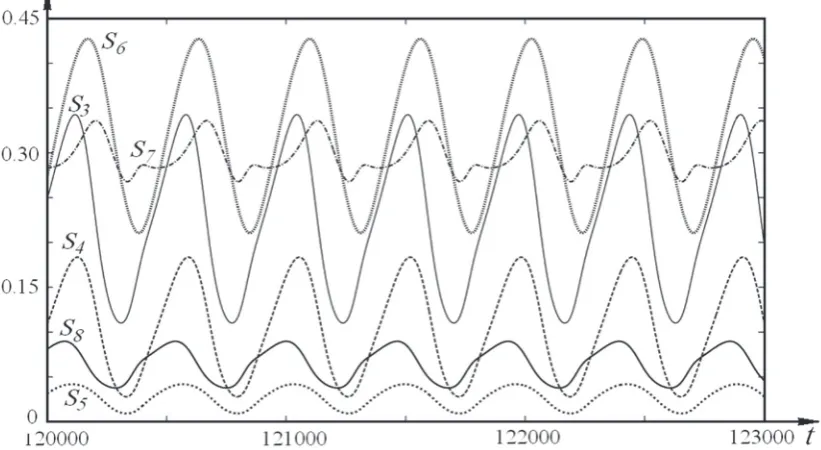
During one turnover of a cycle, one molecule of acetyl-CoA is completely oxidized to malate, and a new molecule of acetyl-CoA is formed at the input. In such a way, the continuous process of ope ration of the Krebs cycle is running and manifests the autooscillatory character. In Fig. 2 we show the kinetics of autooscillations of the cy-cle components. At k15 = 0.23, a 1-fold periodic cycle appears in the system. The oscillations of components occur synchronously with phase shifts corresponding to the space-time positions of these components in the cycle. The oscillations at the same frequency will occur in all components of the given metabolic process.
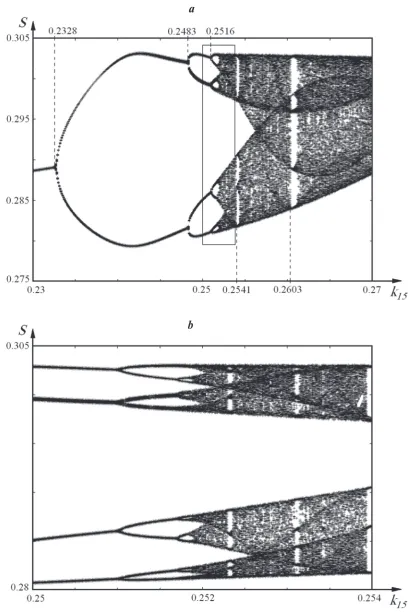
In Fig. 3,a, we show a phase-parametric dia-gram presenting the dependence of the multiplicity
Fig. 2. kinetics of autooscillations of components of the krebs cycle S3 – S8, at k15 = 0.23.
of autooscillations of the input substrate, ethanol (S), on the parameter k15. To construct the phase-parametric diagram, we used the method of cutting. In the phase space of trajectories of the system, we placed a cutting plane at S2 = 0.8. If the trajectory crosses this plane in a certain direction, we indi-cate the value of chosen variable (S, in this case) on the phase-parametric diagram. It is seen from the phase-parametric diagram that at
, the doubling of the period of oscillations arises. At , we observe the repeated period doubling. Then, at , the period of au-tooscillations is doubled once more.
Let us separate a small part of the diagram with k15 ∈ (0.25,0.254) (Fig. 3, a) and magnify it (Fig. 3, b). This part of the phase-parametric dia-gram is identical to the whole diadia-gram in Fig. 3, a. This indicates that, after the (j + 2)th bifurcation, the next bifurcation arises, and so on to (j + n). In other words, we have a cascade of bifurcations. At the following decrease in the scale of the diagram, the pattern will repeat up to the critical value of the parameter k15, after which we observe the ap-pearance of a deterministic chaos. For the derived sequence of bifurcations, we have the relation
4.696969….
Fig. 3. Phase-parametric diagram of the system: (a) – k15 ∈ (0.23,0.27); (b) – k15 ∈ (0.25,0.254)
a
the doubling of the period of autooscillations by the Feigenbaum scenario [36-38] at the increase in the dissipation coefficient α. This means that, for the given unstable modes of the physical system, any arising fluctuation can lead to a chaotic cyclic mode.
At k15 = 0.2541 and k15 = 0.2603 (Fig. 3, a), the windows of periodicity appear. The determinis-tic chaos is destroyed, and periodic and quasi-pe-riodic modes are established. Outside these win-dows, chaotic modes hold. The identical windows of periodicity are observed also on less scales of the diagram (Fig. 3, b). In other words, the phase-parametric diagrams on a small scale (Fig. 3, b) and on a large one (Fig. 3, a) are analogous. This fact indicates the fractal nature of the obtained cascade of bifurcations.
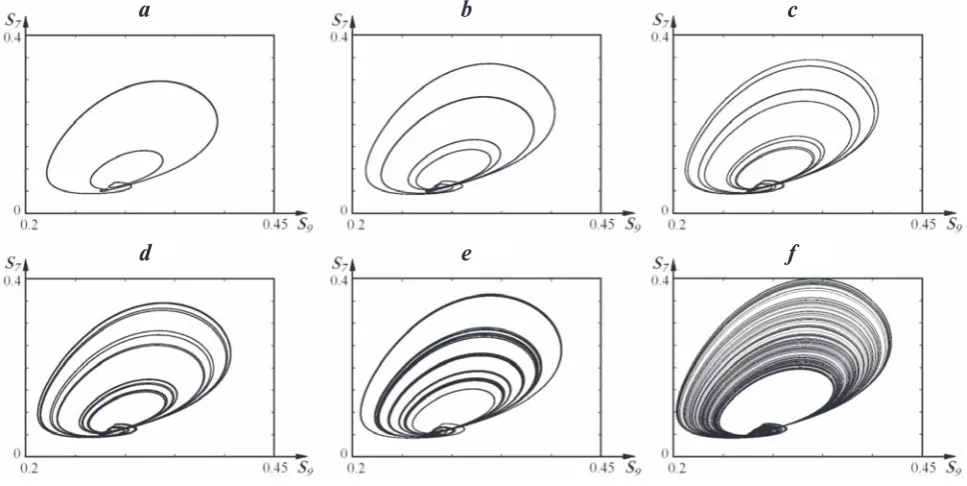
As examples of the successive period doubling for the autoperiodic modes of the system by the Feigenbaum scenario, we present the projections of the phase portraits of appropriate regular attrac-tors in Fig. 4, a-d. In Fig. 4, e, we show a regular attractor of the 6-fold quasi-periodic mode ≈ 6∙20 arising in the window of periodicity at k15 = 0.2543 (Fig. 3, a). Fig. 4, f represents strange attractor 2∙2x
(k15 = 0.267).
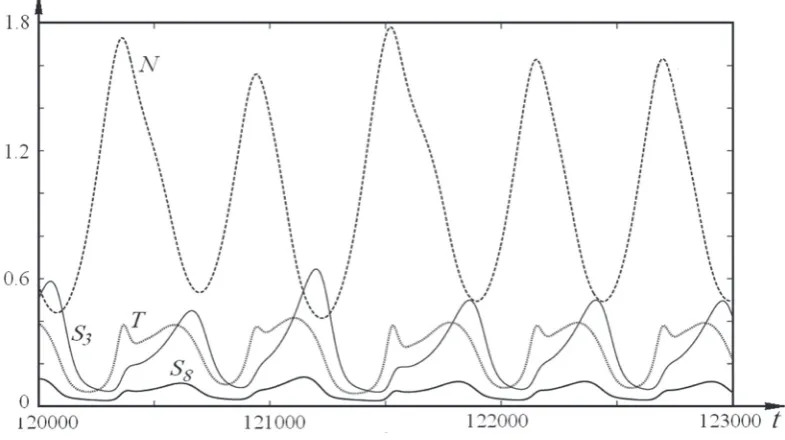
The kinetics of changes in some components of the mode with strange attractor 2∙2x (k
15 = 0.27) is shown in Fig. 5. As compared with Fig. 2, the synchronism of oscillations of citrate S3 and
oxal-Fig. 4. Projections of the phase portraits of attractors of the system: (a) – 2∙20 (k
15 = 0.2482); (b) – 4∙20 (k15 = 0.251); (c) – 8∙20 (k
15 = 0.2517); (d) – 16∙20 (k15 = 0.2518); (e) – ≈ 6∙20 (k15 = 0.2543); (f) – 2∙2x (k15 = 0.267)
a b с
d e f
acetate S8 at the input and the output of the Krebs cycle is violated. The cycle stops to be strictly pe-riodic (Fig. 2). The pepe-riodicity and the amplitudes change and become chaotic (Fig. 5). This occurs due to the violation of the synchronism of meta-bolic processes in the system of transport of elec-trons (NADH↔NAD+) of the redox process in the respiratory chain (Q↔q) and the substrate-linked phosphorylation ADP→ATP.
In Fig. 6, a, b, we show the projections of the phase portraits of the given strange attractor in the three-dimensional coordinate systems. The strange attractors obtained in this case are formed as a result of the folding. An element of the phase volume of such an attractor is stretched in some directions and shrinks in other ones, by conserving its stability. Therefore, we observe the mixing of trajectories in narrow places of the phase space of the system, i.e., a deterministic chaos arises.
Fig. 5. kinetic curves of components of the krebs cycle S3, S8, N, and t in the mode of strange attractor 2∙2x at k15 = 0.27 and
Fig. 6. Projections of the phase portraits of strange attractor 2∙2x at k
15 = 0.27 in the three-dimensional coordi-nate systems: (S, S7,S2) (a) and (ψ,S,S3) (b)
a b
the respiratory chain is also increased. The arisen additional peaks on the plot of ATP correspond to those on the plot of NAD+ (Fig. 5). Since ADP takes participation in the Krebs cycle, this causes nonlinear variations of the periodic kinetics of me-tabolites. The cyclicity of restoration of the level of oxalacetate S8 is violated, which affects the subse-quent cycles. In this case, a chaotic mode arises. Thus, there occurs the permanent adaptation of the metabolic process of a cell to variations in the environment. This leads to the adaptation of the whole metabolic process of a cell and to its self-organization for the conservation of homeostasis.
The results obtained allow one to estimate the stability of the metabolic process of a cell under the action of external factors and to forecast the consequence of this action on the vital activity of live organisms. The developed mathematical model can be useful for the creation of new drugs and in the study of the toxicity of various substances.
Самоорганізація та
фрактальніСть в метаболічних процеСах циклу кребСа
В. Й. Грицай1,*, І. В. Мусатенко2
1інститут теоретичної фізики ім. м. м. боголюбова нан України, Київ;
e-mail: [email protected]; 2Київський національний університет
імені тараса Шевченка, Україна; e-mail: [email protected]
У роботі за допомогою математичної моделі досліджується метаболізм у циклі Кребса. Знайдено автокаталітичні процеси, внаслідок яких відбувається самоорганізація в циклі Кребса і виникає циклічність в його динаміці.
досліджено структурно-функціональні зв’язки, які створюють синхронність
авто-періодичного функціонування під час пере-носу електронів у дихальному ланцюзі та за окислювального фосфорилування. досліджено умови порушення синхронізації процесів, збільшення кратності циклічності та виник-нення хаотичних режимів. одержана фазо-параметрична діаграма каскаду біфуркацій, яка відображає перехід до хаотичного ре-жиму згідно зі сценарієм Фейгенбаума. по-казано фрактальну природу встановленого каскаду біфуркацій. Знайдено дивні атрак-тори, що утворюються завдяки формуванню складки. одержані результати дають уявлен-ня про структурно-функціональні зв’язки, завдяки яким відбувається самоорганізація в метаболічних процесах клітини. побудована математична модель може бути використана для дослідження токсичного та алергічного ефектів ліків і різних речовин на метаболізм клітини.
К л ю ч о в і с л о в а: цикл
Креб-са, метаболічні процеси, самоорга нізація,
фрактальність, дивний атрактор, сценарій Фейгенбаума.
Самоорганизация и фрактальноСть
в метаболичеСких процеССах цикла кребСа
В. И. Грицай1,*, И. В. Мусатенко2
1институт теоретической физики им. н. н. боголюбова нан Украины, Киев;
e-mail: [email protected]; 2Киевский национальный университет
имени тараса Шевченко, Украина; e-mail: [email protected]
в работе при помощи математической модели исследуется метаболизм в цикле Креб-са. найдены автокаталитические процессы, вследствие которых происходит самоорганиза-ция в цикле Кребса и возникает цикличность в его динамике. исследованы структурно-функциональные связи, создающие синхрон-ность автопериодического функционирования при переносе электронов в дыхательной цепи и при окислительном фосфорилировании. ис-следованы условия нарушения синхронизации процессов, увеличения кратности циклично-сти и возникновения хаотических режимов. получена фазопараметрическая диаграмма каскада бифуркаций, отражающая переход к хаотическому режиму согласно сценарию Фейгенбаума. показана фрактальная природа установленного каскада бифуркаций. найдены странные аттракторы, образуемые в результате формирования складки. полученные резуль-таты дают представление о структурно-функ-циональных связях, благодаря которым проис-ходит самоорганизация в метаболизме клетки. построенная математическая модель может быть использована для исследований токсиче-ского и аллергичетоксиче-ского эффектов лекарств и различных веществ на метаболизм клетки.
К л ю ч е в ы е с л о в а: цикл Кребса,
ме-таболические процессы, самоорга низация,
1. krebs H. a., Johnson W. a. // Enzymologia. – 1937. – N 4. – P. 148– 156.
2. Bohnensack r., Sel’kov e. e. // Stud. Biophys. – 1977. – 66. – P. 47–63.
3. Lyubarev a. e., kurganov B. I. // Molekul. Biolog. – 1987. – 21, N 5. – P. 1286–1296. 4. kondrashova M. N. // Biofiz. – 1989. – 34,
Iss. 3. – P.450–457.
5. el-Mansi e. M. t., Dawson G. C., Bryce C. F. a. // Comput. Applic. Biosci. – 1994. – 10, N 3. – P. 295–299.
6. ramakrishna r., edwards J. S., McCulloch a., Palsson B. o. // Am. J. Physiol. Regul. Integr. Comp. Physiol. – 2001. – 280, N 3. – P. R695– R704.
7. Cortassa S., aon M. a., Marban e. et al. // Biophys. J. – 2003. – 84. – P. 2734–2755. 8. yugi k., tomita M. // Bioinformatics. –
2004. – 20. – P. 1795–1796.
9. Singh V. k., Ghosh I. // Theor. Biol. Med. Model. – 2006. – 3. – P. 27.
10. Mogilevskaya e., Demin o., Goryanin I. // J. Biol. Phys. – 2006. – 32(3-4), P. 245–271. 11. Gachok V. P. Kinetics of Biochemical
Processes. – Kiev: Nauk. Dumka, 1988. – 219 p. (in Russian).
12. Gachok V. P. Strange Attractors in Biosystems. – Kiev: Nauk. Dumka, 1989. – 237 p. (in Russian).
13. armiger W. B., Moreira a. r., Phillips J. a., Humphrey a. e. Utilization of cellulose materials in inconventional food production. – New York: Plenum Press, 1979. – P. 111–117. 14. Monod J. Recherches sur la Croissanse des
Cultures Bacteriennes. – Paris: Hermann, 1942.
15. Podgorskij V. S. Physiology and Metabolism of Methanol-Assimilating Yeast. – Kiev: Naukova Dumka, 1982. (in Russian).
16. Drozdov-tikhomirov L. N., rakhimova N. t. // Mikrobiologiya. – 1986. – 55, N 5. – P. 775– 780.
17. riznichenko G. yu. Mathematical Models in Biophysics and Ecology. – Moscow, Izhevsk: Inst. of Computer. Studies, 2003. (in Russian). 18 Watteeuw C. M., armiger W. B., ristroph D. L.,
Humphrey a. e. // Biotechnol. Bioeng. – 1979. – 21, N 5. – P. 1221–1237.
19. Selkov e. e. // Europ. J. Biochem. – 1968. –
4. – P. 79–86.
20. Hess B., Boiteux a. // Annu Rev. Biochem. – 1971. – 40. – P. 237–258.
21. Goldbeter a., Lefer r. // Biophys J. – 1972. –
12. – P. 1302–1315.
22. Godlbeter a., Caplan r. // Annu Rev. Biophys. Bioeng. – 1976. – 5. – P. 449–476.
23. Gachok V. P., Grytsay V. I. // Dokl. AN SSSR. – 1985. – 282, N 1. – P. 51–53.
24. Gachok V. P., Grytsay V. I., arinbasarova a. yu. et al. // Biotechnol. Bioeng. – 1989. – 33. – P. 661–667.
25. Gachok V. P., Grytsay V. I., arinbasarova a. yu. et al. // Biotechnol. Bioeng. – 1989. – 33. – P. 668–680.
26. Chaos in Chemical and Biochemical System / Ed. By R. Field, L. Györgyi. – Singapore: World Scientific, 1993.
27. kordium V., Irodov D., Maslova o. et al. // Biopolym. Cell. – 2011. – 27, N 6. – P. 480– 498.
28. kuznetsov S. P. Dynamical Chaos. – Moscow: Nauka, 2001. (in Russian).
29. anishchenko V., astakhov V., Neiman a. et al. Nonlinear Dynamics of Chaotic and Stochastic System. Tutorial and Modern Developments – Berlin: Springer, 2007.
30. Grytsay V. I. // Dopov. NAN Ukr. – 2000. – N 2. – P. 175–179.
31. Grytsay V. I. // Ukr. J. of Phys. – 2001. –
46. – P. 124–127.
32. Grytsay V. I., andreev V. V. // Matem. Modelir. – 2006. – 18, N 12. – P. 88–94. 33. Grytsay V. I. // Romanian J. Biophys. – 2007. –
17, N 1. – P. 55–62.
34. Grytsay V. I. // Biofiz. Visn. – 2007. – 2(19). – P. 92–97.
35. Grytsay V. I., Musatenko I. V. // Ukr. J. Phys. – 2013. – 58, N 7. – P. 677–686.
36. Feigenbaum M. J. // J. Stat. Phys. – 1978. – 19, N 1. – P. 25–52.
37. Feigenbaum M. J. // J. Stat. Phys. – 1979. – 21, N 6. – P. 669–706.
38. Feigenbaum M. J. // Comm. Math. Phys. – 1980. – 77, N 1. – P. 65–86.
![Fig. 1. General scheme of the metabolism of growth of cells Candida utilis on ethanol [12]](https://thumb-us.123doks.com/thumbv2/123dok_us/10113644.1998478/3.595.59.534.84.416/general-scheme-metabolism-growth-cells-candida-utilis-ethanol.webp)