Adaptive Dynamic Data Placement Algorithm for
Hadoop in Heterogeneous
Environments
Avishan Sharafi1, Ali Rezaee2Received (2016-07-16) Accepted (2016-12-11)
Abstract - Hadoop MapReduce framework is an important distributed processing model for large-scale data intensive applications. The current
Hadoop and the existing Hadoop distributed file
system’s rack-aware data placement strategy in MapReduce in the homogeneous Hadoop cluster assume that each node in a cluster has the same computing capacity and a same workload is assigned to each node. Default Hadoop doesn’t consider load state of each node in distribution input data blocks, which may cause inappropriate overhead and reduce Hadoop performance, but in practice, such data placement policy can noticeably reduce MapReduce performance and may increase extra energy dissipation in heterogeneous environments. This paper proposes a resource aware adaptive dynamic data placement algorithm (ADDP) .With ADDP algorithm, we can resolve the unbalanced node workload problem based on node load status. The proposed method can dynamically adapt and balance data stored on each node based on node load status in a heterogeneous Hadoop cluster. Experimental results show that data transfer overhead decreases in comparison with DDP and traditional Hadoop algorithms. Moreover, the proposed method can decrease the execution time and improve the system’s throughput by increasing resource utilization
Index Terms — Hadoop, MapReduce, Resource-aware, Data placement, Heterogeneous
I. INTRODUCTION
I
N recent years, the World Wide Web hasbeen adopted as a very useful platform for developing data-intensive applications, since the communication paradigm of the Web is
sufficiently open and powerful. The search engine, webmail, data mining and social network
services are currently indispensable
data-intensive applications. These applications need data from a few gigabytes to several terabytes or even petabytes.
Google leverages the MapReduce model to
process approximately twenty petabytes of data per day in a parallel programming models[1].
Hadoop MapReduce is an attractive model for parallel data processing in high-performance
cluster computing environments. MapReduce
model is primarily developed by Yahoo [2][site
apache]. Hadoop is used by Yahoo servers, where
hundreds of terabytes of data are generated on at
least 10,000 cores[3]. Facebook uses Hadoop to process more than 15 terabytes of data per day. In addition to Yahoo and Facebook, Amazon and Last.fm are employing Hadoop to manage the massive huge amount of data [1].
The scalability of MapReduce is proven to be high, because in the MapReduce programming
model the job will be divided into a series of small tasks and run on multiple machines in a large-scale cluster[4]. MapReduce allows a programmer with no specific knowledge of distributed
programming to create his/her MapReduce functions running in parallel across multiple
nodes in the cluster. MapReduce automatically
handles the gathering of results across the multiple nodes and return a single result or set of results
to server[4]. More importantly, the MapReduce 1- Department of Computer Engineering, Islamic Azad
University South Tehran Branch, Tehran, Iran.(Avishan. [email protected])
18 Journal of Advances in Computer Engineering and Technology, 2(4) 2016 platform can offer fault tolerance. MapReduce
model can automatically handle failures and it is
fault tolerance mechanisms. When a node fails, MapReduce moves tasks, which is run on the failed node, to be rerun on another node.[5]
In the Hadoop architecture, data locality is
one of the important factors affecting Hadoop applications performance. However, in a
heterogeneous environment, the data required
for performing a task is often nonlocal ,which affects the performance of Hadoop platform[4].
Data placement decision of Hadoop distributed
file system (HDFS) is very important for the data locality which is a determining factor for
the MapReduce performance and is a primary
criterion for task scheduling of MapReduce model. The existing HDFS’s rack- aware of
data placement strategy and replication scheme
works well with MapReduce framework in
homogeneous Hadoop clusters[6], but in practice, such data placement policy can noticeably reduce heterogeneous environment performance and may cause increasingly the overhead of
transferring unprocessed data from slow nodes to fast nodes [7]. The rest of this paper is organized as follows. In Section II, the Hadoop system architecture, MapReduce model, HDFS, and the motivation for this study is reported. Section
III presents ADDP algorithm, mathematics
formulas, variable description and scenarios.
Experiments and performance analysis are
presented in Section IV. Section V concludes this
paper by summarizing the main contributions of this paper and commenting on future directions
of our work.
II. RELATED WORK AND MOTIVATION
1. Hadoop
Hadoop is a successful and well-known implementation of the MapReduce model, which
is open-source and supported by the Apache
Software.
Hadoop consists of two main components:
the MapReduce programming model and the
Hadoop’s Distributed File System HDFS [4], in which MapReduce is responsible for parallel processing and the HDFS is responsible for data management. In the Hadoop system, MapReduce and HDFS are responsible for management
parallel process jobs and management data,
respectively. JobTracker module in Mapreduce
partitions a job to some tasks and HDFS partitions input data into blocks, and assigns them to every node in a cluster. Hadoop is based on distributed
architecture it means HadoopMapreduce adopts
master/slave architecture, in which a master node controls a group of slave nodes on which the Map and Reduce functions run in parallel. Slaves are nodes that process tasks that master assigns to them .In the MapReduce model, the master is called JobTracker, and each slave is called TaskTracker. In the HDFS, the master
is called NameNode, and each slave is called
DataNode. Master is responsible for distribution data blocks and assigning tasks slot to every node in Hadoop cluster. The default Hadoop
assumes that the node computing capacity and storage capacity are the same in the cluster such a homogeneous environment, the data placement
strategy of Hadoop can boost the efficiency of
the MapReduce model, but in a heterogeneous environment, such data placement has many
problems [1].
2. MapReduce
MapReduce is a parallel programming model used in clusters that have numerous nodes and use computing resources to manage
large amounts of data in parallel. MapReduce is proposed by Google in 2004. In the MapReduce
model, an application should process is called a
“job”. Hadoop divides the input of a MapReduce job into some pieces called “map tasks” and “reduce tasks”, in which the map-tasks run the map function and the reduce tasks run the reduce function. Map function processes input tasks and
data assigned by the Master node and produce
intermediate (key, value) pairs. Based on (key, value) pairs which are generated by map function
processes, the reduce function then merges, sorts,
and returns the result. The MapReduce model is based on “master/slave” concept. It distributes a
large amount of input data to many processing
nodes to perform parallel processing, which
reduces the execution time and improves the
performance. Input data are divided into many of the same size of data blocks; these blocks
are then assigned to nodes that perform the
same map function in parallel. After the map
function is performed, the generated output is an
intermediate several key, value pairs. The nodes
that perform the reduce function obtain these
data[8] . The MapReduce model was conceived with the principle that “moving computation is much cheaper than moving data[5] .
3. HDFS
HDFS is based on the Google File System which is used with the MapReduce model.
It consists of a NameNode module in the MasterNode and many DataNodes modules in
the slaveNodes. The NameNode is responsible for the management and storage of the entire file system and file information (such a namespace and metadata). NameNode is responsible for partition the input files that are written in HDFS into many data blocks. These blocks are the same size with default size of 64 MB. HDFS allocates these data blocks to every DataNode. DataNodes
are responsible for storing and processing these
data blocks and sending the result to NameNode. Hadoop is fault tolerance and makes three replicas of each data block for the files that are stored on HDFS. HDFS’s replica placement strategy is to put one replica of the block on one node in the local rack, another on a different node in the same rack, and the third on a node in some other rack.
When failure happens to a node, these replicas become very important and they should process
instead of lost data blocks [1].
4. Background and motivation
The Hadoop default data placement strategy assumes that the computing capacity and storage capacity of each node in the cluster is the same
.Each node is assigned the same workload. Data
placement strategy of Hadoop can boost the
efficiency of the MapReduce model, but in a
heterogeneous environment, such data placement
has many problems. In a heterogeneous environment, the difference in nodes computing capacity may cause load imbalance. The reason is that different computing capacities between nodes cause different task execution time, so the faster nodes finish processing local data blocks faster than slower nodes do. At this point, the master assigns non-performed tasks to the idle faster nodes, but these nodes do not own the data needed for processing .The required data should be transferred from slow nodes to idle faster nodes through the network. Because of waiting for the data transmission time, the task execution time increases. It causes the
entire job execution time to become extended. A large number of moved data affects Hadoop performance. To improve the performance of
Hadoop in heterogeneous clusters, this paper
aims to minimize data movement between slow and fast nodes. This goal can be achieved by a
data placement scheme that distributes and stores data across multiple heterogeneous nodes based
on their computing capacities. Data movement
can be reduced if each node is assigned to the
workload that is based on node’s data processing speed and node’s system load[4, 7].
Some task scheduling strategies have been proposed in Hadoop framework in recent years. Reference [9] proposed an Adaptive Task Scheduling Strategy Based on Dynamic Workload Adjustment called (ATSDWA). Each tasktracker collects its own load information and reports it to jobtracker periodically, so tasktrackers can adapt to the change of load at runtime, obtaining tasks in accordance with the computing abilities. Reference [4] proposed data placement algorithm (DDP) which distributes input data blocks based on each node
computing capacity in a heterogeneous Hadoop
cluster. Reference[10]proposed a resource aware scheduling algorithm in which algorithm classifies the type of work and node workload to I/O bound jobs and CPU-bound jobs. Each workload assigns to a group of nodes. Algorithm selects appropriate tasks to run according to the workload of the node. Reference[11] explored an extensional MapReduce task scheduling
algorithm for deadline constraints (MTSD) for
Hadoop platforms, which allows the user to specify a job’s deadline and finish it before the deadline. Reference [6] proposed a novel data
placement strategy (SLDP) for heterogeneous
Hadoop clusters. That algorithm changes traditional Hadoop data block replication based on data hotness. SLDP adopts a heterogeneity-aware algorithm to divide various nodes into several virtual storage tiers firstly, and then places data blocks across nodes in each storage tiers circuitously according to the hotness of data.
III. ADDP
1. Main Idea
Computing capacity of each node in the
20 Journal of Advances in Computer Engineering and Technology, 2(4) 2016
adaptive dynamic data placement algorithm
(ADDP) is presented in this paper which uses the
type and volume load of jobs for adjusting the
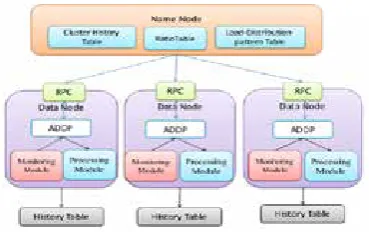
distribution of input data block. The proposed algorithm consists of two main phases. In the first round, NameNode distributes data blocks
based on each node computing capacity ratios
in the Ratio table. In the next rounds, each
node load parameters (average Cpu utilization, average memory utilization) are monitored and registered in the “History table” of the node then NameNode calculates each node appropriate
data block numbers which is more compatible with load status based on comparing each node load parameters with cluster load parameters in the Load-Distribution-Patterns table. This table
has load volume formulas for each load state of a node and these formulas determine the best
workload that is more compatible with node load situation. The workload that is calculated for each node which is more compatible with node
load state is stored in a Cluster-History table and
will distribute to nodes in the next rounds.
Fig. 1. Shows how the Name node deploys data blocks on data nodes
In the algorithm, there are two tables: “Ratio table” and ”Load-Distribution-Patterns table”.
Ratio table is a table that stores computing
capacity ratios of each node in different job type
and Load-Distribution-Patterns table stores load
parameters as defined average Cpu utilization
(AvgCpuUsage) and average memory utilization
(AvgMemUsage) of the whole cluster in different
load states to compare each node load parameters
with cluster load parameters. In the cluster, we assume three main states: the overloading state is defined as overload, the underloading state is defined as “underload” and the normal loading state is defined as “normalload”. There are some sub load states based on cluster load situation. These sub-states are for underload state. Every
row in table belongs to a load state .There is volume load formula for each row. Every load parameters compare with every row. If a node’s load parameters will place in any row in the
table, the formulas calculate data load volume
that is appropriate for the node’s load state to change node’s load state and make it becomes in normalload. The load volume formulas show how much workload should add to the current node’s workload to make it becomes more compatible with node’s load state so that the nodes use resources more efficient. The percentage of added workload is shown by λ factor. Next node’s volume load average (VLAi+1) is equal
to previous volume load average (VLAi) plus
a percentage of the current load average.This percentage factor is different from one row to another and depends on node load state. The percentage factors are defined in definition lambda factor table.
TABLE 1
LOAD-DISTRIBUTION-PATTERNS Load volume formula Average
Cpu Usage AverageMemory Usage load state
) (
1 1 i i i i VLA VLA
VLA+ = +λ α1≤CpuUsage≤α2 β1≤MemoryUsage≤β2 Underload
) (
2 1 i i i i VLA VLA
VLA+= +λ α2≤CpuUsage≤α3 β2≤MemoryUsage≤β3 Normalload )
(
3
1 i i
i VLA VLA
VLA+= −λ α3≤CpuUsage≤α4 β3≤MemoryUsage≤β4 Overload
TABLE 2
DEFENITION- LAMBDA-FACTOR
Lambda
definition Load State 11
λ Very Underload
12
λ
Underload13
λ Underload near to
Normal 2
λ
NormalLoad21
λ
Optimize-NormalLoad3
λ
OverloadEvery load volume formula in the Load-distribution-Patterns table tries to calculate
workload that is more compatible with node load situation. So in general, we have six load levels which will be explained in the next part.
If a node state is” Very underload”, lambda
If a node state is” Underload”, lambda factor
for it in the load volume formula is ; so node’s workload which will be assigned to current node’s workload for the next round is at least 33% of node current workload plus current workload.
If a node state is” Underload near to NormalLoad”, lambda factor for it in the load
volume formula is ; so node’s workload which will be assigned to current node’s workload for
the next round is at least 20% of node current
workload plus current workload.
If a node state is” NormalLoad”, lambda
factor for it in the load volume formula is .When node’s load state is in the normal situation, most of the time there is no need to add workload to node current workload, but sometimes cluster administrator can add some more workload to the node current workload to optimize node resource utilization. In this situation the lambda factore will be and the percentage of this factor is based on administrator opinion. If a node state
is ” Overload”, lambda factor for it in the load
volume formula is ; so node’s workload which will be assigned to current node’s workload is at least 10% of node current workload minus current workload.
2. Mathematical Formulation
For making Ratio table, mathematical formulation 1 to 4 are needed and for making
Load-distribution-Patterns table mathematical formulation 5 to 8 are needed
( )
1
N
i avg
TaskExeTime i T
Number of Tasks
=
=
∑
(1)avg
T ( ) (x)
NumberOfTaskSlot
t
NodeComputingCapacity=T = x (2)
t (x) t T (x) Min (x)
T
t
NodeComputingCapacityRatio R= = (3)
t
1 R (x)
( )
n t t
BlockNumber Total BlockNum
R b
x er
=
= ×
∑
(4)( 1 1 1) ( 2 2 2)
1 2
user sys nice user sys nice
cpuUsage
Total Total
+ + − + +
=
− (5)
1 1 1 1 1 1 1 1
Total user sys nice idle IOwait irq softirq= + + + + + + (6)
2 2 2 2 2 2 2 2
Total user sys nice idle IOwait irq softirq= + + + + + + (7)
Total Memory FreeMemory Buffers Cache MemoryUsage
Total Memory
+ + +
= (8)
3. Variable Description
In the mentioned mathematical formulation, Tavg(i) denotes the average execution time to
complete a batch of tasks in the node(i) and Tt(i) shows the average time required to complete one task for the node (I) [4].
In order to get the real-time information of
CpuUsage, we can use related parameters in the file /proc/stat of Linux system to calculate CpuUsage. Seven pieces of items can be extracted from file /proc/stat: user-mode time (user),
low-priority user-mode time (nice), system mode time
(sys), idle task-mode time (idle), hard disk I/O preparing time (iowait), hardware interrupting time (irq), and software interrupting time (softirq). File /proc/stat keeps track of a variety of different statistics about the system since it was restarted. The time unit is called “Jiffy” (1/100 of Figure
axis labels are often a source of a second for×86
Journal of Advances in Computer Engineering and Technology, 2(4) 2016 22
The followings are algorithm ADDP workflow and pseudocode.
Data Input Job Input
Check if Job Type is In the Ratio Table
YES
Distribute Test DataSet and Test TaskSet
Calculate AvgCpuUsage AvgMemUsage ComputingCapacity
Ratio Is data Volume exist in
ClusterHistoy Table
Check whether Utilize Field in Cluster History Table is true
Make a record in Ratio Table and LoadDistributionPattern Table for job type
Distribute calculated Data Block Numbers on each node
Calculate each node block numbers based on Ratio Table
Calculate all nodes AvgCpuUsage AvgMemUsage
Are All Nodes AvgCpuUsage and AvgMemUsage Utilized based on LoadDistributionPattern Table
Set Utilize Fild false in Cluster history Table
NO
Set Utilize Fild True in Cluster history Table
YES
Add each node blocks number in Cluster history Table Calculate Nubmer of Distribution Data block for each Node Based on
LoadDistributionPattern Table Add Type and
Volume to ClusterHistory Table
and Type to Ratio Table
NO
Add Type and Volume to ClusterHistory Table
NO
Distribute input Data volume based on Block
Number Result in ClusterHistory Table
YES
YES
NO
End Of Process One Job
Algorithm 1: Adaptive Dynamic Data Placement Algorithm(ADDP)
Find number of cluster’s node and number of each node’s core 1.
Find Job Type in Ratio Table 2.
IF Job Type Doesn’t exist in Ratio Table do
3.
Add Job Type and Job input Volume in Cluster-History Table and add Job Type in Ratio Table 4.
Distribute Test data and Test task on each cluster’s nodes 5.
Make a record for Job in Ratio-Table (see Algorithm(2)) 6.
Make Load- Distribution-Patterns Table (see Algorithm (3)) 7.
for each node in the cluster do 8.
Calculate BlockNumbers
9. BlockNumber= Total BlockNumber*[
∑
=n t t
x R
1 t
) ( (x)
R ]
End
10.
for each node in the cluster do
11.
Distribute the calculated Data Block Numbers 12.
End
13.
for each node in the cluster do
14.
Calculate the AvgCpuUsage and the AvgMemUsage 15.
1
[ ]
n
x AvgCpuUsage x
NumberOfNodes
=
∑
AvgCpuUsage =
1
n
x AvgMemUsage
NumberOfNodes
=
∑
AvgMemUsage = 16.
end
17.
each node in the cluster do for
18.
Determine Node’s LoadState by comparing Node’s AvgCpuUsage and AvgMemUsage with Load- Distribution-Patterns Table
19.
Calculate Node’s new volume-load based on Node’s LoadState by using Load- Distribution-Patterns Table’s formulas.
20.
Store Node’s new volume- load in Cluster-History Table 21.
end
22.
All Node’s AvgCpuUsage and AvgMemUsage are Utilized based on Load-Distribution-Patterns Table
do If
23.
Set the Utilized flag = True 24.
Store utilized flag in utilized field in the Cluster-History Table 25.
else
26.
Set the Utilized flag = False 27.
Store utilized flag in utilized field in the Cluster-History Table 28.
end
Journal of Advances in Computer Engineering and Technology, 2(4) 2016 24
Algorithm 1: Adaptive Dynamic Data Placement Algorithm(ADDP) (Continue)
Else
30.
Input data volume exists in Cluster-History Table do If
31.
Distribute the input Data volume based on the value of Block Numbers which exist in the Cluster-History Table
32.
Check utilized flag in utilized field in the Cluster-History Table 33.
The Input data volume is utilized based on utilized field in the Cluster-History Table do if
34.
Print “ The Cluster Is Utilized” and finish 35.
Go to 14
els e
36.
end
37.
Go to 9
Else
38.
End
39.
End
40.
41. End Of Algorithm 1
Algorithm for making Ratio-Table:
Algorithm 2: Make Ratio-Table for each node do
1.
Distribute TestTasks 2.
( )
1N
total i
T TaskExeTime i
=
=
∑
Calculate Node’s TotalExeTime(Ttotal) = 3.
( ) total
avg T
T x
Number of TaskSlots =
Calculate Node’s AverageExeTime(Tavg) = 4.
Calculate Node’s ComputingCapacity (Tt) = Tavg( )x
NumberofTaskSlots
5.
Calculate Node’s ComputingCapacityRatio(Rt) =
(x)
( )
t
x t
T
Min T x
6.
end
7.
Fill Computing-Capacity-Ratio Table with (Rt) ratios 8.
Add JobType in Computing-Capacity-Ratio Table (RatioTable) 9.
End Of Algorithm 2
Algorithm for making Load-distribution-Patterns Table:
Algorithm 3: Make Load-Distribution-Patterns Table for each node in cluster do
1.
Calculate Node’s Average CpuUsage(AvgCpuUsage)
(
1 1 1) (
2 2 2)
1 2
user sys nice user sys nice cpuUsage
Total Total
+ + − + +
=
−
1 1 1 1 1 1 1 1
Total user sys nice idle IOwait irq softirq= + + + + + +
2 2 2 2 2 2 2 2
Total user sys nice idle IOwait irq softirq= + + + + + + 2.
Algorithm 3: Make Load-Distribution-Patterns Table (Continue)
Calculate Node’s Average MemoryUsage(AvgMemUsage)
Total Memory Free Memory Buffers Cache MemoryUsage
Total Memory
+ + + =
3.
End
4
(
)
1( )
n
x
Calculate Cluster AverageCpuUsage LoadParameter AvgCpuUsage x NumberOfNodes
=
→
∑
5.
(
)
1 ( )n
x
Calculate Cluster AverageMemoryUsage LoadParamete AvgMemUsage x NumberOfNodes r →
∑
=6.
Fill Load-distribution-Pattern Table with LoadParameters 7.
End Of Algorithm 3
Journal of Advances in Computer Engineering and Technology, 2(4) 2016 26
When a new job is submitted to a cluster
and there is no information of that job in the
NameNode, at the first round NameNode distributes input data blocks based on values in Ratio table. In the next rounds, the whole cluster will be monitored by monitoring module.
4. Scenarios
In the monitoring phase in general, NameNode monitors each node load state and compare these
states with the values in the Load-distribution-Patterns table until node’s new workload which is more compatible with node’s load state will be calculated. For every node these calculated workloads will be registerd in the Cluster- History table and will be distributed to each node in the next rounds .
In General, based on workflow for every job which is submitted to the cluster, there are there
scenarios (three situations) described in next
subsection. The first scenario happens when a new type of job submits to cluster and there are no
information of job type and its input data volume
in the cluster. The second scenario happens when the type of job isn’t new, but its data volume is new. The third scenario happens when the type of
submitted job and its input data volume are not
new for the cluster.
4.1 Scenario 1 (Statements 1 to 16):
When a new job is submitted to a cluster and data are written into the HDFS, NameNode first checks the RatioTable. These data are used to determine whether this type of job has been performed. If there is no record of the job type in the RatioTable, It means this type of job is new and there isn’t any information of job type in the NameNode, so for distributing input data blocks, NameNode needs to make record of the job type in Ratio Table and make records of the job type and its data volume in Cluster-History Table. Then NameNode makes Load-Distribution-Patterns Table for the job type.After distributing input data blocks based on information in Ratio Table, monitoring phase will start.
4.2 Scenario 2 (Statements 18 to29):
If the RatioTable has a record of the submitted
job, it means the type of job has been performed.
Thus there is a record for the job in the
Cluster-History Table and there is
Load-Distribution-Patterns Table for the job type. Then NameNode checks job input volume in the Cluster-History table.
If the input volume of the submitted job is not on the Ratio table , it means that there is no distribution pattern for input data in the
Cluster-History table. As a result the newly written data will be allocated to each node in accordance with the computing capacity which exists in the RatioTable. After assigning input data blocks, NameNode monitors and compares each node’s load state with the values in the Load-distribution-Patterns table until the workload that is more compatible with node load situation is calculated
by load formulas in the
Load-distribution-Patterns table. This workload will register for each node in the Cluster- History table and will distribute to nodes when that job with same data input will be submitted into the cluster.
4.3 Scenario 3 (Statements 30 to 35):
If there are records of the submitted job type and its load volume input data in the Ratio table and Cluster-History table, it means that NameNode has all information for distributing input data
blocks to each node. NomeNode distributes input data blocks based on information that registered in Cluster-History table. If all nodes in the cluster are in normal load situation, the utilized field for that job with its input load volume in Cluster- History table will set True (T), otherwise will set False (F). These histories in Cluster-History table will help the NameNode to distribute input data blocks without any more effort when a job with the same workload is submitd to the cluster,
because all information for distributing input data
blocks is registered in the Cluster-History table.
IV. EXPERIMENTAL RESULT
This section presents the experimental environment and the experimental results for the
TABLE 3
EACH NODE SPECIFICATION
Machine Operating
system Memory (GB)
Number
ofCores Disk(GB)
Master Windows7 6 4 930
Slave1 Ubuntu Linux15.0 2 1 19.8
Slave2 Ubuntu Linux15.0 3 2 19.8
Slave3 Ubuntu Linux15.0 6 4 583.4
A TestBed was designed for testing and comparing presented algorithm with DDP algorithm and Hadoop framework. WordCount
is a type of job runs to evaluate the performance of the proposed algorithm in a Hadoop
heterogeneous cluster. The WordCount is a
MapReduce application running on a Hadoop cluster and it is an application used for counting
the words in the input file.
The experimental environment is shown in the table. 3. We use Intel Core i5-4210U 1.70GHZ for salve1 and Intel Core i5-4210U 1.70GHZ for salve2 and Intel Core i7-4790 3.60GHZ for salve3.We use VirtualBox 4.1.14 to create our computing node for slave1 and salve2. In order to achieve the effect of a heterogeneous
environment, the capacity of the nodes is not the
same. Different amounts of CPUs and memories were set on nodes. In total, four machines were created: one master and three slaves. One machine
as the master has 4 CPUs, 6 GB of memory, and
930 GB disk; one virtual machine as a slave1 has 1 CPU, 2 GB of memory, and a 19 GB disk; one
virtual machine as a slave2 has 2 CPUs, 3GB of
memory, and a 19 GB disk; one machine as a
slave3 has 4CPUs, 6GB of memory, and a 538
GB disk.
Table 3 presents the specifications of each node. All of the slave machines adopt the operating system as Ubuntu 15.0 LTS, and the
master machine adopts the operating system as
windows 7.
TABLE 4 RATIO TABLE
Job Type Slave1 Slave2 Slave3
WordCount 1 2 4
TABLE 5
RATIO TABLE EXAMPLE
Job Type Input Data Slave1 Slave2 Slave3
WordCount
α 1
1 2 4
α× + +
2 1 2 4
α ×
+ + α×1 2 4+ +4
Parametri c Each node
workload
β 2β 4β
350 MB 50 MB 100 MB 200 MB
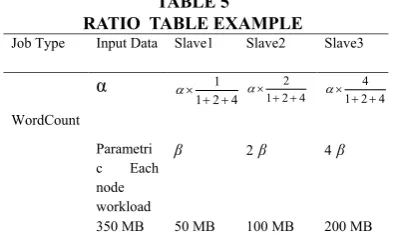
Table 4 shows ratios for WordCount job in the RatioTable. Table 5 is made by ratios in the RatioTable and is shown if input data block is
350 MB, slave1 is assigned 50 MB, slave2 is assigned 100 MB and slave3 is assigned 200
MB. In proposed algorithm number of tasks that run on each node is based on node core numbers. Slave1 has one core, so slave1 just runs 1task in each round .Slave2 has two cores, so it runs 2 tasks in each round simultaneously. Slave3 has four cores, so it runs 4 tasks in each round simultaneously. Each job processes different input data in which the size of input data for slave
1, slave2 and slave3 are 50 MB, 100 MB and 350
MB, respectively.
Experiment 1:
In the experiment 1, a comparison is made
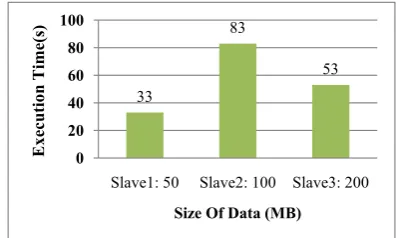
between the DDP algorithm and the ADDP algorithm when an overload state happens in the cluster. Fig 3. Shows the normal execution time of three slaves of cluster when the workloads in
normal load are 50, 100 and 200 MB for slave 1
to 3, respectively.
Slave 2 in the cluster is overloaded (Fig.4.), because it takes 240 s to finish its job (more than its normal execution time). The execution time
of WordCount is measured for each node in all rounds in DDP algorithm and ADDP algorithm
in this situation and the results is shown in Fig. 4 to Fig. 11.
The both algorithms in the first round distribute data blocks based on computing capacity ratios (Fig.4, Fig5.).
In round 2, the DDP algorithm distributes
data blocks based on computing capacity, but
the presented ADDP algorithm distributes data
blocks based on values which is registered in Cluster-History table.
Journal of Advances in Computer Engineering and Technology, 2(4) 2016 28
this values which are calculated by Load-Distribution-Patterns table formulas. Slave2 is overloaded, so 10% of slave2 workload must be added to workload of salve3 which is underload. As a result, in round2 the nodes’ workloads
become 50MB, 90MB, 210MB and the execution times are 33s, 190s and 61s for slave1, slave2 and
slave3, respectively.(Fig.7)
The execution time 190s for slave2 is still too
much, so 10% of slave2 workload must be added to workload of salve3. As a result, in round3 the nodes’ workloads become 50MB, 81MB, 219MB
and the execution times are 33s, 141 s and 73 s for
slave1, slave2 and slave3, respectively (Fig.9).
The execution time of slave2 is still too much,
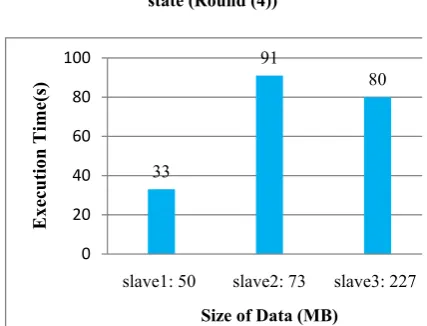
so in similar approach, 10% of slave2 workload is added to workload of salve3 in round 4. Thus, in round4 the nodes’ workloads become 50MB,
73MB, 227MB and the execution times are 33s, 91s and 80s for slave1, slave2 and slave3,
respectively (Fig.11).
After four rounds the cluster with 350 MB
input data volume, is balanced and the average
execution time of the whole cluster is 68 seconds, but the average execution time of the whole cluster in DDP algorithm is 108.66 seconds.
33 83 53 0 20 40 60 80 100
Slave1: 50 Slave2: 100 Slave3: 200
Ex ecu tio n Tim e( s)
Size Of Data (MB)
Fig. 3.Execution time of each slave in normal load state
33 240 53 0 50 100 150 200 250 300
slave1: 50 slave2: 100 slave3: 200
Ex ecu tio n Tim e (s )
Size Of Data (MB)
Fig.4.Execution time of each slave for DDP in overload state (Round (1))
33 240 53 0 50 100 150 200 250 300
slave1: 50 slave2: 100 slave3: 200
Ex ecu tio n Tim e (s )
Size Of Data (MB)
Fig. 5.Execution time of each slave for ADDP in overload state (Round (1))
33 240 53 0 50 100 150 200 250 300
slave1: 50 slave2: 100 slave3: 200
Ex ecu tio n Tim e (s )
Size Of Data (MB)
Fig. 6.Execution time of each slave for DDP in overload state (Round (2))
33 190 61 0 50 100 150 200
slave1: 50 slave2: 90 slave3: 210
Ex ecu tio n Tim e( s)
Size Of Data (MB)
Fig. 7.Execution time of each slave for ADDP in overload state (Round (2))
33 240 53 0 50 100 150 200 250 300
slave1: 50 slave2: 100 slave3: 200
Ex ecu tio n Tim e (s )
Size Of Data (MB)
33
141
73
0 20 40 60 80 100 120 140 160
salve1: 50 slave2: 81 slave3: 219
Ex
ecu
tio
n Tim
e
(s
)
Size Of Data (MB)
Fig. 9.Execution time of each slave for ADDP in overload state (Round (3))
33
240
53
0 50 100 150 200 250 300
slave1: 50 slave2: 100 slave3: 200
Ex
ecu
tio
n Tim
e
(s
)
Size Of Data (MB)
Fig. 10.Execution time of each slave for DDP in overload state (Round (4))
33
91
80
0 20 40 60 80 100
slave1: 50 slave2: 73 slave3: 227
Ex
ecu
tio
n Tim
e(
s)
Size of Data (MB)
Fig. 11.Execution time of each slave for ADDP in overload state (Round (4))
In fact, the whole cluster executions time
of the presented ADDP algorithm are reduced in each round, but executions time of the DDP
algorithm is the same in all rounds (Fig.4, Fig6, Fig8 and Fig10).
The DDP algorithm allocates data to each node
in accordance with the nodes computing capacity which is accordance to hardware, so it doesn’t work well in overload state and underload states.
In contrast, the presented ADDP algorithm not
only considers computing capacity in assigning data, but also monitors and considers load state
of nodes in assigning data block.
Experiment 2:
In the experiment 2, a comparison is made
between the DDP algorithm, the ADDP algorithm and Hadoop1.2.1 when an overload state happens in the cluster. Fig. 12 shows cluster in overload states in the Hadoop-1.2.1 framework. Fig. 13 shows execution time of the whole cluster in the Hadoop framework, the DDP algorithms and the presented ADDP when slave2 is overload. As the results shown, Hadoop framework and DDP algorithm can’t understand overloading state in the nodes and can’t handle underload
and overload state in the cluster, but ADDP can
make the corresponding adjustment to achieve
the optimal state and realize self-regulation and
decrease the execution time in each round.
80
250
83 0
100 200 300
Slave1: 116 Slave2:116 Slave3: 116
Ex
ecu
tio
n Tim
e
(s
)
Size Of Data (MB)
Fig. 12.Execution time of each slave for Hadoop in overload state
108.66108.66108.66108.66 108.6694.66
82.33 68
137.66137.66137.66137.66
0 50 100 150
1 2 3 4
Ex
ecu
tio
n Tim
e(
s)
Execution Rounds
DDP algorithm ADDP algorithm
Fig.13.Comparison between the execution time of the whole cluster for Hadoop, DDP and ADDP algorithms,
in each round in overload state
V. CONCLUSION
This paper proposes adaptive dynamic data
Journal of Advances in Computer Engineering and Technology, 2(4) 2016 30
algorithms classification. IN a heterogeneous environment, the difference in nodes computing
capacity may cause load imbalance and creates the necessity to spend additional overhead to
transfer unprocessed data from slow nodes to fast nodes. To improve the performance of Hadoop in heterogeneous clusters, we aim to minimize data movement between slow and fast nodes. This
goal can be achieved by a data placement scheme that distributes and stores data across multiple heterogeneous nodes based on their computing
capacities and workloads. The proposed ADDP
algorithm mechanism distributes fragments of
an input file to heterogeneous nodes based on
their computing capacities, and then calculates
each node appropriate workload base on load parameters of each node to allocate data blocks,
thereby improving data locality and reducing the additional overhead to enhance Hadoop
performance. The presented algorithm improves
the performance of Hadoop heterogeneous
clusters and significantly benefits both DataNodes and NameNode.
REFERENCE
[1] G. Turkington, 2013. Hadoop Beginner’s Guide: Packt Publishing Ltd.
[2] A. Holmes , 2012. Hadoop in practice: Manning Publications Co.
[3] R. D. Schneider, 2012. Hadoop for Dummies Special Edition, John Wiley&Sons Canada.
[4] C.-W. Lee, K.-Y. Hsieh, S.-Y. Hsieh, and H.-C. Hsiao, 2014. A dynamic data placement strategy for hadoop in heterogeneous environments, Big Data Research,1, pp. 14-22
[5] A. Hadoop, “Welcome to apache hadoop,” Hämtat från http://hadoop. apache. org, 2014.
[6] R. Xiong, J. Luo, and F. Dong, 2015. Optimizing data placement in heterogeneous Hadoop clusters, Cluster Computing, 18, pp. 1465-1480.
[7] J. Xie, S. Yin, X. Ruan, Z. Ding, Y. Tian, J. Majors, et al, 2010. Improving mapreduce performance through data placement in heterogeneous hadoop clusters, in Parallel & Distributed Processing, Workshops and Phd Forum (IPDPSW), IEEE International Symposium on, 2010, pp. 1-9.
[8] K. Singh and R. Kaur, 2014. Hadoop: addressing challenges of big data. In Advance Computing Conference (IACC), on (pp. 686-689). IEEE.
[9] X. Xu, L. Cao, and X. Wang, 2014. Adaptive task scheduling strategy based on dynamic workload adjustment for heterogeneous Hadoop clusters.
[10] P. Xu, H. Wang, and M. Tian, 2014.New Scheduling Algorithm in Hadoop Based on Resource Aware in Practical Applications of Intelligent Systems, ed: Springer, pp. 1011-1020.