Moodle Implementation for L2 Vocabulary
Development and Retention: The Effects on
Extroverted vs. Introverted Iranian Intermediate
EFL Learners
Ali Malmir1
Assistant Professor of Applied Linguistics, Department of English Language, Imam Khomeini International University, Qazvin
Zeinab Aghazamani
M.A. Student of Applied Linguistics, Islamic Azad University, E-Campus
Abstract
Despite all the studies conducted on second/foreign language (L2) vocabulary, most L2 learners suffer from deficiency in their vocabulary development and retention. One of the probable reasons behind this specifically in Iranian EFL context is that less implementation of new technologies such as CALL and Virtual Learning Environments (VLEs). Because the use of new language learning technologies is likely related to learner variables and personality differences, the present study attempted to examine the use of Moodle as an effective type of VLE on 90 introverted vs. extroverted EFL learners' vocabulary development and retention. Myers Briggs Type Indicator (MBTI), researcher-made and validated vocabulary tests used as pretest, posttest, and delayed posttest were employed for data collection. The application of two-way ANOVA indicated that Moodle had a significant positive effect on L2 vocabulary development and retention. However, introversion/extroversion personality factor could not moderate the effect of Moodle on vocabulary learning and retention. The interaction effect of the two independent variables on vocabulary development and retention was not significant as well. Study findings suggest that EFL practitioners and learners can employ Moodle as an effective VLE for L2 vocabulary achievement and retention.
Keywords: Vocabulary Development, Vocabulary Retention, Moodle, Virtual
Learning Environments (VLEs), Introversionism, Extroversionism Received on March 9, 2018
Accepted on February 28, 2019
1. Introduction
Vocabulary plays a pivotal role in the process of learning a foreign language (FL). One of the major concerns among all L2 teachers and researchers is how to efficiently improve learners' vocabulary. In this regard, Zimmerman (2013) points out that vocabulary learning has been the headache of the second language learners and is central to language acquisition, whether the language is first, second, or foreign. In Nation's (2001) opinion, the most frustrating experience in using another language is the inability to use the words that we need to express ourselves. Learning vocabulary is one of the most challenging learning tasks facing L2 learners. According to the latest research, this challenge comes from two important reasons: one reason is that there are a large number of words to be learnt, and the other is that little attention has been paid to the problems of students in this regard (Hill, 1998; Nation, 2006; Sonbul & Schmitt, 2013; Schmitt, 2014). Such being the case, conducting more research on novel ways to facilitate vocabulary learning seems highly warranted.
The other consideration of this study is vocabulary retention. The question of how vocabulary can be taught efficiently in a way that engages the learner and promotes long-term retention for easy retrieval for future communication needs to be addressed. Indeed, the question of what types of input the teacher can deliver in the class so as to transfer vocabulary from input to intake has remained widely unanswered (Schmitt & Schmitt, 2014). As Nation (2006) commented, L2 learners need to internalize the new words and store them in long-term memory in order to easily use them in oral and written communication.
attributed to lack of lexical retention among them. That is why devising some novel ways to help English learners gain better retention of words is highly essential.
On the other hand, recent years have shown a boom of interest in using computers for foreign language teaching and learning (Ayres, 2002; Barker & Gossman, 2013; Burston, 2013; Dudeney & Hockly, 2007; Gunduz, 2005; Murphy, 2009; Walker & White, 2013). A decade ago, the use of computers in the language classroom was of concern only to a small number of specialists in western countries. However, with the advent of multimedia computing and the Internet, the role of computers in language instruction has now become an important issue confronting large numbers of language teachers throughout the world. However, as Dudeney and Hockly (2007) pointed out, L2 instructors need to understand how CALL can best be used to offer effective instruction to language learners.
It has already been hypothesized (Brown, 2014) that extraversion and introversion, among other personality variables, may have some influence on second language achievement. It should be recalled that extraversion is generally viewed as a continuum ranging from introversion to extraversion. In language learning, extraversion has been thought of as a continuum, which is more likely to be operative in a second language than a foreign language situation (Ellis, 2008). Despite this, no study is available to show the effect of using VLE's, in this study Moodle, on introverted and extroverted learners. Similarly, to the best of the researcher's knowledge, very few studies about the application of Moodle in Iranian context are found in the literature. This, therefore, entails that further research be conducted to fill this gap.
2. Literature Review
2.1 CALL and VLEs for Language Learning
ever possible to envisage L2 instruction and learning happening divorced from technology interventions. In this regard, the first example that conjures up in mind is the Internet. At present, many EFL teachers are constantly integrating Internet English lessons into their class programs simply because they have witnessed the numerous advantages offered by this learning medium (Walker & White, 2013). The Internet opens an endless supply of academic sources and teaching material for EFL teachers interested in incorporating them into their current programs as many advocates recommend them. Among them, Warschauer, Shetzer, and Meloni (2001) stated that "authenticity, literacy, interaction, vitality and learners' empowerment" (p. 7) are the main reasons for using the Internet for English teaching.
Computer-Assisted Language Learning (CALL) is seen as an approach to teaching and learning language in which the computer is employed as an assistant to the presentation and assessment of material, which includes a substantial interactive element (Burston, 2013). As a pioneer in CALL research domain, Levy (1997) defines CALL as "the search for and study of applications of the computer in language teaching and learning". This term emerged as researchers in CALL tried to incorporate concepts from SLA into the development of CALL. As Tower (2000) pointed out, instructional designers were looking for some premises to help them make some of the many decisions they are faced with in designing software for instructional purposes. Moreover, teachers need some theoretical foundations to help them assess their learners through CALL.
design that can be incorporated into CALL tasks. More recently, Wu, et. al (2011) listed some methodological principles of language teaching which can be operationalized through CALL pedagogy including numerous learning tasks (e.g., use tasks, not texts, as the unit of analysis), input (e.g., elaborate input), learning processes (e.g., provide negative feedback), and learners (e.g., individualize learning).
CALL has undergone quite a large number of advancements, among which Virtual Learning Environments (called VLE hereafter) stands out. The main point about a VLE is that it can be described an institution-wide system which is used by many educators to present a variety of courses; it is not limited to one course only (Dudeney & Hockly, 2007; Weller, 2007). VLE's are of tremendous help to those educators who want to take advantage of the benefits offered by the Internet to support their L2 teaching activities, but end up with realizing that creating Internet resources that are stimulating, appealing, easy to use and educationally sound is painfully time consuming and requires considerable expertise. In fact, VLEs allow educators to create resources quickly and without the need to develop technical skills (Weller, 2007). More specifically, VLEs provide an integrated set of Internet tools, which enable easy upload of materials and offer a consistent look and feel that can be customized by the user. Some popular commercial VLEs currently being used around the world include Blackboard, WebCT1, and Moodle, the latter of which will be explained in more depth, as it was chosen for the purposes of the study.
2.2 Moodle
to take up their education virtually. Moodle provides simulation, visualization, authoring, assessment, and collaboration capabilities and facilitates the teaching and learning of all the fields including L2 teaching and learning (Murphy, 2009). This software, moreover, includes various pieces of equipment in its virtual classroom, thus allowing students to create a network with an almost unlimited number of devices, encouraging practice, discovery, and troubleshooting. The simulation-based learning environment of Moodle helps students develop many essential skills such as problem solving and critical thinking as two major concepts in an L2 setting. Additionally, Moodle allows teachers to easily teach and demonstrate complex concepts and even evaluate their students at the end of the virtual semester (Beatty & Ulasewicz, 2006).
session or any other variants depending on the teacher or institute. They can be used by one teacher or shared by a group of teachers.
2.3 Introversion vs. Extroversion Personality Type
People possess various characteristics which have an effect on their life; even the way they learn is affected by these features. One reason for possessing these different characteristics is associated with personality types of people. Among all the personality types ever investigated, introversion and extraversion have attracted considerable attention on the side of the researchers of this field (Brown, 2014; Ellis, 2008).
According to Brown (2014), extroverts talk more, louder and more over and over again, with much less pauses and hesitations, they have higher speech rates, smaller silences, a greater verbal output, a lower type/token ratio and a less formal language, while introverts use a wider vocabulary. Extraverts also use more positive emotion words, and show more agreements and words of flattery than introverts (Ellis, 2008).
As far as the relationship between L2 vocabulary is concerned, more studies have supported a stronger relationship between being extrovert and learning more L2 words (e.g., Carrell, Prince, & Astika, 1996; Dewaele & Furnham, 1999; Golaghaei & Sadighi, 2013). Golaghaei and Sadighi (2013), for example, reported that extroverted EFL learners were better that the
3. Research Questions
To fulfill the purposes of the present study, the following research questions were formulated:
1. How does implementing Moodle affect L2 vocabulary development among Iranian EFL learners?
2. How does implementing Moodle affect L2 vocabulary development among introverted vs. extroverted Iranian EFL learners?
3. How does implementing Moodle affect L2 vocabulary retention among Iranian EFL learners?
4. How does implementing Moodle affect L2 vocabulary development among introverted (vs. extroverted) Iranian EFL learners?
4. Method
4.1 Participants
The study sample included 90 intermediate EFL learners at Shokouh English Language Institute in Tehran. To guarantee the representativeness of the sample, the learners were randomly selected based on their performance on a Nelson proficiency test. The participants in this study were all female and within the age range of 20 to 28. They were then randomly divided into an experimental and a control group each including 45 learners. Another group of the participants, including 20 EFL students from the same institute, took part in the pilot phase, as will be further explained later. It is worth mentioning that their English proficiency level and characteristics were similar to the main target sample. However, due care was practiced not to include any of them in the main sample to avoid test practice effect.
4.2 Design
group was taught vocabulary without using VLE's. The dependent variables included L2 vocabulary development and retention which were gauged through administering a vocabulary pretest and a posttest. Before the main study, a vocabulary pretest was also given to the learners. Accordingly, based on Mackey and Gass (2012), this study had all the features of a true-experimental design.
4.3 Instruments
This study utilized five instruments: a Nelson test, a researcher-made vocabulary pretest, a vocabulary posttest, a delayed posttest, and Myers Briggs Type Indicator (MBTI) Questionnaire.
4.3.1 Nelson test
4.3.2 Vocabulary pretest
It was a researcher-made multiple-choice test comprising 40 items, and it was checked for its validity and reliability prior to its main administration. This test was administered at the beginning of the semester to examine the participants' vocabulary knowledge before the treatment. The content was developed based on the wordlist taught in the course. To establish the reliability of this test, it was piloted and checked prior to its actual administration. It was administered to 20 learners who were similar to the targeted group. Cronbach's Alpha was calculated and the reliability was found to be .82, indicating high reliability of the vocabulary pretest. All the needed modifications were made after the pilot study. Beside the reliability of the whole test, other indices involving item reliability, item discrimination (ID), item facility (IF), and choice distribution were shown to be acceptable.
4.3.3 Vocabulary posttest
The vocabulary posttest was also an equivalent vocabulary test to the pretest. It was developed prior to the main study by the same procedure and was validated by the same group. Its reliability was .80 based on the pilot study. This test was given to learners at the end of the treatment to compare the amount of vocabulary learning between experimental and control groups across personality types.
4.3.4 Delayed vocabulary posttest
It was the same as the posttest but with rearranged and scrambled items. It was administered a month after the administration of the posttest the purpose of which was to check learners' vocabulary retention.
4.3.5 Myers Briggs Type Indicator (MBTI) Questionnaire
extroversion and Introversion, perceiving and judging, sensing and Intuition, and thinking and feeling. Though learners filled in the whole questionnaire, only the extroversion/introversion section scores were used in this study.
4.4 Materials
A list of vocabulary words suitable for the intermediate level learners were used for instruction. These words were taught via Moodle but only for the experimental group and the control group received conventional instruction on vocabulary. These words all came from the course book taught at one level higher than the current level of the participants in Shokouh Language Institute, where this study was hosted. Also, to ensure the validity, the words were checked and commented by some ELT professionals.
4.5 Procedure
As the first step, 90 intermediate EFL learners from Shokouh Language Institute were chosen based on their scores on a Nelson proficiency test, and then they were randomly divided into two groups with equal sizes. Afterwards, the vocabulary pretest was conducted to make sure that the participants did not considerably differ in their knowledge regarding the target words which were the focus of the study at the outset.
happened in the in-class instruction for the control group. Here, the instruction was conducted with the contribution of the features available in the Moodle. Moreover, a classroom check was considered by the teacher to ensure their grasp of the new words, thus the consolidation of the treatment. The course took 16 sessions held in two months. Accordingly, about 160 target words were covered in the course.
At one of the sessions during the course, all the participants were asked to fill out the Myers Briggs Type Indicator (MBTI). This was for the purpose of determining whether they were introverted or extroverted. Once the course was finished, a vocabulary posttest was completed in both experimental and control groups. After a month, the delayed posttest was given. The aim of the first posttest was to measure vocabulary development, while the second posttest, called delayed posttest, measured vocabulary retention.
4.6 Data Analysis
5. Results
5.1 Descriptive Statistics
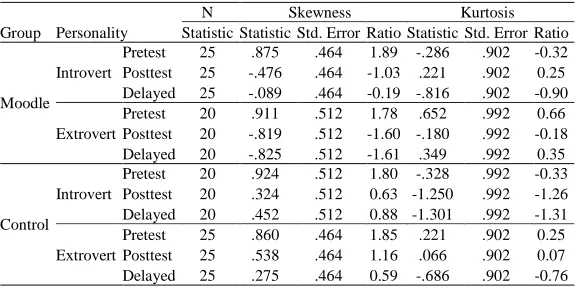
Two-way ANOVA has three assumptions; normality of the data, reliability, and homogeneity of variances of the groups. The normality and reliability assumptions are reported in this section; however, the assumption of homogeneity of variances is checked when reporting the main results. The normality of the data was probed by calculating the ratios of skewness and kurtosis indices over their standard errors. Since the absolute values of these ratios were lower than 1.96, it could be claimed that the assumption of normality was retained.
Table 1
Descriptive Statistics for Testing Normality Assumption of the Three Measures
Group Personality
N Skewness Kurtosis
Statistic Statistic Std. Error Ratio Statistic Std. Error Ratio
Moodle Introvert
Pretest 25 .875 .464 1.89 -.286 .902 -0.32
Posttest 25 -.476 .464 -1.03 .221 .902 0.25
Delayed 25 -.089 .464 -0.19 -.816 .902 -0.90
Extrovert
Pretest 20 .911 .512 1.78 .652 .992 0.66
Posttest 20 -.819 .512 -1.60 -.180 .992 -0.18
Delayed 20 -.825 .512 -1.61 .349 .992 0.35
Control Introvert
Pretest 20 .924 .512 1.80 -.328 .992 -0.33
Posttest 20 .324 .512 0.63 -1.250 .992 -1.26
Delayed 20 .452 .512 0.88 -1.301 .992 -1.31
Extrovert
Pretest 25 .860 .464 1.85 .221 .902 0.25
Posttest 25 .538 .464 1.16 .066 .902 0.07
Delayed 25 .275 .464 0.59 -.686 .902 -0.76
Table 2 displays the KR-21 reliability indices for the pretest, posttest, and delayed posttest of vocabulary. The reliability indices were .79, .86 and .83 for the three tests, respectively.
Table 2
KR-21 Reliability Indices of Pretest, Posttest, and Delayed Posttest of Vocabulary
N Min Max Mean Std. Deviation Variance KR-21
Pretest 90 9 35 17.94 6.53 42.72 .79
Posttest 90 12 39 26.41 7.48 55.97 .86
Delayed Posttest 90 13 37 25.51 7.04 49.60 .83
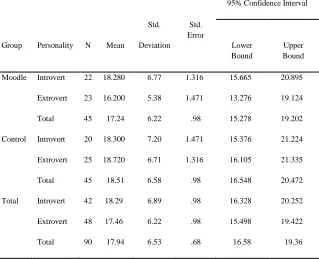
means on the pretest of vocabulary in the Moodle and control groups to check their homogeneity in terms of their vocabulary knowledge prior to the treatment. The assumption of homogeneity of variances was met by employing Levene's test (p>.05), demonstrating that there was not any significant difference between the two groups' variances on pretest.
Table 2
Descriptive Statistics for Learners' Scores on the Vocabulary Pretest
95% Confidence Interval
Group Personality N Mean
Std.
Deviation Std. Error
Lower Bound
Upper Bound
Moodle Introvert 22 18.280 6.77 1.316 15.665 20.895
Extrovert 23 16.200 5.38 1.471 13.276 19.124
Total 45 17.24 6.22 .98 15.278 19.202
Control Introvert 20 18.300 7.20 1.471 15.376 21.224
Extrovert 25 18.720 6.71 1.316 16.105 21.335
Total 45 18.51 6.58 .98 16.548 20.472
Total Introvert 42 18.29 6.89 .98 16.328 20.252
Extrovert 48 17.46 6.22 .98 15.498 19.422
Total 90 17.94 6.53 .68 16.58 19.36
Figure 1. Means on pretest of vocabulary by groups and personality types
In order to check the significance of such a difference, a two-way ANOVA was utilized the results of which are presented in Table 3.
Table 3
Tests of Between-Subjects Effects for Pretest Scores by Experimental and Control Groups
Source Type III Sum of Squares df Mean Square F Sig. Partial Eta Squared
Group 35.842 1 35.842 .828 .365 .010
Personality 15.309 1 15.309 .354 .554 .004
Group * Personality 34.722 1 34.722 .802 .373 .009
Error 3721.480 86 43.273
Total 32783.000 90
As seen in Table 5, the results of two-way ANOVA [F (1, 86) = .828, p = .365, Partial η2 = .010 representing a weak effect size] indicated that there
was not any significant difference between the two study groups on the pretest of vocabulary. Thus it was concluded that the two groups were homogenous in terms of their vocabulary knowledge before the treatment began. The results of the applied two-way ANOVA [F (1, 86) = .354, p = .554, Partial η2 = .004 representing a weak effect size] also showed that there
5.2 First and Second Research Questions
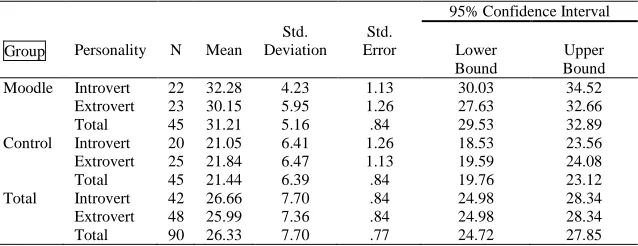
A two-way ANOVA was run to compare the extrovert and introvert learners' mean scores on the posttest of vocabulary in the Moodle and control groups to probe if types of treatments (Moodle vs. tradition) and personality types (extrovert vs. introvert) had any significant effect on the development of vocabulary knowledge among Iranian EFL learners. The assumption of homogeneity of variances was checked in advance of the analysis (p>.05). Table 4 displays the descriptive statistics for the Moodle and control groups on the posttest of vocabulary across two personality types.
Table 4
Descriptive Statistics for the Vocabulary Posttest for Groups by Personality Types
95% Confidence Interval
Group Personality N Mean
Std. Deviation
Std.
Error Lower
Bound
Upper Bound
Moodle Introvert 22 32.28 4.23 1.13 30.03 34.52
Extrovert 23 30.15 5.95 1.26 27.63 32.66
Total 45 31.21 5.16 .84 29.53 32.89
Control Introvert 20 21.05 6.41 1.26 18.53 23.56
Extrovert 25 21.84 6.47 1.13 19.59 24.08
Total 45 21.44 6.39 .84 19.76 23.12
Total Introvert 42 26.66 7.70 .84 24.98 28.34
Extrovert 48 25.99 7.36 .84 24.98 28.34
Total 90 26.33 7.70 .77 24.72 27.85
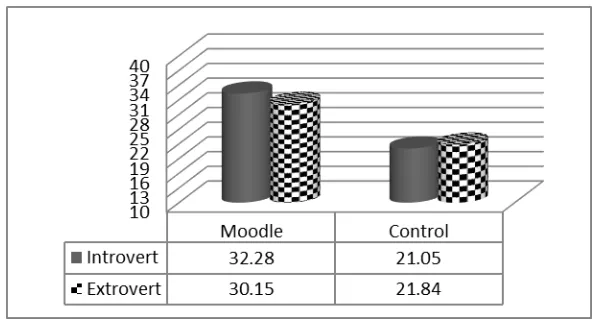
Figure 2. Means on vocabulary posttest for groups across personality types
The results of two-way ANOVA (Table 10) [F (1, 86) = 66.48, p = .000, Partial η2 = .436 representing a large effect size] indicated that the Moodle
group significantly outperformed the control group on vocabulary posttest. Table 5
Tests of Between-Subjects Effects for Vocabulary Posttest by Groups Across Personality Types
Source
Type III Sum of
Squares df
Mean
Square F Sig.
Partial Eta Squared
Group 2121.176 1 2121.176 66.482 .000 .436
Personality 9.976 1 9.976 .313 .578 .004
Group *
Personality 47.369 1 47.369 1.485 .226 .017
Error 2743.900 86 31.906
Total 67761.000 90
Two-way ANOVA also demonstrated that there was not any significant difference between the extrovert and introvert groups on the posttest of vocabulary. [F (1, 86) = .313, p = .578, Partial η2 = .004 representing a weak
effect size]. In addition, no significant interaction was observed between groups and personality types the vocabulary posttest [F (1, 86) = 1.48, p = .226, Partial η2 = .017 representing a weak effect size].
5.3 Third and Fourth Research Questions
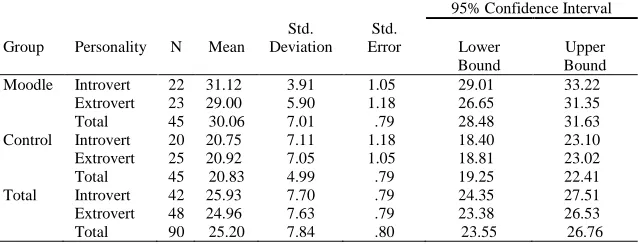
and introvert groups’ means on the delayed posttest to probe any significant difference in the retention of vocabulary among study groups. The assumption of homogeneity of variances was met. Table 6 displays the descriptive statistics for the Moodle and control groups on the delayed posttest of vocabulary.
Table 6
Descriptive Statistics for the Delayed Posttest by Groups and their Subdivisions
95% Confidence Interval
Group Personality N Mean
Std. Deviation
Std.
Error Lower
Bound
Upper Bound
Moodle Introvert 22 31.12 3.91 1.05 29.01 33.22
Extrovert 23 29.00 5.90 1.18 26.65 31.35
Total 45 30.06 7.01 .79 28.48 31.63
Control Introvert 20 20.75 7.11 1.18 18.40 23.10
Extrovert 25 20.92 7.05 1.05 18.81 23.02
Total 45 20.83 4.99 .79 19.25 22.41
Total Introvert 42 25.93 7.70 .79 24.35 27.51
Extrovert 48 24.96 7.63 .79 23.38 26.53
Total 90 25.20 7.84 .80 23.55 26.76
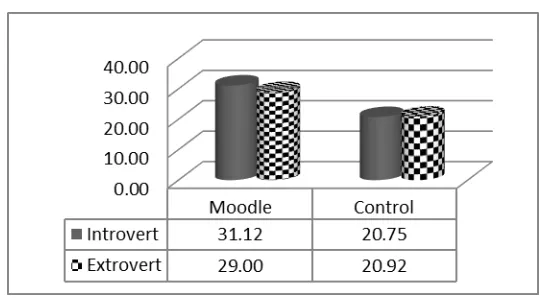
Figure 3. Means on delayed posttest of vocabulary by groups and personality types
Running a two-way ANOVA (Table 7) discovered that the Moodle group significantly outperformed the control group on the delayed posttest of vocabulary [F (1, 86) = 67.64, p = .000, Partial η2 = .440 representing a large
effect size]. Table 7
Tests of Between-Subjects Effects for Delayed Vocabulary Posttest by Groups Across Personality Types
Source
Type III Sum of
Squares Df
Mean
Square F Sig.
Partial Eta Squared
Group 1891.125 1 1891.125 67.646 .000 .440
Personality 21.125 1 21.125 .756 .387 .009
Group *
Personality 29.134 1 29.134 1.042 .310 .012
Error 2404.230 86 27.956
Total 62988.000 90
Based on two-way ANOVA results (Table 7), no significant difference between the extrovert and introvert groups on the delayed posttest of vocabulary was detected [F (1, 86) = .756, p = .387, Partial η2 = .009
representing a weak effect size]. Furthermore, the interaction between groups and personality types on this test was not significant [F (1, 86) = 1.04, p = .310, Partial η2 = .015 representing a weak effect size].
6. Discussion
on vocabulary improvement and retention. Included here also was the introversion and extroversion of the participants as one of the personality traits.
As just mentioned, this study was an attempt to investigate the effect of applying a virtual learning environment, called Moodle, on vocabulary improvement and retention. Of interest here was also examining the effect of introversion and extroversion. Having amassed the results of the research, the following findings were obtained.
In the first place, comparing the results of vocabulary posttests between the experimental and vocabulary group clearly indicated that applying Moodle as a virtual learning environment can have a significant effect on improving vocabulary learning among Iranian EFL learners. This finding is in line with a number of other studies among which the one conducted by Laufer (2000) can be mentioned. With the minor difference that he added an online dictionary to the treatment, he went through the same procedure as the one in the present study, having finally reported that learners' vocabulary skills were significantly improved compared to those sitting for conventional classes. Another seminal, more recent, study the findings of which is in harmony with the ones in this study is Tozcu and Coady's (2004). They investigated the effect of direct vocabulary learning through CALL on vocabulary knowledge. They found that students who used CALL to learn high frequency words mastered a much larger number of words than those in a control group.
classes. The results showed that the learners who received online teaching performed better than the other group in the test of the vocabulary. Working on other variables, Kirkgoz (2011) investigated the speaking ability of student teachers of English using face-to-face instruction as well as technology (i.e., video). At the end of the experiments, students' oral communication skills changed significantly.
As just said, the results showed that the experimental group showed a better performance than the control group in English vocabulary knowledge. This result agreed with that of some previous studies such as Soltani, Tehrani, and Tabatabaie (2012). They carried out a study on the effect of blended on-line and face-to-face instruction on Iranian EFL learners' vocabulary achievement using on-line environment of Nicenet. The results showed the efficiency of the used VLE compared with the traditional paper-and-pencil approaches.
Another study which corroborates the findings of the present is the one carried out by Shafaei (2011) which examined the effect of online learning on vocabulary retention. This research included an empirical case study of a project conducted for vocabulary learning of elementary EFL learners in Iran. According to the analysis and discussion of the outcomes of her study, there was a significant relationship between using online teaching techniques in foreign language teaching and the learners' performance on standard vocabulary tests, even in delayed posttests. She concluded that using virtual learning environment accelerated vocabulary learning and improved vocabulary retention.
this difference.
7. Conclusion and Implications
The main conclusion is that CALL-mediated teaching, here Moodle, had a significant effect on developing vocabulary, both in knowledge and retention. This implies that CALL and VLE's can be considered as effective tools in manipulating L2 skills and subskills. On the other side, introversion and extroversion was not found effective, meaning this personality trait can readily embrace both groups, which is a favorable development in any educational system.
As revealed in the present study as well as other studies (Beatty, 2003; Roed, 2003; Vinther, 2011; Wiebe & Kabata, 2010), CALL has advantages over traditional classroom teaching and learning which can be attributed to many factors including motivation and autonomy for learners, flexible learning, immediate and detailed feedback, reducing anxiety, and enhancing learners’ involvement and participation. Like other empirical research, the findings of the present study are not definitive. In other words, the findings do not suggest that virtual learning described in this study is the only best way to improve vocabulary learning and retention, but rather they represent a useful construct to be employed by teachers as a basis for enhancing learners' performance in vocabulary.
design and adapt language learning materials for improving vocabulary knowledge and retention of participants.
The current vocabulary learning activities can be criticized because they take much of the class time and the teacher's energy. If vocabulary learning integrates to other language skills and components like presenting through Moodle instruction framework, it would help to save teachers' time and energy. More specifically, VLE's should be introduced into EFL teachers' curriculum. In addition to this, material developers can consider VLE intervention while producing EFL lessons related to vocabulary instruction. Here, the inclusion of some tasks and exercises to be done virtually can be seen appropriate.
Clearly, no research effort is exhaustive in itself; thus further research is needed to confirm, validate, and expand upon the results of it. That is why replication of the current study should be mentioned as the main suggestion. This aside, the participants of this study were intermediate learners; replications should be made with participants of other groups and proficiency levels to examine the effect of VLE's in those situations. The same basic design could also be employed for learners of other languages. In the same vein, the effect of implementing VLE's can be gauged within other EFL skills as well as subskills like grammar, speaking, listening, and so on. Moreover, the method used in this study can be accompanied with questionnaires to find out about the attitudes and motivations of the learners and instructors towards Moodle.
Affective factors such as motivation, introversion and extroversion, or attitude towards implementing VLE's have not been given due attention in previous studies, but have begun to be recognized as crucial for more effective use of them. As Schumann (1998) has stated, "success in second language acquisition is emotionally driven'' (p. 323). Learning through VLE's should not be an exception. Any attempt to examine the affect component will definitely widen teachers' and learners' horizons about the virtual world.
References
Ayres, R. (2002). Learner attitudes towards the use of CALL. Computer Assisted Language Learning, 15(3), 241–249.
Barker, J., & Gossman, P. (2013). The learning impact of a virtual learning environment: students’ views. Teacher Education Advancement Network Journal, 5(2), 19–38.
Brown, H. D. (2014). Principles of language learning and teaching (6th ed.).
New York: Pearson Education ESL.
Beatty, K. (2003). Teaching and researching computer assisted language learning. New York: Longman: Pearson Education.
Beatty, B., & Ulasewicz, C. (2006). Online teaching and learning in transition: Faculty perspectives on moving from blackboard to the Moodle learning management system. Tech Trends, 50(4), 36–45.
Burston, J. (2013). Mobile-assisted language learning: A selected annotated bibliography of implementation studies from 1994-2012. Language Learning and Technology, 17(3), 157–225.
Carrell, P., Prince, M. S., & Astika, G. (1996). Personality types and language learning in an EFL context. Language Learning, 46(1), 75–99. Chapelle, C. A. (2001). Computer applications in second language
acquisition: Foundations for teaching, testing and research. Cambridge: Cambridge University Press.
Dewaele, J. M., & Furnham, A. (1999). Extraversion: The unloved variable in applied linguistic research. Language Learning, 49(3), 509–544. Dudeney, G., & Hockly, N. (2007). How to teach English with technology.
England: Pearson Education Limited.
Ellis, R. (2008). The study of second language acquisition (2nd ed.). Oxford:
Oxford University Press.
Golaghaei, N., & Sadighi, F. (2013). Extroversion/introversion and breadth of vocabulary knowledge. Modern Journal of Language Teaching Methods, 3(3), 218–232.
Gunduz, N. (2005). Computer assisted language learning. Journal of Language and Linguistics, 1(2), 193–214.
Hatch, E., & Lazaraton, A. (1991). The research manual: Design and statistics for applied linguistics. Boston: Heinle & Heinle.
Hill, M. (1998). A word in your ear: Vocabulary acquisition by Chinese tertiary students. In N. Bird, P. Falvey, A. B. M. Tsui, D. M. Alison, & A. McNeill (Eds.), Language and Learning (pp. 447–462). Hong Kong: Government Printer.
Holyoke, M. (2011). Virtual learning environment (VLE) or managed learning environment (MLE). Electronic Learning, 11(2), 66–79.
Kilickaya, F., & Krajka, J. (2010). Comparative usefulness of online and traditional vocabulary learning. TOJET, 9(2), 55–63.
Kirkgoz, Y. (2011). A blended learning study on implementing video recorded speaking tasks in task-based classroom instruction. TOJET, 10(4), 1–13.
Laufer, B. (2000). What's in a word that makes it hard or easy: Some intralexical factors that affect the learning of words. In N. Schmitt, & M. McCarthy (Eds.), Vocabulary: Description, acquisition and pedagogy (pp. 140–180). Cambridge: Cambridge University Press.
Levy, M. (1997). CALL: Context and conceptualization. Oxford: Oxford University Press.
Mackey, A., & Gass, S. M. (2012). Research methods in second language acquisition: A practical guide. Malden, MA: Wiley-Blackwell.
Mayer, J. D. (2007). Personality: A systems approach. Boston: Allyn & Bacon.
Myers, I. B. (1962). The Myers-Briggs type indicator manual. Princeton, NJ: Educational Testing Service.
Murphy, E. (2009). Online synchronous communication in the second-language classroom. Canadian Journal of Learning and Technology, 35(3), 10–22.
Nam, J. (2010). Linking research and practice: effective strategies for teaching vocabulary in the ESL classroom. TESL Canada Journal, 28(1), 127–135.
Nation, I.S.P. (2001). Learning vocabulary in another language. Cambridge: Cambridge University Press.
Pennebaker, J. W., & King, L. A. (1999). Linguistic styles: Language use as an individual difference. Journal of Personality and Social Psychology, 77, 1296–1312.
Roed, J. (2003). Language learner behavior in a virtual environment. Computer Assisted Language Learning, 16(2-3), 155–172.
Schmitt, N. (2014). Size and depth of vocabulary knowledge: What the research shows. Language Learning, 64(4), 913–951.
Schmitt, N., & Schmitt, D. (2014). A reassessment of frequency and vocabulary size in L2 vocabulary teaching. Language Teaching, 47(4), 484–503.
Schumann, J. H. (1998). The neurobiology of affect in language. A Supplement to Language Learning, 48, 320–326.
Shafaei, A., (2011). Effect of project-based learning on vocabulary recall and retention, case study from Iran. The Modern Language Journal, 44(2), 67–84.
Soleimani, H., Rahimi, Z., & Sadeghi, H. (2015). Project-based learning and its positive effects on Iranian intermediate EFL learners' reading ability and vocabulary achievement. International Journal of English Language and Literature Study, 4(1), 1–9.
Soltani Tehrani N., & Tabatabaei, O. (2012). The impact of blended online learning on Iranian EFL learners' vocabulary achievement. International Electronic Journal for the Teachers of English, 2(5), 73–88.
Sonbul, S., & Schmitt, N. (2013). Explicit and implicit lexical knowledge: Acquisition of collocations under different input conditions. Language Learning, 63(1), 121–159.
Stanford, J. (2009). Moodle 1.9 for second language teaching: Engaging online language learning activities using the Moodle platform. Birmingham: Packt Publishing Limited.
Svenconis, D. J., & Kerst, S. (1994). Investigating the teaching of second language vocabulary through semantic mapping in a hypertext environment. CALICO Journal,12(2-3), 33–57.
Tower, D. (2000). A quantitative interaction analysis of an authentic CALL environment: New dynamic English. Unpublished M.A. thesis. Iowa State University.
Tozcu, A., & Coady, J. (2004). Successful learning of frequent vocabulary through CALL also benefits reading comprehension and speed. Computer Assisted Language Learning, 17(5), 473–495.
Vinther, J. (2011). Enhancing motivation with cultural narratives in computer-mediated communication. Computer Assisted Language Learning, 24(4), 337–352.
Walker, A., & White, G. (2013). Technology enhanced language learning: Connecting theory and practice. Oxford: Oxford University Press.
Weller, M. (2007). Virtual learning environments. The American Journal of Distance Education, 24(2), 65–80.
Wiebe, G., & Kabata, K. (2010). Students' and instructors' attitudes toward the use of CALL in foreign language teaching and learning. Computer Assisted Language Learning, 23(3), 221–234.