Vol. 5, Issue 2, June 2015
1
Vol. 5, Issue 2, June 2015
2
Modern Journal of Language Teaching Methods
(MJLTM)
ISSN: 2251 - 6204
www.mjltm.com
Editor – in – Chief
Hamed Ghaemi, PhD in TEFL, Islamic Azad University, Iran
Editorial Board
Abednia Arman, PhD in TEFL, Allameh Tabataba‟i University, Tehran, Iran
Azizi Masoud, PhD in Applied Linguisitcs, University of Tehran, Iran
Basiroo Reza, PhD in TEFL, University of Tehran, International Campus, Iran
Elahi Shirvan Majid, PhD in TEFL, Ferdowsi University of Mashhad, Iran
Fernández Miguel, PhD, Chicago State University, USA
Ghaemi Hamide, PhD in Speech and Language Pathology, Mashhad University of Medical
Sciences, Iran
Grim Frédérique M. A., Associate Professor of French, Colorado State University, USA
Izadi Dariush,
PhD candidate in Applied Linguistics, Macquarie University, Sydney,
Australia
Kargozari Hamid Reza, PhD Candidate in TEFL, Payame Noor University of Tehran,
Iran
Kaviani Amir, Assistant Professor at Zayed University, UAE
Kirkpatrick Robert, Assistant Professor of Applied Linguistics, Shinawatra International
University, Thailand
Morady Moghaddam Mostafa, PhD Candidate in TEFL, University of Tabriz, Iran
Ndhlovu Finex, PhD, Linguistics Programme, University of New England, Australia
Raddaoui
Ali Hechemi, PhD, Associate Professor of Applied Linguistics, University of
Wyoming in Laramie, USA
Rezaei Saeed, PhD in TEFL, Sharif University of Technology, Tehran, Iran
Rolstad Kellie, PhD, Associate Professor of Education, University of Maryland, USA
Shahbazirad Mohammad, PhD in English language and Literature, Yerevan State
University, Armenia
Weir George R. S., PhD in Philosophy of Psychology, University of Strathclyde, Glasgow,
UK
Zegarac Vladimir, PhD, University of Bedfordshire, UK
Vol. 5, Issue 2, June 2015
3
Abstracting and Indexing
Vol. 5, Issue 2, June 2015
4
Vol. 5, Issue 2, June 2015
5
Vol. 5, Issue 2, June 2015
6
Vol. 5, Issue 2, June 2015
7
TABLE OF CONTENTS
THE EFFECTS OF TYPES OF ASSESSMENT (CLOZE, OPEN- ENDED, TRUE/ FALSE) ON IRANIAN UPPER INTERMEDIATE MALE AND FEMALE EFL LEARNERS' READING COMPREHENSION PROFICIENCY………..……….12 Saeideh Ahangari, Zahra Ghorbani and Zahra Hassanzadeh
THE EFFECT OF READING ACADEMIC TEXTS ON LEARNING AND RETENTION OF ACADEMIC VOCABULARY: INVESTIGATING THE ROLE OF MODEL ESSAY……….………22 Mohammad Sadegh Alijany, Niloofar Mansoory and Hoda Divsar
EFFECTIVENESS OF WASHBACK IN LANGUAGE TESTING: ANALYZING THE VALIDITY AND RELIANILITY………..…33 Mohammad A. Altowaim
THE IMPACT OF CONTRASTIVE ANALYSIS BASED PRONUNCIATION TEACHING ON IRANIAN EFL LEARNERS' LISTENING COMPREHENSION………..39
Mojgan Aminaeiand Shahrokh Jahandar
EFFECT OF CALL-BASED AND FLASH CARD-BASED TECHNIQUES OF TEACHING ON THE TARGET LANGUAGE VOCABULARY LEARNING………..49 Behzad Barkat and Naeemeh Aminafshar
THE RELATIONSHIP AMONG LINGUISTIC INTELLIGENCE, ETHNIC IDENTITY, AND BILINGUAL IRANIAN EFL LEARNERS‘ READING COMPREHENSION……….55 Amir Reza Nemat Tabrizi and Foad Amjadi
THE EVALUATION OF TOP NOTCH SERIES FOR INTENSIVE LANGUAGE COURSE FROM IMAM ALI TEACHERS‘ AND STUDENTS‘ PERSPECTIVE………...66 Saman Ebadi and Hossein Bakhshi
A CROSS-CULTURAL STUDY OF COMPLIMENT RESPONSE PATTERNS ACROSS GENDER IN PERSIAN AND ENGLISH……….…78 Saman Ebadi, Maryam Beigzadeh and Sajad Sabzevari
THE EFFECT OF TEXT RECONSTRUCTION ON IRANIAN INTERMEDIATE EFL LEARNERS‘ WRITING PERFORMANCE……….……93 Mitra Borji and Masoumeh Arjmandi
THE EFFECT OF DEICTIC EXPRESSIONS ON IRANIAN INTERMEDIATE EFL LEARNERS‘ TEXT INTERPRETATION………..…100 Hamed Damnia and Masoomeh Arjmandi
LEARNER-CENTERED APPROACHES OF LANGUAGE TEACHING AT THE SERVICE OF LANGUAGE INSTRUCTORS IN HONG KONG………109
Sepeedeh Hanifehzadehand Sara Ebrahimi
THE IMPACT OF SPEECH RATE ON IRANIAN INTERMEDIATE EFL LEARNERS' LISTENING COMPREHENSION ABILITY……….…119 Azadeh Ebrahimzadeh Maboud and Morteza Khodabandehlou
THE EFFECT OF USING IELTS SPEAKING CORPUS (ISC) ON IRANIAN EFL LEARNERS‘ SPEAKING ABILITY ACROSS GENDER……….…126 Aghigh Edalatkhah and Masoumeh Arjmandi
Vol. 5, Issue 2, June 2015
8
A COMPARISON OF IELTS SPEAKING ASSESSMENT CRITERIA AND AN IELTS PREPARATION BOOK IN TERMS OF SPEAKING STRATEGIES……….135 Touran Ahour and Saeideh Entezari MalekiIRANIAN EFL LEARNERS‘ CRITICAL THINKING AND THEIR LISTENING COMPREHENSION TEST PERFORMANCE……….……..146 Zohreh Seifori and Farhad Golpour
THE ROLE OF BRAINSTORMING IN ENHANCING IRANIAN EFL LEARNERS‘ SPEAKING PROGRESS AND ACHIEVEMENT………...……157 Ali Hamideh, Mohammad Rostampour and Seyed Jamal Abdorahimzadeh
PROFESSIONAL BURNOUT FROM SOCIAL COMPARISON THEORY: A CASE OF IRANIAN ENGLISH LANGUAGE TEACHERS……….…170 Jaleh Hassaskhah, Maryam Danaye Tous and Niloufar Saber
THE RELATIONSHIP BETWEEN ASSERTIVENESS AND WRITING ABILITY AMONG IRANIAN INTERMEDIATE EFL LEARNERS……….…182 Mohsen Hosseinzadeh Kakroudi, Fereidoon Vahdany and Hoda Divsar
ON THE RELATIONSHIP BETWEEN COGNITIVE STYLES AND WRITING SKILL OF IRANIAN EFL STUDENTS OF UNIVERSITY……….194 Tayyebeh Javadi Shalmani, Fereidoon Vahdany and Hoda Divsar
THE EFFECT OF RECAST ON THE IMPROVEMENT OF IRANIAN EFL LEARNERS‘ SPEAKING ABILITY………..…203 Somayeh Kishani Farahani and Mohammad Reza Khodashenas
THE EFFECTS OF USING BI-LINGUAL TASKS ON IRANIAN EFL LEARNERS' PREPOSITION ERRORS……..………209 Sara Kianoory
THE PROMISING FUNCTION OF CULTURE INCLUSION IN ELT
EDUCATION.………215 Marzieh Mehrnoush and Sima Sayadian
TASK SELF- ASSESSMENT AND READING SKILL OF EFL
STUDENTS……….…………219
Shahin Sheikhand Seyedeh Masoumeh Mirhashem
WORDS OF DOOM IN WINTER POEMS AKHAVAN SALES………223
Mohammad Behnamfar,Golnaz Mirsalari and Seyed Mehdi Rahimi
THE ROLE OF IRANIAN EFL STUDENTS FEEDBACK ON TEACHING IN THEIR READING ACHIEVEMENT………233 Reza Nejati and Abdolhossein Molaee
FREQUENCY OF OCCURRENCE AND THE LEARNING OF
COLLOCATIONS………..……241 Bahman Motaei
ISSUES IN VOCABULARY LEARNING AND TEACHING……….…247 Mohammad Nowbakht, Ahmad Moinzadeh and Azizollah Dabaghi
THE EFFECT OF INFORMATION GAP ACTIVITIES ON SPEAKING ABILITY OF IRANIAN FEMALE STUDENTS………...260 Ebrahim Panjehkoubi, Alireza Bonyadi and Farahnaz Rimani Nikou
Vol. 5, Issue 2, June 2015
9
AN INVESTIGATION INTO AUTHENTICITY OF IRANIAN HIGH SCHOOL ENGLISH TEXTBOOKS………..………268 Toran Ahour and Samira RahbarANALYZING THE ROLE OF TEACHER FOLLOW UP MOVES IN CONTENT-BASED
CLASSROOMS AMONG IRANIAN TEFL AND ENGLISH LITERATURE
LEARNERS……….…………276 Ziba Sadighi Tasuj and Tayebeh Samadi
THE EFFECT OF DIRECT AND PEER FEEDBACK ON ACCURACY OF EFL LEARNERS‘ WRITTEN PERFORMANCE………..……296 Mir Reza Khorasani and Azizeh sadzadeh
THE EFFECTS OF CONTENT-BASED INSTRUCTION ON THE WRITING SKILLS OF IRANIAN INTERMEDIATE EFL LEARNERS………309 Hooshang Khoshsima, Mehrdad Azad and Farshid Saeedi
THE EFFECT OF USING TEACHER MADE SCORING CHECKLIST ON IRANIAN ADVANCED EFL LEARNERS‘ COMPOSITION SCORES……….…321 Mojtaba Safaie and Ramin Rahimy
SOME BASIC GUIDELINES ON TEACHING ENGLISH AS A SECOND/FOREIGN LANGUAGE………..330 Taher Sarhady
A CLOSER LOOK AT LEARNERS‘ USE OF DEFINITE AND INDEFINITE
ARTICLES………..………337 Fereidoon Vahdany, Zohreh Sarvarahmadi and Hoda Divsar
A COMPARATIVE ANALYSIS OF THE MACRO-STRUCTURE FEATURES OF RESEARCH
ARTICLE INTRODUCTIONS IN THE FIELDS OF SOCIOLOGY AND
LINGUISTICS……….………347 Sara Shahab and Nader Assadi Aidinlou
AN INVESTIGATION OF THE RELATIONSHIP BETWEEN EMOTIONAL INTELLIGENCE AND THINKING STYLES AMONG IRANIAN EFL LEARNERS…………...………356 Noushin Shiravand and Abollah Sarani
THE COMPARISON AND ANALYSIS OF MACRO-STRUCTURE SCHEMATIZATION OF ENGLISH AND PERSIAN BLURBS………...………361 Saman Ebadi and Fereshteh Shirzad
THE VERBAL INPUT IMPACT OF WORKING-CLASS VS. MIDDLE-CLASS MOTHERS ON THE LANGUAGE ACQUISITION OF IRANIAN CHILDREN………..………371 Rozi Souzanzan and Firooz Sadighi
REPAIR OPERATIONS AND GENDER DIFFERENCES IN ORAL DISCOURSE OF IRANIAN EFL STUDENTS……….………381 Amirhossein Talebi and Ahmad R. Lotfi
THE IMPACT OF PRAGMATIC AWARENESS TECHNIQUES ON EFL LEARNER 'S REAL LIFE USE OF L2………..…………390 Masoud Khalili Sabet and Nushin Veisy
Vol. 5, Issue 2, June 2015
10
A COMPARATIVE STUDY OF LEANING STYLES AND STRATEGIES ADOPTED BY HIGH ANDLOW PROFICIENT EFL LEARNERS: AN IRANIAN
CASE………401 Zohreh Seifoori and Mohammad Ali Yaghchi
THE EFFECT OF DISCUSSION-BASED ACTIVITIES ON THE SPEAKING ABILITY OF IRANIAN INTERMEDIATE EFL FEMALE ENGLISH LEARNERS………....412 Sohrab Yarahmadi, Alireza Bonyadi and Farahnaz Rimaninikou
THE RELATIONSHIP BETWEEN IRANIAN EFL LEARNERS‘ EMOTIONAL QUOTIENT (EQ) AND THEIR LANGUAGE PROFICIENCY……….……420 Hamid Hosseinpoor, Mohammad Taghvaee and Ali Zangoei
THE EFFECT OF PLANNED DISCUSSION ON PARAMETERS OF SPEAKING SKILL OF IRANIAN INTERMEDIATE EFL FEMALE ENGLISH LEARNERS………434 Sohrab Yarahmadi, Alireza Bonyadi and Farahnaz Rimani Nikou
UNIVERSITY PROFESSORS‘ AND STUDENTS‘ PERCEPTIONS AND SATISFACTION TOWARD
ENGLISH LANGUAGE TEACHING E-LEARNING EDUCATIONAL
SYSTEM………..…444 Sara Pourbonakdar and Fahime Mohamadi Khanaposhtani
SELF- ASSESSMENT TASK AND READING SKILL OF EFL STUDENTS……….….451 Shahin Sheikh and Seyedeh Masoumeh Mirhashem
IRANIAN EFL LEARNERS‘ PERCEPTION OF TEACHING IMPOLITENESS: GENDER IN FOCUS……….……456 Maryam Babapour and Biook Behnam
THE EFFECT OF SELF-CORRECTION AND PEER-CORRECTION ON EFL LEARNERS‘ WRITING ACCURACY IMPROVEMENT ACROSS PROFICIENCY………..……465 Saeideh Ahangari and Maryam Babapour
THE EFFECT OF GENRE-BASED APPROACH ON ENHANCING WRITING SKILL OF IRANIAN LAW STUDENTS………..…474 Kazem Najmi
THE COMPARATIVE EFFECT OF COMPETITIVE LEARNING AND COOPERATIVE LEARNING ON IRANIAN EFL LEARNERS‘ VOCABULARY RETENTION……….484 Zohreh Seifoori and Pezhman Nourzad Haradasht
THE EFFECT OF GENRE-BASED CLASSROOM INSTRUCTION OF ESP ON ENHANCING
READING COMPREHENSION PROFICIENCY OF IRANIAN LAW
STUDENTS……….…492 Kazem Najmi
THE RELATIONSHIP BETWEEN TASK BASED LANGUAGE PERFORMANCE ASSESSMENT AND COGNITION HYPOTHESIS………501 Saedeh Ahangari and Pezhman Nourzad Haradasht
DATA GATHERING INSTRUMENTS IN CROSS CULTURAL PRAGMATICS………507 Zahra Loghmani
DEVELOPMENT AND CONSTRUCT VALIDATION OF THE PRONUNCIATION BARRIERS QUESTIONNAIRE (PBQ) IN IRAN………...…515 Hamed Ghaemi, Fariba Zanjani and Soudabe Rezakhah Khadem
Vol. 5, Issue 2, June 2015
11
UNIVERSITY PROFESSORS‘ AND STUDENTS‘ PERCEPTIONS AND SATISFACTION TOWARDENGLISH LANGUAGE TEACHING E-LEARNING EDUCATIONAL
SYSTEM………..520 Sara Pourbonakdar and Fahime Mohamadi Khanaposhtani
IRANIAN SECONDARY SCHOOL EFL STUDENTS‘ ATTITUDES TOWARD CORRECTION OF ORAL ERRORS………..527 Vahid Safari Zand
THE REASONING TOWARDS USING DYNAMIC ASSESSMENT IN EFL (ENGLISH AS A FOREIGN LANGUAGE) EDUCATIONAL SYSTEM IN IRAN……….534 Saeideh Ahangari and khodaverdi Alizadeh
A SOCIOLINGUISTIC INVESTIGATION OF ENGLISH TEXTBOOKS (A CASE STUDY: GENERAL ENGLISH IN AHAR AZAD UNIVERSITY)……….…541 Zohreh Seifoori and Khodaverdi Alizadeh
THE STUDY OF USING POLITENESS STRATEGIES IN REQUEST BY IRANIAN UNIVERSITY STUDENTS……….…547 Biook Behnam and Farhad Golpour
THE COMPARISON OF COMPUTER ASSISTED TEACHING AND TRADITIONAL EXPLICIT METHOD IN LEARNING/TEACHING ENGLISH VOCABULARY……….554 Sirous Izadpanah and Jafar Asadi
STATE-OF-THE-ART ARTICLE: A SYSTEMATIC REVIEW OF DISCOURSE ANALYSIS IN
ENGLISH AS A FOREIGN LANGUAGE: FOCUS ON IRANIAN
CONTEXT……….570 Hojat Jodaei and Saeed Ghaniabadi
THE RELATIONSHIP BETWEEN SELF-ASSESSMENT AND READING SKILL OF FEMALE EFL STUDENTS……….…580
Shahin Sheikhand Seyedeh Masoumeh Mirhashem
THE EFFECT OF MI-ORIENTED LANGUAGE TEACHING ON READING COMPREHENSION OF
IRANIAN TECHNICAL AND VOCATIONAL COLLEGE
STUDENTS……….586 Zohreh Seifoori and Milad Ramezani
THE STUDY OF THE RELATIONSHIP BETWEEN EMOTIONAL INTELLIGENCE AND WRITING SKILL ON IRANIAN EFL LEARNERS………..…595 Mohammad Shams Nosrati and Ghasem Aghajanzadeh Kiasi
Vol. 5, Issue 2, June 2015
12
THE EFFECTS OF TYPES OF ASSESSMENT (CLOZE,
OPEN- ENDED, TRUE/ FALSE) ON IRANIAN UPPER
INTERMEDIATE MALE AND FEMALE EFL LEARNERS'
READING COMPREHENSION PROFICIENCY
Saeideh Ahangari
Department of English, Tabriz Branch, Islamic Azad University, Tabriz, Iran [email protected] ; [email protected]
Zahra Ghorbani
Roudbar Branch, Islamic Azad University, Iran [email protected]
Zahra Hassanzadeh
Department of English, Tabriz Branch, Islamic Azad University, Tabriz, Iran [email protected]
ABSTRACT
The purpose of this study was to investigate the possible effects of three types of reading assessment on Iranian upper intermediate EFL learners' reading skill. A pretest-posttest quasi-experimental design was employed in this study. The subjects of the study consisted of 120 upper intermediate male and female EFL learners. These subjects were divided into four groups. During treatment, reading comprehension was assessed through cloze type for Group A; open-ended type for group B; true/false item for group C, and a combination of cloze, open- ended , and T/F for group D in each reading session. All groups were pretested to measure their initial reading skill before conducting the experiment. The experiment lasted for about 3 months. After treatment, a posttest was administered to all groups again. The collected data were analyzed using analyses of variance and t-test. The pre-test data analyses revealed that there were no significant differences in the initial reading skills between the four groups (p ≥ 0.05). However, the post-test data analyses showed that there was a statistically significant difference among the four groups of (p≤.05). These findings suggest that reading assessment in the form of various formats is more influential in improving upper intermediate EFL students' reading skills than single types of assessment. The findings imply that a multi-dimensional comprehensive approach to reading assessment is more likely to improve reading skills of upper intermediate-level EFL students.
Keywords: assessment, cloze, open- ended, true/ false
1. Introduction
In language testing, examiners can use different types of test formats for evaluating learners‘ understanding of the main subjects. Tests may have a variety of formats, lengths, item types, scoring criteria, and media. Miller et al. (2009, p.139) state, ―The significant objective of classroom testing and assessment is to get valid, reliable, and useful information with respect to the student achievement‖. In general, test formats can be classified into two main categories including recognition tests and production tests (Farhady, 1985). The most common forms of recognition tests are true-false, multiple-choice and matching-type items. In recognition items, examinees need to comprehend the stem and then recognize and choose the right answer. In true-false items, a stem is given and the examinees are required to recognize whether the idea introduced in the stem is true or false (Farhady,
Vol. 5, Issue 2, June 2015
13
1985). Multiple choice (MC) items, on the other hand, include a stem, which is followed by a few alternatives. Cloze-tests have also been used for evaluating reading comprehension. Taylor (1953) first used the term ―cloze-test‖. He defined cloze procedure as a new tool for measuring readability. He believes that the term "cloze" is derived from Gestalt psychology concept of ―closure‖. It explains a propensity that people have to finalize a known, but not quite completed pattern. An alternative way of testing reading comprehension is by ended questions. In production tests like open-ended questions, the learners are required to produce language. Open-open-ended questions help learners to take the test and answer the questions in their own way, in comparison to questions with limited multiple-choice possibilities (Richards & Schmidt, 2002). There are some advantages and disadvantages for different language test types. In a language classroom, tests can be used to diag-nose problematic areas for the learners or determine sources of learning difficulties, indicate the effectiveness of instructions and teaching activities, motivate student involvement in the learning process, show learner development in language learning, and provide students with feedback about their language learning progress for further classroom-based applications of language tests (Brown, 1998; Cohen, 1994).2. Review of literature 2.1 Reading Comprehension
Brown (2010) defines reading as a process in which the reader constructs meaning and interacts with text trough combination of prior knowledge and previous experience, information in the text, the stance she or he takes in relationship to the text, and immediate, remembered, or anticipated social interaction and communication (Brown,2010). This means that the way people comprehend reading is related to various reader intentions that are connected to situation context and their social anticipation. According to Alexander (1989,p.12), ―reading is interactive process in which a reader‘s previous understanding of the issue and goal for reading affects what is understood from the passage‖.
Comprehending a reading text implies drawing needed information from it as efficiently as possible (Grellet, 1981). Reading comprehension is a complex task that involves many levels of processing. One of the most basic features of comprehension is the skill to deal with unknown words encountered in text (Paynter, Bodrova, & Doty, 2005). As comprehension involves the interaction of different cognitive skills and processes, there are many situations where difficulties arise that many lead to comprehension failure (Cain & Oakhill, 2007). Alderson (2000, p.1) believes that ―reading comprehension is to process text meaning through some processes of interaction with print‖. Richards and Schmidt (2002, p. 443) state, ―reading is an activity of perceiving a written text in order to understand its contents. This can be done silently (silent reading). The understanding that results is called reading comprehension‖. Arietta (2010, p.5) defines reading comprehension as ―holistic process of constructing meaning from written text through the interaction of the knowledge the reader brings to the text, i.e., word recognition ability, world knowledge, and knowledge of linguistic conventions. The reader‘s interpretation of the language that writer used in constructing the text; and the situation in which the text is read‖. Sadeghi, (2007) states there are two factors, which may affect reading comprehension, namely internal and external factors. The internal factors relates to reader variable. This refers to everything that is related to the reader. Background knowledge, cognitive abilities and strategies, and affective characteristics can be considered internal factors. While the external factors refers to text variable, context variable and writer variable. This study is an attempt to examine the effects of item format on EFL learners' reading comprehension.
2.2 Techniques of Testing Reading Skill
In many second and foreign language-teaching situations, reading receives a significant attention. For many foreign language learners reading is one of their most important goals. According to Richards & Renandya (2002), reading is a skill, which is highly valued by students and teachers. Harris (1968) states that the same general types of tests, which are used to test the reading ability of the native English speakers, have the same effectiveness with the foreign learners of the language. Alderson (2000) identifies three different types of questions used in reading test. He classifies them ―as ―textually explicit‖ questions in which the respondents are able to find both the question information and the correct answer, ―textually implicit‖ questions in which the respondents are expected to find the answer by combining information across sentences and ―scripturally implicit‖ questions, in
Vol. 5, Issue 2, June 2015
14
which the respondent needs to refer to his or her background knowledge since the text does not contain the correct answer itself‖. There are many kinds of testing techniques for reading comprehension. Brown (2004, p. 190) suggested, ―Reading aloud, written response, multiple-choice, picture-cued items, editing, gap filling test, cloze-test, C-test, cloze-elide test, short-answer test, ordering test, and summarizing test‖.Heaton (1991, p. 105) has also suggested ―word matching, sentence matching, picture and sentence matching for initial stages of reading; matching tests for intermediate and advanced stages; true/false reading tests, multiple-choice items, completion, rearrangement, cloze procedures, open-ended and miscellaneous items, and cursory reading‖. Three types of reading test that were examined in this study are discussed in the following section:
2.2.1 Cloze Tests
Cloze tests have been widely used for measuring reading comprehension since their introducing to the testing world by Taylor in (1953). However, Klein-Braley (1982), criticized cloze procedure mostly for their deletion and scoring problems. They introduced their newly developed testing procedure, C-test, which was an expanded form of cloze tests without their deficiencies (Klein-Braley, 1995). After that, the effectiveness of C-test and cloze test became the main interest of the scientists in the field of language testing. Urquhart and Weir (1998, p. 156) further explain that it refers to the tendency of individuals to complete a pattern once that have grasped its overall significance. Harmer (2002, p. 323) states, ―cloze test is the deletion of every nth word in a text‖. Manning (1987) also says that classic cloze words are systematically deleted from a text and the testers are required to replace them. This testing technique is considered appropriate to test reading comprehension. It is based on what Heaton (1991) says, ―Perhaps the most common purpose of the cloze test, is to measure reading comprehension‖.
2.2.2 Open Ended Questions
According to Denton (2007), ―one effective way to expand children‘s curiosity, reasoning ability and creativity is by asking open-ended questions, those with no single right or wrong answer. Instead of predictable answers, open-ended questions elicit fresh insights and ideas, opening minds and enabling teachers and students to build knowledge together‖ (Denton, 2007,p. 46). Open-ended question can be defined as a test item that helps the test taker to answer in his or her own way, in comparison to questions with restricted multiple-choice possibilities (Richards & Schmidt, 2002).
2.2.3 True False Items
Another language test format used in reading assessment is true false format. The Most frequent use of the true-false item is in evaluating the examinee‘s skill to identify the correctness of statements of fact, definitions of terms, and differentiate fact from opinion. True-false tests include various opinion statements to which the examinee is required to answer true or false. In most situations, respondents guesse what opinion the teacher holds and mark the answers accordingly. This is one of the disadvantages of true false items. Proponents of true false items such as Miller (2009) assert that true false items have utility for measuring a broad range of verbal knowledge. In developing the true false item test, Miller (2009,p.184) proposed some factors in organizing true false items test. ―First, avoid broad, general, unimportant and negative statements, avoid long complete sentence, avoid including two ideas in one statement, if opinion is used attribute it in some sources, true statement and false statement should be more or less identical in length. The number of true statements and false statements should be roughly the same‖.
Inspired by the reviewed literature the researchers formulated the following research questions and hypotheses.
RQ1. Does item type (cloze, short-answer, True/ False) significantly affect Iranian upper intermediate
EFL learners' reading proficiency?
H01: Item type (cloze, short-answer, True/ False) does not significantly affect Iranian upper
intermediate EFL learners' reading proficiency.
RQ2. Does item type (cloze, short-answer, True/ False) affect Iranian male and female upper
intermediate EFL learners' reading proficiency differently?
H02: Item type (cloze, short-answer, True/ False) does not affect Iranian male and female upper
intermediate EFL learners' reading proficiency differently.
Vol. 5, Issue 2, June 2015
15
3. MethodologyThis quantitative study was conducted in two high schools in Roodbar, Guilan. The data were collected from students‘ reading comprehension mean scores in four test item formats including cloze, open- ended, true false test, and a combination of the cloze, open- ended, true false test items. They were analyzed and compared in order to find out which one of the test formats were more effective to be used in assessing and improving students‘ reading comprehension.
3.1 Participants
The populations of this study were 120 Iranian upper- intermediate EFL learners (69 female and 51 male participants). Subjects of this study were in fourth grade high school. Their age ranged from 17 to 19. OPT was administered to examine the homogeneity of the participants regarding their general foreign language proficiency at the beginning of the study. The four groups received the same amount of instruction (two sessions a week, 90 minutes each session, nearly 12 weeks).
3.2 Instrumentation and Materials
The instrumentation used in this study included:
- OPT test (Oxford placement test): consisted of 60 multiple choice grammar, reading comprehension,
and vocabulary items for checking the homogeneity of the groups regarding language proficiency. The reliability index was estimated through a pilot study on 15 EFL learners (α= .76).
- Longman complete course for the TOEFL test (Deborah, 2004): reading comprehension tests for both
pretest and posttest were selected from this book. Each test comprised of 40 multiple choice questions (α pretest= .81; α posttest= .79)
- Grade four high school English textbook (Birjandi, Anani Sarab, & Samimi, 2013): the course book
was taught during the instructional sessions.
- Teacher- made reading comprehension tests: To determine possible gradual improvement in
reading comprehension ability of the participants each week, teacher- made tests that were in four formats were developed based on the learners' course book. This study consisted of eight teacher- made tests for each group(8 cloze type for Group A; 8 open-ended type for group B; 8 true/false item for group C, and 8 tests that included a combination of cloze, open- ended , and T/F for group D).
3.3 Procedure
First, OPT test was administered to 156 EFL learners and 120 upper intermediate EFL learners were selected based on Oxford test direction. Next, they were randomly divided into four groups. After that a standard reading comprehension test taken from Longman Preparation Course for the TOEFL Test (Deborah, 2004) was administered to four groups as pre-test. It contained 60 questions in multiple-choice form. All the participants received the same educational instructions. The reading passages were taught in three phases (pre reading- while reading and post reading phases) for all the groups. During pre-reading stage, connections were made between students‘ background knowledge
and their prior learning experiences. During reading stage, the teacher helped students to know the
meaning of the text. After reading, teacher gave feedback on students‘ pronunciation, and then asked the students to retell the text on their own word to make certain that they have understood the text. The main difference was that at post-reading stage, students did the comprehension exercises which was specific to their group (i.e. cloze type for Group A; open-ended type for group B; true/false item for group C, and a combination of cloze, open- ended , and T/F for group D). Each week the participants were given a teacher- made reading test that was related to the lesson they were taught every session to assess their reading comprehension; so, all the participants received 12 sessions of instruction and 8 quizzes. At the end of the last session, the participants were given a posttest in order to see the effect of the test format on the performance of the students.
3.4 Data Analysis
SPSS version 22 (Science Statistical Package for the Social) was used for all the statistical analyses in this study. One way ANOVA, independent samples T-test, and Paired sample t-test were used to analyze the statistical data and to answer the research questions.
4. Results
4.1 The results of the Pre-test
Vol. 5, Issue 2, June 2015
16
To establish that the subjects were at almost identical level in terms of their reading comprehension at the beginning of the study, a pretest was administered to the four groups. Prior to fulfilling the analysis, the main supposition of One Way ANOVA specifically, normality of the distributions was evaluated through running Leven statistics.Table 1: Test of Homogeneity of Variances for the pretest Pretest scores
Levene Statistic df1 df2 Sig.
1.041 3 116 .377
The results of Levene statistic revealed that the group variances were similar in reading pre- test (P
pre- test (.377) ≥.05.Table 2 presents the results of ANOVA for the pre-test scores of reading test.
Table 2: One-way ANOVA for the pretest scores
Sum of Squares df Mean Square F Sig.
Between Groups 25.633 3 8.544 .381 .767
Within Groups 2599.533 116 22.410
Total 2625.167 119
Results of One Way ANOVA reflected that there was no significant difference in learners‘ performance in terms of their reading comprehension on the pre-test across the four groups. The significance value of the F test was greater than (0.05) for the pretest. To answer the first research question, the One-Way ANOVA procedure produced a one-way analysis of variance for the quantitative dependent variable to be specific post reading comprehension by the single factor or independent variable (types of assessment). The equality of the variances for the four groups was examined for the results of the posttest, too. To test this assumption, Levene's homogeneity of variance test was run for the results of the post-test.
Table 3: Test of Homogeneity of Variances for the posttest posttest scores
Levene Statistic df1 df2 Sig.
11.454 3 116 .103
Thus, the important first step in the analysis of variance indicated that the variances of the groups were equivalent for the posttest of reading test (sig=.103 ≥0.05).
Table 4: One-way ANOVA for the posttest scores posttest scores
Sum of Squares df Mean Square F Sig.
Between Groups 2346.467 3 782.156 52.234 .000
Within Groups 1737.000 116 14.974
Total 4083.467 119
The significance value of the F test in the ANOVA table was less than (.05). Thus, the hypothesis that average assessment scores of the reading test (post-test) were equal across the three groups was rejected (F 3, 116= 52.234, Sig. = .000≤.05).
Vol. 5, Issue 2, June 2015
17
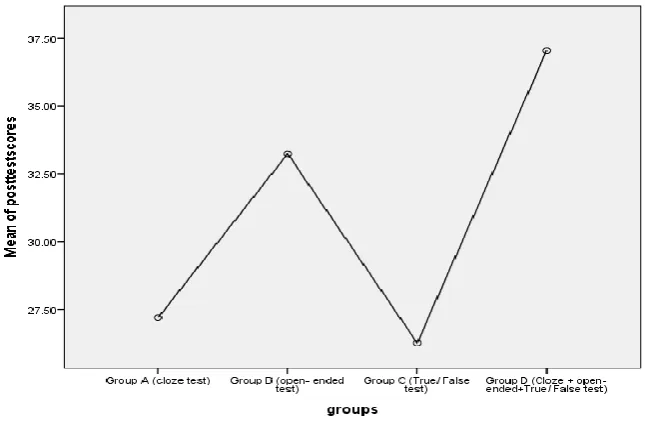
Figure1:Mean Plot for the Results of the reading post Test
In general, F statistics established that there was statistically a significant difference among the four groups' means, and means plots showed the location of these differences. Participants of the experimental group D (cloze, open-ended, and true/false) outperformed their counterparts namely groups (A), (B), and (C). After it was revealed that the groups differed in some way, post- hoc test disclosed more about the structure of the differences.
Table 5: Multiple Comparisons for the Results of the Posttest Scheffe
(I) groups (J) groups Mean
Difference (I-J)
SE Sig. 95% Confidence
Interval Lower
Bound Upper Bound
Group A
(cloze test) Group B (open- ended test) -6.03
* .99 .00 -8.86 -3.19
Group C (True/ False test) .933 .99 .83 -1.90 3.76
Group D (Cloze + open- ended+ True/ False test)
-9.83* .99 .00 -12.66 -6.99
Group B (open- ended test)
Group C (True/ False test) 6.96* .99 .00 4.13 9.80
Group D (Cloze + open-
ended+ True/ False test) -3.80
* .99 .003 -6.63 -.96
Group C (True/
False test) Group D (Cloze + open-
ended+ True/ False test) -10.76
* .99 .00 -13.60 -7.93
*. The mean difference is significant at the 0.05 level.
The highest mean difference was found between experimental (D) group and group(C) mean difference= (10.76). On the other hand, the lowest mean difference was reported for experimental (A) group and experimental (C) group (mean difference= .933).The experimental group (D) outweighed the other three groups in terms of their reading comprehension. In the second place, experimental (B) group performed better than the groups (A) and (C). Finally, group (C) performance was lower than the other three groups. In order to investigate students‘ development within groups, four paired
Vol. 5, Issue 2, June 2015
18
tests were also run, which showed the subjects‘ progress in pre-test and post-test that are shown in Tables 6 and 7.
Table 6: Paired Samples Statistics for the Four Groups
groups Mean N SD SEM
Group A (cloze test) Pair 1 pretest scores 25.53 30 5.61 1.02
posttest scores 27.20 30 5.69 1.03 Group B (open- ended
test)
Pair 2 pretest scores 26.50 30 4.65 .85
posttest scores 33.23 30 3.82 .69 Group C (True/ False
test)
Pair 3 pretest scores 25.40 30 4.09 .74
posttest scores 26.26 30 3.09 .56 Group D (Cloze +
open- ended+ True/ False test)
Pair 4 pretest scores 26.23 30 4.43 .80
posttest scores 37.03 30 1.80 .33
The mean scores of the group (A) has been improved from (25.53) in pre- test to (27.20) in post- test; that of the group (B) has changed from (26.5) in pre- test to (33.23) in posttest, the mean of the group (C) has changed from (25.40) in pre- test to (26.26) in post- test , and finally group (D) has changed from (26.23) in pre- test to (37.03) in post- test on the reading test.
Table 7: Paired Samples Test for the Pre and Posttests
Groups Paired Differences t Df Sig.
(2-tailed )
Mean SD SEM 95% Confidence
Interval of the Difference
Lower Upper
Group A
(cloze test)
pretest scores - posttest scores
-1.66 1.78 .32 -2.33 -.99 -5.10 29 .00
Group B
(open- ended test)
pretest scores - posttest scores
-6.73 5.65 1.03 -8.84 -4.62 -6.52 29 .00
Group C
(True/ False test)
pretest scores - posttest scores
-.86 3.74 .68 -2.26 .53 -1.26 29 .21
Group D
(Cloze +
open- ended +True/ False test)
pretest scores - posttest scores
-10.80 4.49 .82 -12.47 -9.12 -13.1 29 .00
As depicted in the Table 7, three groups had progressed statistically significant in the post-test. Based on the results of paired T-test, this progress was statistically significant for the groups (A), (B), and (D) (P ≤0.05). However, for group (C) that received evaluation based on "true/ false items" the difference between pre and posttest was not significant (p≥.05). In other words, all the three groups made a substantially progress in the post- reading test except group (C). These results also rejected the first null hypotheses that item type does not affect Iranian upper intermediate EFL learners‘ reading comprehension.
The second research question dealt with if item type (cloze, short-answer, True/ False) affects Iranian male and female upper intermediate EFL learners' reading proficiency differently.
Vol. 5, Issue 2, June 2015
19
Table 8: Independent Sample T-Test for Females and Males of the Four GroupsGroups Levene's
Test for Equality of
Variances
t-test for Equality of Means
F Sig
. t df Sig.
(2-taile d) Mean Differ ence Std. Error Differ ence
95% Confidence Interval of the Difference
Lower Upper
Group A (cloze test) Equal variances assumed 2.5
8 .11 .16 28 .87 .35 2.13 -4.01 4.72
Group B (open- ended test) Equal variances assumed
.20 .65 1.93 28 .06 2.58 1.33 -.15 5.31
Group C (True/ False test) Equal variances assumed 1.1 6
.28 -1.31 28 .19 -1.50 1.13 -3.83 .83
Group D (Cloze + open- ended True/ False test) Equal variances assumed
.76 .38 1.79 28 .08 1.16 .64 -.16 2.49
The results of independent samples T-test for the four groups supported the second null hypothesis and showed that there were not significant differences between male and female upper intermediate EFL learners' reading proficiency in posttest (p≥.05).
4.2 Discussion
Alderson (2000: 86) states, ―there are factors affecting the difficulty of reading test items. One of them is different type of question‖. Pearson and Johnson (1978) in Alderson (2000) suggest that test items might vary in their difficulty. The findings of this study showed that there was a significant difference in the students' reading comprehension score tested by using different item types during the class performance. The result of reading scores of the group who were evaluated by the test that combined the three item formats (cloze, open-ended, and true/ false) was better than the result of other groups. In the second place, those who were evaluated based on open-ended questions, had higher performance. It seems that since students of group (B) were required to produce rather than recognize the answer, they tried to be more involved in reading texts and this might have helped them to achieve better results. The participants whose evaluation was based on cloze and true/ false had the least performance on reading test. Cloze Test and true/false were easier for the students because there was an option provided in each text, so the learners did not make further effort to improve their vocabulary. The students could freely determine the words that were appropriate to fill in after they knew the context. They could choose the words that were more familiar or common for them. On the other hand, in the open-ended questions, they had to refer to the context to be able to provide the right answer and this helped them to be involved more with it. The results showed that the fourth group that had all types of assessment during class assessment were more successful. This indicates that all types of assessment are complementary and that one type cannot significantly improve reading skills, nor can it be responsive to individual differences. Therefore, a multi-dimensional comprehensive approach is more likely to improve upper intermediate-level EFL students' reading
Vol. 5, Issue 2, June 2015
20
skills. This implication is in line with Smith and Levin's (1996) contention that "no single type of assessment can always meet all purposes, in all situations," therefore, the solution, as they argue, is to "make the best use possible of various assessment strategies in order to meet the diverse criteria of and purposes for the overall assessment‖ (p. 111). The results revealed no significant differences between males and females in the reading comprehension scores across passages. Therefore, when examining comprehension across multiple passages, males had no advantage over females, and females had no advantage over males. This finding contrasts previous research that suggests that females are better second language learners than males (Huebner, 1995).5. Conclusion
The present study aimed to investigate the effectiveness of using different types of item types in reading comprehension assessment. It was found that using multiple test items is more effective than using single test item type. The results also implied that production item types such as open ended items could helpe EFL readers better comprehend the reading text. Results showed that there was a significant difference between the performances of the four groups. The comparisons made showed that the reading comprehension of those students in the treatment group, where cloze tests, open-ended questions, and true/ false items were implemented simultaneously, differed significantly from those of students in the other groups where single way of testing reading comprehension implemented. It was concluded that using a combination of item types has significant effect on reading comprehension of Iranian upper intermediate EFL learners. The findings of this study are in agreement with the existing studies in the literature that revealed that test methods could enhance students‘ reading comprehension ability. This study also has several important teaching and pedagogical implications. Findings of this study showed that test methods have an important role in EFL instruction. Findings of this study encourage teachers to use different test methods such as cloze tests, true /false and open-ended questions in order to enhance reading comprehension ability of learners. Additionally, this study was conducted for EFL upper intermediate students; this study can be expanded in wider population. It can be replicated with other levels such as elementary or advanced. Finally, interested researchers can investigate the impact of other types of test methods
such as multiple choice question, cloze Elite test, matching items etc.on other language skills such as
writing or listening.
REFERENCES
Alderson, C, J. (2000). Assessing Reading. Cambridge University press.
Alexander, J. Estil. (1989). Teaching Reading. Boston: Scott, foreman and Company. Arieta, C. (2010). Reading Comprehension Overview. The Landmark College Guide: 1-5.
Birjandi, P., Anani Sarab. M.R., and Samimi, D. (2013). Learning to read English for Pre-University students. Tehran: Textbook Publishing Company in Iran.
Brown, H. D. (2004). Language Assessment: Principles and Classroom Practice. White Plains: NY: Longman/ Pearson Education.
Brown, J. D. and Hudson, T. (1998). The Alternatives in Language Assessment. TESOL Quarterly
(1998):32-75.
Brown, H. D and, Priyanvada, A. (2010). Language Assessment Principles and Classroom Practices Second Edition. NY: Pearson Education, Inc.
Cain, K. and Jane Oakhill, J. (2007). Language, Children's comprehension problem in Oral and Written. New York: A Division of Guilford Publications.
Cohen, A. D. (1994). Assessing language ability in the classroom. Boston: Heinle & Heinle.
Deborah, P. (2004). Longman Preparation Course for the TOEFL Test: The Paper Test. New York: Pearson ESL.
Denton, P. (2007).Open-Ended Questions. Responsive Classroom.
Farhady, H. (1985). Forms of language tests. Roshd Foreign Language Teaching Journal, 1 (3), 76-92. Grellet, F. (1981). A Practical guide to Reading Comprehension Exercises. London: Cambridge University Press.
Haertel, E., and Mullis, I. (1996). The evolution of the national assessment of educational progress:
Coherence with best practice. In Joan B. Baron and Dennie P. Wolf (Eds.), Performance-based student
assessment: Challenges and possibilities (pp. 287-304). Chicago, Illinois: The University of Chicago Press.
Vol. 5, Issue 2, June 2015
21
Harmer, J. (2002). The Practice of English Language Teaching. Third Edition. England: Longman Press.Harris, C. W. (1968). Measurement of Comprehension in Literature. New York: Macmillan Publishing Co.
Heaton, J. B. (1991). Writing English language Tests. New York: Longman.
Huebner, T. (1995). A framework for investigating the effectiveness of study abroad programs. In C.
Kramsch (Ed.), Redefining the Boundaries of Language Study (pp. 185-217). AAUSC Annual Volumes.
Boston: Heinle & Heinle.
Hughes, A. (1992).Testing for language teachers. Second Edition. Cambridge: Cambridge University Press.
Manning, P. K. (1987). Semiotics and fieldwork. New York: Sage Publications.
Miller, M. D., Linn, R. L., and Gronlund, N. E. (2009).Measurement and Assessment in Teaching Tenth Edition. New Jersey: Pearson Education, Inc.
Paynter, B. and Doty, B. (2005). For the Love of Words: Vocabulary Instruction that Works. San Francisco: Jossey-Bass.
Raatz, E., & Klein-Braley, C. (1995). Introduction to language testing and C-tests. In Coleman (Ed.), University language testing and the C-test. Retrieved January 26, 2014 from the World Wide Web: http://www.uniduisburg.de/FB3/ angling/forschung/howtodo.html
Richards, J. C. and Renandya. W.A. (2002). Methodology in Language Teaching: an anthology of current practice. New York: Cambridge.
Richards, J.C. and Schmidt. R. (2002). Longman Dictionary of Language Teaching and Applied Linguistics. Third Edition. London: Pearson Education.
Sadeghi, K. (2007). ―The Key for Successful Reader-Writer interaction; Factors Affecting Reading
Comprehension in L2 Revisited‖ Asian EFL journal, 9 (3), article 10. http://www.asian-efl-journal.com/sept_2007_ks.php. Retrieved October 12 2013.
Smith, M., and Levin, J. (1996). Coherence, assessment, and challenging content. In Joan B. Baron and Dennie P. Wolf (Eds.), Performance based student assessment: Challenges and possibilities (pp. 104-124). Chicago, Illinois: The University of Chicago Press.
Taylor, W. (1953). Cloze procedure: A new tool for measuring readability. Journalism Quarterly 30
(1953): 414-433.
Urquhart, S. and C. Weir. (1998). Reading in a second language: Process, Product and Practice. Harlow: Addison Wesley Longman Limited.
Weir, C. J. (1990). Communicative language testing. New York: Prentice Hall, 1990.
Vol. 5, Issue 2, June 2015
22
THE EFFECT OF READING ACADEMIC TEXTS ON
LEARNING AND RETENTION OF ACADEMIC
VOCABULARY: INVESTIGATING THE ROLE OF MODEL
ESSAY
Mohammad Sadegh Alijany
Department of Complementary Education, Rasht Branch, Payam-e Nour University, Gilan, Iran. [email protected]
Niloofar Mansoory
Hoda Divsar
ABSTRACT
word knowledge plays an essential role in determining the success of efl and esl learners in eap setting. it is determinant in speaking, reading, writing and listening (adolphs and schmitt, 2003). this study aimed at investigating the effects of reading academic essay as a representative model of academic texts on incidental vocabulary learning and retention of words from academic word list (coxhead, 2000), and to evaluate the success of the material used. to this end, 40 pre-university and university students were chosen to take part in the experiment. after administering a pretest and during 17 weeks of experiments, study group received fifteen academic model essays, while the control group equally received fifteen top ielts model essays written for academic module. the students in neither groups received instruction of the target words to ensure the incidental manner of learning them. at the end of the experiment, they were given a vocabulary test, to see the effect of reading academic essay on their vocabulary learning and retention. then, their pre and post test scores were compared using a dependent t -test. the result of t-test for vocabulary test (t= -8.39, p= .001) showed that their vocabulary knowledge had improved significantly in post test compared to pre test. also they were administered a delayed post test the result of which showed that besides having a positive effect on vocabulary knowledge, academic essay affects students vocabulary retention positively. therefore, the findings of this study offers that 8.5 -11% of each academic essay is approximately comprised of academic words from awl and, if used as supplementary reading material beside textbooks, can help students to improve their knowledge of academic vocabulary. it is assumed that, the findings of this study can have some main implications for instructors, pre-university and pre-university students as a part of an academic preparation program for the texts and tasks they encounter in college or university.
key words: vocabulary learning, vocabulary retention, academic word list, academic essay
1. Introduction
―Vocabulary is a core component of language proficiency and provides much of the basis for how well learners speak, listen, read, and write‖ (Richards & Renandya, 2002, p.255). Similarly, Sedita (2005) emphasizes the significance of knowledge of vocabulary since it consists of all lexical items which we have to be familiar with as a means of conveyance of our meanings and of effective communication. Accordingly, educators and educational researchers from all around the world for years emphasized that vocabulary knowledge plays a significant role in reading comprehension and more importantly in making an efficient verbal and nonverbal communication (Hirsh & Nation, 1992; Laufar, 1997; Nation, 2001; Coxhead & Nation, 2001).
Nation (1990, P. 2-3) states three strong reasons to emphasize the necessity of a systematic and principled approach to vocabulary by both teachers and learners. The first of them is, because the considerable research on vocabulary we have good information about what to do about vocabulary
Vol. 5, Issue 2, June 2015
23
and about what vocabulary to focus on. The second reason is to show that there is a wide variety of ways for dealing with vocabulary in foreign or second language learning. The third reason for emphasizing the necessity of a systematic and principled approach to vocabulary is that, both teachers and students see vocabulary as being a very important, if not the most important, element in language learning (p. 3).Having a limited vocabulary is considered a serious barrier for reading comprehension and consequently a barrier to improve one‘s mental lexicon. As Hunt and Beglar (2005) mention: ―the heart of language comprehension and use is the lexicon‖. Furthermore, Donmore (1989) takes the
view that vocabulary growth results in promotion of reading comprehension.Some researchers (e.g.
Laufer 1986; Nation 1990) believe that many of learners' difficulties, both receptively and productively, result from an inadequate vocabulary, and even when they are at higher levels of language competence and performance, they still feel in need of learning vocabulary. One of the research implications about the importance of vocabulary is that "lexical competence is at the heart of communicative competence" (Meara, 1996, p.35). This is the case in first language (L1) contexts (Anderson & Freebody, 1981) and in second language (L2) contexts (Laufer, 1991).
Based on what Hwang and Nation (1995) claim, knowledge of the 2,000 most frequent word families enables L2 readers to recognize 84% of the words in various types of authentic texts. This falls well short of the 95% of words which Laufer (1991, 1992) indicated needs to be recognized for unassisted reading, and which would require a minimum vocabulary size of 3,000 word families. More recently, research has provided some evidence with respect to the question what constitutes a sufficient number of words for different tasks. For participating in an everyday conversation it is assumed a learner needs 2,000-3,000 of the most frequent English words (Adolphs and Schmitt 2003), whilst s/he needs 5,000 words to begin to read authentic texts (Schmitt 2007) and around 10,000 for starting an academic degree course (Hazenberg and Hulstijn 1996, as cited in Daller & Milton, 2013).
According to many researchers, there is a general consensus on reading as one of major sources of vocabulary learning (Nagy, Herman et al. 1985; Day, Omura et al. 1991; Hulstijn 1992; Dupay & Krashen 1993; Levine Ferenz & Reves 2000; Nation 2001; Krashen 2004; Waring & Nation 2004; Horst 2005; Pigada & Schmitt 2006; Huang & Liou 2007; Min 2008; Schmitt 2008; Paqout, 2010). Such claim is also applicable to EAP situation as the ability to read academic texts is considered the most important skill that university student of ESL or EFL need to acquire. Indeed, good reading comprehension is essential not only to academic learning in all subject areas but also to professional success and, indeed, to lifelong learning (Pritchard, Romeo, & Muller, 1999). Texts absolutely contribute to vocabulary learning process (Coxhead, 1988; Gass, 1997; Nation & Coxhead, 2012). Indeed, the most vocabulary is acquired through context (Sternberg, 1987; Coady, 1993).
For academic purposes, the use of academic vocabulary and academic texts is a crucial focus in the teaching and learning of English; however, it often causes a great deal of difficulty for language learners (Ferrara & Fine, 1988; Coxhead & Nation, 2001; Chung & Nation, 2003; Cobb & Horst, 2004). Coxhead & Nation (2001) summarize three possible reasons to support the importance of teaching and learning academic vocabulary. First, academic vocabulary represents a substantial number of words in academic texts. Second, learners are more familiar with technical vocabulary in their own academic fields than with general academic vocabulary. Third, while it may be difficult for language instructors to teach technical vocabulary, because they often lack the necessary background knowledge, they have few such problems with academic words, and so these important items can and should be taught.
In order to help learners to focus on the seemingly most important words in their studies word lists based on written or spoken texts and corpus analysis have been created for language learners (Campion & Elley, 1971; Ghadessy, 1979; Francis & Kucera, 1982; Hofland & Johansson,1982 Nation, 1990; Coxhead, 1998 & 2000; Horst, Cobb, & Nicolae, 2005; Huang, 2007; Wang, Liang, & Ge, 2008). In order to build up the academic word list, Coxhead has compiled 3.5 million running words drawn from the four disciplines of law, art, commerce, and science from several hundred written academic texts. The list contains 570 word families not included in the most frequent 2,000 words of English. The basic idea behind the compilation of the list, according to Coxhead (2000), was that it could serve as a basis for making sound decisions concerning the selection of vocabulary items worth focusing on during class time, as well as independent study activities. For learners with academic goals, the 570 word family Academic Word List (Coxhead, 2000) is like a specialized extension of the high frequency words. It covers about 10% of academic texts, 4% of newspapers and approximately 2% of
Vol. 5, Issue 2, June 2015
24
the running words of novels (Chung & Nation, 2003). This vocabulary has been called academic vocabulary (Martin, 1976), sub-technical vocabulary (Cowan, 1974) or semi-technical vocabulary (Farrell, 1990). Numerous studies have shown that AWL vocabulary is essential in comprehending texts from a variety of specialist fields (Chen, Her, & Huang, 2008; Chung & Nation, 2003; Mudraya, 2006).Teachers and materials developers who work with vocabulary lists often assume that frequently occurring words and those which occur in many different kinds of texts may be more useful for language learners to study than infrequently occurring words and those whose occurrences are largely restricted to a particular text or type of text (Nation, in press; West, 1953). Without a basic knowledge of these terms, students will have difficulty understanding information they read or hear (Marzano & Pickering, 2005). The important factor underlying all attempts to teach academic English, however, is the fact that university students who require reading English texts in their fields of study have to expand their vocabulary knowledge in a much more efficient way than ordinary ESL/EFL learners (Cobb 2000).
Almost all recognized text-based studies (e.g. Hwang and Nation, 1989; Hirsh and Nation, 1992; Klinmanee & Sopprasong, 1997; Chen, Hu, & Ho in, 2009), that were meant to investigate the effect of different texts on learning vocabulary, all approved the favorable conditions that such texts provided for learning more vocabulary .Paqout (2010) states that although many corpus-based studies of vocabulary in academic discourse conducted by many researchers (e.g. Johansson, 1978; Coxhead, 2000; Mudraya, 2006) all considered book sections, journal articles and textbooks, academic writing includes other kinds of text than professionally edited articles and books, notably students‘ essays.
2. Statement of the Problem
The importance of academic reading has been well recognized by many researchers. Levine, Ferenz, and Reves (2000) state that the ability to read academic texts is considered one of the most important skills that university students of ESL or EFL need to acquire. The key to understand academic texts is having a good academic lexicon. The main reason for the emphasis is the crucial role such vocabulary plays in reading academic texts and producing academic writing (Cobb, 2007). In fact, knowledge of such vocabulary will not guarantee success, but lack of knowledge of that can lead to failure (Biemiller, 1999). Singleton (1999) calls for greater collaboration between researchers in terms of qualitative, quantitative as well as durative research and warns that vocabulary researchers risk becoming a self referring ghetto unless they start integrating research from other disciplines. Despite the burgeoning interest in recent years, however, a question mark still remains over the precise nature of the vocabulary that needs to be taught in EAP courses, and how best to teach it (Behrouzi &
Taherian 2012). Model texts serve to model rhetorical elements, principles and patterns either by
including a description of parts (thesis statement, claim, support, refutation, introduction and conclusion) or by having students discern these on their own (Rosa, A. & P. Eschholz, 2007). A model essay written by a native speaker may also be a beneficial resource if it can function as a feedback tool (Qi, D.S. & S. Lapkin, 2001).
Regarding all the acknowledging comments on the prominent role of essays in academic area (mostly in the module of academic writing) and the essential role of the promising academic vocabulary used in such texts, to date no published study has investigated the extent to which such texts may provide L2 learners with opportunities to expand their academic vocabulary knowledge, and also to see if reading such academic texts may have significant impact on learning and retention of academic vocabulary. Therefore, this study will extend the research on seeking answers to this long neglected problem.
3. Review of Literature
Grabe and Stoller (2001) claim that in academic setting, reading is assumed to be the central means for learning new information and gaining access to alternative explanations and interpretations. One approach to defining English in academic setting is through analyzing the linguistic elements that make up the register of schooling. One of the pioneer works in distinguishing academic English from other types of reading is Cummins‘s 1979 study that distinguishes academic English (English needed for higher education or for occupational purposes) as Cognitive Academic English Proficiency (CALP), from Basic Interpersonal Communicative Skills (BICS) which is the everyday language.
Vol. 5, Issue 2, June 2015
25
Cummins argues that CALP is both cognitively demanding and context-reduced, whereas BICS is cognitively undemanding and context-embedded.Reading and learning from texts is one of the demands of every academic language in all academic contexts. According to the dictionaries (e.g. Oxford Dictionaries) academic reading text (document) is basically defined as anything related to an educational or scholarly institution or environment that can be used in academic contexts such as school or classroom. It can include school books, articles, textbooks and anything that has been written by someone with experience in the field. According to Spack (1993) academic reading as a means of academic English, is often a process of actively engaging with what is read, gleaning information and then fitting this information by thinking things through, and finally being able to interpret the content flexibly to suit the purposes of the academic writing assignment. Hellekjær (2009) describes Academic reading as a complex, multi-level and different process from other kinds of reading. It is also defined as purposeful and critical reading of a range of lengthy academic texts for completing the study of specific major subject areas. However, for most second language readers, the major problem in academic reading will simply be the gap between what they know and what they the native speakers know in relation to the language and the content of the text written, as nearly all authentic texts are for native speaking readers (Eskey, 1986). Similarly, text types refer to typical formats of text organization, and the traditional way in which texts follow norms of structure, style and layout.
Almost all academic reading texts are presented to students in written form. Thereby, almost always the term academic reading text implies the old familiar ―academic written input‖ or the academic writing and\or any documental material that meets the requirements of academic writing‘s theoretical and contextualized frameworks in a more productive way, written by scholars or native-like proficient learners to be used for academic purposes. Reading such texts remain a staple within academic curricula worldwide, presenting teachers and students with the official knowledge of school subjects as well as the preferred values, attitudes, skills, and behaviors of experts in those. According to Parrish (2004) benefits of using reading texts can meet a learner‘s needs or expectations of having something concrete to work from and take home for further study.
While English language instruction has many important components, the essential constituents to many ESL/EFL classrooms and programs are textbooks (Moghtadi, 2014). Textbook, as a representative of academic materials, has always been on the center of course designer and researchers‘ attention. Although Joan (2001), analyzing textbook tasks for the potential controller of learning conditions related to content choice, procedure options, and evaluation techniques, found that students potentially have few choices and thus little control of the educational process. Furthermore, course books are often quite short and they often fail to present appropriate and realistic language models as well as fostering cultural understanding (Kayapinar, 2009).
According to Cheung and Wong (2002), the major premise of an academic curriculum should aim at developing students‘ intellectual abilities in subject areas that are worthy of study. In order to achieve that goal, ELT course designers and instructors need to have prospective learners exposed to different text types if prove helpful. In fact, there are some other types of academic texts which follow academic discourse, and although not disfavored, rarely sought to find out their potential effects on vocabulary learning. So it paves the way for more research on the potentials of other academic reading texts except for textbooks and also makes a room for the idea of using other types of academic texts in both EAP and EAP preparation settings.
Academic essay could be a proper case for investigating its possible effects on learners‘ learning and retention of academic vocabulary for the benefits that such academic text provides its users with. Morgan (2011) states that while reading model essays students are, in terms of language and academic discourse, exposed to the rhetorical style of academic context. In fact, if features of academic language are represented along a cline, then professional model essays represent one end of the spectrum in terms of the language used, the style of discourse employed as well as the assumed knowledge of related previously conducted researches. According to many researchers (e.g. Park, 1986; Paxton, 2007; Charles, 2007; Hyland, 2009) rhetorical style in the textbooks can mislead students into believing this to be the style of academic writing that should be mimicked in their own essays. This, indeed, calls attention for broadening views on the role and possible effects of applying safer academic written materials in EAP contexts such as academic essay, as a better model, which follows academic rhetorical style while not necessarily being used in textbooks. In fact, this paper is not offering the idea of replacing textbooks with other ELT materials as new alternatives but calling more
Vol. 5, Issue 2, June 2015
26
attentions on the use of other academic materials as supplementary materials beside textbooks for thebenefits that they provide learners with.
Studies investigating the effects of text types on learning vocabulary (e.g. Chern, 1993; Haastrup, 1991; Haynes, 1993; Parry, 1993; Paribakht & Wesche, 1999) have identified many factors such as the nature of the word and the text that contains the word, and the kind of information available in the text to be influential. According to Huckin and Coady (1999, p.188), certain kinds of texts (those personally interesting to the learners) facilitate incidental vocabulary acquisition. Zwaan (1994) suggested that readers mentally represent and process text differently depending on the genre of text involved and their related expectations and schemas.
In spite of this fact, there are not many research that have specifically investigated the effects of text genre on vocabulary learning and retention. Here the findings of the few related researches to the matter of text types and the learning opportunities they provide learners with are presented. Hu and Nation (2000), for example, examined the relationship between text coverage (the percentage of running words in the text) and reading comprehension for non-native speakers of English with a fiction text. In order to achieve this goal they replaced various proportions of low-frequency words in the text with nonsense words to ensure they were unknown. Also in that research reading comprehension was measured in two ways: by a multiple-choice reading comprehension test, and by a written cued recall of the text. The findings of the research showed that a 98% text coverage would be needed for most learners to gain adequate comprehension.
In separated studies, the impact of different types of contexts for example a novel (Saragi et al., 1978), a graded reader (Horst et al., 1998), specially constructed paragraphs (Jenkins, Stein, & Wysocki, 1984), and narrative and expository texts of about 1,000 words (Nagy, Herman, & Anderson, 1985) on incidental vocabulary learning were investigated. Other contexts used in incidental learning of vocabulary experiments were Studies on learning from context have used single sentences (Dempster, 1987; Laufer & Shmueli, 1997), multiple sentences (Dempster, 1987), L2 sentences together with their L1 translations (Griffin, 1992), L1 sentences containing the L2 target vocabulary (Pickering, 1982), three sentences one of which was a definition (Gipe & Arnold, 1979), and L1 and L2 glossed passages (Laufer & Shmueli, 1997).
Gardner (2004), explicitly stating the concept of genre, analyzed the lexical differences between narrative and expository reading materials and their potential effects on student‘s vocabulary acquisition. The findings of his study showed that student‘s narratives tend to utilize a greater proportion of General High Frequency words than their expository texts. Gardner (2004, p. 24) argues that this is because narratives place fewer lexical demands on children in general. Although, more recently, the findings of similar studies conducted by Shokouhi and Maniati (2009) and Khansir and Mohammadi fard (2014) demonstrated the relative superiority of expository texts over narratives in terms of enhancing readers‘ incidental vocabulary acquisition of unknown words.
In the same vein, Sanders and Noordman (2000) also investigated the role of coherence signals (connectives) in text processing in narrative, and expository text types. Using reading verification and free recall tasks, they investigated the type of coherence relation between segments (e.g., problem-solution vs