2008-5435/14/63-156-164
INTERNATIONAL JOURNAL OF OCCUPATIONAL HYGIENE Copyright © 2014 by Irnian Occupational Health Association (IOHA) IJOH 6: 156-164, 2014
Root Mean Square Acceleration
(RMS), Crest Factor and
Hand-Arm Vibration Dose Value In Tiller Users
PARVIN NASSIRI
1, IRAJ ALI MOHAMMADI
2, MOHAMMAD HOSEIN BEHESHTI
3*,
KAMAL A'AZAM
41Department of Occupational Health Engineering, Tehran University of Medical Sciences, Tehran, Iran;
2Department of Occupational Health Engineering, Occupational Health Research Center, Iran University of
Medical Sciences, Tehran, Iran; 3Department of Occupational Health Engineering , Faculty of Health, Gonabad
University Of Medical Sciences, Gonabad , Iran; 4Department of Biostatistics, School of Public Health, Tehran
University of Medical Sciences, Tehran, Iran.
Received May 21, 2014; Revised September 27, 2014; Accepted November 17, 2014
This paper is available on-line at http://ijoh.tums.ac.ir
ABSTRACT
The purpose of this study was to assess exposure to hand-arm vibration in tiller users, Forty users of tiller in northeastern provinces of Iran were examined to measure hand-arm vibration parameters such as root mean square acceleration (RMS), total equivalent acceleration, Vibration Dose Value (VDV) and crest factor in three directions (x, y, and z) and various operating modes for comparing them with the relevant permitted standard levels. The hand-arm vibration measurement was done according to the standards ISO 5349-1 and ISO 5349-2. The obtained results indicated that the exposure level in three modes of rota-tilling, transportation and idling were equal to 16.95, 14.16 and 8.65 m/s2, respectively. In all measurement modes, the exposure to vibration in the direction x was greater than that of y and z. Moreover, the average crest factor was calculated less than six. The highest vibration dose values were measured in rota-tilling mode when the tiller was in 2nd gear (60.76 m/s1.75) and 1st gear (56.83 m/s1.75). The results indicated that the permitted working time was only few seconds and there was a risk of musculoskeletal disorders. The present study emphasizes on the need for interventional and control managerial measures to eliminate or reduce hand-arm vibration transmitted to the tiller users' hands for avoiding major problems such as musculoskeletal disorders, discomfort and premature fatigue. In this regard, further studies are required to identify vibration sources in different types of tillers.
KEYWORDS:Tiller,Hand-arm vibration, Hand Tractor, Vibration
INTRODUCTION
Tillers or hand-tractors are included among extensively used devices in recent years causing numerous injuries to farmers through exposing to hand-arm vibration. While operating the device, tiller operator is exposed to excessive vibration. Feeling much vibration by hands while gripping handles is of the main shortcomings of working with this device [1].
Hand-arm vibration can cause musculoskeletal, nervous and circulatory disorders generally known as hand-arm vibration syndrome, among which white finger so called Raynaud's syndrome would be the most common disorder [2].
towards directions x and y was much greater than that of z direction. The total vibration levels in idling, transpiration and rota-tilling modes were respectively 9.62, 8.37 and 3.36 m/s2. The obtained results showed that, after a relatively short period of 3-4 years, 10% of the exposed workers were subjected to the white finger disorder caused by vibration [4]. Salokhe et al. studied vibrational properties of tiller at different engine speeds under station and field conditions. They declared that rigid connection of tiller handle to the chassis increases the vibration transmitted to the user's hands [5]. The results of another study showed that vibration severity and type of individual activities were effective on amount of vibration transmitted to the worker's body. Maximum transmission rate was observed in rota-tilling and the average transmission rates to metacarpal, wrist, elbow and acromion were equal to 0.91, 0.47, 0.3, and 0.21 m/s2, respectively [6].
Almost all studies carried on hand-arm vibration assessment have emphasized on the RMS acceleration while the crest value of 6 presented by the Britain Standard (BS 6841, 1987) indicates that the RMS acceleration methods are not valid any longer and the Vibration Dose Value (VDV) should be applied as an alternate variable. According to the Britain Standard for vibration assessment, when the crest factor exceeds 6 or vibration has variable amplitude or the motion include sudden shocks as well as transient and instantaneous moves, the VDV method should be used [7-9]. Besides, some laboratory studies [10, 11] and field investigations [12] have shown that in predicting vibration discomfort, the fourth power of the frequency-weighted acceleration is preferred or at least they are as important as the second power quantities (such as RMS). Therefore, in assessment of vehicle convenience, it is recommended to use DVD or crest methods instead of RMS [13]. The present study aimed at assessing exposure level of tiller users to hand-arm vibration based upon RMS acceleration, crest factor and VDV.
MATERIALS AND METHODS
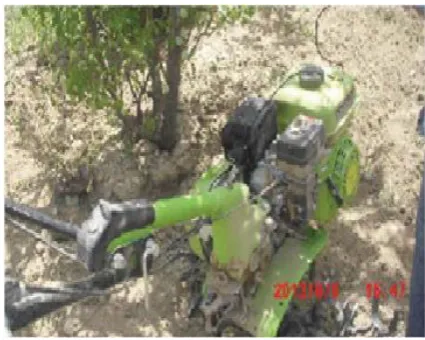
This descriptive-analytical and cross-sectional study was done on a total number of 40 tiller users having more than one year of working experience with the device; the farmers from the Kashmar County, Iran. The image and specifications of the investigated tiller are depicted in Fig. 1.
Fig 1. Specifications of the Tiller
Root Mean Square Acceleration (RMS) … ijoh.tums.ac.ir | 158
Fig 2. Human -Response Vibration Meter Type 2512 [14]
Fig 3. Calibrator Accelerometer Type 4294 [14]
Complete assessment of exposure to vibration involves measuring acceleration in the considered directions, frequencies and exposure duration. According to the ISO standard, three orthogonal directions of the coordinate system in which the vibration acceleration levels should be measured include direction Z that is along the metacarpal bones, X direction perpendicular to the Z and direction Y parallel to the longitudinal axis of grip. Vibration measurement was carried out at three directions consecutively so as the working conditions were the same in all three measurements. Measurements were performed on a vibrating surface as close as possible to the grip center of tiller handle. Vibration assessment according to ISO 5349 standard should be shown as a number containing the values of three directions. This value is expressed as either total amount of ahv
vibration or Weighted Acceleration Sum (WAS) which is the root mean square of three values, measured.
Where;
ahwx , ahwy and ahwz are RMS
acceleration values of each axis. The exposure level depends on magnitude of the total vibration dose value and duration of exposure. The duration of daily exposure refers to the total period in which the hands are exposed to vibration during a working day. Daily exposure to vibration can be calculated in terms of 8-hour equivalent acceleration or total frequency-weighted vibration.
(2)
Wherein;
T is total duration of daily exposure (s) and T0 is 8-hour reference period (28800
seconds).
Vibration level was measured using a piezoelectric accelerometer mounted on the handle of the tiller.
Crest factor: the crest factor is a dimensionless factor defined as the ration of crest acceleration value over the RMS acceleration. In this research, the crest factor was calculated using the following mathematical formula [13]:
(3)
CF= ))
)
In which, ahw is the
frequency-weighted acceleration.
The Vibration Dose Value (VDV): Great shock is imposed to the off-road machines such as agricultural machineries due to the ruggedness of the terrain. Considering that shocks are of great importance in VDV calculations over time, therefore, it would be the best criterion to measure driver's comfort [15] . Considering the measurement period of Ts, N number of points in a given period of time and frequency-weighted vibration data (a(i)), the VDV is defined as follow [8, 16] :
[ ∑ )] (4)
The value of crest factor is shown for all operating modes. Regarding the average crest value of less than 6, the estimated VDV equation was used as follow:
0
) 8
( a T T
eVDV is the estimated VDV in m/s1.75 and T is the measurement time period (s). The following equation was used to incorporate the coordinate axes of VDVs.
√ (6)
Installation manner of vibration transducer: The vibration measurement should be done based on the standard ISO 5349-1 on or near hands where the vibration enters the body. The measurements were done using the adapters (Types; UA 0894 and UA0891) manufactured by the Company Bruel $ kjaer (B$K). The Axes of the acceleration components in ISO 5349-2001 and image Installation of UA 0894 transducer at directions X, Y and Z in this study are depicted in Fig.4 and 5.
Fig 4. Axes of the acceleration components, ISO 5349-2001[22]
Fig 5. Installation of UA 0894 transducer at directions X, Y and Z in this study
The data was analyzed using Software Excel and SPSS. The data obtained from vibration measurements in three directions and
total vibration of idling, transportation and rota-tilling were assessed by Kolmogorov-Smirnov Test (KS-test) in terms of being normal. According to which, total vibration was the only variable following a normal distribution. Even after taking the logarithm of these variables, they were still not normally distributed. Thus, non-parametric tests were used to analyze these variables.
RESULTS
RMS acceleration of hand-arm vibration Total hand-arm vibration: The comparison test results of average total hand-arm vibration of tiller users are presented in Table 1 in separation of various positions and modes measured.
Table 1. Tiller features used in this study [14]
Name Tiller
Engine HONDA 168
Fuel Gasoil
Type 1 Dual mode clutch
Engine power 6.5 hp
Gearbox Sprockets and Chains
Gear Two forward gears and one
reverse gear
Tier One pair- 8-400
Blade and shaft
Working width 80-120cm
Working depth 5-35cm
Total weight 90Kg
Dimensions 150*97*100
Root Mean Square Acceleration (RMS) … ijoh.tums.ac.ir | 160
Table 2. Comparing average total hand-arm vibration of tiller users in separation of various positions and modes measured (m/s2)
p-value Maximum
Minimum Standard
deviation Average
Mode
(P-value ≤0.001) 10.42
7.02 0.75
8.6 Neutral
gear Idling
15.17 11.72
0.87 13.59
1st gear Transportation
16.45 11.56
1.06 14.74
2nd gear
23.65 15.10
1.98 18.97
1st gear
Rota-tilling 2 20.29 1.34 18.94 23.09
nd
gear
12.46 10.58
0.52 11.61
Reverse gear
Significant at 5% level, (P-value ≤0.001)*
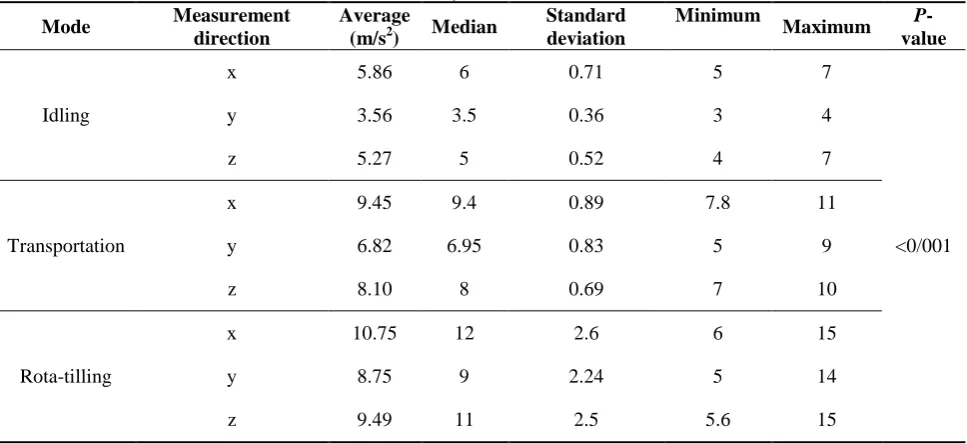
Hand-arm vibration in directions x, y and z: The central tendency and dispersion parameters of hand-arm RMS acceleration at different directions were measured in various modes of idling, transportation, and rota-tilling that the obtained results are shown in Table 3.
The results of the Kruskal-Wallis Test revealed that there is a significant difference (P-value ≤0.001) between the hand-arm values of idling, transportation and rota-tilling modes at different directions of x, y and z.
Table 3. Central tendency and dispersion parameters of hand-arm RMS acceleration at different directions of x, y and z
P
-value Maximum
Minimum Standard
deviation Median
Average (m/s2) Measurement
direction Mode
<0/001 7
5 0.71
6 5.86
x
Idling y 3.56 3.5 0.36 3 4
7 4
0.52 5
5.27 z
11 7.8
0.89 9.4
9.45 x
Transportation y 6.82 6.95 0.83 5 9
10 7
0.69 8
8.10 z
15 6
2.6 12
10.75 x
Rota-tilling y 8.75 9 2.24 5 14
15 5.6
2.5 11
9.49 z
According to the Table 3, the average hand-arm vibration values at different directions of x, yand z were respectively equal to 5.8, 3.5 and 5.2 m/s2 when the tiller was in idling mode, 9.4, 6.8 and 8.1 m/s2 in transportation mode and 10.7, 8.5 and 9.8 m/s2 in rota-tilling mode. At all steps, the highest exposure was measured in the direction x
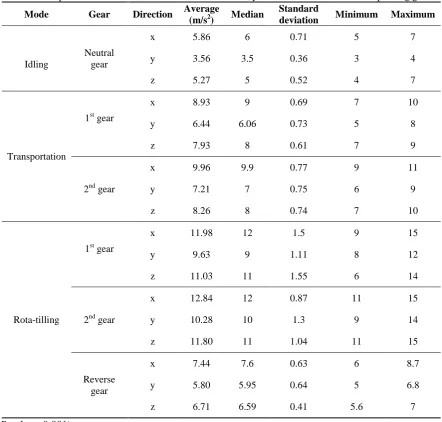
Table 4. Descriptive statistics of hand-arm vibration towards x, y and z directions in different operating g modes Maximum Minimum Standard deviation Median Average (m/s2) Direction Gear Mode 7 5 0.71 6 5.86 x Neutral gear
Idling y 3.56 3.5 0.36 3 4
7 4 0.52 5 5.27 z 10 7 0.69 9 8.93 x
1st gear
Transportation 8 5 0.73 6.06 6.44 y 9 7 0.61 8 7.93 z 11 9 0.77 9.9 9.96 x
2nd gear y 7.21 7 0.75 6 9
10 7 0.74 8 8.26 z 15 9 1.5 12 11.98 x
1st gear
Rota-tilling 12 8 1.11 9 9.63 y 14 6 1.55 11 11.03 z 15 11 0.87 12 12.84 x
2nd gear y 10.28 10 1.3 9 14
15 11 1.04 11 11.80 z 8.7 6 0.63 7.6 7.44 x Reverse
gear y 5.80 5.95 0.64 5 6.8
7 5.6 0.41 6.59 6.71 z
)P-value <0.001)
Crest factor: The crest factor of the total hand-arm vibration (vector sum of three directions x, y and z) are presented in Table 5.
Table 5. the crest factor of the total hand-arm vibration during different operating modes of idling, transportation and rota-tilling
Mean Maximum Minimum Number Gear Mode 2.1284 3.18 1.48 40 Neutral gear Idling 2.1625 3.54 1.31 40
1st gear Transportation
2.0979 2.80
1.24 40
2nd gear
2.2110 2.87
1.56 40
1st gear
Rota-tilling 2 40 1.53 2.40 2.1310
Root Mean Square Acceleration (RMS) … ijoh.tums.ac.ir | 162
As the Table 5 shows, in all measurement modes, the peak acceleration is 2 to 3 times the RMS acceleration. The highest amount of crest factor was measured in rota-tiller mode when the rota-tiller was in reverse gear. This is probably due to intense shaking of the tiller in rota-tiller mode.
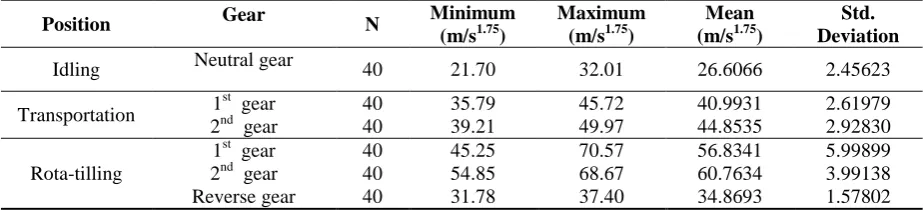
Vibration Dose Value (VDV): As regards, in calculation of VDV, the shocks and impact vibrations would be of great importance over time, so it could be the best criterion to measure comfort [8]. The VDVs used to calculate the total hand-arm vibration (vector sum of three directions x, y and z) are shown in Table 6.
Table 6. The VDVs of tiller drivers during idling, transportation and rota-tilling modes (m/s1.75)
Std. Deviation Mean
(m/s1.75) Maximum
(m/s1.75) Minimum
(m/s1.75) N
Gear Position
2.45623 26.6066
32.01 21.70
40 Neutral gear
Idling
2.61979 40.9931
45.72 35.79
40 1st gear
Transportation
2.92830 44.8535
49.97 39.21
40 2nd gear
5.99899 56.8341
70.57 45.25
40 1st gear
Rota-tilling 2nd gear 40 54.85 68.67 60.7634 3.99138
1.57802 34.8693
37.40 31.78
40 Reverse gear
According to Table 6 the highest VDVs of 60.76 m/s1.75 and 56.83 m/s1.75 were measured in the rota-tilling mode when the tiller was in 2nd and 1st gears, respectively.
DISCUSSION
According to the results of the present study, tiller users' exposure to vibration in rota-tilling, transportation and idling modes are equal to 16.95, 14.16 and 8.65 m/s2, respectively. Vlado Goglia et al. showed that the average vibration levels in different modes of idling, transportation and rota-tilling are tantamount to 3.37, 8.37 and 9.62 m/s2, respectively. They concluded that the highest exposure to vibration was related to the rota-tilling, transportation and idling modes in descending priority [4].
In India, the vibration of three types of tiller was investigated in three modes of transportation in asphalt road, rota-tilling and rota- puddling. The maximum vibration was observed as 45 m/s2 while walking behind and 20 m/s2 with the seating arrangement. According to their research findings, the highest vibration was in modes rota-tilling, transportation and rota-puddling, respectively [17]. Dewangan and Tewari showed that the highest vibration rates were equal to 10.17, 7.77 and 6.22 m/s2 related to the modes transportation, rota-tilling and rota-puddling,
5.27 and 8.07 m/s2 t different modes of transportation, rota-puddling and rota-tilling [18].
The results of this study appear to be relatively higher than that of other studies. Perhaps one of the main reasons for such a difference is the difference in the types of the tiller examined. Qunying et al. [19] concluded that terrain roughness and engine inertia force are of main vibration sources in hand tractors. The single cylinder engine, due to the dynamic imbalance, is the main source of vibration in tiller [20].
musculoskeletal disorders.
According to the Standard ISO 5349, the permissible level of hand-arm vibration for an exposure of 4 hours is 2.9 m/s2[22]. Based upon the One-Sample T-test results, the difference between the mean hand-arm vibration exposure and the permissible limit recommended by TCOHI is significant in all measurement modes. According to Table 5, in all measurement modes, the crest factor varies between 2 to 3 and in consequent, the peak acceleration will be 2 to 3 times the RMS acceleration. The highest crest factor was recorded while rota-tilling when the tiller was in reverse gear. This is probably due to sever shaking of tiller in this mode.
There is no universal consensus on crest factor threshold, however, according to the standard BS6841 (1987), the crest value of 6 indicates the RMS acceleration methods are not valid and it is necessary to use VDV [13]. Various studies have demonstrated a strong reduction of vibration because of installing adsorbent at different parts of tiller. As such, a study was done by Bini Sama and Kathirve to design, develop, install an isolator on engine, handle rods and handle of tillers. The obtained results revealed that installation of isolator reduces vibration of handles between 50 and 60%. The key element of the used isolation was the isomer of Styrene Butadiene Rubber (SBR) type [23].
CONCLUSION
1. Comparison of tiller users’ occupational exposure and the permissible amount recommended by TCOHI revealed that exposure to hand-arm vibration was much higher than the permissible limit in all operating conditions and there is a risk of musculoskeletal disorders.
2. Maximum exposure was measured at rota-tilling, transportation and idling modes in descending order of priority.
3. Maximum exposure to hand-arm vibration was measured towards the directions x, z and y, respectively.
4. The highest crest factor was measured in rota-idling mode when the tiller was in reverse gear. This is probably due to sever shaking of tiller in this mode.
5. Comparing the VDVs measured and the standard level of 15 m/s1.75, it was revealed that driving with these kinds of tractors at mentioned conditions will result in extreme
discomfort caused by vibration.
6. Other relevant studies suggest that engine is the main source of vibration in tiller so that increasing engine speed, tiller vibration will increase, as well.
ACKNOWLEDGEMENTS
This study was supported by Tehran University of Medical Sciences (grant No: 92-02-27-23308). The authors declare that there is no conflict of interests.
REFERENCES
1. Tewari VK , Dewangan K . Effect of vibration isolators in reduction of work stress during field operation of hand tractor. Biosyst Eng 2009; 103(2); 146-158.
2. Issever H , Aksoy C, Sabuncu H , Karan A. Vibration and its effects on the body. Med Prin Pract 2003; 12(1); 34-38.
3. Pourabdian S, Habibi E, Rismanchian M. Effectiveness of anti-vibration handle the amount of vibration generated by the grinder. JHSR 2010 ; 6(1) ; 124-133 (in Persian(
4. Goglia V, Gospodaric Z, Filipovic D, Djukic I. Influence on operator's health of hand-transmitted vibrations from handles of a single-axle tractor. Ann Agr Env Med 2006; 13(1) ; 28- 33.
5. Salokhe V, Majumder B, Islam M.Vibration characteristics of a power tiller. J Terramechanics: 1995; 32(4); 181-197.
6. Dewangan K, Tewari V. Characteristics of vibration transmission in the hand–arm system and subjective response during field operation of a hand tractor. Biosyst Eng 2008; 100(4); 535-546
7. BSI. Measurement and evaluation of human exposure to whole-body mechanical vibration and repeated shock. BS 6841; 2008
8. Hostens I , Ramon H. Descriptive analysis of combine cabin vibrations and their effect on the human body. J Sound Vib 2003; 266; 453-464.
9. ISO. Evaluation of human exposure to whole-body vibration. ISO 2631-1;1997. 10.Mansfield NJ, Griffin MJ . Non-linearities
Root Mean Square Acceleration (RMS) … ijoh.tums.ac.ir | 164
vehicles. J Sound Vib 2000; (1) 253; 215- 241.
12.Wikstrom B, Kjellberg A, Dallner M. Whole-body vibration: a comparison of different methods for the evaluation of mechanical shocks. Int J Ind Ergonom 1991; 7(1); 41-52.
13.Nassiri P, Mairorid H, Jahangiri M, Rismanhian M and Karimi A.human response to vibration. 1st ed, fanavaran Publishing Co., Iran, tehran 2009 (in Persian).
14.Nassiri P , Ali Mohammadi I , Beheshti MH, Azam K . Hand-Arm vibration assessment among tiller operator.JHSW 2013; 3(2); 35-46.
15.HostensI, Ramon H . Descriptive analysis of combine cabin vibrations and their effect on the human body. J Sound Vib 2003; 266(3) ; 453-464.
16.Griffin M. A comparison of standardized methods for predicting the hazards of whole-body vibration and repeated shocks. J Sound Vib 1998; 215; 883-914.
17.Tewari V, Dewangan K, Karmakar S. Operator's fatigue in field operation of hand tractors. Biosyst Eng 2004; 89;1-11.
18.Dewangan K, Tewari V. Vibration energy absorption in the hand-arm system of hand tractor operator. Biosyst Eng 2009; 103; 445-454
19.Qunging J, Qianhua W, Kuifu C, and Daxing Z. The excitations and characteristics of the vibration of walking tractors handle using isolators. Trans Chinese So AgriMach 1993; 24; 74-79. 20.Taghizadeh A , Tavkoli T, Ghobadian B.
Tiller vibration analysis at station position. JIJAS 2010; 41; 27-35 in persian( )
21.Ying Y, Zhang L, Dong M. Vibratory characteristics and hand-transmitted vibration reduction of walking tractor. ASABE1998 ; 41;917-922.
22.ISO. Mechanical Vibration-Measurement and Evaluation of Human Exposure to Hand-Transmitted Vibration-Part 2: Practical Guidance for Measurement at the Workplace. ISO 5349-2; 2001
![Fig 3. Calibrator Accelerometer Type 4294 [14]](https://thumb-us.123doks.com/thumbv2/123dok_us/10096893.1996517/3.595.95.251.76.182/fig-calibrator-accelerometer-type.webp)
![Fig 4. Axes of the acceleration components, ISO 5349-2001[22]](https://thumb-us.123doks.com/thumbv2/123dok_us/10096893.1996517/4.595.87.277.324.456/fig-axes-acceleration-components-iso.webp)