PhD Dissertation
International Doctorate School in Information and Communication Technologies
DISI - University of Trento
Exploring Dynamic Constraint Enforcement and
Efficiency in Access Control
Fatih T¨
urkmen
Advisor: Prof. Dr. Bruno Crispo
Committee Members:
Prof. Dr. Fausto Giunchiglia
Prof. Dr. Alessandro Armando
Dr. Benjamin Aziz
Abstract
Dynamic constraints such as Separation of Duty (SoD) prevent the possibility of frauds and enable flexible protection of sensitive resources appearing in active contexts. They are enforced in various ways depending on the access control model and the application. Role based access control (RBAC) employs restrictions on the activation of roles and the exercise of permissions by individuals for enforcing the constraints. However, whether a constraint specification correctly enforces a given dynamic policy is an open research question. This is mainly due to the nature of the dynamic constraint enforcement: a constraint satisfied at a state can be violated at a future state as a result of the event sequences occurred in between. Moreover, the support of dynamic enforcement usually imposes low level extensions to the implementation, which in return requires another level of verification. In the approaches that tackle this problem at run-time, efficiency is a key concern.
In this dissertation, we present two approaches for analyzing and enforcing dynamic constraints. The first is employed off-line and is based on software testing features avail-able in software model checkers. The relevant components of an access control system are modeled as a software and the execution of this software mimics the RBAC run-time. A software model checker is used to check some properties that represent constraint specifica-tions and the actual authorization policies encoded in eXtensible Access Control Language (XACML). We demonstrate our approach by using an open source software model checker, Java Path Finder (JPF) [Cena], and its sub-projects for different testing scenarios. In this first approach, efficiency is not the main concern but coverage is.
that takes a policy and a request as input, and produces an access control decision. Our experimental results show that the Eval function can create a bottleneck in application domains where the number of policies and rules is large. We present a list of optimization techniques that can speed up the evaluation performance.
Keywords
[Access Control, Run-time, Constraint Enforcement, Verification, XACML Performance]
Acknowledgements
First of all, I would like to thank my advisor, Bruno Crispo, for his guidance and patience during all years of my PhD. Without his support, this work would not be possible.
A lot of details on the first part of the thesis have been developed from discussions in the Java Path Finder (JPF) mail group. My prototype implementation extensively uses JPF and its sub-projects. I would especially like to thank JPF maintainers from NASA, Darko Marinov and Steven Lauterberg for their patient answers to my, somewhat, naive questions. This work could not be realized without their helps.
Much gratitude goes to security groups at the University of Trento and Fondazione Bruno Kessler (FBK). In particular, the contributions of Alessandro Armando and Silvio Ranise from FBK have been priceless. The development of a constraint aware run-time decision procedure would not be possible without our intensive discussions as my under-standing of boolean satisfiability (SAT) have been deeply influenced from them. I wish to thank Daniel Le Berre for his support in the use of SAT4J in my implementation.
Discussions with Lalana Kagal and Xiaoqian Jiang helped me a lot to understand the XACML policy evaluation process. I am also grateful to Seth Proctor for his comments on my XACML policy evaluation experiments. I also appreciate the useful discussions with Mario Lischka during my time at NEC. I improved a my policy generator to a more sophisticated tool.
I wish to thank my thesis committee members; Fausto Giunchiglia, Alessandro Ar-mando and Benjamin Aziz .
I am extremely lucky to have persistent support of my family. I can not remember how many times a simple talk with them at a difficult moment turned into a fresh start. Most importantly, I am grateful to Arianna Bisazza for standing on my side during the course of my PhD and the thesis writing. I can not thank you enough for your patience, love and encouragement. You made this tough path a joy.
Majority of this work have been financially supported by funding from University of Trento and FBK.
Contents
1 Introduction 1
2 Background 5
2.1 Propositional Satisfiability . . . 5
2.2 Role Based Access Control . . . 6
2.2.1 Separation of Duty (SoD) . . . 7
2.3 Security Policies, Principles and Mechanisms . . . 8
2.4 Enforcement of Constraints . . . 10
3 A New Approach for Design-time Analysis of RBAC Systems with Dy-namic Constraints 11 3.0.1 Contributions and Organization . . . 12
3.1 Problem Definition . . . 13
3.1.1 Defining States . . . 14
3.1.2 Analyzing Dynamic Constraints and Their Enforcements . . . 15
3.1.3 Java Path Finder . . . 15
3.2 Example Policy . . . 16
3.2.1 Enforcing Dynamic Constraints . . . 17
3.3 State Changing Event Instances . . . 17
3.4 Approach: Policy Testing as Software Testing . . . 19
3.4.1 Environment Attributes as Run-time Parameters . . . 21
3.4.2 Defining Constraint Check Points . . . 23
3.5 Demonstration . . . 23
3.5.1 Exhaustive State Space Traversal . . . 24
3.5.1.1 Symbolic Execution . . . 27
3.5.2 Actor Based Testing . . . 28
3.5.2.1 Implementing Actor Testing . . . 30
3.5.2.2 Component Communication Patterns . . . 30
3.5.2.3 Running Basset . . . 31
4 An Efficient Authorization Decision Procedure for RBAC User
Autho-rization Queries 33
4.1 Problem Definition . . . 35
4.1.1 Supported Constraints and Their Enforcements . . . 36
4.2 The User Authorization Query Problem . . . 37
4.3 A SAT-based Procedure for Solving UAQ Problems . . . 39
4.3.1 Illustration . . . 43
4.4 Experimental Evaluation . . . 44
4.4.1 Dimensions of the UAQ problem . . . 44
4.4.2 Generation of valid histories . . . 47
4.4.3 Results . . . 49
4.4.3.1 Comparison with the SAT-based procedure of Wickra-maarachchi, Qardaji, and Li . . . 53
4.5 Supporting Separation of Duty (SoD) . . . 54
4.5.1 Encoding RSoD Constraints . . . 55
4.6 Conclusions and Future Work . . . 56
5 Performance Analysis of XACML Policy Decision Point (PDP) Imple-mentations 57 5.1 eXtensible Access Control Markup Language (XACML) . . . 59
5.1.1 Policy Evaluation Architecture . . . 62
5.2 PDP Implementations . . . 63
5.2.1 Sun XACML . . . 63
5.2.2 XACMLight . . . 64
5.2.3 XACML Enterprise . . . 64
5.3 Performance Evaluation . . . 65
5.3.1 Policy Test Suite . . . 66
5.3.2 Testbed . . . 68
5.3.3 Experiment Results . . . 68
5.3.3.1 Large Number of Policies . . . 68
5.3.3.2 Large Number of Rules . . . 68
5.3.3.3 Policy Similarity . . . 71
5.3.4 Testing Response Times . . . 71
5.4 Discussion . . . 71
5.5 Possible Optimizations . . . 73
5.6 Conclusions and Future Work . . . 74
6 Related Work 77
6.1 Off-line Analysis of RBAC Systems . . . 77
6.1.1 Static Analysis . . . 78
6.1.2 Dynamic Analysis . . . 78
6.2 Constraint Enforcement for RBAC . . . 79
6.3 XACML . . . 82
6.3.1 SoD with XACML . . . 83
6.3.2 Performance . . . 83
7 Conclusions and Future Work 85
8 Appendix A: Summary of Standard RBAC Functions 87
Bibliography 89
List of Tables
2.1 Example Motivations, Policies and Mechanisms . . . 9
3.1 Constraint Types and Effected Access Control components . . . 15
3.2 Run-time state changing events and corresponding RBAC functions . . . . 19
4.1 Definition of χk(rs, s) . . . 38
4.2 RBAC Relations for the example . . . 43
4.3 History for the example . . . 44
4.4 Experimental Settings . . . 46
List of Figures
2.1 RBAC Model Components . . . 7
3.1 RBAC Authorization Queries in XACML . . . 14
3.2 Overall Approach . . . 21
3.3 Example Listener for Constraint Enforcement . . . 24
3.4 Test Environment with Explicit Exhaustive Search . . . 26
3.5 Symbolically executed ConFunc() of policy example and a state example from its symbolic execution with SPF . . . 28
3.6 RBAC system with Concurrent Sessions . . . 29
3.7 Actor Interactions . . . 31
4.1 Relations between MER constraints . . . 37
4.2 add−Y O−clauses() Procedure . . . 40
4.3 SAT-based procedure for the UAQ Problem . . . 41
4.4 Set of hard clauses generated for the example . . . 45
4.5 History generation . . . 48
4.6 Increasing number of roles . . . 51
4.7 Increasing number of sessions per user . . . 51
4.8 Increasing history length . . . 52
4.9 Increasing number of permissions . . . 52
4.10 Comparison with the SAT-based procedure of Wickramaarachchi, Qardaji, and Li (2009) . . . 53
5.1 XACML Syntax in EBNF . . . 60
5.2 Example policy encoded in XACML . . . 61
5.3 XACML Evaluation Architecture . . . 63
5.4 Large Number of Policies (Load) . . . 69
5.5 Large Number of Policies (Evaluation) . . . 69
5.6 Large Number of Rules (Load) . . . 70
5.7 Large Number of Rules (Evaluation) . . . 70
5.10 Request/Response Times . . . 73
Chapter 1
Introduction
Today the Internet has become a commodity rather than a privilege allowing people to share information, governments to provide services to their citizens and companies to perform commercial activities. The larger it grows the more information is exposed to it. Nowadays, it is not a surprise to hear the governmental secrets are unleashed [Wik] or the private information of an individual is misused. The detection of frauds or unauthorized access to sensitive information has changed the pace of security in this decade. The owners of sensitive information have been long concerned with the question “How do we manage authorizations under certain constraints?”
Historically, organizations employed security measures for the regulation of data access or completion of a sensitive job function in two perspectives: a strong model of access control and an expressive policy specification language. Without a proper model, the organizational needs cannot be captured and without an expressive language the rules of access cannot be encoded properly. Extensive research has been conducted on both aspects leading to a certain level of maturity. Role based access control (RBAC) has emerged as the dominant model, and eXtensible Access Control Markup Language (XACML) as the language. In fact, a dedicated line of literature and various prestigious conferences and journals have been established for their research.
research have found a successful application in security system research and development. For instance, supporting SoD constraints in a system where the least privilege is applied can be considered as a constraint optimization problem.
The correctness of the mapping between an authorization model and its encoding in a policy has been the subject of many papers, as well as the analysis of properties that represent static constraints. Also referred to as static analysis, this verification deals with the problem of whether a policy captures all semantics of the authorization model and entails a set of static constraints. Static analysis methods have been an important motivation for the development of many formal systems in security research. An important application area of static verification has been change impact analysis, in which a new version of a policy is analyzed with regards to an old version. However, there are security constraints that are dynamic in nature and their verification cannot be done with static analysis. This is mainly due to the following reasons:
− A dynamic constraint cthat is satisfied at a system states may not hold at a future
state s0 during system execution.
− Dynamic constraints are enforced throughmechanisms available in the authorization
model or the specification language and these mechanisms usually require run-time knowledge and implementation support.
− The mapping between a constraint and the mechanism that implements it may be
incorrect.
Thefirst reason requires to model an authorization system as a state transition system, where the verification of dynamic constraints is done in the execution context (or an abstraction of it). Access control decisions that involve such constraints use parameters and the context in which they are evaluated changes over time. Hence, some constraints require continuous monitoring of relevant events happening during system execution and the occurrence of an event may effect future decisions. These events can be considered as
abstract actions that cause a state transition. The second reason originates from the fact
that many constraint definitions involve parameters that change over time. The exercise of a permission or the activation of a role may change the satisfiability of a dynamic
constraint. The third reason is related to the errors in model specifications and the way
3
Intuitively, empirical methods such as those used in software testing can be used to verify properties of an authorization system. They can generate instances of particular states and check if a certain property holds. Empirical methods are efficient but they do not give any guarantee on the system behavior for all different input values. They only verify one execution path at a time, determined by the input set. In many authorization systems, the size of the state machine representing all possible execution paths is large and the constraints need to be analyzed dynamically for all possible evaluation contexts.
Thanks to the recent developments in automated reasoning techniques (e.g. model checking), an abstract model of a system (e.g. a software or a protocol) can now be verified rigorously by using available tools and different formalizations. Nevertheless, the application of these techniques to access control systems in a dynamic context has been limited. Such an approach allows certain security guarantees in the support of constraints
during policydesign. Moreover, even though dynamic analysis can lead to state explosion,
many optimizations can be applied. In most of the cases, these optimization techniques provide significant performance gains by eliminating unnecessary state search. This en-ables model checking techniques to be efficient alternatives to their empirical counterparts under many scenarios.
Problem Statement
From a broad perspective, the two research problems addressed by this thesis can be described as follows: First, given an access control model and its encoding in a policy together with a set of dynamic constraints, how can we exploit the existing verification tools and automated reasoning techniques for efficient verification of dynamic constraints while enhancing the authorization decision process? Second, is the performance a prob-lem in the current impprob-lementations of an access control language if a constraint aware decision procedure is to be integrated to the policy evaluation process?
Contributions
even in the case of optimizations. In the second, a decision procedure is developed to be used at run-time. Such a procedure works on a snapshot of the system that propagates the necessary decision parameters to the current state incrementally. More importantly, because the majority of the components are static, they can be processed in an off-line manner. A run-time decision procedure brings further requirements to the development, such as efficiency. Because it is employed at run-time, the response time of the procedure is a critical concern. The optimizations used to reduce run-time overhead play a key role in the development of the approaches presented in this thesis. Thus, the contributions of this thesis regarding the two research questions presented above are the followings:
− We present an approach for design-time analysis of dynamic constraints that borrows
ideas from software verification.
− We develop an efficient constraint-aware decision procedure based on propositional
satisfiability for policy evaluation at run-time.
− We provide an extensive study of policy evaluation performance for XACML by
identifying the steps in access control decisions.
Structure of the Dissertation
Chapter 2
Background
2.1
Propositional Satisfiability
Propositional satisfiability (SAT) is an NP-complete problem that dates back to 1920s. It played a key role in defining, understanding and solving many computationally com-plex problems. A boolean satisfiability problem amounts to finding an assignment of all
boolean variables {x1, . . . , xn} available in a propositional formula ϕ such that the
for-mulaϕwill be true. If no such assignment is found the formula is said to be unsatisfiable.
A boolean formula can constitute of a single variable x, a set of variables {x1, . . . , xn}
or other formulae that are associated with each other using propositional connectives,
¬,∧,∨, =⇒ , ⇐⇒ . Parenthesis can be used to modify precedence among the
opera-tors. Most of the SAT solvers accept Conjunctive Normal Form (CNF) formatted boolean
formulae for solving. In CNF, a formulaϕ is composed of a conjunction of clauses ω.
ω1∧. . .∧ωn
Eachω is either single propositional variable (i.e. unit clause) or a disjunction of them.
x1∨. . .∨xk
SAT also plays a key role in the development of new approaches for solving problems with more complex structures. For instance Satisfiability Modulo Theories (SMT) is a new research area that tackles problems with a first-order nature. SMT can be considered as a SAT instance in which some of the variables are replaced by predicates. The predicate is a boolean function defined by non-binary variables.
2.2
Role Based Access Control
RBAC has been the predominant access control model with a wide industry support and a wealth of literature. It eases the administration of permissions by grouping them as roles (i.e. job function) and assigning those roles to the users. Many variants of RBAC have appeared since its initial proposal. Among the various versions RBAC96[SCFY96] found a wide acceptance and lead into a standardization[oSN04] of the model. The stan-dard RBAC distinguishes between three different RBAC models: core, hierarchical and
constrained. Core RBAC includes the basic features of RBAC with users (U), roles (R),
permissions (P RM S) and sessions (S). Hierarchical RBAC adds role hierarchies to core
RBAC in two forms, general and limited. In general hierarchy model, the hierarchy rela-tion forms a partial order and supports multiple inheritance between roles. Limited role
hierarchy restricts the multiple inheritance by imposing ∀r,r1,r2∈R, r r1 ∧r r2 =⇒
r1 = r2. Constrained RBAC adds Separation of Duty (SoD) constraints to hierarchical
RBAC in two contexts, static and dynamic SoD. Static SoD (SSoD) exploits the user assignment (UA) relation for supporting constraints. Dynamic SoD (DSoD) provides a more relaxed approach and prevents simultaneous role activations in the same session. DSoD is of particular interest in this thesis because of the way it is enforced.
Unless it is explicitly mentioned we will refer to constrained RBAC, when we use the acronym RBAC throughout the thesis. The features of constrained RBAC can be summarized as follows:
− Permissions are defined as pairs P RM S ⊆OBS×OP S where OPS is the set of
opera-tions and OBS is the set of objects.
− Roles in a set R associate permissions in a set P to users in a set U by using
user-assignment relation U A ⊆ U ×R and a permission-assignment relation P A ⊆ R×P.
If (u, r)∈U A, then we say that user u is a member of role r.
− The set of roles R is endowed with a hierarchy relation, i.e. a partial order ⊆R×R
where r1 r2 means that r1 is more senior than r2 for r1, r2 ∈R.
Role Based Access Control 7
Figure 2.1: RBAC Model Components
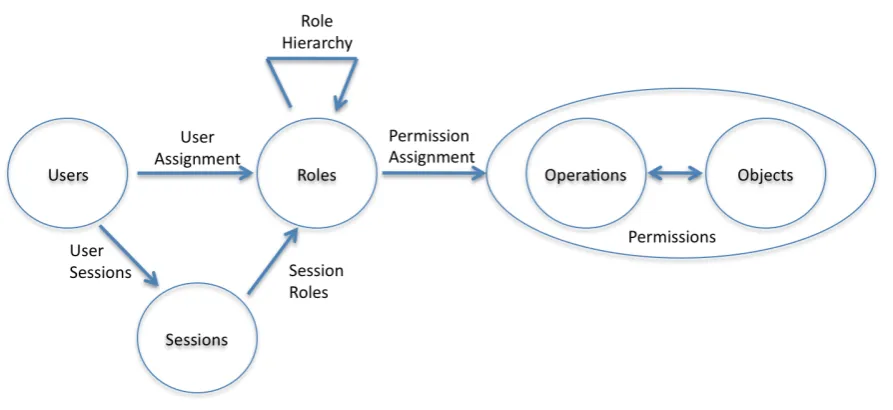
session1 (s∈SESSION S). According to functional specification in the RBAC standard
documentation, a user can exercise her rights in a session by activating an initial set of roles during session creation or activating further roles in an active session. Figure 2.1 summarizes the RBAC model components and the relations between them.
− Static and dynamic Separation of duty (SoD) constraints are specified on sets of roles:
SSoD, DSoD ⊆ (2Roles × N), such that an RBAC SoD constraint (rs, n) where rs is
defined by a subset of roles (rs ⊂ R) and a natural number, n ≥ 2. As we will see in
the following chapters, the way a DSoD constraint is enforced (i.e. per session) is widely considered as underspecification.
A user u has permission p iff there exist roles r, r0 ∈R such thatr r0, (u, r)∈U A,
and (r0, p)∈P A. Conventionally, anRBAC policy is a tupleRP = (U, R, P, U A, P A,).
All the RBAC policies considered in this thesis are assumed to befinite, i.e.U,R, andP
have finite cardinality (and thusU A, P A, and have finite cardinality too).
2.2.1 Separation of Duty (SoD)
SoD[CW87] has been considered as a mechanism to eliminate errors or accidents in the performance of a sensitive function (i.e. task). Known as two man rule, it regulates the completion of a sensitive task by putting constraints on the users performing it. SoD has been studied extensively and solutions have been proposed at different levels of access control objects. A role based SoD defines SoD policies in terms of roles, a permission
1
based SoD defines SoD policies in terms of permissions and so on. We should note that the original definition (aka Separation of Privilege [SS75]) referred to the permissions of a user while the most recent SoD research defines SoD policies in terms of users.
2.3
Security Policies, Principles and Mechanisms
In this section, we discuss some of the well-known security policies to support security motivations and a set of principles that should be taken in the design and deployment of any security system. A rather pragmatic approach is followed when choosing the terms for a security element and specifying the category it belongs to. For instance, the separation of privileges is considered as a principle in various resources and a policy in some others. Apart from conventional use in access control systems (i.e. authorization policy), a security policy in access control refers to a security measure that regulates certain
func-tionalities, mainly via restrictions, for security motivations including conflict of interest,
prevention of fraud,error detection,information integrity andconfidentiality. In the liter-ature, they are sometimes named as objectives [LTB07a], constraints [SZ97] or concerns.
We will often use the term constraints to refer to security policies. However, when
pos-sible, a clear distinction is preserved between authorization and security policies in this thesis. The former is considered to encode usually, but not necessarily, static informa-tion and does not need state noinforma-tion, while the latter might be dynamic and requires state maintenance. Security policies might be application dependent and a custom specification language might be needed for their specification. They are usually authorization model transparent and exist indepedently of the underlying security model. Among the others, SoD policies are widely employed and dicsussed in the literature and are the main policies that are considered in this thesis.
Security policies are enforced through mechanisms. Mechanisms are methods or
ap-proaches for supporting the requirements of security policies in a particular authorization model. Hence, they are usually model specific. The nuance between authorization policies and security policies lies in their evaluation results. The evaluation of an authorization
policy results either with a negative authorization A− (i.e. denial of the request) or
with a positive authorization A+ (i.e. set of privileges P
f ound). If the result is A+, then
the evaluation of security policies can further retrict the availability of these privileges.
Specifically, the set of privileges requested (Preq) can be either a subset of the set of
privileges (Pconstrained) that does not violate the security policy (Preq ⊆ Pconstrained) and
preserving a positive authorization A+ or a superset (Preq ⊃ Pconstrained) that turns a
Security Policies, Principles and Mechanisms 9
Motivation Policy Mechanism
Conflict of Interest, Prevention of
Fraud, Confidentiality Separation of Duty
Mutually Exclusive Roles (MER) Role enablement
Minimum Cardinality on Usersets Chinese Wall Conflict of Interest Classes
Table 2.1: Example Motivations, Policies and Mechanisms
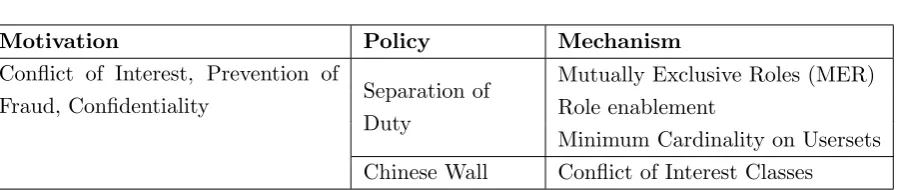
the sake of simplicity, we will consider an intuitive approach as described above: security policy enforcement follows the authorization policy evaluation. Table 2.1 presents two constraints (i.e. SoD and Chinese Wall[BN89]) and a set of mechanisms that can be used to enforce the security policy.
Security principles are best practices that help a security system to be feasible. They
provide common considerations that need to be taken into account during the design and deployment of the system. In fact, many security decision problems can be cast as optimization problems in their existence. For instance, the well-known principle of least
privilege would require Pconstrained \Preq to be minimized. This thesis covers the cases
for three types of such principles: least privilege, economy of mechanism and complete mediation. These principles set the guidelines for security system design.
Least Privilege: Least privilege principle requires that a user should be provided only the permissions that are necessary to complete her task and not more[Bis04]. It is also known as need-to-know principle in mandatory access control [Gol06]. Least privilege has been widely applied as a best practice in security design for eliminating frauds and errors. It is also used as a motivation for various security enforcement mechanisms. For instance it serves as a strong motivation for dynamic mutual exclusive role specifications in the context of RBAC.
Complete Mediation: Complete mediation is a generic principle that has a particu-lar impact on the performance of a security mechanism. It requires that every access to a sensitive resource must be checked for authorization. It implies that in an authorization system, the number of access requests is quite likely to be very high. The support of complete mediation requires efficient approaches to authorization policy evaluation and constraint checking.
Economy of Mechanism: In order a security system to be feasible it must cost-effective. Economy of mechanism principle makes sure that a security mechanism serves its purpose in the most efficient way. It implies that the mechanism must be efficient in terms of time, resources while maintaining its primary purpose.
2.4
Enforcement of Constraints
The constraints considered in this thesis can be named as authorization constraints fol-lowing the terminology introduced by [BFA99] and the mechanisms to enforce them are dynamic. That means their enforcement involves state information. A dynamic constraint that is satisfied at a state, might still be violated at a future state because of events in the system. Some of the literature also consider the order in the enforcement of constraints such that in an order dependent constraint, a specific event order must be followed. In an order independent sceheme, the order of events is immaterial. However, in many access control systems such a distinction is unnecessary. For instance, a cheque must be created for being signed is a business or application requirement, rather than authorization, in
the course of events: create and sign rather than a constraint enforcement scheme.
Chapter 3
A New Approach for Design-time
Analysis of RBAC Systems with
Dynamic Constraints
While the security analysis of RBAC based authorization policies have been well studied, it has been mostly abstraction based. In abstraction based techniques, an abstract model of the authorization policy is created in a custom modeling language and properties are analyzed on the created model. The knowledge of the custom language and the func-tionalities provided by the underlying analysis tool are key elements in abstraction based analysis. Moreover, majority of the analysis work were tailored to static access control elements (e.g. user-role assignments in RBAC). Design time information governed by the administrative operations were enough to build an abstract model. The subject of the
analysis was the relations between elements such as a query that would yield the state of
these relations. For instance, asking whether a user can perform an operation through one of her roles could ensure that she can perform her daily job function within this context. In this approach, the state is defined by the static RBAC relations and it changes through administrative events such as assigning a new role to a user or changing the definition of a role. From a dynamic constraint point of view, the run-time state of an access control system changes also through some other events that are not administrative such as past user actions and dynamic run time context. In fact, as summarized in Chapter 1 an enforcement mechanism to support dynamic constraints works in an active context that frequently changes. Hence, majority of the dynamic constraint enforcement mechanisms
require astate definition and proper handling of state changes.
However, XACML run-time provided by the architecture represents a stateless system. While we can use the history of exercised permissions and past role activations of a user at the RBAC model level, at the language level XACML does not provide the necessary means. XACML components need to be updated for a stateful decision process. Sev-eral proposals, in the form of implementation support, appeared to enrich XACML with stateful policy evaluation. These proposals required new approaches for testing access control policies that are closer to the implementation level and that can test the policy dynamically so that the provided implementation support can also tested.
It is difficult to analyze the dynamic constraints of an access control system and verify its correctness at design time. In particular obtaining good test cases is challenging. This is mainly due to the fact that the authorization policy and the constraint specifications are part of an active system and the context which they are verified changes frequently. However, similarly to what is done in software verification, it is possible to statically give some approximations of the run-time behavior and analyze a finite number of possible configurations that represent both the user behavior and the decision parameters in a run-time context. The use of software verification tools can be handy in generating the test cases. In this way, not only constraints (e.g. history based) can be analyzed dynamically but they can also be analyzed in combination so that their co-existence can be projected. However, using software model checking requires careful considerations on two aspects: optimizations to avoid state explosion and understanding of RBAC run-time events that cause a state change. For the former, we discuss some of the optimization techniques available in the software model checker we use during demonstrations. For the latter, a detailed analysis of RBAC operational semantics that result with clear definitions of relevant run-time events are presented.
3.0.1 Contributions and Organization
In this section of the thesis, we present a new approach to dynamic constraint analysis, in particular verifying the enforcement of Dynamic Separation of Duty (DSoD) policies. The authorization systems we consider are RBAC systems designed according to XACML RBAC profile[XO05b]. Our approach exploits the operational semantics of RBAC stan-dard and the functionalities provided by an explicit state software model checker, Java Path Finder[Cena]. A shorter version of this chapter appeared in [TJC11].
Because our approach models the RBAC system as a mix of programming language constructs, it does not require the knowledge of specific modeling languages. The pre-sented approach differs from state-of-the-art in ways as the following:
exe-Problem Definition 13
cution based). We believe that writing program code is easier than learning custom
languages/notations required by model checkers1.
− Tests also the implementation extensions required by the constraints and automates
the test generation process.
− Provides insights about a running RBAC system with concurrency in mind and the
constraints by exhaustively submitting requests to an actual XACML policy and it does this in an off-line manner.
In Section 3.1 and 3.2, we define the problem with relevant background information and present a running example respectively. Section 3.3 surveys standard RBAC specifi-cation [oSN04] and presents our findings from analysis of RBAC operational semantics. Analyzing operational semantics of RBAC provides a functional view to RBAC and helps us to define event instances that change a state in a running RBAC system. In Section 3.4 we present our approach for dynamic analysis and Section 3.5 demonstrates various test-ing cases and possible optimizations by ustest-ing the software model checker we employ. Section 3.6 concludes the chapter and presents a list of future work.
3.1
Problem Definition
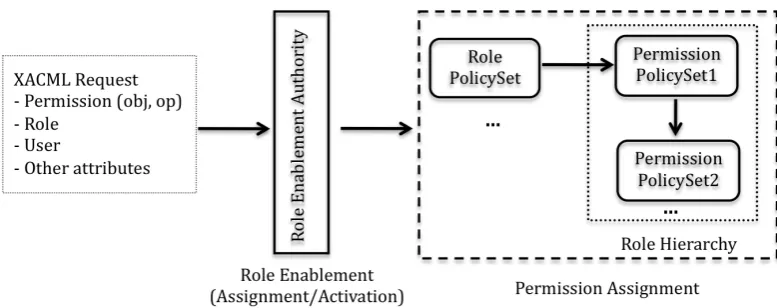
The RBAC model used in this chapter is the one described in XACML RBAC pro-file [XO05b]. The model supports all hierarchical RBAC features of standard RBAC. In addition, it allows the specification of a set of attributes whose values are only available at run-time to enable further dynamicity. It does not fully support DSoD constraints without extensions to the XACML architecture as we will see. In this profile, roles are represented as sets of subject (and resource in some cases) attributes and role hierarchies as policy references. Figure 3.1 shows how an RBAC query is responded through the available policies. Three policies are defined in the profile:
− Permission PolicySet (PPS): Contains actual permissions by specifying resources and actions to be performed on resources.
− Role PolicySet (RPS): Specifies roles by associating role attributes with a given
Permission PolicySet. RPS handles the P A relations of RBAC.
− Role Enablement Authority (REA) Policy : Manages role assignments to
subjects. REA handles the user assignment (U A) relations of RBAC.
1Note that model checkers input a custom language specification while software model checkers input source
Figure 3.1: RBAC Authorization Queries in XACML
Among these policies, REA policies are of particular importance for us as they contain the UA relations. The architectural components for enforcing policies (see Chapter5 for
more details) in XACML include: 1. Context handler acts as a communication bus by
creating a mutual context between components, 2. Policy decision point (PDP) makes
an access control decision by evaluating the request against the available policies, 3.
Pol-icy enforcement point (PEP) forwards the received requests to PDP and enforces the
obligations returned from PDP, 4. Policy administration point (PAP) makes the
poli-cies available to PDP, 5. Policy information point (PIP) retrieves the attribute values
requested by context handler. Among these components, PEP and PDP are of partic-ular importance for us as they are the components in which state information can be maintained.
3.1.1 Defining States
Conventionally, the state of an RBAC system with static constraints is defined by the
tuple hU, R, P, U A, P A, RHi where U, R, P are the set of users, roles and permissions
respectively, U Ais the user assignment relation,P Ais the permission assignment relation
and RH is the role hierarchy. In RBAC with dynamic constraints, the state must be
extended,hU, R, P, U A, P A, RH, H, Rpiwith dynamic information obtained from the past
events (H) and the run time parameters Rp whose values obtained from the execution
Problem Definition 15
represented as program constructs.
3.1.2 Analyzing Dynamic Constraints and Their Enforcements
In standard RBAC terms, we consider only DSoD motivated constraint definitions, specif-ically mutually exclusive roles (MER). In the context of RBAC specified using XACML, constraints on role activations and restrictions on exercising permissions are also sup-ported. For the enforcement of DSoD motivated constraints, several approaches have been
proposed [FB09, Cra05]. In each proposal, theimplementation support that extends the
XACML enforcement architecture plays a key role. Table 3.1 summarizes the XACML architectural components to be extended for supporting DSoD enforcement mechanisms introduced in these proposals. The first row refers to MER specifications which implies
a maximum of k roles can be activated at the same time from the set {r1. . . rn}. The
second row refers to a high level SoD specification which implies there must be at leastk
users exercising the permissions {p1. . . pn}. In both rowsn ≥k.
In general, verifying whether the constraint specifications (e.g. MER) correctly enforce the security policies (Table 2.1 of Chapter 2) behind them is difficult. With the addition of implementation support, the situation gets more complicated as there can also be errors in
the extensions. Thus the aim of this chapter is first,trying to find an approach to analyze
if the security policies are correctly enforced with the implementation support and second, observing the behavior of the whole authorization system in a realistic environment where the authorization sessions can exist concurrently.
Specification Extended XACML Component ({r1. . . rn}, k) PEP
({p1. . . pn}, k) PEP + PDP
Table 3.1: Constraint Types and Effected Access Control components
3.1.3 Java Path Finder
While there are many freely available tools for the execution based verification of software (i.e. that takes source code as input rather than an abstract model), we illustrate the proposed approach by using Java Path Finder (JPF) [Cena] because of its wide user support and stable development cycle. JPF is an explicit state model checker that analyzes
programs written in Java. It works on top of a custom built Java Virtual Machine
visited, or partial order reduction to reduce the size of state space. Although, JPF works as an explicit model checker when used alone, there are many subprojects that extend its functionality with different testing schemas including symbolic execution and actor testing.
3.2
Example Policy
Throughout the chapter we will be using an example policy designed for a banking system dealing with money transfer operations. The money transfer requested by a customer passes several steps before being realized. Based on customer’s request the bank teller initiates a transaction on customer’s name. The initiated transaction together with the customer data is validated through a security check that is done by an auditor. A valid transaction is finally approved by a manager for the actual transfer.
The system can be modeled with the following RBAC elements:
U ={alice, bob, seth}
P ={p1(initiate, transaction),p2(approve, transaction),p3(validate, transaction)} R ={manager, teller, auditor}
P A={(teller, p1), (manager, p2), (auditor, p1)}, (auditor, p3)} U A={(alice, teller),(bob, auditor),(bob, manager),(seth, teller)}
In such a system, there are several rules that regulate the process:
r1 A transaction can occur only during the week days (Monday - Friday) and between
the hours (08 - 12).
r2 A money transfer process must involve at least two different people, that is ({initiate
, approve, validate},2).
There are various ways of encoding these rules. For rule r1 we use a role enablement2
constraint that permits the activation of a role only under certain circumstances. For
rule r2 we use a MER specification that prevents the simultaneous activationauditor and
manager roles. More concretely, the following constraint specifications are available in the system:
RE ={(teller, time∈(08−12am)),(teller, day ∈(M onday−F riday))}
M ER ={({auditor, manager},2)}
2A role enablement policy contains only one role in the definition and restricts the sequential activation of the
State Changing Event Instances 17
3.2.1 Enforcing Dynamic Constraints
As can be noted, each of the constraint specifications of the example requires various
degrees of run-time support in their enforcement. M ER specification relies on the
his-tory information whether one of the roles in {auditor,manager} has been activated. RE
specification is defined by using the run-time values.
Intuitively, the REA policy of Figure 3.1 is a point of defense where the relevant
re-strictions can be applied at the policy level. One method to specify simultaneous role
activation restrictions is the use of an additional ”deny” rule in the role enablement
pol-icy that denies a request asking the activation ofauditor andmanager at the same time.
In fact, earlier versions of XACML RBAC profile included a set of policies, called SoD
policies, that prevents the simultaneous activation of a given role set rs = {r1. . . rn}.
In order such a rule to be effective, a request must contain a set of roles rsR such that
rs ⊆ rsR. This approach may not be feasible out of the box because the role
activa-tions correspond to a duration in most of the authorization systems. However, with an implementation support, this drawback can be overcome by an extension to PEP that allows keeping track of already active roles and prevents the new ones that contradict the constraint definitions. The necessary information (e.g. history) can be added as variables to the implementation. To illustrate the concepts, we will be mainly referring to the use of REA policies for constraint enforcement, even though it is not the best approach to follow.
3.3
State Changing Event Instances
Standard RBAC provides the ”session” notion that encapsulates the state changing events. For that reason, they are central in understanding the operational semantics of RBAC and implementing a software system that represents RBAC dynamics. However they are defined only in very generic terms in the standard. In fact, standard RBAC defines a
ses-sion as ”a mapping between a user and theactivated subset of roles (rs) that are assigned
to him/her” 3:
SessionRoles(s) ⊆ AuthorizedRoles(u) s.t. s ∈ user sessions(u).
The definition of sessions and the standard RBAC functions (see Appendix 8 for a list of available functions) have the following implications when there are dynamic constraints (C) available:
1. Each session is associated with only one user and each user is associated with one or more sessions.
2. Sessions are active once they are created or inactive once they are deleted. Being
3The functions in capital letters are from RBAC standard and we assume their semantics are self evident from
active is a precondition for all other RBAC events at run-time. Beware that the events happened in an inactive session may need to be stored in order to enforce some historic constraints.
3. A user can add (and drop) multiple rolesrsin an active session as long as the dynamic
constraints are not violated: rs⊆ AuthorizedRoles(u) ∧ c, for each c∈C.
4. A user can exercise a permissionp in an active sessions if there is an active roler and
the dynamic constraints are not violated: (p, r) ∈ P A ∧ r ∈ SessionRoles(s) ∧ c, for
each c∈C.
There are three events, namelysession creation,role activation andpermission exercise
that are significant when run-time state changes are considered. The first two events also have their closing events, i.e. session deletion and dropping of a role. Another important point to mention is the chronological dependency relation between them such that a session has to be created before a role is activated or a role has to be activated before a permission invoked.
Session Creation. According to the requirements of the application domain, an RBAC user can create (or be associated with) multiple sessions each having a unique identifier. Each session is instantiated with an initial set of roles and enables the user to perform various activities related to her job function. Because it involves automatic activation of some roles it is also a relevant event in dynamic constraint analysis. RBAC
standard provides two functions for the rudimentary creation/deletion of sessions:
Cre-ateSession and DeleteSession.
Role Activation. The discussion of sessions as a run-time aspect has been mainly centered around role activations. Note that role activation does not only refer to ini-tial activation of roles during session creation but also the dynamic activation/dropping
of roles, denoted as RA and RD respectively, through functions AddActiveRole and
DropActiveRole. These functions can be invoked in anactive session. For instance for
the example in Section 3.2, the user bob can create two sessions and activate auditor and
manager roles in each session respectively. Such a configuration would not be prevented by the standard RBAC.
The literature suggests that there are two types of RA in a session: single (sRA)
and multiple (mRA). mRA enables further flexibility but also adds more complexity in
the run-time permission management. In a multiple session enforcement setting, an RA
may create a restriction on the activation of roles in other sessions of a user if there is a dynamic constraint specification. In general, role activation is a point of contention where the main RBAC criticism originates. Among the very arguments listed in [LBB07],
(mRA) is considered to be in conflict with theeconomy of mechanism principle [SS75]. In
Approach: Policy Testing as Software Testing 19
Event RBAC Supporting Functions Session Creation CreateSession(), DeleteSession() Role Activation AddActiveRole(),DropActiveRole() Permission Exercise CheckAccess()+
Table 3.2: Run-time state changing events and corresponding RBAC functions
(e.g. dynamic separation of duty of RBAC) and this causes mRA to be more expensive
thansRA. Moreover, the control required for checking all combinations of roles (i.e. their
permissions) is more complicated than the one for a single role in a session. Although our
primary focus would be on mRA in what follows, the analysis can be easily restricted to
a case where only sRA sessions are considered.
Exercising Permissions. While role activation plays a key role in the discussion of dynamic constraint enforcement, it is the exercise of permissions that makes role
ac-tivations meaningful in practice. RBAC standard provides a functionCheckAccess to
request a permission in a given session. Conventional RBAC constraint mechanisms work at the role level and enforcement is done per session. If permission level granularity is not considered, then role level enforcement requires the assumption that a role activation entails the exercise of all associated permissions of the role activated. In reality, it is the
permission p1 of the role auditor in a session of bob that again effects bob to undertake
role manager role or exercise p2. Hence, we also consider the exercise of permissions as
atomic events that can change a state in order to accommodate permission level constraint specifications.
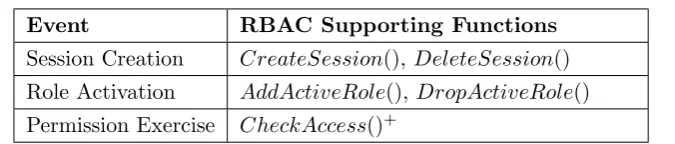
It is easy to see that the events listed above correspond to supporting functions of
RBAC standard as summarized in Table 3.2. We will be using these events as class methods in one testing scenario and in the other as instances of a class declaration. In both cases, they have access to relevant information such a role activation event can can access to the associated role.
3.4
Approach: Policy Testing as Software Testing
We assume that the policy authors describe their access control requirements (e.g. privi-leges) in XACML according XACML RBAC profile and the person in charge of deploying the authorization system provides an enforcement logic (i.e. implementation support) for the dynamic constraints. Apart from the XACML policy, the testing system we will present is provided a set of inputs that constitutes an active RBAC system. These ele-ments include:
constrain the user request. Any constraint enforcement mechanism that can be encoded as a Listener (see Section 3.1.2) function can be used.
Domains of Run-time Parameters (PD). In the first testing scenario we will present, we require a finite set of parameter values used in policy evaluation and constraint defi-nitions. A more automated approach to generate these domains is also presented at later section as an optimization.
In order to analyze an access control system automatically, we first extract some attribute values from a given policy. These attribute values correspond to attributes that are only available at run-time summarized previously. We call them as run-time parameters in what follows. We further create a software system that simulates an RBAC system and stores the necessary information representing the extended RBAC state as variables. For instance the set of active roles in a session is represented by a variable, activeRoles, of Java vector structure. During the operation the software emits some event instances. When doing this it makes use of the attribute values obtained from previous step to form proper XACML requests. The generated event instances are state changing
events listed in Section 3.3 and they carry a system from an initial state, s0 to a future
state, sn. Some of these events may cause a constraint violation that can be detected at
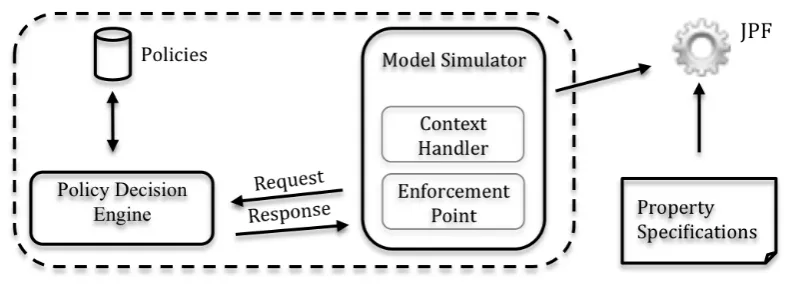
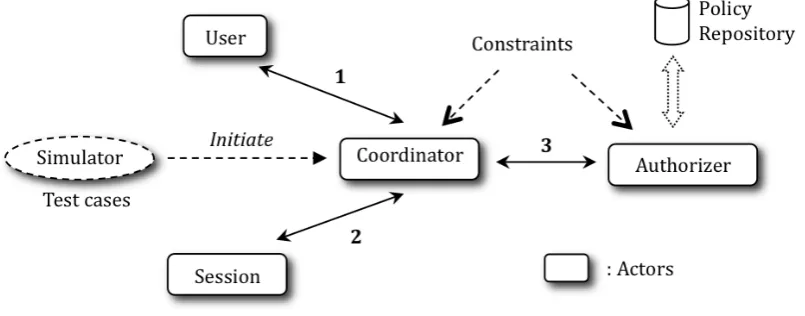
run-time. We represent these events as program constructs that are instantiated during the policy load. The source of state changing events is the unknown user behavior, that means, their occurrence is indeterministic. In our approach they are generated by the software model checker that wraps our software and executes it for all possible execution paths according to chosen testing strategy. The events corresponding to indeterministic user behavior forms an access request and is forwarded to the policy decision point for evaluation. Beware that, it is the actual policy as opposed to an abstract representation of it in a formalization (e.g. Datalog program), that is used for the evaluation. Figure 3.2 depicts our approach at a high level. We believe that the simulator component can be replaced with a wrapper implementation (e.g. API) of the authorization system software with a minor effort. This leads to systematic testing of actual authorization systems as a whole.
The context in which a policy is evaluated or a constraint is checked is called a
deci-sion context and corresponds to state notion in formal analysis. In addition to the static information contained in the policy, a decision context is composed of two types of
dy-namic information as explained before: execution history (H) and run-time parameters
(P). Both information can be represented as variables in the RBAC software
implemen-tation: Execution history is a sequence of state changing event instances, H ={e1. . . en}.
Approach: Policy Testing as Software Testing 21
Figure 3.2: Overall Approach
history grows by the addition of new events and provides background information for the evaluation of dynamic constraints. Optimizations can be applied for reducing the size of history. A run-time parameter is a variable that is bound to a value at run-time and used during enforcement of constraints (or the evaluation of actual access requests) with a ma-nipulation logic. As we will see in the following section, we map the run-time parameters to a restricted set of attribute values in XACML.
3.4.1 Environment Attributes as Run-time Parameters
XACML enables the specification of various attributes that are either retrieved from the request or from the execution environment at run-time. We call the attributes that are defined in REA policies as run-time parameters. Run-time parameters regulate the activation of roles and are retrieved from the execution environment. Finding run-time parameters and their representation in an authorization language usually requires custom mining algorithms. However, as it is in XACML, the majority of authorization languages provide special constructs or expressions where such parameters are specified. Hence, we conveniently assume that the discovery of run-time parameters amounts to finding these
constructs and forming a top level recursive functionf(X) whereX has the form :
X ::=p1. . . pk | v1. . . vn | f0(X)
The elements p1. . . pk denote the set of run-time parameters, v1, . . . vn denote a set
of values (usually hardcoded in the policy) used in computation of f, and f0(X) is a
In the case of XACML, some of the AttributeDesignator (AD) elements represent the
run-time parameters which appear in Apply elements of XACML conditions. Apply
ele-ments act as a container for them and provide a manipulation logic through rich XACML
functions. An Apply element also contains a set ofAttributeValue(AV) elements used in
the computation of the function. As you can see in the function form presented above, Apply elements can be nested. Accordingly, a condition containing run-time parameters
can be represented in the following form in XACML (ConF unc represents the function
of top level Apply element):
ConF unc(X)→ {true, f alse}
X ::=AD1. . . ADk | AV1. . . AVn | Apply(X)
Algorithm 1 presents an algorithm (T ransf ormExpression) to generate this flat form
from a given XACML condition element. Note that, the top level function (ConF unc(X))
must be a boolean function. While XACML allows the specification of different run-time
Data: Condition expression (ex)
Result: Expression of the form{XACMLFunction funcId; Expression[] parameters; Object[] values}
Initialize expr and set its function id;
foreachchild ∈ex do switchchild.type do
caseApply
ExpressionnewEx←−transformExpression(child);
if expr.parameters =∅theninstantiate expr.parameters; expr.parameters.Append(newEx);
return;
caseAttributeValue
if expr.values =∅theninstantiate expr.values; expr.values.Append(child);
return;
caseAttributeDesignator
instantiate expNew∈Expression, ; expNew.funcId←−(attributeId∈child) ; expNew←− ∅;
if expr.parameters =∅theninstantiate expr.parameters; expr.parameters.Append(expNew);
return;
endsw end
returnexpr;
Algorithm 1:TransformExpression
Demonstration 23
with the execution environment. In the standard specification, the following attributes are explicitly specified as parameters that needs to be handled by a context handler at run-time:
− urn:oasis:names:tc:xacml:1.0:environment:current-time: Represents the current time in the execution environment.
− urn:oasis:names:tc:xacml:1.0:environment:current-date: Represents the current date in the execution environment.
In what follows we will consider only these attributes as run-time parameters for simplicity even though the concept can be easily generalized to other types of attribute values.
3.4.2 Defining Constraint Check Points
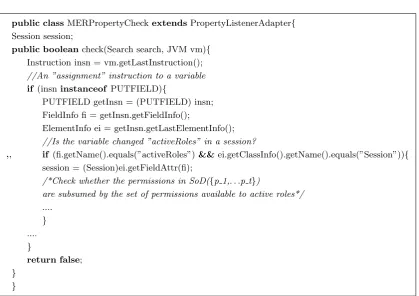
In order to verify the enforcement of dynamic constraints, we need to define checkpoints (e.g. execution locations) where the current state is verified. JPF provides various ways of specifying properties that represent the constraint specifications in dynamic analysis. One of the simplest ways is to use program assertions in the program (i.e. software) under test. In this method, the violation of the constraint specification, i.e. bad state, is typically implemented as a function whose return values are used in assertion checking. An alternative approach is the use of property extensions provided by the model checker. Property extensions provide a more granular view to the verification process by inter-cepting lower level events and we will be using them. While it should be relatively easy to extract bad states for SoD specifications from a policy, we assume that the properties representing them are implemented by the policy author. We believe, this gives the policy author a better understanding of the policy content during refinement process. Figure 3.3 presents an example JPF listener that intercepts the relevant events and evaluates them according to given enforcement logic. For instance, a subsumption check, whether a M ER({r1, . . . , rn}, k) specification correctly enforces the given SoD policy (p1, . . . , pt)
can be checked in this listener.
3.5
Demonstration
,,
public classMERPropertyCheckextendsPropertyListenerAdapter{
Session session;
public booleancheck(Search search, JVM vm){
Instruction insn = vm.getLastInstruction();
//An ”assignment” instruction to a variable if (insninstanceof PUTFIELD){
PUTFIELD getInsn = (PUTFIELD) insn; FieldInfo fi = getInsn.getFieldInfo();
ElementInfo ei = getInsn.getLastElementInfo();
//Is the variable changed ”activeRoles” in a session?
if (fi.getName().equals(”activeRoles”)&&ei.getClassInfo().getName().equals(”Session”)){
session = (Session)ei.getFieldAttr(fi);
/*Check whether the permissions in SoD({p 1,. . .p t})
are subsumed by the set of permissions available to active roles*/
....
}
....
}
return false;
} }
Figure 3.3: Example Listener for Constraint Enforcement
JPF is forwarded to PDP engine after generating a request. We will now demonstrate how JPF and its sub-projects can be exploited for testing the specifications and the im-plementation support. When doing this, we will use the example policy introduced in Section 3.2.
3.5.1 Exhaustive State Space Traversal
An access control policy can be exhaustively verified for analyzing a given property that represents dynamic constraint. By approximating the values of the given run-time pa-rameters, an RBAC policy can be simulated as a whole to obtain insights about a running
system. Approximation is necessary for variables of large domains such astimeand effect
the possible number of test cases. The system events are generated randomly by JPF according to the testing environment. Each relevant user event (i.e. request) is evaluated whether it is compatible with the provided constraint enforcement mechanism. The events are also provided with a a list of parameter values (the result of Algorithm 1) randomly selected from possible parameter combinations. For example, a time parameter can be
selected from a set of values {09 : 00,18 : 00, ...} for the time variable of the example
Demonstration 25
necessary for the generation of XACML request (i.e. the policy to be applicable for the request) and they are concrete values in this section provided by the user.
JPF has a special class, V erif y, [VPP06] that acts as one possible type of interfaces
to its verification features. We use some of the methods available in this class:
− beginAtomic(). . . endAtomic() creates a code block that will be executed atomically. − random(n) returns a random value between 0 and n.
− ignoreIf(cond) forces the model checker to backtrack when condevaluates to true.
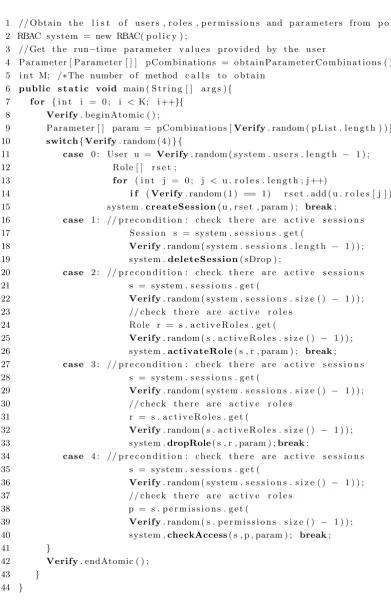
The analysis cases that can be performed by exhaustive state space traversal includes activity overlaps (simultaneous role activations) among sessions and the verification of simple dynamic constraints. Figure 3.4 illustrates one possible testing environment in which the provided enforcement implementation is called after each function call to
createSession(), activateRole() and checkAccess(). It is executed by JPF for all
pos-sible combinations of the values selected in V erif y.random() method. The number M
is used to obtain different method call sequences of size K such as: [createSession,
addActiveRole, createSession . . . ]. A listener implementation similar to Figure 3.3 in-tercepts all low level instructions that modify a set of variables. In our case, these variables represent the RBAC state (e.g. activeRoles) and their modification would mean a state change. A check whether a constraint is violated is performed (e.g. activeRoles) by using
the requested modification instruction. The class RBAC encapsulates the functionality
required by an RBAC system (see 3.3) its constructor inputs an XACML policy. The
method obtainP arameterCombinations() generates parameter lists from user provided
set of parameter values.
The main problem of this approach is the number of combinations to be analyzed
can be very large leading to state explosion problem. Moreover, obtaining
combina-tions of parameter values can be cumbersome in this approach as the user needs to
provide a set of discrete value ranges for the variables. JPF supports various
opti-mization techniques for defending against state explosion and generating test inputs for
unknown variable domains. For example, to eliminate redundant state visits it
em-ploys state matching. State matching can be enabled by calling the function,
Ver-ify.IgnoreIf (CheckSubsumptionAndStore
1 // Obtain t h e l i s t o f u s e r s , r o l e s , p e r m i s s i o n s and p a r a m e t e r s from p o l i c y 2 RBAC s y s t e m = new RBAC( p o l i c y ) ;
3 // Get t h e run−t i m e p a r a m e t e r v a l u e s p r o v i d e d by t h e u s e r
4 Parameter [ Parameter [ ] ] pCombinations = o b t a i n P a r a m e t e r C o m b i n a t i o n s ( ) ; 5 i n t M; /∗The number o f method c a l l s t o o b t a i n
6 public s t a t i c void main ( S t r i n g [ ] a r g s ){
7 f o r {i n t i = 0 ; i < K; i ++}{
8 Verify. b e g i n A t o m i c ( ) ;
9 Parameter [ ] param = pCombinations [Verify. random ( p L i s t . l e n g t h ) ) ] ; 10 switch{Verify. random ( 4 )} {
11 case 0 : User u = Verify. random ( s y s t e m . u s e r s . l e n g t h − 1 ) ; 12 R o l e [ ] r s e t ;
13 f o r ( i n t j = 0 ; j < u . r o l e s . l e n g t h ; j ++)
14 i f (Verify. random ( 1 ) == 1 ) r s e t . add ( u . r o l e s [ j ] ) ; 15 s y s t e m .createSession( u , r s e t , param ) ; break;
16 case 1 : // p r e c o n d i t i o n : c h e c k t h e r e a r e a c t i v e s e s s i o n s 17 S e s s i o n s = s y s t e m . s e s s i o n s . g e t (
18 Verify. random ( s y s t e m . s e s s i o n s . l e n g t h − 1 ) ) ; 19 s y s t e m .deleteSession( sDrop ) ;
20 case 2 : // p r e c o n d i t i o n : c h e c k t h e r e a r e a c t i v e s e s s i o n s 21 s = s y s t e m . s e s s i o n s . g e t (
22 Verify. random ( s y s t e m . s e s s i o n s . s i z e ( ) − 1 ) ) ; 23 // c h e c k t h e r e a r e a c t i v e r o l e s
24 R o l e r = s . a c t i v e R o l e s . g e t (
25 Verify. random ( s . a c t i v e R o l e s . s i z e ( ) − 1 ) ) ; 26 s y s t e m .activateRole( s , r , param ) ; break; 27 case 3 : // p r e c o n d i t i o n : c h e c k t h e r e a r e a c t i v e s e s s i o n s 28 s = s y s t e m . s e s s i o n s . g e t (
29 Verify. random ( s y s t e m . s e s s i o n s . s i z e ( ) − 1 ) ) ; 30 // c h e c k t h e r e a r e a c t i v e r o l e s
31 r = s . a c t i v e R o l e s . g e t (
32 Verify. random ( s . a c t i v e R o l e s . s i z e ( ) − 1 ) ) ; 33 s y s t e m .dropRole( s , r , param ) ;break;
34 case 4 : // p r e c o n d i t i o n : c h e c k t h e r e a r e a c t i v e s e s s i o n s 35 s = s y s t e m . s e s s i o n s . g e t (
36 Verify. random ( s y s t e m . s e s s i o n s . s i z e ( ) − 1 ) ) ; 37 // c h e c k t h e r e a r e a c t i v e r o l e s
38 p = s . p e r m i s s i o n s . g e t (
39 Verify. random ( s . p e r m i s s i o n s . s i z e ( ) − 1 ) ) ; 40 s y s t e m .checkAccess( s , p , param ) ; break;
41 }
42 Verify. endAtomic ( ) ;
43 }
44 }
Demonstration 27
3.5.1.1 Symbolic Execution
Some of the variables in a given RBAC system can be replaced with symbolic values to ease the testing process and to gain improvements in generation of method call sequences. We consider the run-time parameters and the manipulation logic provided by them as the
functions (i.e. ConF unc of Section 3.4.1), to be symbolically executed. By employing
symbolic execution, we can eliminate the requirement of run-time parameter domains (PD) and create a line of defense for state explosion problem. As we will see in the example, some of the variables representing the run-time parameters can be replaced with symbolic variables in order reduce the size of state space to be explored. We use Symbolic Path Finder (SPF)[Cenb] for implementing symbolic execution tests. SPF is a project that works on top of JPF and performs symbolic execution of Java bytecode by combining symbolic execution techniques with model checking and constraint solving. Several different constraint solvers and decision procedures are integrated to SPF for finding execution paths in a program.
SPF supports various program constructs such as integer variables or data structures that are replaced with symbolic variables. Hence, the RBAC class as a whole can also be used for symbolic execution. However, for the sake of simplicity, we consider only the
function ConF unc(X) to be symbolically executed and replaced its non-integer
param-eters with integer ones. There are tools that can automatically instrument code to be used in SPF. Symbolic execution requires the code under test to be instrumented. In particular, the symbolic expressions obtained from execution must be supported by the underlying decision procedure. SPF supports a large number of decision procedures for solving symbolic expressions, but it is still restricted to certain types of expressions. In addition to compliance with decision procedure, some of the method definitions such as the ones that update variables must be revised in order to be processed by SPF.
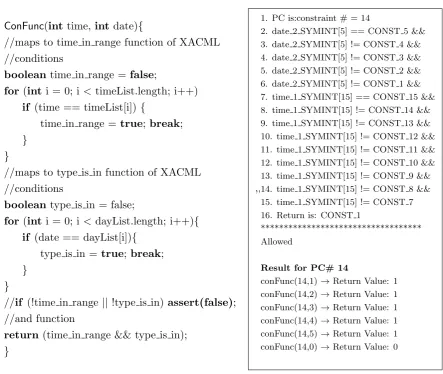
Figure 3.5 illustrates the code that corresponds to the condition of our policy example.
It contains the run-time parameters time and date as int parameters and represents the
predicates accompanying based on the functions provided in XACML conditions. The
functionConF unccan be executed symbolically by replacing some (or all) parameters by
symbolic variables. The result of the symbolic execution is a predicate defined by using the parameters represented symbolically. This predicate can then be fed to a decision procedure SPF supports to obtain value ranges which are the only ones that makes the predicate true. For instance, the right side of the Figure 3.5 shows one of the possible
snapshot of running both parameters ofConF uncsymbolically. It shows that if the time
(represented by the variabletime 1 SY M IN T[15]) is 14 : 00 (i.e. constant CON ST 15)
then the function is true during the week day “Friday” (i.e. variabledate 2 SY M IN T[5]
ConFunc(int time, int date){
//maps to time in range function of XACML //conditions
boolean time in range =false;
for (int i = 0; i< timeList.length; i++) if (time == timeList[i]){
time in range =true;break; }
}
//maps to type is in function of XACML //conditions
boolean type is in = false;
for (int i = 0; i< dayList.length; i++){ if (date == dayList[i]){
type is in =true;break; }
}
//if (!time in range ||!type is in)assert(false); //and function
return (time in range && type is in); }
,,
1. PC is:constraint # = 14
2. date 2 SYMINT[5] == CONST 5 && 3. date 2 SYMINT[5] != CONST 4 && 4. date 2 SYMINT[5] != CONST 3 && 5. date 2 SYMINT[5] != CONST 2 && 6. date 2 SYMINT[5] != CONST 1 && 7. time 1 SYMINT[15] == CONST 15 && 8. time 1 SYMINT[15] != CONST 14 && 9. time 1 SYMINT[15] != CONST 13 && 10. time 1 SYMINT[15] != CONST 12 && 11. time 1 SYMINT[15] != CONST 11 && 12. time 1 SYMINT[15] != CONST 10 && 13. time 1 SYMINT[15] != CONST 9 && 14. time 1 SYMINT[15] != CONST 8 && 15. time 1 SYMINT[15] != CONST 7 16. Return is: CONST 1
*********************************** Allowed
Result for PC# 14
conFunc(14,1)→Return Value: 1 conFunc(14,2)→Return Value: 1 conFunc(14,3)→Return Value: 1 conFunc(14,4)→Return Value: 1 conFunc(14,5)→Return Value: 1 conFunc(14,0)→Return Value: 0
Figure 3.5: Symbolically executed ConFunc() of policy example and a state example from its symbolic execution with SPF
With symbolic execution, only the relevant value sets for run-time parameters that can
cause the function ConF uncto return trueare obtained. Symbolic execution can reduce
the number of states to be visited and provide a set of input values for the domains of our run-time parameters.
3.5.2 Actor Based Testing
As shown in the previous sections, a simulation environment can be generated for ex-haustive analysis of access control systems. However, an access control system is a more
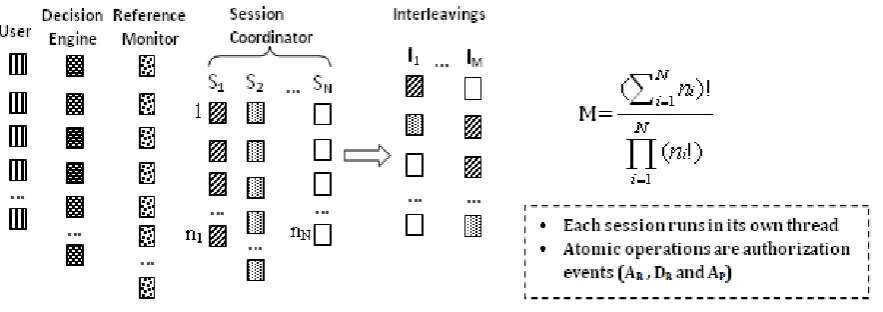
complex entity with the following abstract components: User front-end (e.g. enforcement
point), Decision engine, Reference monitor and Session Coordinator. In such a system,
Demonstration 29
Figure 3.6: RBAC system with Concurrent Sessions
different interleavings between them. Figure3.6 provides a view to RBAC with sessions existing concurrently. The possible role activations and the requests for the permissions of those roles create different interleavings. The calculation of total number of interleavings
(M) between concurrent sessions is given by the formula 4. It involves the length of a
session (N, the number of atomic operations such as role activation) and the total number
of sessions (n). In order to verify all possible cases of session interleavings the numberM
represents the upper bound.
There are similarities between the way an actor system works and an RBAC system operates. In real-world applications, the authorization systems contain multiple active components (e.g. subjects) that exist and act concurrently. These subjects might be actual users or programs acting on behalf of them. Hence, we propose an actor based [Agh86] approach to model user behaviour. An actor is a concurrent process that interacts with other actors via asynchronous message passing. In response to a message, an actor can create other actors, send messages to known actors or change its behavior. The ben-efits of actor model and its message passing paradigm over shared-memory threads with locks is summarized in [HO09]. Actor model is potentially more efficient than threads and more secure than shared-memory systems because of its race-free mail box mecha-nism. Eliminating low level problems caused by race conditions (e.g. concurrent policy requests) and allowing autonomous dynamic behavior, actor model enables us to capture the semantics of dynamicity in authorization system operation.
Once an actor based model of the authorization system is obtained and implemented as part of the software model previously described, Basset [LKDM10] can be used to an-alyze constraints. Basset is an extension to JPF fram