Scarcity and meeting water demands
Water scarcity occurs when the demand for water exceeds the available amount of water. Water scarcity also occurs when the poor quality of water limits its usability. Therefore, water quantity is not the only benchmark indicator for scarcity, water quality also has a bearing (UNDP 2006). Usually, scarcity is assessed by analysis of the population-water equation. The norm, as such, is to consider 1,700 cubic metres per person as the national threshold for meeting water
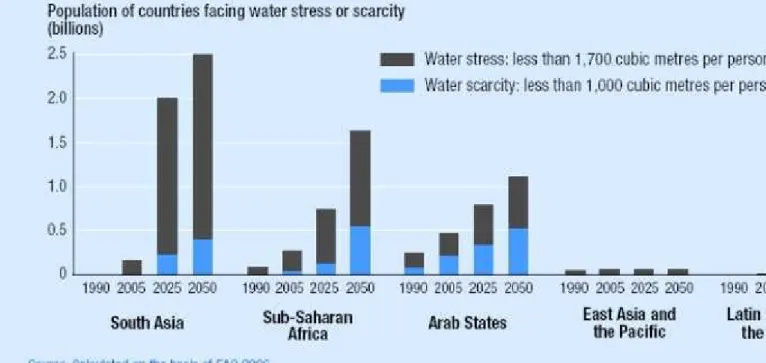
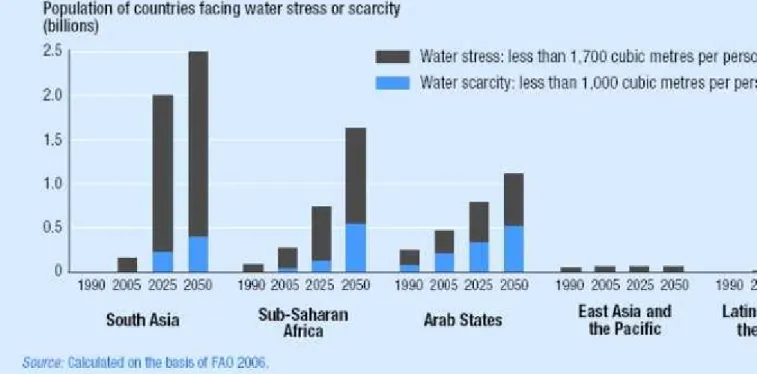
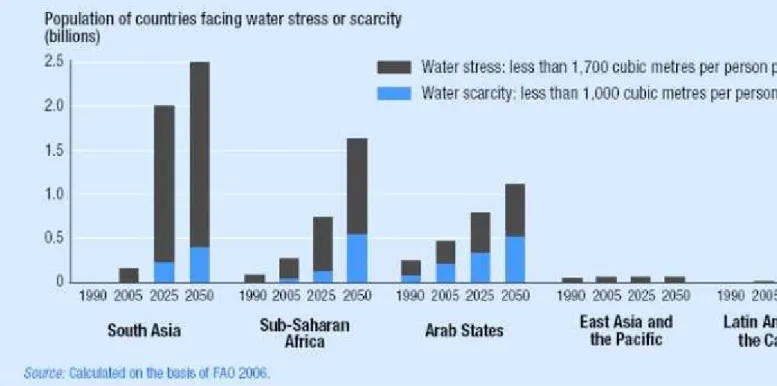
requirements. Consequently, water availability below 1,000 cubic metres represents a state of “water scarcity” and below 500 cubic metres represents “absolute scarcity” (Rijsberman, 2004). Based on this threshold, the figure below represents water scarcity states in different regions around the world.
Figure 2 Water status in different regions
Growing demand for water is the first of the components of a water scarcity situation. Population growth increases demand for water for the production of food, but also fordomestic and for industrial uses. This adds social and economical parameters to water related problems including scarcity. The three sectors compete for water allocation and this competition will get more intense in the future. In fact, population growth and rapid development comprise the major factors affecting water resources and their sustainability in the world.
population, under the current growth trajectory, is expected to reach nearly 9 billion by the year 2042 (Worldometers; IDB) with an average growth rate of about 2.19% (Nielsen, 2006; IDB).
However, the annual renewable water resources in the world amount to about 48,619 km3 only (Gleick, 1998). As such, the high population growth rate exceeds the rate of water resource development. Consequently, the annual per capita share of water resources is decreasing, and at an ever-increasing rate. As such, the rate of development and usage of water should be maintained at a lower level than the renewable rate of water resources (EEA, 1999). Human kind should be aware that the water resources are indispensable "partners-for-life", in a partnership in which humankind should not be dominant. Therefore, humankind should realize that there is a limitation of development and usage of water resource.
However, what is usually forgotten is the policies’ role in water scarcity. This is basically apparent in terms of acts of commission and omission (UNDP 2006). For example, perverse incentives as an example of commission acts are damaging because they promote overuse. This is observed in areas where water is provided for free or subsidized, which necessarily remove the incentive to conserve water or at least rationalize its use (EWG 2005). As such, one can only imagine the case in the Middle East and North Africa, where the cost of water is set well below cost-recovery levels even though the scarcity value of water is much in evidence (Shetty, 2006; Abderrahman, 2002).
In parallel, acts of omission has a breakthrough impact on scarcity particularly that to date little if any country show the deterioration or depletion of water in the national accounts as a loss, or depreciation, in natural resource assets. As such, national accounting conventions reinforce the market blind spot for water where natural services are seldom traded in markets, have no price and thus are not properly valued (Repetto et al., 1989; Solórzano et al., 1991; Daly & Cobb, 1989).
GDP accounts for losses of watercapital are expected to change economic and
environmental performance indicators for a large number of countries and will pass the message on sustainability to future generations (Repetto et al., 1989; Solórzano et al., 1991; Daly & Cobb, 1989).In this regard, the World Bank, in an attempt to comprehensively understand and present the issue of water scarcity, has identified different factors that interplay to cause water scarcity, an important part of which comes from outside the water sector (IBRD/WB,2007).
After all, these represent important reasons for why many countries face critical difficulties in ensuring self-reliance in meeting their water demand (Comair, 2005; Al- Alawi, 1998). This issue is further heightened when the link between water and food security is raised. For instance, currently, agriculture uses up the biggest part of the total water use and it seems probable that availability of water rather than land will be in the future the binding constraint to expanding food production worldwide.
It becomes clear, here, that there is no obvious solution for water scarcity as it is multifaceted and branched. However, there is indeed one solution that serves all which is sustainability i.e. sustainable development and sustainable natural resources use.. This introduces the issue of sustainability of water resources’ particularly in the developmentand usage of water resources. As such, the following section will introduce watersustainability and highlight the practices (planning, management, monitoring…) that guarantee the environmental conditions, which is needed to ensure water resources being renewable.
Sustainable Development and Water Sustainability
The concept of "sustainable development" dates back to the famous publication Our Common Future. Back then, sustainable development was defined as: "to ensure meeting the needs of the present without compromising the ability of future generations to meet their own needs" (World Commission on Environment and Development, 1987). This points that sustainable development does imply limitations imposed by technological and social impacts on environmental resources and by the carrying capacity and resilience of natural systems to absorb human activities.
Therefore, sustainable development clearly indicates that the carrying capacity of environment is limited. Applying the sustainable development concept in the water resources realm, it is
development and utilization that meet current water needs without compromising the ability of future generations to meet their own needs -- both for water supplies and for a healthy aquatic environment. The notion of sustainable development consists of three dimensions: the social, ecological, and economic dimension (Rogers et al., 1998; WSSD 2002; Hildering, 2004).
Criteria have further been proposed to make these three dimensions more tangible (Daly, 1996; Rogers et al., 2002). These criteria are ecological sustainability, social equity and
economic efficiency.
1. Social equity: is measured by the Gini-coefficient, which measures inequality of a distribution of resources. The Gini-coefficient is a ratio with values between 0 (uniform distribution) and 1 (fully inequitable distribution) (Verkerk et al., 2008).
3. Economic efficiency: is measured by ‘the criterion of Pareto efficiency, which defines the economically optimal situation as the state in which no individual can be made better off without another being made worse off’ (Verkerk et al., 2008).
Moreover, when the definition of sustainable development is converted into economic terms, it can be understood as “the development that pays its full cost during the process of development” (Panayotou, 1994). In other terms, it is development that accounts for all costs from production to disposal including: cost of resources’ depletion called a user cost, cost of environmental damage called environmental cost … etc. and it receives no subsidies except in proportion to positive externalities that it generates (Panayotou, 1994).
According to Panayotou, this development is “internalizing the conservation of resources, the protection of the environment and the provision of environmental and social infrastructure to the very economic activities and actions that place additional demands on these resources"
(Panayotou, 1994). On the other hand, from the perspective of water sustainability, it should transcend beyond quantity and quality. It should assess water reuseand water
resources management systems, in terms of their broader environmental and social impacts (Hermanowicz, 2005).
However, there is a lack of a framework for assessment of water sustainability in its broader sense. Current definitions do not offer proper aid to an engineer, a decision maker or an accountant, for instance, to deal and apply sustainability. As such, if sustainability is to be incorporated in business activities, it is argued that it must have a reasonably simple and quantitative definition. This could be through pricing which will, for instance, at least allow the comparison of alternatives.
To better explain achievement of water sustainability, at the Johannesburg World Summit on Sustainable Development (WSSD) in 2002, the Technical Advisory Committee of the Global Water Partnership introduced the concept of Integrated Water Resources Management (IWRM), to promote sustainability of water resources and defined it “as a process, which promotes the coordinated development and management of water, land and related resources in order to maximize the resultant economic and social welfare in an equitable manner without
compromising the sustainability of vital ecosystems,” and emphasized that water should be managed under the principles of good governance and public participation.
According to the World Water Assessment Programme (2003), the weaknesses
in governance systems, is what greatly impeded progress towards sustainable development and the balancing of socio-economic needs with ecological sustainability. They even go further to note that the water crisis is essentially a crisis of governance (WWAP 2003). After all, the core challenge with water governance is to realign water use with demand at levels that maintain the integrity of the environment (UNDP 2006) i.e. achieve a condition of social equity,
ecological sustainability and economic efficiency indirectly assuring sustainability.
Water Governance
Governance models are descriptions of the ownership and organizational structure, and allocation of responsibilities and risks for operational management and/or infrastructure maintenance and improvement of a business/industry (Bakker, 2003).
Governance models are also interchangeably called business models. As such different business or governance models allocate ownership to different stakeholders. Governance models usually describe a set of structures, functions and practices that define who does what, and how they do it (Bakker, 2003). In the case of water supply, two main governance models apply. One of which is the allocation of ownership of assets and management of assets to the government.
The other is their allocation to the private sector. Emerging also is the model in which public and private actors partner for the management of water sector. Water governance in general
comprises a range of political, organizational and administrative processes through which (Bakker, 2003; Rogers & Hall 2003):
1. Communities articulate their interests, 2. Decisions are made and implemented,
3. Decision makers are held accountable in the development and management of water resources, and
4. Delivery of water services is overseen.
It is important to note that the United Nations General Assembly in 2003 proclaimed the years 2005 to 2015 as the International Decade for Action 'Water for Life' (UN-Water, 2003, 2006; Martinez Austia P. and Van Hofwegen P. 2006; Verkerk M.P. et al. 2008).
In this sense, as a commitment, achieving good water governance is perceived as a global challenge; however, usually water governance is generally seen as a local or regional issue (UNGA, 1997; Verkerk M.P. et al. 2008). As such, the international water community has not recognized the necessity of global coordination in ‘water governance’. As a result, most efforts focus on seeking proper institutional arrangements (structures or mechanisms of social order and cooperation) at a local basin level.
water issues should be handled at the lowest governance level possible and by the fact
that water resources in the global sense are not scarce. It is understood that ‘aggregate annual withdrawals are below annual renewable water resources at the global level’ (Verkerk et al., 2008; Gleick, 1993; Postel et al., 1996; Shiklomanov, 2000; Vörösmarty et al., 2000; Zehnder et al., 2003). The actual issue is then the water demand and supply disparities at local scales.
Further to this discussion, Hoekstra (2006) clarifies how water governance has a global dimension. He relates this to the multiple global factors [information] climate change, (ii) privatization of drinking water, sanitation and irrigation services, and (iii) increasing ‘virtual water trade’ between nations which are directly or indirectly affecting water resources. However, according to Verkerk et al. (2008) institutional responses have not kept pace with the effects of climate change, privatization and trade liberalization that have led to or are expected to lead to changes in water supply or demand in various places.
However later, this was reflected after World War II and the expansion of the era of globalization, commoditization and neo-liberalism, where privatization gained increased enthusiasm in the water sector. Initially, governments have been the main provider of water, electricity, waste collection, and health services based on the raison d'être of governments, which places the delivery of services to a country’s citizens at its core. As such, the known paradigm of water management puts the public sector at its centre as most countries depended in the past on the public sector to provide water services to the population.
Nevertheless this was not free of problems and complaints, which resulted from
disputed efficiency and quality of water supply and reliability services. Even in developed countries public systems perform with lower competency than private systems (Easter, 1993; Estache & Rossi, 1999). In fact, it has been reported that government operation and delivery of water services has been subject to multiple problems that have caused undesirable results to both the government and the customer (Comair, 2005). It is believed that most government operated water production, distribution and collectionmsystems are characterized by inefficiency and ineffectiveness.
Reasons reside in the weakness of the institutional framework or the poor operation and maintenance and the lack of monitoring allowing illegal connections and thefts (Nyangeri Nyanchaga, 2003), as well as in the ineffective pricing (Nyangeri Nyanchaga, 2003; Dawoud et al., 2007). Naturally, this leads to poor service delivery, low revenues, poor operation and maintenance, high unaccounted-for water loss, low capital investments, low accountability of water undertakers, inadequate incentive system resulting from absence of transparency in financial management, overstaffing and wrong deployment of staff, and unsustainable operations and lack of regulation and enforcement (Nyangeri Nyanchaga, 2003; Azpiazu et al., 2003; Mashauri, 2003; Torregrosa, 2003).
restructuring of this governance model and mainly a shift from public management to privatization in water production and services (Comair, 2005).
This has expanded particularly due to the growing literature on water markets that documents the capacity of markets to create efficiency gains and to provide an efficient system for allocating water among sectors (Easter & Hearne, 1994; Chang & Griffin, 1992; Colby, 1990; Crane, 1994). As such, published literature presents multiple examples of successful water privatization in different parts of the world, including the Gulf countries, Latin American, as well as some European countries.
Basically, there are three main reasons for restructuring which include improving performance, sourcing finance, and meeting new legislative requirements (Bakker, 2003).It is insightful to note that almost all countries expressed the same reasons for water privatization (Al Alawi, 1998; Azpiazu et al., 2003; Mashauri, 2003; Nyangeri Nyanchaga, 2003; Darwish et al., 2007, Darwish & Al Najem, 2005). These reasons, fitting in the above categorization, mainly included:
- Poor water quality poor water administration, - Service inefficiency and ineffectiveness, - The inability to expand the service, and
- The need to remove the financial burden from governments’ budgets.
In summary, countries are observed to be adopting water privatization in an attempt to improve the quality of the water services supply, to expand the water services, to improve efficiency in operations and proper maintenance and to secure financial resources for investment (Mashauri, 2003), as well as to incorporate new technologies (Azpiazu et al., 2003). As such, privatization is observed as a tool to reduce the burden on public budgets while improving the customer service (Comair, 2005).
This mentioned, it is important to clarify that today there exists a wide range of business models and governance structures for water management systems in the world. They range from full public models to full private models and mainly include 1) government management, 2)
community cooperatives, 3) corporatized utilities, 4) government delegated management and 5) privatization also called direct private management or divestiture (Bakker, 2003).
The table below summarizes the most important differences between these three models: the planning, the market and the community models.
For instance, the difference is apparent between the planning and market governance models where the owner and operator of assets is the government and the private corporation
respectively. It is important to note that under the planning model, the consumer is a citizen while s/he becomes a customer under the market model.
Another important difference is that the hierarchy in the planning model serve as the
accountability mechanism, while the contract serve this purpose under the market model. On the other hand, it is to be noted that practical implementations of these models revealed the
emergence of hybrid models. These are apparent in, for example, the delegated management contracts and corporatized utilities which adopt elements from both the planning and market models (Bakker, 2003).
Most representative examples from the world include the cases in France and England. In France, private-sector management via management contracts is widespread. But water supplies infrastructures are owned by the municipalities who are forbidden to sell their infrastructure and do retain control over long-term strategic planning, which is characterized by features of the planning approach (Bakker, 2003). In England on the other hand, the water
supply and wastewater industry have been fully privatized since 1989, where the market model has been chosen.
However, England has created extensive regulatory frameworks and regulatory agencies for the water sector, to protect consumers and public health (Bakker, 2003). Resuming, a shift from public management to privatization is indeed a change in governance, a shift from
Basically, it is a debate on the commodification of water that stems from different approaches and perspectives to define, view and manage water. It is the same debate that rises on the management of any common resource in parallel to the known ‘tragedy of the commons’. As such, no one can address water, sustainability and privatization without dwelling on this debate.
Water: a human right or a human good
The major debate on water issues lies on the perception of water as a right or good. It is the ongoing struggle between viewing water as an economic commodity whose use and distribution is determined by profit or as a fundamental human right (Barlow & Myers, 2002). Therefore, it is a simple dichotomy between economic efficiency and basic welfare or human rights (Pradhan & Dick, 2003).
This debate heightened after the 1992 Dublin Water Conference and World Water Vision described water as an economic good. However, the aim of this statement was to promote that water be priced at a level that makes people use it sparingly (Faruqui, 2003). The argument behind this is that charging for water will conserve it. But still, the idea that water is an economic good remains controversial. In this regard, there are two main opposing arguments, one that recommends that ‘the state’ control natural resources to prevent their destruction while another that recommends privatization as the solution for the problem (Ostrum, 1991).
The human right to water is generally derived from the human rights to life, including food, drinking water, health, and a clean environment (McCaffrey, 1997). The human right to drinking water also stems from the human right to life: without drinking water people die (Beckmann & Beckmann, 2003).
Believers and supporters of the view of water as a human right challenge the view of privatization or the consideration of water as an economic good. They argue that commodification of water is ethically, environmentally and socially wrong because it bases decisions of water allocation on commercial, not environmental or social justice considerations (Barlow & Clarke, 2002).
Proponents of this view point further refuses privatization because it entails principles of scarcity and profit maximization rather than long-term sustainability in water management. They claim that some transnational corporations, backed by the World Bank and the International Monetary Fund, are increasingly forcing Third World countries to abandon their public water delivery systems and contract with their companies through what is called structural adjustments (Barlow & Clarke, 2002; Verghese, 2003).
Proponents of commodification of water base their argument on the perceived widespread corruption of the public sector in many developing countries (Segerfeldt, 2005). Defendants believe that unless water is treated as an increasingly precious commodity and priced to reflect its value much of it will be wasted (Barlow & Myers, 2002). In support of their argument, they highlight the cases of water scarcity, water related fights, appropriation as well as wasteful use of water resources, lack of finances for the effective management of water resources and attribute them to public management of water resources. In this sense, they promote public management as a recipe for over- consumption (Segerfeldt, 2005) and offer privatization as the only best solution (Verghese, 2003).
Islam, Christianity, Judaism and other religions call for water as a human right. Furthermore, in Islam, which is most important within the context of this study, water is a social good owned by the community (Faruqui, 2003). By further elaboration of the Islamic emphasis on equity, water is considered a fundamental human right (Faruqui, 2003).
According to Islam, a government may fully recover its costs for providing water to its people, but at the same time it must provide a social safety net to protect the poor (Sabeq, 1981; Zouhaili, 1992; Faruqui, 2003). This does not preclude the opportunity for privatization within the water sector because a government following the principle of maslaha or public interest, could
‘privatize’ an existing public utility, or give a private corporation the right to provide water services and recover costs (Faruqui, 2003). The model must be one of a public – private partnership, where the government maintains its ‘ownership’ of water for the community (Faruqui, 2003).
Water is known to be a common good. Hence, the arguments presented are mainly about how to manage this common good. However, as observations in the world showed that neither ‘the state’ nor ‘the market’ is uniformly successful in enabling individuals to maintain sustainability in water use (Ostrum, 1991); therefore this debate should be guided more towards finding ‘an ethical balance’ among using and preserving our water and land resources. While sustainable development aims to achieve a balance between the utilitarian use of and respect for the intrinsic value of Earth’s resources; then,mwhatever management, that can ensuresustainability is worth adopting.
For the purpose of this study, the following sections attempts to explore the shift emerging in the water sector towards privatization, the reasons behind it and its impacts on the market, the clients, and the product. It will also include literature review of the impact of privatization of water resources in different countries around the world in their pursuit of water resources protection.
Privatization, a Water Governance Model
Privatization levels and modes in the water sector differ among countries as different public-private partnerships exist. While most privatization is limited to the distribution and maintenance works, there exist cases of full privatization, including ownership of assets (Comair, 2005). In view of this increasing trend, the debate on the impact of privatization on the water sector, on the country and on the resources is gaining more significance and is still unsettled.
Published academic literature shows that privatization has been adapted to varying levels among the different countries. These levels stem from the different possible publicprivate partnership combinations, where each has its specific allocation of rights, duties and gains. A public-private partnership arrangement is, by definition, a contract between a public client and a private service provider (WB, 2007).
It is important to note that the first public-private partnership (PPP) contracts in the water sector derived mainly from the French historical model of public service delegation (gestion déléguée). At present, PPP provides water to 5 percent of the world’s population, and private financing in water supply and sanitation accounts for somewhat less than 10 percent of the sector’s total investment.
Table 4 summarizes the potential forms of public – private partnerships in the water sector
As Table 4 shows, basic differences exist among these partnership types, which in turn result in different impacts on the privatized sector. ‘A corporatized utility is a public owned corporation that operates like a private business, with the government acting as the shareholder’ (Bakker, 2003). It is not subject to the public law.
full privatization. With respect to delegated management, water utility management is contracted out to another entity i.e. ‘outsourcing of core activities such as construction, operations and maintenance, and customer services’ (Bakker, 2003).
This model is also referred to as “private sector participation”. Under delegated utility, different contract forms may be signed. Table 5 summarizes the different forms of contract and allotments under delegated management.
Table 5 Contracts forms under delegated management
In the case of fully privatized utilities, private-sector corporations own and operate the water supply infrastructure. Relatively few examples of fully privatized water utilities exist. Where they do exist, they have usually been created through the sale of a public utility to the private sector.
Table 6 below presents the public-private partnership type adopted by sample countries in their water privatization processes. The most common type of partnership is delegated management as many countries refrain, at least at this stage, from full privatization. Concessions and leases seem to be the most common contract form under delegated management. Under these contracts, the assets remain owned by the government.
Each of the above mentioned partnership types, carry its own advantages and disadvantages. Advantages mainly include:
1. Availability of finance
2. Better efficiency and effectiveness 3. New technologies.
As for the main disadvantages, they include potential monopoly, increased prices to users, and high costs relative to perceived risks (Bakker, 2003). A disadvantage that is of more concern to fully privatized utilities is that such a model is difficult to reverse.
As observed in Table 6, regulation goes hand in hand with the different partnerships and contract types, however, the nature of the regulatory agency differs as each country sees fit. Indeed, advantages are doubtful in the absence of regulation. As such, efficiency and innovation only occur if regulation is effective. Published literature emphasizes the role of regulation in
privatization processes as a tool to ensure transparency and accountability of private companies and utilities to the government and more importantly to the (Castro, 2007; Bakker, 2001).
Regulation needs to include all aspects of privatization, from network expansion to water pricing, and management of theft and no fee-payment to be effective.
Impact of privatization
From 1990 onwards, private participation in the water sector in developing countries started increasing and a growing number of governments are turning to the private sector to build, recover, expand and/or operate their water and sanitation networks. In the years up to 1997, more than 90 projects, in thirty-five countries, about water resource management have been undertaken by the private sector. Hence, it is observed that the private capital investment for water projects in developing countries is increasing together with the increase in the number of projects (Gray, 2001).
Case studies published in academic literature show that private sector participation in the water sector is likely to result in improved managerial practices and higher
operating efficiency (Comair, 2005). On the whole, available evidence suggests that private involvement can improve, significantly, service provision to the poor and save budgetary resources for other, perhaps pro-poor, projects. In many cases, poor households show high motivation to pay for improved services with contingent valuation studies (Tynan, 2000). Most common developments achieved by private sector participation in water
sector can be categorized into:
Improvement in water service quality;
Improvement in water production efficiency;
Diminished water losses;
Strengthening of management of the water sector, and
Enhancement of customer care.
To achieve these improvements, the private sector has invested in the expansion of coverage and in regular maintenance and has enhanced billing and revenue collection activities. This, indeed, required a significant rise in the cost of water, as observed in England, France, Mexico, Kenya, Tanzania etc. (Nyangeri Nyanchaga, 2003; Azpiazu et al., 2003; Mashauri, 2003; Torregrosa, 2003; Bakker, 2003). The demand reaction to these privatization improvements can be summarized by overall satisfaction with the services, but accompanied with complaints about the high water cost. Interestingly, privatization was accompanied with variable average per capita consumption rates. It is reported that, after water privatization in Kenya for instance, the average per capita water consumption increased in parallel to the water cost increase (Nyangeri
Nyanchaga, 2003). This can be attributed to the improvement of water quality and service under privatization, which rendered the current increased price as still cost-effective.
decreased efficiency losses, proper maintenance and consequent saving of water which have been otherwise lost and need to be replaced adding up to the cost. Third, the total cost of private financing may bring about an increase in prices. Hence, prices after privatization will reflect full costs and the consumer will be charged instead of the taxpayer.
Positive Experiences from selected countries
England and Wales is a typical example of private participation in infrastructure. Privatization in the water sector started in 1989 when the regional water authorities, owned by the central government, were privatized by flotation on the stock exchange (Bakker, 2001; Bakker, 2003; Dore et al., 2004). The reasons behind this included the efficiency of the private sector and the financial ability of private companies to finance the large investments needed to repair the water systems in addition to increased competition (Dore et al., 2004; Bakker, 2003). These private companies were responsible to provide the entire cycle of services from extraction of raw water, delivery of processed water and collection, treatment and discharge of wastewater (Bakker, 2003).
This privatization ‘entailed a change in the ownership, financing and regulation of the water industry’ (Bakker, 2003). To this end, England developed extensive regulatory frameworks for the water sector to protect consumers and public health: “companies were forbidden from
disconnecting domestic consumers (even for non-payment of bills), and were required to create special, low tariffs for vulnerable consumers. They were also required to submit strategic financial plans as well as resource development and water supply management plans to an economic regulator and an environmental regulator for review” (Bakker, 2003).
As such, an environmental regulator, an economic regulator and a drinking water
quality regulator were created where the economic regulator relied on price caps and yardsticks to improve competition (Dore et al., 2004; Bakker, 2003; Littlechild, 1988). However, it is believed that such regulatory efforts have heavy requirements with regards to information (Van den Berg, 1997). At that time, the water industry in England and Wales was best characterized as “publicly regulated private monopolies operating on modified market principles” (Hay, 1996; Bakker, 2003). Nonetheless, the water industry in England has been re-regulated (Bakker, 2003). Some companies have entered into delegated management contracts, and many have replaced equity financing with bond financing.
Today, in England and Wales, nine of the ten water companies that were privatized by
In Australia, Sydney Water, a State Owned Company operated till 1995, and thereafter as a Statutory Authority incorporated in 1995, was responsible for capturing, storing, treating and distributing water in Sydney. Faced with major capital expenditure to improve and expand water treatment capacity, and having established private enthusiasm to pay for services, Sydney Water decided to subcontract to private companies for privately built, owned and operated (BOO) systems of water treatment. Prices were regulated by a Government Pricing Tribunal, now an Independent Pricing and Regulatory Tribunal. Following some abnormal climatic conditions that led to the deterioration of water quality, major concerns have been raised about quality of services unforeseen in the contract, putting the contractual relationship under pressure. It remains to be seen what impact such events might have on risk sharing, contractual transparency and regulation (Chapman & Cuthbertson, 1999).
Another considerable efficient case is that of Bolivia. In Santa Cruz, the largest city in Bolivia, home to one million people, the world’s largest co-operative, known as SAGUAPAC operates. It has proved to be highly competent and successful. The unaccounted-for-water levels are
relatively low, all connections are metered, the number of employees per 1000 water connections is quite low and there is a 96 percent bill collectionefficiency rate. Its positive impact can be attributed to two key advantages: its co-operative structure shields management from excessive political interference: it can put into operation investment projects much faster and more
competently than other companies since it is not bound by legal delays; and it can finance an external loan more easily. Nevertheless, a successful co-operative is an exception rather than the rule, as the experience with the co-operative model in different sectors worldwide is rather disappointing (Crespo et al., 2003).
In parallel, a study done by Megginston and Netter (2001) that reviewed 61 cases of water privatization concluded that privately managed firms tend to be more productive and profitable than public firms in both developed and developing countries (Megginston & Netter, 2001).
In Senegal, after signature of contract with Saur in 1996, water production increased by 20% between 1997 and 2002, the number of customers increased by 50% between 1996 and 2003, and the network commercial rate improved from 68% in 1996 to 80% in 2006 (Carcas, 2004; UNESC 2005). Similarly, a management contract between Suez and Johannesburg Water in 2001 for the suburb of Soweto in South Africa reported dramatic decreases in leakages and unaccounted-for-water losses (Blanc & Ghesquières, 2006).
In the city of Indianapolis, where it has created a successful public-private partnership with Veolia Water, the city is gaining economic and environmental benefits where the partnership saves local governments an $85 million during the 20-year contract. In addition, it has also greatly improved the problem-ridden billing system, and caused the drop of customer complaints down from 500 in 2001 to an annual average of 30 (DLC2003).
administrative burdens. However, it is unrealistic to expect that any short term privatization can overcome the inherited institutional and operational in-efficiencies of the public sector.
Privatization has encountered several problems, such as unfavourable macroeconomic conditions, political involvement, inadequate incentives, and weak regulatory frameworks (Nyangeri Nyanchaga, 2003). It is worth re-iterating that the failure to establish clear regulatory frameworks, threaten thesustainability of any private sector involvement.
Drawbacks of Privatization
Published literature also provides case studies where privatization of water was not the solution, but further exacerbated the water problem (Bortolotti & Perotti, 2007). Reasons reported behind privatization failure include the following:
Unacceptability to consumers of private sector participation because they were not involved in the privatization process (Nyangeri Nyanchaga, 2003);
Opposition of consumers to the high water costs leading to their withholding payment, as well as increased dependence on other alternative water sources (rivers) (Nyangeri Nyanchaga, 2003; Birdsall & Nellis, 2002);
Private companies’ unacceptable practice of disconnecting users that are not paying,which can lead to widespread undesirable health conditions (Torregrosa, 2003; Dore et al., 2004).
This emphasizes the role of regulation and associated measures as the cornerstone of sustainable public-private participation in the water sector. Whilst there exists no universally applicable regulatory model, effective regulation relies on effective regulatory institutions, strong public administration, adequate incentives and regulatory instruments and, indeed, the
enforcement of these regulations. In fact, there have also been cases of privatization withdrawal from sectors and countries (Auriol & Blanc, 2007; Harris 2003).
Negative Experiences from selected countries
The World Economic Forum reports that public criticism of private sector participation in water infrastructure rehabilitation and expansion is common; the most frequent charge is that networks are not extended to the poorest (World Economic Forum 2004). Similarly, surveys from Sub- Saharan Africa and South Asia show strong popular opposition to privatization policies (Kikeri & Kolo, 2005). In fact, Africa, privatization reforms have been qualified as "re-colonization" due to the participation of foreign firms in many cases (Auriol & Blanc, 2007).
Al-Alawi (1998) in his study of privatization in gulf countries, he concluded that the sudden rush towards privatization has resulted in unfortunate obstacles mainly attributed to:
‘No thorough planning and inadequate preparation by governments in defining their long term objectives of privatization.
High levels of subsidies for water and electricity.
Absence of real competition resulting in very high unit costs proposed by developers of independent electricity and water projects.
Scarcity of water in this area of the world, and the requirements
of desalination processes, dictate the need for combined planning and operation of water and electricity utilities in order to maximize efficiencyand reduce overheads.
Unique local problems such as legislation, risks, lack of local knowledge’ etc. In Kuwait, for example, the same water problem persisted under privatization, which was expected to message them.
These include the policy for seawater desalination itself,combining desalination units with steam turbines, and lack of timely response to match increases in water demand with
increased desalination capacity, as well as the lack of measures and public incentives for water conservation, unrealistically low pricing of water and power, the lack of awareness of the cost of water in homes and public buildings like mosques, and schools, and the high cost of desalinated water production (Darwish & Al Najem, 2005).
Moreover solid research done in three studies that reviewed 204 privatizations in 41 countries showed that one-fifth to one-third of privatized firms have registered very slight to no
improvement, and even worsening situations occasionally (Megginson & Netter, 2001). In Malaysia, for instance, after the government awarded a 28-year concession to a private consortium, to carry out improving, rehabilitating, and extending the country’s sewer system, progress has been considered quite slow because of major public and commercial repercussion from tariff collection and tariff increases (Estache & Rossi,1999).
A rather interesting yet alarming finding is what Harris (2003) reported on private firms who retreated from utility services, notably in water and electricity, due to their disappointment by the profits they secured indeveloping countries and unpopularity of their actions (Harris, 2003). Examples of these companies include Veolia in Guinea, Saur in Mali, Hydro- Québec and Elyo in Senegal, Thames water in East Djakarta and Biwater in Tanzania (Auriol & Blanc, 2007). For example, water privatization in East Jakarta began in February 1998 with the award of a 25-year water concession to a subsidiary of the British firm Thames Water International for the
management, operation, and maintenance of the city’s water supply system including the provision of capital investment, billing, and collection (Andrews &Yniguez, 2004).
The 1997 East Asian financial crisis carried major financial problems where the water rate increased by 15% in February 1998, 35% in April 2001, 40% in April 2003 and 30% in January 2004 (Hall et al, 2005). Consequently, the contracts were renegotiated in 2001 and the Water Supply Regulatory Body was established as an "autonomous" regulator in charge of supervising the concessions (Hall et al, 2005). In 2003, it was reported that Seven years into the privatization investments and efficiency has not been majorly improved in East Jakarta as consumers still complain of poor service and frequent water disruptions. Consumer groups sued the
concessionaires for providing poor services;however, in early 2004 a regular increase of tariffs every six months between January 2004 and 2007 was agreed. In a similar case, the
World Bank and European Investment Bank, as a precondition to receive aid. Starting 2003, City Water, a Biwater joint venture, was contracted through a leasing scheme to provide water and wastewater services in the city of Dar-es-Salaam (USLaw Blog Directory website) for ten years.
However, in 2005, just two years after the contract signature, the Tanzanian government cancelled the concession (PSI website) highlighting that the City Water neglected continuously the installation of pipes to households, have not made the required with continuous water quality decline (Food and World Watch website). To this end, Biwater filed a case against the Dar-es-Salam Authority but the international arbitration panel ruled against the company where it found that City Water failed to fulfilcontractual clauses and that Tanzania's decision to cancel the contract in 2005 was justified. The panel also awarded Dar-es-Salam Authority US$8 billion in damages enough to provide improved water to more 53,000 people in Dar-es-Salaam (PSI website; Food and World Watch website).
In a similar case, in Argentina, privatization was initiated in 1991 through a process of
restructuring of most of the state controlled public service companies, which also included the national monopolies in water. This privatization act aimed to create competition that would benefit consumers through reduced utilities fees (Ivanier, 2007).To accompany the privatization process, the government created a regulatory entity to control the operations. However, instead of de-bundling the water service into production, transportation and distribution, the government maintained the integration of this service when offered for bidding. In April 1993, the concession was signed with Aguas Argentinas S.A. led by a French firm. The case of privatization in
Argentina is controversial where it has ended by a revoke of the concession and the re-statization of the water services and where an arbitration case is still pending under the International Center for Settlement of Investment Disputes (Ivanier, 2007). This experience carried both advantages and disadvantages to Argentina. With respect to the advantages, within the first two years of operations, production capacity expanded by 27 percent (Azpiazu et al., 2003), and in the 14 year concession services of potable water expanded to include 1,700,000 (Ivanier, 2007) with a drop in the response time for repairs to just two days (Azpiazu et al., 2003). Moreover, it was shown that child mortality dropped by 5 to 7 percent more in areas included under the privatization scheme compared to the others particularly in the poorest areas (24%) (Galiani et al., 2002).
The case in Argentina represented an important case of the reversal of privatization; however it was not the only case. In a similar case, Uruguay sought private sector participation in water supply and sanitation to improve the efficiency and the quality of the water service. To this end, it signed two concessions for water service operation in two cities and created a utility regulatory agency to overview the water sector. However, allegations of overcharging and poor service quality arose associated with campaigns against the companies. In result, the concession of URAGUA was withdrawn in 2004 and the Uruguayan Parliament amended the constitution to prohibit any form of private sector participation in the water sector.
In Bolivia, the government signed a 40-year concession with Aguas del Tunari of International Water Limited, which aimed to provide water and sanitation services to the residents of Cochabamba (Finnegan, 2002; Nash, 2002; CNN 2000). However, after one week of taking control of the Cochabamba water supply system, the company imposed a large rate increase where bills reached 28% of monthly incomes in the area of service. This led to a big wave of demonstrations in 2000 in Bolivia and Washington D.C. leading to a state of emergency in Cochabamba. This issue was highlighted by its critics as an example of corporate greed and a reason to resist globalization. The case ended by 2006 where a settlement was reached between the Government of Bolivia and the company who agreed to terminate the concession due to civil unrest in Cochabamba while dropping any financial claims against one another and not
discussing performance or contract (Bechtel website).
To this end, a UNDP report in 2006 assessing water privatization in different countries concluded that the overall results were not encouraging; stating that “From Argentina to Bolivia, and from the Philippines to the United States, the conviction that the private sector offers a magic bullet for unleashing equity and efficiency needed to accelerate progress towards water for all has proven to be misplaced. While these past failures of water concessions do not provide evidence that the private sector has no role to play, they do point for the need of greater caution, regulation and a commitment to equity in public-private partnerships” (UNDP 2006; 10).