Development and performance evaluation of a mini horizontal
flash dryer
B. O. Soyoye
1*, O. J. Olukunle
1and O. J. Alakhunmen
2(1. Agricultural and Environmental Engineering Department, School of Engineering and Engineering Technology, Federal University of
Technology, P. M. B. 704 Akure Ondo State Nigeria;
2. Agricultural Engineering Department, Edo State College of Agriculture Iguoriakhi, P. M. B. 1471 Benin City Edo State Nigeria)
Abstract: Cassava (Manihot esculenta) is a major staple crop in Nigeria, as cassava itself and its products are found in the
daily meals of Nigerians. Currently, cassava crop is undergoing a transition from a mere subsistent crop found on the field of peasants to a commercial crop that will be grown in large quantities in plantations. A flash dryer was designed, fabricated, assembled and tested following the standard procedures. The flash dryer is a mechanized way of drying cassava mash for mass production of cassava flour, for flour mills, confectionery and pharmaceutical industries. The traditional method of producing cassava flour, results to low product quality and quantity for industrial usage because the mode of drying is dependent on climatic conditions and susceptible to contamination. The equipment was tested using already prepared cassava mash dewatered to a moisture content of 40%. Twenty five samples of this prepared cassava mash at varied temperatures of 70°C, 80°C, 90°C, 100°C and 110°C were subjected to different air velocities of 5 m/s, 10 m/s, 15 m/s, 20 m/s and 25 m/s. The equipment was fed at the rate of 60 kg/h. Air velocities of 5 m/s and 10 m/s were too low to convey the cassava mash and not all the material fed into the dryer went through. Air velocities of 20 m/s and 25 m/s were too high and do not allow enough drying time instead, the materials formed knots. Thus, these velocities and their corresponding temperatures were not appropriate for use in this dryer. At air velocity of 15 m/s all the materials went through and the combination of this velocity (15 m/s) with the air temperature of 90ºC the first constant moisture content of 12.4% was obtained. The same moisture content was also obtained at a temperature of 100°C and 110°C at air velocity of 15 m/s. The flash dryer is very effective in drying cassava mash; it can be used to dry products to safe storage moisture content level.
Keywords: flash dryer, cassava mash, cassava flour
Citation: Soyoye, B. O., O. J. Olukunle, and O. J. Alakhunmen. 2015. Development and performance evaluation of a mini horizontal flash dryer. Agric Eng Int: CIGR Journal, 17(4):211-228.
1 Introduction
1Cassava (Manihot esculenta) is a root crop
cultivated and consumed as a staple in many regions of
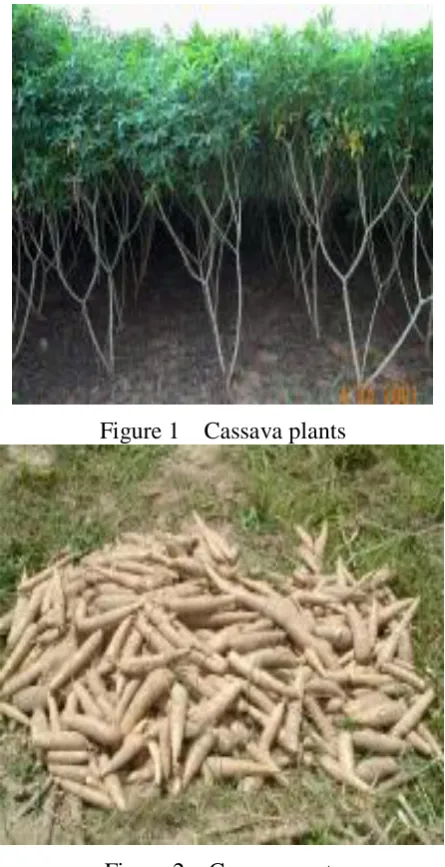
the developing world (Figure 1 and Figure 2). Africa
produced 101.6 million Mega-tonnes of cassava in 2003,
making cassava the most important root crop (FAO, 2004)
and a major source of dietary calories. The importance
of cassava to the livelihoods of many millions of poor
people has made the commodity a target for interventions.
Received date: 2014-06-09 Accepted date: 2015-09-08
*Corresponding author: B. O. Soyoye. Agricultural and
Environmental Engineering Department, School of Engineering and Engineering Technology, Federal University of Technology, P. M. B. 704 Akure Ondo State Nigeria. Email: [email protected], [email protected]
Cassava is a major staple crop in Nigeria, as cassava itself
and its products are found in the daily meals of Nigerians.
Currently, cassava crop is undergoing a transition from a
mere subsistent crop found on the field of peasants to a
commercial crop that will be grown in large quantities in
plantations (IITA, 2003). This unprecedented expansion
on an African crop is attributed to the discovery of
cassava as a cheap source of edible carbohydrate that
could be processed into different forms of human
delicacies and animal feeds (FAO, 2006). Furthermore,
cassava could be source of raw materials for a number of
industrial products which include starch, flour and
ethanol. The production of cassava is relatively easy as
it is tolerant to the biotic and edaphic encumbrances that
grown in commercial quantity in most agro-ecologies in
Nigeria; it could tolerate marginal soil fertility status,
where other crop will fail completely. Although,
cassava is best adapted to the rainforest agro-ecology,
research activities over the years have identified varieties
that are tolerant to drought and low moisture conditions.
Figure 1 Cassava plants
Figure 2 Cassava roots
Approximately 65% of all cassava produced is used
for human consumption, 25% for industrial use, mostly as
starch (6%) or animal feed (19%), and 10% is lost as
waste (Fish and Trim, 1993). More than 40% of cassava
is currently processed, mainly into traditional food
products. There are many opportunities to extend the
traditional uses of cassava and introduce it into a wide
range of new food products, particularly in the rapidly
urbanizing societies of the developing countries. A
concerted effort to realize the promise of cassava roots
could give it a more central role in socio-economic
development. The key to establishing the potential role
of cassava is to establish a strong link between
small-scale producers and new products. Numerous
barriers obstruct this ideal. Cassava is perishable and
bulky. To overcome these limitations requires
appropriate strategies and technology for postharvest
processing and utilization. Processing provides a means
of producing shelf-stable products (thereby reducing
losses), adding value at a rural level, and reducing the
bulk to be marketed (Dufour et al., 2002). Cassava flour
is popular in the food industry because of its special
characteristics - clarity of appearance, low flavour
overtones, and ideal viscosity. It has been shown to have
potential for use as filler in comminuted meat products
(Annor-Frempong et al., 1996).
1.1 Objectives of the research
The main objective of this research is to develop a
durable and easy to operate dryer for peasant farmers and
small sale industrialist. The specific objectives of the
study are to:
i. Design parts of the dryer.
ii. Fabricate the dryer using locally available
materials
iii. Evaluate the performance of the dryer to
determine the best operating conditions.
1.2 Justification of the project
Mashed cassava do not store long when wet. To
store as long as up to one or two weeks, requires daily
changing of water which leads to the lost of quantities
and qualities. This dryer will process the mash into
powder that can be packaged into manageable packets
easy to prepare products that can be stored longer and yet
retained its nutritional values.
2 Main body
Nigeria is one of the largest producers of cassava in
the world and its production is currently put at about 33.8
million tonnes a year (IITA, 2003). Total area harvested
of the crop in 2001 was 3.1 million ha with an average
yield of about 11 t/ha. Cassava plays a vital role in the
food security of the rural economy because of its capacity
to yield under marginal soil conditions and its tolerance
to drought. It is the most widely cultivated crop in the
country; it is predominantly grown by smallholder
farmers and dependent on seasonal rainfall. Rural and
urban communities use cassava mainly as food in both
fresh and processed forms. Cassava production is still
carried out by manual labour using local simple farm
implements such as hoes and knives in most parts of the
country because it is yet to be mechanized (FAO, 2006).
Cassava roots are processed at household and cottage
levels in the rural areas of the major cassava producing
states by traditional methods handed down through time
as cassava was adopted as food by the people.
Processing at these levels involve mainly the production
of garri, fermented and unfermented flour, as well as fufu
(local delicacy) for both domestic consumption and
industrial uses (FAO, 2006).
2.2 Cassava processing and utilization
Cassava is a very versatile commodity with
numerous uses and by-products. Each component of the
plant can be valuable to its cultivator. The leaves may
be consumed as a vegetable or cooked as a soup
ingredient or dried and fed to livestock as a protein feed
supplement (IITA, 1990). The stem is used for plant
propagation and grafting. The roots are typically
processed for human, animal and industrial consumption.
In Nigeria, the consumption pattern varies according to
ecological zones. Garri, a roasted granule is the
dominant product and is widely accepted in both rural
and urban areas. It can be consumed without any
additives, or consumed with a variety of additives such as
sugar, groundnut, fish, meat and stew. Fufu or Akpu, a
fermented wet paste from cassava is also widely
consumed throughout the country especially in the
southern zones (Ajao and Adegun, 2009).
2.3 Drying of agricultural products
Drying is the application of heat to remove the
majority of water normally present in a food by
evaporation (Fellows, 2003). Drying of Agricultural
Product is used to prevent germination of grains, to retain
maximum quality of product to reach a level of moisture
content which does not allow the growth of bacteria,
fungi and considerably retards the development of insects.
Drying affects the quality of products and so its values to
purchasing organizations. Drying is a unit operation
aimed at removing nearly all water present in foodstuff.
Cassava is dried when water contained within them is
removed into the surrounding air. This drying is
associated with water present in cassava for prolonged
shelf life of food. Water needs to be removed or
reduced to a certain amount which hinders both
biochemical and microbial activities Desroseir (1970)
acknowledged that sun drying is an adequate method of
food preservation under most conditions in developing
economy, while dehydration denotes drying effected by
artificial means; it is usually reserved for artificial drying
methods employing a forced draft of conditioned air by
mean of fans. The capacity of air for moisture removal
depends on its humidity and its temperature. For
Agriculture, drying air is used usually as the drying
medium to conduct heat to the produce and to convey the
vapour away from the drying produce (Johnston and
Mello, 1961).
3 Materials and methods
3.1 Design considerations
The following factors were considered for the
development of the dryer.
i. The dryer will be simple in design and easy to
fabricate.
ii. Simple operational and maintenance
requirements to meet the need of the local farmers and
iii. The dryer should be cheap and affordable.
iv. Portability and detachability for easy
transportation.
v. The dryer will be fabricated with locally
available materials to reduce cost.
vi. Minimal power requirement
vii. Easy to replace components
viii. It should not require a lot of technical know
how to operate
ix. It should reduce labour requirement associated
with mash drying.
3.2 Designanalysis
Flash dryer is a dryer to dry and separate the dried
product from the air. To effectively carry out this
operation, it requires some functional component as
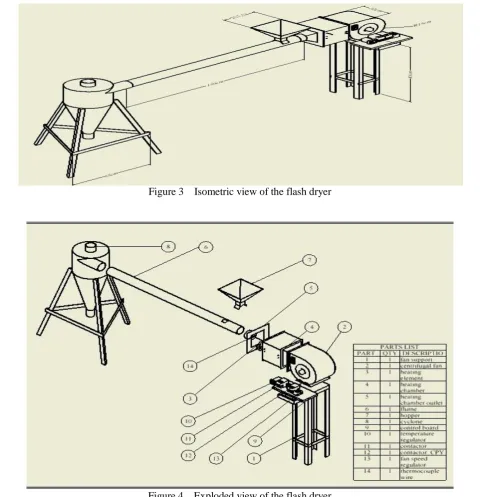
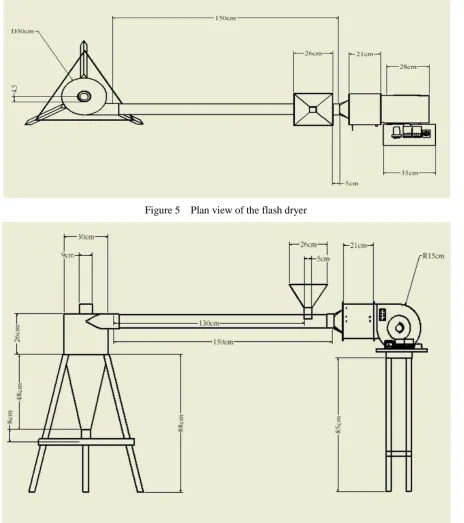
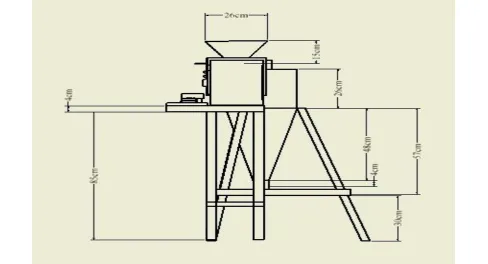
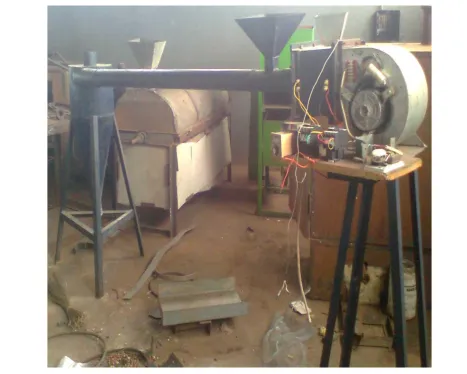
shown in the Figure 3, Figure 4, Figure 5, Figure 6 and
Figure 7:
Figure 3 Isometric view of the flash dryer
Figure 5 Plan view of the flash dryer
3.2.1 Fan
The fan used in this dryer is forward curved blade
centrifugal fan which is a bought out material. It has the
advantage of moving more air than both propeller and
axial fans of the same diameter and speed. It has the
following dimensions; housing, 300 mm × 340 mm and
diameter of 170 mm. This fan has an in built fan drive
having a motor of 2 kW, where it is connected to the
source of electricity. This helps to eliminate the use of a
separate electric motor, motor sitting, belt and pulleys,
which should have otherwise made the dryer more bulky,
occupy more space, more costly to fabricate and have
more power requirement.
3.2.2 The heating chamber
The heating chamber was constructed from the
following materials:
Mild steel sheet
Wooden blocks
Heating elements
Angle bar.
The mild steel sheet was cut to size and welded to
get two sections. Wooden blocks were installed in
between to act as insulator. Angle bars cut to size were
welded to the sides of the box to provide room for nuts
and bolts to couple the fan and the drying duct to this unit.
The dimensions of the heating unit are as guided by Tung
and Steinbrecht (2008). Two heating coils or heating
elements of 2 kW each were installed for rapid heat
generation.
3.3 The drying chamber
The drying unit which is a pipe was constructed
from a sheet of mild steel. The dimensions used were
guided by the geometry of the cyclone. The diameter of
the drying chamber is 7 cm and 1. 5 m long. This was
welder to a flat metal sheet cut to size to enable this unit
to be coupled to the heating chamber with nuts and bolts.
These are bought out materials connected to vary the
operation of the dryer. They are:
1. Two temperature control switches connected to
the heating chamber.
2. Two thermocouples or sensors.
3. One fan speed control switch connected to the
fan.
3.4 The Cyclone
For high efficiency, the cyclone was designed using
3.4.1 Height to diameter ratio (H:D ratio)
The length to diameter ratio
D
H
is the total cyclone
height (cylinder length + cone vertical length) divided by
the diameter of the cone body.
This ratio is between 3 and 6 (Ayaode et al., 2006).
In the design of the cyclone, H = 900 mm and D =
300 mm were used.
3
300
900
D
H
3.4.2 Discharge port diameter (Do) to Cyclone
Diameter (Ds) Ratio
This is given by Ifadah, 2005 as
s O
D
D
Here, Ds is taken as 300 and Do as 70 mm
23
.
0
300
70
s o
D
D
3.4.3 Angle of inlet pipe
Angle of inlet pipe to the cyclone body is given to be
between 10º and 20º, but smaller angle give high
efficiency unit (Ayoade et al., 2006). Therefore 10º was
used here.
3.4.4 Outlet pipe length (Gas)
The outlet pipe should extend below the bottom of
the inlet by 10%- 60% of the inlet height.
Inlet height used here = 75 mm.
Outlet pipe length = 75 + 45 = 120 mm3.4.5 Cone shape
To design and construct the cone, the following are
needed:
The base diameter which is the diameter of the
cone. This is 300 mm.
The cone height which is twice the cone diameter.
That is 300 × 2 = 600 mm.
A frustum of the cone was constructed by
development.
The cyclone discharge diameter was found to be
70 mm
70 mm was used as the discharge diameter3.5 The feeding unit
3.5.1 The hopper
A square frustum was constructed from a sheet of
mild steel by development method with the following
dimensions, 300 mm2 × 360 mm. The frustum was cut
at a height of 300 mm to give an outlet of 40 mm2.
3.5.2 The drying chamber inlet
A square mild steel pipe of 40 m2 cut to a length of
60 mm was wedded to the outlet of the hoper and the
drying chamber to form the neck of the feeding chamber.
3.5.3 The sieve
This was constructed of a wooden frame of 304 mm
× 304 mm ×150 mm. A fine wire sieve was fitted to the
frame such that it is easily coupled to the hoper.
3.6 Assembly of the fabricated dryer
The components were fabricated and coupled in the
workshop of the Department of Agricultural Engineering,
Federal University of Technology, Akure. The
3.7 Machine testing
The machine was tested in the workshop of the
Agricultural and Environmental Engineering Department
of the Federal University of Technology Akure, Ondo
State.
3.7.1 Sample preparation
The procedures of processing cassava tubers into
cassava mash used for the testing of the dryer involves:
peeling, washing of tubers, cutting into pieces, soaking in
clean container which last for between three and four
days, filtering, putting in a bag and de-watering using
jack to reduce the moisture content from 80% to 40%.
The moisture content was determined using the triode
Digital moisture meter AG – 3.
Twenty-five samples of 1000g each was prepared by
weighing using the mettler toredo SB 32000 digital
balance. The samples were categorised into five groups
according to air velocities and temperatures for which the
fan and heaters have been calibrated to operate. The
samples were labelled accordingly. Air velocities used
were 5m/s, 10m/s, 15m/s, 20m/s, and 25m/s.
Temperatures used were: 70°C, 80°C, 90°C, 100°C and
110°C. The rate of feeding of the machine was 1 kg of
material per minute, thereby giving a feeding rate of 60
kg/h.
3.7.2 Operation of the dryer
The dryer was connected to a 220/240 V electricity
source. The circuit breaker and the heat
generation/distribution units were turned on. The heater
element glow and fan blew simultaneously. As the
temperature inside the heating chamber increased and
thermocouple or sensor inside the chamber cut off the
current supply and sent signal to the electronic
temperature controller, which disengaged automatically.
This enhanced uniform heat development in the heating
chamber. The blowing of fresh air across the heater
elements result in heated air been passed through the
drying chamber. If the air is carrying materials to be
dried, separation takes place resulting to the escape of the
air through the gas outlet and the dried material through
the dust or particle outlet.
The mixture of the cassava flour passes through the
inlet line and then to the flash duct. In the flash duct,
drying take place due to reduction in pressure and the
larger space for the air and cassava flour to mix together.
From the flash duct through the inlet line, the mixture of
cassava flour and hot air enters the cyclone. Due to
large pressure drop in the cyclone, cassava flour drops by
gravity and the dried product is then collected at the exit
port while hot air proceeds through the exhaust line.
4 Results and discussion
The conditions under which the flash dryer was
tested are; ambient temperature of 30°C, mean relative
humidity of 65%, initial air temperature of 90°C, initial
moisture content of the material 40%, initial weight of
sample of 1000g and particle size of material was 0.0725
mm. The results obtained during the evaluation of the
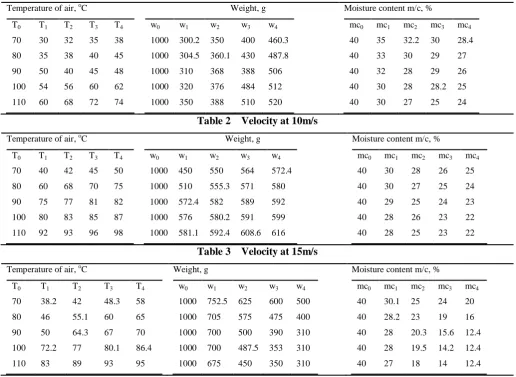
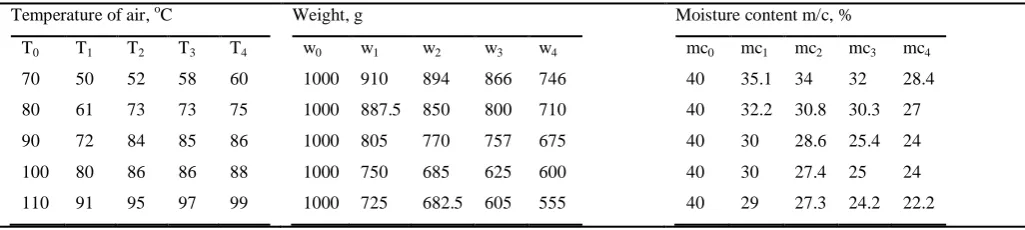
dryer at different air velocities are as shown in Table 1,
Table 2, Table 3, Table 4 and Table 5. A sample of
1000 g was also oven dried, oven dry moisture content
was found to be 9.8%.
Table 1 Velocity at 5m/s
Temperature of air, oC Weight, g Moisture content m/c, % T0 T1 T2 T3 T4
70 30 32 35 38 80 35 38 40 45 90 50 40 45 48 100 54 56 60 62 110 60 68 72 74
w0 w1 w2 w3 w4
1000 300.2 350 400 460.3 1000 304.5 360.1 430 487.8 1000 310 368 388 506 1000 320 376 484 512 1000 350 388 510 520
mc0 mc1 mc2 mc3 mc4
40 35 32.2 30 28.4 40 33 30 29 27 40 32 28 29 26 40 30 28 28.2 25 40 30 27 25 24 Table 2 Velocity at 10m/s
Temperature of air, oC Weight, g Moisture content m/c, % T0 T1 T2 T3 T4
70 40 42 45 50 80 60 68 70 75 90 75 77 81 82 100 80 83 85 87 110 92 93 96 98
w0 w1 w2 w3 w4
1000 450 550 564 572.4 1000 510 555.3 571 580 1000 572.4 582 589 592 1000 576 580.2 591 599 1000 581.1 592.4 608.6 616
mc0 mc1 mc2 mc3 mc4
40 30 28 26 25 40 30 27 25 24 40 29 25 24 23 40 28 26 23 22 40 28 25 23 22 Table 3 Velocity at 15m/s
Temperature of air, oC Weight, g Moisture content m/c, %
T0 T1 T2 T3 T4
70 38.2 42 48.3 58
80 46 55.1 60 65
90 50 64.3 67 70
100 72.2 77 80.1 86.4
110 83 89 93 95
w0 w1 w2 w3 w4
1000 752.5 625 600 500 1000 705 575 475 400 1000 700 500 390 310 1000 700 487.5 353 310 1000 675 450 350 310
mc0 mc1 mc2 mc3 mc4
At velocity one (V1) of 5 m/s, the air velocity was
not sufficient to move all the material fed through the
dryer. Over half of the materials were clogged in the
dryer that variation in temperature had no or little effect
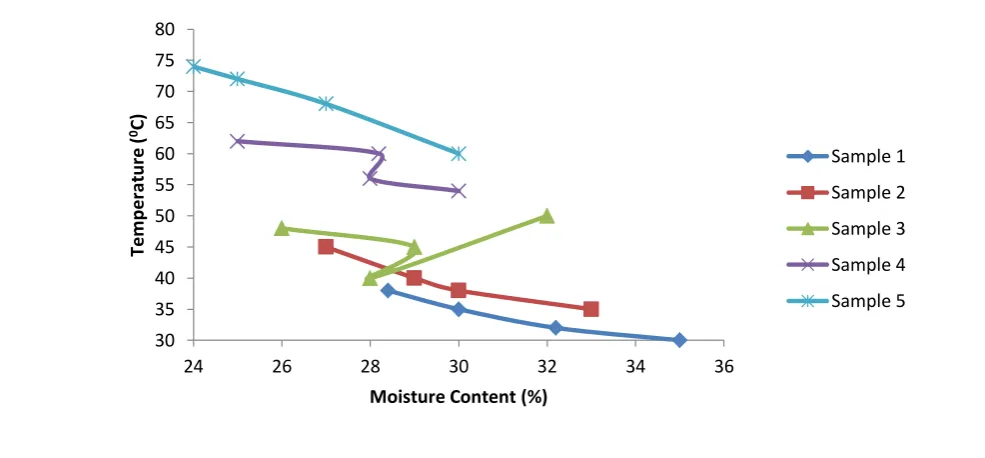
Figure 9. Clogged material was removed by
dismounting the dryer due to the moisture retention and
the weight of the material as contributed by the moisture
content (Table 1). Since at air velocity of 5 m/s over
half of the material got clogged in the dryer, it then
indicate that the heat supplied to the dryer had no effect
on the material as all the materials were not available for
drying. For the same reason, the temperature had no
effect on the weight of the material as very little water
was evaporated. Also because most of the material
could not pass through the dryer for drying, little water
was evaporated. Therefore the temperature had no
significant effect on moisture content of the material
Figure 10.
Table 4 Velocity at 20m/s
Temperature of air, oC Weight, g Moisture content m/c, %
T0 T1 T2 T3 T4
70 50 52 58 60 80 61 73 73 75 90 72 84 85 86 100 80 86 86 88 110 91 95 97 99
w0 w1 w2 w3 w4
1000 910 894 866 746 1000 887.5 850 800 710 1000 805 770 757 675 1000 750 685 625 600 1000 725 682.5 605 555
mc0 mc1 mc2 mc3 mc4
40 35.1 34 32 28.4 40 32.2 30.8 30.3 27 40 30 28.6 25.4 24 40 30 27.4 25 24 40 29 27.3 24.2 22.2
Table 5 Velocity at 25m/s
Temperature of air, oC Weight, g Moisture content m/c, % T0 T1 T2 T3 T4
70 53 56.1 58 61.8 80 61.2 64 68 70
90 72 78 80 83
100 83 85 87 89 110 92 96 99 100
w0 w1 w2 w3 w4
1000 906 900 889 844 1000 875 850 800 775 1000 825 775 715 677.5 1000 800 785 675 650 1000 775 675 632 605
mc0 mc1 mc2 mc3 mc4
40 36.2 36 35 33.4 40 35 34 32 31 40 33 31 28.6 27.1 40 32 31.4 27 26 40 31 27 25.3 24.2
Figure 9 Effect of temperature on weight at 5 m/s
30 35 40 45 50 55 60 65 70 75 80
300 350 400 450 500 550
Te
m
p
e
ra
tu
re
(
0C
)
Weight (g)
Sample 1
Sample 2
Sample 3
Sample 4
At velocity two (V2) of 10 m/s, the air velocity was
not also sufficient to move all the material fed through the
dryer but work much better than the air velocity of 5 m/s.
The moisture retention is also high at this velocity as a
result of the insufficient air velocity (Table 2). As the
temperature increases, the quality of dried materials
through the cyclone increases. However, the left over
clogged materials in the drying chamber was also
removed when the cyclone was dismounted from the
drying chamber.
Figure 11 shows that temperature variation had no
significant effect on weight of the material was connected
to the fact that some materials were not readily available
for drying as it got stocked in the dryer.
Figure 12 confirmed that although not all the
materials went through, the temperature did have effect
on the moisture content as it was reduced from 40% to 22%
as the temperature increased from 70°C to 110°C. Figure 10 Effect of temperature on moisture content at 5 m/s
30 35 40 45 50 55 60 65 70 75 80
24 26 28 30 32 34 36
Te
m
p
e
ra
tu
re
(
0C
)
Moisture Content (%)
Sample 1
Sample 2
Sample 3
Sample 4
Sample 5
Figure 11 Effect of temperature on weight at 10 m/s
40 50 60 70 80 90 100 110
450 500 550 600 650
Te
m
p
e
ra
tu
re
(
0C
)
Weight (g)
Sample 1
Sample 2
Sample 3
Sample 4
At velocity five (V5) of 25 m/s, the material also had
no sufficient time to dry Figure 13 and Figure 14.
Though all materials fed into the machine went through
the dryer fully. However, as the temperature increases,
sign of burnt was visible. Air velocity of 25 m/s is too
high and do not allow enough drying time and therefore
the rate of drying is slow with evidence of burnt material
which resulted in waste of materials as described in Table
5 and Figure 13 and Figure 14. Then, these velocities
(5, 10, and 25) m/s and their corresponding temperatures
are not appropriate for use in this dryer. Figure 12 Effect of temperature on moisture content at 10 m/s
40 50 60 70 80 90 100 110
20 22 24 26 28 30 32
Te
m
p
e
ra
tu
re
(
0C
)
Moisture content (%)
Sample 1
Sample 2
Sample 3
Sample 4
Sample 5
Figure 13 Effect of temperature on weight at 25 m/s
50 60 70 80 90 100 110
550 600 650 700 750 800 850 900 950
Te
m
p
e
ra
tu
re
(
0C
)
Weight (g)
Sample 1
Sample 2
Sample 3
Sample 4
At air velocity three (V3) of 15 m/s all the materials
fed into the dryer were carried through the drying
chamber (Table 3). Results obtained are displayed in
Figure 15, Figure 16 and Figure 17. Figure 14 Effect of temperature on moisture content at 25 m/s
50 60 70 80 90 100 110
22 24 26 28 30 32 34 36
Te
m
p
e
ra
tu
re
(
0C
)
Moisture Content (%)
Sample 1
Sample 2
Sample 3
Sample 4
Sample 5
Figure 15 Effect of temperature on moisture content at 15 m/s
35 45 55 65 75 85 95 105
10 15 20 25 30 35
Te
m
p
e
ra
tu
re
(
oC)
Moisture Content (%)
Sample 1
Sample 2
Sample 3
Sample 4
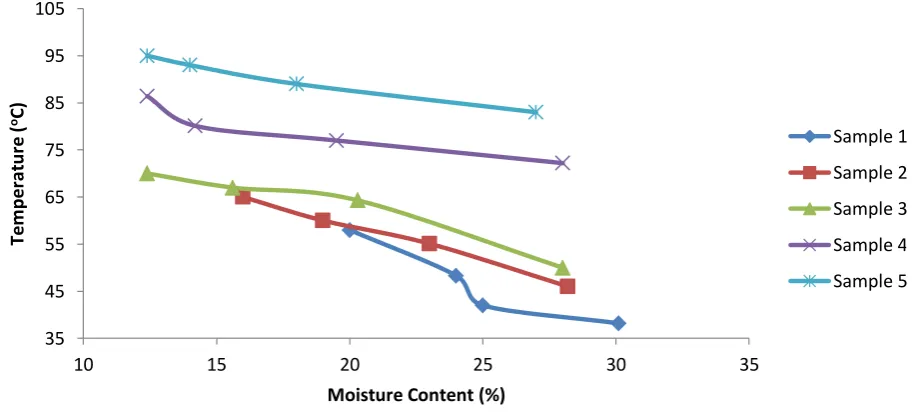
In Figure 15 and Figure 16 it was shown that
temperature has significant effect on the weight of the
materials being dried. As the temperature increases,
weight decreases and more water was evaporated. This is
in agreement with Rajput (2011) that in dryers, weight of
material decreases with increase in temperature for such
material received at the outlet. All the samples fed into
the dryer confirmed this as the weight was reduced from
1000g to 310g in Sample 4 at a temperature of 90°C.
The same weights were also obtained at temperatures
100°C and 110°C respectively.
Materials fed into the dryer came out well and dried,
no clogging or burning of material. The moisture
content of 12.4% that was obtained is good for storability
of the product (Figure 15). Figure 16 Effect of temperature on weight at 15 m/s
35 45 55 65 75 85 95 105
250 350 450 550 650 750 850
Te
m
p
e
ra
tu
re
(
oC)
Weight (g)
Sample 1
Sample 2
Sample 3
Sample 4
Sample 5
Figure 17 Effect of moisture content on weight at 15 m/s
10 15 20 25 30 35 40 45
250 350 450 550 650 750 850 950 1050
M
o
is
tur
e
C
o
n
te
n
t
(%
)
Weight (g)
Sample 1
Sample 2
Sample 3
Sample 4
At velocity four (V4) of 20 m/s, the material fed into
the dryer was carried through the drying chamber but in a
faster rate than that of the 15 m/s. Variation in
temperature had no sufficient effect on the material at the
initial stage (Table 4). But as temperature increases
from 100°C to 110°C, the material begins to show sign of
burnt.
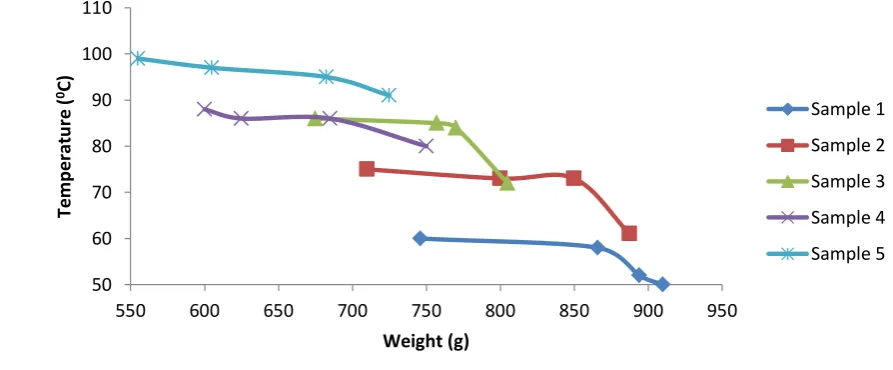
It was shown in Figure 18 and Figure 19 that
increase in temperature resulted in corresponding
decrease in moisture content. However, because of the
high air velocity, the effect of temperature on moisture
content was not as effective as in 15 m/s.
The effect of moisture content on weight is moderate
(Figure 20). This attests to the fact that as weight was
reduced from 1000g to 555g with corresponding moisture
contents of 40% to 22.2%. If the material is exposed to
heat for enough period of time, it has a significance effect
on moisture content.
Figure 18 Effect of temperature on moisture content at 20 m/s
Figure 19 Effect of temperature on weight at 20 m/s
50 60 70 80 90 100 110
24 26 28 30 32 34 36
Te
m
p
e
ra
tu
re
(
0C
)
Moisture Content (%)
Sample 1
Sample 2
Sample 3
Sample 4
Sample 5
50 60 70 80 90 100 110
600 650 700 750 800 850 900
Te
m
p
e
ra
tu
re
(
0C
)
Weight (g)
Sample 1
Sample 2
Sample 3
Sample 4
The results displayed in Figure 9, Figure 11, Figure
13, Figure 16 and Figure 19 showed the effect of
temperature on weight of the cassava mash. The least
ambient temperature was recorded in the first sample
(sample 1) in all the air velocities (5, 10, 15, 20 and 25
m/s). At air velocity of 5 m/s the temperature was
between 30°C and 35°C (Figure 9). The temperature
was between 40°C and 50°C was recorded at air velocity
of 10 m/s (Figure 11). The trends displayed in Figure 9
and Figure 11 confirmed that the machine cannot work
effectively at these air velocities because as the
temperature increases also the weight of the cassava mesh
produced increase. The linear relationship that was
revealed between the temperature and the weight of the
mesh negates the principle of drying. This result is due
to the congestion in the machine formed as a result of the
low air velocities which are not capable of moving the
materials through the dryer and implies that at air
velocities of 5 m/s and 10 m/s, not all the material fed
into the dryer went through.
The same trends of temperature-weight relationship
were recorded in Figure 13, Figure 16 and Figure 19.
As the temperature of the cassava mash increased
reasonable drops in weight were observed and recorded.
This shows that the machine can perform better using any
of the air velocities (15 and 20 m/s). At air velocity of
15 m/s and a temperature of 90°C the first constant
moisture content of 12.4% was obtained. A moisture
content of 12.4% was also obtained at a temperature of
100°C and 110°C (Figure 15 and Figure 18). This has
the advantages of reducing extra cost of power if the
temperature was to be increased further. Also material
fed into the dryer came out dried and fine, with no
clogging of material and burning of material. The
moisture content of 12.4% obtained is good for storability
of the product as this is in the same trend with what was
obtained by Ajao and Adegun (2009). They reported
that cassava chip is stored well at moisture content of
between 11.48% and 12%. However, since the moisture
content of 12.4% was first obtained at 90°C, it means that
the best operating air and temperature combinations for
this dryer is air velocity of 15 m/s at 90°C.
The effect of temperature on moisture content
showed a linear relationship as shown in Figure 15 and
Figure 18. Increase in temperature resulted in
corresponding decrease in moisture content. Figure 16
and Figure 19 showed the effect of temperature on weight
and it could be deducted that increase in temperature
resulted in decrease in weight. This agrees with the
findings of Antekhai and Ozakhome (2005) who Figure 20 Effect of moisture content on weight at 20 m/s
24 26 28 30 32 34 36 38
600 650 700 750 800 850 900 950
M
oi
st
u
re
C
on
te
n
t
(%
)
Weight (g)
Sample 1
Sample 2
Sample 3
Sample 4
observed that a wet cassava chip exposed to heated air
experiences progressive loss of weight due to removal of
three forms of water; first is the free water, then the
absorbed and finally the chemically bound water.
Figure 17 and Figure 20 showed the influence of moisture
content on the weight of product; it is shown that the
increase in moisture content resulted in the increase in
weight of the product.
The result showed that during drying of the cassava
mash, there was reduction in the weight of the cassava
mash, although the reduction in weight is not at a regular
time interval. This could be attributed to the wind
velocity which affects the drying rate and moisture
removal. This statement agrees with Yayock and
Coubin (1988). They reported that when drying with air,
the main role of the air is to pick up the moisture from the
surface of the product and this is further affected by its
speed and amount of moisture it originally contains.
Yayock and Coubin (1988) further reported that air serves
as a medium in picking up moisture from the surface of
cassava chip, hence, the free moisture is the one involve
in the drying process. Drying becomes apparently
difficult if all the free water in cassava have been
removed. Because the moisture left in the product
remains bound in it by hydration which has to be broken.
It could be observed that there was a decrease in the free
moisture contained in the cassava mash for the 15 m/s, 20
m/s, and 25 m/s respectively over the drying period. It
was also observed that the central moisture loss for the 15
m/s air velocity remains the highest. The moisture loss
for the 15 m/s was negligible after one hour whereas for
20 m/s and 25 m/s it took two hours. This is because the
15 m/s attains the constant period over a short period of
two hours of drying followed by the falling rate period for
the remaining periods. The observed difference in the
two cases can be attributed to retention period in the
drying chamber and therefore, the rate of moisture loss.
From the result obtained during drying process it was
observed that the higher the temperature the lower the
moisture content and the higher the water evaporated.
Also, the lower the weight, the lower the moisture content,
and the higher the water evaporated. Furthermore, the
higher the moisture content the higher the weight of
produce, and the lower the water evaporated.
5 Conclusions
From the result obtained it can be deduced that:
This dryer is very effective in drying cassava
mash
The dryer can be used to dry cassava produce to
safe storage moisture content level
This can be used to dry other similar
agricultural products
The dryer is relatively cheap and easy to use.
The heating elements installed can generate
enough heat to meet the heat requirement of the dryer.
High moisture content mash cannot be dried in
this dryer.
The thermal efficiency of the dryer of 86%.
References
Annor-Frempang, I. E., A. Annan-Prah, and R. Wiredu. 1996. Cassava as Non-Conventional Filler in Comminuted Meat Products. Meat Science, 44(3):193-202.
Antekhai, W. E., and M. Ozakhome. 2005. Production of a composite flour (Casava manihot esculenta and soybean Gycinemaxima) for the production of nutritionally balanced biscuits. Internatonal journal of Food and Agricultural Research, 2(1, 2): 52-56.
Ayoade K., A. Daniel, O. Kenneth, F. Taofeek, C. Frankkhin, A. Abdulkarim, and M. Sylvester. 2006. Design of Gas cyclones; Raw Materials Research and Development Council Abuja, Nigeria.
Desroseir, N. W. 1970. The Technology of food preservation Westport Connecticut: Avi Publishers.
Dufour, D., G. M. O’Brein, and R. Best. 2002. Cassava flour and starch: progress in research and development. Centro internacial de Agricutura Tropical (CIAT), Apartado Aereo 6713, Cali, Colombia.
FAO. 2004. Cassava.
www.fao.org/dorcrep/x5032E/x5032E07.HTM. Accessed 07/08/2004 at 4.55pm.
FAO. 2006. Integrated cassava project. Food and Agricultural Organization (FAO). Available at www.fao.org. Accessed on 12th December, 2008.
Ifadah. 2005. Opening remarks at the opening session of the Tri-Term Implementation. Review of RTEP, Abuja, Nigeria. 22nd March.
IITA. 1990. Cassava in Tropical Africa. A conference manual by International Institute of Tropical Agriculture (IITA), Ibadan, Nigeria.
IITA (International Institute of Tropical Agriculture). 2003. Pre-emptive management of the virulent cassava mosaic disease through an integrated cassava development approach for enhanced rural sector economy in the south-south and south-east zones of Nigeria. IITA, Ibadan, Nigeria.
Johnston, B., and J. Mello. 1961. The role of agriculture in economic development. American Economic Review, 5(4): 556 - 593.
Fellows, P. 2003. Food Processing Technology, Principles and Practice. CRC Press, Boca Raton Boston New York Washington, DC.
Rajput, E. R. K. 2011. Heat and Mass Transfer S. Chand and Company Ltd. (An ISO 9001:2000Company) 7361, RAM NAGAR, New Delhi-110055.
Tung, N.D. and D. Steinbrecht. 2008. Modeling a Combined Heat and Power Cogeneration system in Vietnam with a Fluidized Bed Combustor Burning Biomass. Agricultural Engineering International: the CIGR E-journal. (10).