The Neural Representation of
Polysemy: the Case of Dot-objects
Yuan Tao
A Dissertation
Presented to the Faculty of University of Trento in Candidacy for the Degree
of Doctor of Philosophy
Recommended for Acceptance by the Department of
Center of Brain and Mind Sciences (CiMEC) Adviser: Professor Poesio Massimo
c
Abstract
Abstract and concrete concepts are generally considered fundamentally distinct cate-gories. However, many concepts have both concrete and abstract senses, for instance book can refer to both a physical object (as in a torn book) and the abstract content (as in an interesting book). How is the meaning of such concepts represented in the brain? In this thesis, we address this question in the light of Pustejovsky’s dot-object hypothesis (Pustejovsky, 1995, 2011). According to the hypothesis, words such as book and lunch are dot-objects: a class of logically polysemous words which have multiple senses that are closely bound together. As a result of the close binding, both senses can be accessed simultaneously (as in read the book), however sometimes only a single aspect is emphasised by the context (e.g. the book burned, he summarised the book).
We argue that the complex meanings of the dot-objects are represented and ma-nipulated in semantic hubs in the brain, where all aspects of conceptual knowledge converge and are represented in a modality-independent manner (thus accommodat-ing diverse aspects of knowledge such as that cakes are made of pastry and are related to both birthdays and diabetes).
We present three experiments investigating the neural representation of three dot-object categories with clear concrete and abstract senses: print matter such as book (OBJECT•INFORMATION), meal concepts such aslunch (FOOD•EVENT), and institution such as church (BUILDING •ORGANISATION). In all the experiments, participants read the dot-objects in a minimal context which elicited either the con-crete or the abstract interpretation (e.g. open the book / consult the book, cook the lunch / organise the lunch). We found the neural distinction between the concrete
Acknowledgements
First of all I would like to thank Professor Massimo Poesio and Dr. Andrew Anderson; without their generous support throughout my PhD this thesis would not be possible. I would like to thank the CLIC lab of CiMEC and all the supports I have been receiving from them; Professor Marco Baroni and Professor Roberto Zamparelli has provided many helpful suggestions and feedbacks for my project. I would like to express my gratitude to the crucial assistance of the MRI lab and the MEG lab of CiMEC during the data acquisition. I am grateful to all the administrative and tech-nical staff, the PhD programme administrator Leah Mercanti, for making everything much easier.
Contents
Abstract . . . iii
Acknowledgements . . . v
List of Tables . . . x
List of Figures . . . xi
1 Introduction 1 1.1 Problem description . . . 1
1.2 Thesis outline . . . 7
1.3 Road-map . . . 9
2 Related Work 11 2.1 The neurobiology of concept representation . . . 11
2.2 The distinction between abstract and concrete concepts . . . 15
2.2.1 Hypotheses in psychology . . . 15
2.2.2 Evidence from cognitive neuropsychology . . . 17
2.2.3 Evidence from cognitive neuroscience . . . 18
2.3 Polysemy and coercion . . . 21
2.3.1 Polysemy and homonymy are represented differently in the brain 22 2.3.2 Complement coercion . . . 24
2.3.3 Novel metonymy . . . 25
2.4 Semantic composition . . . 27
2.4.1 Studies on conceptual combination in Psychology . . . 27
2.4.2 The neural basis of semantic composition . . . 28
2.5 Neuroimaging and MVPA . . . 30
2.5.1 A brief introduction of the main brain imaging techniques . . 30
2.5.2 Neural decoding and Multivariate Analysis (MVPA) . . . 31
3 The Neural Representation of Dot-objects: The Case of Book 33 3.1 Introduction . . . 33
3.2 Methods and materials . . . 36
3.2.1 Participants . . . 36
3.2.2 Materials . . . 37
3.2.3 Procedure . . . 38
3.2.4 Data acquisition . . . 39
3.2.5 Univariate analysis . . . 41
3.2.6 Regions-Of-Interest (ROIs) . . . 42
3.2.7 Pattern Classification . . . 46
3.2.8 Whole-brain parcellation analysis . . . 47
3.3 Results . . . 47
3.3.1 Behaviour . . . 47
3.3.2 Univariate analysis . . . 48
3.3.3 ROI-based Multivariate Pattern Analysis (MVPA) . . . 48
3.3.4 Effects in the right hemisphere . . . 51
3.3.5 Whole-brain parcellation MVPA . . . 52
3.4 Discussion . . . 54
3.4.3 The implications to the neural representations of concepts . . 60
3.4.4 The effect in the right hemisphere . . . 62
3.4.5 The effect of phrase comprehension . . . 63
3.4.6 Final remarks . . . 64
4 The Neural Representation of Dot-objects: The Case of Lunch 66 4.1 Introduction . . . 66
4.2 Methods and Materials . . . 70
4.2.1 Participants . . . 70
4.2.2 Materials . . . 70
4.2.3 Procedure . . . 71
4.2.4 Data acquisition . . . 74
4.2.5 Analysis . . . 74
4.3 Results . . . 75
4.3.1 Behaviour . . . 75
4.3.2 Univariate analysis . . . 75
4.3.3 ROI-based Multivariate Pattern Analysis (MVPA) . . . 75
4.3.4 Whole-brain parcellation MVPA . . . 80
4.4 Discussion . . . 80
4.4.1 A shift of focus within the ATL . . . 81
4.4.2 The dot-objects are also distinguishable in ROIs outside the ATL 84 4.4.3 Final remarks . . . 87
5 Oscillatory MEG Gamma-band Activity Dissociates Concrete and Abstract Coercion: A Decoding Study 88 5.1 Introduction . . . 88
5.2 Methods and Materials . . . 94
5.2.2 Materials . . . 94
5.2.3 Procedure . . . 95
5.2.4 Data acquisition and preprocessing . . . 96
5.2.5 Wavelet decomposition and decoding analysis . . . 97
5.2.6 Time-frequency analysis . . . 99
5.3 Results . . . 100
5.3.1 Behaviour . . . 100
5.3.2 Two-way classification and sensitivity analysis . . . 100
5.3.3 Four-way classification . . . 102
5.3.4 Time frequency analysis . . . 102
5.4 Discussion . . . 103
5.4.1 The role of gamma frequency in combinatorial processing . . . 105
5.4.2 Coercion occurs in later in time . . . 107
5.4.3 The ATL effect . . . 108
5.4.4 Final remarks . . . 109
6 Discussion 110 6.1 Discussion . . . 110
6.1.1 The semantic hub theory and how it relates to the meaning representation of dot-objects . . . 113
6.1.2 The differential functional specialisation within the semantic hub115 6.1.3 Interaction between the lexical semantics and semantic compo-sition . . . 117
7 Appendix 120
List of Tables
3.1 Stimuli of Experiment 1 (book) . . . 40
3.2 Norming result . . . 41
3.3 Details of the seven Regions-Of-Interest (ROIs) in fMRI . . . 43
3.4 Univariate analysis result . . . 49
3.5 Result of the ROI-based MVPA . . . 50
3.6 Whole-brain parcellation result . . . 53
4.1 Stimuli of Experiment 2 (lunch) . . . 72
4.2 Norming result . . . 73
4.3 Result of univariate analysis . . . 77
4.4 ROI-based MVPA result . . . 78
5.1 Stimuli of Experiment 3 (MEG) . . . 92
List of Figures
1.1 Two hypothetical models of the mental representation of the dot-objects 6
1.2 The sample schema of the dot-objectbook . . . 7
3.1 The schematic representations of the concrete and abstractcoercion by dot-exploitation . . . 35
3.2 Design of Experiment 1 (book) . . . 36
3.3 Norming result . . . 39
3.4 Experimental paradigm . . . 41
3.5 Region-of-interest (ROI) masks . . . 44
3.6 Univariate analysis result . . . 51
3.7 Result of the ROI-based MVPA . . . 52
3.8 Result of comparing LH and RH . . . 53
4.1 Sample schemata of book and lunch . . . 67
4.2 Design of Experiment 2 (lunch) . . . 68
4.3 Norming result . . . 73
4.4 Experimental paradigm . . . 74
4.5 Result of univariate analysis . . . 76
4.6 ROI-based MVPA result . . . 79
4.7 Result of comparing LH and RH . . . 79
5.2 Decoding dataset construction illustration . . . 98
5.3 The ATL sensor groups . . . 100
5.4 Classification result (two-way) . . . 101
5.5 Classification result (time-window) . . . 103
5.6 Classification result (four-way) . . . 104
Chapter 1
Introduction
1.1
Problem description
Entities in the world generally fall into two categories: concrete and abstract. Con-crete concepts (e.g. chair, apple) usually have rich sensory-motor properties and are easy to imagine, whereas abstract concepts (e.g. justice, idea) are considered to be heavily dependent on our language experience (Paivio, 1986, 1991; Schwanenflugel & Stowe, 1988; Wiemer-Hasting & Xu, 2005; Vigliocco et al., 2009). Neuroimaging studies support this intuition: the areas most activated by concrete concepts are re-gions related with processing multimodal information, while the neural correlates of abstract concepts largely overlap with the areas involved in general language process-ing (D’Esposito et al., 1997; Wise et al., 2000; Jessen et al., 2000; Grossman et al., 2002; Noppeney & Price, 2004; Binder et al., 2005; Sabsevitz et al., 2005; Wang et al., 2010, 2012).
Caramazza & Grober (1976) identified twenty-six senses of another polysemous word, line, including a concrete and continuous mark sense, as in gas line, a line of trees, and many other abstract senses, as in line of reasoning,line of business.
In fact, malleable concepts such as book and line are pervasive in daily life. In particular for some of them likebook, the multiple senses are linked by certain logical relations and exhibit ambiguity in a systematic manner, a phenomenon termedlogical polysemy (or regular polysemy, systematic polysemy) in linguistics (e.g. Apresjan, 1973; Cruse, 1986; Copestake & Briscoe, 1995; Pustejovsky 1995; Jackendoff, 1997). For instance, the concrete and the abstract sense of book, along with others such as catalogue and magazine, are linked by the relation that the print matters hold information (Pustejovsky, 1997). Some other words such aschurch, hospital, school, can in turn refer to the organisation and/or the building/location the organisation is located. Other examples include words refer to food and/or the event of eating (e.g. lunch, dinner), to the livestock and/or the meat (e.g. chicken, lamb), among many
others.
Interestingly for some logically polysemous words, the distinct senses are even more closely related and can be perfectly accessed in one expression, a phenomenon called co-predication in the linguistic parlance. This phenomenon is intensively studied in Pustejovsky’s Generative Lexicon (GL) framework. Considering the examples (1a-1c) below taken from Asher & Pustejovsky (2006). By contrast, some words refer to utterly unrelated things, i.e. homonyms. For instance the word bank cannot refer to both the financial institution and the river bank at the same time, thus the sentence of example (1d) is not acceptable. What is more, for some other logical polysemous words like lamb and chicken, co-predication is also problematic (1e).
a. The book was a huge pain to lug home and turned out to be very uninteresting. b. Lunch was delicious but took forever.
c. The Sunday newspaper weighs 5 lbs and documents in depth the economic news of the week.
d. *The bank specializes in IPO’s and is being quickly eroded by the river. e. *The lamb is cute and delicious.
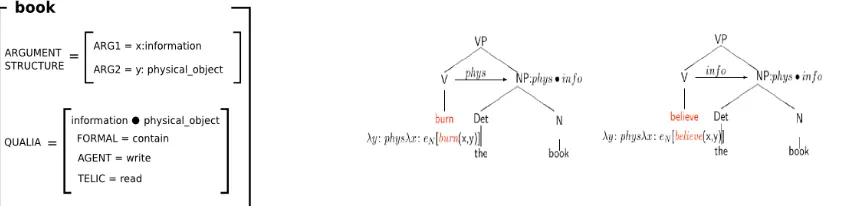
In order to account for the co-predication phenomenon, Pustejovsky proposed that such words as in (a-c) are dot-objects: the distinct senses are coherently bound together via a “dot” operator, resulting in a complex concept that allows for co-predication (i.e. both senses can be accessed simultaneously) as well as meaning shifting (i.e. only one aspect of the meaning is emphasised) (Pustejovsky 1995, 2011; Asher & Pustejovsky, 2006). The meaning of book, for instance, can be seen as a dot-product of a concrete object component and an information component (OBJECT • INFORMATION). When the context selects a more specific sense (e.g. the book burned, or I summarized the book for her), a process called coercion-by-dot-exploitation takes place. Some other classic examples of dot-objects are listed below
adapted from Pustejovsky’s work.
(2)
a. PHYSICAL OBJECT • INFORMATION:book, catalogue
b. FOOD • EVENT:lunch, dinner the lunch was delicious but took forever.
c. LOCATION • SOCIAL GROUP:hospital, church
People gathered in front of the church to protest against its decision.
d. PHYSICAL OBJECT • LIQUID:bottle
e. PROCESS• STATE: examination, arrival
The party will begin after John’s flamboyant arrival.
It is not yet known whether all polysemous words are treated in the brain in the same way, but the phenomenon of co-predication strongly suggested that the different senses of a dot-object are associated with a single lexical entry in the mental lexicon. A handful of psycholinguistic studies have looked at the intricate relation between the sense components of the dot-objects. Srinivasan & Snedeker (2011) studied four-year-old children who had only limited meta-linguistic abilities (e.g. they were unable to count the number of words in a sentences; they do not realise the relation between a word form and the meanings), and found the children could understand the concrete and abstract senses of the book-like concepts equally well. As a result they argued that the two senses had a common mental representation. Frisson (2015) conducted a reaction-time and an eye-tracking experiment on comprehending thebook-like words in a concrete or an abstract context. The results also suggested that the concrete and abstract senses were equivalent. For instance in the eye-tracking experiment, no facilitating effect was found when a sense was repeated as in typical ambiguity resolution, implying that the two senses ofbook-like words had an even closer relation than other typical polysemy.
com-pared the neuroanatomical distinction between the dot-objects that were coerced into the concrete and the abstract interpretation to the typical, mono-sense concrete and abstract concepts. In another experiment, we investigated the oscillatory neural dy-namics of reading those verb-noun phrases through MEG, with an emphasis on the timing of coercion.
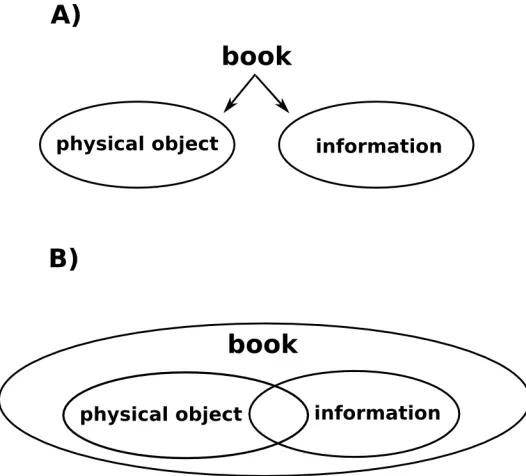
The central question addressed by the fMRI experiments is whether the coerced concrete and abstract senses of dot-objects are represented in the brain differently to mono-sense concrete and abstract concepts. And if so, what are the differences? First, if the neural distinction between the coerced dot-objects is similar to the typical concrete-abstract distinction, we can speculate that the mental representation of a dot-object is a simple combination of the two sense components, and each component can be accessed independently a mental representation more close to the one of homonyms (Fig. 1.1). Conversely, if the concrete- and abstract-coerced dot-objects yield a different neural distinction from the typical one, it is more likely that the meaning of a dot-object is represented as a whole in semantic memory and a biasing context will render the on-line meaning shift into different directions (Fig. 1.1).
Figure 1.1: The graphical depictions of the two hypothetical models for the mental representation of the dot-objects. A. The dot-object book is a simple combination of the two sense components, and each component can be accessed independently (similar to the multiple-lexical-entry model pertained to homonyms). B. The dot-object is represented as a single underspecified structure, as the single-lexical-entry hypothesis predicts. Both senses can be accessed simultaneously and a biasing context will render the on-line meaning shift into different directions.
Figure 1.2: Left: The sample schema of thebook dot-object in the Generative Lexicon Framework (adapted from Pustejovsky, 1997). Right: The depictions of the concrete and the abstract coercion (cit. Pustejovsky).
also been found with healthy subjects in neuroimaging experiments (e.g. Tyler et al., 2004; Rogers et al., 2006; Clarke & Tyler, 2014).
In this thesis, we also would like to emphasise the interaction between semantic composition and lexical semantics. The meaning representation of a word in the long-term memory and the on-line meaning retrieval are typically treated as separate components. Yet we argue that the word meaning in fact largely determines what compositional processing can happen. As to dot-objects, the semantic composition plays an even more defining role than to the unambiguous concepts. To illustrate,book can be an object and/or the abstract information, and the appropriate interpretation has to be determined in the context (e.g. a torn book / a difficult book, pick up the book / explain the book). By contrast, meanings of the simple concepts (e.g. pick up
the flower / explain the plan) rely less on semantic composition, in other words, the
meaning of flower or plan in the above examples rarely depends on the context.
1.2
Thesis outline
mechanism in the brain. FMRI gives snapshots based on the oxygen level of the blood in the brain. The snapshot images of the brain can have millimetre spatial resolution, which allows us to paint a fine-grained picture of the neuroanatomical profiles of the meaning representation. However the hemodynamic responses fMRI measures are rather slow, therefore the time resolution of fMRI is usually about several seconds. MEG, on the other hand, measures the electro-physiological activities of the neurons. It has a temporal resolution of millisecond, which provides a different angle to answer the research question.
We probe the concrete-abstract distinction by examining where, when, and how (i.e. in which frequency band) the abstract and the concrete senses of dot-objects can be discriminated using multivariate pattern analysis (MVPA). In the two fMRI experiments, we examined where in the brain they could be distinguished. Despite some discrepancies between the two categories, both experiments pointed to the an-terior temporal lobe (ATL). Given the role of ATL in modality-independent concept representation and concept specification, we argue that the results are compatible with the linguistic hypothesis that, (1) the representation of those concepts involves a single, underspecified structure; (2) in context, the representation instantiates to a more specific one.
The MEG experiment, in turn, highlighted the gamma-band frequency in dif-ferentiating the different kinds of semantic composition (i.e. concrete vs. abstract, coercion vs. non-coercion). The gamma-band has been indicated in a variety of com-binatorial processes, including sentence comprehension (Weiss et al., 2003; Hald et al., 2006; Penolazzi et al., 2009), world knowledge retrieval (Hagoort et al., 2004), perceptual and conceptual feature binding (Matsumoto & Lidaka 2008; Friese et al., 2012), and so forth. Moreover the gamma-band activity patterns of the concrete- and abstract-coerced dot-objects diverged not before 400ms post-stimulus onset, suggest-ing that coercion took place not only after the lexical knowledge retrieval but also the initial semantic integration.
1.3
Road-map
Chapter 2
Related Work
How word meanings are represented in the brain is a central topic of concept represen-tation. In this thesis we address this issue by investigating the meaning representation of logical polysemy in the brain. First, we review the research on the neural repre-sentation of concepts and the more semantic hub theory, followed by a throughout overview in section two of the neural distinction between concrete and abstract con-cepts in psychology, neuropsychology and cognitive neuroscience. In section three we turn to the psycholinguistic research on comprehending polysemy and coercion, then in section four we extend the review into semantic composition as it is the crucial mechanism of ambiguity resolution. In the last section we provide a brief introduction of neuroimaging methods and multivariate pattern analysis (MVPA).
2.1
The neurobiology of concept representation
asdog, chair, are first learned by children, most frequently used in everyday life, and possesse “an ideal balance between internal similarity and external distinctiveness” (cit. Ungerer & Schmid, 2006). Following Wittgenstein’s family resemblances theory, Rosch & Mervis (1975) proposed the prototype theory that objects in the world were organised as clusters centred on prototypes, e.g. robin as the prototype forbird,apple as the prototype for fruit.
Patients with category-specific deficits have shed great light on the neural basis of human concept system. Warrington & Shallice (1984) documented four patients that showed a discrepancy between their ability to identify inanimate objects, living things, and food, and they reasoned that the concepts were categorised in the mind based on features. For instance living things are mostly represented by their visual features whereas inanimate objects such ashammer andchair are characterised more by their functional features. The author further argued that features of different modalities were stored in modality-specific sub-systems in the brain. By contrast, some have argued for a domain-specific account, stating that these category-specific deficits arise from the evolutionary value of the categories themselves (Caramazza & Shelton, 1998; Caramazza & Mahon 2003; Capitani et al., 2003).
sensitive to knowledge of action and verb reading (Martin et al., 1995; Chao et al., 1999; Perani et al., 1999; Bedny et al., 2008; Binder et al., 2009; Peelen et al., 2012). Two highly specific areas were also identified: the fusiform face area (FFA), which is a small area in the medial fusiform gyrus that is particularly sensitive to face stimuli (Kanwisher et al., 1997), and the parahippocampal place area (PPA), an area in the posterior parahippocampus that shows high sensitivity to building as well as large objects (the parahippocampal place area, PPA) (Aguirre et al.,1996; Ishai et al., 1999; Konkle & Oliva, 2012).
Nevertheless the research above emphasises the sensorimotor aspects of concept knowledge but does not take into account the extremely rich body of high-level, modality-independent knowledge about entities as well as abstract concepts. With respect to the neural basis of such knowledge, the semantic hub theories have achieved much progress recently (Rogers et al., 2004; Patterson et al., 2007; Binder & Desai, 2011; Lambon Ralph, 2014). The core of the theories is that there is a “hub” (or hubs) in the brain in which such modality-independent knowledge is stored and ma-nipulated.
suggests, the “spokes-and-hub” model consists of multiple modality-specific yet inter-connected subregions distributed in the brain, i.e. the spokes, and the single “hub”, i.e. the ATL, that is shared by the spokes and represents modality-independent con-cept knowledge. The authors argued that this model could account for the various observations of semantic deficits that a a-hub model would fail to explain. Rogers et al. (2004) constructed a computational model based on this framework and it could predict the patient data. The model learned a variety of features such as vi-sual, functional, and encyclopedic, and the features were fused in the hub to form a modality-independent representation. Critically, cross-modality generalisation was done via the hub, for instance when given an object name, the system has to go through the hub to retrieve the other information such as the shape, colour, function, and so on. Lambon Ralph et al. (2010) also highlighted the computational nature of the ATL. The authors tested six semantic dementia patients ranging from mild to se-vere semantic impairment, with a new assessment which emphasising the underneath modality-independent knowledge rather than surface similarity. As the semantic hub theory predicted, they found the more severe the semantic impairment was, the more the patients relied on the surface similarity.
processing. Different from the “spokes-and-hub” architecture, however, their hub in Binder & Desai (2011) stretched from the angular gyrus (AG), the posterior middle temporal lobe, to the ATL. In particular, they underlined the role of the angular gyrus in receiving and integrating information from various modality-specific cortices, and it might played a crucial part in representing complex event concepts like birthday party.
2.2
The distinction between abstract and concrete
concepts
2.2.1
Hypotheses in psychology
Altarriba 1999; Jesson et al., 2000; Binder et al., 2005; Wiemer-Hastings and Xu, 2005; Crutch & Warrington 2005; Adorni & Proverbio,2012). Although they are not mutually exclusive, the majority results corroborate the claims of the Dual-Coding theory.
to concrete concepts. Vigliocco and colleagues focused the affective factor for ab-stract concepts. According to their hypothesis, experiential information, language and emotion all serve as crucial dimensions of concept knowledge. Given the fact that abstract concepts are lack of reliable sensorimotor properties, they argued that emotion played the principal role in representing abstract concepts (Vigliocco et al., 2009, 2014; Kousta et al., 2009, 2011).
2.2.2
Evidence from cognitive neuropsychology
studies with healthy subjects that concrete concepts are more self-sustained whereas abstract concepts more rely on associations (e.g. Wiemer-Hastings & Xu, 2005)
2.2.3
Evidence from cognitive neuroscience
The distinction between concrete and abstract concepts has also been found with healthy subjects in cognitive neuroscience studies. Consistent to the Dual-Coding theory, the overall result suggests that concrete concepts involve a wide distribution of multimodal brain areas while the abstract concepts largely overlap with the language areas. Nevertheless the observations seem to vary significantly across studies depending on the specific experimental design and stimulus, implying that this neural distinction is the result of the interplay of many factors.
EEG/ERP
imagery-based, multimodal knowledge had a crucial contribution to the concreteness effect (but see Barber et al. (2013) for a different argument that N400 and N700 observed for concrete concepts reflected the difference in the level of processing and meaning activation).
Neuroimaging
bilateral network including the left anterior IFG (more anterior than the Brocas area identified in the same study), the lower bilateral parietal lobe, the posterior cingulated gyrus and the precuneus. Binder et al. (2005) also compared the fMRI activities of reading concrete and abstract words with a lexical decision task, and the results corroborated the Dual Coding theory: reading concrete concepts involved both hemisphere while abstract concepts was almost confined in the left hemisphere. Moreover concrete concepts recruited the bilateral posterior cingulate gyrus and the precuneus, which were associated with mental imagery. Yet the temporal lobe was surprisingly absent in that study. Sabsevitz et al. (2005) later conducted a similar experiment but in which participants judged the semantic similarity instead of judging word or non-word, and indeed the concrete concepts additionally activated the ventral temporal lobe. Therefore they argued that the lexical decision task in Binder et al. (2005) did not elicit sufficient semantic knowledge to activate the temporal lobes (see similar proposal in Kan et al. (2003) with property verification task).
the hypothesis that abstract concepts are intrinsically more ambiguous. They in-cluded both ambiguous and unambiguous words. In contrast to typical findings, the abstract condition activated a more widespread activation and no regions was found for the concrete > abstract comparison.
To our knowledge, there are two meta-analyses concerning the concrete-abstract neural distinction. Binder et al. (2009) analysed 120 neuroimaging studies of se-mantic processing. The contrast between concrete / perceptual vs. abstract /verbal knowledge revealed a widespread distribution of perceptual foci, including the bilat-eral angular gyrus, the left mid-fusiform gyrus, the left dorsomedial prefrontal cortex (DMPFC), the left precuneus / posterior cingulate cortex (PCC); on the other hand the verbal foci included the left inferior frontal gyrus (IFG) and the left superior temporal sulcus (STS). Wang et al. (2010) conducted a meta-analysis with 19 neu-roimaging studies on the topic of concrete-abstract neural distinction. They found the traditional language processing regions were robustly activated more by abstract con-cepts, including the left IFG, mid-superior temporal gyrus (M/STG). Meanwhile the left precuneus, posterior cingulated gyrus, fusiform gyrus, and the parahippocampal were identified for the concrete>abstract effect. Wang and colleagues further carried out a study with multivariate analysis (MVPA), a more sensitive analysis approach, and showed that the concrete-abstract distinction could be found across the whole brain, suggesting that the distinction was more profound than previous presumed.
2.3
Polysemy and coercion
shift depending on the context. Specifically we investigate this issue by means of logical polysemy, i.e. dot-objects. In the current section, we review neurolinguistic evidence about polysemy comprehension and coercion. And in the next section, we extend the review to the neural mechanism of semantic composition in general, including not only language processing but also concept combination.
2.3.1
Polysemy and homonymy are represented differently in
the brain
Most words in nature language are ambiguous but in many different ways. Linguists and lexicographers have made an important dichotomy between two types of ambigu-ity. Homonyms likebat have multiple unrelated meanings (e.g., nocturnal mouse-like mammal with forelimbs modified to form membranous wings and a club used for hitting a ball in various games). In such cases, the distinct meanings are taken to be the expression of distinct entries in the mental lexicon, i.e. different words that ac-cidentally share the same word form. Such cases are contrasted with polysemies like mouth, that also have multiple, but related senses (e.g., the opening through which food is taken in and vocalizations emerge and an opening that resembles a mouth, e.g., of a cave). The distinction between homonymy and polysemy is not always easy to make, but linguists and lexicographers agree that at least in the clearest cases, polysemous words are associated with a single lexical entry whose conceptual mean-ing encodes the different senses (Lyons, 1977; Cruse, 1986; Ravin & Leacock, 2000; Taylor, 2003).
Note that following the convention, we say a polysemous word has multiple SENSES whereas a homonymous word has multiple MEANINGS. Frazier & Rayner (1990) showed their subjects homonyms like bank or polysemous words like newspaper fol-lowed by disambiguating context. They observed lexical garden paths (manifested by longer reading time) if the following context was not consistent with the most frequent interpretation of the homonym; however no such effect was observed for polysemous words. The result was taken as evidence that the multiple senses of a polysemous word were associated with a single lexical entry, as opposed to homonyms that con-sist of multiple entries and all but one of which were discarded after disambiguation (Swinney, 1979; Tanenhaus et al, 1979). Rodd et al. (2002) observed an ambiguity advantage that ambiguous words were processed faster and easier; importantly the advantage was only for polysemy and absent for homonymy. The authors reasoned that polysemy was facilitated by the rich semantic associations linked to one lexical entry, on the other hand the multiple lexical entries of homonyms generated com-petition. Evidence for this single lexical entry hypothesis was also obtained using magnetoencephalography (MEG) with a priming paradigm (Pylkkanen et al., 2006). One meaning/sense of the homonyms or polysemies was selected by a modifying word, and the targets were primed by the same ambiguous word but with the other meaning/sense selected (e.g. river bank - savings bank, lined paper liberal paper). The authors measured the M350 component which had been associated with lexical activation, and found that the polysemous targets elicited a left hemisphere M350 latency reduction, suggesting that the selected sense of the target polysemy (liberal paper) was already activated to certain degree even the prime had a different sense
2.3.2
Complement coercion
Within polysemy, coercion has been argued to be an important mechanism of resolving various kinds of ambiguity and meaning mismatch (Partee & Rooth, 1983; Moens & Steedman, Jackendoff 1997; Pustejovsky 1993, 1995, 2006, 2011). One of the most studied kinds of coercion in psycholinguistics is complement coercion, exemplified by Mary began the book. In the VP construction, a event-selected verbbeginis combined with an entity noun, thus the object book is said to be coerced into an event such as writing the book, reading the book. The neural mechanism(s) of this process has been
investigated in a considerable number of psycholinguistic studies. Most experiments found an additional cognitive cost. Many proposed that this cost was attributed to the noun undergoing a type-shifting process, i.e. the entity-denoting noun was coerced into an event interpretation, rather than other factors such as ambiguity and pragmatic inference (McElree et al., 2001; Traxler et al., 2002, 2005; Pickering et al., 2005; Frisson & McElree, 2008; Katsika et al., 2012). Frisson et al. (2011) also found the coercion effect when an eventive-adjective was combined with an entity-noun (e.g. a difficult mountain), compared with the cases in which the eventive-adjective was
paired with an eventive noun (e.g. a difficult exercise).
dis-played dissimilarities in both studies. In Baggion et al. (2010) complement coercion additionally evoked a later sustaining negativity. In Kuperberg et al. (2010) anomaly elicited a later component P600 as well while this effect was absent for complement coercion. Using fMRI, Husband et al. (2011) underlined the effect in the left IFG, the classic language locus, in comprehending complement coercion, implying a higher semantic composition demand.
2.3.3
Novel metonymy
Another similar mechanism that too involved context-induced meaning is novel metonymy. Though disputable, metonymy generally refers to expressions in which the salient aspect of an entity is used to indicate the whole or other part of the entity, e.g. the Dickens on the bookshelf, Hollywood is making a big profit (Nunberg, 1995, 2004; Lakoff 1987; Jackendoff 1997). As to novel metonymy, the interpretation has to be fully inferred from the context. For instance the Needham published in 1977 is on the bookshelf is a novel metonymy because Needham is a made-up name.
and a late positivity effect was identified regardless of the contextual information (Schumancher 2011, 2014).
2.3.4
Inherent polysemy and dot-objects
2.4
Semantic composition
2.4.1
Studies on conceptual combination in Psychology
2.4.2
The neural basis of semantic composition
Semantic composition is usually investigated in the form of sentence processing, fo-cusing on how a target word fits into the sentential or phrasal context. High temporal resolution methods such as EEG and MEG prove to be valuable tools to study this on-line meaning construction process (e.g. Kuperberg 2007, Pylkkanen 2008). Ku-perberg (2007) gave a throughout review on ERP studies on this topic. The author claimed that the P600 ERP component denoted a prolonged analysis that went be-yond a simple semantic violation. Based on this assumption and data from a large number of ERP studies, the author further proposed that the P600 effect was the neural signature of the combinatory mechanism(s). Pylkkanen (2008) reviewed psy-cholinguistic and neurolinguistic evidence on the topic of syntax-semantic mismatch. To illustrate, both complement coercion (e.g. the author began the book) and aspec-tual coercion (e.g. the clown jumped for 10 minutes) are typical examples because the mismatches occur only on the semantic level. Note that these mismatches cannot be resolved by a strong composition account but require the brain to flexibly generate coherent interpretations. The author emphasised the role of the mid-frontal lobe in resolving such mismatches. The mid-frontal lobe, nonetheless, has been shown to be closely associated with social cognition and theory of mind, indicating that semantic composition may involve more than just language but also other general cognitive mechanisms.
concep-tual combination paradigm which required participants maintaining several concepts in the working memory, and combined them in order to make a property judgment (e.g. egg, boiled, long -> hard). Although this study focused on the maintaining of semantic working memory, the results showed that the LIFG and the posterior temporal area played an essential role in this combinatory task. Grave et al., (2010) compared the fMRI activities when participants comprehended the typical, highly meaningful noun-noun phrases (e.g. lake house) and the non-typical ones (e.g. house lake). The non-typical phrases were derived from reversing the word order of the
in-teraction between concept specificity and composition in the left ATL, such that the activation of the left ATL was modulated mostly by the low-specificity adjective-noun combinations. They argued that when in a combinatorial context, the low-specificity concepts required a greater degree of specification and thus it yielded the largest effect in the ATL; therefore the effect of concept specificity and the semantic composition might stem from a shared mechanism.
2.5
Neuroimaging and MVPA
2.5.1
A brief introduction of the main brain imaging
tech-niques
Functional Magnetic Resonance Imaging (fMRI) has developed rapidly during the last decades and become the most popular functional neuroimaging technique to date. It can give snapshots based on the oxygen level of blood in the brain, precisely the Blood-Oxygenation-Level-Dependent response (BOLD), which has been showed to be correlated with neural activity (Boynton et al., 1996; Logothetis et al., 2001; Ban-dettini and Ungerleider, 2001). During functional scanning, the magnetic gradients posit a three-dimension grid on the brain, segmenting it into tens of thousands of cells called voxels, and the BOLD signal is measured at each voxel. Thus fMRI image can measure the whole brain with millimetre spatial resolution. However the hemo-dynamic responses fMRI measures are rather slow, therefore the time resolution of fMRI is usually about several seconds.
it has a millisecond time resolution. Moreover it suffers the inverse problem that is theoretically impossible to reconstruct the original generators from the observed sig-nal. More recently the magnetoencephalography (MEG) technique seems to provide a promising solution to the resolution dilemma: it has a high time resolution as EEG and a high spatial resolution as fMRI. MEG measures the magnetic field caused by the electric currents that are also generated from the post-synaptic potentials; it is much more precise and sensitive than EEG but it also endures the inverse problem. However the ample MEG data points allow mathematical models to reconstruct the source more accurately.
2.5.2
Neural decoding and Multivariate Analysis (MVPA)
The General Linear Model (GLM), which adapted from multiple regression analysis, has been the traditional analysis method for fMRI. GLM allows decomposition of the usually overlapped BOLD signal based on the per-defined experimental contrasts. Specifically, the actual signal of one voxel is treated as a linear superimposition of multiple BOLD activities with an assumed shape (Fig. X). The regression analysis then finds the voxels whose responses correlate the best to the pre-defined model. The regression is done with each voxel individually, hence the result has to be corrected for multiple comparisons, which poses an obstacle given the number of voxels is usually tens of thousands.
nearest-neighbour classifier (Haxby et al., 2001). The key assumption of this method is that it is the distinct patterns that contain the crucial information.
Chapter 3
The Neural Representation of
Dot-objects: The Case of
Book
3.1
Introduction
The word book is probably the most cited term of dot-object. It represents the “information print matter” category of which the concepts refer to artefacts used to stored information; and they exhibit a systematic ambiguity between a concrete interpretation as the physical object and an abstract information interpretation (consider, e.g., a wet book / an influential book). As a result, in the General Lexicon framework, those words are considered as dot-objects of OBJECT•INFORMATION. As described in the Section 1.1, the two senses could be accessed simultaneously in a single expression, as in (3.1a). Furthermore some context would select only one aspect of the meaning, a process called coercion-by-dot-exploitation (Fig. 3.1), such as (3.1b) and (3.1c) (cf. Pustejovsky, 2011)
(3.1)
b. Jess almost dropped the book, then hastily replaced it on the shelf. c. The author will be discussing her new book.
According the dot-object theory, meanings of those words should be represented by a single lexical entry, to which the multiple senses are systematically related. In this experiment we investigated the implications of the single lexical entry hypothesis with respect to theories of the neural distinction between concrete and abstract concepts. The question we address is, how is the meaning of the dot-object words such as book represented in the brain? Specifically we probe the issue that whether the coerced concrete and abstract senses of dot-objects are represented in the brain differently to mono-sense concrete and abstract concepts. If so what are the differences? To answer this question, we used functional magnetic resonance imaging (fMRI) to examine the neural activation patterns originated by reading the book-like dot-object words in a minimal context, i.e. a verb-noun phrase, that coerce them into either the concrete or the abstract interpretation (e.g. open the book / consult the book). As a comparison, we also examined the neural correlates of reading phrases that contained monosense, typical concrete and abstract concepts. This experiment design allows us 1) to compare the neural representations of the coerced concrete and abstract concepts to the typical concrete-abstract neural distinction, 2) to look into the neural representation of complex concepts and semantic composition (Fig. 3.2).
How-Figure 3.1: The schematic representations ofcoercion by dot-exploitation (c.f. Puste-jovsky). The physical object or the information component is selected by the verbal context respectively.
Pylkka-nen, 2014). Interestingly Westerlund & Pylkkanen (2014) also found an interaction between concept specificity and composition in the ATL, suggesting that the two aspects were closely related.
Figure 3.2: Experimental design. The three vertical lines indicate the three concrete-abstract contrasts. In the target contrast, dot-object, the dot-object words are com-bined with verbs that coerce the meaning into either the concrete or the abstract interpretation. The simple contrast contains typical concrete and abstract words combined with generic verbs. In the verb-control contrast, the same coercing verbs in the dot-object contrast are used but paired with unambiguous concrete and abstract nouns.
3.2
Methods and materials
3.2.1
Participants
3.2.2
Materials
All experiments were conducted in Italian. We considered 4 words from a class of dot-object concepts, informational print matter book, magazine, catalogue, sketch, and used verbs to coerce the meaning into either the concrete or the abstract sense. We first came up with a pool of verbs that could potentially coerce the dot-objects into either the concrete object sense or the information sense, and then we constructed all combinations of all the nouns and verbs, excluding the meaningless and ambiguous ones. Following the procedure proposed in Barca et al. (2002), thirty-eight native speakers were recruited to rate the familiarity, concreteness and imageability of each verb-noun combination. Based on the norming result, we then selected 3 concrete (open, pick, give (as a present)) and 3 abstract (explain, consult, present) verbs as the coercing verbs. We refer to this target contrast with the coercing verbs and the dot-object nouns as the dot-object contrast.
solely due to differences in verbs between conditions. Phrases in this contrast had the same coercing verbs as in the dot-object conditions, but the verbs were combined with their common complement words drawn from various concrete or abstract cat-egories (e.g. open the door, open the parcel / explain the problem, explain the plan). Therefore this contrast should most reflect the verb semantics. Hence if the effect of the dot-object contrast were driven by the verbs only, the same effect should be picked up by this verb-control contrast too. The verb-noun combinations of these two additional contrasts were rated in the same norming experiment as described above. The experiment design and the list of stimuli can be found in Fig. 3.2 and Table 3.1. After the norming, we selected 7 concrete and 7 abstract phrases for each contrast, resulting in 42 phrases in total (7 phrases * 2 categories * 3 contrasts). The stimuli in Italian and the English translation are listed in Table X. Phrases of each contrast were matched in length and the number of phonemes (number of letters: tDot-object(12)=-0.46, p=0.65; tSimple(12)=0.8, p=0.44; tVerb-control(12)=-1.36,
p=0.2. number of phonemes: tDot-object(12)=-0.27, p=0.79; tSimple(12)=-1.15, p=0.27;
tVerb-control(12)=1.16, p=0.7). All categories matched familiarity (F(5,36)=0.27,
p=0.93). For each concrete-abstract contrast the concreteness and the image-ability ratings differ significantly (concreteness: tDot-object(12)=-3.82, p=0.0025;
tSimple(12)=-16.12, p=1.7e-09; tVerb-control(12)=-7.94, p=4.06e-06. Imageability:
tDot-object(12)=-2.3, p=0.0402; tSimple(12)=-6.86, p=1.7544e-05; tVerb-control(12)=-8.05,
p=3.5184e-06). The detailed results are in Table 3.2 and Fig. 3.3. None of these subjects of the norming experiment participated in the fMRI experiment.
3.2.3
Procedure
Figure 3.3: Ratings of familiarity, concreteness, and imageability of each category. Two-sample t-tests were calculated for each concrete-abstract contrast. The con-creteness and imageability ratings are significantly different for all three contrasts.
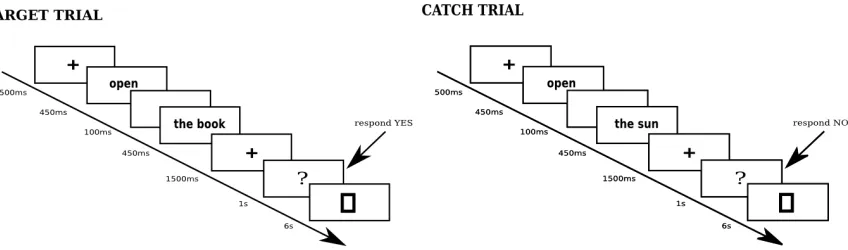
contained meaningless combinations (e.g. open the sun). We adopted a slow-event design. Each trial started with a fixation cross for 500ms, followed by a verb and then an article-noun phrase, each of them was present for 450ms with a 100ms interval. A black cross then remained on the screen for 1500ms to encourage participants to form an elaborate mental representation, then a question mark was displayed for 1000ms at which point participants responded by pressing the left or right button box (counterbalanced across participants). The next trial started after 6 second fixation time (Fig. 3.4). During one scanning session, all 42 verb-noun phrases along with 5 catch trials (around 10% of all trials) appeared once in a random order. Each participant completed 6 sessions.
3.2.4
Data acquisition
Table 3.1: Stimulus words used in the three concrete-abstract contrasts. Each con-trast contains seven concrete and seven abstract verb-noun phrases. The original Italian stimuli are showed below the English translation. The dot-objects are high-lighted in bold font.
English:
dot-objects simple verb-control
ABSTRACT
consult thebook have the idea consult the expert
consult themagazine have the opinion present the request
consult thecatalogue change the story present the problem
present thebook change the judgement present the plan
present thesketch change the idea explain the motive
explain thebook give the judgement explain the expression
explain thesketch give the idea explain the reason
CONCRETE
open thebook have the table open the parcel
open thecatalogue have the chair open the envelop
pick up thebook have the desk pick up the flower
pick up themagazine change the closet pick up the coin
pick up thecatalogue change the table pick up the ball
give (as a present) thebook change the desk give (as a present) ticket
give (as a present) thesketch give the chair give (as a present) flower
Italian:
dot-objects simple verb-control
ABSTRACT
consultare illibro avere la idea consultare l’esperto
consultare larivista avere l’opinione presentare la domanda
consultare ilcatalogo cambiare la storia presentare il problema
presentare illibro cambiare il giudizio presentare il programma
presentare ildisegno cambiare la idea spiegare il motivo
spiegare illibro dare il giudizio spiegare la parola
spiegare ildisegno dare la idea spiegare la ragione
CONCRETE
aprire illibro avere il tavolo aprire il pacco
aprire ilcatalogo avere la sedia aprire la busta
raccogliere illibro avere la scrivania raccogliere il fiore
raccogliere larivista cambiare l’armadio raccogliere la moneta
raccogliere ilcatalogo cambiare il tavolo raccogliere la palla
regalare illibro cambiare la scrivania regalare il biglietto
Figure 3.4: During the experiment, participants performed a semantic meaningfulness judgement task and responded by pressing the button boxes with the left or the right hand (counterbalanced across participants). In one scanning session, all the 42 verb-noun phrases along with 5 catch trials (around 10% of all trials) appeared once in a random order. Each participant completed 6 sessions.
Table 3.2: The psycholinguistic parameters of the stimulus phrases in each condition. Familiarity, concreteness, and imageability are obtained from the norming experiment with thirty-eight participants. Standard deviations are showed in parentheses.
Category familiarity concreteness imageability letters phonemes
abstract Dot-object 3.9(0.51) 3.65(0.33) 3.86(0.39) 18.71(1.58) 7.57(0.90)
concrete Dot-object 4.1(0.50) 4.32(0.28) 4.34(0.34) 18.14(2.59) 7.43(0.90)
abstract Noun 4.08(0.44) 2.22(0.14) 3.24(0.26) 14.43(2.92) 6.14(0.64)
concrete Noun 4.09(0.36) 3.65(0.17) 4.04(0.11) 15.71(2.60) 6.71(1.03)
abstract Verb 4.12(0.29) 3.32(0.22) 3.85(0.10) 19.14(1.81) 7.43(0.49)
concrete Verb 4.14(0.23) 4.41(0.25) 4.53(0.18) 17.43(2.50) 7(0.76)
3.2.5
Univariate analysis
participant were combined with the fixed-effects single-group average method (one sample t-test). The group-level activation maps of the three contrasts were computed using a two-sample paired t-test that the concrete and the abstract conditions were modeled within-subject. The ordinary least square (OLS) mixed-effects model was applied. The z-value maps (Gaussianised T/F) were thresholded using the cluster-based method provided by the FSL software. The primary voxel-wise threshold was set to Z>2.3 (corresponding to p<0.05) and a (corrected) cluster significance threshold of P=0.05 was used. The activation maps of each participant were registered to the MNI-standard brain (2mm resolution) to form the final group map.
3.2.6
Regions-Of-Interest (ROIs)
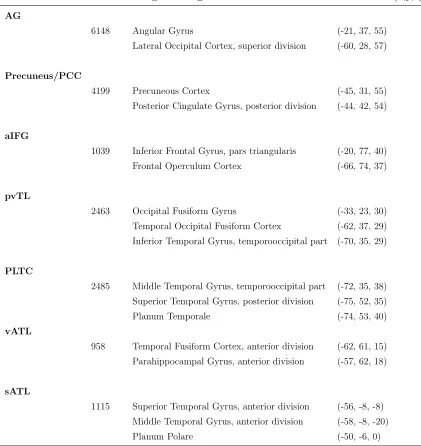
We focused on seven left hemisphere Regions-Of-Interest (ROIs) which have been consistently shown to discriminate between concrete and abstract concepts, and/or to play a role in semantic interpretation processes such as disambiguation or seman-tic composition. The seven ROIs are 1) the anterior inferior frontal gyrus (aIFG), 2) the angular gyrus (AG), 3) the precuneus/posterior cingulate cortex, 4) the posterior ventral temporal lobe (pvTL), 5) the posterior lateral temporal cortices (PLTC), 6) the ventral anterior temporal lobe (vATL), and 7) the superior anterior temporal lobe (sATL). The ROI masks were derived from the Harvard-Oxford atlas, a probabilistic atlas that divided the whole cerebral cortex into 48 bilateral cortical subregions (De-sikan, et al., 2006). We obtained each ROI mask by merging several subregions with the 25% probabilistic threshold; the MNI co-ordinates reported in other studies were also taken into account (Table 3.3, Fig. 3.5).
Table 3.3: Details of the seven Regions-Of-Interest (ROIs). The ROIs are derived from merging several subregions from the Harvard-Oxford probability atlas with cut-off probability threshold 25%. The extent shows the resulting number of voxels (resultion 2mm). The MNI coordinates indicate the centre of the subregion in the atlas. AG: angular gyrus, PCC: posterior cingulate cortex, pvTL: posterior ventral temporal lobe, PLTC: posterior lateral temporal cortices, vATL: ventral anterior temporal lobe, sATL: superior anterior temporal lobe
Extent Merged subregions MNI coord (x,y,z)
AG
6148 Angular Gyrus (-21, 37, 55)
Lateral Occipital Cortex, superior division (-60, 28, 57)
Precuneus/PCC
4199 Precuneous Cortex (-45, 31, 55)
Posterior Cingulate Gyrus, posterior division (-44, 42, 54)
aIFG
1039 Inferior Frontal Gyrus, pars triangularis (-20, 77, 40)
Frontal Operculum Cortex (-66, 74, 37)
pvTL
2463 Occipital Fusiform Gyrus (-33, 23, 30)
Temporal Occipital Fusiform Cortex (-62, 37, 29)
Inferior Temporal Gyrus, temporooccipital part (-70, 35, 29)
PLTC
2485 Middle Temporal Gyrus, temporooccipital part (-72, 35, 38)
Superior Temporal Gyrus, posterior division (-75, 52, 35)
Planum Temporale (-74, 53, 40)
vATL
958 Temporal Fusiform Cortex, anterior division (-62, 61, 15)
Parahippocampal Gyrus, anterior division (-57, 62, 18)
sATL
1115 Superior Temporal Gyrus, anterior division (-56, -8, -8)
Middle Temporal Gyrus, anterior division (-58, -8, -20)
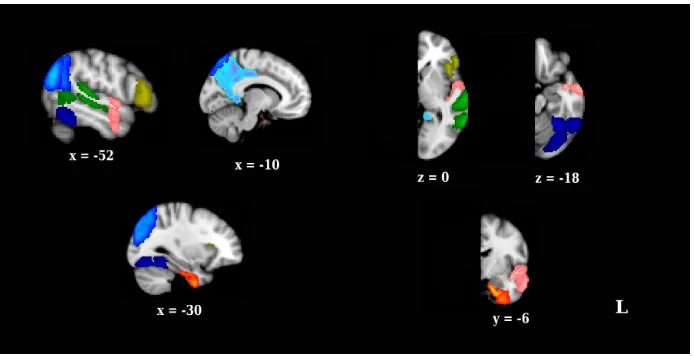
Figure 3.5: The left hemisphere region-of-interest (ROI) masks used in the ROI-based analysis. Yellow: anterior inferior frontal gyrus (aIFG); green: posterior lateral temporal cortices (PLTC); blue: angular gyrus (AG); light-blue: precuneus and the posterior cingulate gyrus; dark-blue: posterior ventral temporal lobe (pvTL); red-yellow: ventral anterior temporal lobe (vATL); pink: superior anterior temporal lobe (sATL).
ROI was showed to be activated by all verbs and not sensitive to the verb type (e.g. verbs referred to action, motion, or event).
3.2.7
Pattern Classification
We employed multivariate pattern analysis (MVPA) to investigate the different kinds of concrete-abstract contrast in each ROI. Specifically we used a statistical classifier to distinguish between brain activity patterns associated with comprehending the concrete and abstract phrases of each contrast, i.e. the simple contrast, the dot-object contrast, and the verb-control contrast. MVPA considers the values of multiple voxels simultaneously; thus it has high sensitivity and has been successfully applied to decode a variety of neural activities (e.g. Haxby et al., 2001; Cox & Savoy, 2003; Wang et al., 2013). Within each ROI, a support vector machine (SVM) classifier was used to distinguish between concrete and abstract conditions for each of the three contrasts.
P-values for the classification accuracy were calculated with a one-sample t-test against the 0.5 chance level. We calculated one-tail p-values because, if there was no difference between the two categories, the aforementioned cross-validation procedure should yield a chance level classification accuracy (a result that was considerably lower than chance level usually implied that there were pitfalls in the cross-validation procedure), and here we wanted to test whether the accuracy was better than chance. The p-value threshold was set to 0.05 and control for false discovery rate (FDR) following the Benjamini-Hochberg procedure (Benjamini & Hochberg, 1995).
3.2.8
Whole-brain parcellation analysis
To look for potential effect outside the ROIs, we ran a whole-brain parcellation anal-ysis in addition to the ROI-based analanal-ysis. The identical classification procedure and statistics as in the ROI-based analysis were carried out in all the 96 subregions defined by the Harvard-Oxford probabilistic atlas. Following the same strategy in the ROI-based analysis, each subregion was extracted with the 25% probabilistic threshold.
3.3
Results
3.3.1
Behaviour
3.3.2
Univariate analysis
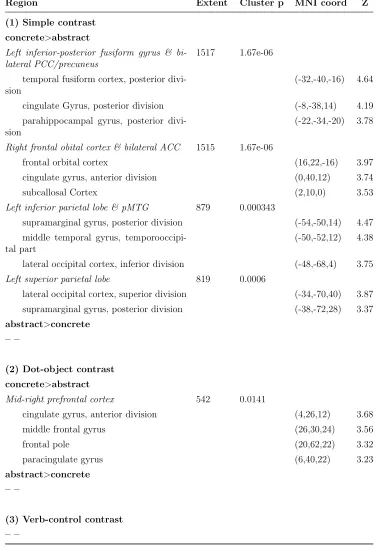
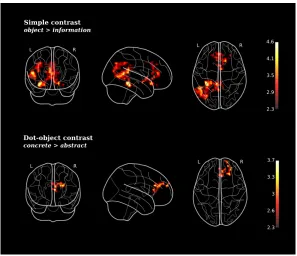
Four clusters were identified for the OBJECT>INFORMATION comparison in the simple contrast. The clusters were located in the 1) left posterior fusiform gyrus and the precuneus lateralised to the left, 2) the left superior parietal lobe, 3) the left inferior parietal lobe that extends to the posterior middle temporal gyrus, and 4) the bilateral anterior cingulate gyrus and the right frontal orbital cortex. For the dot-object contrast one cluster encompassing the anterior cingulate cortex and the mid-to-right frontal lobe was found for the CONCRETE>ABSTRACT comparison. No significant effect was found for the verb-control contrast (Fig. 3.6. Table 3.4).
3.3.3
ROI-based Multivariate Pattern Analysis (MVPA)
Table 3.4: Univariate analysis result. The significant clusters were calculated by the cluster-based inference using the Gaussian random field (GRF) method, using the cluster-level threshold p<0.05 (FWER corrected). The MNI coordinates show the voxels with the local maxima z-values (Gaussianised T/F) within the cluster.
Region Extent Cluster p MNI coord Z
(1) Simple contrast
concrete>abstract
Left inferior-posterior fusiform gyrus & bi-lateral PCC/precuneus
1517 1.67e-06
temporal fusiform cortex, posterior divi-sion
(-32,-40,-16) 4.64
cingulate Gyrus, posterior division (-8,-38,14) 4.19
parahippocampal gyrus, posterior divi-sion
(-22,-34,-20) 3.78
Right frontal obital cortex & bilateral ACC 1515 1.67e-06
frontal orbital cortex (16,22,-16) 3.97
cingulate gyrus, anterior division (0,40,12) 3.74
subcallosal Cortex (2,10,0) 3.53
Left inferior parietal lobe & pMTG 879 0.000343
supramarginal gyrus, posterior division (-54,-50,14) 4.47
middle temporal gyrus, temporooccipi-tal part
(-50,-52,12) 4.38
lateral occipital cortex, inferior division (-48,-68,4) 3.75
Left superior parietal lobe 819 0.0006
lateral occipital cortex, superior division (-34,-70,40) 3.87
supramarginal gyrus, posterior division (-38,-72,28) 3.37
abstract>concrete – –
(2) Dot-object contrast
concrete>abstract
Mid-right prefrontal cortex 542 0.0141
cingulate gyrus, anterior division (4,26,12) 3.68
middle frontal gyrus (26,30,24) 3.56
frontal pole (20,62,22) 3.32
paracingulate gyrus (6,40,22) 3.23
abstract>concrete – –
(3) Verb-control contrast
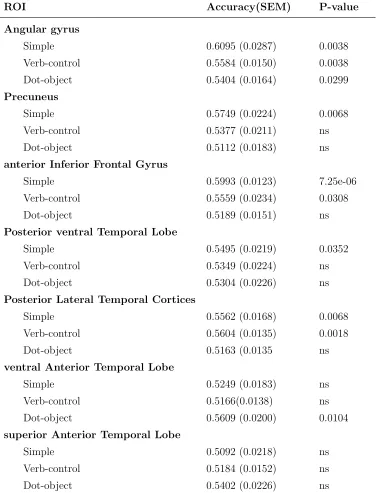
Table 3.5: Classification accuracy for the three concrete-abstract contrasts in each ROI. P-values were calculated with one-sample t-test (dof=15) against the 0.5 chance level, FDR corrected.
ROI Accuracy(SEM) P-value
Angular gyrus
Simple 0.6095 (0.0287) 0.0038
Verb-control 0.5584 (0.0150) 0.0038
Dot-object 0.5404 (0.0164) 0.0299
Precuneus
Simple 0.5749 (0.0224) 0.0068
Verb-control 0.5377 (0.0211) ns
Dot-object 0.5112 (0.0183) ns
anterior Inferior Frontal Gyrus
Simple 0.5993 (0.0123) 7.25e-06
Verb-control 0.5559 (0.0234) 0.0308
Dot-object 0.5189 (0.0151) ns
Posterior ventral Temporal Lobe
Simple 0.5495 (0.0219) 0.0352
Verb-control 0.5349 (0.0224) ns
Dot-object 0.5304 (0.0226) ns
Posterior Lateral Temporal Cortices
Simple 0.5562 (0.0168) 0.0068
Verb-control 0.5604 (0.0135) 0.0018
Dot-object 0.5163 (0.0135 ns
ventral Anterior Temporal Lobe
Simple 0.5249 (0.0183) ns
Verb-control 0.5166(0.0138) ns
Dot-object 0.5609 (0.0200) 0.0104
superior Anterior Temporal Lobe
Simple 0.5092 (0.0218) ns
Verb-control 0.5184 (0.0152) ns
Figure 3.6: Univariate analysis result. The concrete and the abstract conditions of each contrast were compared with a two-sample paired-test. The colour bars indicate the voxel-wise Z (Gaussianised T/F) statistics thresholded by Z>2.3 (p<0.05). The significant clusters were calculated with the cluster-based method provided by the FSL software (cluster p<0.05, FDR-corrected). The individual maps were registered to the MNI-standard brain (2mm resolution) to form the final group map. Significant effects were found for the object > information comparison in the simple contrast, and the concrete > abstract in the verb-control contrast. No other significant effect was found for other comparisons.
3.3.4
Effects in the right hemisphere
We further explored the effect in the right hemisphere (RH) given that, first, the univariate analysis showed some RH effect for the dot-object contrast; moreover there is also evidence suggesting that the RH plays some parts in processing ambiguous words, although its exact role is still unclear (Chairello, 1988; Kircher et al., 2001; Chan et al., 2004; Zempleni et al., 2007; Pobric et al., 2010).
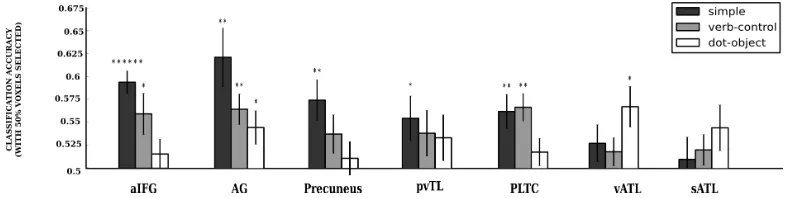
Figure 3.7: Classification accuracy for the three types of contrast in each ROI. Error bars indicate SEMS. P-values of the classification accuracy were calculated with one-sample t-test (dof=15) against the 0.5 chance level (one-tailed p-value, FDR corrected, *****p<0.00001, ****p<0.0001, ***p<0.001, **p<0.01, *p<0.05).
the RH ROIs achieved higher classification accuracy than their LH counterparts; one-sample t-test on the group-level accuracy showed that the right aIFG, AG, and the pvTL had p < 0.05 (uncorrected). To the contrary, the opposite pattern was found for the two ROIs in the ATL that the left ROIs outperformed the right ones. However the right vATL also showed a significant effect p <0.05 (uncorrected).
3.3.5
Whole-brain parcellation MVPA
tempo-ral gyrus (mean accuracy=0.5577, t(15)=3.39), and the right superior parietal lobe (mean accuracy=0.5293, t(15)=2.74).
Figure 3.8: Comparing the classification accuracy for the dot-object contrast of each ROI in the left and the right hemisphere. Error bars indicate SEMS. P-values of the classification accuracy were calculated with one-sample t-test (dof=15) against the 0.5 chance level (one-tailed p-value, uncorrected, *****p<0.00001, ****p<0.0001, ***p<0.001, **p<0.01, *p<0.05).
Table 3.6: Significant subregions (corrected p<0.05) identified in the whole-brain parcellation MVPA. The identical classification procedure and statistics as in the ROI-based analysis were carried out in all the 96 subregions defined by the Harvard-Oxford probabilistic atlas. The MNI coordinates show the center of the subregion. P-values were calculated with one-sample t-test (dof=15) against the 0.5 chance level, FDR corrected.
Subregion Accuracy(SEM) p MNI coord
(1) Simple contrast
Left inferior frontal gyrus, pars triangularis 0.5734 (0.0174) 0.0354 (-50, 28, 8)
(2) Dot-object contrast
Left temporal fusiform cortex, anterior division 0.5679 (0.0188) 0.0306 (-34, -4, -42)
Right intracalcarine cortex 0.5672 (0.0157) 0.0311 (4, 80, 8)
Right frontal operculum cortex 0.5620 (0.0164)) 0.0261 (42, 22, 2)
Right temporal fusiform cortex, posterior division 0.5610 (0.0151) 0.0295 (38, -32, -24)
(3) Verb-control contrast
3.4
Discussion
In this experiment, we investigated the neural representation of the archetypal class of dot-objects: artefacts that are used to stored information, such asbook andmagazine. Those words fall under the definition of logical polysemy that they have multiple but systematically related senses; they can refer to the concrete object (e.g. a heavy book) or the abstract information they carry (e.g. an influential book). It is generally
assumed that logical polysemy words have a single entry in the mental lexicon; on the other hand, it has been showed that concrete and abstract concept knowledge is represented in different ways in the brain.
So how are these dot-object concepts represented in the brain? To probe this ques-tion, we have healthy participants scanned with fMRI while reading the dot-object nouns in combination with verbs which coerced the meaning into either the concrete or the abstract interpretation (e.g. open the book vs. consult the book). Multivariate pattern analysis (MVPA) was used to compare the neural correlates of the coerced concrete and abstract dot-objects to those elicited by typical concrete and abstract concepts (e.g. desk vs. idea). Our results revealed that the coerced concrete-coerced abstract distinction particularly engaged the ventral anterior temporal lobe (vATL), in which the typical concrete-abstract distinction was not distinguishable. Given the role the vATL plays in high-level concept representation as well as semantic compo-sition, we argue that this effect reflects accessing the specific conceptual knowledge of the dot-objects. Accordant with the dot-object theory proposed in the Generative Lexicon of Pustejovsky, we hypothesise that the knowledge representations of the dot-objects involve an underspecified complex structure, i.e. the qualia; moreover when put in context, the representation instantiates to a more specific one.
differ-entiated from the information concepts such as idea and opinion in the ROIs that were often found in the literature: the angular gyrus (AG), the precuneus, the ante-rior infeante-rior frontal gyrus (aIFG), the posteante-rior ventral temporal lobe (pvTL) and the posterior lateral temporal cortices (PLTC). The univariate analysis also identified the left AG and the precuneus/posterior cingulate cortex (PCC) for the OBJECT> IN-FORMATION comparison, regions that have been closed related to concrete objects and mental imagery (e.g. Jessen et al., 2000; Binder et al., 2005; Sabsevitz et al., 2005). Moreover the OBJECT>INFORMATION comparison revealed the posterior parahippocampus, an area known as the parahippocampal place area (PPA) because it was shown to be specifically activated by seeing building pictures (Aguirre et al., 1998; Ishai et al., 1999) as well as large unmanipulable objects (Konkle & Oliva, 2012; He et al., 2013). Thus it is unsurprising that we found the PPA given the furniture category we used here. This comparison also identified the anterior cingulate cortex (ACC), which we attribute to a joint effect of concreteness and composition. We will discuss it in more detail in the later section.
distinction between the concrete and the abstract interpretation, rather than the verbs per se.
3.4.1
Polysemy, underspecification, and the mental
represen-tation of dot-objects
Why do the dot-object contrast and the typical concrete-abstract contrasts yield dissociated effects and why does this representation of dot-objects crucially involve the ventral anterior temporal lobe (vATL)? Our answer is that this dissociation is what we will predict on the basis of Pustejovskys refinement of the single lexical entry hypothesis which we call here the dot-object hypothesis (Pustejovsky 1995, 2011; Asher and Pustejovsky, 2006). We argue that this special nature of the dot-objects makes the underpinning neural mechanism(s) different from the one for the simple concrete and abstract concepts. And the reason that the dot-object contrast particularly engaged the vATL (which includes the anterior parahippocampus and the anterior fusiform gyrus, see Fig. 3.5), we argue, can be traced to the two roles the vATL plays which until recently have been considered distinct: as a “semantic hub” and as the centre of semantic composition.
although conceptual knowledge is represented in several distinct modality-specific systems across the brain (e.g. action, colour, etc.), the brains conceptual system also includes a component in which high-level, modality-independent conceptual knowl-edge is stored, i.e. the hub. The aforementioned evidence from both SD patients and healthy subjects led some to argue that the vATL contributes this storage. Impor-tantly, activation in the vATL appears to be sensitive to the degree of specificity of a concept. One of the most robust findings about SD is the specificity effect: SD patients typically have more difficulty in tasks that require accessing more specific conceptual knowledge. For instance, SD patients usually show a reversed basic level effect: in contrast to normal subjects, SD patients perform better with tasks involv-ing concepts at the superordinate level (e.g. animal) than with concepts at the basic level (e.g. dog) (Hodges & Patterson 1996; Rogers, et al., 2006; Wright et al., 2015). Moreover, SD patients’ ability to recognise famous people and buildings is usually impaired (Damasio et al., 1996; Snowden et al., 2004). This sensitivity of the vATL to specificity has also been found in healthy subjects in neuroimaging experiments (Gorno-Tempini & Price, 2001; Tyler et al., 2004; Rogers et al., 2006). For instance, Tyler et al. (2004) examined the fMRI activation patterns of healthy subjects nam-ing common object pictures, and found that the vATL was more activated in the basic-level naming compared to the superordinate-level; conversely the effect of the superordinate-level was restricted to the posterior temporal lobe. The authors rea-soned that the vATL was activated when there was a need to access more specific properties and integrate information in order to make a detailed discrimination.
In contrast, interpreting simple concepts does no