Anuradha, 2014 ISSN: 2349 – 4891
Correlations of
BiomechanicalCharacteristics with Ball Speed in Penalty Corner Push-In
Knowledge Management – Driving Force
to SuccessDr.A.Anuradha
Associate Professor, Department of MBA and Research Centre, CMR institute of Technology, Bangalore, Karnataka, India.
Received 30th September 2014, Accepted 26th November 2014
Abstract
This study proposes a conceptual framework of knowledge management and the methods of imparting culture through KM. Knowledge is the widely accepted valuable asset in this competitive world. Knowledge Management is acting as a connecting tool for planning, organizing, communicating, estimating and controlling organizations’ skills and assets. Knowledge Management helps an individual to utilize his creativity to the fullest extent which will promote the culture of the organization. It is the initial step in achieving the goals of the organization. Culture consist of traditional values that passes from one generation to the next but it should be learnt with due care. Cultural change is never an easier one; it will take time to introduce changes in organization. But cultures can be imparted through the systematic methodology of KM. It helps to realize the significance of nurturing a conducive culture before beginning any activity. The ultimate purpose of the organization will be fulfilled, if knowledge is utilized and managed effectively. Therefore culture depends on knowledge sharing and smooth environment in the organization as well as in the society. This study also aims at finding out the updation level of knowledge and how far it act as the key factor for achieving the goals. The empirical research aims at finding out the significance and updation of knowledge among the gender of the respondents.
Keywords: Knowledge Management, Organization, Success.
© Copy Right, IJRRAS, 2014. All Rights Reserved.
Introduction
The Prime resource of the organization is the knowledgeable employees. Knowledge is the widely accepted valuable asset in this competitive world. The culture of the organization plays a vital role in the implementation of the valuable asset, knowledge. Many researches conducted in information technology sector, medical and petroleum products reflected the importance of Knowledge Management which enhances the promotion of corporate culture in the organization. Organization’s mission, vision, objectives, plans; procedures should have a reflection of knowledge management.
Knowledge- An Asset
Knowledge management is acting as connecting tool for planning, organizing, communicating, estimating and controlling organizations’ skills and assets. KM depends on the ability and willingness of an individual to update their mental power. Effectiveness of the asset knowledge has to be measured which depends upon environment where the individual is working and also on the culture that prevails in organization. Organization culture reflects the past and predicts the future which is possible only with the systematic implementation of KM.
Correspondence Dr.A.Anuradha,
E-mail: [email protected], Ph. +919964795238
Knowledge Management
Knowledge Management is a conscious strategy of getting the right knowledge to the right people at the right time and turning information into action to improve performance.
The growth of KM is supported with the advent of new technologies. In the revolutionized world of information technology, employees get easy access to company’s norms, objectives, plans and procedures which in turn are converted into knowledge. Thus technical advancements help the employees to gain competitive intelligence. Marshall identifies three types of knowledge:
Identification knowledge – the facts and concepts making up the knowledge domain.
Elaboration knowledge – the relationships between the individual knowledge components and the way they are organized.
Execution knowledge – the conceptual skills and procedures required to execute an activity.
3CS of Knowledge Sharing – Imparting Ethical Values
Culture
Knowledge Management helps an individual to utilize his creativity to the fullest extent which in turn will promote the culture of the organization. The strengths and weaknesses of company’s culture can be determined with the implementation of KM. Knowledge
ISSN: 2349 - 4891
International
promotion and sharing of valuable information. It offers several financial and non-financial benefits to an organization.
There are some cultural barriers in organization often held as responsible for failures to share, promote and transfer knowledgeable information. Therefore it is correctly said that KM can undertake the challenging task of changing an organization’s culture to achieve goals. Thus growing resistance among employees can be changed. Culture consist of traditional values that passes from one generation to next but it should be learnt with due care. Cultural change is never an easier one, it will take time to introduce changes in organization .But cultures can be imparted through the systematic methodology of KM. Culture has the following qualities: Structured: consists of certain norms an individual has to follow in the paths of life.
Attitudinal: culture consist of behaviours, pattern of life style an individual has to adhere to
Rational: contain ideas that exhibit the use of sixth sense, helps in the process of problem solving.
Societal: culture consist of certain values, interpersonal relations, adjustability to environmental factor
Status symbol: Culture consists of certain traits which reflect the basic qualities and characteristics of an individual, projects status of the person.
Knowledge is Power. It is used as key factor which has no diminishing returns. In multinational company where team work is more emphasized, collective participation of the employees provides a framework for the implementation of KM System. Most organizations are utilizing the opportunities available to them in an effective way as jobs are becoming highly intellectual nowadays. A well conceived KM programme would protect the interest of different groups. Employer and employees should be highly
talented as their Intelligent Quotients (IQs) are challenged often. A unique way of building KMS (Knowledge Management System) increase the importance and necessity of learning culture to exist in environment. Sufficient representation needs to be given to KM.
Knowledge Management is useful to all employees. An organization makes lot of investment on human assets. Employee has to gradually develop his or her skills and abilities to become a valuable asset for the organization. Knowledge acquired at one incident can be used to analyze different cases. It is not going to yield any diminishing returns. Knowledge gained in the formal process of organization stimulates IQs among employees. The innovative ideas and implementation of creative process emerging from KM promotes welfare of the organization as well as employees.
Research Methodology
This study aims at finding out the updation level of knowledge and how far it act as the key factor for achieving the goals. The empirical research also aims at finding out the significance and updation of knowledge among the gender of the respondents.
The sample size of this study is 50. The sampling unit is the employees working in ABT services in Madurai city. Chi-square, ANOVA are the analysis tools used for this study.
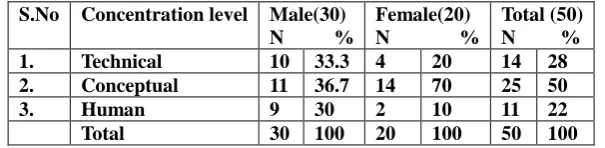
Knowledge management has a great impact on the work culture and it has a major role in achieving goals. The skills are classified as technical, conceptual and human skills. The skills of the respondents and the gender is presented in Table I.
Table I. Gender wise classification based on skills of the respondents
Source: Primary Data
It can be inferred from the Table I that 33.3 per To test whether there is any relationship between the S.No Concentration level Male(30)
N %
Female(20) N %
Total (50) N %
1. Technical 10 33.3 4 20 14 28
2. Conceptual 11 36.7 14 70 25 50
3. Human 9 30 2 10 11 22
Table II. Chi –Square Test for Independency
Calculated value of χ2 Table value of χ2 Inference
22.222* 5.99 H0 is rejected
d.f. = 2 p < 0.05 sig
d.f. : Degrees of freedom.
Indicates that the χ2 value is significant at 5 per cent level with 4 degrees of freedom. The results of Table 2 reveal that null hypothesis is rejected, since the calculated value is more than the Table value. It is concluded that there is significant relationship between gender and skills of the respondents.
Gender and its association with study variables Knowledge management is the essential tool to achieve the personal and career goals. In order to examine whether the gender influences the study variables, ANOVA test is applied. In order to test this
significance, it is Hypothesized (H0) that there is no relationship between gender and the study variables. Hence the following null hypotheses (H0) have been formulated for the study:
1. H0: Gender do not differ with regard to updation of knowledge.
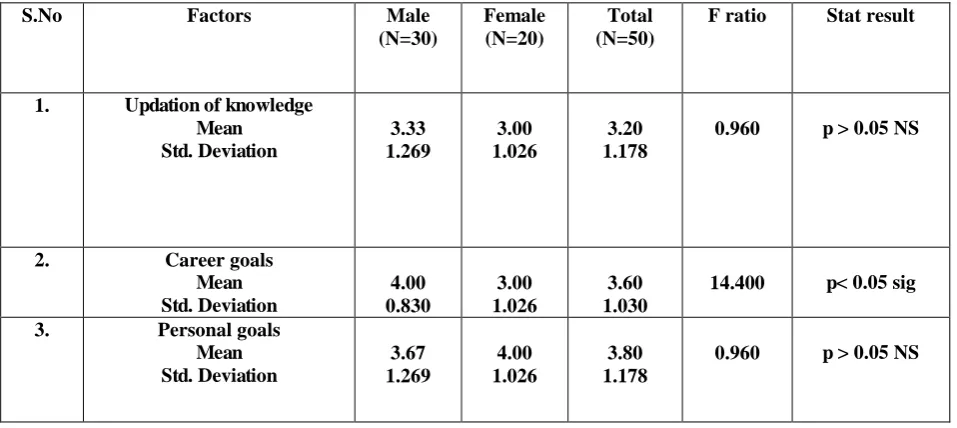
2. H0: Gender do not differ with regard to career goals. 3. H0: gender do not differ with regard to personal goals. ANOVA test is computed in order to test the null hypothesis H0. The result of ANOVA test is presented in Table III.
Table III. One way ANOVA results for various factors based on gender of respondents
Table III reveals that male respondents update knowledge at very high level when compared to Female respondents. However this observed difference is not statistically significant at 0.05 level. It is observed that male respondents achieve their career goals at very high rate when compared to Female respondents. However
this observed difference is statistically significant. With regard to Personal goals it is found that female respondents achieve more when compared to male respondents. However this observed difference is not statistically significant at 0.05 level.
S.No Factors Male
(N=30)
Female (N=20)
Total (N=50)
F ratio Stat result
1. Updation of knowledge Mean
Std. Deviation
3.33 1.269
3.00 1.026
3.20 1.178
0.960 p > 0.05 NS
2. Career goals
Mean Std. Deviation
4.00 0.830
3.00 1.026
3.60 1.030
14.400 p< 0.05 sig
3. Personal goals
Mean Std. Deviation
3.67 1.269
4.00 1.026
3.80 1.178
Transformation of Culture Through KM
Knowledge Management helps to develop an awareness of change needed, and methods planned to achieve the change. It defines problem, identify solutions and implement them. Then stabilizes the situation, build or rebuild relationships and goal of the organization achieved in KM. Thus transformation of culture can be easily imparted through KM.
Knowledge Management Month
October month is considered for celebration of international “Knowledge Management Month.” Knowledge Management Month is a month for KMPro members and all other KM'ers worldwide to participate in activities intended to increase awareness and focus upon Knowledge Management.
Recognizing that Peter Drucker had identified improving the effectiveness of knowledge workers as the “most important management challenge of the 21st century” knowledge management has become critical to organizations world-wide.
Dr. Nick Bontis, member of KMPro's Advisory Board had this to say about KM Month: “October is Knowledge Management Month. This means that for 31 days knowledge workers around the world will unite in their effort to harvest the full intellectual capital potential of their organizations”.
KM Benefits Tree
The following KM trees highlight some of the commonly found benefits. Four different classes of benefit have been used.
Knowledge Benefits – It includes benefits derived from sharing of ideas and information in formal and informal
discussions, seminars, conferences and the like. It helps in speedy progress of work.
Knowledge
Benefits
Better
Sharing
Quick Access
Aware about
others
Good
Thinking
Intermediate Benefits – These benefits improves interpersonal skills, Build cohesiveness in groups. It
improves communication between groups and individuals.
Personal Benefits- These benefits are derived through KM which facilitates the fulfillment of individual goals.
It helps a person to handle stress, frustration and conflicting situations.
Intermediate
Benefits
Problem
Solving
Innovation
Energetic
Confidence
Personal Benefits
Good Standard of living
Managing Stress
Self Esteem
Organizational Benefits – It relates to increasing productivity, achieving goals and better quality of work, achievement of the benchmark as fixed by organization, creates a good corporate image
Cultural Change Through Knowledge Management Cultural change is not an easiest task which will take time to implement changes. At the same time organization’s culture can be changed through KM. Culture is defined as “commonly held beliefs, attitudes and values”. The analytical power of mind differentiate one group form another. It also influences functions, norms, objectives of the working environment. Some of the methods of sharing knowledge to impart culture are group discussion, brain storming session, seminar or conference, participation role plays, employee development programmes, team work, skill games and the like.
Conclusion
KM is a strategic tool because it could be used as a key factor for decision-making and in formulating strategies. KM should be coupled with technology to promote culture. Computer Assisted Instruction provides for accountability, as tests are taken on the computer. So that Management can monitor the ability of the employees. Updating of knowledge can be imparted based on it. Knowledge Management diagnoses present problems and predict challenges that the organization will face in future. Inefficiency in performance may be due to lack of skill or knowledge which can be solved
through effective KMS. Technology is changing in a faster way; to sustain in it requires new skills. It is important that employees have to be trained to acquire new skills and adapt to organization culture. Thus KM helps in career path of employees. Behavioural objectives like attitudinal changes can be made possible through KM. Clear standards of KM and expected results are necessary to impart culture to employees. The more one share the knowledge the more it grows and helps to know the ethical values and issues in society. It helps to realize the significance of nurturing a conducive culture before beginning any activity. Powerful KMS has to be designed effectively and evaluated on regular basis. It is evident from this study that female respondents achieve more personal goals when compared to male respondents and also male respondents update knowledge at very high level when compared to Female respondents. Therefore Culture depends on Knowledge sharing and a supporting environment in society.
References
1. www.wikipedia.org/wiki/work-life_balance, January,2, 2007.
2. www.tesionline.com/ March, 2007 3. www.interscience.wiley.com / June 2007.
4. Freud, S. 1965. New Introductory lectures, New york Norton.pp.10-12
5. Carbonnel, J.L., Sex and roles and leadership, Journal of applied psychology, 69, pp.44-49. 6. Bass, B.M, Leadership beyond expectations, New
york, Free press, 1985, p.2.