All rights reserved by www.ijirst.org 11
Comparative Analysis of a High-Rise Structure
using Various International Codes
Karthik N Varuna Koti
P.G Student Assistant Professor
Department of Civil Engineering Department of Civil Engineering
Global Academy of Technology, Bengaluru - 560098 Global Academy of Technology, Bengaluru - 560098
Abstract
Most of the population of world is being concentrated in the metropolitan cities. Since the land areas of metropolitan cities are scarce with the high number of population, to counteract this problem, the structures which are being used as both commercial and residential purposes must grow vertically instead of growing horizontally. This vertical growth must be implemented to counteract the recurring growth of the population in most of the parts in the world. In this study, the vertical growth is referred to a high-rise building, and a comparative analysis of dynamic loads are carried out on these high-rise structures using various International Standard Codes (American, European and Indian), with the inclusive of recently developed IS 1893:2016.
Keywords: Population, Metropolitan Cities, Recurring, High-Rise Buildings, Dynamic Loads, IS 1893:2016
_______________________________________________________________________________________________________
I. INTRODUCTION
Our planet, Earth is the 3rd planet in the solar system, and this is the only planet that supports life. The area of Earth is 510.072 million sq. km out of which 29.1% is land i.e., 148.940 million sq. km and 70.9% is covered by water i.e., 361.132 million sq. km. In the given land mass of 148.940 million sq. km is the home for human population of about 7.5 billion people, according to the United Nations estimates, here the land mass remains constant and the population keeps on increasing. Due to this constant land mass and growing population there is a scarcity of land. Most of the population of world is being concentrated in the metropolitan cities. As the structure grows in height it must satisfy many conditions, like to carry the earthquake loads safely, counteract the wind loads and stability of the structure must also be maintained in other words the structure must be in Equilibrium during the forces acting on it.
II. LITERATURE REVIEW
III. OBJECTIVES
To study and understand various International standard codes, which are being used in this thesis. (American, European and Indian)
To assign the loading values and other parameters to the structure according to the codes of the respective Countries. To analyze the structure for Response Spectrum Analysis (RSA) or Dynamic Analysis.
To obtain the structural parameters of the structure and generate the graphs.
To compare the graphs and decide which International code parameters give good results regarding the strength, durability and stability of the structure.
IV. METHODOLOGY
Model Description:
A Reinforced concrete building of 25 floors has been considered for this project. The proposed structure is irregular in shape, which resembles the ‘+’ shape.
The structure has voids in the upper block and the adjacent block to its left to provide ventilation, plumbing accessories and electrical lines etc.,
Shear wall is provided for the lifts, there are two lifts, one for the main use and another is used are service lift, where it is used in case of failure or maintenance of the main lift.
Each floor consists of 8 units with 2 stair cases and lift services.
Marble and Granite finish is given for the structure for interiors, parapet walls are provided for balconies and terrace. Proposed area for the construction of the Edifice is 2320.34 m2, Carpet area is 1337.89 m2.
Structural Data of the Building:
Structural Elements Description
Column
450 x 1500 mm 450 x 1800 mm 450 x 2400 mm
Beam 300 x 750 mm
300 x 900 mm
Slab 150 mm
Shear wall 200 mm
Main wall 230 mm
Partition wall 115 mm
Parapet wall 115 mm
Height of parapet wall 1300 mm
Height of the structure 75400 mm
Floor-to-floor height 2900 mm
No. of stories 25 nos.
Material used Reinforced Cement Concrete
Concrete Frame SMRF
Reinforcement used HYSD Rebar
All rights reserved by www.ijirst.org 13
Model:
Fig. 1: Plan of the model Fig. 2: Column beam layout of the model
Fig. 3: Centre line plan of the structure Fig. 4: 3D line diagram of the structure
Results of Analysis:
Structural parameter = Storey shear
Case Combo, SPEC X Storey Shear
ASCE 7-05 4513.53
IS 1893:2016 6951.09
IS 1893:2002 10609.26
EN 8 14928.20
Storey Shear values for case combo SPEC X for various International Standard Codes
Fig. 6: Graphical representation of Storey shear results for SPEC X of various codes.
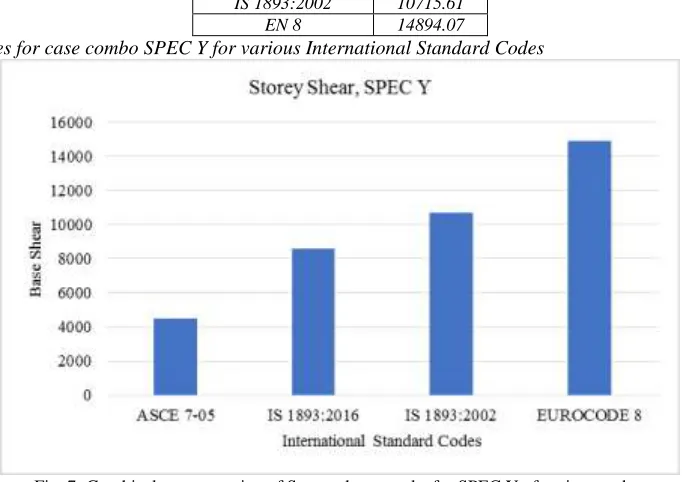
Case Combo, SPEC Y Storey Shear
ASCE 7-05 4512.85
IS 1893:2016 8583.03
IS 1893:2002 10715.61
EN 8 14894.07
Storey Shear values for case combo SPEC Y for various International Standard Codes
Fig. 7: Graphical representation of Storey shear results for SPEC Y of various codes.
Structural Parameter = Maximum storey displacement
Case Combo, SPEC X Maximum Storey Displacement (mm)
ASCE 7-05 10.33
IS 1893:2002 21.69
IS 1893:2016 14.21
All rights reserved by www.ijirst.org 15 Max. Storey Displacement values for case combo SPEC Y for various International Standard Codes.
Fig. 8: Graphical representation of Max. Storey Displacement results for SPEC X of various codes.
Case Combo, SPEC Y Maximum Storey Displacement (mm)
ASCE 7-05 11.05
IS 1893:2002 21.15
IS 1893:2016 11.05
EN 8 31.82
Max. Storey Displacement values for case combo SPEC Y for various International Standard Codes.
Fig. 9: Graphical representation of Max. Storey Displacement results for SPEC Y of various codes.
Structural Parameter = Maximum Storey Drift
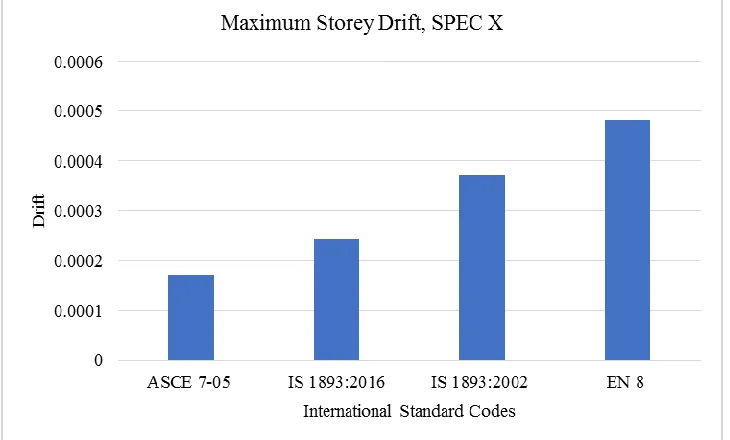
Case Combo, SPEC X Maximum Storey Drift
ASCE 7-05 0.000171
IS 1893:2016 0.000244
IS 1893:2002 0.000373
Max. Storey drift values for case combo SPEC X for various International Standard Codes
Fig. 10: Graphical representation of Max. Storey Drift results for SPEC X of various codes.
Case Combo, SPEC Y Maximum Storey Drift
ASCE 7-05 0.000183
IS 1893:2016 0.000296
IS 1893:2002 0.000369
EN 8 0.000531
Max. Storey Drift Values For Case Combo SPEC Y for Various International Standard Codes
Fig. 11: Graphical representation of Max. Storey Drift results for SPEC Y of various codes.
Structural Parameter = Storey Overturning Moment.
Case Combo, SPEC X Storey Overturning Moment (kN-m)
ASCE 7-05 202970
IS 1893:2016 326593
IS 1893:2002 494870
All rights reserved by www.ijirst.org 17 Overturning Moment values for case combo SPEC X for various International Standard Codes
Fig. 12: Graphical representation of Overturning Moment results for SPEC X of various codes.
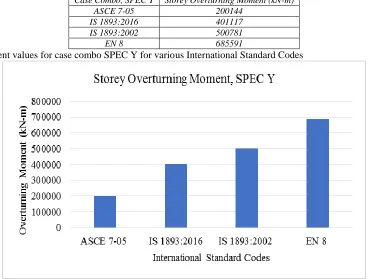
Case Combo, SPEC Y Storey Overturning Moment (kN-m)
ASCE 7-05 200144
IS 1893:2016 401117
IS 1893:2002 500781
EN 8 685591
Overturning Moment values for case combo SPEC Y for various International Standard Codes
Fig. 13: Graphical representation of Overturning Moment results for SPEC Y of various codes.
V. CONCLUSION
In this present study, the dynamic analysis for various structural parameters which governs the stability, durability and safety of the structure was carried on a high-rise structure for various International Standard Codes. Based on the results attained after the dynamic analysis of structure, following conclusions can be drawn.
The structure analysed for IS 1893:2016 has shown better values for all the structural parameters considered, when compared to its previous code IS 1893:2002. Hence IS 1893:2016, the 6th revision is better in terms of structural parameters and structural safety in contrast to IS 1893:2002.
Since EUROCODE surpasses all the other codes when compared in terms of values obtained for structural parameters, hence during the design, EUROCODE needs more reinforcement area when compared to other codes, due to the increased reinforcement area with contrast to other International Standard codes, the structure analysed for EUROCODE is comparatively ductile.
IS 1893:2002 and IS 1893:2016 has less base shear when compared with the EUROCODE, hence it is evident that, Structure analysed for IS 1893:2002 and IS1893:2016 is more rigid, while the structure analysed for EUROCODE is more ductile. However, what so ever the values obtained during the analysis of the structure for various structural parameters, it is obvious
that the variations of values are due to the independent constants, loading and load combinations of their respective International Standard codes.
Finally, it can be summarized that the variations in values is due to the independent constants, loading and load combinations of their respective International Standard codes, and during the design process of these structures it can be designed in such a way that it serves it service period without any complications and made safe and durable.
REFERENCES
[1] B Aba Raju, F Atique, Z Wadud, “A Comparision of BNBC-93 With Other Building Codes With Respect to Earthquake and Wind Analysis.”
[2] Maria A Parisi, “The Eurocode for Earthquake-Resistant Design”, Practice Period Structure Design Construction May-2008.
[3] Vijay Namdev Khose, Yogendra Singh, Dominik Lang, “Comparative Seismic Performance of RC Frame Building Designed For ASCE 7 and IS 1893”,
ISET October-2012.
[4] P P Tapkire, Saeed J Birajdar, “Comparative Study of High Rise Buildings using Indian Standards and EURO Standards Seismic forces”, IJSR Volume:04
Issue:07 July 2015.
[5] Deepak Suthar, H S Chore, P A Dode, “High Rise Structure Subjected to Seismic Forces and Its Behavior” 12th IRF International Conference June-2014
[6] Shruthi Badami, M R Suresh, “A Study on Behavior of Structural System for Tall Buildings Subjected To Lateral Loads”, IJERT Volume:03 Issue:07
July-2014.
[7] Vinit Dhanvijay, Prof. Deepa Telang, Vikrant Nair, “Comparative Study of Different Codes in Seismic Assessment”, IRJET, Volume: 02 Issue: 04
July-2015.
[8] S Karthiga, Hanna Elza Titus, Reetwiz Raj Hazarika, Mohamed Harrish. “Design and Comparison of a Residential Building (G+10) for Seismic Forces Using
The Codes: IS 1893, EUROCODE 8, ASCE 7 and British Code”, IJRET Volume:04 Issue:06 June-2015.
[9] Pamela Jennifer J P, Jegidha K J, “Review on Seismic Design on Multistoreyed RC Building Using Various Codes”, IJISET Volume:02 Issue:10
October-2015
[10] Surabhi A Bambal, M A Banarase, “Review on Comparative Study on Analysis and Design of Multistoried Structure Using Different Codes”, IJREST
Volume:01 December-2015.
[11] Mr. Mehul J Bhavsar, Mr. Shrenik K Shah, Miss Khyati K Choksi, “Comparative Study of Typical RC Building using Indian Standards and Euro Standards
under Seismic Forces”, GRD Journals March-2016.
[12] Asmita Ravindra Wagh, Prof. P J Salunke, Prof. T N Narkhede, “Review on Seismic Design and Assessment of High-Rise Structures Using Various
International Codes”, IJSRD Volume:04 Issue:03 November 2016.
[13] S H C Santos, L Zanzica, C Bucur, M Traykova, C Giarlelis, S S Lima, A Arai, “Comparative Study of Some Seismic Codes for Design of Buildings”,
16WCEE January-2017.
[14] Dr. S.V.Itti, Prof. Abhishek Pathade and Ramesh B Karadi, “A Comparative Study on Seismic Provisions Made in India and International Building Codes
for RC Buildings”.
[15] Yogendra Singh, Vijay Namdev Khose, Dominik H Lang, “A Comparative Study of Code Provisions for Ductile RC Frame Buildings” 15WCEE
[16] K LovaRaju, Dr. K V G D Balaji, “Effective Location of Shear Wall on Performance of Building Frame Subjected to Earthquake Load”, IARJSET Volume:02
Issue:01 January-2015.
[17] IS 456 (2000): Plain and Reinforced Concrete - Code of Practice.
[18] IS 875-2 (1987): Code of Practice for Design Loads (Other Than Earthquake) For Buildings and Structures, Part 2: Imposed Loads.
[19] IS 875-3 (1987): Code of Practice for Design Loads (Other than Earthquake) for Buildings and Structures, Part 3: Wind Loads.
[20] IS 875-5 (1987): Code of Practice For Design Loads (Other Than Earthquake) For Buildings And Structures, Part 5: Special Loads And Combinations.
[21] IS 1893-1 (2002): Criteria for Earthquake Resistant Design of Structures, Part 1: General Provisions and Buildings.
[22] IS 1893 (Part-1):2016, Criteria for Earthquake Resistant Design of Structures. (Sixth Revision)
[23] ACI 318M-08: Building Code Requirements for Structural Concrete (ACI 318M-08) and Commentary.
[24] ASCE 7-05: Minimum Design Loads for Buildings and Other Structures.
[25] EN 1992-1-1 (2004) (English): Eurocode 2: Design of concrete structures - Part 1-1: General rules and rules for buildings.
[26] EN 1991-1-4 (2005) (English): Eurocode 1: Actions on structures - Part 1-4: General actions - Wind actions.
[27] EN 1990 (2002) (English): Eurocode - Basis of structural design [Authority: The European Union Per Regulation.
[28] BS NA EN 1991-1-4 (2010) (English): UK National Annex to Eurocode 1. Actions on structures. General actions. Wind actions.
[29] EN 1998-1 (2004) (English): Eurocode 8: Design of structures for earthquake resistance – Part 1: General rules, seismic actions and rules for buildings.