ISSN 2373-7662 (Print) 2373-7670 (Online) Copyright © The Author(s). All Rights Reserved. Published by American Research Institute for Policy Development DOI: 10.15640/ijn.v6n1a11 URL: https://doi.org/DOI: 10.15640/ijn.v6n1a11
The Relationship between the Usability of fall Prevention Tools and Characteristics of Nurses
Akiko Hiyama
1Abstract
Objective: This study aimed to clarify in which situations fall risk assessment tools are used, the relationship between the usefulness of a tool and its characteristics, and the reasons for judgments of usefulness. Methods: Participants were ward nurses and were asked to return their answered questionnaires. Data were collected from anonymous questionnaires and included into background characteristics, situations in which a tool was used and the usability of the fall risk assessment tool and the fall preventive plan tool. Results: A total of 705 nurses completed the survey. Of the respondents, 91.2% used a fall risk assessment tool, of which 93.5% concerned a scoring system. The use of the tool at the plan was 56.5%. Regarding the usefulness of the tool, advantages concerned satisfactory assessment, assistance for planning, and evaluation viewpoint, but there were also many disadvantages concerning poor accuracy and evidence of clinical effect. Conclusion: It was a type that most of the assessment tool which most of respondents used an assessment tool and used were types of the scoring. The group with 16 years or more of nursing experience did not find the tool useful. The advantages and disadvantages of the fall prevention tool have become clear.
Keywords: fall prevention, fall assessment tool, fall risk assessment, medical safety
1. Introduction
Accidental falls occur frequently in hospitals in Japan. The Japan Council Quality Health Care (JCQHC) is collecting information on all accidents and incidents in public hospitals and registered hospitals. Falls account for 19.3% of all medical accidents in hospitals (JCQHC, 2016) and is a frequently occurring accident. Falling causes not only physical injuries but can also cause social problems, such as medical costs associated with the “post-fall syndrome” (i.e., a fear of falling) and the fall itself (Vellas et.al., 1997; Pua et.al., 2017).
To prevent falls in hospitals; of staff education and education for patients, the high-risk patients is extrinsic, and prevent the promotion of the communication between staffs, but the frequency and the degree of serious accident is insufficient. Complications of a fall depend on a variety of factors. Falls can occur because of multiple factors: both internal factors, such as the physical state or mental status of the patient, as well as external factors, such as furniture or lightning. Because falls can also occur in the daily life of patients, they cannot be prevented only by medical staff being more cautious. Therefore, nurses need to check for the existence of these internal and external factors, and they need to change their assessment to the influence of falling factors in living behavior. Various fall risk assessment tools have been developed. Research on risk factors and fall risk prediction has been conducted since around 1980. The Morse Fall Scale (MFS, Morse et al., 1989), the St. Thomas’s Risk Assessment Tool in Falling Elderly Patients (STRATIFY, Oliver et al., 1997), and the Hendrich II Fall Risk Model (HFRM, Hendrich, 1995) are famous fall risk assessment tools, and several researchers have tested their predictive accuracy. According to a meta-analysis published in 2013 on the fall predictive accuracy of these tools, the sensitivity (0.80) of the STRATIFY was the highest in hospitals for acute settings, and the specificity (0.68) of the MFS was the highest (Aranda et al., 2013). Additionally, according to a study that compared the convenience of fall risk assessment tools, the completion time of the STRATIFY was the shortest, with a mean entry time of 3.85 minutes (Vassallo et al., 2005).
In Japan, various fall risk assessment tools have been developed since 1999 when the use of a Fall Assessment Sheet was first recommended by the Japan Nursing Association (JNA, 2003). However, in Japan, most of the hospitals use their own tool based on the one which the JNA recommends, and the predictive precision of these tools has not often been tested. In clinical practice, it is important that tools are practical, and it is necessary that there is usefulness in the nursing process for prevention. Therefore, this study considers the requirements that a tool needs by determining the problems for which tools are used and the results of these tools. There are three objectives of the survey: 1. To clarify in which situations fall risk assessment tools are used, 2. To clarify the relationship between the usefulness of a tool and its characteristics, 3. To clarify the reasons for judgments of usefulness.
2. Methods 2.1 Study design
The study design was descriptive and utilized survey methodology.
2.2 Participants
Using data from the medical institution information system in Japan, 160 hospitals were selected through random sampling. Of these hospitals, 49 agreed to participate in this study. The participants were ward nurses who had observed accidental falls of patients and who had at least 5 years of nursing experience.
2.3 Data collection
Data were collected using self-administered, anonymous questionnaires in Japanese. Written information about this study was sent to the nurse managers of the selected hospitals, and the nurse managers distributed the questionnaires and return mail envelopes to the nurses. Participants were asked to return their completed questionnaires within approximately 2 weeks of receiving it. The survey period lasted from February 2014 to May 2014.
2.4 Instrument
The questionnaire was divided into two sections: background characteristics, situations in which a tool was used and the usability of the fall risk assessment tool and the fall preventive plan tool. Several variables were regarded as background characteristics, including years of nursing experience, job title, previous basic nursing education, types of medical institutions where the nurses currently worked, and the number of beds per institution. The following aspects were considered in examining the use of fall prevention tools: the use or nonuse of an assessment tool, the type of assessment tool that was used, the use or nonuse of a fall prevention plan, and the type of fall prevention plan that was used. The variable indicating the usability of the tool for fall prevention concerned four viewpoints (assessment, plan, implementation, and evaluation) along the nursing process. Participants answered questions on the usability of the fall prevention tool on a 5-point scale (1=none, 2=low, 3=moderate, and 4=high, 5=very high). In addition, participants were asked for their opinion about the usability of the tool using a free response format.
A pilot form of the questionnaire was administered to 30 nurses who met the inclusion criteria. The purpose of this pilot study was to evaluate the construct validity and scale setting. The findings from the pilot study did not show any potential problems with the questionnaire. To avoid response bias, the participants in the pilot study were not included in the main survey.
2.5 Ethical considerations
This study was reviewed and approved by the Ethics Committee of Sapporo City University Graduate School of Hokkaido, Japan (No.58/2014). All potential participants received a general letter of introduction including acceptance or refusal instructions; consent was assumed if the survey document was completed and returned to the researcher. All answers were anonymous.
2.6 Data analysis
Statistical analysis was performed to clarify the usability of the fall prevention tool. Data were analyzed using IBM SPSS version 24 statistical software for windows (IBM Corporation, Armonk, New York, USA). Descriptive statistics included frequencies, means, and standard deviations.
For all comparisons, a two-sided statistical significance level of 0.05 was used. Concerning the open ended-question, answers were coded based on the similarity of the meaning contents of the answers.
3. Results
A total of 705 nurses completed the survey (response rate: 62.9%), with 682 valid responses (ratio of valid responses: 96.7%). Questionnaires with more than 15% of missing items were considered invalid. In this study, missing data ranged from 0.7% to 4.0% across items. The study respondents had a mean nursing experience of 17.4 years (Standard deviation: SD=8.5). Most of the respondents were staff (74.2%) and most respondents had completed nursing education up to the third year of nursing school (53.8%) (Table 1).
Table1.Characteristics of the participants
Table2.Fall prevention tool utilization and type
Mean Standard
Deviation
Nursing experience (year) 17.4 8.5
Number Percent
Job title
Staff 506 74.2
Sub-manager 122 17.9
Maneger 46 6.7
Other 3 0.4
Missing data 5 0.7
Education
College 21 3.1
Junior college( third year) 41 6
Junior college( second year) 18 2.6
Nursing school( third year) 367 53.8
Nursing school( second year) 207 30.4
Upper secondary school, advanced course 17 2.5
Missing data 11 1.6
Certification
None 654 95.9
Certified Nurse Specialist 2 0.3
Certified Nurse 18 2.7
Missing data 8 1.2
Types of medical institutions
Special functioning hospitals 71 10.4
Regional medical care support hospitals 208 30.5
General hospitals 381 55.9
Missing data 22 3.2
The number of beds per institutions
<99 80 11.7
100-299 386 56.6
300-499 121 17.7
>500 68 10.0
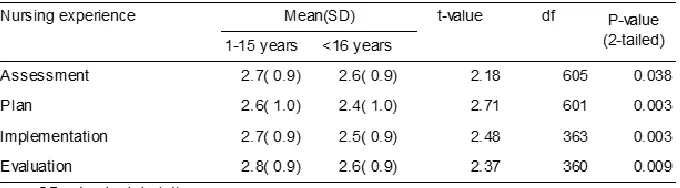
It was a type that most of the assessment tool which most of respondents used an assessment tool (91.2%) and used were types of the scoring. The use of the tool at the plan was 369 (56.5%) of the half degree. A type to plan according to a fall risk level was most common and drew up a plan along 61.1% followed by a fall risk factor was 26.9% (Table 2). The mean rating was 2.7 (SD=0.9) for the assessment, 2.6 (SD=1.0) for the prevention, 2.6 (SD=0.9) for the implementation, and 2.7 (SD=0.9) for the evaluation. The result of comparing the answers of nurses with less than 15 years of nursing experience with the answers of nurses with 16 years or more of nursing experience showed that the group with 16 years or more of nursing experience did not find the tool useful during all processes (Table 3).
Table3. Comparisons of utility of fall-prevention tool by t-test
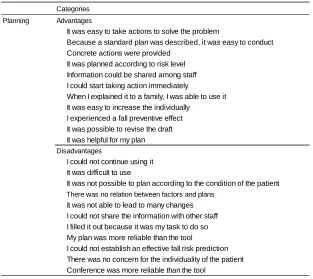
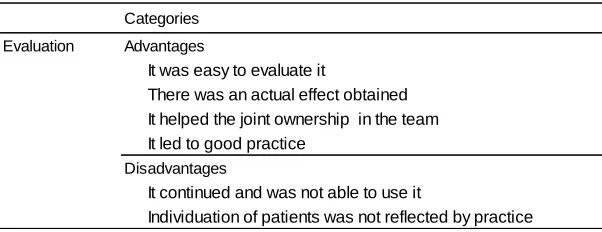
The respondent was asked to describe their reasons for judging the tool to be useful or not during the nursing process in the open-ended question. 349 cords were extracted from the answers describing the usefulness for assessment, which formed 18 categories (Table 4). A total of 269 cords were extracted from the answers describing the usefulness for planning, which were organized into 22 categories (Table 5). In total, 144 cords were extracted from the answers describing the usefulness for implementation, which were organized into 21 categories (Table 6). A total of 111 cords were extracted from the answers describing the usefulness for evaluation, which we reorganized into 7 categories (Table 7).
Table 4. Categories of the usefulness for assessment
Categories Advantages
The assessment was enriched Assessment became easy
It became possible to understand the state of the patient concerning risk factors for falling I understand that I have to be careful
It could be used in guiding beginning nurses It became possible to objectively evaluate fall risk It led to evaluation at regular intervals
It led to a prevention plan
It was easy to inform others about the state of the patients
Disadvantages
Assessment did not accord with the state of the patients
After completing it once, I was not using the tool anymore I did not use it consciously
I filled it out because it was my task to do so
It was difficult to respond to a changing state of a patient I did not see many high-risk people who I should pay attention to I could not establish an effective fall risk prediction
Table 5. Categories of the usefulness for planning
Table 6. Categories of the usefulness for implementation
Categories
Planning Advantages
It was easy to take actions to solve the problem
Because a standard plan was described, it was easy to conduct
Concrete actions were provided It was planned according to risk level Information could be shared among staff
I could start taking action immediately
When I explained it to a family, I was able to use it It was easy to increase the individually
I experienced a fall preventive effect
It was possible to revise the draft It was helpful for my plan
Disadvantages
I could not continue using it It was difficult to use
It was not possible to plan according to the condition of the patient
There was no relation between factors and plans
It was not able to lead to many changes I could not share the information with other staff I filled it out because it was my task to do so
My plan was more reliable than the tool
I could not establish an effective fall risk prediction There was no concern for the individuality of the patient Conference was more reliable than the tool
Categories
Implementation Advantages
Care was continuous
Prevention could start soon after a patient was hospitalized
It could be used systematically.
The concrete practice method was shared in the patient and family I could share the information with family
A practice method was chosen easil
There was support available to understand the concrete method
The revision could be carried out in consideration for the individual situation
It led to a prevention plan
It led to developing skills on thinking about precaution
It could be linked to assessment and evaluation.
It was easy to use
Disadvantages
Individualization of patients was not reflected in practice Because I used it as a routine, it did not lead to utilization There was no concern for the individuality of the patient The judgment of the nurse was more effective than a tool
Connections with the fall risk were not enough The staff lacked interest
A result was not seen
Table 7. Categories of the usefulness for evaluation
4. Discussion
4.1 Situations in which the tools were used
Nurses care for an inpatient’s life while ensuring their safety. It is necessary to understand the state of the patient so that the nurse can sufficiently meet their needs. Because a fall might happen, it is necessary that medical staff predict the likelihood that a patient might fall and possible causes of this. Therefore, nurses use several tools aiming to accurately assess fall risk and interventions targeted to individual patients. Results of examining the use of tools show that many respondents used assessment tools that are based on scoring. The findings showed that assessment tools calculating are commonly used. Fall risk screening tools are used for planning preventive measures, but nurses evaluated their usefulness as moderate, which means nurses do not experience a benefit of using these tools. Morse, who developed the Morse Fall Scale, mentioned that the fall risk assessment tool is a tool for screening and lacks adequate prediction by confusion with tools for planning preventive measures (Morse, 2006). The personal attribute and condition are factors affecting the fall risk, but are not connected in practicing the measures that were correct to patients individual directly because they are not causes of the fall. In other words, the use of a fall risk assessment tool focusing on age, sex, specific disease, specific medical condition helps to understand the risk of falls, but cannot grasp the situation of falls. The result show that the fall preventive plan tool was used by 56.5% of respondents, which means that it is not widely used. Many of the fall preventive plan tools are based on the risk level calculated by the assessment tool. The results showed that the assessment tool and fall preventive plan tool are used jointly. However, from the average usefulness rating it became clear that these tools are not very useful at the time of implementation and evaluation. It was found that both assessment tools and planning tools were the use that a utility was not felt for a nurse in problem solving that much.
4.2 The relationship between tool usefulness and characteristics
According to the results of this study, only the difference in nurses’ years of experience was associated with usefulness of the tools. It is possible that this association is due to the development of nursing skills over the years, leading to decreased usefulness of the tool. In addition, it is thought that individual clinical skills exceed the value of the tool, and there are problems associated with its use, its prediction accuracy, and its application in practice. The group with 16 years or more of nursing experience did not find the tool useful for any of the processes. This result suggests that the currently used tools are useful for beginning and mid-level nurses, but not for skilled nurses. This suggestion is based on the expert nurses’ view that their personal assessment has higher validity, and it is thought to be associated with the low accuracy of the fall risk prediction tool. Meanwhile, the group with 15 years or less of nursing experience deemed the tool to be useful. These nurses, whose assessment ability is undeveloped, considered the tool to be a guide when predicting fall risk and planning preventive measures. Evidence of accuracy, a necessary element of clinical diagnostic tools, is not considered to be useful unless it is at least as accurate as medical staff predictions (Wyatt JC, Altman DG, 1995). The development of a tool with high accuracy is necessary to increase the use of the tool.
4.3 To clarify the reasons for judging the usefulness.
A consequence of using a tool includes the ability to support nursing intervention. Furthermore, in a tool, there was "an effect to fall prevention" "a risk prediction" an effect and problem "assistance to assessment.” Thus, similar to prior research, it appears that tools for assessment were confused with tools for risk screening. The efficacy of assessment tools is frequently questioned. Risk factors for falling include internal factors such as a decline in functional ability, cognitive impairment, previous experiences of falling, visual impairment, unsteady gait, and external factors such as the design of rooms and bathrooms, and the brightness of lighting (Payson &Haviley,2007, p.5).
Categories
Evaluation Advantages
It was easy to evaluate it
There was an actual effect obtained It helped the joint ownership in the team It led to good practice
Disadvantages
It continued and was not able to use it
The understanding of risk factors is necessary for fall prevention. Several researchers have examined the prediction accuracy of the MFS (Morse et al.,1989), the STRATIFY (Oliver et al.,1997), and the HFRM (Hendrich,1995). The MFS (Morse et al.,1989) is a tool comprised of history of falling, secondary diagnosis, ambulatory aid, IV/heparin lock, gait/transferring, and mental status. The STRATIFY (Oliver et al., 1997) is a tool comprised of previous falls, agitation, visual impairment, frequent toileting, and a mobility score (the Barthel Index). The HFRM (Hendrich,1995) is a tool comprised of confusion/disorientation/impulsivity, symptomatic depression, altered elimination, dizziness vertigo, gender, administered anti-epileptics, administered benzodiazepines, and a “Timed-up and go” test. These tools primarily focus on the internal factors of patients and do not mention the relationship with external factors.
Additionally, there are various tools available in Japan and their predictive accuracy is not guaranteed. The development of these tools is not considered statistically, and it is based on retrospective study design. Since a prediction tends to become highly (Haines et al., 2007), the study of the retrograded design may become hard to feel a clinical utility. As for the examination of the items to adopt in an assessment tool, the investigation with the prospective design is required. In clinical practice, each facility or ward often uses their own fall risk assessment tool while not statistically examining their prediction accuracy. Additionally, as for the fall risk assessment tool used in Japan, construct is vague, and it is pointed out that there is a problem of the construct validity (Hiyama, 2016). In order for tools to be useful in fall prevention, they need to have sufficient accuracy and generalizability. Another reason for the staff for not finding the tools useful was the difficulty of use. It was inferred that this was associated with a lack of clinical reliability. The results of this study are in line with previous studies, such as the various ways to score points by nurses (Yamamoto et al., 2006) and practice according to the expansion of ADL cannot be done (Katou et al., 2004). Hospitalizations of short duration, only during the acute phase of treatment, are becoming increasingly common. Therefore, nurses observe the situations of various patients only during a short-term period, and because is necessary to conduct accurate assessments, short assessments tools are preferable. Developing a tool for nurses of which the “fall prediction precision is high, and which is effective in fall prevention,” and examining the usability of this tool will be necessary in the future.
5. Conclusion
Of the respondents, 91.2% used a fall risk assessment tool, of which 93.5% concerned a scoring system. In addition, 56.5% made use of a planning tool, of which 61.1% focused on planning according to risk level, and 26.9% concerned planning according to risk factor. The usability of the tool was 2.7 (SD=0.9) at the time of assessment, 2.6 (SD=1.0) during planning, 2.6 (SD=0.9) during the time of implementation, and 2.7 (SD=0.9) during evaluation. Regarding the usefulness of the tool, positive opinions concerned satisfactory assessment, risk prediction, assistance for planning, and evaluation viewpoint, but there were also many negative opinions concerning poor accuracy and evidence of clinical effect.
References
Aranda-Gallardo M., Asencio JM., Canca-Sanchez JC., Barrero-Sojo, M., Perez-Jimenez, C., & Morales-Fernandez, M., Luna-Rodriguez, M., Moya-Suarez, A., & Mora-Banderas, A. (2013). Instruments for assessing the risk of falls in acute hospitalized patients: a systematic review and meta-analysis, BMC Health Services Research, 13, 122-122.
Haines, TP., Hill, K., Walsh, W., & Osborne, R. (2007). Design-related bias in hospital fall risk screening tool predictive accuracy evaluations: systematic review and meta-analysis. Journals of Gerontology: MEDICAL SCIENCES, 62(6),664-672.
Hendrich, A. (1995). Hospital falls: development of a predictive model for clinical practice. Applied Nursing Research, (8), 129-139.
Hiyama, A., & Nakamura, K. (2016). Prediction accuracy of inpatient fall risk assessment tools - A review of the literature using databases in Japan-. Journal of the Japan Society for Healthcare Administration, 53(1), 31-39. Japan Council for Quality Health Care. The Project to Collect Medical Near-Miss/Adverse Event Information 2016
annual report. [Online] Available: http://www.med-safe.jp/pdf/year_report_2016.pdf (July 19, 2018)
Japanese Nursing Association (2003). Japan Nursing white paper 2003. Tokyo: Japanese Nursing Association Publishing Company.
Morse, JM. (2006). The Safety of Safety Research: The case of Patient Fall Research. Canadian Journal of Nursing Research, 38(2), 74-88.
Oliver, D., Britton, M., Seed, P., Martin, FC., & Hopper, AH. (1997). Development and evaluation of evidence based risk assessment tool (STRATIFY) to predict which elderly inpatients will fall case-control and cohort studies. British medical journal,315,1049-1053.
Payson, CA., &Haviley, CA. (2007). Patient falls assessment and prevention Global Edition: Opus Communications, 5, Massachusetts: HCPro Inc.
Pua, Y. H., Ong, P. H., Clark, R. A., Matcher, D. B., &Lim, E.C. (2017). Falls efficacy, postural balance, and risk for falls in older adults with falls-related emergency department visits: prospective cohort study. BMC geriatrics. 17;291. doi: 10.1186/s12877-017-0682-2
Vassallo, M., Stockdalem, R., Sharma, JC., Briggs, R., & Allen, S. (2005). A comparative study of the use of four fall risk assessment tools on acute medical wards. Journal of the American Geriatrics Society, 53(6), 1034-1038. Vellas BJ, Wayne SJ, Romer LJ, Baumgartner RN, & Garry PJ. (1997).Fear of falling and restriction of mobility in
elderly fallers. Age and ageing,26(3), 189-193.
Wyatt, JC., & Altman, DG. (1995). Prognostic models: clinically useful or quickly forgotten?. British medical journal,311, 539–541.