ISSN: 2306-9007 Mulolli, Islami & Skenderi (2015) 1171
I
www.irmbrjournal.com December 2015I
nternationalR
eview ofM
anagement andB
usinessR
esearchVol. 4 Issue.4
R
M
B
R
Human Resource Management Practices and SMEs
Performance: Study Based In Kosovo
ENIS MULOLLI
Department Management and Informatics, University of Prishtina, Faculty of Economics, Kosovo.
XHAVIT ISLAMI
Department Management and Informatics, University of Prishtina, Faculty of Economics, Kosovo.
Email: [email protected]
Tel: +37745669399
NAGIP SKENDERI
Ass. Prof. University of Prishtina, Faculty of Economics, Kosovo.
Abstract
Human resources are considered the most precious asset of SME. In order to reach its values the firm must pay a huge importance in human resource management. The implementation of enterprise strategy is dependent from the employee’s quality who are arranged to realize it. The aim of this research paper is to show the application of human resource practice and their impact in SME performance. The methodology used in the study is a combination of quantitative and qualitative data. Results of the research are processed data of 53 SMEs that implement their activity in different parts of Kosovo. These data were processed with the help of SPSS v 21 program. The data revealed that studied SMEs use their practice more to manage the human resources in realizing their aspiration such as “compensation and rewarding”. Also, implementation of this practice has increased the enterprise performance more than the usage of other practices such as: “selection and recruiting” or “training and development”, but even these last ones influenced positively in the SME success. Good management of human resource helps three fundamental intention of each enterprise: surviving, increasing and rising their incomes. On the other hand, it offers to them an easy confrontation with the market competitiors which is very cruel.
Key Words: Human Resource Practices, SME, Recruiting, Training, Compensation of Human Resources, Performance.
Introduction
ISSN: 2306-9007 Mulolli, Islami & Skenderi (2015) 1172
I
www.irmbrjournal.com December 2015I
nternationalR
eview ofM
anagement andB
usinessR
esearchVol. 4 Issue.4
R
M
B
R
practice (Zheng et al, 2006; Katou, 2012). Practices of human resource consist of formal access used in human management (Armstrong, 2008). Generally speaking, SME follow informal practices of management (Behrends, 2007), they persuade these informal practices of management in order to control the employees, where the formal structures of communication and control do not exist (Willkinson, 1999). The owners and managers of SMEs percept formal human resource management as a road leading to bureaucracy (Katz et al., 2000). According to Marlow (2002), SME ignore the application of formal HRM practice, for the reason that they do not have necessary resources. Informal practices of management, with increase they build formal regulation and policies for SME employees‟ control (Nguyen and Bryant, 2004; Marlow, 2002). The movement toward a more structured of formal persuade HRM can be seen when an enterprise starts to form a hierarchical structure with an access to split the work and administrative increasing process (Kotey and Slade, 2005). Informal practices of management resources are more developed in small and medium enterprises than big enterprises. According to Wright and McMahan, 1992 it is revealed that management of human resources of SME to be less structured and planned in comparison with big firms that apply more formal practices of human resources. The study made from Kotey and Slade (2005) has showed that small firms that raised the formal adaption of practices of HRM in comparison with previous periods. SME applying the formal management of human resources have a better performance than SME which do not apply the formal management of human (Gibbons and O‟Connor 2005). The study of human practices are studied also from Bacon and Hoque (2005), according to them the wide range of practices which are used in SME are depended from the scale of employees‟ qualification, SME with low employees‟ qualification have less opportunity to approve some practices of HRM, whereas SME that have a high percentage of employees‟ qualification have more opportunity to invest in such practices in order to keep and develop their talents. SME in general do not have specific department to manage human resources and decisions are made usually from the director, owner or firm management (Marlow and Patton, 2002; Fabi et al, 2009). Even in some cases where the specialists of HRM are employed again the top of HRM is the owner or director which takes decisions for HR (Kroon et al., 2013).
Literature review
Armstrong (2008) showed that the assumption of human resources is that people are key source of organization and the performance of organizations depends especially from people. And that the wide range of appropriate policies and human resources process is developed and applied effectively, HR will substantially influenced in the firm performance. Using human resources practices effectively, the firm can survive from traditional practices not effective nor efficient which disturbs the firm to achieve the objective (Delery and Doty, 1996).The practices of HRM with the focus on employees in firm strategy implementation, influences positively the performance of firm, in the same form as the small enterprises and in the big enterprises (Arthur, 1994; Hayton, 2003).
From various empirical studies that have been made has been showed that the application of SME traditional practices of human resource management are useful for all the sizes of enterprises. Selection and formal recruiting (Terpstra & Rozell, 1993), offering trainings for employees (Litz & Stewart, 2000), and using a system of formal evaluation of performance (Gerhart & Milkovich, 1992), are evidenced that have a positive influence in the enterprise performance.
ISSN: 2306-9007 Mulolli, Islami & Skenderi (2015) 1173
I
www.irmbrjournal.com December 2015I
nternationalR
eview ofM
anagement andB
usinessR
esearchVol. 4 Issue.4
R
M
B
R
The usage of these practices of HRM in SME has improved their performance (Chandler & McEvoy, 2000). Also, the same opinion is shared from these authors (Huselid, 1995; Osman et al, 2011) which came to conclusion that HRM practices or the relationship in between the staff, training, development and compensation are related directly with the firm performance. The other authors such as Tocher and Rutherford (2009) showed that the formal practices of HRM are positively related with firm performance.
Recruiting and Selecting
According to Cassell et al. (2002), recruiting and selecting are the practices of human resources which are used more than any other practice in SME. Recruiting and selecting refer the selection of staff, Wright et al. (2005), points out that the staff selection includes structured interviews and official tests of the candidates through the process of employment. Tocher and Rutherford (2009), claimed that the SME in general have a traditional access with the process of recruiting. The traditional method of recruiting includes: describing the places of work, deciding the duties, duties and responsibilities for the employees. Generally, the traditional method starts with recruiting process, through continuing with the selection of employees, their training and in the end employees „performance evaluation (Tocher and Rutherford, 2009). In comparison with the SME big organizations have more problems in recruiting of clever staff, because they use more attractive channel of employees, such as commercials in newspaper and walking, in comparison with big recruiting agencies (Bacon and Hoque, 2005). Barret and Mayson (2007) have stated that the mostly used method of recruitment in SME is the word of mouth, which is an option with low cost of withdrawal of candidates.
Training and Development
Hill and Stewart (1999), claimed that a lot of SME do not have disposition for training but even if there is, there is only reactive and informal with short term leading exclusively in problem solution that are related with the place of work and not with the human development. As well as some authors like Kotey and Folker (2007) pointed out that training of employees in SME is informal, not planned, with minimum dispositions and oriented in a short-term period. On the other hand, formal offer of trainings for employees is a problem for small firms as it costs (Mayson and Barrett, 2006).
According to Johnston et.al, (2003), the potential of SME is effectively achieved only if abilities and competencies of employees are developed appropriately. Whereas, Chandler and McEvory (2000), stated that regular trainings of employees has appositive effect on the individual productivity of an employee. The improvement of individual productivity will result in improvement of performance and organization rise (Wright, et al., 2005).
Compensation and Rewarding
Compensation and rewarding is any kind of payment, monetary reward or not monetary. Development of an employment plan is so important for small firms as well as for big firms (Dessler, 2003). Compensation as a practice of management of human resources are an important part to contribute in the success of a firm (Collins and Smith, 2006).
ISSN: 2306-9007 Mulolli, Islami & Skenderi (2015) 1174
I
www.irmbrjournal.com December 2015I
nternationalR
eview ofM
anagement andB
usinessR
esearchVol. 4 Issue.4
R
M
B
R
realize with success the duties with the purpose to raise their personal performance which is rewarded financially or non-financially such as promotion.
Compensation of SME causes a lot of costs, for this reason its application is rare (Wright et al., 2005). But, despite that a formal evaluation of performance that results in compensation might have increased the performance of a firm (Sun, Aryee and Law, 2007).
Firm Performance
According to Armstrong (2009), the concept of performance includes two things the one that has to be reached and the one reached. He further claimed that the performance of firm can be evaluated in different manners, but mostly used methods in a lot of studies are key indicators of a performance (KPI )that includes financial indicators and the second manners have to be with the evaluation “who” which is supported with the qualitative data in abilities of evaluation or effective organization.
This opinion is shared from the authors Wright et al (2005) that pointed out that there are two methods to evaluate the performance of a firm. The first method is the organizative result, whereas the other function of measures like productivity and quality are used to evaluate the employee‟s performance and the second method is financial or countable result, which is an evaluation of a real financial performance.
Measurement from financial results are costs, incomes and profitability (Wright et al., 2005). In firm evaluation performance in SME, the method of financial indicator is selected in a lot of studies (Simpson, Padmore and Newman, 2012). This evaluation method is acceptable even for us and we will apply the same method to evaluate SME performances.
Methodology
In order to realize this study a methodology consisting from a combination of primary and secondary data has been used. A considerable amount of secondary data are gathered from existing literature about the usage and the impact of human resource practices in SME performance. For empirical analysis of the study, a questionnaire has been used. The results include the analysis of 53 questionnaires gathered from the SME that work in different regions of Kosovo. The data collected from questionnaire are tested with descriptive regresion and correlation analysis.The data were prossessed with SPSS version 21. The rate used in the questionnaire is based on 5-point Likert scale (with 1=strongly disagree, 2=slightly disagree, 3=neutral, 4=agree, 5= strongly agree)
Descriptive data
In order to do the analysis of the gathered data, the variables have been devided into independent variables such as: “recruitment and selection”( which consists as an average of five questions of the questionnaire), “training and development”(which consists as an average of six questions of the questionnaire ) as well as “ compensation and rewarding” (which consists of an average of five questions of the questionnaire) whereas, the dependent variable is the “ performance of the firm” which consists of an average of five questions of the questionnaire( increasing the profit, increasing the income, part of market, returning on investment(ROI), lowing the costs, improving the quality).
Study Questions: How are used the human resources in SME?
ISSN: 2306-9007 Mulolli, Islami & Skenderi (2015) 1175
I
www.irmbrjournal.com December 2015I
nternationalR
eview ofM
anagement andB
usinessR
esearchVol. 4 Issue.4
R
M
B
R
Table. 1. Descriptive Statistics of varibles (n= 53)
Practices of human resources in SME Mean Standart deviation (Sd)
Recruitment and selection 3.49 .891
Training and development 3.45 .911
Compensation and reward 3.57 .866
Results from the table showed that the average of using the practice of human resources in studied SME vary from 3.49 to 3.57, which means that these practices are used from the most SME with the purpose of improving their performance.
“Compensation and reward” are methods that are mostly used as the practices of human resources in studied SME (Mean = 3.57, Sd = .866). Compensation and reward are effective methods, which start the rotation success of the firm if the employee realize bonus like raising the incomes or personal satisfaction they will be more motivated for work and will improve their individual performance as the results of these firms which have the employees clever and motivated for work, the performance will be better.
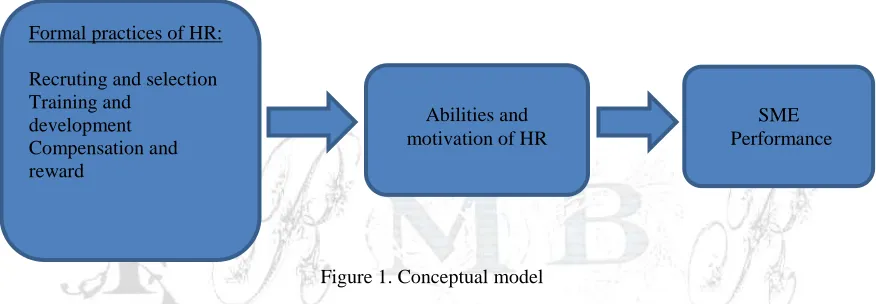
Figure 1. Conceptual model
Starting from the concept of individual performance of Vroom (1964) which claimed that motivation for work is depended from the level of abilities of employees and the relationship of the abilities for performance. He further continues to say that the effect of the ablilities and motivation in performance are not added, but are effectively interactive. So, Vroom has stated that people have necessity for abilities and motivation in order to increase the firm performance, and in case that if the abilities or motivation is zero there will not be effective performance, Performance = (Ability Motivation).
The formal practices of recruitment and selection influence that SME to increase human abilities through selecting the adequate people, whereas the formal practice of training and development influences the improvement of the SME abilities through development and improvement of human abilities of the firm formal practices of compensation and rewards raise the motivation of human resources in SME and as a result of a huge ability and motivation of people the firm performance will be increased.
Research Question: How do the practices of human resource influence in the performance of SME?
To answer this question, the responses of the respondend were included in the analysis of multiple regression, the results of the analysis can be seen on table 2.
Formal practices of HR:
Recruting and selection Training and
development Compensation and reward
Abilities and motivation of HR
ISSN: 2306-9007 Mulolli, Islami & Skenderi (2015) 1176
I
www.irmbrjournal.com December 2015I
nternationalR
eview ofM
anagement andB
usinessR
esearchVol. 4 Issue.4
R
M
B
R
Table 2. Analysis of multiple regression for dependent variable “firm performance”
Model R² Adjusted R² B Std. Error t Sig.
(Constant) .897 .890 .258 .168 1.532 .132
Recruting and selecting .311 .062 4.986 .000
Training and development .210 .063 3.332 .002
Compensation and reward .440 .075 5.861 .000
Based on the regression analysis all the independent variables explain 89% of the variance of dependend variable “firm performance”. Using non- standardized weight of regression, multiple regression of equation can be presented as below:
Ŷ =β0 + β 1 x1+ β 2 x 2+ β 3 x 3+ εi
Ŷ= 0.258+ 0.311 x1 +0.210 x 2+0.440 x 3+ εi
Ŷ = dependent variable “firm performance”
x 1 = independent variable “Recruting and selection”
x 2 = independent variable “Training and development”
x 3 = independent variable “compensation and reward”,
εi = standard error.
From this formula can be represented that the performance of an eneterprise is equal with the sum of production for non- standardized weight with the average of using the appropriate method and non- standardized weight constant.
From multiple regression analysis (see tab.2) results that three independent variables are stastically meaningful for the model. The three independent variables have regression coefficient positive which means with the raise of one of the independent variables factos will have even raise of the dependent variable-in “firm performance”.
From this three practices of human resources a huge influence in firm performance has the variable “compensation and reward” with non- standardized coeficients (B= 0.440). F value (3,49)= 141,635 and (p=.000) means that at least one of the variables is meaningful for level control (0,05), because (0,000<0.5).
According to the results the statistical test for individual coefficient control the same result is taken ( t1=4.986 and p=0.000), (t2= 3.332 and p=0.002), (t3= 5.861 and p=0.000), individual coeficients showed
that independent variables have a huge contribution for the model in order to improve SME performance.
Conclusion
ISSN: 2306-9007 Mulolli, Islami & Skenderi (2015) 1177
I
www.irmbrjournal.com December 2015I
nternationalR
eview ofM
anagement andB
usinessR
esearchVol. 4 Issue.4
R
M
B
R
compensation and reward” results with the average (M= 3.57 and DS= 0.866), “recruitment and selection” (M= 3.49 and DS= 0.891), as well as “training and development” (M= 3.45 and DS= 0.911), this showed that the three variables are important for the improvement of performance of SME. Besides that, this can be the object of study for further researches.
If SME managers use the appropriate practices in certain momenets, this offers the enterprise to realize its intention and to precede to be confronted with competitors or even to pass them in positive aspect.
Study Limitations
This study contributes in literature richment related with HR practices, but it has its limitation. Study limitations are:
- The size of selected SME that participated in the study is low (53). For this reason, a close attention must be payed in trying to generalize the data of this study.
- Factors used in this study are not the only that influence in enterprise performance improvement. There are other factors which are used as the practices of human resource.
- The data gathered in a moment of time, not in different periods of time. The value of the study would have been higher if the data had been gathered in different periods of time with the purpose of searching the dinamics of usage of human resource practices.
References
Armstrong, M. (2008). “Strategic Human Resource Management: A Guide to Action” (4th ed.) Kogan Page; Armstrong, M. (2009). “Armstrong's handbook of performance management: An evidence-based guide to
delivering high performance”,Kogan Page Publishers;
Arthur, J. B. (1994). “Effects of human resource systems on manufacturing performance and turnover”, Academy of Management journal, 37(3), 670-687;
Bacon, N., & Hoque, K. (2005). HRM in the SME sector: valuable employees and coercive networks. The
International Journal of Human Resource Management, 16(11), 1976-1999.
Barrett, R., Mayson, S. (2006), “Exploring the intersection of HRM and entrepreneurship - Guest editors introduction to the special edition on HRM and entrepreneurship”, Human Resource Management
Review, 16: 443 – 446;
Barrett, R.; Mayson, S. (2007). “Human Resource Management in Growing Small Firms”, Journal of Small
Business and Enterprise Development, 14 (2): 307-32;
Behrends, T. (2007), “Recruitment practices in small and medium size enterprises: An empirical study among knowledge-intensive professional service firms”, Management Review, Vol.18, No.1, pp. 55-74;
Cardon, M. S., & Stevens, C. E. (2004). “Managing human resources in small organizations: What do we know?”, Human resource management review, 14(3), 295-323;
Cassell, C., Nadin, S., Gray, M and Clegg, C. (2002) “Exploring Human resource Management practices in small and medium sized enterprises”, Personnel Review, 31 (5/6): 671-692;
Chandler, G. N., & McEvoy, G. M. (2000). “Human resource management, TQM, and firm performance in small and medium-size enterprises”, Entrepreneurship: Theory and Practice, 25(1), 43;
ISSN: 2306-9007 Mulolli, Islami & Skenderi (2015) 1178
I
www.irmbrjournal.com December 2015I
nternationalR
eview ofM
anagement andB
usinessR
esearchVol. 4 Issue.4
R
M
B
R
Delery, J. E., & Doty, D. H. (1996). “Modes of theorizing in strategic human resource management: Tests of universalistic, contingency, and configurational performance predictions”. Academy of management Journal, 39(4), 802-835;
Dessler, G. (2003). “Human resource management”, (9th ed.). Upper Saddle River, NJ: Prentice-Hall; Fabi, B., Raymond, L. and Lacoursière, R. (2009), “Strategic alignment of HRM practices in
manufacturing SMEs: a Gestalts perspective”, Journal of Small Business and EnterpriseDevelopment, Vol.16, No.1, pp. 7-25;
Gerhart, B., & Milkovich, G. T. (1992). “Employee compensation: Research and practice (In MD Dunnette & LM Hough (Eds.)”. Handbook of industrial and organizational psychology (Vol. 3, pp. 481–569). Palo Alto;
Gibbons, P. T., and T. O'Connor (2005). “Influences on Strategic Planning Processes among Irish SMEs”,
Journal of Small Business Management, 43 (2), 170-186;
Hayton, J. C. (2003). “Strategic human capital management in SMEs: An empirical study of entrepreneurial performance”, Human resource management,42(4), 375-391;
Hill, R. & Stewart, J. (1999). “Human resource development in small organisations”, HRDI, 2(2): 103-123; Hornsby, J. S., & Kuratko, D. F. (1990). “Human resource management in small business: Critical issues
for the 1990's”. Journal of small business management, 28(3), 9;
Huselid, M. A. (1995). “The impact of human resource management practices on turnover, productivity, and corporate financial performance”. Academy of management journal, 38(3), 635-672;
Islami, Xh. (2015). “The process and techniques to overcome the resistance of change Research based in the eastern part of Kosovo”, International Journal of Multidisciplinary and Current Research, vol.3, issue 6, pp.1122-1130
Johnston, K. & Loader, K. (2003). “Encouraging SME participation in training: identifying practical approaches”, Journal of European Industrial Training, 27/6:273-280;
Katou, A. A. (2012). “Investigating reverse causality between human resource management policies and organizational performance in small firms”, Management Research Review, 35(2): 134-156;
Katz, J.A., Aldrich, H.E., Welbourne, T.M. and Williams, P.M. (2000), “Guest editors comments on special issue on human resource management and the SME: Toward a new synthesis”, Entrepreneurship Theory and Practice, Vol.25, No.1, pp. 7-10;
Kotey, B., & Slade, P. (2005). “Formal human resource management practices in small growing firms”, Journal of small business management, 43(1), 16-40;
Kotey, B., Folker, C.( 2007), “Employee Training in SMEs: Effect of Size and Firm Type – Family and Nonfamily”, Journal of Small Business Management, 45(2) : 214-238;
Kroon, B., Voorde, K. and Timmers, J. (2013), “High performance work practices in small firms:a resource-poverty and strategic decision-making perspective”, Small Business Economics, Vol.41, No.1, pp. 71-91;
Litz, R. A., & Stewart, A. C. (2000). “Research note: trade name franchise membership as a human resource management strategy: does buying group training deliver „true value‟for small retailers?”, Entrepreneurship Theory and Practice, 25(1), 125-135;
Marlow, S. (2002), “Regulating labour management in small firms”, Human Resource Management
Journal, Vol.12, No.3, pp. 25-43;
Marlow, S. and Patton, D. (2002), “Minding the gap between employers and employees: The challenge for owner-managers or smaller manufacturing firms”, Employee Relations, Vol.24, No.5, pp. 523-539; Nguyen, T. and Bryant, S. (2004), “A study of the formality of human resource management practices in
small and medium-size enterprises in Vietnam”, International Small BusinessJournal, Vol.22, No.6, pp. 595-618;
ISSN: 2306-9007 Mulolli, Islami & Skenderi (2015) 1179
I
www.irmbrjournal.com December 2015I
nternationalR
eview ofM
anagement andB
usinessR
esearchVol. 4 Issue.4
R
M
B
R
Simpson, M., Padmore, J., & Newman, N. (2012). “Towards a new model of success and performance in SMEs”, International Journal of Entrepreneurial Behavior & Research, 18(3), 264-285;
Sun, L.Y., Aryee, S. & Law, K.S. (2007). “High performance human resource practices, citizenship behavior, and organizational performance: A relational perspective”, Academy of Management Journal, 50, 558-577;
Terpstra, D. E., & Rozell, E. J. (1993). “The relationship of staffing practices to organizational level measures of performance”, Personnel Psychology, 46(1), 27-48;
Tocher, N., & Rutherford, M. W. (2009). “Perceived acute human resource management problems in small and medium firms: an empirical examination”, Entrepreneurship Theory and Practice, 33(2), 455-479; Vroom, V. (1964) “Work and Motivation”, Wiley, New York;
Wilkinson, A. (1999), “Employment relations in SMEs”, Employee Relations, Vol.22, No.3, pp. 206-217; Wright PM, Gardner TM, Moynihan LM, Allen MR. (2005). “The relationship between HR practices and
firm performance: Examining causal order”, Personnel Psychology, 58 :409–446;
Wright, P. M. and McMahan, G. C. (1992). “Theoretical perspectives for strategic human resource management”, Journal of Management, 18(2): 295-320;