An Apriori based Algorithm for Frequent Pattern
Mining
Chaitali Patel Deepali Koul Computer Department Computer Department Kautilya institute of technology Kautilya institute of technology
[email protected] [email protected]
Abstract:
Frequent pattern mining is a widely researched area in the field of data mining with wide range of applications. Mining frequent patterns from large scale databases has emerged as an important problem in data mining and knowledge discovery community. A number of algorithms have been proposed to determine frequent pattern. Apriori algorithm is the very first algorithm proposed in this area. With the time a number of changes proposed in Apriori to enhance the performance in term of time and number of database pass. In this paper three different frequent pattern mining approaches (Record filter, Intersection and Proposed Algorithm) are given based on classical Apriori algorithm. In these approaches Record filter approach proved better than classical Apriori Algorithm, Intersection approach proved better than Record filter approach and finally proposed algorithm proved that it is much better than other frequent pattern mining algorithm. In last we perform a comparative study of all approaches on dataset of 2000 transaction.
Keywords:
Data Mining, Frequent Patterns, Knowledge Discovery, Pattern mining.
1. Introduction:
This section introduces the basic concept of frequent pattern mining for the discovery of interesting associations and correlations between item sets in transactional and relational database. Frequent pattern are patterns that appear in a dataset frequently. For example, a set of items, such as milk and bread that appear frequently together in a transaction data set is a frequent item set. Frequent patterns are prevalent in real-life data, such as sets of items b o u g h t t o g e t h e r i n a s u p e r m a r k e t . Frequent pattern mining has been successfully applied to association rule mining, pattern-based classification, clustering, finding correlated items, and has become an essential data-mining task.
Frequent item sets play an essential role in many data mining tasks that try to find interesting patterns from databases. The original motivation for searching frequent pattern came from the need to analyze so called supermarket transaction data, that is, to examine customer behavior in terms of the purchased products. Frequent Pattern describe how often items are purchased together. Since their introduction in 1993 by Argawal et al. [1], the frequent item set and association rule mining problems have received a great deal of attention. Within the past decade, hundreds of research papers have been published. Presenting new algorithms or improvements on existing algorithms to solve these mining problems more efficiently. In this chapter, we explain the basic frequent item set mining problems.
2. Problem
The problem is usually decomposed into two sub problems.
1. One is to find those item sets whose occurrences exceed a predefined threshold in the database; those item sets are called frequent or large item sets.
2. The second problem is to generate association rules from those large item sets with the constraints of minimal confidence.
Chaitali Patel et al, International Journal of Computer Science and Mobile Applications,
Vol.1 Issue. 5, November- 2013, pg. 51-56 ISSN: 2321-8363
consequent of the rule. The rule X Y holds in the transaction set D with confidence if among those transactions that contain X % of them also contain Y. The rule X Y has support S in the transaction set D if S% of transactions in D contains X Y. The selection of association rules is based on these two values (some additional constraints may also apply). These are two important measures of rule interestingness. They respectively reflect usefulness and certainty of a discovered rule. They can be described by the following equations:
Support (X Y) = Frequency (X Y) / /D/ Confidence (X Y) = Frequency (X Y) / Frequency (X) where /D/ represents the total number of transactions (tuples) in D.
Suppose one of the large item sets is Lk, Lk = {i1, i2, … , ik}, association rules with this item sets are generated in the following way:
The first rule is {i1, i2, … ,ik-1} {ik}, by checking the confidence. This rule can be determined as interesting or not. Then other rule are generated by deleting the last items in the antecedent and inserting it to the consequent, further the confidences of the new rules are checked to determine the interestingness of them. These processes iterated until the antecedent becomes empty. Since the second sub problem is quite straight forward, most of the researches focus on the first sub problem.
The first sub-problem can be further divided into two sub-problems: candidate large item sets generation process and frequent item sets generation process. We call those item sets whose support exceeds the support threshold as large or frequent item set.
3. Apriori Algorithm for Frequent Pattern Mining
Apriori is a algorithm proposed by R. Agrawal and R Srikant in 1994 [1] for mining frequent item sets for Boolean association rule. The name of algorithm is based on the fact that the algorithm uses prior knowledge of frequent item set properties, as we shall see following. Apriori employs an iterative approach known as level-wise search, where k item set are used to explore (k+1) item sets. There are two steps in each iteration.
The first step generates a set of candidate item sets. Then, in the second step we count the occurrence of each candidate set in database and prunes all disqualified candidates (i.e. all infrequent item sets). Apriori uses two pruning technique, first on the bases of support count (should be greater than user
specified support threshold) and second for an item set to be frequent , all its subset should be in last frequent item set The iterations begin with size 2 item sets and the size is incremented after each iteration. The algorithm is based on the closure property of frequent item sets: if a set of items is frequent, then all its proper subsets are also frequent.
3.1 Apriori Algorithm
Initialize: k := 1, C1 = all the 1- item sets;
read the database to count the support of C1 to determine L1.
L1 := {frequent 1- item sets}; k:=2; //k represents the pass number// while (Lk-1 ≠ ) do
begin
Ck := gen_candidate_itemsets with the given Lk-1 prune(Ck)
for all transactions t T do
increment the count of all candidates in CK that are contained in t;
Lk := All candidates in Ck with minimum support ; k := k + 1;
end
Answer := k Lk ;
The first weakness of this algorithm is the generation of a large number of candidate item sets. The second problem is the number of database passes which is equal to the max length of frequent item set.
4. Record Filter Approach based on Apriori Algorithm for Frequent Pattern Mining
This approach has taken very less time as compared to classical Apriori.
4.1 Record filter approach based on Apriori Algorithm
Initialize: k := 1, C1 = all the 1- item sets;
read the database to count the support of C1 to determine L1.
L1 := {frequent 1- item sets}; k:=2; //k represents the pass number// while (Lk-1 ≠ ) do
begin
Ck := gen_candidate_itemsets with the given Lk-1 prune(Ck)
for all transactions t whose length is greater than or equal to k T do
increment the count of all candidates in CK that are contained in t;
Lk := All candidates in Ck with minimum support ; k := k + 1;
end
Answer := k Lk ;
In this new approach we require very less time in comparison to classical apriori algorithm.
5. Intersection Approach Based On Apriori Algorithm for Frequent Pattern Mining
In the previous section we have describe the Record filter approach based on Apriori, now we are suggesting one another changes in Apriori which gives the better result as compare to the Record Filter approach. The Intersection Algorithm is designed to improve the efficiency, memory management and remove the complexity of Apriori. Here we are presenting a different approach in Apriori algorithm to count the support of candidate item set. Basically this approach is more appropriate for vertical data layout, since Apriori basically works on horizontal data layout. In this new approach, we use the set theory concept of intersection. In Classical Apriori algorithm, to count the support of candidate set each record is scanned one by one and check the existence of each candidate, if candidate exists then we increase the support by one. This process takes a lot of time, requires iterative scan of whole database for each candidate set, which is equal to the max length of candidate item set. In modified approach, to
5.1 Intersection Algorithm Based On Apriori
Initialize: K: = 1, C1 = all the 1- item sets;
read the database to count the support of C1 to determine L1.
L1 := {frequent 1- item sets}; k:=2; //k represents the pass number// while (Lk-1 ≠ ) do
begin
Ck: = gen_candidate_itemsets with the given Lk-1 Prune (Ck)
for all candidates in Ck do
count the number of transactions that are common in each item Ck
Lk := All candidates in Ck with minimum support ;
k := k + 1; end
Answer := k Lk ;
This modified (Intersect Method) approach, takes only one data base pass to change the horizontal data layout to vertical datalayout..
6. Proposed Algorithm Based On Apriori for Frequent Pattern Mining
In this new approach we have determined changes that are going to serve the best in the field of frequent pattern mining. In this new approach, we are presenting an algorithm that uses the concept of both algorithm i.e. Record filter approach and Intersection approach in Apriori algorithm .To count the support of candidate item set ,we have considered both above mentioned approach. In this new approach, we use the set theory concept of intersection with the record filter approach.. In proposed algorithm, to calculate the support, we count the common transaction that contains in each element’s of candidate set, with the help of the intersect query of SQL. In this approach, we have applied a constraints that we will consider only those transaction that contain at least k items, not less than k in process of support counting for candidate set of k length. This approach requires very less time as compared to all other approaches.
6.1 Proposed Algorithm Based On Apriori
Initialize: K: = 1, C1 = all the 1- item sets;
read the database to count the support of C1 to determine L1.
L1 := {frequent 1- item sets}; k:=2; //k represents the pass number// calculate the support we count the common
transaction that contains in each element’s of candidate set, by using the intersect query of SQL.
while (Lk-1 begin
≠ ) do This approach requires very less time as compared to
classical Apriori.
Chaitali Patel et al, International Journal of Computer Science and Mobile Applications,
Vol.1 Issue. 5, November- 2013, pg. 51-56 ISSN: 2321-8363
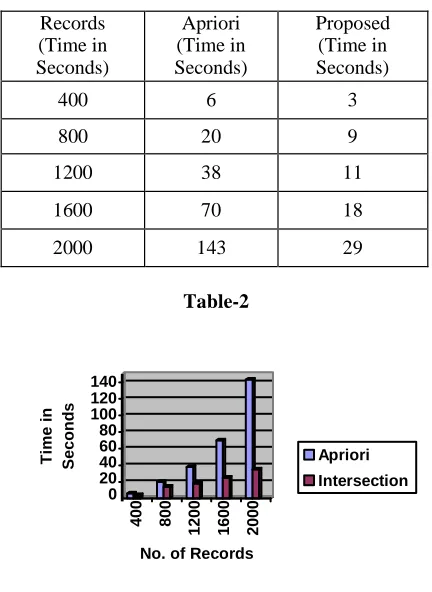
Records (Time in Seconds)
Apriori (Time in Seconds)
Proposed (Time in Seconds)
400 6 3
800 20 9
1200 38 11
1600 70 18
2000 143 29
Records Apriori
(Time in Seconds)
Record filter
(Time in Seconds)
400 6 4
800 20 17
1200 38 33
1600 70 64
2000 143 132
4
0
0
1
2
0
0
2
0
0
0
T
im
e
i
n
S
e
c
o
n
d
s
4
0
0
8
0
0
1
2
0
0
1
6
0
0
2
0
0
0
for all candidates in Ck do
count the number of transactions of atleast k length that are common in each item Ck
Lk := All candidates in Ck with minimum support ;
k := k + 1; end
Answer := k Lk ;
In this modified (Intersect Method) approach we require only one data base pass to change the horizontal
7.2 Time Comparison between Apriori and Intersection
It is clear from the figure2 and Table2 that Intersection approach is efficient than the apriori algorithm. In the Analysis process when we have taken the 400 record apriori takes 6 second while Intersection takes the 4 second when we increase the size of record we can see in the table the results are
very efficient related to time.
7. Time Comparison in Apriori, Record Filter, Intersection and Proposed Algorithm
7.1 Time Comparison between Apriori and Record Filter
It is clear from the figure1 and Table1 that Record filter approach is efficient than the classical apriori algorithm. In the Analysis process when we have taken the 400 record apriori takes 6 second while Record filter takes the 4 second when we increase the size of record we can see in the table the results are very efficient related to time.
140 120 100 80 60 40 20 0
Table-2
Apriori
Intersection
No. of Records
Figure-2
Table –1
140 120 100 80 60 40 20 0
Figure-1
Apriori
Record Filter
7.3 Time Comparison between Apriori and Proposed Algorithm
It is clear from the figure3 and Table3 the Proposed Algorithm is efficient than the apriori algorithm. In the Analysis process when we have taken the 400 record apriori takes 6 second while Proposed Algorithm takes the 3 second when we increase the size of record we can see in the table the results are very efficient related to time. In the conclusion we can say that Proposed Algorithm is better than the
Records Apriori Intersection
400 6 4
800 20 14
1200 38 18
1600 70 25
2000 143 35
T
im
e
i
n
S
e
c
o
n
d
s
4
0
0
8
0
0
1
2
0
0
1
6
0
0
2
0
0
0
140
120 100 80 60 40 20
0
Table-3
Apriori
Efficient
7.4 Time Comparison between Classical Apriori, Record Filter, Intersection and Proposed algorithm
For the comparative study of Classical Apriori, Record Filter, Intersection and Proposed Algorithm, we have taken a database of 2000 transaction of 50 items. In this analytical process we considered 500 transactions to generate the frequent pattern with the support count 10% .We have repeated the same process by increasing the transaction. Here we first compare the result of all approaches with Classical Apriori Algorithm because all approaches are based on Classical Apriori. After that we compare all approaches to find out the best. After the experiment on all approaches, we have designed a graph and summarized a result in the following table
No. of Records
Figure-3
Records (Time in Seconds)
Apriori (Time in Seconds)
Record Filter (Time in Seconds)
Intersection (Time in Seconds)
Proposed (Time in Seconds)
400 6 4 4 3
800 20 17 14 9
1200 38 33 18 11
1600 70 64 25 18
2000 143 132 35 29
Chaitali Patel et al, International Journal of Computer Science and Mobile Applications,
Vol.1 Issue. 5, November- 2013, pg. 51-56 ISSN: 2321-8363
160 140 120 100 80
T
im
e
i
n
S
e
c
o
n
d
s
60 40 20 0
400 800 1200 1600 2000
No. of Records
Apriori Record Filter Intersection Proposed
Figure-4
Conclusion:
Association rule mining has a wide range of applicability such as market basket analysis, medical diagnosis/ research, website navigation analysis, homeland security and so on. In this paper, we surveyed the list of existing association rule mining techniques and compare these algorithms with our modified approach. The conventional algorithm of association rules discovery proceeds in two and more steps but in our approach discovery of all frequent item will take the same steps but it will take the less time as compare to the conventional algorithm. We can conclude that in this new approach, we have the key ideas of reducing time. As we have proved above how the proposed Apriori algorithm take less time than that of classical apriori algorithms. That is really going to be fruitful in saving the time in case of large database. This key idea is surely going to open a new gateway for the upcoming researcher to work in the filed of the data mining.
References
[1]Agrawal, R., Imielinski, T., and Swami, A. N. 1993. Mining association rules between sets of items in large databases. In Proceedings of the 1993 ACM SIGMOD International Conference on Management of Data, 207-216.
[2] Agrawal, R. and Srikant, R. 1994. Fast algorithms for mining association rules. In Proc. 20th Int. Conf. Very Large Data Bases, 487-499.
[3] Agarwal, R. Agarwal, C. and Prasad V., A tree projection algorithm for generation of frequent itemsets. In J. Parallel and Distributed Computing, 2000.
[4] R. Agrawal and R. Srikant. Fast algorithms for mining association rules. IBM Research Report RJ9839, IBM Almaden Research Center, San Jose, California, June 1994.
[5] R.J. Bayardo, Jr. Efficiently mining long patterns from databases. In L.M. Haas and A. Tiwary, editors, Proceedings of the 1998 ACM SIGMOD International Conference on Management of Data, volume 27(2) of SIGMOD Record, pages 85–93. ACM Press, 1998.
[6] S. Parthasarathy, M. J. Zaki, M. Ogihara, S. Dwarkadas; Incremental and interactive sequence mining; Int'l Conf. on Information and Knowledge Management; 1999.
[7] Helen Pinto, Jiawei Han, Jian Pei, Ke Wang, Qiming Chen, Umeshwar Dayal; Multi-Dimensional Sequential Pattern Mining; Int'l Conf. on Information and Knowledge Management; 2001. [8] Assaf Schuster, Ran Wolff, and Dan Trock; Distributed Algorithm for Mining Association Rules; IEEE Int'l Conf. on Data Mining; November 2003.
[9] Wei-Guang Teng, Ming-Syan Chen, and Philip S. Yu; Resource-Aware Mining with Variable Granularities in Data Streams; SIAM Int'l Conf. on Data Mining; 2004.
[10] Adriano Veloso, Wagner Meira Jr., Marcio Carvalho, Srini Parthasarathy, Mohammed J. Zaki; Parallel, Incremental and Interactive Mining for Frequent Itemsets in Evolving Databases; Int'l Workshop on High Performance Data Mining: Pervasive and Data Stream Mining; May 2003.
[11] Adriano Veloso, Matthew Eric Otey, Srinivasan Parthasarathy, Wagner Meira Jr.; Parallel and Distributed Frequent Itemset Mining on Dynamic Datasets; Int'l Conf. on High Performance Computing; 2003.
[12] Haixun Wang, Wei Fan, Philip S. Yu, Jiawei Han; Mining Concept-Drifting Data Streams using Ensemble Classifiers; ACM SIGKDD Int'l Conf. on Knowledge Discovery and Data Mining; August 2003.
[13] Li Yang, Mustafa Sanver; Mining Short Association Rules with One Database Scan; Int'l Conf. on Information and Knowledge Engineering; June 2004.
[14] Jeffrey Xu Yu, Zhihong Chong, Hongjun Lu, Aoying Zhou; False Positive or False Negative: Mining Frequent Itemsets from High Speed ATransactional Data Streams; Int'l Conf. on Very Large Databases; 2004.
[15] Qingguo Zheng, Ke Xu, Shilong Ma; When to Update the Sequential Patterns of Stream Data; Pacific-Asia Conf. on Knowledge Discovery and Data Mining; 2003.