Public Auditing & Automatic Protocol
Blocking with 3-D Password
Authentication for Secure Cloud Storage
P. Selvigrija, Assistant Professor, Department of Computer Science & Engineering, Christ College of Engineering &Tech., Pondicherry
D. Sumithra, M.Tech, II Year, Department of Computer Science & Engineering, Christ College of Engineering &Tech., Pondicherry
E-Mail Id: [email protected]
Abstract
Using cloud storage, users can remotely store their data and enjoy the on-demand high-quality applications and services from a shared pool of configurable computing resources, without the burden of local data storage and maintenance. However, the fact that users no longer have physical possession of the outsourced data makes the data integrity protection in cloud computing a formidable task, especially for users with constrained computing resources. Moreover, users should be able to just use the cloud storage as if it is local, without worrying about the need to verify its integrity. Thus, enabling public auditability for cloud storage is of critical importance so that users can resort to a third-party auditor (TPA) to check the integrity of outsourced data and be worry free. To securely introduce an effective TPA, the auditing process should bring in no new vulnerabilities toward user data privacy, and introduce no additional online burden to user. User level security is provided using the 3-D Password by combining textual, graphical and Biometric Finger print. For data level security symmetric key based encryption/decryption using Galois Counter Mode (GCM).
Keywords: 3-D password; Automatic protocol blocker; third party auditing; Audit
I. INTRODUCTION
computing is used by many software industries now a days. Since the security is not provided in cloud, many companies adopt their unique security structure. Introducing a new and uniform security structure for all types of cloud is the problem we are going to tackle in this paper. Since the data placed in the cloud is accessible to everyone, security is not guaranteed.
To ensure security, cryptographic techniques cannot be directly adopted. Sometimes the cloud service provider may hide the data corruptions to maintain the reputation. To avoid this problem, we introduce an effective third party auditor (TPA) to audit the user’s outsourced data when needed.
Infrastructure Models There are many considerations for cloud computing architects to make when moving from a standard enterprise application deployment model to one based on cloud computing.
Software as a Service (SaaS) Software as a service features a complete application offered as a service on demand. A single instance of the software runs on the cloud and services multiple end users or client organizations.
Platform as a Service (PaaS) Platform as a service encapsulates a layer of software and provides it as a service that can be used to build higher-level services.
Infrastructure as a Service (IaaS) Infrastructure as a service delivers basic storage and compute capabilities as standardized services over the network. Servers, storage systems, switches, routers, and other systems are pooled and made available to handle workloads that range from application components to high-performance computing applications.
II. PUBLIC AUDITING
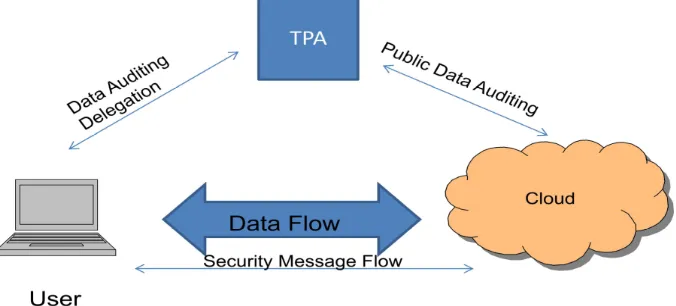
Cloud computing is a model which provides a wide range of applications under different topologies and every topology derives some new specialized protocols. TPA is the third party auditor who will audit the data of data owner or client so that it will let off the burden of management of data of data owner. TPA eliminates the involvement of the client through the auditing of whether his data stored in the cloud are indeed intact, which can be important in achieving economies of scale for Cloud Computing. The released audit report would not only help owners to evaluate the risk of their subscribed cloud data services, but also be beneficial for the cloud service provider to improve their cloud based service platform. This public auditor will help the data owner that his data are safe in cloud.
Figure 1: Cloud Storage Architecture
The system and Threat Model: We consider a cloud data storage service involving three different entities, the cloud user (U), who has large amount of data files to be stored in the cloud, the cloud Server (CS), which is managed by the cloud service provider (CSP) to provide data storage and has significant storage space and computation resources., the third party Auditor (TPA), who has expertise and capabilities that cloud users do not have and is trusted to assess the cloud storage service security on behalf of the user request.
III. PROPOSED ARCHITECTURE
Figure2: Security using APB
AUTOMATIC PROTOCOL BLOCKER
The proposed system is designed to prevent the unauthorized data access for preserving data integrity. The system monitors the user requests according the user specified parameters and it checks the parameters for the new and the existing users. The system accepts existing validated user, and prompts for the new users for the parameter to match requirement specified during user creation for new users. If the new user prompt parameter matches with cloud server, it gives privileges to access the Automatic Protocol authorized the system automatically blocks the Audit protocol for specific user. Based on the 3-D password authentication the blocking of unauthorized user accessing the cloud storage is carried out.
3-D PASSWORD AUTHENTICATION
Recall based and Recognition based.
Recall-based techniques require the user to repeat or reproduce a secret that the user created before. Recognition based techniques require the user to identify and recognize the secret, or part of it, that the user selected before. One of the most common recall-based authentication schemes used in the computer world is textual passwords. One major drawback of the textual password is its two conflicting requirements: the selection of passwords that are easy to remember and, at the same time, are hard to guess.
Graphical password - Many authentication systems, particularly in banking, require not only what the user knows but also what the user possesses (token-based systems). However, many reports have shown that tokens are vulnerable to fraud, loss, or theft by using simple techniques. Various graphical password schemes have been proposed. Graphical passwords are based on the idea that users can recall and recognize pictures better than words. However, some of the graphical password schemes require a long time to be performed. Moreover, most of the graphical passwords can be easily observed or recorded while the legitimate user is performing the graphical password; thus, it is vulnerable to shoulder surfing attacks.
Biometric Password- Biometrics (or biometric authentication) refers to the identification of humans by their characteristics or traits. Biometrics is used in computer science as a form of identification and access control. It is also used to identify individuals in groups that are under surveillance. Biometric identifiers are the distinctive, measurable characteristics used to label and describe individuals. For secure authentication to any medium the biometric authentication will be highly secure.
1. 3-D PASSWORD
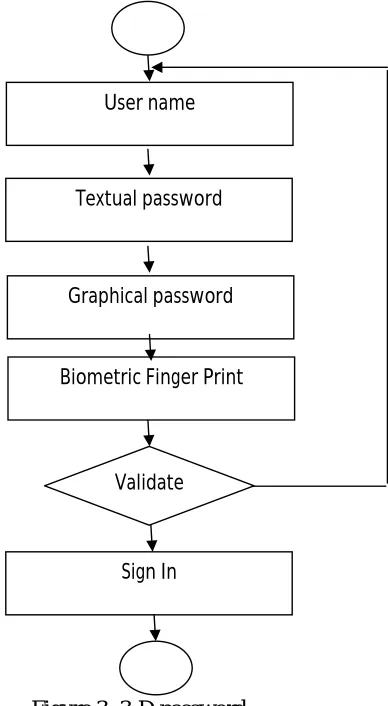
3-D password – The 3-D password authentication is used to avoid the unauthorized accessing the cloud storage. The 3-D password authentication scheme is multi factor authentication method to provide more security to the cloud accessing.
1. Textual password – In textual password a secret question will be asked by the cloud server for authentication for the proper user login.
2. Graphical password – the user will be given the image as the password, the mouse clicked by the user on the image is taken as the password.
Figure 3: 3-D password
2. AUDIT
Upon user request the Third Party Auditor (TPA) verifies the user data on the cloud server, using the GCM encryption and decryption algorithm.
A) GALOIS/COUNTER MODE (GCM)
Galois/Counter Mode is a mode of operation for symmetric key cryptographic block ciphers that has been widely adopted because of its efficiency and performance. GCM throughput rates for state of the art, high speed communication channels can be achieved with reasonable hardware resources. It is an authenticated encryption algorithm designed to provide both data
User name
Biometric Finger Print Textual password
Graphical password
GCM Decryption -The GCM decryption algorithm is used to retrieve the original stored data from the cloud server.
IV. CONCLUSION
Public auditing can be achieved using the Automatic Protocol Blocking for the secure cloud storage, which improves the efficiency of the user storage. Thus the 3-d password will improve the user level security in Cloud Server and the data level security will be effectively provided using the GCM based encryption and decryption algorithms. Thus the public auditing ensures that the data leakage and data loss will be reduced and more number of users will be improved.
REFERENCE
[1] G. Divya Zion, D.Kavitha “Remote Sensing Data as a Service in Hybrid Clouds: Security Challenges and Trusted Third-party Auditing Mechanisms”Vol. 1, Issue 7, September 2012.-pg: 1
[2] Sichuan Province Email: [email protected]. -pg:2
[3] RagibHasan” Security and Privacy in Cloud Computing” Johns Hopkins Universityen.600.412 Spring 2010.-pg: 2,5
[4] Balakrishnan.S, Saranya.G, Shobana.S, Karthikeyan.S” Introducing Effective Third Party Auditing (TPA) for Data Storage Security in Cloud” IJCST Vol. 2, Issue 2, June 2011.-pg: 31,34, 61.
[5] Everaldo Aguiar ”An Overview of Issues and Recent Developments in Cloud Computing and Storage Security “University of Notre Dame, Notre Dame, IN, e-mail: [email protected]: 1, 4,5
[6] Cong Wang, Qian Wang, and KuiRen “Ensuring Data Storage Security in Cloud Computing” Email: {cwang, qwang, kren}@ece.iit.edu.-pg:2,3
[7] K.S.Sathiyapriya” Integrity And Security Check Through Data Coloring And Water Marking Using Third Party Auditor In Cloud Computing Atmosphere”Vol. 2 Issue 1, 2012,95-99.-pg: 1, 2,6.
[8] Wang Shao-huiP 1, 2 *P , Chang Su-qinP1P, Chen Dan-weiP1P, Wang Zhi-weiP “Public Auditing for Ensuring Cloud Data Storage Security With Zero Knowledge Privacy” 1. College of Computer, Nanjing University of Posts and Telecommunications, Nanjing210046, China; pg:1 to 19.
[10] Katukam Ganesh” Ensuring and Reliable Storage in Cloud Computing” Vol. 3 (5) , 2012,5157 – 5163.pg: 3, 4
[11] D. Kishore Kumar, G.VenkatewaraRao, G.SrinivasaRao” Cloud Computing: An Analysis of Its Challenges & Security Issues” Issue 5, October 2012.-pg: 1, 2