EVOLUTIONARY SEARCH FOR COMPUTATIONAL
MODELS OF CELLULAR DEVELOPMENT
by
Nicolas Scott Cornia
A thesis
submitted in partial fulfillment of the requirements for the degree of Master of Science in Computer Science
Boise State University
DEFENSE COMMITTEE AND FINAL READING APPROVALS
of the thesis submitted by
Nicolas Scott Cornia
Thesis Title: Developing an Application for Evolutionary Search for Computational Models of Cellular Development
Date of Final Oral Examination: 20 February 2015
The following individuals read and discussed the thesis submitted by student Nicolas Scott Cornia, and they evaluated his presentation and response to questions dur-ing the final oral examination. They found that the student passed the final oral examination.
Timothy Andersen, Ph.D. Chair, Supervisory Committee
Jeff Habig, Ph.D. Member, Supervisory Committee
Elena A. Sherman, Ph.D. Member, Supervisory Committee
VPEvolve is a free and open source application that utilizes a Visual Programming Environment (VPE) for the setup of the Genetic Algorithm (GA), for optimization of computational models. Specifically, the User Interface uses connected glyphs to represent the genetic operators of mutation, reproduction, fitness and selection. These glyphs give the user an intuitive way to set the parameters for the GA, and better visualization of the population’s flow through these operators.
VPEvolve is currently being developed alongside research being done in Biocom-puting to create models of cellular regeneration based on the regenerative properties of Planaria or flatworms. Since these models are difficult to produce by hand, GAs can be particularly useful to facilitate the process of model creation and validation. VPEvolve is a client-side application that allows the user to setup the parameters for the GA, runs a search using the GA, utilizes a modeling platform, such as CellSim (Cellular Simulator), to perform simulations, evaluates the fitness of each individual with user-defined fitness evaluators and presents the fitness values of the individuals in a population to the user as the evolutionary search is performed.
ABSTRACT . . . iv
LIST OF TABLES . . . vii
LIST OF FIGURES . . . viii
1 Introduction . . . 1
2 Background . . . 8
2.1 Computational Modeling . . . 8
2.2 Biological Modeling . . . 10
2.3 Evolutionary Search . . . 11
2.4 Visual Programming Languages . . . 12
2.5 Previous Work . . . 14
3 VPEvolve . . . 16
3.1 Motivation . . . 16
3.2.2 Configuration File . . . 21
3.2.3 Genetic Algorithm Parameter Setup . . . 21
3.2.4 Evolutionary Search Status View . . . 24
3.2.5 Console Mode . . . 26
3.2.6 Integration with a Modeling Platform Through Middleman Soft-ware . . . 29
3.2.7 Evolutionary Search Checkpointing . . . 30
3.3 Architecture . . . 31
3.3.1 Modular Design . . . 31
3.3.2 Implementation of Genetic Operators . . . 33
4 Results . . . 36
4.1 Comparison . . . 36
4.2 Experiments . . . 43
5 Conclusions . . . 46
5.1 Future Directions . . . 46
4.1 Average Time Elapsedfor One Generation inSeconds (over1000 runs)...42
1.1 Planaria 6-cut Experiment . . . 5
2.1 Multi-agent Computational Model of a DNA Chain . . . 10
3.1 Cantata VPE . . . 17
3.2 VPEvolve VPE . . . 19
3.3 Genetic Operator Parameter Setup Window . . . 22
3.4 XML Editor for Individuals . . . 23
3.5 Custom Python Fitness Evaluator Editor . . . 25
3.6 Evolutionary Search Status Window . . . 26
3.7 VPEvolve Evolutionary Search in GUI . . . 27
3.8 VPEvolve Evolutionary Search in Console Mode . . . 28
3.9 VPEvovle Client-Server Individual Processing . . . 30
3.10 VPEvolve Module Diagram . . . 32
3.11 VPEvolve Class Diagram . . . 34
4.2 CSGA Translated Evolutionary Search . . . 38
4.3 CSGA Console Mode . . . 39
4.4 Client-Server Individual Processing . . . 40
4.5 Wild-Type Worm . . . 43
4.6 Planarian Cellular Models . . . 43
4.7 Single Lateral Cut Experiment . . . 44
4.8 “Shark-bite” Cut Target Worm . . . 45
4.9 1.0 FitnessWorm Produced by VPEvovle ... 45
CHAPTER 1
INTRODUCTION
The use of advanced laboratory techniques, such as high-throughput screening, cause an accumulation of massive amounts of data describing complex systems. This data is exponentially increasing due to the advancement of these laboratory techniques and has the tremendous potential to accelerate and aid scientific inquiry, and reveal insights into how complex systems operate in a way that has heretofore been impos-sible. However, there are significant challenges that must be overcome in order to realize this potential. The volume and complexity of the data is so great that an unaided human has little chance to assimilate it to the degree necessary to reliably deduce higher-order, governing principles. As an example of this challenge, robotic microarray systems are used for pharmaceutical drug screenings to test thousands of molecules. The test data are then accumulated for analysis. Similar experiments conducted by an unaided human would be impossible to accomplish in the same amount of time.
new, meaningful groupings of data; and visualization tools can present data in ways that make it easier to understand. In addition to these types of software tools, there are also more advanced tools that can aid researchers in simulating complex systems. For example, software simulations can be run using models that range from single-cell biochemical reactions to multi-cellular environments that simulate tissues, organs or even whole organisms. Such simulations have the potential to be extremely powerful tools for wet-bench researchers, enabling them to develop and validate models that are hypothesized from experimental data, and even to use such models as the predictive basis for further experimentation.
For example, a perfect computational model of the influenza virus, one that reacted just as the virus would to every possible perturbation, could be used to identify drug targets for inhibiting the reproduction of the virus in the body, or to prevent infection. However, developing models that fully explain how these types of systems work is an imposingly difficult task. Even relatively simple biological systems can be astoundingly complex in their interactions, with highly non-linear responses, and complex self-regulatory feedback loops. Moreover, these systems are difficult to elucidate, requiring large amounts of experimental data gathered under varying conditions in order to fully characterize them. This is particularly true when trying to model whole cells or groups of cells, where there are elaborate biochemical path-ways and interactions, including processes that maintain homeostasis, extra-cellular signaling, and cell division.
biological discoveries.
Embryogenesis is an area of research where automated model derivation could help clarify the mechanism which describes how an embryo forms and develops. This process begins as a single cell, which develops into separate lineages over a number of cellular divisions. These groups continue to develop and eventually become specific tissues and organs such as the central nervous system, digestive system, and musculature. Throughout this process each cell must determine whether to maintain its pluripotent potential or differentiate into particular cell type using information location and neighbors based upon short and long-range cellular communication [11].
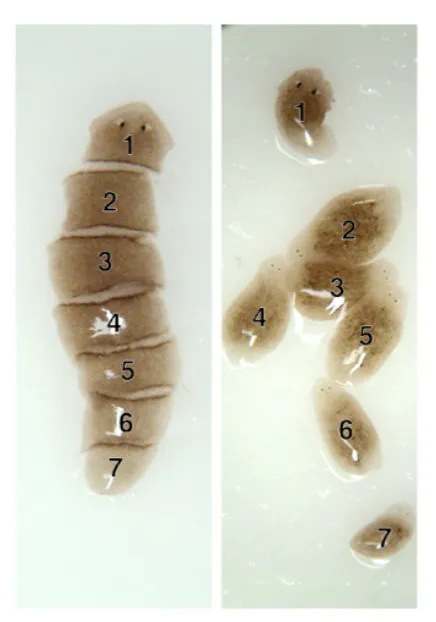
its morphology to produce smaller replicas of the adult worm that can then grow into larger versions akin to the original worm. An astounding feature of this regeneration is that the worm appears to maintain the original head and tail orientation following regeneration, even when the excised region no longer contains either head or tail tissue. These creatures and their impressive regenerative capabilities have fascinated and perplexed biologists for centuries [16]. Despite being the subject of many regenerative experiments, including drug treatments [15, 5], amputations [19], irradiation, and gene ablation or silencing using RNA interference [17, 20, 18, 24, 23],there are major gaps in our understanding of the mechanisms underlying this regenerative potential [2]. Even after hundreds of years and extensive experimentation and research there is still a limited understanding of planarian regeneration and no comprehensive model has been found that can explain more than one or two aspects of this regenerative ability [13].
Figure 1.1: Planaria 6-cut Experiment
the orientation of head and tail in the intact worm. Upon excision, it “knows” which side of the cell is oriented towards the head and which side orients towards the tail, much as a bar magnet “knows” the orientation of its poles after being cut into smaller pieces. Each of these models provides valuable information to the virtual organism, but they all have short-comings that limit their ability to respond to a large dataset of experimental outcomes.
THESIS STATEMENT
CHAPTER 2
BACKGROUND
This chapter provides an introduction to computational modeling, the use of modeling in the biological sciences, the role of evolutionary search, and the potential benefits of visual programming environments when developing software tools.
2.1
Computational Modeling
Computational modeling is used to study the behavior of complex systems by uti-lizing mathematics, physics and computer science, to run computer simulations. Researchers can use the results of simulations to make better predictions about what will happen in real systems that are being studied in response to changing conditions. Therefore, research can be expedited with computational modeling by allowing scientists to create and run thousands of simulated experiments in parallel, in order to identify which wet-bench experiments will be most likely to produce valuable information for the problem being studied.
often perturbs its progression. Moreover, operational theories of the model can be derived from these computational experiments.
Computational models are generally complex nonlinear systems, and therefore intuitive, direct, analytical solutions are not readily available. This model complexity means that there are a number of parameters that characterize the system being studied. Therefore, model discovery often requires adjusting the parameters of the system, and studying the differences in the results of the experiments, instead of mathematically deriving an analytical solution to the problem.
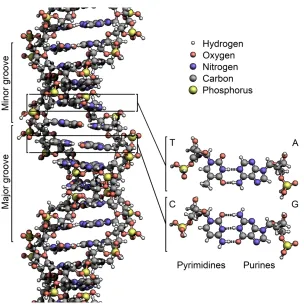
Figure 2.1: Multi-agent Computational Model of a DNA Chain
2.2
Biological Modeling
Multi-cellular systems biology is an emerging field aiming at a mechanical under-standing of the processes of physiology, pathology, and development, which is done by studying the multi-scale interactions at the subcellular, cellular and tissue levels. In order to explore and predict a system’s behavior and to integrate quantitative data, there is an increasing need for computational simulation.
systems. There is a range of multi-scale modeling methods that could potentially be employed in systems biology. Shah and Wambaugh have classified these methods as either continuous or discrete methods, based on the strategy the methods use to integrate the various scales [22]. These models simulate cellular behavior in a multi-cellular context. Cellular behavior is modeled with process diagrams using deterministic and/or stochastic model elements.
Creating a model that explains cellular behavior and cellular interaction is complex enough even without introducing the fact that tissues encompass a number of different cell types that behave differently. Moreover, the model definitions themselves for such a system can be complicated since each cellular process needs to be noted and explained. It makes manual attempts intractable.
2.3
Evolutionary Search
The beginning of an evolutionary search starts off with a randomly generated population of individuals. Then to produce a successor population, a GA carries out a process of fitness-based selection and recombination, which creates the next generation. Parent individuals are selected and their descriptions are recombined to produce child individuals during recombination. These child individuals then pass into the successor population. Through this iterative process, a sequence of successive generations evolves and the average fitness of the individuals tends to increase until some stopping criterion is reached. In this way, a GA evolves a best solution to a given problem.
The development and success of GAs have greatly contributed to a wider interest in computational approaches based on natural phenomena and it is now a major strand of the wider field of Computational Intelligence, which encompasses techniques such as Particle Swarm Optimization, Neural Networks, Artificial Immunology and Ant Colony Optimization [10].
2.4
Visual Programming Languages
(top to bottom) and where the tokens are defined as words. There are a number of examples of visual expressions in VPLs, such as demonstrations of actions performed by graphical objects, diagrams, icons, or even hand-drawn sketches. Additionally, many VPLs are based on the design of screen objects such as boxes, treated as entities and connected by connections such as lines, arcs or arrows, representing the relationship of the entities [8].
It might be argued that traditional textual programming languages employ two di-mensions in defining the code syntax and semantics where the x-dimension represents the language as a strings and the y-dimension is used to make distinction between code sections and statements. This description can only be considered multi-dimensional in a limited way, since the spatial representation in the y-dimension doesn’t actually add to the languages syntax and semantics, but specifically allows clearer understanding of the language through that separation. This extra dimension can be remove and the language can be written on a single line without any loss of syntax or semantics, although it would be very difficult to write and read at that point [9].
Use of VPEs for textual languages help to further research in VPLs, and provide a conduit to putting research into practice, which can provide a gradual migration to using VPLs.
2.5
Previous Work
The earliest work in visual programming was in two directions: visual approaches to traditional programming languages (e.g., executable flowcharts), and approaches that deviated significantly from traditional approaches (such as programming by demonstrating the desired actions on the screen). There were advantages that many of these early systems had, which seemed exciting and intuitive on demonstrated example programs, however when attempts were made to extend them to programs that were more realistically sized, it caused a number of problems. These problems caused many to believe that visual programming was unsuited to real work, that it was just an academic exercise, leading to an early disenchantment with visual programming.
supports the Smalltalk language, and Visual Basic for the programming language Basic [6], while other VPEs have instead focused on coarse programming, such as the Computer-Aided Software Engineering (CASE) tools. These tools support having a visual specification, by way of diagrams and relationships among the program modules, which allow it to automatically generate composition code [9].
CHAPTER 3
VPEVOLVE
3.1
Motivation
VPEvolve is a client user interface that utilizes a visual programming environment (VPE) that allows setup of the GA parameters, manages the evolutionary search, and gathers and summarizes the progression of the search. Some motivations for VPEvolve were to create an application that could identify computation models in an automated fashion, use computer resources, such as network bandwidth and computational calculations, efficiently and have an interface that is simple and easy to use for researchers. Since creating complicated models is such a difficult manual task, VPEvolve uses evolutionary search to identify models that explain specific real world experiments. VPEvolve also utilizes distributed solutions to perform the search efficiently and with high resource utilization.
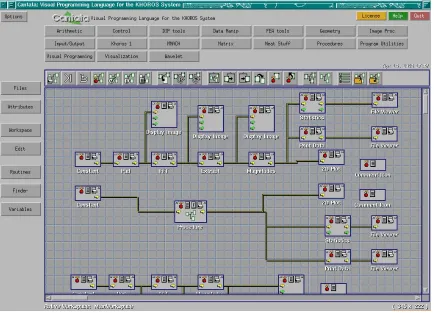
Figure 3.1: Cantata VPE
Cantata uses components called glyphs that are connected together to provide its work-flow, which was used in a similar way in VPEvolve. Specifically, VPEvolve has an emphasis on glyphs and inter-connectivity, which is used to manage the genetic operator work-flow of the evolutionary search. A glyph based VPE reduces the time for new users to become proficient with the user interface (UI) as well as give experienced users a better understanding of their genetic operator work-flow through visualization. In summary, this type of VPE provides a more intuitive environment to design and set up an evolutionary search.
with the python-based evolutionary search application (CSGA) that was designed as a companion to Cellsim, and was unable to work with any other modeling platforms.
3.2
Design Features
The mentioned motivations were considered heavily when designing the implementa-tion for VPEvolve. The programming language used was Java, a compiled language, to stream-line its run-time efficiency. VPEvolve was created using the NetBeans IDE and GUI builder, which enables user interface customization at the source code level [7]. Additionally, this customizable interface also allows users to save their client desktop environment (window layout, locations, etc.) according to their preferences and desired work-flow. The decision to use NetBeans and Java makes the client source code simpler, which improves tasks of future maintenance and development.
VPEvolve was designed as a general platform for initializing, managing and mon-itoring an evolutionary search. This generality is attributed to the modular architec-ture of the application, which theoretically allows it to be used as an evolutionary search application in any problem space. Another aspect of VPEvolves modularity is the weak coupling between the user interface code and the core logic that manages the GA.
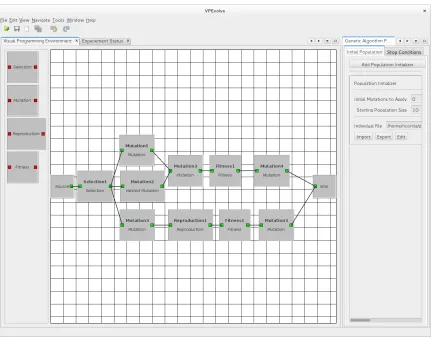
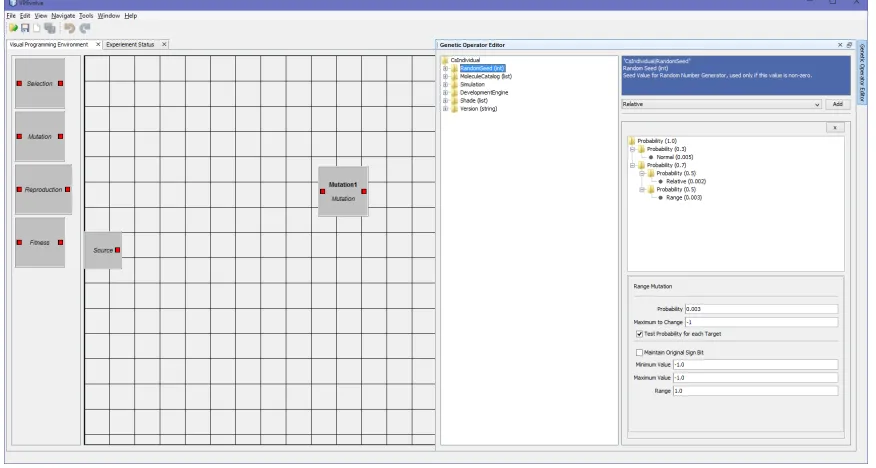
VPEvolves main window is the VPE, where the genetic operator components are created, connected and the GA parameters are set. The connected components (i.e., glyphs) are used to represent the genetic operators of the GA. Since a GA includes the application of genetic operators to individuals from a population over a given generation, the VPE window is organized to highlight this workflow (Figure 3.2).
Figure 3.2: VPEvolve VPE
the desired genetic operator work-flow. If used with CellSim, as the simulation server, there are four available operators to begin with, namely Selection, Mutation, Reproduction, and Fitness. Each of these operators have input and output points. Connections can be made between the output of one glyph and the input of another. In particular the Mutation operator allows the user to choose it to be a Nested Mutation, where the user can pick more than one mutation to apply at that point in the genetic operator work-flow. The user interface was designed to allow easy removal of glyphs or their connections by choosing the delete option following a right mouse click.
Glyphs are initially given a unique numbered name, which allows them to be identified in the operator network. These names can be changed at anytime through the pop-up menu, making them easier to identify. Additionally, mutation operators also display which part of the individual description to be mutated for quick differ-entiation. Upon starting an evolutionary search, VPEvolve does a simple validation to check that all components are connected, (i.e., there exists a path form Source to Sink). If this condition is violated then the tool reports the violating glyph’s name, so the glyph with the error can be quickly found in the VPE and the error corrected.
evaluation phases. This new set of individuals represents the population for the subsequent generation.
3.2.2 Configuration File
The configuration for VPEvolve file is in XML format, and contains two main sections, Core and GUI. The Core portion is requested from GA logic code, which will be further explained in Section 3.3.2. Meanwhile the GUI portion contains the relative locations for all the glyphs and their inter-connectivity.
3.2.3 Genetic Algorithm Parameter Setup
Figure 3.3: Genetic Operator Parameter Setup Window
of the nodes of the tree, the panel to the right of the tree is populated with either editable parameter fields or a selection box that allows you to add a specific type of mutation that applies to the node selected. For example, if the Effect node under the Genome node is selected, which describes the amount of promotion a molecule will have on a gene assembly, a selection box is populated with Numeric Mutations because effect is the data type float. By using the selection box, a mutation operator such as NormalMutation can be chosen and added, which will show the editable parameters for that mutation. Once focus is lost on the Genetic Operator Editor window, by clicking somewhere outside of its bounds, the window slides to the right and disappears so that the VPE can be clearly seen.
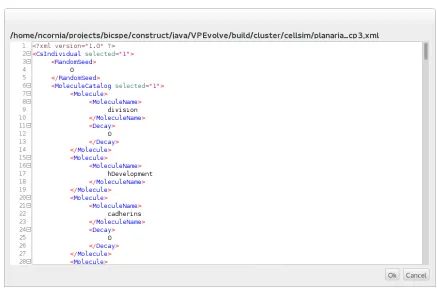
as where cells are located, gene assemblies, chemistry equations and the molecule catalog. In VPEvolve, the individual XML file can be imported and edited in the internal text editor to make desired changes. This editor highlights syntax for convenience of editing and complying with correct XML syntax (Figure 3.4).
Figure 3.4: XML Editor for Individuals
These fitness functions need to be supplied to VPEvolve, which are very specific to the algorithm used and how it is calculated based on the individual description.
Fitness evaluators are very specific to the system and problem under consideration. Due to its wide acceptance and use by biologists, fitness evaluators are user-defined and coded in Python, that is easy to learn and a flexible programming language. Contributing to its flexibility is its ability to invoke library functions from higher performing compiled languages like C and C++. Therefore, a Python file import option is provided in VPEvolve, as well as an editor to make any necessary changes (Figure 3.5). Prior work in our lab has led to development of a number of fitness eval-uators implemented as C libraries accessible from Python. These include evaleval-uators such as Difference Distribution, Overlay Distribution and Graph Edit Distribution.
3.2.4 Evolutionary Search Status View
Figure 3.5: Custom Python Fitness Evaluator Editor
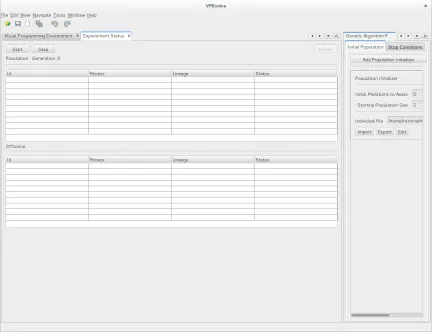
Figure 3.6: Evolutionary Search Status Window
3.2.5 Console Mode
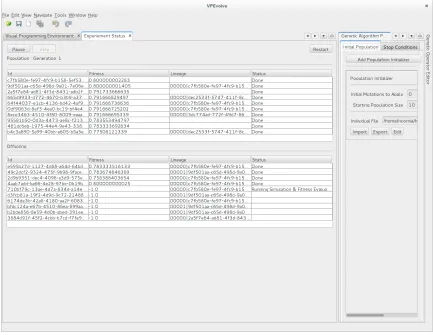
Figure 3.7: VPEvolve Evolutionary Search in GUI
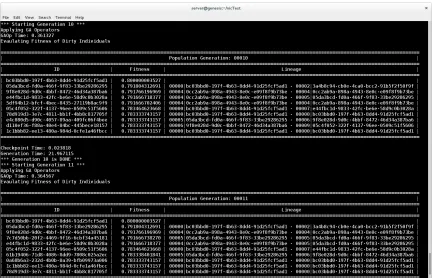
need to forward a GUI, which often makes interaction slow or unresponsive. Moreover, all the same status information provided in the GUI is displayed to the console except a table format (Figure 3.8).
Figure 3.8: VPEvolve Evolutionary Search in Console Mode
Since VPEvolve starts processes on separate nodes of a computer cluster, therefore it was advantageous to delegate as much work to the compute nodes and keep GA logic processing the same node as VPEvolve. The diagram in Figure 3.9 shows the process of starting the middleman software on a separate node, doing a model simulation of a single individual, calculating the fitness value and sending it back to VPEvolve. Since VPEvolve was designed to be generic and be able to use any platform to run simulations, middleman software was needed to correctly integrate with CellSim. The middleman software interacts with CellSim as the simulation is in process, and once the simulation is completed it calculates the fitness of the individual with the specified fitness evaluator. This separation of functionality allows the simulation and fitness evaluation, the most expensive calculations, to be done on a different node than VPEvolve. Therefore, VPEvolve needs to simply create the new individuals for each generation by applying the genetic operators, collect the fitness values, and report on the progress of the search.
Figure 3.9: VPEvovle Client-Server Individual Processing
which are used by the middleman software in the fitness evaluator to calculate the fitness value. The middleman software then sends the fitness value for that individual back to VPEvolve. If VPEvolve identifies the fitness value to be unique, it tells the middleman software to save both the snapshot and individual description in a shared folder for later analysis.
3.2.7 Evolutionary Search Checkpointing
can be used to load both the GA configuration and the starting population where the correct information about generation and population is preserved. During this process of loading the file, VPEvolve will detect which file is being used and load the search appropriately. The individual descriptions for our experiments typically consist of a sheet of about 120 cells, which take up about 100KB of disk space. Therefore, a typical GA setup with a population size of 100 individuals, each checkpoint file will be about 10MB, and over 100 generations it will grow to 1GB of disk space. This is obviously a problem if disk space is limited, so the user can specify at what generation interval to checkpoint or choose to disable check pointing all together.
3.3
Architecture
3.3.1 Modular Design
could be deployed on a remote system without any of the GUI modules which would save disk space.
Figure 3.10 shows the critical modules that are used in VPEvolve where lines represent internal dependencies. For simplicity and readability of the figure, some
Figure 3.10: VPEvolve Module Diagram
notifications of its progress to any processes waiting for those notifications.
3.3.2 Implementation of Genetic Operators
The Genetic Algorithm Core module contains the GA logic used in an evolutionary search and describes how the genetic operators are applied and how communication between VPEvolve and the middleman software is done. The implementation of the genetic operators is contained in its own module. This separation of logic definition and implementation allows new genetic operators to be implemented and added as needed. If new operators are needed the GeneticOperator abstract class should be implemented and be placed in the GeneticOperatorImpl module. When VPEvolve is first opened, it searches this module for all the source files and registers them with their appropriate factories in the GeneticAlgorithmCore module. Afterwhich, any operator can be requested and returned from the operator’s factory. This factory design pattern allows VPEvolve to contain and support new implementations of the genetic operators without needing to change how the GA or VPE component code works.
Figure 3.11: VPEvolve Class Diagram
numeric values in the individual description are changed. The Mutation Operator is a subclass of the Genetic Operator class, so that once an evolutionary search is run it performs a single operation of applying all specified genetic operators in the operator network. This approach allows the search to be run without the search understanding all the definitions of subclass operators.
These genetic operators are implemented specifically to make modifications to the scheme used by CellSim. This scheme file is used to identify the location for editing the individual and for genetic operator category, there is a do<category>Operation method, which directly edits xml tags of the individual description. By designing VPEvolve in a modular way, other modeling platforms can be used in place of CellSim.
2. provide genetic operators that describe how an individual should be manip-ulated, implemented in Java and implement the corresponding GeneticAlgo-rithmCore Class
3. provide a way to translate the individual from the xml format used in VPEvolve (i.e., the provided scheme file) to the platform being used for simulation if the scheme file format is incompatible
4. provide fitness evaluator(s) that will determine the fitness value of the individual
5. provide a middleman piece of software that is used to start the simulation platform given an individual from VPEvolve, run the fitness evaluator and report that result back to VPEvolve
CHAPTER 4
RESULTS
4.1
Comparison
This section provides a comparison between VPEvolve and CSGA. The following areas will be covered, user interface, architecture, computer resource usage and per-formance. VPEvolve uses a VPE for its user interface, which provides significant benefit over parameter input in CSGA, since VPEvolve allows the user to visually evaluate how the genetic operators are be applied. In contrast, CSGA only provides a primitive interface to setup the GA, which requires that users specify the genetic operators in tabbed views (Figure 4.1). This can lead to confusion about ther order of operator application, especially since the tabbed views can be reordered and the default order isn’t the actual order the operators are applied during the evolutionary search. VPEvolve on the other hand shows precisely where operator application be-gins (Source operator), how individuals flow through operator application and where it ends (Sink operator), in a visually understandable way. Furthermore, VPEvolve also provides additional flexibility for experiment setup.
Figure 4.1: CSGA GA Parameter Setup View (Replacement Operator)
Figure 4.2: CSGA Translated Evolutionary Search
one-dimensionality of the CSGA genetic operator workflow, is in contrast to the flexibility of VPEvolve, which allows a multi-dimensional genetic operator work-flow. This type of work-flow allows VPEvolve to create genetic algorithm setups with greater complexity and that promote to explore parts of a search space that were previously not possible.
Figure 4.3: CSGA Console Mode
(a) CSGA
(b) VPEvolve
Figure 4.4: Client-Server Individual Processing
individual can be run separate from the main software, taking advantage of parallel computation.
which can depend on the experiment being performed. The studies being done in the Andersen lab generate snapshots that are about 3MB in size. Therefore with a population size of 1,000 network traffic could peak at 3GB if there are enough nodes to run all simulations for the 1000 individuals in parallel. If CSGA is running on a computer cluster this bandwidth would amount to inter-node traffic, in which case there are a number of high-speed connections available such as InfiniBand which could handle that amount of traffic, but such solutions require expensive equipment. Comparatively, VPEvolve moves the fitness evaluation logic out to the same node as experiment simulation. Therefore, the individual snapshot never needs to be sent back to VPEvolve. After the fitness calculation, VPEvolve will receive a 64-bit number, the fitness value. Therefore, for a population size of 1,000 individuals VPEvolve would use 100MB of network bandwidth compared to at least 3GB for one snapshot per individual with CSGA which is an order of magnitude improvement.
simulation before communicating the result back it to VPEvolve. The average times
Runtime Comparison
Population Size VPEvolve CSGA (CSGA / VPEvovle)
5 8.665 31.214 3.60
10 16.923 34.667 2.00
25 33.473 57.889 1.73
50 60.359 117.899 1.95
100 116.496 185.067 1.59
250 276.577 486.286 1.76
500 556.069 941.791 1.70
Table 4.1: Average Time Elapsed for One Generation in Seconds (over 1000 runs)
In order to derive a comprehensive model of planarian cellular regeneration, simula-tions are being done in the Andersen lab using CellSim, where the worms are simulated as shown in Figure 4.5, consisting of a simple sheet of cells having a head region (purple) and a tail region (blue). The models in Figure 4.6, are able to reproduce
Figure 4.5: Wild-Type Worm
wet-bench experimental results from a single lateral cut as shown in Figure 4.7a. After the single cut the worm is able to regenerate the missing tail on the portion left with the head and vice versa as shown in Figure 4.7b.
(a) Gradient Based (b) Polarity Based
Figure 4.6: Planarian Cellular Models
(a) Before Regeneration (b) After Regeneration
Figure 4.7: Single Lateral Cut Experiment
generate tail near the cut, because it still has the head molecular concentration and the tail concentration has decayed away. Figure 4.6b depicts a model that has two cellular subunits. One subunit points towards the head of the worm, and is labeled with head polarity, and the other subunit points towards the tail and is labeled with tail polarity. In this case, when the single lateral cut happens the correct regions of head and tail are regenerated correctly because the cells along the cut know their orientation and can turn into the correct cell type.
In another experiment where a “shark-bite” portion is removed from the side of the worm, shown in Figure 4.8, the regeneration of neither a head region nor a tail region is expected because the worm is still considered whole. However, both the gradient and polarity models are not able to reproduce the wet-bench experimental results (Figure 4.8) for this experiment, which means there are critical mechanisms missing from either model that keep them from accurately representing planarian cellular regeneration.
Figure 4.8: “Shark-bite” Cut Target Worm
in half laterally, where a line of cells are removed and then again allowed to achieve stability. For this experimental setup the expected outcome would be the following: After the “shark-bite” cut there should be no regeneration of head or tail because the worm is considered to still be whole, but after the single lateral cut the side portion with the head should regeneration a new tail region and the portion with the tail should regeneration a new head region. When VPEvolve was used to run the GA for this setup a model was was found that produced a 1.0 fitness, meaning it was able to reproduce the wet-bench experimental results for both the “shark-bite” experiment, and the single later cut experiment in tandem as shown in Figure 4.9.
CHAPTER 5
CONCLUSIONS
VPEvolve is a desktop application aimed to facilitate initialization, running, and monitoring the progress of an evolutionary search. It was created as a free and open source application, which utilizes a VPE to make GA setup more convenient and efficient. Specifically, glyphs and connections are used to represent how individuals flow through the genetic operator application of the GA, which is an intuitive visual representation of how this work-flow proceeds.
VPEvolve offers improvements over a currently used GA setup implementation in the Andersen lab (CSGA), which allow evolutionary searches to be carried out faster and in a more efficient manner. Additionally, these improvements allow VPEvolve to scale better when more resources are available for an evolutionary search with 1) computational power and 2) network bandwidth. This is because VPEvolve manages the calculations for fitness evaluations on the nodes of a computer cluster and send the minimal amount of data over the network.
5.1
Future Directions
Selection of a set of glyphs in the UI could give an option to create a custom glyph that contains the glyphs and connections of the selection. This would allow sections of repeating glyphs and connections to be more concise. The additional benefit would be that the glyphs and interconnections could be better organized and labeled more concisely, which would make the setup easier to understand.
GUI Hooking and Unhooking
Since the GA logic is completely separate from the UI, a feature could be intro-duced to allow detaching the evolutionary search from either the console or the GUI. After which you could log out of the remote machine, then login from somewhere else, and reattach the GUI or console to the GA process running on the remote machine. This would allow more flexibility as to how an evolutionary search could be monitored. Allowing researchers to start an evolutionary search at one device, then check the status of the search from another device or location (e.g., home/work).
Proof of Concept and Guide for Using Modeling Platforms
REFERENCES
[1] A. Aziz Aboobaker. Planarian stem cells: a simple paradigm for regeneration. Trends in Cell Biology, 21(5):304 – 311, 2011.
[2] T. Adell, F. Cebri`a, and E. Sal´o. Gradients in planarian regeneration and homeostasis. Cold Spring Harbor perspectives in biology, 2(1), January 2010.
[3] W. S. Beane, J. Morokuma, D. S. Adams, and M. Levin. A chemical genetics approach reveals h,k-atpase-mediated membrane voltage is required for planarian head regeneration. Chemistry & Biology, 18(1):77 – 89, 2011.
[4] Marat Boshernitsan and Michael S. Downes. Visual programming languages: a survey. Technical Report UCB/CSD-04-1368, EECS Department, University of California, Berkeley, Dec 2004.
[5] Tim Boudreau, Jim Glick, Simeon Greene, Jack Woehr, and Vaughn Spurlin. NetBeans: The Definitive Guide. O’Reilly Media, Sebastopol, CA, USA, 2003.
[6] Steven D. Bragg and Carl G. Driskill. Diagrammatic-graphical programming languages and dod-std-2167a. InAUTOTESTCON’94. IEEE Systems Readiness Technology Conference.’Cost Effective Support Into the Next Century’, Confer-ence Proceedings., pages 211–220. IEEE, 1994.
[7] Margaret M. Burnett. Visual programming. Wiley Encyclopedia of Electrical and Electronics Engineering, 1999.
[8] Andries P Engelbrecht.Computational intelligence: an introduction. John Wiley & Sons, 2007.
[9] Scott F. Gilbert. Developmental Biology. Sinauer Associates, 2000.
[10] Gabor Karsai. A configurable visual programming environment: A tool for domain-specific programming. Computer, 28(3):36–44, 1995.
[13] N. J. Oviedo, J. Morokuma, P. Walentek, I. P. Kema, M. B. Gu, J. M. Ahn, J. S. Hwang, T. Gojobori, and M. Levin. Long-range neural and gap junction protein-mediated cues control polarity during planarian regeneration. Developmental Biology, 339(1):188 – 199, 2010.
[14] P. S. Pallas. Spicilegia zoologica quibus novae imprimis et obscurae animal-ium species iconibus, descriptionibus atque commentariis illustrantur. Berolini, Prostant, Apud Gottl., 8(4), 1774.
[15] C. P. Petersen and P. W. Reddien. Smed-βcatenin-1 is required for anteropos-terior blastema polarity in planarian regeneration. Science, 319(5861):327–330, 2008.
[16] C. P. Petersen and P. W. Reddien. Polarized notum activation at wounds inhibits wnt function to promote planarian head regeneration. Science, 332(6031):852– 855, 2011.
[17] P. W. Reddien and A. S´anchez Alvarado. Fundamentals of planarian regener-ation. Annual Review of Cell and Developmental Biology, 20(1):725–757, 2004. PMID: 15473858.
[18] J. C. Rink, K. A. Gurley, S. A. Elliott, and A. S´anchez Alvarado. Planarian hh signaling regulates regeneration polarity and links hh pathway evolution to cilia. Science, 326(5958):1406–1410, 2009.
[19] H. B. Sarnat and M. G. Netsky. The brain of the planarian as the ancestor of the human brain. The Canadian journal of neurological sciences. Le journal canadien des sciences neurologiques, 12(4):296–302, November 1985.
[20] Imran Shah and John Wambaugh. Virtual tissues in toxicology. Journal of Toxicology and Environmental Health, Part B, 13(2-4):314–328, 2010.
[21] J. M. Sikes and P. A. Newmark. Restoration of anterior regeneration in a planarian with limited regenerative ability. Nature, July 2013.
[22] Y. Umesono, J. Tasaki, Y. Nishimura, M. Hrouda, E. Kawaguchi, S. Yazawa, O. Nishimura, K. Hosoda, T. Inoue, and K. Agata. The molecular logic for planarian regeneration along the anterior-posterior axis. Nature, July 2013. [23] Mark Young, Danielle Argiro, and Steven Kubica. Cantata: visual programming