Patron: Her Majesty The Queen Rothamsted Research Harpenden, Herts, AL5 2JQ
Telephone: +44 (0)1582 763133 Web: http://www.rothamsted.ac.uk/
Rothamsted Research is a Company Limited by Guarantee
Rothamsted Repository Download
G - Articles in popular magazines and other technical publications
Phillips, A. L., Jing, H-C. and Hammond-Kosack, K. E. 2006. Exploiting T.
monococcum as a model for detection of traits, genes and variant alleles
and for identifying phenotype:genotype relationships. Department for
Environment, Food and Rural Affairs (DEFRA).
The publisher's version can be accessed at:
•
http://www.wgin.org.uk/wgin_2003-2008/Stakeholders/WGINStakeholderNewsletterOctober2006.pdf
The output can be accessed at:
https://repository.rothamsted.ac.uk/item/89v33
.
© 1 October 2006, Department for Environment, Food and Rural Affairs (DEFRA).
Next stakeholder workshop: 21st of November 2006 at Rothamsted Research
UPDATE ON PROJECT OBJECTIVES Project management (Objective 1)
Staff changes: Dr. Katie Tearall, who was employed within the WGIN core project at RRes, resigned her post in May to join the Business & Innovation Unit at BBSRC Swindon Office. Katie had successfully implemented the TILLING protocols at RRes and established an EMS-mutagenised population of 4,500 lines of cv. Cadenza. Katie’s results indicate a very high mutation rate in this population, which implies a high likelihood of success in TILLING for novel alleles in target genes. We wish Katie all success in her new post. Meanwhile, Carlos Bayon has been appointed as a replacement, as from 18th September. His first task will be to re-establish the TILLING methods and screen the EMS populations for mutations in primary target genes. In April 2006 Dr. Simon Griffiths has taken over the role of Dr. Robert Koebner at JIC.
Germplasm and COS markers at JIC (JIC) (Objective 3)
At the John Innes Centres we were excited to see how our first large scale field sowing of the Paragon EMS population would turn out. Because the lines have now undergone six rounds of single seed descent since mutagenesis they should show beautiful levels of uniformity within rows and fascinating phenotypic differences between rows. This was the case. Some of
the more striking mutants were the extreme
dwarfs, many late flowering lines, developmental shifts, and loads of the classical phenotypes such as awns, loss of wax, club ears ... This genetically fixed population has immense value for UK wheat research and is now being exploited in a number of projects including the BBSRC/INRA nitrogen use efficiency project.
Also at the JIC Church Farm we grew the Watkins collection (3200 lines) and the Defra reference mapping population Avalon x Cadenza. The aim of the study of the Watkins material was to assess the heterogeneity of the accessions held at JIC, so four head rows were grown for each. The material from each row will now become a distinct accession. The Watkins collection was also phenotyped for height (with plant growth regulator), flowering time, and vernalization requirement. The use of a collection like the Watkins is an altogether more daunting task than the conceptually simple experiments possible with the Paragon EMS
population. It is interesting to note though that a subset of the Watkins sent to Australia in the 1980s turns out to be the source of some important nematode resistance for Australian wheat breeding programs. It can be done and the rewards are potentially great.
A great resource for mapping, genotyping,
and mutation detection in all these
Orthologous Sequence (COS) markers. With primers anchored in exons these markers are highly transferable between grass genera but because they amplify across introns (highly mutated compared to exons) the products are rich in SNPs. The problem for wheat has always been finding a high throughput platform to resolve the SNPs. We now have these markers working as well as SSRs on an ABI 3730. Our first set of 140 COS primers designed to give even coverage over the wheat genome will soon be posted on the WGIN website. We will design and test more, mapping them on the Avalon X Cadenza double haploid population. Please
contact Simon Griffiths ([email protected]) if you would like to
become involved with this work or use any of the resources mentioned.
Exploiting T. monococcum as a model for detection of traits, genes and variant alleles and for identifying phenotype: genotype relationships (RRes) (Objective 6)
To achieve these aims, a global collection of T. monococcum accessions was obtained. In the previous newsletter (February 06), we reported that a considerable genetic diversity exists in the RRes T. monococcum collection as assessed by a type of molecular markers called SSR (Simple Sequence Repeat). This provides a basis for phenotype/genotype association studies.
We selected 30 T. monococcum accessions and examined the variation of several important morphological and agronomic traits including plant height, number of tillers, yield, grain storage protein profiles, grain hardness and resistance to abiotic and biotic stresses. Several traits have been found to be associated with SSR markers located at specific chromosomal regions. For instance, a large variation in grain hardness was observed in the 30 T. monococcum accessions and this variation was linked to the genetic differences in a region on chromosome 5A which encompasses the Hardness locus.
Another activity pertaining to identifying phenotype:genotype relationships is the construction of a high-resolution SSR marker map for T. monococcum. For this, we generated mapping populations by crossing accessions with contrasting phenotypes in key traits. A F3 population consisting of 94
individuals from the cross MDR308 (DV92) x MDR002 has been used for the construction of a SSR marker linkage map. Li-cor slab-gel based DNA analyser and fluorescence dye-labelled
primers are used for high throughput multiplexing SSR marker analysis (Figure 1).
Figure 1. Constructing the first T. monococcum
SSR marker map. Two Li-cor gel images deciphering the PCR products amplified in Triticum monococcum and T. aestivum using red and green fluorescence-labelled primer sets from hexaploid wheat A genome SSR markers. The four red and green bands in the two images represent SSR markers amplified from Avalon, MDR308, MDR002 and Cadenza from left to right.
Once constructed, the linkage map will facilitate association genetics for the identification of novel genes and variant alleles. So far we have assigned over 60 SSR markers on the 7 chromosomes. These SSR markers are also located on the A genome of T. aestivum.
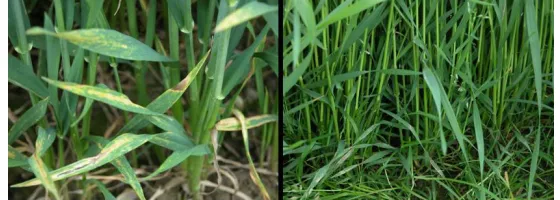
Our three-year of field experiment indicates that all the tested T. monococcum accessions exhibit high resistance to Septoria tritici (telemorph
Mycosphaerella graminicola) leaf blotch under UK wheat production conditions (Figure 2).
Figure 2. High resistance of T. monococcum to
A detailed cytological study indicated that the post-penetration hyphal growth of the fungus was reduced in most of the T. monococcum
accessions (Figure 3).
Bread wheat
(Cadenza) Hybrids
T. monococcum
(MDR308)
Hybrid seed setting
Hybrid embryo rescue
Bread wheat
(Cadenza) Hybrids
T. monococcum
(MDR308)
Hybrid seed setting
Hybrid embryo rescue
Figure 3. Scanning Electron Microscope
Cryofracture images showing different growth patterns of Mycosphaerella graminicola (Septoria tritici) in leaves of bread wheat Riband (top panel) and T. monococcum accession MDR308 (bottom panel). Abundant post-stomatal growth of Mycosphaerella graminicola was observed in bread wheat, whereas in most of T. monococcum accessions fungal hyphae mostly grew on the leaf surface but post-stomatal growth was restricted. The images were taken 11 and 24 days post inoculation for Riband and MDR308, respectively, at the Rothamsted Research Bioimaging Centre (courtesy of Jean Devonshire).
Under controlled environmental conditions by varying light and humidity, sporulation could be triggered for a few Septoria tritici isolates on a limited number of T. monococcum accessions. Thus, both field and controlled environmental tests indicated that T. monococcum could be a rich source of resistance to Septoria tritici leaf blotch. More importantly, the identification of both resistant and susceptible T. monococcum
accessions has allowed us to study the mode of inheritance of resistance in T. monococcum.
This genetic dissection of resistance is underway using the F3 population from the cross
MDR308 (DV92) x MDR002 which is also used to construct the SSR map as mentioned above.
To demonstrate the usefulness of the resistance traits for bread wheat genetic improvement, we selected two T. monococcum accessions (MDR308 and MDR002) and crossed them with genotype Chinese Spring and two UK wheat cultivars, Riband and Cadenza. Over a dozen viable hybrids have been obtained through either directing seed setting or embryo rescue (Figure 4). These will be backcrossed to a small selection of bread wheat cultivars in the near future.
Figure 4. Comparison of morphology and growth status of T. monococcum and bread wheat hybrids with corresponding parental lines. The male organs of bread wheat varieties were emasculated and pollinated with pollen from T. monococcum donors. The top panel shows that the hybrid seeds obtained by letting the crosses set seed are often shrunken and small in size in comparison with the parental lines. The bottom panel shows the growth of the hybrid seedlings obtained through embryo rescue 19-21 days after pollination and the corresponding parental lines. The embryo rescue work was carried out at the RRes Wheat Transformation Lab (Angela Doherty and Huw Jones).
A forward genetics approach has been employed in WGIN objective 6 to generate mutagenised T. monococcum populations for detection of novel variant alleles. In total 1500 M2 seeds of accession M308 (DV92) treated with
0.3, 0.4, or 0.5% EMS were obtained. Individual lines comprising the M3 population will be
season. Accession M308 (DV92) was chosen because it exhibited good resistance to many UK wheat pathogens and a BAC library is available for this genotype (Lijavetsky et al.,
1999, Genome 42:1176-1182.). A third
mutagenised population generated through the use of a low energy ion beam radiation platform by our collaborators in China was sown in the RRes glasshouse and M2 population is expected
to be harvested in early 2007.
Collectively, these three T. monococcum
mutagenised populations will form the reverse
functional genomic platform and will be used for novel allele mining by the TILLING technique. The gene RAR1, coding for one of the important signalling components in plant defence responses, has been selected as the initial TILLING target gene. The RAR1 gene has been identified in T. monococcum and the three homoeologous genes in bread wheat have also been identified. Currently, we are using TILLING to identify natural and induced variant alleles and examine the role of RAR1 in wheat resistance to major UK wheat pathogens.
For further information on the WGIN project please see www.wgin.org.uk or contact us at
The contributors to this newsletter were: At Rothamsted Research: Andy Phillips, Hai-Chun Jing and Kim Hammond-Kosack. At the John Innes Centre: John Snape, Leodie Alibert, Simon Griffiths and Simon Orford.
Next stakeholder workshop: 21st of November 2006 at Rothamsted Research