VOLUME 37, ARTICLE 62, PAGES 1949
−
1974
PUBLISHED 15 DECEMBER 2017
http://www.demographic-research.org/Volumes/Vol37/62/ DOI: 10.4054/DemRes.2017.37.62
Research Article
Gendered division of domestic work and
willingness to have more children in China
Juhua Yang
This publication is part of the Special Collection on “Domestic Division of Labour and Fertility Choice in East Asia,” organized by Guest Editors Ekaterina Hertog and Man-Yee Kan.
© 2017 Juhua Yang
This open-access work is published under the terms of the Creative Commons Attribution NonCommercial License 2.0 Germany, which permits use, reproduction, and distribution in any medium for noncommercial purposes, provided the original author(s) and source are given credit.
1 Introduction 1950
2 Gender, division of housework, and fertility 1951
3 Gender equality and fertility in the context of state intervention in China
1953
3.1 Division of housework 1953
3.2 Fertility 1954
3.3 Link of housework to fertility 1955
4 Data and method 1956
4.1 Data 1956
4.2 Measurements 1957
5 Descriptive statistics 1959
5.1 Living children ever born and desire for another child 1959
5.2 Division of domestic work 1960
5.3 Sample distributions of other variables 1962
6 Modeling fertility desire and domestic labor division 1964
7 Summary, discussion, and conclusion 1966
8 Acknowledgments 1968
Gendered division of domestic work and
willingness to have more children in China
Juhua Yang1
Abstract
BACKGROUND
Fertility research in the new century has shifted from how gender equality may suppress fertility to issues of how gender equality in the family may help recover fertility, as low fertility persists among developed countries. In contrast with much of the work in the developed world, little research has been done on China, an East Asian society characterized by extremely low fertility.
OBJECTIVE
This paper analyzes the link between gender equality at home and fertility among respondents aged 20–40.
METHODS
This study uses multiple waves of data from the China Health and Nutrition Survey to address the issue. In this project, we will measure fertility as wanting to have another child. First, we will provide a basic description of fertility intentions and couples’ involvement in domestic work. Then we will use binary logistic models to gauge the link between the extent of equality of engagement in domestic work in a family and their willingness to have another child.
RESULTS
While there is a positive correlation, a husband’s time spent on domestic work is insignificantly connected to fertility desire, all else being equal. A wife’s domestic work is inversely and significantly associated with the desire to have another child only when the child’s sex is not considered. Biological and cultural factors (e.g., age and the sex composition of existing children) are strong predictors of wanting another child.
CONCLUSIONS
More research is needed to establish an association between gender relations and childbirth in unique cultural and socioeconomic contexts. In China, there is still a restriction on the number of children due to the country’s universal two-child policy, but there has been a resurgence of some traditional gender norms in the process of
rapid-pace marketization. This implies more severe discrimination against mothers in the labor market, especially those with more than one child.
1. Introduction
In exploring transition from high fertility to low fertility, gender equality within and beyond the home has been shown to be one of the most important factors (e.g., Espenshade 1972; McDonald 2000a, 2000b). Originally researchers argued the association is negative, but recently researchers have argued that gender equality in the home, assisted by pro-family public policy that aims to reduce the conflicts of a woman’s workload and family obligations, may be positively associated with recovering childbirth in regimes with below-replacement or lowest-low fertility(e.g., Duvander and Andersson 2006; Goldscheider, Bernhardt, and Brandén 2013; Neyer, Lappegård, and Vignoli 2013; Oláh 2003). While findings vary, potentially due to divergent measurements used for both gender equality and domestic work, studies tend to suggest a significant link between the husband’s involvement at home and fertility.
So far, little research has looked at the association between these two factors in China. However, China presents an interesting and important case for analysis in this area for two reasons. The first relates to the legacy of a socialist and planned economy with high involvement of all women in the labor force. Although there has been a shift away from socialist practices to free market economy since 1978, and more women are retiring from the labor market (Shen, Zhang, and Yan 2012), China remains to have a high rate of female labor force participation (World Bank 2014). In the past 68 years, women have been strongly encouraged to reduce the time spent on domestic work, which goes against traditional gender ideology, in order to promote gender equality both inside and outside the home. Generally, these two trends have resulted in a greater number of husbands involving themselves more in domestic work. The second factor is the mechanisms by which China achieved its very low fertility. Unlike the West where low fertility has been an aggregate outcome of individual fertility choices, China’s well-below replacement level of birthrate has been imposed and enforced by the government. On the one hand, the implications are that the Chinese have little choice in the number of children they have in this policy context. On the other hand, the restrictive fertility policy, combined with the greatly reduced number of children, make every child extremely valuable, which may motivate the husbands to voluntarily share more housework and childcare responsibilities.
Nutrition Survey, this paper examines whether some of the same patterns and associations that characterize Western societies hold in a very different cultural context. We analyze the link between gender equality at home and fertility, with fertility measured as the desire for another child among married women with at least one child. The core research question to be addressed is whether gender equality, e.g., the husband’s involvement in domestic responsibilities, contributes to a higher fertility desire. We hope that the analytical findings will enrich our understanding of the association between domestic work or, more broadly, gender equality within the household boundary and fertility desire and reproductive behavior.
2. Gender, division of housework, and fertility
The increasing rate of the female labor force participation in the global community since the 1960s has broken the boundary of “women stay inside and men work outside,” meaning women fulfill domestic roles at home while men are the sole breadwinners. Such a notion has characterized the traditional division of labor and generated tensions between work and family. The balance of work and family obligations has been a classic research topic in academia and a practical dilemma that women have faced for many years. As a result, some women may choose not to have children or reduce the number of children they have (Gilbert 2008; Lai et al. 2017; Matysiak and Vignoli 2008; Williams 2000).
As one of the most essential aspects of family life and indicators of gender equality, husbands’ participation in domestic work and its association with fertility choice has become a popular research topic. The discourse on this relationship lies in the assumption that the low fertility in the West is largely related to the woman’s double burden at work and at home. Indeed, the growing female labor force participation in the West has been associated with a gradual shift to below-replacement fertility or lowest-low fertility (Kohler, Billari, and Ortega 2006). Since women traditionally bore the full burden of housework and fertility decisions (Becker 1991; Willis 1973), their labor force participation has been argued to be inversely linked to fertility (Becker 1960, 1965, 1991; Francesconi 2002; Heckman and Walker 1990; Willis 1973). The dual shift inside and outside the home may motivate women to decide not to have another child to avoid additional burdens (Brewster and Rindfuss 2000; Pinnelli and Fiori 2008; Craig and Siminski 2010b). Conversely, greater equality within the household could ease domestic burdens and reduce conflicts (McDonald 2000a, 2000b) and thereby motivate women to have more children.
children if husbands increase their contributions to domestic work. There has been a number of large comparative studies using developed countries’ data (Garcia-Manglano, Nollenberger, and Sevilla 2015) or data from multiple European nations (Crespi and Fontaine 2012; Harknett, Billari, and Medalia 2014; Kohler, Billari, and Ortega 2006), as well as research on specific countries, such as Australia (Craig and Siminski 2010a, 2010b), Finland (Miettinen, Basten, and Rotkirch 2011), Germany (Cooke 2004), Hungry (Oláh 2003), Italy (Pinnelli and Fiori 2008; Rizzi 2012), Japan (Komatsu 2011), the Netherlands (Mills et al. 2008), Portugal (Andrade and Bould 2012), Spain (Cooke 2009), Sweden (Goldscheider, Bernhardt, and Brandén 2013; Nilsson 2010), and the United States (Torr and Short 2004). These analyses document a variety of patterns.
Cooke (2004) and Mills et al. (2008) find a negative relationship between the share of female housework and the risk of having a second birth in both Germany and Italy, respectively. Husbands’ involvement in childcare is shown to be positively linked to the risk of having a second child in Spain and Italy (Cooke 2009), particularly for working women (Pinnelli and Fiori 2008). In Japan, the husband’s helpfulness impacts the ultimate number of children the wife decides to have, but its effect is only observed with the second child (Komatsu 2011).
Torr and Short (2004) discover a U-shape relationship between the wife’s share of domestic work and the number of children in the United States; that is, the most traditional women who take on over 84% of housework and the most modern women who take on 25% to 54% of housework are more likely to have a second child.
Finally, some studies find the relationship between domestic work and fertility patterns to be insignificant. For example, Craig and Siminski (2010a) find no evidence that the way housework or childcare is shared between couples, or the amount of the husbands’ contribution to domestic work, has any effect on the risk of having a second child directly or indirectly in Australia. In general, women in Germany have stronger decision power regarding whether to have a second child or higher order birth when life course perspective is taken into account because they are still the ones more affected by the concomitant housework (Bauer and Kneip 2014).
Inconsistent findings appear not only in studies conducted in different countries but also in studies conducted in the same country. In Sweden, for example, Nilsson (2010) finds no effect of housework on having more children controlling for age and the number of existing children. Conversely, Goldscheider, Bernhardt, and Brandén (2013) argue that having a partner who does not share housework suppresses fertility, measured by transition to parenthood and the second and third birth.
study links low fertility with the husbands’ low share of family responsibility in China. Husbands’ low involvement in domestic work suppresses fertility, although the association may not be sufficient to make a statistic difference. In China, it is also uncertain whether a more equitable division of domestic labor among couples and greater involvement by husbands specifically contributes to a higher fertility as the recent research suggests or whether gender equality leads to fewer children being born. Differences in political, economic, and cultural contexts, especially their intersections and combinations, may provide different answers to this question. Similarly, studies comparing men and women in relation to gender norms and practices may also lead to divergent results. Past studies tend to pay more attention to females, but attention has been increasingly devoted to the husbands’ domestic roles in exploring the relationship between gender equality and fertility transition.
3. Gender equality and fertility in the context of state intervention in
China
3.1 Division of housework
Studies on the division of housework have consistently found that, although men in China do more housework compared to men in Japan (Stockman, Bonney, and Sheng 1995), Chinese women remain the major performers of domestic work. Similar findings emerge from studies using qualitative data (Fang 2011; Zhang and Farley 1995), localized quantitative data (e.g., Chen 2005; Huang and Zhang 2007; Lu, Maume, and Bellas 2000; Zhang and Hu 2012; Zuo and Bian 2001), and nationally representative data (All-China Women’s Federation 2001; Yang 2006, 2014; Zheng 2013). Clearly, the shift to working outside the home for women has not brought about a shift to performing more domestic work for men. The unfinished women’s emancipation (Jiang 2012; Jin 2006; Wu 2009) corroborates what Hochschild (1989) observed among couples in the United States in the early 1980s, a phenomenon she labeled a “stalled revolution,” a reference to deeply rooted gender role norms in society (Goldscheider, Bernhardt, and Lappegård 2015).
3.2 Fertility
Reducing fertility has been used as a tactic to emancipate women from motherhood since the early stages of the communist regime. Family planning services were first implemented to improve maternal and child health and to improve women’s statuses (Peng 1991; Peng 1997). Since the early 1970s, the major purpose of fertility programs has shifted to curb population growth rate, and in 1980, China initiated the very restrictive one-child policy. Consequently, the state has intervened in private issues, e.g., how many children a family could have, which has also been incorporated into the agenda of the long-term socioeconomic development of the nation.
2016, may drive couples, women in particular, to choose between childbearing and career, rendering work and family more incompatible (Yang 2016).
3.3 Link of housework to fertility
China’s unique political setting makes the relationship between division of domestic work and fertility more complicated than in more developed countries. First, the Chinese have a limited choice of fertility due to the restrictive fertility policy. Couples in most countries can decide how many children they want based on their own personal (and household) judgments of the surrounding environments during their lives, but couples in China have little choice in this regard. Most urban couples are allowed to have only one child; some rural residents are allowed to have a second child, and most members of ethnic minority populations are allowed to have multiple children. Such restrictions are particularly rigid and powerful for employees in state-owned sectors. Although some rural residents can choose to have one or two children, urban residents have no choice but to have one child under normal circumstances, even if they desire two or more children.
Therefore, the value of children in a low fertility regime has been further reinforced, although some parents may no longer expect their children’s support in old age or to pass on the family line. As mentioned earlier, the rapid reduction of fertility in China is a result of strong state enforcement. Realistically, such a policy has cultivated an environment in which having more children has become a privilege for some segments of the population. There may be an implication that when people have little choice over the number of children, the husband’s participation in home tasks can hardly play an important role in fertility.
Chinese women do disproportionately more domestic work but still believe it to be fair, even among highly educated, professional women (Zhang and Farley 1995; Zuo and Bian 2001). Traditional gender attitudes have been internalized and reconstructed in the reform era and have been incorporated as a part of the social and economic structure. Since there is a resurgence of traditional gender norms in the division of labor, together with the minimal choice of fertility, we do not expect to find a strong link between fertility and the husband’s involvement in domestic work.
4. Data and method
4.1 Data
This paper uses data from the China Health and Nutrition Survey (CHNS) from 1993 to 2011 to explore the relationship of fertility and gendered participation in domestic work. This dataset is one of the few datasets in China that includes information on both the division of housework and fertility desires; thus, it is suitable to address our research question. CHNS is a longitudinal survey started in 1989, and nine follow-up surveys have been carried out over the past two decades. It is conducted jointly by the University of North Carolina and the China Academy of Preventive Medicine, now known as the CDC. The survey covers 12 provinces in total, Heilongjiang and Liaoning in the northeast, Shangdong and Henan in the north, Hubei and Hunan in the middle, Jiangsu in the east, and Guangxi and Guizhou in the southwest. In 2011, the survey added three new provincial-level units, Beijing, Shanghai, and Chongqing. While these provinces are not selected randomly, they are highly heterogeneous in socioeconomic and cultural aspects, as well as in fertility policies and behaviors. More importantly, samples within each province are drawn randomly using the Probability Proportional to Size sampling method. Consequently, findings emerging from this analysis provide valid insights into the relationship between domestic work and fertility.
sample selection criteria. Rather, we pool all the available samples together. After excluding cases with missing data, the final sample size is 3,331 (all survey waves included) or 2,434 (the 2009 and 2011 survey waves excluded). There are 1,940 unique women among 3,331 respondents and 1,520 unique women among 2,434 respondents. To obtain data on husbands’ involvement in domestic labor, we merge the husband’s information with their wife’s information.
4.2 Measurements
We first define the dependent variable. Given data availability and considering causal problems between domestic work and fertility, we measure it as the desire for another child. The survey asks respondents without children whether they want to give birth to a child, and it asks respondents with at least one child whether they want another child in addition to their existing children. We generate the dependent variable based on the respondent’s answer, wanting to have another child, which is coded as 1 when the respondent does wish to have another child and 0 when the respondent answers otherwise.
We use four groups of factors to predict fertility desire: (1) key predictors, which refer to husband-and-wife involvement in domestic work; (2) couples’ demographic and socioeconomic characteristics; (3) household context; and (4) macro context. We control the last three groups of factors to eliminate their potential confounding linkages between the key predictors and the response variable.
Regarding key predictors, we highlight gendered practice at home, which is measured as the division of domestic work, including both housework (defined in this paper as traditional female tasks, e.g., cooking, laundry, cleaning, and grocery shopping) and childcare (defined as taking care of children, feeding, showering, dressing, etc.). Following existing literature that separates measures of housework time or frequency (Craig and Siminski 2010a, 2010b; Pinnelli and Fiori 2008) and the time spent taking care of existing children (Craig and Siminski 2010a, 2011b), we also operationalize weekly housework and care work hours independently for both respondents and spouses. This yields four variables: the wife’s housework time, the wife’s childcare time, the husband’s housework time, and the husband’s childcare time. Housework is measured daily in minutes, while childcare time is measured weekly in hours.
and Rotkirch 2011) and the share of the wife’s work (Craig and Siminski 2010b; Torr and Short 2004) totaled together for time spent doing housework. Therefore, we also construct two variables reflecting relative hours using the respondent’s hours with the spouse’s hours subtracted to create a difference in the housework time variable and a difference in the care time variable, in addition to considering absolute measures. In this regard, great disparities exist between wives and husbands, but since the findings are substantially similar to what we have presented here, we do not present models with these variables.
The sociodemographic factor of age reflects both biological capacity of childbearing and completion of fertility and thus is closely related to desire for another child. For the purpose of this research, age is measured in years. Different types of
hukou, rural versus urban household registration, are entitled to corresponding identities, peasants and urbanites. As previously mentioned, fertility policies for urban people are more restricted compared to their rural counterparts. We code this variable dichotomously using 1 for rural hukou and 0 for urban hukou. Education, occupation, and income are used to capture the association of respondents’ socioeconomic characteristics with their desire for another child. In this paper, it is operationalized into four categories: no school or primary school, middle school, high school, and college or above. Occupation may be closely linked to fertility and fertility desire since it is directly related to work–family balance, with some occupations having a more restrictive work schedule than others. Further, it could control for the effect of fertility policies since certain cadres are under stricter policy control. In this paper, we code it as four categories: cadre (including administrators, professionals, service personal, etc.), ordinary workers, farmers, and those not working or in other occupations. Income is the most important indicator of power and determines who does more housework; it is also associated with how many children a couple has since higher incomes allow people the ability to pay a social compensation fee (e.g., fine) for out-of-policy births. We use both respondents’ and spouses’ income from all sources to predict their desire for another child. Since the distribution of these variables is highly skewed, we take their log forms and treat 0 income as 0.5 prior to the transformation.
coresidence with at least one parent is operationalized dichotomously: If respondents coreside with any parent, they are assigned a value of 1 and 0 otherwise. Living arrangements, or parental availability, may reflect both traditional family norms and parental assistance in domestic tasks. Such inter-generational reciprocity, especially parental help with childcare in this case, may reduce respondents’ time crunches when it comes to balancing work and family, leading to stronger desires for another child.
In the macro context we use the survey year to capture period effect and province to capture macro contextual effect on fertility desire, treating each year or province dichotomously. With substantially varying socioeconomic, sociodemographic, cultural, and institutional changes over time and across space, we expect that the desire for another child will vary over time and across space.
5. Descriptive statistics
We approach our analysis in two stages: First, we describe the characteristics of variables to understand the basic distribution of the sample. Then we regress desire for another child on division of domestic work to see the independent relationship between time devoted to domestic work and having another child.
5.1 Living children ever born and desire for another child
To begin, we describe the actual number and sex of children and whether respondents want another child. On average, respondents have 1.32 living children, but averages disguise the disparity of the number of children over time. The average number of children is 1.5 in 2003, decreased to 1.19 in 2006, and increased to 1.25 in 2011. For the sample without 2009 and 2011, a higher percentage is associated with those respondents with sons than those with daughters. About two-thirds of the sample has only one child, and the rest has two or more children, at the time of the survey.
5.2 Division of domestic work
The mean domestic work time of respondents and their spouses is presented in Table 1. A wife’s housework time is about 145.54 minutes daily and 10.39 hours for childcare work weekly. A husband’s time spent doing housework is only 57.37 minutes, which is much less than his wife; his weekly childcare time is also about three times lower than his wife. Additionally, about 43.26% of husbands did not do any housework, and 58.69% of them did not do any childcare work in the week prior to the survey.
Table 1: Distribution of division of domestic work (N=3,331)
Variables Mean/proportion SD
Husband’s daily minutes in domestic work
Housework 57.37 190.64
Childcare work (hours)a 3.44 9.01
Husband doing no domestic work
Housework 43.26% –
Childcare work (hours)a 58.69% –
Wife’s daily minutes in domestic work
Housework 145.54 239.07
Childcare work 10.39 20.89
Note:a = Childcare work is only calculated for respondents with at least one child younger than age 7. We consider that, generally
speaking, children of older ages are no longer in need of feeding or dressing.
Figure 1: Detailed distribution of routine housework time for husband and wife
Figure 2: Detailed distribution of childcare time for husband and wife
5.3 Sample distributions of other variables
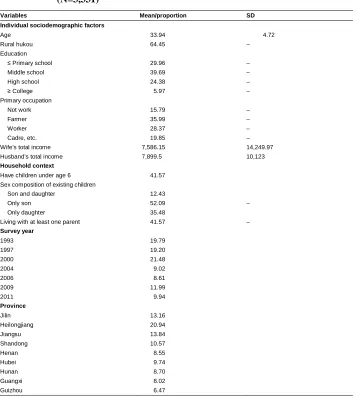
As Table 2 shows, the average age of respondents is 33.94 years old, suggesting that the sample is relatively old. This may be because we exclude those who are childless from the sample and because some respondents are follow-ups. Slightly less than two-thirds of women have a rural hukou registration. Women also differ in education, occupation, and income, and the monthly income of female respondents is much lower than that of their husbands.
Table 2: Descriptive statistics of other variables used in this analysis (N=3,331)
Variables Mean/proportion SD
Individual sociodemographic factors
Age 33.94 4.72
Rural hukou 64.45 –
Education
≤ Primary school 29.96 –
Middle school 39.69 –
High school 24.38 –
≥ College 5.97 –
Primary occupation
Not work 15.79 –
Farmer 35.99 –
Worker 28.37 –
Cadre, etc. 19.85 –
Wife’s total income 7,586.15 14,249.97
Husband’s total income 7,899.5 10,123
Household context
Have children under age 6 41.57
Sex composition of existing children
Son and daughter 12.43
Only son 52.09 –
Only daughter 35.48
Living with at least one parent 41.57 –
Survey year
1993 19.79
1997 19.20
2000 21.48
2004 9.02
2006 8.61
2009 11.99
2011 9.94
Province
Jilin 13.16
Heilongjiang 20.94
Jiangsu 13.84
Shandong 10.57
Henan 8.55
Hubei 9.74
Hunan 8.70
Guangxi 8.02
6. Modeling fertility desire and domestic labor division
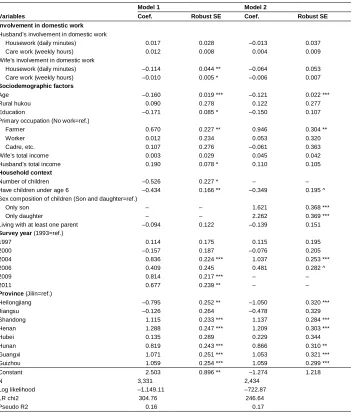
Since the dependent variable is dichotomous with 1, meaning that the respondent desires another child, we use a binary logistic regression technique for model analysis. First, we fit models for all samples, including those from 2009 and 2011. Including samples from the two most recent waves of the survey is important because they provide more up-to-date information on fertility desire. These two waves of survey also provide insight into whether respondents in 2009 and 2011 have different fertility desires from their peers in 1993 because the strength of implementation of fertility policy has been largely relaxed since 2005. The caveat of including them is that the sex composition of existing children cannot be measured accurately in these two waves of survey. Since the sex composition of existing children is central to fertility analyses and its association to fertility outcomes has been well established, it must be included in our analysis. So we fit a second model excluding the sample from 2009 and 2011 to see how the combination of number and sex of existing children may be associated with the response variable. We adopt a robust standard error to correct sample clustering problems in communities. Since the continuous and dichotomous measures of domestic work are highly correlated, they are fitted in two separate models. The results are very similar, and only models with continuous measures are reported here.
Table 3: Binary logistic model results of desire for another child
Model 1 Model 2
Variables Coef. Robust SE Coef. Robust SE
Involvement in domestic work
Husband’s involvement in domestic work
Housework (daily minutes) 0.017 0.028 –0.013 0.037
Care work (weekly hours) 0.012 0.008 0.004 0.009
Wife’s involvement in domestic work
Housework (daily minutes) –0.114 0.044 ** –0.064 0.053
Care work (weekly hours) –0.010 0.005 * –0.006 0.007
Sociodemographic factors
Age –0.160 0.019 *** –0.121 0.022 ***
Rural hukou 0.090 0.278 0.122 0.277
Education –0.171 0.085 * –0.150 0.107
Primary occupation (No work=ref.)
Farmer 0.670 0.227 ** 0.946 0.304 **
Worker 0.012 0.234 0.053 0.320
Cadre, etc. 0.107 0.276 –0.061 0.363
Wife’s total income 0.003 0.029 0.045 0.042
Husband’s total income 0.190 0.078 * 0.110 0.105
Household context
Number of children –0.526 0.227 * – –
Have children under age 6 –0.434 0.166 ** –0.349 0.195 ^
Sex composition of children (Son and daughter=ref.)
Only son – – 1.621 0.368 ***
Only daughter – – 2.262 0.369 ***
Living with at least one parent –0.094 0.122 –0.139 0.151
Survey year(1993=ref.)
1997 0.114 0.175 0.115 0.195
2000 –0.157 0.187 –0.076 0.205
2004 0.836 0.224 *** 1.037 0.253 ***
2006 0.409 0.245 0.481 0.282 ^
2009 0.814 0.217 *** – –
2011 0.677 0.239 ** – –
Province(Jilin=ref.)
Heilongjiang –0.795 0.252 ** –1.050 0.320 ***
Jiangsu –0.126 0.264 –0.478 0.329
Shandong 1.115 0.233 *** 1.137 0.284 ***
Henan 1.288 0.247 *** 1.209 0.303 ***
Hubei 0.135 0.289 0.229 0.344
Hunan 0.819 0.243 *** 0.866 0.310 **
Guangxi 1.071 0.251 *** 1.053 0.321 ***
Guizhou 1.059 0.254 *** 1.059 0.299 ***
Constant 2.503 0.896 ** –1.274 1.218
N 3,331 2,434
Log likelihood –1,149.11 –722.87
LR chi2 304.76 246.64
Pseudo R2 0.16 0.17
Note: *** p<0.001; **p<0.01; *p<0.05; ^P<0.10
for education is consistent with most existing findings and expectations: Better educated women are less likely to want another child, perhaps because they are more receptive to the outside arrangements and have a higher opportunity cost of childbearing. Compared to those who do not work or do not engage in regular work, the likelihood of wanting another child is higher among women who are farmers, family workers, cadre, civil servants, professionals, and employees of state-owned enterprises. However, statistical significance is only detected between farmers and the reference group. While respondents in the category of cadres are under stricter controls of fertility policy, and most of them are limited to having only one child, such restriction may contradict with their ideal number of children, which is about two (namely a son and a daughter); therefore, they have a higher desire for another child. Conversely, the lower risk associated with those not working or having no regular work is perhaps because they have already met their fertility desires or they quit their jobs due to work–family conflicts. Wives’ and husbands’ incomes are positively, but insignificantly, related to the outcome variable.
Household contextual factors, especially the number and sex composition of children, are strong predictors of wanting another child. As number of children goes up, women’s probability of wanting another child significantly reduces, and if the respondent has children under age 6 (inclusive), her risk of desire for another child goes down by 36%, compared to those without preschool aged children (Model 1). When Model 2 replaces the separate measures of child information with the composite measure, this variable clearly becomes the most important predictor for wanting another child. Those who have only daughters or only sons are significantly more likely to want another child than those with both sons and daughters. Taking the exponential of the coefficients for those with only sons and only daughters clearly shows that women with only sons are four times more likely to want another child, and women with only daughters are eight times more likely to want another child, compared to women with both sons and daughters. This suggests that the existing number of children affects women’s desires to have another child in the future. Furthermore, the sex composition of existing children, particularly traditional preference for sons, plays an additional and crucial role when it comes to future fertility plans. Interestingly, coresiding with at least one parent decreases the likelihood of wishing for another child, but this is not significant.
7. Summary, discussion, and conclusion
fertility behaviors and preferences in the West. While studies have suggested that husbands’ housework sharing responsibilities tend to be positively correlated with fertility, particularly the risk of having another child (Goldscheider, Bernhardt, and Brandén 2013), similar studies in China are absent. Research in China provides insight into the way the relationship between gender equality and reproduction is translated into a very unique social, economic, political, and policy context.
Drawing on multiple waves of data from China Health and Nutrition Survey, this paper aims to illustrate the association of gendered division of domestic work, controlling for other factors, with fertility, measured as wanting another child among women aged 20–40. Major findings emerging from descriptive statistics and binary logistic regression models are summarized as follows.
First, few respondents, only 14.24% in our sample, desire to have another child. Several reasons may account for this low percentage. For example, the sample is relatively old, 34 years on average. Because of this, a good proportion of women (25%) have already had two or more children. Indeed, among women aged 20–24, the actual number of children is 1.10, and, correspondingly, 25.5% of them desire another child. Conversely, those aged 35–40 have 1.40 children on average, and only 8.59% of them desire another child.
Also, since the survey is conducted during the period of the restrictive fertility policy, people who want another child may not report their true intentions due to concerns that they may be supervised by family-planning cadres. Couples in China tend to desire two children, specifically one son and one daughter, which is not compatible with the fertility policy for some segments of the population. When their preferences are in conflict with policy, some couples may covertly attempt to have the desired number and sex of children. Researchers have argued that the actual fertility rate and desired number of children are higher than the reported rates due to the underreporting of the desired number of children (Chen 2015; Yang 2015; Zhai, Chen, and Li 2015). Additionally, the increasing conflict between work and family may contribute to the disparity between the number of children a woman wants to have and the number of children they actually have.
them may not be found in China either because children remain extremely valuable and cherished in the low-fertility regime or because domestic work remains largely reserved for women ideologically and practically. In this context, how much domestic work the husband does is less important when a couple makes fertility decisions.
Third, the critical factor for fertility desire is child composition. The composite measure of the number and sex of existing children is the most important predictor, which yields the strongest effect on wanting another child. Overall, in our study population, fertility desire has little to do with the gendered practices at home between the husband and wife when the sex composition of existing children is considered. In other words, when only the existing number of children is considered, women’s own involvement in domestic work reduces their desire for another child, but when the sex composition of children is jointly considered, the association of domestic work with fertility desire goes away. It is children’s composition, specifically the sex of their children, that motivates women to want another child.
This analysis should be considered as an illustration of the relationship between fertility desires and involvement of husbands and wives in domestic work. While this study does not provide strong evidence to support the patterns emerging in the West, the importance of gender equality in domestic work for fertility should be examined closely. What the study findings and related studies suggest is that more research is needed to establish the linkage of gender relations to childbirth (Nilsson 2010), especially in the context of universal two-child policy, and having another child is more of a personal or family choice. The results also suggest that unique cultural, socioeconomic, demographic, and policy contexts in each country may intervene with the relationship between the husband’s participation and fertility outcomes. Therefore, it is important to expand relevant research to settings outside of the West in order to explore the universality of this relationship.
8. Acknowledgments
References
All-China Women’s Federation (2001). Report on the main data from the second sample investigation on Chinese women’s social status [in Chinese].Collection of Women’s Studies 5: 4–12.
Andrade, C. and Bould, S. (2012). Child-care burden and intentions to have a second child: Effects of perceived justice in the division of child-care. International Review of Sociology 22(1): 25–37.doi:10.1080/03906701.2012.657527.
Bauer, G. and Kneip, T. (2014). Dyadic fertility decisions in a life course perspective.
Advances in Life Course Research 21: 87–100.
Becker, G. (1960). An economic analysis of fertility. In: Roberts, G.B. (ed.).
Demographic and economic change in developed countries. New York City: Columbia University Press: 209–240.
Becker, G. (1965). A theory of the allocation of time.The Economic Journal 75(299): 493–517.doi:10.2307/2228949.
Becker, G. (1991).A treatise on the family. Cambridge: Harvard University Press.
Brewster, K.L. and Rindfuss, R. (2000). Fertility and women’s employment in industrialized nations. Annual Review of Sociology 26: 271–296.
doi:10.1146/annurev.soc.26.1.271.
Cai, Y. (2010). China’s below-replacement fertility: Government policy or socioeconomic development? Population and Development Review 36(3): 419–440.doi:10.1111/j.1728-4457.2010.00341.x.
Chen, F. (2005). Employment transitions and the household division of labor in China.
Social Forces 84(2): 831–851.doi:10.1353/sof.2006.0010.
Chen, W. (2015). China’s fertility estimation: A generalized stable population approach [in Chinese].Population Studies China 39(6): 35–43.
Cooke, L.P. (2004). The gendered division of labor and family outcomes in Germany.
Journal of Marriage and Family 66(5): 1246–1259. doi:10.1111/j.0022-2445.2004.00090.x.
Craig, L. and Siminski, P. (2010a). If men do more housework, do their wives have more babies?Social Indicators Research 101(2): 255–258. doi:10.1007/s11205-010-9644-1.
Craig, L. and Siminski, P. (2010b). Men’s housework, women’s housework, and second births in Australia. Social Politics: International Studies in Gender, State and Society17(2): 235–266.doi:10.1093/sp/jxq004.
Crespi, I. and Fontaine, A. (2012). Transition to parenthood and fertility intentions in Europe: Family choices and child-birth challenges. International Review of Sociology22(1): 1–4.doi:10.1080/03906701.2012.657525.
Duvander, A.Z. and Andersson, G. (2006). Gender equality and fertility in Sweden: A study on the impact of the father’s uptake of parental leave on continued childbearing. Marriage and Family Review 39(1–2): 121–142. doi:10.1300/ J002v39n01_07.
Espenshade, T.J. (1972). The price of children and socio-economic theories of fertility.
Population Studies 26(2): 207–221.doi:10.1080/00324728.1972.10405546.
Fang, Y. (2011). The distribution of household work: Women’s life experiment and gender politics [in Chinese].Social Science in Guangdong 4: 219–226.
Francesconi, M. (2002). A joint dynamic model of fertility and work of married women.Journal of Labor Economics 20(2): 336–380.doi:10.1086/338220.
Garcia-Manglano, J., Nollenberger, N., and Sevilla, A. (2015). Gender, time-use, and fertility recovery in industrialized countries. In: Wright, J.D. (ed.).International encyclopedia of the social and behavioral sciences. Amsterdam: Elsevier: 775–780.doi:10.1016/B978-0-08-097086-8.31104-7.
Gilbert, N. (2008). A mother’s work: How feminism, the market, and policy shape family life. New Haven: Yale University Press.
Goldscheider, F., Bernhardt, E., and Brandén, M. (2013). Domestic gender equality and childbearing in Sweden. Demographic Research 29(40): 1097–1126. doi:10. 4054/DemRes.2013.29.40.
Goldscheider, F., Bernhardt, E., and Lappegård, T. (2015). The gender revolution: A framework for understanding changing family and demographic behavior.
Hagewen, K.J. and Morgan, P. (2005). Intended and ideal family size in the United States, 1970–2002. Population and Development Review 31(3): 507–527.
doi:10.1111/j.1728-4457.2005.00081.x.
Harknett, K., Billari, F.C., and Medalia, C. (2014). Do family support environments influence fertility? Evidence from 20 European countries. European Journal of Population 30(1): 1–33.doi:10.1007/s10680-013-9308-3.
Heckman, J.J. and Walker, J.R. (1990). The third birth in Sweden. Journal of Population Economics 3(4): 235–275.doi:10.1007/BF00179336.
Hochschild, A. (1989).The second shift: Working parents and the revolution at home. New York: Viking Press.
Huang, H.Q. and Zhang, J.G. (2007). A study on the current husband’s and wife’s views of family: An analysis of the 2005 sampling survey in Shanghai [in Chinese]. Journal of East China Normal University (Philosophy and Social Sciences)39(4): 86–92.
Jiang, Y.P. (2012). Dual construction of both nation and family and women’s gender role: Nation and women in China’s planned economy period [in Chinese].
Journal of Shandong Women’s University1: 1–6.
Jin, Y.H. (2006). Rethinking the ‘iron girls’: Gender and social work in China during the cultural revolution [in Chinese].Sociological Studies 1: 169–193.
Kohler, H.P., Billari, F.C., and Ortega, J.A. (2006). Low fertility in Europe: Causes, implications and policy options. In: Harris, F.R. (ed.). The baby bust: Who will do the work? Who will pay the taxes? Lanham: Rowman and Littlefield: 48–109.
Komatsu, H. (2011). An economic analysis of fertility in Japan: Will the husband’s time spent in housework and childcare increase birth probabilities? [PhD thesis]. Washington, D.C.: American University, Department of Economics.
Lai, D., Meng, D., Li, C., Wang, Q. (2017). China labor market development report 2016: Female employment in the process of gender equality. Beijing: Beijing Normal University Publishing Group.
Lu, Z.Z., Maume, D.J., and Bellas, M.L. (2000). Chinese husbands’ participation in household labor.Journal of Comparative Family Studies 31(2): 191–215.
McDonald, P. (2000a). Gender equity in theories of fertility transition.Population and Development Review 26(3): 427–439.doi:10.1111/j.1728-4457.2000.00427.x.
McDonald, P. (2000b). Gender equity, social institutions and the future of fertility.
Journal of the Australian Population Association 17(1): 1–16.
doi:10.1007/BF03029445.
Miettinen, A., Basten, S., and Rotkirch, A. (2011). Gender equality and fertility intentions revisited: Evidence from Finland. Demographic Research 24(20): 469–496.doi:10.4054/DemRes.2011.24.20.
Mills, M., Mencarini, L., Tanturri, M.L., and Begall K. (2008). Gender equity and fertility intentions in Italy and the Netherlands. Demographic Research 18(1): 1–26.doi:10.4054/DemRes.2008.18.1.
National Health and Family Planning Commission of the PR China (2015). Press Conference (July 10, 2015) of the National Health and Family Planning Commission. http://www.nhfpc.gov.cn/xcs/s3574/201407/f8a362e80bd4412fa 70d862bdff183b3.shtml.
Neyer, G., Lappegård, T., and Vignoli, D. (2013). Gender equality and fertility: Which equality matters?European Journal of Population 29(3): 245–272.doi:10.1007/ s10680-013-9292-7.
Nilsson, K. (2010). Housework and family formation: Exploring the relationship between gender division of housework and having children. The Open Demography Journal 6(3): 1–10.doi:10.2174/1874918601003010001.
Oláh, L.S. (2003). Gendering fertility: Second births in Sweden and Hungary.
Population Research and Policy Review 22(2): 171–200. doi:10.1023/ A:1025089031871.
Peng, P.Y. (1997). A complete collection of china family planning programs [in Chinese]. Beijing: China Population Publication House.
Peng, X.Z. (1991).Demographic transition in China: Fertility trends since the 1950s. Oxford: Clarendon Press.
Pinnelli, A. and Fiori, F. (2008). The influence of partner involvement in fatherhood and domestic tasks on mothers’ fertility expectations in Italy. Fathering: A Journal of Theory, Research, and Practice about Men as Fathers 6(2): 169–191.
Rizzi, E.L. (2012). Gender inequity and low fertility in Italy: The mechanisms of influence. Paper presented at the conference “Sustainability of Population Changes,” IRES, Louvain-la-Neuve, 21–22 May, 2012.
Shen, K., Zhang, Y., and Yan, P. (2012). Family structure and female labor force participation in China [in Chinese].Population Research China 36(5): 15–27.
Stockman, N., Bonney, N., and Sheng, X. (1995).Women’s work in East and West: The dual burden of employment and family life. London: UCL Press.
Torr, B.M. and Short, S. (2004). Second births and the second shift: A research note on gender equity and fertility.Population and Development Review 30(1): 109–130.
doi:10.1111/j.1728-4457.2004.00005.x.
Williams, J. (2000).Unbending gender: Why family and work conflict and what to do about it. New York: Oxford University Press.
Willis, R.J. (1973). A new approach to the economic theory of fertility behavior. The Journal of Political Economy 81(2): S14–S64.doi:10.1086/260152.
World Bank (2014). Labor force participation rate, female (% of female population ages 15+) (modeled ILO estimate) [electronic resource]. Washington, D.C.: World Bank. http://data.worldbank.org.cn/indicator/SL.TLF.CACT.FE.ZS?order= wbapi_data_value_2012+wbapi_data_value+wbapi_data_value-last&sort=desc.
Wu, X.Y. (2009). A striking transformation of gender discourse under the marketization background [in Chinese].Social Sciences in China2: 163–176 and 207–208.
Yang, J.H. (2006). Gendered division in private space: Evidence from division of domestic work [in Chinese].Collection of Women’s Studies 5: 16–22.
Yang, J.H. (2014). Continuity or strategy: Gender pattern of division of household work in China between 1990–2010 [in Chinese].Academic Research 2: 31–41.
Yang, J.H. (2015). Has China really fallen into fertility crisis? [in Chinese].Population Studies China 39(6): 44–61.
Yang, J.H. (2016). Family-friendly policy and the implementation of the universal two-child policy [in Chinese].Collection of Women’s Studies 2: 11–14.
Zhang, C.X. and Farley, J.E. (1995). Gender and the distribution of household work: A comparison of self-reports by female college faculty in the United States and China.Journal of Comparative Family Studies26(2): 195–205.
Zhang, J.H. and Hu, J.H. (2013). The impact of urban–rural difference on family time use in China: The case of housework [in Chinese]. Chinese Journal of Population Science6: 83–92.
Zheng, D.D. (2013). The socialization of household work promotes gender equality [in Chinese].Chinese Social Sciences Today A8.
Zuo, J.P. and Bian, Y.J. (2001). Gendered resources, division of housework, and perceived fairness: A case in urban China. Journal of Marriage and Family