DEMOGRAPHIC RESEARCH
VOLUME 37, ARTICLE 52, PAGES 1695
−
1706
PUBLISHED 5 DECEMBER 2017
http://www.demographic-research.org/Volumes/Vol37/52/ DOI: 10.4054/DemRes.2017.37.52
Descriptive Finding
The magnitude and timing of grandparental
coresidence during childhood in the United
States
Mariana Amorim
Rachel Dunifon
Natasha Pilkauskas
© 2017 Amorim, Dunifon & Pilkauskas.
This open-access work is published under the terms of the Creative Commons Attribution 3.0 Germany (CC BY 3.0 DE), which permits use, reproduction, and distribution in any medium, provided the original author(s) and source are given credit.
1 Introduction 1696
2 Data and method 1697
2.1 Data 1697
2.2 Measures 1697
2.2.1 Coresidence with grandparents 1697
2.2.2 Age at coresidence 1698
2.2.3 Race 1698
2.3 Methods 1699
3 Results 1700
3.1 Cumulative probabilities of grandparental coresidence 1700 3.2 Age-specific probabilities of grandparental coresidence 1701
4 Conclusions 1703
5 Acknowledgements 1704
Demographic Research: Volume 37, Article 52
Descriptive Finding
The magnitude and timing of grandparental coresidence during
childhood in the United States
Mariana Amorim1
Rachel Dunifon2
Natasha Pilkauskas3
Abstract
BACKGROUND
The likelihood that a US child will live with a grandparent has increased over time. In 2015, nearly 12% of children lived with a grandparent. However, the likelihood that a child will ever live with a grandparent is not known.
OBJECTIVE
We calculate the cumulative and age-specific probabilities of coresidence with grandparents during childhood. We stratify our analyses by types of grandparent-grandchild living arrangements (grandfamilies and three-generation households) and by race and ethnicity.
METHODS
We use two data sets – the pooled 2010–2015 American Community Surveys (ACS) and the 1997 National Longitudinal Survey of Youth (NLSY–97) – and produce estimates using life tables techniques.
RESULTS
Results indicate that nearly 30% of US children ever coreside with grandparents. Both three-generation and grandfamily living arrangements are more prevalent among racial and ethnic minority groups, with three-generation coresidence particularly common among Asian children. Black children are nearly two times as likely to ever live in a grandfamily as compared to Hispanic and white children, respectively. Children are much more likely to experience grandparental coresidence during their first year of life than in any other year.
1
Cornell University, USA. E-Mail:[email protected].
CONCLUSION
This paper suggests that the magnitude of grandparental coresidence is greater than previously known, particularly in early childhood.
CONTRIBUTION
This is the first study to calculate age-specific and cumulative probabilities of coresidence with grandparents during the whole childhood. Doing so allows us to better craft public policies and guide new research on family complexity.
1. Introduction
In the United States, the likelihood that a child will live with a grandparent has increased over time. In 1990, 6.5% of children lived with a grandparent; by 2015, this number increased to nearly 12% (Pilkauskas and Dunifon 2016). To date, the prevalence of grandparental coresidence has only been described using point-in-time estimates (Dunifon, Ziol-Guest, and Kopko 2014; Ellis and Simmons 2014; Taylor et al. 2010; excepting Pilkauskas and Martinson 2014 who study early childhood). Point-in-time estimates, however, underestimate the number of children who will ever coreside with grandparents and are arguably less informative than cumulative estimates when seeking to understand the magnitude and importance of coresidence with grandparents in American children’s lives.
This study sheds light on the role of coresidence in the lives of US children. We estimate the cumulative probability of grandparental coresidence over all of childhood (birth to age 18) and the age-specific probabilities of first experiencing grandparental coresidence. We examine two types of grandparent-grandchild living arrangements: grandfamilies (households with a grandparent and child, no parent present) and three-generation households (households with at least one grandparent, one parent, and one child). We study these households separately because they form for different reasons. Whereas grandfamilies often result from parental substance use, incarceration, mental health issues, or death (e.g., Gleeson et al. 2009), three-generation households generally arise from teen parenthood, parents’ or grandparents’ need for financial or instrumental support, and/or cultural preferences (Dunifon, Ziol-Guest, and Kopko 2014).
Demographic Research: Volume 37, Article 52
are also important moderators of linkages between grandparental coresidence and child well-being (Dunifon and Kowaleski-Jones 2007; Pilkauskas 2014).
We produce our age-specific and cumulative estimates by applying life table techniques. Life tables are used to examine the extent to which specific events occur across intervals of time (Bumpass and Lu 2000; Pettit and Western 2004; Wildeman 2009). As we cannot estimate the key life table figures for this study using a single data set, we rely on two data sets: the American Community Survey (ACS) and the 1997 National Longitudinal Survey of Youth (NLSY–97). The ACS is uniquely suited for this study due to its large and current sample. Although the NLSY–97 is less current, it is the only nationally representative longitudinal survey that gathers detailed information on children’s living arrangements from birth to age 18.
2. Data and method
2.1 Data
The American Community Survey is an annual 1/100 national random sample of the US population collected by the Census Bureau. The ACS is well suited to the study of rare events such as grandparental coresidence due to its large sample size. We use five years of pooled ACS data (2010–2014), which further increases the accuracy of estimates. Our ACS analytic sample is composed of 3,347,721 children under the age of 18 who were not living in group quarters.
The National Longitudinal Survey of Youth consists of a sample of 8,984 children ages 13–17 in 1997. We rely on retrospective information collected during the first round of the survey (1997) through a parent questionnaire. We exclude from our sample 1,048 children whose parents did not answer the 1997 questionnaire and 42 whose parents refused or did not know the answer for key questions. Our final analytic sample contains 7,894 children. When weighted, the sample is representative of children born between 1980 and 1984.
2.2 Measures
2.2.1 Coresidence with grandparents
present in the household. We account for biological, adopted, and step or in-law children. Presence of parents in the household is determined using the parent pointers developed by IPUMS-USA (Ruggles et al. 2010). We are able to identify all the grandfamilies and three-generational families in which the grandparent or parent is the reference person.
In the NLSY–97, we use retrospective calendars indicating changes in living arrangements from the moment of the child’s birth to the date of interview. We classify as three-generation arrangements those arrangements in which parents reported living with any grandparents for three or more months while also living with the children, or those arrangements in which children lived in three-generation households in 1997. We identify exposure to grandfamilies when parents indicated that they did not always live with their children and that the children lived with a grandparent instead or when children were currently living with a grandparent and without a parent. The NLSY–97 precludes definitive classification of some coresidential arrangements (N = 88).
2.2.2 Age at coresidence
The ACS asks whether each member of a household moved to the household in the last year, allowing us to create an indicator of whether coresidence with a grandparent started within 12 months of the interview date. This question is central to our purposes since estimation of cumulative risks using synthetic cohort life tables relies solely on people who experienced the event within 12 months of the survey date. Information from this question together with information on the child’s age allows us to determine the age at which coresidence started.
In the NLSY–97, respondents were asked when each living arrangement with grandparents started and ended. Using this information, we calculate children’s ages at the beginning of each coresidence.
2.2.3 Race
Demographic Research: Volume 37, Article 52
2.3 Methods
We use the ACS to produce a multi-decrement period life table. In assessing the probability that a child will ever live with a grandparent, we consider living in three-generation households and grandfamilies as two independent causes of grandparental coresidence based on their very different reasons for formation (e.g., Dunifon, Ziol-Guest, and Kopko 2014). Our goal is to estimate cumulative and age-specific probabilities of experiencing grandparental coresidence. Cumulative probabilities, or probabilities of ever living with grandparents, are calculated as the sum of all age-specific probabilities of living with grandparents for the first time. Age-age-specific probabilities are converted from age-specific rates, which represent the number of children experiencing grandparental coresidence for the first time between age x and x+1, divided by the number of children who had not yet experienced grandparental coresidence by the time they reached age x. The denominator of each of our age-specific rates include all children surveyed in the ACS who were between age x and x+1 adjusted by the probability of survival by age x. This adjustment is necessary because the ACS only allows us to identify children who experienced grandparental coresidence if they were coresiding with grandparents at the time of the survey. Without this adjustment, our inability to identify children who moved in and out of grandparent coresidence before the survey would inflate the denominator of our age-specific rates and yield downward biased age-age-specific and cumulative probabilities.
The ACS does not allow us to calculate one key measure: the proportion of children experiencing grandparental coresidence for the first time at any age. By including all children who moved in with grandparents in the last 12 months in the numerator of our age-specific estimates, regardless of whether they experienced this event for the first or for a repeated time, we would produce upwardly biased estimates. Using the NLSY–97, we calculate the proportion of children experiencing each type of grandparental coresidence for the first time at each age and use it to adjust the numerator of the age-specific estimates produced using the ACS. Adjustments for three-generational arrangements are computed separately for children of different races, except for Asian children, for whom we use the adjustment factor computed for all children due to small sample size. Similarly, due to the small number of occurrences of grandfamily arrangements, we calculate the adjustments for this type of coresidence using all children. Full life tables and adjustment calculations can be obtained upon request.
has been steep increase in the prevalence of grandparental coresidence over time (Ellis and Simmons 2014), what matters for our purposes are trends in the stability (not prevalence) of these arrangements. Unfortunately, we do not know whether and how instability in these arrangements changed over time. In spite of this limitation, sensitivity analyses indicate that changes in instability would need to be very high in order to affect our estimates in any meaningful way (i.e., an increase of 100% in the proportion of youth experiencing repeated moves at each age interval yield estimates of grandparental coresidence 8% to 16% smaller).
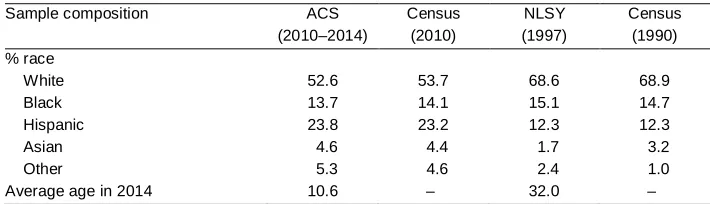
Table 1: Descriptive statistics of analytical sample benchmarked with census data, by data set
Sample composition ACS (2010–2014)
Census (2010)
NLSY (1997)
Census (1990) % race
White 52.6 53.7 68.6 68.9
Black 13.7 14.1 15.1 14.7
Hispanic 23.8 23.2 12.3 12.3
Asian 4.6 4.4 1.7 3.2
Other 5.3 4.6 2.4 1.0
Average age in 2014 10.6 – 32.0 –
Source: Weighted ACS (N = 3,347,721), weighted NLSY–97 (N = 7,894). Data from the 1990 census and 2010 census was collected through estimates generated by the Federal Interagency Forum on Child and Family Statistics’s website (http://childstats.gov).
Note: Census data from 2010 is not directly comparable with data from 1990 because categories of race in the survey are different. In the ACS and NLSY–97, data on race and Hispanic origin are collected separately. In all surveys, persons of Hispanic origin may be of any race.
3. Results
3.1 Cumulative probabilities of grandparental coresidence
Demographic Research: Volume 37, Article 52
Figure 1: Cumulative probability of coresiding with grandparents, by living arrangement and race
Source: Weighted NLSY–97 and weighted 2010–2014 ACS (pooled).
We find striking racial variation in the probability of coresiding with grandparents: 37.5% of Asian children, 29.2% of black children, 26.6% of Hispanic children, and 20.5% of white children will ever live in three-generation households. Our estimates also indicate that approximately 10.2% of black children, 5.3% of Hispanic children, 3.5% of white children, and 1.7% of Asian children will ever live in grandfamilies.
3.2 Age-specific probabilities of grandparental coresidence
Figure 2: Age-specific probabilities of coresiding with grandparents, by living arrangement
Source: Weighted NLSY–97 and weighted 2010–2014 ACS (pooled).
Figure 3 shows the age-specific prevalence by children’s race. Results indicate little difference in the age-specific patterns by race, with a child of any race being much more likely to first experience grandparental coresidence of either type during their first year of life as compared to any other age-interval. A child of any race faces low and virtually stable risks of starting to coreside with grandparents in any arrangement after reaching their first birthday. The risks of experiencing three-generation arrangements, however, are consistently higher than those of experiencing grandfamily arrangements.
Demographic Research: Volume 37, Article 52
Figure 3: Age-specific probabilities of coresiding with grandparents, by living arrangement and race
Source: Weighted NLSY–97 and weighted 2010–2014 ACS (pooled).
4. Conclusions
This paper is the first to estimate the cumulative and age-specific probabilities of three-generation and grandfamily coresidence over childhood. We find that about 30% of American children will spend some time living with a grandparent, which is consistent with previous research (Pilkauskas and Martinson 2014). We also find striking racial disparities in the probability of ever living with a grandparent. Consistent with earlier research, we find a higher prevalence of three-generation and grandfamily living arrangements among racial and ethnic minority groups (e.g., Ellis and Simons 2014; Dunifon, Ziol-Guest, and Kopko 2014; Pilkauskas 2014; Baker, Silverstein, and Putney 2008). We find that three-generation coresidence is particularly common among Asian children. No prior research has examined the cumulative probability of living in grandfamilies, and we find that black children are nearly two times as likely to live in grandfamilies as compared to Hispanic children and three times as likely compared to white children.
research on grandfamilies finds no age-gradient (Pilkauskas and Dunifon 2016) or finds that children in grandfamilies tend to be older (Mutchler and Baker 2004). The discrepancy in the grandfamily findings may be due the fact that earlier research does not examine when children first entered grandfamilies but rather examines the average age of children in grandfamilies.
Our study has some limitations. As previously noted, our estimates need to be interpreted with caution as the NLSY–97 refers to an older cohort of children than the ACS, and they will only be unbiased if the instability in living arrangements calculated using the NLSY–97 remained constant over time. Sensitivity analyses, however, indicate that even large changes in instability would only slightly bias our estimates. Second, our estimates might be downward biased as the ACS collects data on current living arrangements once a year and, accordingly, underestimates the number of children experiencing short-lived spells of grandparental coresidence at other moments of the year. Third, the NLSY–97 data relies on retrospective data, which is subject to recall bias. Last, our estimates for the risk of living in each separate type of coresidence might be downward biased if a significant number of children experience both types of arrangements over their childhood. Robustness checks (available upon request) suggest that this is not the case.
Despite some limitations, this paper represents the best existing effort to estimate the age-specific and cumulative prevalence of grandparental coresidence over the whole childhood period. This paper sheds light on an increasingly important living arrangement, one that is likely to impact children, parents, and grandparents alike. By understanding the likelihood that a child ever lives with a grandparent and whether grandparent coresidence varies by developmental age, we can better craft policies targeting both children and older adults, gain insight into the American family, and potentially guide new research on family complexity.
5. Acknowledgements
Demographic Research: Volume 37, Article 52
References
Baker, L.A., Silverstein, M., and Putney, N.M. (2008). Grandparents raising grandchildren in the United States: Changing family forms, stagnant social policies.Journal of Societal and Social Policy 7: 53–69.
Bumpass, L. and Lu, H.H. (2000). Trends in cohabitation and implications for children’s family contexts in the United States.Population Studies54(1): 29–41. doi:10.1080/713779060.
Dunifon, R.E., Ziol-Guest, K.M., and Kopko, K. (2014). Grandparent coresidence and family well-being implications for research and policy. The Annals of the
American Academy of Political and Social Science 654(1): 110–126.
doi:10.1177/0002716214526530.
Dunifon, R. and Kowaleski-Jones, L. (2007). The influence of grandparents in single-mother families.Journal of Marriage and Family 69(2): 465–481.doi:10.1111/ j.1741-3737.2007.00377.x.
Ellis, R.R. and Simmons, T. (2014). Coresident grandparents and their grandchildren, 2012. Washington, D.C.: US Census Bureau (Population characteristics P20– 576).
Fields, J. (2003). Children’s living arrangements and characteristics, March 2002. Washington, D.C.: US Census Bureau (Current population reports P20–547).
Gleeson, J.P., Wesley, J.M., Ellis, R., Seryak, C., Talley, G.W., and Robinson, J. (2009). Becoming involved in raising a relative’s child: Reasons, caregiver motivations, and pathways to informal kinship care. Child and Family Social Work14(3): 300–310.
Mutchler, J.E. and Baker, L.A. (2004). A demographic examination of grandparent caregivers in the Census 2000 supplementary survey. Population Research and
Policy Review23(4): 359–377.doi:10.1023/B:POPU.0000040018.85009.c1.
Pettit, B. and Western, B. (2004). Mass imprisonment and the life course: Race and class inequality in US incarceration.American Sociological Review69(2): 151– 169.
Pilkauskas, N.V. (2014). Living with a grandparent and parent in early childhood: Associations with school readiness and differences by demographic characteristics. Developmental Psychology 50(12): 2587–2599. doi:10.1037/ a0038179.
Pilkauskas, N.V. and Martinson, M.L. (2014). Three-generation family households in early childhood: Comparisons between the United States, the United Kingdom, and Australia. Demographic Research 30(60): 1639–1652. doi:10.4054/Dem Res.2014.30.60.
Pilkauskas, N.V. and Dunifon, R.E. (2016). Children living with grandparents: Prevalence, characteristics, and complexity. Paper presented at the Population Association of America, Washington, D.C., March 31–April 2, 2016.
Rossi, A.S. and Rossi, P.H. (1990). Of human bonding: Parent–child relations across the life course. New York: Aldine de Gruyter.
Ruggles, S., Alexander, J.T., Genadek, K., Goeken, R., Schroeder, M.B. and Sobek, M. (2010). Integrated Public Use Microdata Series: Version 5.0 [electronic resource]. Minneapolis: University of Minnesota.
Stykes, B., Manning, W.D. and Brown, S.L. (2014). Grandparenthood in the US: Residence status of grandparents. Bowling Green: National Center for Family and Marriage Research (NCFMR Family Profiles FP-14-12).
https://www.bgsu.edu/content/dam/BGSU/college-of-arts-and-sciences/NCFMR/documents/FP/FP-14-12-grandparents-us.pdf.
Taylor, P., Passel, J., Fry, R., Morin, R., Wang, W., Velasco, G., and Dockertman, D. (2010). The return of the multi-generational family household. Washington, D.C.: Pew Research Center (Social and demographic trends report).