The University of San Francisco
USF Scholarship: a digital repository @ Gleeson Library |
Geschke Center
Master's Theses
Theses, Dissertations, Capstones and Projects
5-13-1999
Chief Executive Officers of California
Environmental Organizations: A Study of Personal
Values Congruence with Organizational Mission
Christine Marie Schmidt
University of San Francisco
Follow this and additional works at:
https://repository.usfca.edu/thes
This Thesis is brought to you for free and open access by the Theses, Dissertations, Capstones and Projects at USF Scholarship: a digital repository @ Gleeson Library | Geschke Center. It has been accepted for inclusion in Master's Theses by an authorized administrator of USF Scholarship: a digital repository @ Gleeson Library | Geschke Center. For more information, please [email protected].
Recommended Citation
Schmidt, Christine Marie, "Chief Executive Officers of California Environmental Organizations: A Study of Personal Values Congruence with Organizational Mission" (1999).Master's Theses. 1141.
The author of this thesis has agreed to make available
to the University community and the public a copy of this dissertation project.
Unauthorized reproduction of any portion of this dissertation is prohibited.
The quality of this reproduction is
contingent upon the quality of the original copy submitted
.
University of San Francisco Gleeson Library/Geschke Center
2130 Fulton Street
Chief Executive Officers of California Environmental Organizations:
A Study of Personal Values Congruence with
Organizational Mission
A THESIS SUBMITTED
by
Christine Marie Schmidt
In Partial Fulfillment of the Requirements
for the Degree of
Master of
Nonprofit Administration
The University of San Francisco
ChiefExecutive Officers ofCalifomia Environmental Organizations:
A Study of Personal Values Congruence with
Organizational Mission
This Thesis written by
Christine Marie Schmidt
This Thesis written under the guidelines of the Faculty Advisory Committee, and approved by all its members, has been accepted in partial fulfillment of the requirements for the degree of:
Master ofNonprofit Administration
at the
University of San Francisco
Research Committee:
Chairperson
~~e~r
~::t.,o{
&M-ee
0r-/
f
7
Program Director Date
4,~c ll~~£7:
c.brfq9
Table of Contents
Abstract ... Iv
Vita Auctoris ... v
Acknowledgments ... vi
List of Tables ... vii
List of Appendices ... ix
Chapter One: Introduction ... 1
Chapter Two: Review of Related Literature ... 18
Chapter Three: Methodology ... 31
Chapter Four: Results ... 42
Chapter Five: Summary and Conclusions ... 91
References ... · ... 98
Abstract
This study surveyed the ChiefExecutive Officers of300 California environmental
organizations to investigate whether these officers were personally committed to their
organizations' missions as demonstrated by 1) past and present activities in their personal
lives that indicated personal values similar to those espoused by the organization, and 2)
their intent to stay with their organization. It was hypothesized that the level of activity in
the personal lives ofthe CEOs demonstrating personal commitment to their organizations
would be positively related to their intent to stay with their organizations. It was also
expected that there would be a negative association between the size of the environmental
organization, and the amount of evidence indicating that the CEO had personal values that
were congruent with those of the organization's mission.
This study demonstrated that the congruence of CEO personal values and
organizational mission had a significantly positive effect on the intended length of stay of
CEOs with their organizations. It also substantiated that individuals with high levels of
values congruence (and therefore intent to stay) were strongly influenced by the
environmental mission of the organization when accepting their current position. This has
Name
Date of Birth
High School
Graduated
Baccalaureate Degree
College
Graduated
Vita Auctoris
Christine Marie Schmidt
January 13, 1972
Carondelet High School Concord, California
1990
Bachelor of Arts Degree
University of California Davis, CA
Acknowledgments
To Bob Brewer, for all the love, support, patience, coaxing, prodding, and outright
bribery that enabled me to start and finish this study. To my mother, Sandra Pearson, for
teaching me the value of education, and for showing me what knowledge can do. To
Evan, Maddie, and Todd, for giving me all the quiet time I needed, and for being so
helpful with the surveys. Thanks also to Neil Pelkey, for taking the time to teach me how
to highlight what the surveys really revealed. Finally, thank you to Norah Holmgren and
Ed Rimer for providing insightful and objective comments that never failed to keep this
Table 1 Table 2 Table 3 Table 4 Table 5 Table 6 Table 7 Table 8 Table 9
Table 10
Table 11
Table 12
Table 13
Table 14
Table 15
Table 16
Table 17
Table 18
List ofTables
Values Congruence and Individual Commitment to Organization
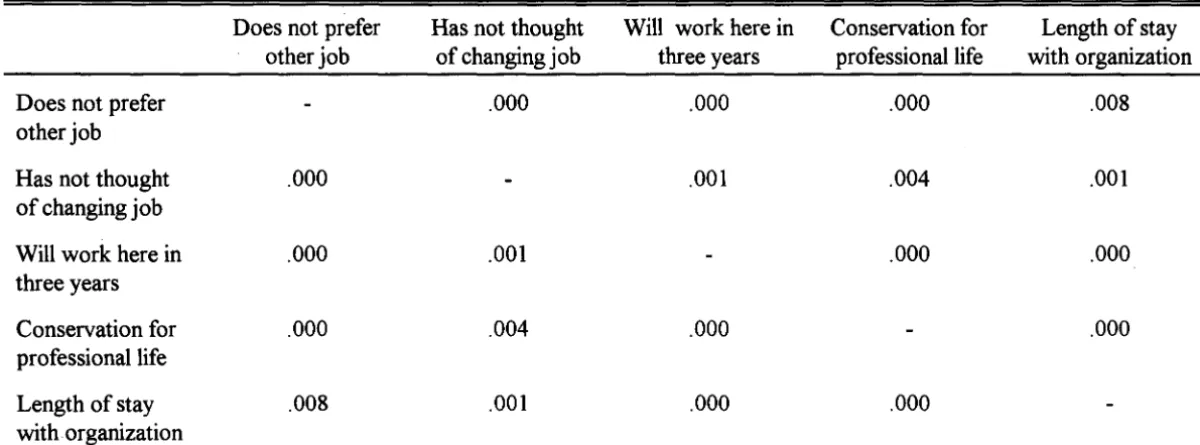
Intercorrelations of the Five Items Assessing Intent to Stay
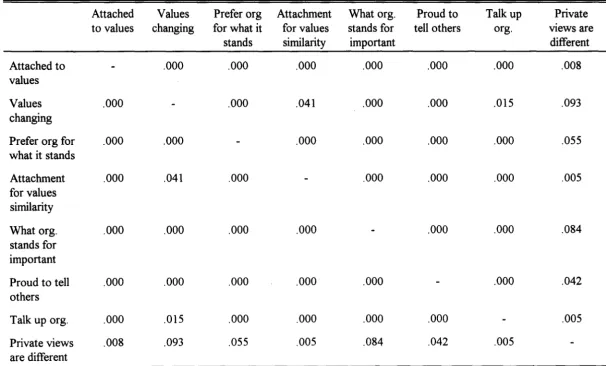
Intercorrelations of the Eight Items Assessing Personal Values Congruence
Pearson Correlation Scores for Values and Intent to Stay
Mean Ranks of Values Factor Compared with Intent to Stay
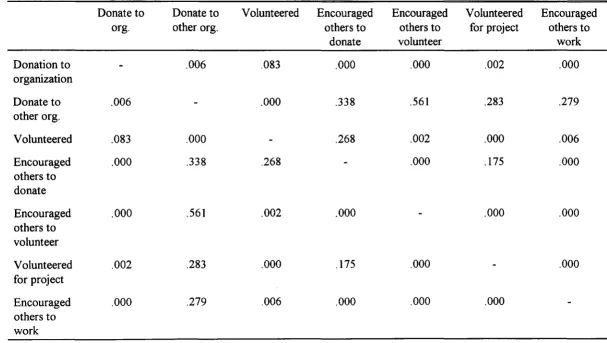
Intercorrelations of Seven Action Items
Factor Analysis Results from Actions Items
Pearson Correlation Scores for Actions and Intent to Stay
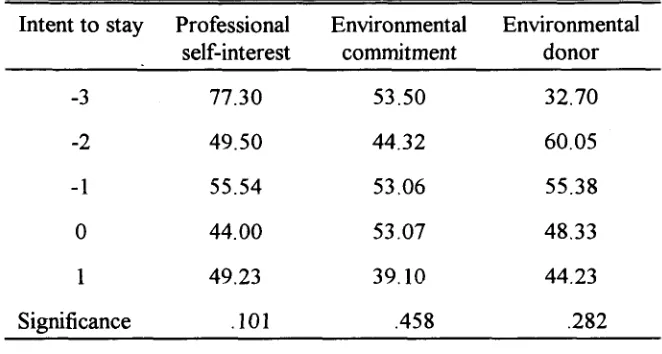
Mean Ranks ofProfessional Self-interest, Environmental Commitment, and Environmental Donor when Compared to Intent to Stay
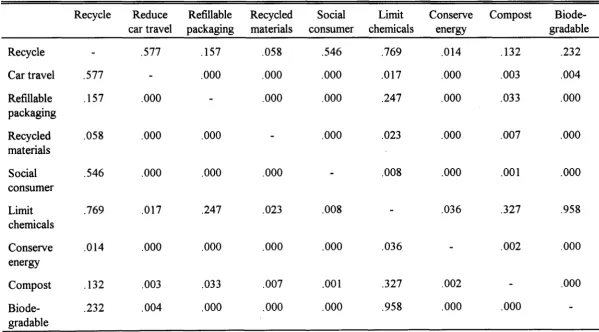
Intercorrelations of the Nine Items Assessing Home Activities
Factor Analysis Results from Home items
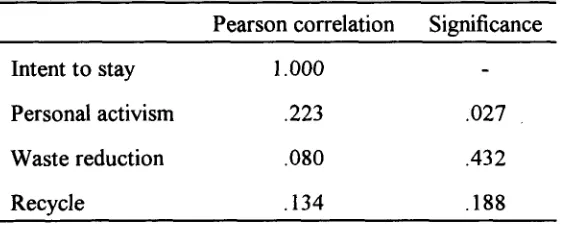
Pearson Correlation Scores for Home Activities and Intent to Stay
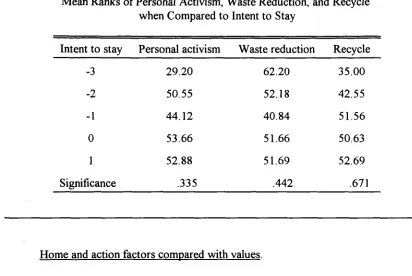
Mean Ranks of Personal Activism, Waste Reduction, and Recycle when Compared to Intent to Stay
Pearson Correlation Scores for Values, Actions, and Home
Mean Ranks of Actions and Home Compared with Values
Pearson Correlation Scores for Values, Actions, Home Compared to Organization Size
Mean Ranks ofValues Compared with Organization Size
Table 19 Table 20 Table 21 Table 22 Table 23 Table 24 Table 25 Table 26 Table 27 Table 28 Table 29 Table 30 Table 31 Table 32 Table 33 Table 34
Mean Ranks ofHome Activities Compared with Organization Size
Pearson Correlation Scores for Intent to Stay with Organization Size
Measured Variables for Predicting Intent to Stay
Regression Statistics for Internal and State Variables Regressed with Intent to Stay
Scatterplot of Standardized Residuals: Internal and State Variables
Pearson Correlation Scores for Values, Actions and Home Compared with Environmental Job Choice
Mean Ranks of Values, Actions, and Home Compared with Environmental Job Choice
Pearson Correlation Scores for Values, Action, and Home, Compared with Founder Status
Mean Ranks of Values, Actions, and Home Compared with Founder Status
Factor Analysis Results from Hire Items
Pearson Correlation Scores Between Values, Actions, Home, and Mission-oriented Skills
Pearson Correlation Scores Between Values, Actions, Home, and Business Acumen Skills
Mean Ranks of Values, Actions, Home, and Mission-oriented Skills
Mean Ranks of Values, Actions, Home, and Business Acumen Skills
Pearson Correlations Between Values, Actions, Home, and Affiliation
List of Appendices
Appendix A ... Survey cover letter
Appendix B ... Survey
Appendix C ... Follow-up postcard
Chapter One: Introduction
Nonprofit organizations fulfill a special role in American society. Outside the
government bureaucracy and untainted by private inurement, they are strong voices
protecting societal rights and values, and act as avenues for recreation, artistic expression,
and philanthropy. Each organization's role and purpose is communicated by the
organization's mission statement and implemented by the organization's voluntary and
professional leaders.
Based upon years of research, Kouzes and Posner (1995) have come to define
.
leadership as "the art of mobilizing others to want to struggle for shared aspirations"
(p. 30). They apply this definition to the role of leadership within an organization by
saying that the leader's primary responsibility is to keep the organization focused on the
ultimate view of the future that the organization strives to create. "No matter how much
involvement other people have in shaping the vision, we expect that the leader will be able
to articulate it" (p. 11 0). By keeping the organization focused on its vision, the leader can
energize staff and volunteers to work to attain it. This thesis surveys the executive
leadership of California environmental organizations to see how prepared these executives
are to fulfill this important role within their organizations.
The environmental movement is an example of a social movement that has been
nurtured throughout its development by the nonprofit sector. "Free from the constant
demands of profit margins and elections, the independent sector can experiment with new
strategies of social action, respond quickly to new social needs, and generally provide
'social risk' capital" (O'Neill, 1989, p. 16). Starting as a budding movement spurred by
movement has grown to include thousands of organizations that represent the interests of
millions of Americans who actively participate by donating money, volunteering, or
participating with these groups in other ways. The conclusions drawn from this study,
therefore, will be illuminating with regard to the leadership of this particular social
movement, and will hold potential implications for other movements being fostered within
the nonprofit sector.
Literature indicates that managers who are personally committed to the values of
their organization are more effective at their work, and enable others in the organization to
be more enthusiastic and effective also (Meglino, Ravlin, & Adkins, 1989; O'Reilly &
Chatman, 1986; Kouzes & Posner, 1995). "Commitment" can be measured in many ways,
including personal values that are similar to those of the organization, or a manager's
feelings of loyalty and dedication to the organization. At a time when environmental
leaders self-identify themselves as "overworked and undersupported" (Snow, 1992, p. 80),
it is recognized that these CEOs have competing demands on their time, including needs
for fund-raising, coalition building, and lobbying. This thesis will investigate whether
CEOs of California environmental organizations, in spite of the administrative demands
placed upon them, are personally focused on and committed to the future that their
organizations wish to create. This vision is most prominently communicated through an
organization's mission statement.
This thesis investigates whether chief executive officers of environmental
organizations in California are personally committed to their organizations' missions. This
commitment will be measured by past and present activities in the personal lives of CEOs
the expressed intent of CEOs to stay with their organizations. It is hypothesized that the
level of activity in the personal lives of the CEOs demonstrating personal commitment to
their organizations will be positively related to their intent to stay with their organizations.
It is also hypothesized that there is a negative association between the size of an
environmental organization, and the amount of evidence indicating that the personal values
ofthe CEO are congruent with those expressed in the organization's mission statement.
Background of the Issue
Environmental organizations have undergone extreme institutional transformations
throughout the twentieth century. The environmental movement, according to Snow, is
now the place "where science, the humanities, policy and law meet in a uniquely holistic
setting" (1992, p. xxxii). In the early years ofJohn Muir and Aldo Leopold, however, the
issues were less complex and environmentalism simply combined the exploration and
enjoyment of nature, with the preservation ofnature from development. Even during
these two leaders' lifetimes, however, the challenges of environmental protection became
too great for individual activism, and so they responded by creating the Sierra Club and
other organizations. Since that time, these organizations have indeed become significant
forces in the environmental movement, representing the environmental ideals of millions of
people.
Along with this growth, however, came tremendous responsibility. To ensure
efficacy, funding, credibility, and sustainability, the environmental organizations began to
adopt organizational structures that at times looked more like businesses. At the root of
growth was the result of successful volunteer efforts to expand the conservation message
and to recruit voices and signatures to save the environment.
The late 1960s and early 1970s were revolutionary years for environmental policy,
which witnessed the enactment of landmark environmental laws including the Wilderness
Act, the Clean Air Act, the Clear Water Act, and the Endangered Species Act, and the
National Environmental Policy Act (NEPA). Enacted in 1969, NEPA required federal
agencies to include environmental protection in all their plans and activities.
Environmental impact statements were to be written for each project that agencies
intended to manage or endorse, after extensive investigation into the effect the project
would have on the environment. Legislation like this provided environmentalists a role in
the review of federal projects, and guaranteed that environmental issues would not be
overlooked. Although not a foolproof safety measure, this approach of adding an
environmental safeguard to federal project planning was a major milestone.
President Reagan's anti-environmental policies during the 1980s infuriated the
public, who thought their wildlands had been saved in the preceding decades, and that they
had been guaranteed clean air and water. According to Stewart Udall, U.S. Secretary of
the Interior between 1961 and 1969, "After nearly two decades of gains under five
presidents, environmentalists were stunned in 1981 when the new Secretary of the
Interior, James Watt, characterized their goals as 'extremist' and announced that the
Reagan administration intended to "reverse twenty-five years of bad resource
management" (Borrelli, 1988, p. 99). Reagan's philosophy that the marketplace, rather
than the government, should dictate resource management practices, led to "an
promotion of nuclear technology, regardless of the resulting pollution and danger to
surrounding communities; and the abandonment of energy-efficient policies. In response
to these threats, the memberships of national environmental organizations rose
dramatically, from four million members in 1981 to approximately seven million in 1988
(p. 103). President Reagan's indifference to environmental protection issues mobilized
individual Americans to get involved themselves.
Environmental groups reacted to these events by strengthening their internal
structures to resist the backlash of federal-level anti-environmentalism, and to
accommodate rapid membership growth. The public joined to voice their environmental
concerns and protest the Reagan Administration's policies. In addition, as federal funds
for publicly supported environmental programs (such as National Park acquisition and
maintenance) decreased dramatically, environmental organizations had to emphasize
membership revenue to support an increased need for their services and higher levels of
legislative activity in Washington D.C. Competition for members increased significantly
among environmental organizations, leading each to use increasingly professional
marketing programs and direct mail campaigns. Dues-paying contributors had become the
foundation, in a sense, of the modern environmental movement.
This shift to expensive, staff-led marketing and membership promotion programs
differentiated small, grass-roots, volunteer-driven and often local groups from the larger,
more established national organizations. The increased need for stafflobbying in
Washington, law professionals working within the court system, and scientists defending
clean policies, also contributed to the differentiation, because only the national
tended to favor larger, more professional and established organizations in their funding
practices. This thesis will examine chief executive officers from both types of
organizations, to attain an understanding of existing trends in environmental leadership.
Due to rapid growth in membership, national organizations had to increase staff
levels and adopt professional management practices to increase membership revenue to
support conservation projects and maintain fiscal survival. The professionalization of
environmental organizations was necessary to gain legitimacy and respect in the eyes of
funders, policy makers, economists, natural resource managers, and scientists. One of the
many internal conflicts encountered during this time was the Sierra Club's search for a
replacement for Michael McCloskey, who resigned as executive director in 1985. The
board sought someone "capable of concentrating its professional, technical, and lobbying
resources" (Gottlieb, 1993, p. 151), and settled on former Nixon aide Douglas Wheeler,
who rapidly became a focus of contention, at least in part due to his lack of understanding
and appreciation of the organization's volunteer/activist culture and traditions. He was
fired by the board after only 16 months in the position.
While large organizations struggled to make a smooth transition to professional,
expertise-oriented entities, the small organizations fought to survive. Small groups found
that individual supporters were more attracted to the marketing strategies of large
organizations, and funders were less inclined to support organizations that participated in
direct-action environmentalism. In short, smaller groups found it difficult to gain the
support necessary to allow them to develop the professional attributes they required to
survive. Environmental Action is an organization, for example, which suffered from a lack
1970. Lack offoundation support hampered expansion ofthe organization's professional
capabilities, and the organization remained "a group without a clearly defined role,
walking on the divide between the various movements" (Gottlieb, 1993, p. 13 6).
The difficulties encountered by environmentalists during the Reagan era fostered
internal reflection on the nature of organizations and the environmental movement.
Environmental professionals reassessed their role in environmental protection. As Borrelli
(1988) comments in his book covering the movement's development, "Obstacles placed in
the way of aggressive environmental action . . . have forced environmental advocates not
only to try harder but to reexamine priorities and strategies" (p. 3). Snow (1992) indicates
that the debate over the appropriate level of professionalism is a topic of reflection today
within the environmental community, with some leaders complaining that the era has
passed when "conservationists were employed for their zeal, persistence, and charisma
rather than their ability to manage sophisticated fund-raising campaigns or make prudent
decisions over whether to build a new headquarters" (Snow, 1992, p. 4).
Statement of the Issue
Nonprofits define their special roles in society by the use of mission statements that
outline organizational purposes beyond profit-making and financial health. Mission
statements indicate why organizations exist. The mission of the organization is referred to
at the budget negotiating table, when new programs are added or old ones are modified,
and when new opportunities are discovered or threats are posed. This mission is often
referred to as taking the place of the profit motive in private businesses (Knauft, Berger &
Mission statements are effective management tools, and private corporations are
widely adopting them to improve their management. According to Peter F. Drucker, the
mission statement and the management of an organization around it may be the most
important lesson nonprofits can offer for-profit corporations (Drucker, 1989). However,
in for-profit corporations, the mission statement is a means to the realization of profit, and
not an end in itself For a nonprofit corporation, the mission is the true purpose of the
organization's existence, and the financial health ofthe organization is important only so
that the mission can be achieved.
Chief executive officers are not only managers of their organizations, but leaders
representing the mission oftheir organization to volunteers and staff internally, and to
funders, policy makers, and the general public externally. Drucker (1990) states that "the
first task of the leader is to make sure that everybody sees the mission, hears it, lives it"
(p. 45). A mission is what creates internal motivation and momentum for an organization,
while communicating a consistent message externally. Unlike their corporate
counterparts, CEOs of nonprofit organizations must consider more than simply the
financial health of their organization. They must also make sure that, by satisfying its
mission, the organization fulfills the commitment it made to society.
Historically, people hired as CEOs were chosen because they had demonstrated a
strong commitment to the mission of the organization through volunteer work or
contributing in other ways. Today, however, nonprofits focus heavily on the ability of
chief executive officers to handle the business aspects of managing organizational
resources. The Conservation Fund noted this trend in its 1992 Conservation Leadership
average, staff leaders spend 71 percent of their time performing administrative duties,
including personnel and board development, planning, fund-raising and public speaking.
Program planning and implementation take up 29 percent ofleaders' time (Snow, 1992, p.
58).
Also in the Conservation Leadership Project, environmental leaders identified high
staff turnover as a barrier for effectively influencing public policy, enforcing environmental
regulations, and soliciting voter support for environmental positions (Snow, 1992). In
addition to the staff issues cited by the environmental leadership, a CEO's tenure affects
an organization in unique ways. As experienced by an academic who recently spent a year
as an executive of a private firm, new executives "have almost no real power as individuals
and very little real influence, at least in their first year" (Goldhar, 1996, p. 46). Given the
time sensitivity of most environmental issues, organizations trying to address them would
be much more effective if they had leaders able to exert their power and. influence. For
this study, a CEO's "intent to stay" with their organization for a long period is used as an
indicator of a CEO's commitment to the organization.
Literature has shown that leaders within an organization are more effective at their
functions when their personal values are congruent with those of their organization. For
example, in a discussion of the importance of mission statements and the best ways to
utilize them within nonprofit organizations, Drucker ( 1990) writes that one of the three
most important things to remember, is that the mission is not "impersonal. I have never
seen anything being done well unless people were committed" (p. 7). Based upon
extensive study of organizations in the private, public, and nonprofit sectors, Kouzes and
organizational values, there's significant payoff for leaders and their organizations" (p.
213). These findings have heavily influenced the present study, which investigates the
congruence of personal values held by chief executive officers of California environmental
organizations with the primary values of their organizations, as expressed in mission
statements.
Normative Definitions of Variables
CEO: The chief executive officer, or lead staff person of an organization by any
other title, frequently "executive director." Literature indicates that it is the CEO who has
the responsibility to translate the mission of an organization to the employees and other
constituents (Drucker, 1990; Kouzes & Posner, 1995). A CEO does this by designing and
overseeing programs, implementing policy, and fostering an organizational culture that
facilitates achievement of the organization's mission.
Environmental organization:
An
organization whose primary purpose is the protection, conservation, and preservation of the earth's natural resources. Suchorganizations may be classified into several categories, as developed in the research of
Snow (1992). Traditional groups, Snow wrote, include "any group whose principal
mission is to foster the wise, sustained use of natural resources for human need,
enjoyment, and betterment" (p. 12). Preservationist organizations on the other hand,
"stand for the maintenance of natural living systems intact and as whole as possible,
usually under the aegis of special protective designations, whether public or private"
(p. 12). Others environmental groups specify as their main goal the protection of air,
of group includes some animal rights organizations. The Coral Reef Alliance, for
example, is fighting to preserve oceanic ecosystems by focusing its efforts on one animal
within it, the coral.
Mission: The mission of an organization is the purpose of an organization, as
stated in IRS documents, publications and promotional brochures, and the stated
commitment that it makes to stakeholders and the public. A mission statement may
outline the activities an organization is involved with, as for example the Sierra Club's
statement: "To explore, enjoy and protect the wild places ofthe earth; to practice and
promote the responsible use of the earth's ecosystems and resources; to educate and enlist
humanity to protect and restore the quality of the natural and human environments."
Other mission statements may focus more on the future they strive to create.
Size: Comparing the leadership of small and large organizations can be valuable
because the comparison may indicate what leadership attributes work and promote
organizational survival. Such comparison may also foreshadow the characteristics small
organizations will be most likely to adopt in the future, because if an organization
survives, it will likely become larger over time (O'Neill & Young, 1988; Snow, 1992).
Organizational values: Business organizations may have many values directed
to specific aspects of organizational operations: customer service, timeliness, or workplace
safety, for example. In nonprofit organizations, however, the mission statement is the
primary value of the organization. The mission statement ofHarley-Davidson is "Tell the
Truth; Be Fair; Keep Your Promises; Respect the Individual; Encourage Intellectual
Curiosity." Microsoft's mission statement is "To push technology forward, making
perform more effectively as individuals." These are strong statements of organizational
values, but they cannot compare with the mission statements of environmental
organizations that tap people's emotions regarding social responsibility issues. The
mission statements of nonprofit organizations state the primary values and purposes of the
organization (Rarick & Vitton, 1995).
CEO personal values: The personal values of CEOs are investigated as they
relate to the environmental missions of their organizations. These include environmental
values acted upon in the personal lives of CEOs and in their career choices. The survey
conducted for this study will ascertain to what degree CEOs observe in their personal lives
Research Question
This thesis will inquire whether CEOs of California environmental organizations
have personal values that are congruent with their organizations' missions, as indicated by
their present and past activities demonstrating values similar to those espoused by their
organizations through their mission statements. This thesis also investigates the level of
commitment of CEOs to their organizations, as indicated by their intent to stay with their
organizations and the environmental movement. It is hypothesized that the level of
personal activity demonstrating personal commitment to an organization will be positively
related to an intent to stay with that organization and the environmental movement. It is
also expected that there will be a negative association between the size of an
environmental organization, and the degree to which personal values of a CEO are
congruent with those of the organization's mission.
Importance of the Study
A large, professionally-managed and mission-driven national organization recently
hired a chief executive officer to head one of its chapters. The chapter breathed a sigh of
relief to have a skilled professional at the helm. The new executive, however, resigned
two weeks later. He did not quit because he could not work with the board of directors or
because the financial statements were worse than he expected. He quit because he had a
strong, moral conviction that was drastically different from the position stated in the
mission statement of the organization and enacted through its programs. Officials of this
organization indicate that this case is far from usual; but it demonstrates, quite effectively,
primarily because they are personally committed to the mission of the organization, rather
than for other criteria.
The available research literature shows that the congruence of an executive's
personal values with those of an organization is an indicator ofleadership excellence and
organizational success (O'Reilly & Chatman, 1986; Meglino, Ravlin & Adkins, 1989;
Kouzes & Posner, 1995). Assuming that a mission statement accurately indicates the
primary values of an organization, and following the suggestion made by researchers that
"the most significant values deal with the organization's hoped-for impact on society" (Posner, Kouzes & Schmidt, 1985, p. 304), this thesis will assess the congruence of a
CEOs' personal values and an organization's environmental mission, relative to
organizational size. This methodology may prove useful to boards of directors as they
hire new chief executive officers. If the data show that a majority of current CEOs do not
have personal values that are consistent with the missions of their organizations, perhaps
boards of directors should be considering this factor more in the selection of chief
executive officers.
The findings of this study may also assist people looking for a position as chief
executive officer of an environmental organization. If study results indicate that larger
organizations have CEOs who demonstrate less dedication to their organizations'
missions, for example, this may indicate that the culture of larger organizations favors
managers with more technical skills than personal dedication to environmental
preservation. If so, prospective CEOs may wish to consider managing smaller
organizations that foster and utilize greater personal commitment to environmental work.
documenting the importance of missions, but there is a lack ofliterature concerning how
missions are translated into operational terms. This thesis is intended to partially fill this
literature gap concerning the role of the chief executive officer, and the hiring of the chief
executive officer, by providing current information regarding trends in executive
dedication to organizational missions and how this dedication is utilized in the hiring
process.
Current literature indicates that the "primacy of mission" in the management and
operation of an organization is an indicator of organizational effectiveness (Knauft, et al.,
1991). Data from this study will indicate to what degree mission was a factor in selecting
CEOs.
Limitations of the Study
Because this is a cross-sectional study, many internal factors operating within
individual organizations will not be considered. The leadership structure in some
organizations, for example, may afford the chief executive officer a more limited role than
the typical leadership position assumed for the purposes of this study.
Due to time and financial considerations, the sample used in this study may not be
representative of the nonprofit sector throughout California. The diversity of
organizations in this state would render determination of representativeness a difficult
issue in any study, and this study is not perfectly representative.
The sample was drawn exclusively from California. The unique economic,
geographic and demographic characteristics of California may limit this study's
impact on the employment pool because many people make career choices to relocate
here.
The Harbinger File, from which survey participants were selected, is the most
complete directory of environmental organizations in California, but it is not a complete
directory. Very small and very new organizations are unlikely to be included in the
database. Those not listed are not included in this study's sample.
Organizations were chosen for inclusion in the study based on a "small" and
"large" organization classification scheme proposed by O'Neill and Young (1988). The
size of the categories - annual budgets under $1 million and annual budgets over $1
million- are no longer as applicable as they were in 1988. The range of organizational
budgets in 1998 is significantly different. A related limitation is that environmental
organizations may have different budget ranges than the nonprofit organizations discussed
in the articles. Further, the present study focuses only on environmental organizations,
and so the applicability to other nonprofit subsectors is limited. This study proceeded
from a decision to gather in-depth information about one nonprofit subsector, rather than
a broad knowledge of many.
This study assumes that mission statements are the primary indicators of
organizational values. This assumption allows the researcher to investigate the
congruence of CEO personal values with organizational values as presented in mission
statements.
In this study, organizational and individual values are evaluated independently.
The values of the individual are self-assessed as being congruent or not, based on the
to certain values in the survey being assessed by the respondent as "socially desirable."
Question 16a ofthe survey, for example, asks how often the survey respondent recycles
household items. This is a very "socially desirable" activity, and respondents may feel
impelled to provide affirmative answers to conform to society's expectations, rather than
to reflect their actual behavior (Meglino, et al., 1989, p. 425).
This thesis attempts to assess the environmental values of CEOs, but does not
claim to completely capture them. There are many ways to positively and negatively
impact the environment, and no questionnaire could adequately assess an individual's
values regarding all environmental issues. In addition, there are many reasons for being
loyal and dedicated to an organization, and this study does not inquire about them all. For
example, a person may be committed to an organization because of social relationships
with others who are involved in the organization.
Every environmental organization has a unique mission statement. This thesis will
review mission statements as reported in the survey to be sure that they are similar enough
to combine for the purposes of comparison. If one organization has a mission statement
that glorifies water pollution, for example, this mission would vary significantly from the
other organizations and the congruence of the CEOs to this value would not be accurate
across the sample. The survey was written to include indicators of commitment to the
Chapter Two: Review ofRelated Literature
Nonprofit organizations are corporations that must manage day-to-day operations
just like private companies such as General Motors or Pacific Bell. In addition, nonprofit
organizations have criteria for success that go beyond fiscal survival and expansion. Many
nonprofits focus on issues of strong emotional appeal to individual donors, volunteers, and
staff members. An organization serving food to AIDS-affected adults, for example, must
survive financially and compete for foundation and corporate funding, but must also strive
to ensure that the needs of the AIDS community are being met as fully, respectfully, and
compassionately as possible. This basic purpose of a nonprofit organization is defined in
its mission statement.
The mission statement has been an effective tool for nonprofit organizations,
providing a core focus for their programs, and an impetus for organization leaders to look
outside their organizations and constantly evaluate the social need for their missions.
Mission statements have become a management phenomenon in the private sector during
the early 1980s, primarily because of two books, In Search of Excellence: Lessons from America's Best-run Companies, by Thomas J. Peters and Robert H. Waterman, Jr. (1982) and Theory Z: How American Business Can Meet the Japanese Challenge, by William G.
Ouchi ( 1981 ). Both books emphasize the benefits of clear statements of values and
philosophies. In the years that have followed, mission statements and other statements of
corporate values have proven effective tools in practice. Approximately six out of every
ten large American companies now have their own statement of values, mission, vision or
principles (Ledford, Wendenhof, & Strahley, 1995). The difference inherent between
that private businesses utilize mission statements to solidify business plans, market
strategy, and internal loyalty and motivation. In the nonprofit sector, the mission
statement is the sole purpose of the organization; the business plan is created to support it.
In an article describing the benefits of mission statements, Romuald A. Stone
(1996) concludes that the mission statement is the key to "creating a competitive
advantage" (p. 38) Stone makes the point early in his article that mission statements are
used to increase the profit margin of companies. He cites several examples of companies,
including Quaker State Corporation and United Parcel Service, that designed mission
statements as a means of recreating corporate cultures to enable them to gain market
share. Both companies have realized significant benefits from this practice.
Three purposes for corporate mission statements have been outlined by Ledford
and colleagues, who performed an extensive literature review and case study to explain the
popularity of mission statements (Ledford, Wendenhof, Strahley, 1995). They summarize
that mission statements can be used to guide individual and organizational behavior and
decisions; express organizational culture, internally and externally; and contribute to
organizational performance by motivating employees or by inspiring feelings of
commitment. If the lofty ideals expressed in the statement resonate with employees'
private values, employees may view organizational goals as consistent with their own
desires.
Researchers Lee Ginsburg and Neil Miller (cited by Ledford, et al., 1995) state
that rather than achieving all of the above goals, many mission statements are not taken
seriously, and that "for many firms, corporate values, if addressed at all, were only cited in
become, in practice, an internal and external public relations tool, bolstering a positive
corporate culture within a business, and promoting the business in the market.
The Independent Sector, a national leadership forum that promotes philanthropy,
volunteering, nonprofit initiative, and citizen action, sponsored a study entitled "Profiles in
Excellence" in 1996. The authors ofthe study, Knauft and colleagues, described the
importance of organizational missions and pointed to the importance of further research
on the issue. The authors emphasized the importance of a clearly stated mission by
coining the term "primacy of mission." They found that CEOs and board chairs surveyed
for their study most often listed a "clear sense of mission" as a characteristic of an
effective organization. In addition, 82 percent of the board chairs interviewed indicated
that "a strong mission orientation is the top criterion on which to judge the effectiveness
of a chief staff officer" (Knauft, et al., 1991, p. 4). "The best leaders, we found, embody
their organizational mission. They can clearly articulate the mission and transmit it to
others with a sense of excitement" (p. 8).
Profiles ofExcellence collected data from existing literature, focus groups, a
questionnaire answered by 950 chief executive officers in the nation, and 10 organizational
case studies. This study concluded that the four characteristics of excellence for an
organization are a clearly stated mission; a leader who fosters a culture that enables and
motivates the organization to fulfill the mission; an involved and committed board that
works effectively with the CEO and acts as a liaison with the community; and the ability to
attract sufficient resources (Knauft, et al., 1991, p. 2).
Although the Profiles in Excellence project revealed the importance of mission, it
statements (for example, to evaluate programs or assess organizational effectiveness).
Given the research findings stressing the importance of mission statements, further
research regarding how these organizations utilize their mission statements in these ways
would be useful for the nonprofit sector (Sheehan, 1996).
One criteria commonly used to measure how well organizations are using their
mission statements is the ability of leaders to create and maintain momentum toward
achieving a vision. This vision not only applies to the management of the organization,
but also in how well the organization's purpose matches leaders' internal values. In
numerous studies, the personal values of a manager are cited as a criteria for
organizational prosperity. In a study ofleadership in about 30 organizations, including the
Girl Scouts of America and Southwest Airlines, two of the key components of successful
leadership were a balance between values and strategies, and consistent communication of
the organization's mission and values (Heskett & Schlesinger, 1997). Ina similar study by
Tait (1996) based upon interviews with 18 business leaders, vision was found to be the
most important leadership attribute. Tait emphasized that the simply stated mission of an
organization should remain at the forefront to guide an organization.
Research on the importance of vision has been prevalent in the management field in
recent years. Kouzes and Posner define "vision" as the ability of a manager to think of the
long-term future of an organization and communicate this vision to others. The manager
must remain committed to the mission and continuously remind others of it. Kouzes and
Posner write, "Leaders animate the vision and make manifest the purpose so that others
can see it, hear it, taste it, touch it, feel it. In making the intangible vision tangible, leaders
Nonprofit organizations are inherently structured to capitalize on the "vision"
movement because they have mission statements already written and institutionalized to
serve as the basis for related vision statements. These missions are one piece of the larger
vision as defined by Senge. "Values" are the first stepping stone, defining day-to-day
behaviors and attitudes. "Mission" is the purpose of the organization itself, while "vision"
is the long-term view of the future, incorporating the contributions of the organization
(Senge, 1990). Inspiring a contagious commitment to the values, mission, and vision of an
organization is particularly important for CEOs of nonprofit agencies, because they often
fulfill the role of the external voice for an organization, as a leader of staff and volunteers,
and as a spokesperson for the larger issue that the organization was founded to address.
In a 15-year study ofthousands ofbusiness managers, Kouzes and Posner (1995)
found that a positive correlation between the personal values of individual managers and
values of the organizations they lead yielded significant benefits for those organizations.
Among the benefits were increased consensus about key organizational goals;
development of a culture valuing ethical behavior; and higher levels of dedication to
organizational goals. In addition, Kouzes and Posner found that not only is there a
positive influence on managers' efficacy if their values are in line with their organizations,
but there is an even stronger effect if the managers have clarity about their personal
values, and those values are congruent with those of the organization. This study focuses
on the personal activities of CEOs, because personal action indicates that CEOs have
clarity about personal values. If this study focused on stated values only, rather than
actions, the data captured would include values about which CEOs have less clarity, as
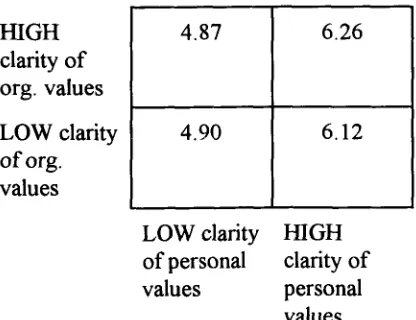
Table 1 graphically represents earlier research findings of Posner and Schmidt
(1993), as cited in Kouzes and Posner (1995), regarding the similarity between personal
and organizational values, and the degree of commitment to an organization. Over one
thousand surveys of managers' personal and organizational values were compiled, and
analysis of variance tests produced the values in Table 1. This table illustrates the added
effect found when the individual in question has high clarity about his/her personal values,
and high clarity about organizational values. The cells in Table 1 represent clarity about
personal and organizational values. The numbers within the cells represent the extent of
an individual's commitment to their organizations on a scale of 1, low, to 7, high.
Table 1
Values Congruence and Individual Commitment to Organization
IDGH clarity of org. values
LOW clarity oforg. values
4.87 6.26
4.90 6.12
LOW clarity HIGH of personal clarity of
values personal
values
There are many definitions for commitment utilized throughout the literature
analyzing the importance of individual and organizational values congruence. The "central
theme that continues to appear is the individual's psychological attachment to an
organization" (O'Reilly & Chatman, 1986, p. 492).
An
important component of psychological attachment is the process of identification between an employee and the organization. This includes an employee'spersonal identification with the values of the organization. For the purposes of their
study, O'Reilly and Chatman define organizational commitment as the psychological
attachment to the organization felt by the employee, which reflects the "degree to which
the individual internalizes or adopts characteristics of perspectives of the organization"
(O'Reilly & Chatman, 1986, p. 493). Citing Kelman (1958), O'Reilly and Chatman
describe a three-tier hierarchy of organizational commitment. The classifications are
compliance, which is involvement based upon expectation of reward; identification, which
is involvement based upon desire for affiliation; and internalization. It is this third
classification that is most related to the current study. According to O'Reilly and
Chatman, "Internalization occurs when influence is accepted because the introduced
attitudes and behaviors are congruent with one's own values: that is, the values of the
individual and the group or organization are the same" (p. 493).
Among O'Reilly and Chatman's findings was a significant positive relationship
between internalized organizational commitment (personal and organizational values
congruence) and the dependent variables ofintrarole and extrarole behaviors, and very
strong relationship between similar values and the intent to remain with the organization.
association between personal and organizational values congruence and turnover 16
months later. Posner and colleagues echo this latter finding. "Managers who felt that
their values were particularly compatible with those of the organization were significantly
more confident that they would remain with their current employer for the next five years"
(Posner, Kouzes & Schmidt, 1985, p. 298).
O'Reilly and Chatman's study (1986) measured levels of commitment as the
independent variable by using a survey that offered 21 statements indicating levels of
commitment to the organization and its values. Respondents chose levels of agreement
with each statement by way of a Likert scale. The dependent variable, on-the-job
behaviors, was measured through 11 questions, also on a Likert scale. On-the-job
behaviors are not assessed in this thesis, although O'Reilly and Chatman's methods for
quantifying commitment and values congruency are adapted in question I 0 of this study's
survey.
Literature indicates that organizational commitment motivates staff members to
perform their job to their utmost potential, and to perform spontaneous and innovative
tasks that enhance the performance of the organization. The willingness of staff members
to engage in "extrarole behaviors" reduces the need for organizations to implement
stringent control systems to motivate employees, and can bolster the strength of the
organization as staff members consistently act on behalf of the organization's values
(O'Reilly & Chatman, 1986, p. 493). O'Reilly and Chatman summarize this idea by
writing, "In sum, pro social behaviors requiring the expenditure of personal time and effort
on behalf of the organization are most strongly related to commitment based on value
behavior for rewards" (p. 497).
Environmental Organization Trends
In a 1992 study entitled the Conservation Leadership Project, Donald Snow and
the Conservation Fund (a nonprofit organization which supports natural resource
conservation) surveyed more than 500 conservation leaders throughout the nation,
including board members, key staff members and CEOs to assess the needs of
environmental leaders, with special emphasis on formal training and education. The
Conservation Leadership Project research design overlaps with the present study. A
review of the methods and data of that study is enlightening.
Selecting environmental organizations to survey, Snow sorted conservation groups
into five sectors: government, nongovernmental organizations, academic, private
philanthropic, and natural resource-oriented businesses. Snow again classified
organizations by size, using the following criteria to categorize them. A nonprofit
organization was classified as large if it possessed one or more ofthe following attributes:
an annual budget of $1 million or higher; a staff of thirty or more full-time professionals;
or an endowment sufficient to sustain the organization at its current level of activity on an
ongoing basis.
Due to difficulties getting respondents to answer staff question with a consistent
definition of"professional," and a decision not to follow up on endowments due to
expected difficulties with confidentiality, Snow used budget size alone as indicator of size,
and found correlations between size and geographic scope of organizations. Snow
important differences in the needs and attitudes of the leaders surveyed and the demands
that their organizations place on them" (Snow, 1992, p. 83).
Snow received completed surveys from 147 CEOs, which constituted a 60 percent
response rate. Ofthe sample, 56 percent of the officials had been affiliated with their
organizations six years or fewer, and the mean duration of affiliation was seven and a half
years.
The study also found that professional staffing has become a standard
characteristic of environmental organizations, but recommended that organizations "strive
to maintain the spirit and vigor of volunteerism even as they become increasingly
professional in their management" (Snow, 1992, p. 33).
Earth Day 1970 was a turning point for the environmental movement. The media
latched onto this event and created a spectacle showcasing the benefits of a healthy
environment. Broad media coverage portrayed environmentalism as a new and
mainstream movement, which provided environmental groups the power to become more
active in shaping the attitudes and behavior of the general public, and the legitimacy to
work with industry and government to implement federal regulations. As Gottlieb ( 1993)
summarized, "a number of groups, including existing conservationist organizations,
developed along professional lines, creating a mainstream environmental movement in the
process" (Gottlieb, 1993, p. 113).
Many organizations felt obliged to increase their expertise in environmental
science, law, or other technical fields so that they could participate in policy formation or
help buffer the impact of industry's teams of scientists participating in the drafting of
ofEarth Day, the potential for further mobilization, most groups felt an even more
pressing need to professionalize to better respond to and shape the new legislative and
administrative structures rapidly being put in place" (p. 134).
The late 1980s and early 1990s brought more changes in the management of
environmental organizations, as they adapted to further challenges by industry special
interests and stiff competition between environmental groups for members. The political
environment in these years was drastically different from the earlier years of the
environmental movement, and the leaders had to respond to challenges using different
skills. Shabecoff(1993) states that "the new group [of environmental leaders] was in
many ways more pragmatic and professional, more inclined to cooperate with existing
political and economic forces to achieve its goals" (p. 257). These leaders were faced
with complex environmental issues, like the depleting ozone layer, and were further
challenged by industry groups and corporations that had gained an appreciation for how
environmental regulations could alter their work practices. Organizations further
developed their marketing skills, launching large-scale direct-mail, canvassing, and
lobbying campaigns. These complex programs made it necessary for organizations to
departmentalize to best utilize their human resources. "Specialized staff positions and
bifurcated management structures - separating business management from the
management substantive programs - have replaced the monolithic arrangements frequently
found among nascent groups" (Snow, 1992, p. 67).
During this period ofprofessionalization ofthe environmental movement, veteran
environmentalists expressed a prevalent fear that the "professionalization of environmental
of mission after Earth Day. They wondered if environmentalism was becoming just
another career and its cadre was growing to resemble the-corporate executives and
government officials with whom they were supposed to be doing battle" (Shabecoff, 1993,
p. 261 ). Indeed, Michael Frome, a prominent environmental journalist (quoted in Borrelli,
1988) remarked that "Thirty years ago saving the earth was a mission rather than a career
... Now, people go to some very respectable colleges and universities to train for
professional careers in the environment" (Borrelli, 1988, p. 251 ).
The dedication of nonprofit CEOs is rarely debated. A thorough literature review
did not reveal, in fact, any study that questioned the commitment of these nonprofit
managers to their organizations or to the environmental movement. The above concerns
about environmental leadership, however, are serious enough to warrant further
investigation, which this thesis attempts to fulfill. Borrelli ( 1988) again quotes the
journalist Frome: "Natural resource professionals ought to be in the lead of the revolution
ofvalues. So should the environmental organizations and the people working for them.
The problem is that compassion must be at the root ofthe revolution of values, while
compassion, and emotion, are repressed in the training of natural resource professionals
and obscured in the management of organizations" (p. 251 ). Indeed, if current CEOs of
environmental organizations are lacking the passion and moral zeal of their predecessors,
they will be less able to lead a values revolution. As Kouzes and Posner (1995) point out,
we are much more likely to follow leaders whose actions are consistent with their avowed
values. This thesis will highlight the level to which the leaders of environmental
organizations exhibit activities in their personal lives consistent with their organization's
Finally, this thesis will fill a gap in the literature on environmental leadership by
attempting to measure the personal commitment of executives on the basis of the leaders'
expressed intent to remain with their organization and the movement. This commitment is
often taken for granted. For example, Snow's (1992) study simply presumed a high level
of commitment among the study subjects. This thesis will test the validity of this
Chapter Three: Methodology
This thesis investigates whether chief executive officers of environmental
organizations in California are personally committed to their organizations' missions as
demonstrated by past and present activities in their personal lives that indicate personal
values congruent with those espoused by the organization; and by their intent to remain
with their organization as indicated by projected duration oftenure as CEO. It is
hypothesized that the level of activity in the personal lives of the CEOs demonstrating
personal commitment to their organizations is positively related to their intent to stay with
their organizations. It is also expected that a negative association will be demonstrated
between the size of an environmental organization, and the amount of evidence indicating
congruence of CEO personal values with those identified in the organization's mission
statement.
Survey Respondents
California environmental organizations were chosen from the National
Environmental Directory Project's Harbinger File, a database maintained by Global Action
Information Network. This database contains information on 1,840 environmental
organizations in California, including nonprofit agencies, government bodies, educational
institutions, and for-profit businesses. The subset of the database containing information
of nonprofit organizations was used for this study.
The database was stratified by budget size to address hypothesis two, which
suggests that there is a negative association between the size of an environmental
congruent with those in the organization's mission statement. Although the Harbinger File
database does not have complete budget information for all organizations listed, because
many environmental leaders chose to maintain confidentiality in this regard, the sample for
this study was selected using the available information to achieve the most diverse and
representative sample possible.
Following a method first proposed by Jonathan B. Cook (Cook, 1988), and later
applied by Snow (1992) in the Conservation Leadership Project study, the present study
identifies a budget amount of $1 million as a break point differentiating large from small
organizations. According to Cook, large organizations are organizations that have 30 or
more professional staff and a strong funding base to support them, an annual budget of $1
million or more, or an endowment large enough to support it on an ongoing basis
(Cook, 1988). Snow, in the 1992 Conservation Leadership Project study, used only the
budgetary test, because of difficulties obtaining reliable data for the other two criteria
(Snow, 1992). The staff level was problematic because the definition of"professional
staff' was not interpreted consistently by survey respondents. Information necessary to
establish the size of the endowment was also difficult to verify due to confidentiality
concerns of survey respondents. Therefore, Snow utilized the $1 million annual budget as
the primary measurement of size.
Within the Harbinger File database, all of the organizations (68) that indicated that
their a budget larger than $1 million were selected.
An
additional 68 organizations were selected from the organizations that indicated annual budgets less than $1 million. Theremaining 164 organizations selected for the sample were chosen, using a computer
Bourque and Fielder ( 1995) indicate that a single mailing of a self-administered
questionnaire to the general public normally result in a 20 percent response rate.
Therefore, two follow-up mailings, including a second mailing of the survey itself, were
expected to improve upon this average response rate. In addition, the cover letters made
it clear to the CEOs that they were not chosen at random from the "general public," and
this personalization was expected to further improve the response rate. The goal for
completed surveys was 100.
Research Design
The self-administered questionnaire asked about the personal activities of the
CEOs and their level of commitment to their organizations. The questions in the survey
were adapted from published articles measuring values congruence and organizational
commitment in a variety of organizations and industries.
Questions 1 through 4 assessed the organization's exact mission and size
characteristics, including staff and volunteer core size, and budget size. Questions 5, 6,
and 7 assessed the primary type of affiliation (staff, volunteer, or other) between the CEOs
and their organizations, how long each CEO had been associated with the organization,
and their length of tenure as CEO. Other questions inquired further about the nature of
the affiliation, and the length of time the CEOs expect to remain with their organizations.
Question 11 assessed "extrarole behaviors," defined by O'Reilly and Chatman as
"acts beyond what was specified in the job description" (1986, p. 494). Activities listed
here included acts assumed to be performed by someone who is committed to the goals of
friend to volunteer for the organization, or volunteering for an environmental project in
the CEO's community. In a study outlining and investigating three distinct levels of an
individual's commitment to their workplace, O'Reilly and Chatman (1986) discovered that
"there exist different dimensions of commitment to an organization, and that the more
internalized the commitment, the more prosocial the behavior of the individual" (p. 497).
The authors further state that "critical voluntary behaviors that are not specified by job
descriptions are largely a function of identification and internalization rather than
instrumental involvement" (p. 497). The survey items included in the present study are
indeed behaviors critical to nonprofit organizations, and were chosen on the assumption
that a person not committed to their organization would feel no obligation to perform
them, and therefore, would not.
In addition, items from O'Reilly and Chatman's 1986 study were adapted in
question 15 to assess organizational commitment. O'Reilly and Chatman used 12 items in
their survey, and respondents used a Likert scale to indicate their level of agreement or
disagreement with each statement. The O'Reilly-Chatman design was not used in its
entirety for this study, because their items are better suited for staff in non-executive
positions and are not completely appropriate for the chief staff person of an organization.
For example, questions such as, "How hard I work for the organization is directly linked
to how much I am rewarded" (O'Reilly & Chatman, 1986, p. 494), were not included in
this study.
Question 16 was designed to measure the level of environmental activism
performed by the CEO at his/her home. The individual items listed in this question were
concern for the environment (Schwartz & Miller, 1991 ). The Roper study grouped
individuals into environmental types, depending upon their level of"environmentally
friendly" activity. "True-Blue Greens," accounting for II percent of the U.S. adult
population, are the most environmentally concerned, and most engaged in
pro-environmental activities. "Greenback Greens," who make up another 11 percent of the
U.S. adult population, are less likely to accept inconvenience for the environment's sake,
but will pay up to 20 percent more for environmentally friendly products. The "Sprouts"
category, 26 percent of American adults, is considered a key "swing" group, because these
individuals are willing to accept inconvenience to be environmentally friendly, but have
ambivalent views about environmental regulations. "Grousers" are indifferent to the
environment, but have considered environmental issues and have decided to act on what
they feel is society's prevalent indifference to environmental activism. Grousers, who
constitute 24 percent of adult Americans, are less likely to participate in environmentally
friendly activities. The final group identified by the Roper Organization is the "Basic
Browns." This group is the largest, including 28 percent of the U.S. adult population, and
is characterized by a "virtual absence of any pro-environmental activities" (Schwartz &
Miller, 1991, p. 34).
This thesis did not attempt to classify the CEOs of California environmental
organizations using the Roper study categories, because the complete Roper survey design
was not being replicated in the present study. The activities measured in this survey,
however, do include some of the measures tested and used in the Roper Organization
study.