Paper: AQ
INFORMATION METAMORPHOSIS IN PHYSICS AND ASTRONOMY
LIBRARIES
Christina Louis & A.Vagiswari, Indian Institute of Astrophysics, Bangalore - 560034 e-mail : [email protected], [email protected]
There is an enormous range of available information in the world. The role of the library is to select, acquire, organise and make available an appropriate subset of these resources. Information technology has changed the format of the information, thus enhancing the quality and accessibility. Library has a great responsibility in this changed Digital World of information to identify the required sources, suitable and essential for its consumption.
Physics and Astronomy libraries have an intense participation in balancing the tools of information technology and the traditional information resources in their disciplines. Essentially, the goal of these libraries is to match the institution’s needs and budget against the available information and its costs. Increasingly, digital information, especially in Physics and Astronomy comes with a price tag, sometimes frighteningly large. But the library negotiating on behalf of the institution (and perhaps as a part of a consortium) has a chance of providing access to the required information at a reasonable cost. We discuss here, the important electronic sources available in Physics and Astronomy disciplines and their optimum use in the libraries.
1. INTRODUCTION
information products in the new environment accordingly. Libraries and librarians have a major role to play in not only providing the high-tech information, they also have to train themselves to use the electronic resources and communication channels suited to their libraries. Physics and Astronomy are two major disciplines in science, and we have attempted to explore the electronic resources available in these disciplines and their impact on the libraries. The forms in which electronic or digital information is produced is many, hence we have tried to concentrate on the resources available electronically on World Wide Web only. We have also compiled a list of websites dedicated to Physics and Astronomy research, which are live, professional and useful.
2. SHIFT IN INFORMATION CULTURE:
2.1 Traditional Information Vs Electronic Information
As more and more information is being generated, there has been much speculation as to whether the information will survive in its existing "traditional" format. There have been numerous discussions and presentations about this crucial topic, and among the library personnel, there is an interesting discussion forum called 'library link' which had posted this topic recently for the members to discuss and air their views. Many of them agree in general, that in the global information age, it is imperative to adapt to the new technology. In the early 90s when the shift from traditional resources to E-resources started librarians and information professionals, geared themselves to face this challenge. They started working in a hybrid information environment. As Chris Rusbridge puts it "the hybrid library should be designed to bring a range of technologies from different sources together in the context of a working library, and also to begin to explore integrated systems and services." The point of this is to facilitate the users to look at the best information resources for their needs regardless of its format (Rusbridge,1998).
There is a paradigm shift in Physics and Astronomy libraries, which has tried to accommodate more of E-resources in their collection and services. A decade ago a well-equipped Astronomy library was concentrating on buying all the important books and jour nals published in astronomy. In alignment with the IT technology, slowly many of these libraries have automated the library functions and have created a database of their collection. In the current scenario libraries are trying to acquire as much information as necessary which is available electronically irrespective of the form, location and tool. In a library environment, the introduction of this much talked about electronic sources can be traced to the 1960s, with the development of machine-readable files such as ERIC and early version of the National Library of Medicine Online database. In the 1970s, OCLC and other online database vendors, such as DIALOG, BRS and Orbit became standard resources in reference departments. The 1980s saw the arrival of personal computers, Online Public Access Catalogue(OPAC) to replace the card catalog, and databases on CD-ROM, for Workstations. The early 1990s saw the arrival of Local Area Networks(LANs) to replace stand-alone workstations. The Mid 1990 brought the latest changes like - Windows and the Internet. By the late 1990s, many OPACs and CD-ROM based databases, became available in Web-based systems, and many services became available via remote access to patrons outside the library (Rowland,1997).
By the end of 2000, technology will be able to transfer information using radio waves, to enable computers, to communicate with one another wirelessly, through a short-distance protocol connecting devices.
2.2 Access to Electronic Information
The architecture for accessing electronic information consists of a network of large information servers, which may be geographically distributed, and each of which may search for, and retrieve, information in its own way. Some important features in accessing the servers, as far as the users are concerned:
1. Users can retrieve information from a network of distributed servers;
2. Users need no special knowledge of the specific query language and retrieval method employed by a remote service,
3. Users need no special knowledge of how information is stored at any given server, 4. The software is built upon International standard protocols,
5. The software has a flexible and extensible design that is readily customised to specific requirements.
3. PREPARING FOR TOMORROW
Information access through electronic media has had a considerable impact on the library community. It has made it necessary for librarians to develop new research and management skills. LIS schools have an important role to play, in this development.
Library schools should re-orient their training, while designing the curricula. Various techniques like Indexing, Abstracting, Classifying and Archiving which are prerogative of a traditional library training, can be still applied to the IT environment. Some of the guidelines listed below are typical requirements and skills expected of a working library and information professional.
a) In an electronic library environment the librarians should have the skills to identify the electronic resources required for their library (Abate,1999; Edwards,1998).
1. They should be conversant with the location or URLs of the required electronic resources. 2. They should be able to evaluate the contents of the resources, their suitability to their own
users.
3. The economics of accessing these e-resources, both commercial and free databases, has to be worked out.
4. The libraries, which decide to have access to E-journals, should be able to provide the proper infrastructure. Wherever the IP addresses of the machines located in the campus or the university are registered for accessing E-journals, proper subscription and linking has to be maintained.
1. The librarians should be able to check the links, periodically whether they are live or not. 2. They should be familiar with the policies, since these differ from one publisher to another. They should know whether the sites require login/ password or allow the users to get into their databases, without these requirements.
3. Librarians should be in communication with the publishers/vendors through e-mail.
c) When the Electronic resources are identified and checked for their currency, it is essential to have a proper organisation and linking to those resources. Library personnel with the background of Indexing knowledge should be able to do this organising by providing these links in the library homepage. They should be able to design the format with the help of IT people, or learn themselves the minimum requirements of designing WebPages. At this stage library schools should be able to train the library personnel to various techniques of Web Engineering. In designing the WebPages, every librarian will be able to utilise his skills of indexing and classifying techniques (Chan, 1999).
d) Archiving the resources is a very important aspect of any library. Currently, it is the work of the information manufacturers and publishers who are constantly evolving new techniques and procedures everyday. In Astronomy, ADS-Astrophysics Data System is an abstract service offered by NASA, which gives access to modern technical literature. ADS has begun a long-term project to put the most important historical literature of astronomy on-line, in collaboration with Harvard University Preservation Department. This project will preserve and provide access to past research in astronomy by digitizing the observatory publications in addition to their modern astronomical literature. Library personnel with suitable training in preservation and digitization techniques should be able to participate in this project, if required ( Brenda,1995).
4. ACCESS TO E-RESOURCES IN PHYSICS AND ASTRONOMY LIBRARIES IN INDIA
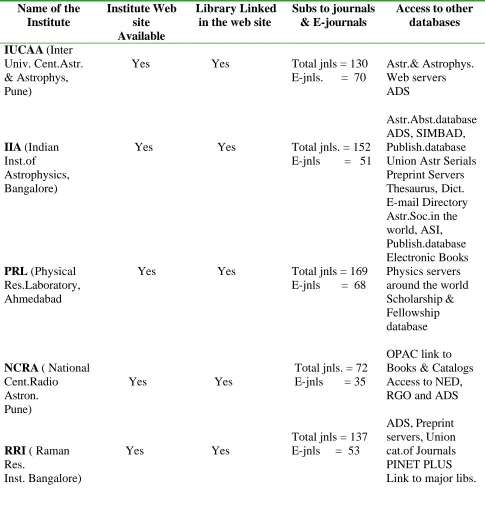
We have collected data on access to electronic resources in some libraries in India where Physics and Astronomy are major research areas. We have assumed that, libraries and their resources should reflect users needs and their information seeking behaviour. A well equipped library which has a powerful retrieval technique to access, outside resources in addition to its own resources is a bonus for the information seeker. So, the data we have collected, include the library's access to Internet, the most-sort after information provider, and whether a library has a representation in the Internet in the form of having its own web, and also whether it has access to the E-journals, access or link to other databases. If these points can have any bearing on the assessment of a library's role in the IT environment, then it is encouraging to note that many of our research libraries are already taking part in the emerging technology.
libraries wherever they have access, both by subscription and free of cost. Since TIFR and PRL have both Physics and Astronomy subjects, the number of electronic journals accessed in these libraries include journals in Physics and Astronomy. National Physical Laboratory (NPL) at Delhi does not have the Institute Home page, but the library has a well-represented web page.
Table 1 – Astronomy and Physics Libraries in India & Link to E-Resources
Name of the Institute
Institute Web site Available
Library Linked in the web site
Subs to journals & E-journals
Access to other databases
IUCAA (Inter Univ. Cent.Astr. & Astrophys, Pune) Yes
Yes Total jnls = 130 E-jnls. = 70
Astr.& Astrophys. Web servers ADS
IIA (Indian Inst.of Astrophysics, Bangalore) Yes
Yes Total jnls. = 152 E-jnls = 51
Astr.Abst.database ADS, SIMBAD, Publish.database Union Astr Serials Preprint Servers Thesaurus, Dict. E-mail Directory Astr.Soc.in the world, ASI,
PRL (Physical Res.Laboratory, Ahmedabad
Yes
Yes Total jnls = 169 E-jnls = 68
Publish.database Electronic Books Physics servers around the world Scholarship & Fellowship database
NCRA ( National Cent.Radio Astron. Pune) Yes Yes
Total jnls. = 72 E-jnls = 35
OPAC link to Books & Catalogs Access to NED, RGO and ADS
RRI ( Raman Res. Inst. Bangalore) Yes Yes
Total jnls = 137 E-jnls = 53
TIFR (Tata Inst.of Fund. Research, Mumbai) Yes
Yes Total jnls = 600 E-jnls = 250
Link to CD-ROM Database available in the library. Link to other Databases are available from the respective depts.
UPSO ( Uttar Pradesh State Obs. Nainital) Yes No information not available. Astronomy on Internet links, Astr.database servers ESO, CFHT, STSci, ADS, CDS Links to general servers in India USO ( Udaipur
Solar
Observatory, Udaipur) (Field station PRL)
Yes Access from PRL Library Homepage
same as PRL Lib.
links
same as PRL Lib. links
IOP ( Institute of Physics, Bhuvaneshwar) Yes Yes
Total Jnls = 90 E-jnls = 65
Link to online Books, Publishers’ database
IISc.( Indian Institute of Science, Physics Dept., Bangalore) Yes Yes
Total jnls = 158 E-jnls = 137
Institute For Plasma Research, Ahmedabad
Yes Yes
Total jnls = 115 E-jnls = 90
plasma.phys.res. labs, space phys., NASA sites Mehta Research Institute Allahabad (Maths & Mathematic. Physics)
Yes Yes
Total jnls = 500 E-jnls = NA
SAHA Institute of
Nuclear Physics, Calcutta
Yes Yes
Total jnls = 174 E-jnls = 95
Physics servers Los Alamos Preprint server, SPIRES database, HEP Inf.center, Particle Data group, American Physical Society, CDS, NED, STSci S.N.Bose National
Center for Basic Sciences, Calcutta
Yes No
Total jnls = NA
E-jnls = 9 SLAC- High Energy Physics databse, Physics Resource Guide at LAN
American Physical Society
ADS
NPL ( National Physical Laboratory, Delhi) No Yes
Total jnls = 175 E-jnls = 25
information not available
5. E-RESOURCES IN ASTRONOMY AND PHYSICS
(http://xxx.lanl.gov/). This site allows astronomers and physicists to distribute their preprints prior to publication (Sarah Stevens-Rayburn,1998).
Sometimes, the time-critical information- such as the new discoveries of any astronomical objects and their coordinates need to be announced and distributed to other astronomers, which has immediate implications for observations. This information has been distributed through networks. The most widely used format network is the electronic IAU circular (http://cfa-www.harvard.edu/cfa/ps/cbat.html)
ATEL is Astronomer's Telegram, is a website, which has exploited the www for the information distribution needed by astronomers. (http://fire.berkeley.edu:8080/) This site provides an easy way of posting, reading and searching telegrams at zero cost at the point of use to both authors and readers. These Astronomer’s Telegram is a process, earlier to publishing in Astronomical circulars.
Annual Reports are considered as important document for any research institute. These annual reports generated by the astronomical observatories all over the world are compiled by ESO, and available at http://www.eso.org/gen-fac/libraries/reports.html This site includes information about both print and electronic versions of the annual reports.
In the field of Physics, some important databases which need special mention are;(Thomas,1995)
Los Alamos physics Information Service http://xxx.lanl.gov
It is the main archive for physics preprint source files and this site allows the users to submit their papers, electronically. It has become the main gateway for preprints in physics.
SPIRES HEP bibliography search http://www-spires.slac.stanford.edu
This database at SLAC contains papers from the last 20 years. This high-energy physics database includes articles in journal papers, preprints, e-prints, technical reports conference papers and theses. The efficient search facility in this database is an added facility for the users.
CERN –High Energy Physics On-line Experiments
This list contains the websites of all the labs working on High Energy Physics around the world. A very useful electronic resource which also gives link to servers of many publishers and physical societies.
TIPTOP: The Internet Pilot to Physics http://physicsweb.org/TIPTOP/
Physnet:
Physnet was established by the university of Oldenb urg, Physics department and offers a set of lists of links to all Physics Institutions worldwide ordered by country and town and a search facility on the Web through local Physics Institutions for locally stored documents. Physnet is sponsored by the European Physical Society.
PROLA:
PROLA is the American Physical Society’s Physical Review Online Archive and it contains a (nearly) complete electronic copy of Physical Review from 1985 through 1996.
In the national level we have the National Center for Science Information, at Indian Institute of Science, a premier information center providing computer-based information services to the research and academic community in Science and Technology for over a decade. The center has introduced services based on CD-ROM and Online databases and also started network based information services like an e-mail based bibliographic information server CPSERVER. It has established an E-mail discussion forum called LIS-FORUM. Besides having links to several Physics databases, it has also created a Union list of journals available in Bangalore Libraries. The center has also initiated a project for building up a Union catalog of Books available in Science libraries in Bangalore. For a comprehensive list on Astronomy & Physics E-Resources see Appendix.
Publishers/vendors are partners with librarians in the information industry. Their participation in offering the different form of electronic resources to the users is more and more visible in recent times. The various combination of offers to library community and users reflect on their changing marketing strategy, to attract the end users, and at the same time make their design beneficial to the scientific community.
There are 12 publishers who have come together to offer an innovative service for the scientific community at large. Following is the text of the announcement made by DOI(Digital Object Identifier) foundation on "Crossref" in Nov. 1999, on behalf of the participating publishers:
REFERENCE LINKING SERVICE TO AID SCIENTISTS CONDUCTING ONLINE
RESEARCH: SCIENTIFIC AND SCHOLARLY PUBLISHERS COLLABORATE TO OFFER GROUND-BREAKING INITIATIVE
Twelve leading scientific and scholarly publishers announced that they are collaborating on an innovative, market-driven reference-linking initiative that will change the way scientists use the Internet to conduct online research. This cross reference linking is called Crossref and it is expected to be launched during the first quarter of 2000.
At the outset, approximately three million articles across thousands of journals will be linked through this service, and more than half a million more articles will be linked each year thereafter. This will enhance the efficiency of browsing and reading the primary scientific and scholarly literature. Such linking will enable readers to gain access to logically related articles with one or two clicks-- an objective widely accepted among researchers as a natural and necessary part of scientific and scholarly publishing in the digital age.
The reference-linking service will be run from a central facility, which will be managed by an elected Board and will operate in cooperation with the International Digital Object Identifier (DOI) Foundation. It will contain a limited set of metadata, allowing the journal content and links to remain distributed at publisher's sites. Each publisher will set its own access standards, determining what content is available to the researcher following the link (such as access to the abstract or to the full text of an article, by subscription, document delivery, or pay-per-view, etc). The service is being organised as a not-for-profit entity to safeguard the independence of each participating publisher to set his or her own access standards and conditions.
The service, which is based on a prototype developed by Wiley and Academic Press, was developed in cooperation with the International DOI Foundation and builds on work by the Association of American Publishers and the Corporation for National Research Initiatives. It takes advantages of the DOI standard and other World Wide Web standards and Internet technology. By taking a standards-based approach the international initiative is confident that the sophisticated demands of the readers of scientific and scholarly journals for linking of references can be implemented broadly and rapidly.
Representatives of the participating publishers and the International DOI Foundation are in active discussions with other scientific and scholarly primary journal publishers to make this a broad-based, industry-wide initiative. Through the reference-linking service publishers will have an easy, efficient and scalable means to add links to their online journals.
When this service comes into effect, all the research libraries will have the benefit of accessing numerous journals according to their use and subscription policy. For a country like India, we constantly face budget constraints. We need to carefully evaluate our requirements if we have to access many journals. Though the publishers have not directly made any reference here, to the Consortium of libraries, who can participate very effectively in this service, it is an important aspect for the libraries and the research organisations in India to take the initiative to form a consortium and get the optimum benefit from this service (Louis,1999).
6. IMPACT OF E-RESOURCES IN LIBRARIES
There is no waiting for communication from the publishers, through traditional mail or printed catalogues. Participating in the electronic discussion forums and accessing the electronic Newsletters of different libraries has helped the library staff to improve their awareness. Online access to library catalogs, has facilitated the Interlibrary exchange of documents, and also to some extent, has been helpful in avoiding buying several copies of the same document between small group of libraries. To some extent e-access has contributed towards space saving and reduction in operating costs of journal subscription. The problems of missing, late, stolen or mutilated issues of journals can also be avoided by implementing full-text online databases into the services (Bandyopadhay,1999).
As the concept of consortium has emerged in recent times, more and more libraries are exploring the possibilities of forming their own consortium, with different goals. In a formal consortium, all the members have the additional facility to access all the E-resources of all the libraries, within a committed budget. For(e.g.) if a consortium of all the science libraries in Bangalore is formed the members of the consortium group can enjoy not only the local resources of the libraries involved, but also the E-resources, which every individual library gets access to.
From the user point of view, the impact of accessing the E-resources from the library depends on the ease of access. The advantages are numerous. Users get access to information instantly, without delay. The time factor has an important effect on their better use of information. Since Internet is a two-way function, users also have the opportunity to host their information, in addition to accessing the information. This has facilitated in the publication of scientific papers, where, the authors submit the papers electronically, the referees evaluate them electronically, and the publishers also communicate and publish the papers electronically in journals. The whole process involves much less time. There is another advanta ge of accessing multidisciplinary information with the help of the hypertext links. In addition to traditional plain text, tables, figures, and graphics can be accessed from the electronic page layout.
There are some disadvantages too, to mention a few even now, not all academicians and researchers have everyday individual control of their own networked PC. This is also true of many universities and individual departments. If we discuss the technical difficulties, the use of viewing software used for research papers published in online journals has not been without its difficulties. The different versions and their capacities are still ambiguous. For e.g. Adobe Acrobat PDF software, has many versions and different publishers have introduced different versions in their publishing. Another aspect of ease of access is the use of user names and passwords. It is not very comfortable for the user to remember and use the username/password every time he accesses a certain database. Above all, slow response times and server down time cause frustrations to the user, which is a global phenomenon. In our libraries in India, this is a problem which needs more attention in the betterment of IT technology.
7. CONCLUSION
balance the factors, which would make these e-resources, beneficial to their libraries. Also the role of information provider has to blend with the delivery of services, which is suitable to the changing technology and users needs. Currently it is a concerting feeling that the e-resources and e-journals will not replace but co-exist with the print format. Government agencies have a supporting role to play in this information providing service, by not only subsidizing the network accessibility to the libraries but to review the regulatory and control issues which can have a flexible approach between the communications and computing technology to facilitate the information flow smoothly.
8. REFERENCES
1. Abate, A.K. Shape up your Web presence, 1999, Information Outlook, 3, no.6, p.31
2. Bandyopadhay, A. 1999 Accessing Sci-tech literature. Collection Building, 18, no.1, p.10-15
3. Brandt, D.S. 1996, Evaluating Information on the Internet. Computers in Libraries, 16, no.5, p.44-46
4. Chan, L, 1999, Electronic journals and academic libraries, Library Hi Tech, 17, no.1, p.10-16
5. Corbin, B.G. and Coletti, D.J. 1995, Digitization of Historical Astronomical Literature, Vistas in Astr., 39, p.161.
6. Edwards, J, 1998, The good, the bad and the useless: evaluating Internet resources, Aridne, no.16, July
7. Hickey, T.B, 1995, Present and future capabilities of the online journals, Library Trends,43, no.4, p.528-43
8. Kidger, M, et al, Des, 1999, Internet Resources for Professional Astronomy. Proc. IX Canary Islands Winter School, Cambridge, Cambridge Univ. Press.
9. Louis,C. and Vagiswari, A. 1999, PAM-APF(Physics, Astronomy and Mathematics – Asia/Pacific Forum): Network for Resource sharing and Consortium Formation, In, Proc. Recent Advances in Information Technology, IGCAR, Kalpakkam, p.182.
10.New International Webster’s Comprehensive Dictionary of the English Language, 1996, Trident Press International
11.Rowland, F, 1997, Print journals: fit for the future? Aridne, no.7, Jan, p.6-7
12.Rusbridge, C, 1998, Towards the Hybrid Library, D-Lib Magazine, July/Aug
14.Thomas, B.J, 1995, Internet for Scientists and Engineers; Online Tools and Resources, Washington, SPIE
15.Vagiswari, A. and Christina Louis, 1998, Networking of Astronomy Libraries and Resource Sharing in India, Proc. Astr. Soc. Pacific Conf. Vol.153, p. 237
http://upso.ernet.in
http://www.iiap.ernet.in/~library
http://www.iucaa.ernet.in/library.shtml
http://www.rri.res.in/
http://physics.iisc.ernet.in/
http://www.ncsi.iisc.ernet.in/
http://www.tifr.res.in/
http://www.prl.ernet.in/
http://www.aridne.ac.uk/
http://www.iopp.res.in/
http://www.ncra.tifr.res.in/
http://boson.bose.res.in/
http://www.liblink.co.uk/
http://ksklib.faithweb.com/
http://prola.apa.org/
http://www.physnet.uni-hamburg.de/
http://www.eso.org/gen-fac/libraries/report.html
http://www.plasma.ernet.in/
http://www.saha.ernet.in/
APPENDIX
ASTRONOMY RESOURCES
Abstract Service
http://adswww.harvard.edu/abs-doc/abstract-service.html
ADS Einstein Archive Service
http://adswww.harvard.edu/einstein-service.html
American Astronomical Society
http://blackhole.ass.org/AAS-homepage.html
ARI Bibliographical Data Base for Astronomical References(ARIBIB) http://www.ari.uniheidelberg.de/aribib
ASP Catalog of POSSI-
http://isis.spa.umn.edu/homepage.aps.html
Archive of Starlink Newsgroups http://castO.ast.cam.ac.uk/starnews/
ASA Goddard Space Flight Center's Solar Data Analysis Ctr.(SDAC) http://umbra.gsfc.nasa.gov/sdac.htm
Astronomer's Bazaar
http://cdsweb.u-strasbg.fr/Cats.html
Astronomical Anonymous FTP Sites
http://seds.lpl.arizona.edu/pub/faq/astroftp.html
Astronomical Data Analysis Software and Systems http://ra.stsci.edu/ADASS.html
Astronomical Image Processing System http://info.cv.nrao.edu/aips/
Astronomical information on the Internet http://ecf.hq.eso.org/astro-resources.html
Astronomical Internet Resources(CFHT)
http://www.cfht.hawaii.edu/html/astro-info.html
Astronomy and the Web
http://castO.ast.cam.ac.uk/overview.html
Astronomy and As trophysics
http://info.cem.ch/hypertext/Datasources/bySubject/astro/Overview.html
Astronomy Resources on the Internet(at GNN) http://nearnet.gnn.com/wic/astro.toc.html
Astronomy Resources on WWW
http:/cui-www.unige.ch/w3catalog?astronomy
Astronomy resources on the Internet
http://fits.cv.nrao.edu/www/astronomy.html
Astronomy Servers
http://info.er.usgs.gov/network/science/astronomy/index.html
Astronomy Thesaurus
http://www.aao.gov.aul.AAO/library/thesaurus.html
Astrophysics Data System
http://adswww.colorado.edu/adswww/adshomepg.html
Canadian Astronomy Data Centre http://cadcwww.dao.nrc.ca/
CCD Images of Messier Objects http://zebu.uoregon.edu/messier.html
Centre de Donnees Astronomiques de Strasbourg (English) http://cdsweb.u-strabg.fr/CDS.html
CERN Preprint Server http://darssrv1.cern.ch/
Einstein Data Archive http://hea-
www.harvard.edu/einstein/Ein-home/ein-welcome.html
ESRIN- European Space Agency
Hubble Space Telescope
http://ucluelet.dao.nrc.ca/hst.html
Infrared Sky Survey Atlas
http:/brando.ipac.caltech.edu:8888/ISSA-PS
IRAF home page(preliminary)
http://iraf.noao.edu/iraf-homepage.html
NASA Astronomical Data Ctr.
http://hypatia.gsfc/nasa.gov/about/about-adc.html
NASA Online Information
http://mosaic.larc.nasa.gov/nasaonline/nasaonline.html
NASA Planetary Data System
http://stardust.jpl.nasa.gov/pds-home.html
NASA Space Physics Data System
http://hypatia.gsfc.nasa.gov/spds-overview/html
NASA/STI/RECON STELAR abstracts database
http://hypatia.gsfc.nasa.gov/AboutStelar/STELAR-wais.html
PAM-Astronomy Resources
http://pantheon.yale.edu/-elstern/pamtop.html
PAM-APF (PAM-Asia Pacific Regional Forum) http://msowww.anu.edu.au/library/pam-apf/intro.html
SIMBAD User's Guide
http://cdsweb.u-strasbg.fr/simbad/guide12.html
Space Telescope Science Data Analysis System http://ra.stsci.edu/STSDAS.html
SPIE-The Intl. Society for Optical Engineering http://www.spie.org/
STAR
http://tdc-www.harvard.edu/software/star.html
STARLINK(at UCL)
Two Micron All-Sky Survey
http://scruffy.phast.umass.edu/GradProg/2mass.html
Uncover
http://uncweb.earl.org/
Universal Research Archive of Networked Information in Astronomy(URANIA) http://www.aas.org/urania
Union List of Astronomy Serials(ULAS) http://sesame.stsci.edu/lib/union.html
World Wide Astronomy Servers
http://eems.strw.leidenuniv.nl/astroww.html
Physics Resources
Advances Photon Source
http://epics.aps.anl.gov/welcome.html
American Physical Society http://aps.org/
Caltech
http://www.theory.caltech.edu/
e-Print archive at babbage.sissa.it physics (SISSA - ISAS)
Einstein Archive Service
http://adswww.harvard.edu.einstein_service.htm
Energy
http://solstice.rest.org/online/
Gen. Relativity and Quantum Cosmology http:/xxx.lanl.gov/gr-qc
HEP Physics Newsletters
http://www.hep.net/documents/newsletters/newsletters.html
High Energy Particle Theory Group http://gloun.physics.wayne.edu/
High Energy Physics
http://www.cern.ch/Physics/HEP.html
ICTP
http://euclid.tp.ph.ic.ac.uk/
LANL Physics e-Print archive http://xxx.lanl.gov/
LANL Physics Information Service http://mentor.lanl.gov/Welcome.html
NASA - National Aeronautics and Space Administration http://hypatia.gsfc.nasa.gov/NASA_homepage.html
Oxford Univ.Astrophysics Server http://www-astro.physics.ox.ac.uk/
Physical Societies
http://www.cern.ch/Physics/PhysSoc.html
Physics World Digest
http://info.desy.de/pub/faq/physics/PhysicsWorld
Plasma Gate
http://plasma -gate.weizmann.ac.il/
Space Science Web Group
http://enemy.gsfc.nasa.gov/sswg/SSWG.html
SPIRES abstracts search
http://heplibw3.slac.stanford.edu/FIND/ABSTRACTS
SPIRES Databases
http://heplibw3.slac.stanford.edu/FIND/default.html
Stanford Linear Accelerator Center (SLAC)
http://heplibw3.slac.stanford.edu/FIND/SLAC.html
Univ.of Washington High Energy Physics Lab. http://squark.phys.washington.edu/
What is Particle?
http://afalO1.cern.ch/C++/Particle.html
CERN library
telnet://alice @ vxlib.cern.ch/
NASA Extragalactic Database (NED) telnet://ned.ipac.caltech.edu/
UCSD Science & Engineering Library infopath.ucsd.edu