Construction Practices and its Effect on Bond Strength of Pavements
Extensive study is carried out to ascertain the effects of various construction practices on the bond strength between different layers of the pavement. In this study various construction practices refers to curing time of the pavement, various equipments used during construction of pavement, surface treatment provided. In this study a review is also carried out of the research work carried out by various researchers for estimating the bond strength between the existing old hot mix asphalt (HMA) layer and the new hot mix asphalt (HMA) layer overlaid. Also a review is taken in study regarding various experiments conducted by the researchers on the bond strength of different layers. Normally milling provides a good strength and good bond at the interface between the old layer and new layer overlaid on it. It is also observed that curing time has least effect on the bond strength.
Ankur Arun Kulkarni
Shri Rawatpura Sarkar University, Raipur (CG), India
Email: [email protected]
1. Introduction
Any pavement consists of various layers made up of different materials. All layers have different bonds at the interface surface. Till date a very extensive research is carried out regarding performance of the pavement material. But unfortunately very less research is carried out on the performance of adhesion between different layers of the pavement and its effect on the overall performance of the pavement and its life. Due to that very few codes, standards and procedures are existing which specify the quality of interface between different layers of the pavement.
Journal on Today’s Ideas - Tomorrow’s
Technologies
Journal homepage: https://jotitt.chitkara.edu.in/
Keywords: Hot mix asphalt (HMA), pavement, bond strength, construction practices
ARTICLE INFORMATION ABSTRACT
The Author(s) 2018. This article is published with open access at www.chitkara.edu.in/publications. https://doi.org//10.15415/
DOI: 10.15415/jotitt.2018.62006
slow-setting type of emulsion is most com-monly used in various countries.
Optimum use of tack coat is essential because lesser quantity results in poor bonding between layers and excessive quantity results in slippage between layers. Mohammed et al. [2] suggested 0.09 L/ m2 as optimum residual rate, while Lavin[03] recommended, rate of application of tack coat as 0.2 to 1.0 L/ m2. He also suggested 1.0 L/ m2 for milled pavements. For obtaining the shear strength of the pavements Sholar et al.[04] developed shear testing device. He concluded that the shear strength of the pavement can be slightly improved by increasing the curing time.
Sholar et al. [4] also found that the fine graded mix of HMA has poor shear strength than the coarse graded mix because the sur-face roughness increases with coarseness and adds the shear strength. But at the same time West et al. [5] proved that the fine graded mix of HMA has higher bond strength than the coarse graded mix at 25ºC.
Piotr and Wałach [6] conducted the study for evaluation of strength of bond be-tween concrete layers. The experiments con-ducted by them showed different modes of interface failure depending on the configura-tion type of concrete in composite specimens.
2. Experimental work
Extensive experimental work is carried out by Laith Tashman et al. [6]. During experimental
work various factors related with construction practices where considered such as;
• surface treatment- milled versus non-milled
• curing time- broken versus unbroken • approximate target residual rate- 0.00,
0.08, 0.22, and 0.32
• equipment tracking- track of the wheel versus middle of the track
The three quality tests for tack-coat construc-tion quality verificaconstruc-tion are considered. The three tests considered are FDOT shear test, Torque bond test and UTEP pull-off test.
3. Result and analysis
The above mentioned three types of tests were conducted to study the influence of var-ious factors on the bond strength of track coat at the interface between the two layers of the pavements.
3.1 FDOT shear tester
In this test the road pavement was divided in two type’s milled and non-milled sections and surface condition as unbroken, broken and non-tack. Target residual rates of 0.075, 0.215 and 0.33 L/m2 were applied to both broken and unbroken sections. For the milled sections it was observed that there is no considerable difference in the mean shear strength for the three curing time slot categories considered. For both surface condition i.e. milled and non-milled surfaces there was negligible differ-ence in broken and unbroken sections. Table 1 shows the observed results.
Table 1: FDOT shear tester observations
Factor Degree of freedom Sum of squares Mean square Ratio of mean square P value
Surface condition 1 271,439 271,439 501.30 0.000
-Curing time 4 020,937 005,546 008.97 0.000
-Residual rate 8 019,849 002,490 004.51 0.000
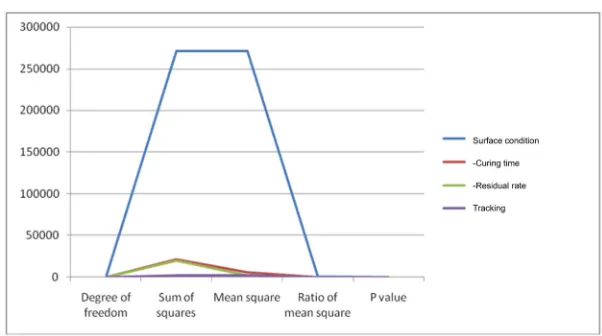
Figure 1: FDOT shear tester observations
Figure 2: FDOT shear tester observations
From Fig. 1 it may be observed that during FDOT Shear test, the surface condition do not affect the residual rate as well as tracking. From Fig. 2 it is seen that the residual rate varies along with curing time. Also it can be observed that the tracking is having negligible effect over shear strength.
3.2 Torque bond test
The torque bond test was performed
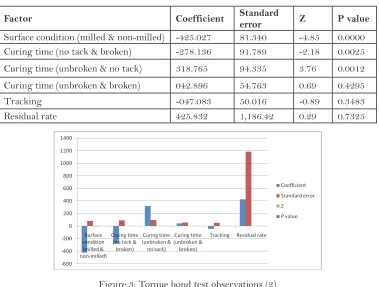
Table 2: Torque bond test observations (1)
Factor Coefficient Standard error Z P value
Surface condition (milled & non-milled) -425.027 81.340 -4.85 0.0000
Curing time (no tack & broken) -278.136 91.789 -2.18 0.0025
Curing time (unbroken & no tack) 318.765 94.335 3.76 0.0012
Curing time (unbroken & broken) 042.896 54.763 0.69 0.4295
Tracking -047.083 50.016 -0.89 0.3483
Residual rate 425.832 1,186.42 0.29 0.7325
Figure 3: Torque bond test observations (2) From Fig. 3 it may be observed that in Torque
bond test, the surface condition has negative effect on coefficient. Curing time also adversly
affects with surface condition. From Fig. 4 it is seen that the standard error is relatively constant for all factors except residual rate.
3.3 Pull off test
In this test the road is divided in to two separate parts as milled and non-milled section. Thus surface condition is considered as main governing factor. Further the surface condition is classified into different residual rates. Testing time is also a factor that affects the results. During the experiments it was observed that the base contact plate has better adhesion with the non-milled
section than the milled section. This results in higher tensile strength for non-milled section as compared to milled section.
Also it is interesting to note that the pull off strength inversely varies with the time. As time increases the pull of strength reduces. This effect was observed over entire length of the road. Table 3 show the observed results.
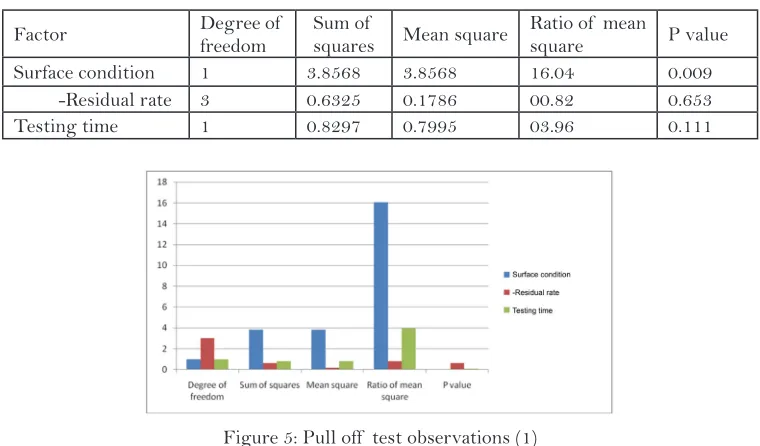
Table 3: Pull off test observations
Factor Degree of freedom Sum of squares Mean square Ratio of mean square P value
Surface condition 1 3.8568 3.8568 16.04 0.009
-Residual rate 3 0.6325 0.1786 00.82 0.653
Testing time 1 0.8297 0.7995 03.96 0.111
Figure 5: Pull off test observations (1) From Fig. 5 it may be observed that in Pull
Off test, the surface condition do not have considerable effect. From Fig. 6 it is seen that the residual rate does not vary considerably.
4. Conclusion
The study and review of experimental work presented in this research paper is for the three tests which has different mechanisms. The experiments conducted for FDOT shear tester and tabulated in Table 1, shows that, except tracking factor all other factors are statistically significant. It is also observed that for milled as well as for non-milled sections, increase in residual rate does not improve the shear strength.
The results presented in Table 2, shows that, there is large difference in torque strength between milled and non-milled section. Milled section offers higher torque resistance than the non-milled section. Also it was observed that for non-milled section a significant difference exists for the torque resistance in no tack, broken and unbroken specimens.
The results of Pull-off test presented in Table 3, clearly indicates that the non-milled sections have higher pull-off strength than that of the milled section. Overall it is observed that the milled section provides considerably higher bond strength at the interface of existing and new pavement surface. The tack coat does not affect the bond strength of milled section. But for non-milled section the tack coat significantly affects the bond strength of the pavement.
5. Acknowledgement
The experimental work described here was supported by Government of Singapore. The School of Civil and Environmental Engi-neering provided manpower support to this research project. The author wishes to ac-knowledge their contribution and the assis-tance throughout the experimental work.
References
[1] H. R. Paul, and J. A. Scherocman, “Friction testing of tack coat surfaces”,
Transportation Research Record, 1616, Transportation Research Board, Washington, D.C., 1998, pp. 6-12. [2] L. N. Mohammed, M. A. Raqib and B.
Huang, “Influence of asphalt tack coat materials on interface shear strength”,
Transportation Research Record, 1789, Transportation Research Board, Washington D. C., 2002, pp. 56-65. [3] P. G. Lavin, “Asphalt pavements”, E &
FN Spon, New York, 2003.
[4] G. Sholar, G. Page, J. Musselman, P. Upshaw and H. Moseley, “Preliminary investigation of a test method to evaluate bond strength of bituminous tack coats”, in Association of Asphalt Paving Technologists Technical Sessions, 2004, Baton Rouge, Louisiana, USA, 2004, vol. 73, pp. 771-801.
[5] R. C. West, J. Zhang and J. Moore, “Evaluation of bond strength between pavements layers, NCAT Rep. No. 05-08, National Center for asphalt technology, Auburn, Ala, 2005.
[6] T. Laith, N. Kitae, T. Papagiannakis, K. Willoughby, L. Pierce and T. Baker, “Evaluation of construction practices that influence the bond strength at the interface between pavement layers”,
Journal of Performance of Constructed Facilities, vol. 22, pp. 154-161, 2008. [7] D. Piotr and W. Daniel, “Evaluation