CONCLUION AND DISCUSION
From this research results, it showed that it is important and effective to evaluate the plant growth to consider with canopy cover, species richness and changes of yield. The wintering of Medicago falcata L is 70-76 percent and yield is 12-16.4 centner/ha in the abandoned land, and 80-85 percent for wintering and yield is 2-3.5 centner/ha in the degraded land. Due to planting perennials, xerophyte plants decreased by 18.7 percent and mesophyte plants increased by 17.7 percent in the abandoned land. In contrast, mesophyte plants decreased by 2 percent, and xerophyte plants decreased by 8 percent in the degraded land from mining activities. From third
year of study in the abandoned land, when planting only Elymus dahuricusL and Bromus inermis, grass occupied 70 percent; planting Medicago falcate L, grass occupied 5 percent; mixed amount variation, which planted elymus and bromus inermis, grass occupied 40 percent. Depending on the variations, Grass family plants occupied more than half percent in the degraded land from mining activities. For example, planting only Elymus dahuricus L and Bromus inermis Leyss, grass occupied 80 percent, and planting Medicago falcate L, grass occupied 50 percent; mixed variation, grass occupied 65 percent.
ACKNOWLEDGEMENT
This study was carried out and founded by The Institute of Geoecology, MAS under the project of “Tsum technology, planting perennials in the degraded lands”. We would like to say thank to whom joined this study R. Delgertsetseg, A.
Enkhbaatar, G. Ariunsukh , Ts. Solongo, and director of the institute J. Tsogtbaatar (Ph.D). Especial thanks to Ya. Baasandorj (Ph.D) who leaded this project and gave valuable
recommendations on this project.
REFERENCES
1. Alimaa D., 2014, The result of innovation project on the seed breeding of forage plants. The Series of Research Institute of Animal Husbandry. Ulaanbaatar, ¹36, p. 83.
2. Avaadorj, D (Eds)., 1997, Scientific report on rehabilitation and possibilities on the degraded land. Institute of Geoecology, MAS. Ulaanbaatar, p.8.
3. Batima, P and Dagvadorj, D (Eds.)., 2000, Climate Change and Its Impacts in Mongolia. JEMR Publishing, Mongolia, p. 227.
4. Dejidma, Ts and Uuganzaya, M., 2014,. Growth dynamics of Bromus Inermus Leyss. The Series of Research Institute of Animal Husbandry. Ulaanbaatar, ¹36, p. 99-103
5. Erdenejav G., 1968, Some results of planting perennials in the forest-steppe zone. The series of institute of Biology, MAS. Ulaanbaatar, ¹3. 6. Institute of Geoecology, MAS., 2002, Scientific
report of “Biological rehabilitation on the abandoned land from agriculture activities”. Ulaanbatar. Pages 3.
7. Institute of Geoecology, MAS., 2010, Scientific report of “The inventory of degraded lands from mining activities in Tuv, Bulgan and Selenge aimag of Mongolia”. Ulaanbaatar.
8. Institute of Geoecology, MAS., 2014, Scientific report of “Assessment of multiple land use types and mapping”. Ulaanbaatar.
9. The Ministry of Nature, green development and tourism of Mongolia. 2015. http://www.eic.mn/dlid/ (Seen 2015.04.26)
10. R. Otfinowski, n.C Kenkel, and P.M Catling., 2006, The Biology of Canadian weeds. Bromus inermus leyss. Canadian journal of plant science. p. 183-196.
11. Research Institute of Animal Husbandry., 2011, Feed crops and seed selection within 50 years. Ulaanbaatar.
12. J. Undarmaa et al, 2015, p. 244. Rangeland plants in Mongolia (Ulaanbaatar; Munkhiin useg printing).
13. Zhang XingXu., Li ChunJie and Nan Zhibiao., 2012, Effect of cadium stress on seed germination and seedling growth of Elymus dahuricus infected with the Neotyphodium endophyte. Scinece China Life Sciences. Vol.55 No.9 p.793-799.
14. United States Department of Agriculture. February, 2014.
http://plants.usda.gov/plantguide/pdf/pg_elda3.p df. (Seen 2015.05.1)
CONTENT OF NONESSENTIAL ELEMENTS AND CHIMICAL COMPOSITION OF MAIN COMMUNITY of GRASSLAND in ECOLOGICAL ZONES
Tserendash S.1*, Bolormaa D.2, Enkhtsetseg B.2
1-Mongolian Academy of Agricultural Sciences 2-Research Institute of Animal Husbandry, MULS
*-Corresponding author, E-mail: [email protected]
ABSTRACT
Result of studying a nutrition value of main communities in grasslands is depending on ecological zones and growth stage. Contamination of non essential elements, macro-micro element is non-significant difference between forest steppe and steppe while a significant difference came out in semi desert area.
INTRODUCTION
The chemical composition of pasture grasses is different, with substances presented in various amounts. The plants are considered valuable in nutrition if contains protein, fat, minerals and have less crude fiber. The chemical composition depends on many facts like the geographic location, weather condition, type of pasture and development stages, and varies consequently. It is important to achieve the information about contents of macro micro elements and chemical composition of the common represented pasture grasses and most preferred plant species for every type of zones. This is decisive for solving the problems related to feeding animals and to establish a knowledge about the process of development of those zones.
Objective:The main objectives of the research work was to determine the nutrition value, amount of macro-micro element and contamination of non-essential elements in needle grass-forbs types of ecological zones.
Samples and methodology: Representing for forest steppe zone that is Dadal sum, Hentii aimag, steppe zone is Hustai National Park, Tuv aimag and semi dessert zone is Eredenedalai sum, Dundgovi aimag. All of the research samples were taken from main pasture type of these zones in the autumn. The samples are include three mixed pasture and five dominant individual plants that are Stipa Krylovii Roshev., Cleistogenes squarrosa (Trin) Keng., Agropyron cristatum (L) P.B., Carex duriuscula C.A. Mey., Artemisia Frigida willd ., from semi dessert zone’s Cleistogenes soongorica Ohwi., Stipa gobica Roshev.. The sample were collected in August when the plants reached their maximum yield.
(Kjeltec titration) (AOAC, 1995), acid detergent fiber (ADF) using Ankom®fiber analyzer (AOAC, 1990a). Neutral detergent fiber (NDF) determined using Ankom ®fiber analyzer as described by Van Soest et al.(1991). Lignin (ADL) was determined by first performing ADF and then ADL (AOAC, 1990c) and either extract through diethyl ether extraction (AOAC,1990b).
Mineral and toxic metal analysis was conducted at
the Western College of Veterinary Medicine Mineral Diagnostics Lab using ICP Mass Spectrometry (Thermo Electron corp., X series ICP-MS, serial #1263). Samples were digested in 5mL concentrated nitric acid, and heated in Mars Xpress (CEM corp.) pressurized microwave for 50 min with gradual temperature increase to 1800C. Duplicate samples were diluted to 100 ppb and 50 ppb to increase accuracy.
RESULTS AND DISCUSSION
The chemical composition of pasture grasses is the main characteristic in determination of the nutrition value of the pasture and it is quality. By comparing of the chemical composition of the same type of pasture grass-forbs in different ecological zones, one could determine that the pasture in the steppe
forest region contained less protein (8.75%), has more fiber and was less nutrition value than in the other regions.(see table 1). This result depend on vegetation period and growing stage. Same time we are collected samples but growing stage was late in forest steppe area.
Table1
Nutrition value of mixed sample of three different ecological zones
The higher NDF content of forest and steppe zones which is indicated decrease to intake. It is concluded that the higher ash content in the steppe regions with semi desert area can be linked to the higher content of macro-micro elements in those regions.
The comparison of the ME of the dominant species of grass-forbs pasture shows no significant differences in quality between steppe and steppe-forest pasture species even though there are some differences in chemical composition which was
influenced by the geography, climate and growing stage.
The Content of Macro- and Microelements of pasturelands
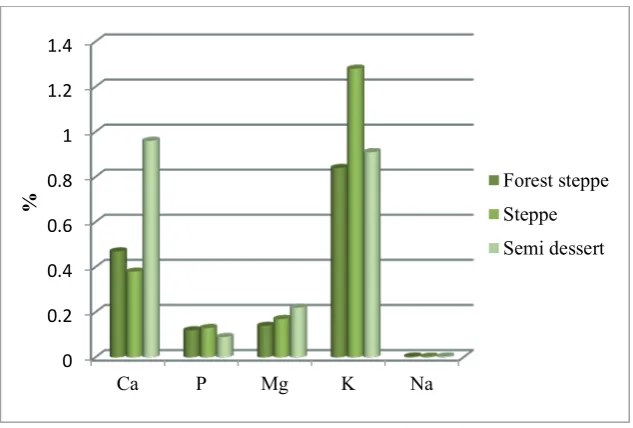
Mongolian grasslands macro-microelements was determined by some researchers. These three ecological zones’ plants have more concentration of potassium then other macroelements and lower concentration of phosphorus. That result is according to Tserendulam.R [28,29] and other researchers analysis. (see figure 1)
¹ Content of Nutrition value Forest steppe
zone Steppe zone Semi dessert zone
1 Moisture, % 5.4 5.48 4.52
2 Crude protein , % /CP/ 8.75 13.48 10.29
3 Fat, % /DF/ 3.45 3.93 4.9
4 Crude fiber, % /CF/ 29.4 28.3 27.2
5 Ash, % 7.5 6.4 10.06
7 Neutral detergent fiber, % /NDF/ 53.7 51.7 49.1
8 Acid detergent fiber, % /ADF/ 34.9 33.8 32.4
(Kjeltec titration) (AOAC, 1995), acid detergent fiber (ADF) using Ankom®fiber analyzer (AOAC, 1990a). Neutral detergent fiber (NDF) determined using Ankom ®fiber analyzer as described by Van Soest et al.(1991). Lignin (ADL) was determined by first performing ADF and then ADL (AOAC, 1990c) and either extract through diethyl ether extraction (AOAC,1990b).
Mineral and toxic metal analysis was conducted at
the Western College of Veterinary Medicine Mineral Diagnostics Lab using ICP Mass Spectrometry (Thermo Electron corp., X series ICP-MS, serial #1263). Samples were digested in 5mL concentrated nitric acid, and heated in Mars Xpress (CEM corp.) pressurized microwave for 50 min with gradual temperature increase to 1800C. Duplicate samples were diluted to 100 ppb and 50 ppb to increase accuracy.
RESULTS AND DISCUSSION
The chemical composition of pasture grasses is the main characteristic in determination of the nutrition value of the pasture and it is quality. By comparing of the chemical composition of the same type of pasture grass-forbs in different ecological zones, one could determine that the pasture in the steppe
forest region contained less protein (8.75%), has more fiber and was less nutrition value than in the other regions.(see table 1). This result depend on vegetation period and growing stage. Same time we are collected samples but growing stage was late in forest steppe area.
Table1
Nutrition value of mixed sample of three different ecological zones
The higher NDF content of forest and steppe zones which is indicated decrease to intake. It is concluded that the higher ash content in the steppe regions with semi desert area can be linked to the higher content of macro-micro elements in those regions.
The comparison of the ME of the dominant species of grass-forbs pasture shows no significant differences in quality between steppe and steppe-forest pasture species even though there are some differences in chemical composition which was
influenced by the geography, climate and growing stage.
The Content of Macro- and Microelements of pasturelands
Mongolian grasslands macro-microelements was determined by some researchers. These three ecological zones’ plants have more concentration of potassium then other macroelements and lower concentration of phosphorus. That result is according to Tserendulam.R [28,29] and other researchers analysis. (see figure 1)
¹ Content of Nutrition value Forest steppe
zone Steppe zone Semi dessert zone
1 Moisture, % 5.4 5.48 4.52
2 Crude protein , % /CP/ 8.75 13.48 10.29
3 Fat, % /DF/ 3.45 3.93 4.9
4 Crude fiber, % /CF/ 29.4 28.3 27.2
5 Ash, % 7.5 6.4 10.06
7 Neutral detergent fiber, % /NDF/ 53.7 51.7 49.1
8 Acid detergent fiber, % /ADF/ 34.9 33.8 32.4
9 Metabolitic Energy, MJ/Kg 8.1 9.0 8.3
Figure 1. Content of Macroelements in three different zones
The needle grass-forbs pasture type and species by choice have proved enough potassium content in all regions, but not sufficient content of sodium (Na) in steppe-forest zones and also not enough phosphorus
was found in the semi desert area for the animal requirements. All other elements were presented in sufficient amounts.
Figure 2. Content of Microelements in three different zones
The iron content in the samples from desert region was 547.3 ppm which is by 70% more than of steppe regions and by 21% more than of forest-steppe zones. The iron as microelement was presented more than any other elements in all regions (Figure 2). The selenium was also found not sufficient, but cobalt has met with its 0.09-0.23 ppm the required amount for the animals.
The chemical composition and nutrition value of grass-forbs pasture and dominant species were analyzed and compared to each other in different
ecological zones. In steppe and forest steppe zones there were no significant differences in regards to quality and nutrition value, when the content in macro, micro elements differed slightly. But there was a significant difference in above characteristics of desert steppe compared to the other two zones. This study shows that the concentration of macro, microelements is related directly to the soil where the plants growing. The chemical composition of those plants was compared to the result of previous studies Tserendulam.R [5,6] and Yunatov.A.A [7].
0 0.2 0.4 0.6 0.8 1 1.2 1.4
Ca P Mg K Na
%
Forest steppe
Steppe Semi dessert
0 100 200 300 400 500 600 700
Co Cu Fe Mn Mo Se
M
g/
kg
Forest steppe
Steppe
Table 2 Content of Microelements in the three different Ecological zone, mg/kg
Microelements Forest steppe zone Steppe zone Semi dessert zone
Cobalt (Co) 0.23 0.09 0.27
Copper (Cu) 3.82 6 6.61
Iron (Fe) 508.4 193.1 647.3
Manganese (Mn) 42.2 29.4 45.7
Molybdenum (Mo) 1.23 0.35 1.2
Selenium (Se) 0.27 0.44 0.2
The contents of molybdenum, manganese, cobalt and copper in soil increase if the location gets closer from forest-steppe to desert steppe .
Nonessential elements
Our result that is the concentration of toxic and heavy metal in the grasslands normally to equalized
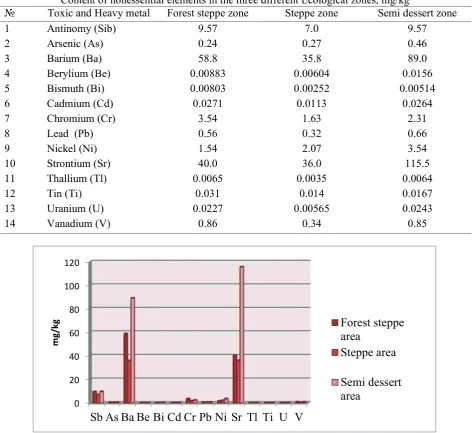
with NRC [8]. Furthermore semi dessert zone’s grassland includes more amount of nonessential elements.(See table 3). Also more amount of heavy metal strontium 40-115 mg/kg, barium 35.8-89.0 mg/kg than other nonessential elements (see figure 4).
Table 3 Content of nonessential elements in the three different Ecological zones, mg/kg
¹ Toxic and Heavy metal Forest steppe zone Steppe zone Semi dessert zone
1 Antinomy (Sib) 9.57 7.0 9.57
2 Arsenic (As) 0.24 0.27 0.46
3 Barium (Ba) 58.8 35.8 89.0
4 Berylium (Be) 0.00883 0.00604 0.0156
5 Bismuth (Bi) 0.00803 0.00252 0.00514
6 Cadmium (Cd) 0.0271 0.0113 0.0264
7 Chromium (Cr) 3.54 1.63 2.31
8 Lead (Pb) 0.56 0.32 0.66
9 Nickel (Ni) 1.54 2.07 3.54
10 Strontium (Sr) 40.0 36.0 115.5
11 Thallium (Tl) 0.0065 0.0035 0.0064
12 Tin (Ti) 0.031 0.014 0.0167
13 Uranium (U) 0.0227 0.00565 0.0243
14 Vanadium (V) 0.86 0.34 0.85
Figure 3. Content of nonessential elements in the three different Ecological zones
0 20 40 60 80 100 120
Sb As Ba Be Bi Cd Cr Pb Ni Sr Tl Ti U V
m
g/k
g
Forest steppe
area
Steppe area
Table 2 Content of Microelements in the three different Ecological zone, mg/kg
Microelements Forest steppe zone Steppe zone Semi dessert zone
Cobalt (Co) 0.23 0.09 0.27
Copper (Cu) 3.82 6 6.61
Iron (Fe) 508.4 193.1 647.3
Manganese (Mn) 42.2 29.4 45.7
Molybdenum (Mo) 1.23 0.35 1.2
Selenium (Se) 0.27 0.44 0.2
The contents of molybdenum, manganese, cobalt and copper in soil increase if the location gets closer from forest-steppe to desert steppe .
Nonessential elements
Our result that is the concentration of toxic and heavy metal in the grasslands normally to equalized
with NRC [8]. Furthermore semi dessert zone’s grassland includes more amount of nonessential elements.(See table 3). Also more amount of heavy metal strontium 40-115 mg/kg, barium 35.8-89.0 mg/kg than other nonessential elements (see figure 4).
Table 3 Content of nonessential elements in the three different Ecological zones, mg/kg
¹ Toxic and Heavy metal Forest steppe zone Steppe zone Semi dessert zone
1 Antinomy (Sib) 9.57 7.0 9.57
2 Arsenic (As) 0.24 0.27 0.46
3 Barium (Ba) 58.8 35.8 89.0
4 Berylium (Be) 0.00883 0.00604 0.0156
5 Bismuth (Bi) 0.00803 0.00252 0.00514
6 Cadmium (Cd) 0.0271 0.0113 0.0264
7 Chromium (Cr) 3.54 1.63 2.31
8 Lead (Pb) 0.56 0.32 0.66
9 Nickel (Ni) 1.54 2.07 3.54
10 Strontium (Sr) 40.0 36.0 115.5
11 Thallium (Tl) 0.0065 0.0035 0.0064
12 Tin (Ti) 0.031 0.014 0.0167
13 Uranium (U) 0.0227 0.00565 0.0243
14 Vanadium (V) 0.86 0.34 0.85
Figure 3. Content of nonessential elements in the three different Ecological zones
0 20 40 60 80 100 120
Sb As Ba Be Bi Cd Cr Pb Ni Sr Tl Ti U V
m
g/k
g
Forest steppe
area
Steppe area
Semi dessert
area
CONCLUSION
This research work would be the first of this kind because there was not yet done such complex studies to determine the various characteristics for one type of pasture in different regions and establishing the
chemical composition of common type of plants and their contents in macro, micro elements and nonessential elements.
REFERENCES
1. Amgalan, J., 1977. Microelements research and future goals for 1963-1975 of People's Republic of Mongolia. In: Scientific findings of MAS 15, pp. 243-245, UB.
2. Dulamsuren, Ch. 1972. Study of the nutritional quality and digestibility of vegetation in the Gobi. Agricultural scientific findings of Gobi zone. 2.
3. Jamsran,j., Garidkhuu,J., Amgalan, J. 1972. Distribution of manganese and boron in soil of Mongolia. Research findngs of Chemical Institute & MAS 10, pp 132-150,
4. Tserendash,S. 1985. Chemical composition of green grass and litter mass of grassland for Zelter and Shaamar soums. Research findings of Institute of grassland and fodder. 10, Ulaanbaatar
5. Tserendulam,R., 1958. Nutritional quality of various fodders, Ulaanbaatar
6. Tserendulam,R., 1980. Fodder’s Nutritional quality Ulaanbaatar.