159
Design and evaluation studies on novel floating tablets for peptic ulcer
treatment
Putta Rajesh Kumar*, Hiremath Doddayya, S. Rajendra Reddy
Department of Pharmaceutics, N. E. T. Pharmacy College, Raichur, Karnataka, India.
*Corresponding author: [email protected]
ABSTRACT:
The aim of this study was to develop enteric coated esomeprazole core tablet followed by
compression coating with clarithromycin coat granules to obtain a single unit core in
coat floating tablet. The tablets were prepared by investigating various porous carriers,
cellulosic polymers and natural gums. Sodium bicarbonate is used as gas generating
agent. The enteric coating of core tablet showed significant protection of esomeprazole
from gastric acid by acryl EZE and in vitro release of drug in simulated intestinal fluid.
The rheological and compressional parameters of the core powder and coat granular
beds showed their ease of flow and compaction in to tablet. The tablets showed
optimum floating parameters with minimum floating lag time. In vitro dissolution in
modified dissolution apparatus indicated the clarithromycin release in simulated gastric
fluid for first 2h and esomeprazole in simulated intestinal fluid for 10h. A zero order
drug release was observed for clarithromycin coat and first order drug release for
esomeprazole. Porous carriers, HPMC and natural gums as matrix polymers
optimization studies indicated their suitability for floating tablet formulations. The
dosage forms could be further evaluated for pharmacokinetic studies to study actual
drug release in vivo.
Key words: Peptic ulcer, Esomeprazole, Super disintegrant, Clarithromycin, Porous carriers.
INTRODUCTION:
Peptic ulcer is an open sore in the lining of the stomach or intestine, much like mouth
or skin ulcers. Peptic ulcers are usually caused by acid and pepsin, a digestive stomach
enzyme. An ulcer forms when there is an imbalance between aggressive and defensive
factors. More than 50% of the world population is believed to be infected by Helicobacter
160
ulcer is caused by H. pylori, non steroidal anti inflammatory drugs and aspirin.
Esomeprazole an S-isomer of omeprazole that acts as proton pump inhibitor used to
treat gastric ulcer. It suppresses acid production by inhibiting gastric parietal H+/K ATPase involved in hydrochloric acid production in the stomach. [1] Clarithromycin is a
broad spectrum antimicrobial new generation macrolide active against most Gram
positive aerobic cocci and Gram positive bacilli. [2] The activity of clarithromycin is
enhanced by its extensive tissue distribution and by formation of the
14-(R)-hydroxyclarithromycin metabolite. Clarithromycin and 14-(R)-14-(R)-hydroxyclarithromycin
have a minimum inhibitory concentration of 0.03 and 0.06 µg/ mL for h. pylori,
respectively. The clarithromycin is reported that it has activity against h pylori bacteria
that causes peptic ulcer. [3]
The literature was updated for floating dosage forms and some of the relevant recent
references related to present study were presented here. Nama M. et al., prepared
clarithromycin floating tablets by wet granulation. They observed the mechanism of
drug release of from tablets is anomalous diffusion with zero order kinetics. In vivo
radiographic studies indicated increased gastric residence time of tablet evidenced
localized drug action for peptic ulcers. [4] Chandira M. et al., designed famotidine
effervescent floating tablets by direct compression technique. They concluded that
HPMC K4M, HPMC K100 M and Xanthan gum can be successfully used in formulation
of Famotidine sustained release gastro retentive floating drug delivery system using low
density polymer. [5] Kumar R. et al., developed famotidine floating drug delivery system
using sodium bicarbonate, citric acid, HPMC and carbopol 934P. They found that the
mechanism of drug release occurred by diffusion due to polymeric relaxation. The type
of polymer affected the drug release rate and mechanism. Polymer swelling is crucial in
determining the drug release rate and for flotation. Optimized formulation was stable
during storage at 45 °C/75% RH for three months. [6] Prakash K.G. et al formulated
Ranitidine HCl floating tablets with isolated chitosan by wet granulation technique.
They concluded that the floating formulations were able to delay the gastric emptying of
Ranitidine HCl tablets in beagle dogs. This would maximize absorption by allowing the
slowly released drug in the stomach to reach the upper small intestine. The floating
tablets of Ranitidine HCl also showed better gastric cytoprotection when compared with
conventional dosage form due to its extended duration of release and action. [7]
Floating delivery systems when come in contact with stomach fluid, carbon dioxide is
generated and entrapped in the hydrocolloid gel leads to an upward drift of the dosage
161
stomach. The patients with peptic ulcer and h. pylori infection require treatment with
anti secretory agent along with antimicrobial agent acts against h. pylori that gives more
symptomatic relief and patient compliance. Hence the present study is designed to
develop a single unit core in coat floating tablet containing esomeprazole core and
clarithromycin coat to deliver the drugs simultaneously at different sites in GIT for the
effective treatment of h. pylori associated peptic ulcer.
The formulated core in coat tablet is intended to deliver clarithromycin in stomach and
helps to act against h pylori localizedin the mucosal lining of stomach. Later, due to the
erosion of polymer coat core tablet released, passed through pyloric antrum to
duodenum to deliver esomeprazole to suppress excess acid secretion. The esomeprazole
core tablets were developed using various super disintegrants along with directly
compressible vehicles by direct compression technique. The powder bed was studied for
various rheological parameters and compressed tablets were subjected for compression
parameters studies. Later these tablets were enteric coated with methacrylic acid
copolymer Acryl EZE to protect esomeprazole from gastric acid. The coated tablets were
subjected for acid uptake studies. The results were presented in our previously
published article. [8] In continuation to this in the present study the developed core
formulations were compression coated with clarithromycin coat blends and studied for
in vitro drugrelease profiles.
Various clarithromycin formulations was developed by investigating porous carriers,
cellulosic polymers and natural gums for preparing its powder blend or granular bed for
compression coating over the developed esomeprazole cores to form single unit core in
coat floating tablet. The coat formulations were also studied for pre and post
compressional characteristics. Further the developed formulations were subjected for
various floating parameters followed by in vitro dissolution studies in modified
dissolution apparatus that mimics open flow through cell assembly.
MATERIALS AND METHODS:
Esomeprazole magnesium trihydrate was gifted by Aurobindo pharma limited, A.P,
India. Crospovidone, Sodium starch glycolate, Croscarmellose sodium obtained from
Danmed Pharmaceuticals Pvt Ltd, Hyderabad. Lactose DC and Mannitol DC were
procured from SD Fine Chemicals Limited, Mumbai. Acryl EZE (Eudragit L 30 D55,
Colorcon) was supplied by Medreich Limited, Bangalore. Polypropylene, Calcium
162
HPMC K4M, MCC was purchased from INR Chem and yarrow chemicals, Mumbai.
Other solvents and chemicals used in the research were of LR grade.
Porous carriers size reduction:
The Polypropylene pellets were placed in a ball mill (J.T. Jagtiani Instruments, India)
containing pebbles that occupied 45% volume. Drum was rotated at optimum speed for
90 min. The size reduced material through impact and attrition was taken out and is
subjected for further size reduction in a waring blender (Samurai instruments, India)
operated at 12,000 rpm for 20 min. The fine powder obtained was taken and placed
over sieve shaker with # 120 sieve and operated for 05 min. Over sized polypropylene
particles retained on # 120 sieve were subjected for further size reduction in waring
blender. The process continued till all polymer powder passed or undersized through #
120 sieve. The fine powder passed through # 120 sieve is collected in receiving pan was
taken out and placed in self sealing polythene bag and then packed in air tight
container and labeled as porous polypropylene undersize # 120 until further use.
Similarly fine powder of Calcium silicate and Silicon dioxide (Aerosil) was undersized
through # 100 followed by # 120 sieve. The fine powder was taken out and placed in self
sealing polythene bag and packed in air tight container and labeled as porous Calcium
silicate undersize # 120, porous silicon dioxide undersize # 120 until further use.
Various polymers and excipients were studied for their suitability towards formulation
of proposed core in coat gastroretentive tablets. Porous carriers like fumed silicon
dioxide, calcium silicate and polypropylene, sodium bicarbonate as effervescence agent,
matrix forming agents like xanthan gum, guar gum, carbopol and HPMC K4M along
with drug and lubricants were subjected for preliminary screening studies by using
direct compression and wet granulation techniques for their effect on rheological and
post compressional parameters along with significant parameters like floating lag time,
duration of floating time for gastroretentive tablets.
Clarithromycin powder blend preparation for compression coating over Esomeprazole magnesium enteric coated core tablets by Direct Compression:
The clarithromycin coat formulation Ingredients of F1, F2, F3 and 1 to 4 were
accurately weighed, milled and passed through sieve # 100/ 120 and then thoroughly
blended with glidant and lubricant. The powder blends blended was studied for
rheological characteristics and further the uniform blend of powder containing
163
compression coating over esomeprazole core tablets by direct compression through
compression coating technique using various core tablets in a 10 station tablet
punching machine using 13 mm flat punches at a pressure of 4-6 kg/cm2. In each batch 300 core in coat tablets were prepared.
Clarithromycin coat granules preparation by wet granulation for compression coating over Esomeprazole magnesium enteric coated core tablets:
The formulation ingredients containing drug, porous carrier, effervescent agent and
matrix carrier for a batch 300 tablets were weighed accurately and passed through #
100 mesh sieve and the powder was uniformly blended in a cube mixer. The powder
blends of CC1 to CC4 and CT1 to CT3 were wet granulated with water and starch paste
(15% w/w) as binder to produce wet mass. The wet mass was passed through mesh #
16, dried in an oven at 40°C for 4 - 5 h, and again passed through mesh # 20. Later,
talc and magnesium stearate as required were incorporated and blended. Later for
formulations T1 to T3 the powder blends of ingredients were wet granulated with (1.5%
w/w) each of guar gum, xanthan gum and HPMC K4M as binder in water to produce
wet mass. The wet mass of respective coat formulations was then passed through mesh
# 14, dried in an oven at 40°C /30 % RH for 4 h. Later dried coat granules were passed
through mesh # 16. Later, talc and magnesium stearate were incorporated as glidant,
lubricant and blended thoroughly. The granules were studied for their rheological
parameters and used for compression coating over esomeprazole core tablets. [9, 10]
Rheological parameters evaluation of Clarithromycin coat Powder / Granular bed: Angle of repose (°°°°θθθθ):
Angle of repose of granules was determined by measuring the height and radius of the
heap of the powder/granule bed. A cut stem funnel was fixed to a stand and bottom of
the funnel was fixed at a height of 3 cm from the horizontal plane. Powder/granule was
placed in the funnel and allowed to flow freely to form a heap. With the help of vernier
calipers (Mitutoyo) the height and radius of the heap were measured and noted. ø = tan -1 h /r. Where h is height of heap of powder/granule bed. r is radius of heap of powder/granule bed. Average of three repose angles was taken and tabulated. [11]
Bulk density:
Bulk density was determined (Konark instruments, India) by placing a fixed weight of
164
Instruments, India) and the total volume was noted. Bulk density was calculated by
using the formula. Bulk density = Total weight of powder or granules / Total volume of powder or granules. Average of three densities of powder/granule was taken and
tabulated. [11]
Tapped density:
Tapped density was determined in a bulk density testing apparatus (Konark
instruments, India) by placing the powder/granules blend in the measuring cylinder
and the total volume of powder blend was noted before and after 100 tappings. Tapped
density was calculated by using the formula.
Tapped density = Total weight of powder or granules / Total volume of powder/ granules after 100 tappings.
Average of three densities of powder/granule was taken. [12]
Carr’s Compressibility index:
Compressibility index was determined by placing the powder/granules in a measuring
cylinder and the initial volume (V0) was noted before tapping. After 100 tapping again final volume (V) was noticed. Compressibility index = (1- V/ V0) x 100. Where V0 = volume of powder/granules before tapping. V = volume of powder/granules after 100
tappings. Average of three readings was taken. [12]
Method of preparation of Core in coat tablet containing Esomeprazole magnesium trihydrate core andClarithromycin coat:
PP1D Pilot press loaded with 13 mm dies was cleaned and dried as per standard
operating procedure. The punching pressure was adjusted to produce tablets of
hardness 4 to 6 kg/ cm2. Then compression coating was performed with clarithromycin coat powder blend / coat granules over enteric coated esomeprazole magnesium core
tablets. Initially 55% w/w of the coat powder blend / coat granules containing
Clarithromycin was placed into the die cavity (diameter 13 mm) and then core tablet of
esomeprazole (diameter 6 mm) was placed into the same die cavity, by carefully
adjusting the core tablet to the centre of the coat blend inside the die cavity. The
remaining 45 % w/w of clarithromycin coat powder blend / coat granules were filled
over the core tablet so that the core is completely and uniformly surrounded by the coat
165
(PP1D, Chamunda, India). These tablets were studied for compression characteristics
and later in vitro dissolution studies were carried out. [13]
Evaluation methods for Esomeprazole magnesium trihydrate core in Clarithromycin coat compressional parameters of compression coated tablets:
Tablet weight variation:
Ten tablets were randomly sampled and accurately weighed on Dhona analytical
balance. The tablet weight variation was expressed as mean values ± SD. [14]
Friability test:
Roche Friabilator was used for testing the friability of the tablets. Ten tablets were
weighed accurately and placed in the tumbling chamber and rotated at 20 rpm for a
period of 5 min. The tablets were removed, dedusted and accurately weighed. The
percent weight loss was calculated by using formula given below.
Percent friability = Initial weight of tablets- Final weight of tablets / Initial weight of
tablets ×100. [15]
Hardness test:
Pfizer hardness tester was used for the determination of the hardness of tablets. Tablet
was placed in contact between the tester plungers, and the handle was pressed, the
force of the fracture was recorded in the recorder guaze. The results were expressed as
mean values ± SD. [14]
Diameter test:
The tablets were evaluated for their diameter using a vernier Caliper (Mitutoyo, Japan).
Average of three readings were taken and tabulated (n = 3) and their respective SD was
computed. [16]
Tablet thickness:
A vernier calipers (Mitutoyo, Japan) was used to determine thickness of randomly
selected tablets (n=3). [16]
Determination of drug content:
Coat tablet of clarithromycin was separated from core in coat tablet and crushed into
166
dry ethanol and kept aside with constant shaking for 24 hours on a rotary flask shaker
(Konark instruments, Ambala cantonment, Haryana.) to extract total drug present in
the tablet. The absorbance of the solution was measured after suitable dilution at 211
nm against dry ethanol as blank (n=3). [16]
Density measurement:
The apparent density was calculated from the volume and mass of the tablet. The
volumes V of the tablets were calculated from their height h and radius r using
micrometer. Volume of the tablets was calculated by using the following equation.
Average of three readings were taken and tabulated (n = 3). V = ∏ x r2 x h. [17]
Floating lag time:
The in vitro buoyancy was determined by floating lag time, as per the method described
by Rosa et al. The tablets were placed in a 100 ml beaker containing 100 ml 0.1 N HCl
and the time required for the tablet to rise to the surface and float was determined as
floating lag time. Average of three readings was taken and recorded. [18]
Duration of floating time:
A glass beaker containing 100 ml of 0.1N HCl was taken, in which a tablet was placed
for observation. The total duration for which a tablet remains floating was recorded as
duration of floatation. Average of three readings were taken (n = 3). [19]
In vitro dissolution studies through modified flow through dissolution system:
A modified dissolution apparatus was fabricated from a 100 ml glass beaker, by attaching an S-shaped side arm (glass tube) and capable of holding 70 ml of dissolution medium (simulated gastric fluid/simulated intestinal fluid). The medium was stirred on a magnetic stirrer. A burette was mounted above the beaker to deliver the dissolution medium at a flow rate of 2 ml/min. The tablet was put in the modified beaker containing 70 ml of dissolution medium and the medium was stirred at 75 rpm. The temperature of the medium was maintained at 37 ± 0.5 ºC. From the burette, simulated gastric fluid pH 3.0 was added at a rate of 2 ml/min. Samples of 1 ml were collected at predetermined time intervals for 2 h. The dissolution was further carried out with the same tablet by replacing the dissolution media with alkaline borate buffer pH 9.0 and
study continued for next 10 h and samples of 1 ml were withdrawn periodically and
167
for esomeprazole magnesium trihydrate and at 211nm for clarithromycin respectively throughout the study by using U.V. 1700 (Pharmaspec Shimadzu. Japan). [20, 21]
RESULTS AND DISCUSSION:
Treatment of peptic or gastric ulcer requires an antibacterial agent like clarithromycin,
a broad spectrum antibacterial agent, which is effective against peptic ulcer causing h.
pylori bacteria and a gastric acid suppressing drug like esomeprazole magnesium
trihydrate, a proton pump inhibitor. Clarithromycin has its absorption window in
stomach where as esomeprazole is absorbed well from small intestine because of its
instability in stomach. In lieu of the previous reports, in the current investigation a
novel core in coat gastro retentive tablets were developed by compression coating
method. The dosage form containing 20 mg of esomeprazole presented as enteric
coated core tablet within coat formulation containing 250 mg clarithromycin dispensed
as a single unit. Further the clarithromycin coat tablets were formulated as FDDS or
GRDF and esomeprazole core as enteric release tablets. The core tablets were initially
punched using 6 mm punches and later coat formulation was manipulated in 13 mm
die cavity so as to surround the core tablets completely and then the tablets was
punched in a 10 station Pilot press. Porous polymers, gas generating agents and other
excipients were studied in preliminary studies for their suitability towards formulation
of proposed core in coat gastroretentive tablets.
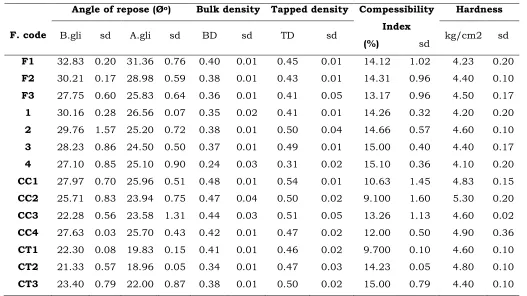
The developed formulations were studied for the following rheological properties. The
angle of repose (°θ) of Clarithromycin coat powder blends of F1, F2, F3 and 1 to 4 was
found to be in the range of 24.50 to 31.36. The bulk density of coat formulation powder
blend is in between 0.240 to 0.400 and tapped density is from 0.310 to 0.500.
Compressibility index of the above directly compressible Clarithromycin coat powder
blends were found to be in between 13.17 to 15.10. Rheological parameters evaluation
showed the angle of repose (°θ) of Clarithromycin coat granules of formulations CC1 to
CC4 and CT1 to CT3 was found to be in the range of 18.96 to 25.96. The bulk density of
coat formulation granular blend is in between 0.340 to 0.480 and tapped density is
from 0.460 to 0.540. Compressibility index of the above compressible Clarithromycin
coat granular blends were found to be in between 09.10 to 15.00. The results were
represented in table1. The floating parameters of preliminary coat formulations were
168
Table 1. Rheological parameters of preliminary Clarithromycin coat formulations
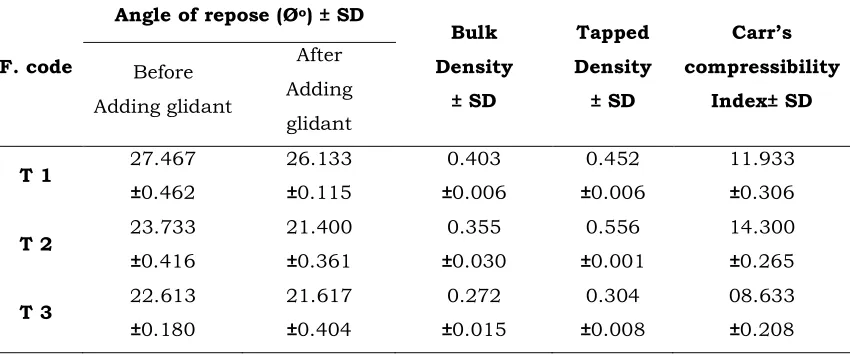
The angle of repose (°θ) of Clarithromycin granules of T1 to T3 coat formulations was
found to be in the range of 21.401 to 26.113. The bulk density of coat formulation
granular blend is in between 0.356 to 0.403 and tapped density is from 0.414 to 0.452.
Compressibility index of the above compressible Clarithromycin coat granular blends
were found to be in between 11.633 to 14.200. The data was represented in table 3. The
rheological characteristics of Clarithromycin coat powder blends and granular blends
indicated that the powder / granular beds of coat formulations are freely flowable and
easily compressible.
Later the compression coated tablets of T1 to T3 formulations showed the floating lag
time was in the range of 02 sec to 112 sec. whereas the duration of floating was found
to be 02 h to 24 h and core tablet exposed / released in 39 to 124 min. These results
showed in table 4 revealed the suitability of the above formulations to explore as core in
coat gastroretentive tablets. The core in coat tablets during the investigation initially
sanked to bottom of the beaker, hydrated and floated to the surface of 0.1 N HCl gastric
fluid with minimum lag time desired for gastroretentive tablets. Further the tablets were
continued to float over surface with a prolonged duration of floating which is desirable
F. code
Angle of repose (Øo) Bulk density Tapped density Compessibility Index (%) sd
Hardness
B.gli sd A.gli sd BD sd TD sd kg/cm2 sd
F1 32.83 0.20 31.36 0.76 0.40 0.01 0.45 0.01 14.12 1.02 4.23 0.20
F2 30.21 0.17 28.98 0.59 0.38 0.01 0.43 0.01 14.31 0.96 4.40 0.10
F3 27.75 0.60 25.83 0.64 0.36 0.01 0.41 0.05 13.17 0.96 4.50 0.17
1 30.16 0.28 26.56 0.07 0.35 0.02 0.41 0.01 14.26 0.32 4.20 0.20
2 29.76 1.57 25.20 0.72 0.38 0.01 0.50 0.04 14.66 0.57 4.60 0.10
3 28.23 0.86 24.50 0.50 0.37 0.01 0.49 0.01 15.00 0.40 4.40 0.17
4 27.10 0.85 25.10 0.90 0.24 0.03 0.31 0.02 15.10 0.36 4.10 0.20
CC1 27.97 0.70 25.96 0.51 0.48 0.01 0.54 0.01 10.63 1.45 4.83 0.15
CC2 25.71 0.83 23.94 0.75 0.47 0.04 0.50 0.02 9.100 1.60 5.30 0.20
CC3 22.28 0.56 23.58 1.31 0.44 0.03 0.51 0.05 13.26 1.13 4.60 0.02
CC4 27.63 0.03 25.70 0.43 0.42 0.01 0.47 0.02 12.00 0.50 4.90 0.36
CT1 22.30 0.08 19.83 0.15 0.41 0.01 0.46 0.02 9.700 0.10 4.60 0.10
CT2 21.33 0.57 18.96 0.05 0.34 0.01 0.47 0.03 14.23 0.05 4.80 0.10
169
for regioselective absorption of Clarithromycin from the dosage form through gastric
mucosa. The enteric coated core tablet is released due to coat erosion with in time to
deliver esomeprazole in pH 9.0 which simulates intestinal environment. The tablets also
showed minimum erosion of particles during floating lag time studies.
Table 2. Floating lag time and duration of floating of preliminary Clarithromycin coat formulations
F
code Tablet Floating lag time and Duration of Floating studies observations
F1 Tablet sank to the bottom, was swollen, later eroded but did not float to the
surface.
F2 Tablet sank to the bottom, was swollen, later eroded but did not float to the
surface.
F3 Tablet sank to the bottom, was swollen, later eroded but did not float to the
surface.
1 Tablet sank to the bottom hydrated but did not float to the surface.
2 Tablet sank to the bottom hydrated but did not float to the surface.
3 Tablet sank to the bottom hydrated but did not float to the surface.
4 Tablet sank to the bottom hydrated, swelled but did not float to the surface.
CC1 Tablet sank to the bottom, was swollen, later eroded with effervescence but did
not float to the surface.
CC2 Tablet sank to the bottom, eroded with effervescence but did not float to the
surface.
CC3 Tablet sank to the bottom, eroded by effervescence but did not float to the
surface.
CC4 Tablet sank to the bottom and eroded but did not float to the surface.
CT1 Tablet sank to the bottom eroded with effervescence but did not float to the
surface.
CT2 Tablet sank to the bottom eroded with effervescence but did not float to the
surface.
CT3 Tablet sank to the bottom eroded with effervescence but did not float to the
surface.
The accuracy studies of Clarithromycin from T1 to T3 coat formulations was 94.93 to
97.50 % and precision of 0.115 to 0.306 shows the drug content uniformity of
170
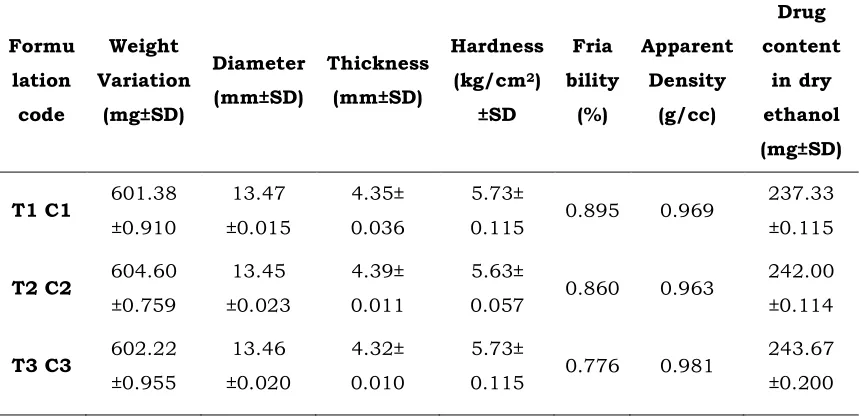
compressional parameters. The weight variation of C1T1 to C3T3 formulations was
found to be uniform and thicknesses (mm) of 4.32 to 4.39 were observed. Similarly
diameters of (mm) 13.45 to 13.47 were found to be uniform. The hardness (Kg/cm2) of the tablets was found to be between 5.63±0.113 to 5.73±0.115, the friability of C1T1 to
C3T3 tablets was 0.776 to 0.895 which was found to be minimum. The density (g/cc) of
C1T1 to CT33 formulations obtained as 0.963 to 0.981 indicates the suitability of
tablets for their floating ability to the surface in 0.1N HCl. The drug content studies of
Clarithromycin from C1T1 to C3T3 tablets in dry ethanol released 237.33 to 243.67 mg
of drug from tablets containing 250 mg dose shows the uniformity in drug content.
Results were represented in table 5. Esomeprazole magnesium trihydrate C20 from C1 to C3 was 21.0 to 59.0 min, with slope ranges from 0.0352 to 0.0656 and showed
regression values (r2) of 0.9049 to 0.9323. Clarithromycin C20 from T1 to T3 was 15.7 to 21.0 min, with slope ranges from 1.9520 to 1.9906 and showed regression values of
0.9840 to 0.9985. Data showed in table 6.
In vitro release was studied by using modified flow through cell apparatus model in
simulated gastric juice for 2 h and continued with the same tablet in simulated
intestinal fluid. A constant temperature of 37 ± 0.5°C and 75 rpm for a period of 12 h
was maintained during the studies.
Table 3. Rheological parameters of T1 to T3 Clarithromycin coat formulations granules:
F. code
Angle of repose (Øo) ± SD
Bulk Density ± SD Tapped Density ± SD Carr’s compressibility Index± SD Before Adding glidant After Adding glidant
T 1 27.467
±0.462 26.133 ±0.115 0.403 ±0.006 0.452 ±0.006 11.933 ±0.306
T 2 23.733
±0.416 21.400 ±0.361 0.355 ±0.030 0.556 ±0.001 14.300 ±0.265
T 3 22.613
171
Table 4. Floating parameters study of C1T1 to C3T3 core in coat formulations.
Sl.no Floating Parameter C1T1 C2T2 C3T3
1 Floating lag time (sec) 02 11 112
2 Duration of floating (h) 24 02 18.25
Table 5. Post compressional parameters of core in coat tablets:
Formu lation code Weight Variation (mg±SD) Diameter (mm±SD) Thickness (mm±SD) Hardness (kg/cm2)
±SD Fria bility (%) Apparent Density (g/cc) Drug content in dry ethanol (mg±SD)
T1 C1 601.38
±0.910 13.47 ±0.015 4.35± 0.036 5.73±
0.115 0.895 0.969
237.33
±0.115
T2 C2 604.60
±0.759 13.45 ±0.023 4.39± 0.011 5.63±
0.057 0.860 0.963
242.00
±0.114
T3 C3 602.22
±0.955 13.46 ±0.020 4.32± 0.010 5.73±
0.115 0.776 0.981
243.67
±0.200
Table 6. Drug release kinetics of core in coat floating tablets:
F.Code Core/coat C20 (min) Slope(m) Regression (r)
T1 C1
T1 21.0 1.9520 0.9985
C1 59.0 0.0656 0.9323
T2 C2
T2 16.5 1.9906 0.9936
C2 48.0 0.0406 0.9148
T3 C3
T3 15.7 1.9870 0.9840
172
Figure 1.a) Cumulative amount release of clarithromycin from T1 containing guar gum and esomeprazole magnesium trihydrate from C1 containing DC lactose. b) Cumulative amount release of clarithromycin from T2 containing xanthan gum and esomeprazole
magnesium trihydrate from C2 containing DC lactose. c) Cumulative amount release of clarithromycin from T3 containing HPMC K4M and esomeprazole magnesium trihydrate
173
In vitro dissolution study of T1C1 showed Clarithromycin from T1 coat released 20% of
drug in 21 min and 232.96 mg (93.18%) in 120 min from 237.33 mg dose. The release
followed zero order kinetics with slope value 1.9520 and correlation coefficient (r) of
0.9985. Esomeprazole from C1 core released 20% of drug in 59 min and 18.527 mg
(92.63%) in 600 min from 19.79 mg dose. The release followed first order kinetics with
slope value 0.0656 and correlation coefficient (r) of 0.9323. Graphically represented in
figure 1 a. In vitro dissolution study of T2C2 showed Clarithromycin from T2 coat
released 20% of drug in 16.5 min and 238.18 mg (95.27%) in 120 min from 242.0 mg
dose. The release followed zero order kinetics with slope value 1.9906 and correlation
coefficient (r) of 0.9936. Esomeprazole from C2 core released 20% of drug in 48 min and
18.762 mg (93.18%) in 600 min from 19.84 mg dose. The release followed first order
kinetics with slope value 0.0406 and correlation coefficient (r) of 0.9148 as represented
in figure 1 b. In vitro dissolution study of T3C3 showed Clarithromycin from T3 coat
released 20% of drug in 15.7 min and 242.76 mg (99.61%) in 120 min from 243.67 mg
dose. The release followed zero order kinetics with slope value 1.9870 and correlation
coefficient (r) of 0.9840. Esomeprazole from C3 core released 20% of drug in 21 min and
19.550 mg (98.59%) in 600 min from 19.86 mg dose. The release followed first order
kinetics with slope value 0.0352 and correlation coefficient (r) of 0.9049 indicated in
figure 1 c.
CONCLUSION:
The enteric coating of esomeprazole magnesium trihydrate tablets with Acryl EZE
protects the drug from degradation in gastric environment and it can be successfully
delivered to proximal part of small intestine. Drug content estimation studies of
Clarithromycin in coat tablet formulations indicated the fair uniformity of
Clarithromycin in coat formulations. Studies on rheological characteristics of
Clarithromycin coat powder blends and granular blends showed their free flowing
nature and ease for compression to tablet. Evaluation of floating lag time, duration of
floating showed the suitability of the formulations to formulate core in coat
gastroretentive tablets for release of Clarithromycin in gastric pH and esomeprazole in
alkaline pH to treat peptic ulcer disease associated with h. pylori bacteria. Studies on
core in coat tablets of esomeprazole magnesium core and Clarithromycin coat indicated
uniform and reproducible compression characteristics. The tablets also showed
optimum floating parameters with density < 1. The drug content in all coat formulations
was found to be uniform and consistent. The in vitro dissolution studies in modified
dissolution apparatus simulates open flow through assembly and are suitable to mimic
174
and esomeprazole magnesium trihydrate in proximal intestine regions for effective
peptic ulcer treatment.
ACKNOWLEDGEMENTS:
We acknowledge Aurabindo Pharma Ltd. Hyderabad and Medreich Labs, Bangalore for
providing esomeprazole and clarithromycin.
REFERENCES:
1. Sean C.S. Esomeprazole. In: Sean C.S. Martindale: The Complete Drug Reference.
32nd ed. London: Royal Pharmaceutical Society of Great Britain; 2002.
2. Fraschini F., Scaglione F., Demartini G. Clarithromycin clinical pharmacokinetics.
Clinical Pharmacokinetics. 1993; 25:189-204.
3. Gustavson L.E., Kaiser J.F., Edmonds A.L., Locke C.S., DeBartolo M.L., Schneck
D.W. Effect of omeprazole on concentrations of clarithromycin in plasma and gastric
tissue at steady state. Antimicrobial Agents and Chemotherapy. 1995;
39:2078-2083.
4. Nama M., Gonugunta C.S.R., Reddy P.R.V. Formulation and evaluation of
gastroretentive dosage forms of clarithromycin. AAPS Pharm Sci Tech. 2008;
9:231-237.
5. Chandira M., Bhavesh, Venkateshwarlu B.S., Jayakar B., Bhowmik D., Chiranjib,
Kumar K.P.S. Studies on formulations and evaluation of floating tablets containing
anti ulcer drugs. Der Pharmacia Lettre. 2009; 1:102-114.
6. Kumar R., Patil M.B., Patil S.R., Paschapur M.S. Formulation and evaluation of
effervescent floating tablet of famotidine. International Journal of Pharm Tech
Research. 2009; 1:754-763.
7. Prakash K.G., Shekhar K.B.C., Chetty C.M.S. Floating tablets of Ranitidine HCl with
natural polymer: An approach for gastric treatment. Int. J. Pharm. Health Sci. 2010;
175
8. Kumar P.R., Shekar S.S., Gouda M.M., Kumar S.M.S. Development of tablet
formulations of enteric coated esomeprazole with Acryl EZE. Der Pharmacia Sinica.
2011; 2: 31-42.
9. Michael D.T. The Granulation Process 101 basic technologies for Tablet Making.
Pharmtech. 11 August 2010.
http://pharmtech.findpharma.com/pharmtech/data/articlestandard//pharmtech/
432 002/36208/article.pdf (11 Aug. 2010).
10.Tablet manufacturing methods granulation. Pharmpedia. 8 August 2010.
http://www.pharmpedia. com /Tablet: Manufacturing methods/Granulation. (18
Aug. 2010).
11.Desouza T.P., Pacheco R.M., Amoza J.L.G., Petrovick P.R. Eudragit E as excipient
for production of granules and tablets from phyllanthus niruri spray dried extract.
AAPS Pharm Sci Tech. 2007; 8:E1 - E7.
12.Kumar V., Kothari S.H, Banker G.S. Compression, compaction and disintegration
properties of low crystallinity celluloses produced using different agitation rates
during their regeneration from phosphoric acid solutions. AAPS Pharm Sci Tech.
2001; 2:01-07.
13.Lin S.Y., Li M.J., Lin K.H. Hydrophilic excipients modulate the time lag of time
controlled disintegrating press coated tablets. AAPS Pharm Sci Tech. 2004; 5:01-05.
14.Yagnesh B., Anand D., Maulesh J., Suhas N., Raviprakash P. Bhatt Y., Deshmukh
A., Joshi M., Nalle S., Paladi R. Evaluation and characterization of dispersible
etoricoxib tablets. Int. J. Ph. Sci. 2009; 1:310-314.
15.Chhater S., Rajesh K., Kshitij A., Nema R.K. Development and evaluation of enteric
coated tablet containing diclofenac sodium. International journal of pharmaceutical
sciences and nanotechnology. 2009; 2:443-449.
16.Tadros M.I. Controlled release effervescent floating matrix tablets of ciprofloxacin
hydrochloride: Development, optimization and in vitro - in vivo evaluation in healthy
human volunteers. European journal of pharmaceutics and biopharmaceutics.
176
17.Varshosaz J., Tavakoli N., Roozbahani F. Formulation and in vitro characterization
of ciprofloxacin floating and bioadhesive extended release tablets. Drug delivery.
2006; 13:277–285.
18.Gambhire M.N., Ambade K.W., Kurmi S.D., Kadam V.J., Jadhav K.R. Development
and in vitro evaluation of an oral floating matrix tablet formulation of diltiazem
hydrochloride. AAPS Pharm Sci Tech. 2007; 8:E1 –E9.
19.Dave B.S., Amin A.F., Patel M.M. Gastroretentive drug delivery system of ranitidine
hydrochloride: Formulation and in vitro evaluation. AAPS Pharm Sci Tech. 2004;
5:1-6.
20.Karande A.D., Yeole P.G. Comparative assessment of different dissolution apparatus
for floating drug delivery systems. Dissolution Technologies. 2006; 2:20-23.
21.Gohel M.C., Mehta P.R., Dave R.K., Bariya N.H. A more relevant dissolution method
for evaluation of floating drug delivery system. Dissolution technologies. 2006;