Emel Kiyak Caglayan
¹, A, D, Mustafa Kara
¹, B, Sema Etiz
2, B, F, Pinar Kumru
3, C, D,
Nurettin Aka
2, F, Gultekin Kose
2The Effects of Progesterone Selection
on Psychological Symptoms
in Hormone Replacement Therapy
1 Department of Obstetrics and Gynecology, Bozok University Faculty of Medicine, Yozgat, Turkey
2 Department of Obstetrics and Gynecology, Haydarpasa Numune Research and Training Hospital, Istanbul, Turkey
3 Department of Obstetrics and Gynecology, Zeynep Kamil Research and Training Hospital, Istanbul, Turkey
A – research concept and design; B – collection and/or assembly of data; C – data analysis and interpretation;
D – writing the article; E – critical revision of the article; F – final approval of article; G – other
Abstract
Objectives. The aim of this study is to evaluate the effects of hormone replacement therapy using dienogest and medroxyprogesterone acetate on psychological symptoms in perimenopausal and postmenopausal women.
Material and Methods. A total of 73 patients who sought treatment at the menopause units of the authors’ gyne-cology and obstetrics clinics between of November 2003 and October 2004 complaining of vasomotor symptoms were included in the study prospectively. The cases were divided into two groups: Group I (37 patients) was given 2 mg estradiol valerate and 2 mg dienogest, and Group II (36 patients) was given 2 mg estradiol valerate and 10 mg medroxyprogesterone acetate. The groups’ results in months 0 and 6 were compared through the evaluation of vasomotor and psychological symptom levels.
Results. No significant difference was found between the groups when the initial levels of vasomotor and psy-chological symptom subtypes were compared (p = 0.16). It was observed that all the psypsy-chological symptoms decreased in the 6th month in the group using dienogest in comparison with the initial situation, and that psycho-logical symptoms increased in the group using medroxyprogesterone acetate in the evaluation performed in the 6th month compared with the initial levels. It was also found out that there was a statistically significant difference between the two groups when compared in terms of these symptoms (p < 0.0001).
Conclusions. While the use of dienogest normalizes the general psychological situation and sleep, it was observed that the use of medroxyprogesterone acetate (MPA) worsens the general psychological situation (Adv Clin Exp Med 2014, 23, 1, 63–67).
Key words: menopause, dienogest, medroxyprogesterone acetate, psychological symptoms.
Adv Clin Exp Med 2014, 23, 1, 63–67 ISSN 1899–5276
ORIGINAL PAPERS
© Copyright by Wroclaw Medical University
Menopause is generally defined as the ending of menstruation. Psychological, social and cultural factors should be evaluated together in menopaus-al period. Although menopause is accepted as an endocrinopathy, its symptoms play an important role in a woman’s life. It is controversial wheth-er this pwheth-eriod is clinically a psychological disordwheth-er or a period that causes psychological symptoms to emerge more [1]. While some patients go through this period with mild complaints, the others can have a series of symptoms of physiological changes such as feeling hot, vasomotor symptoms, changes
in mood, sleep disorders and somatic complaints. The effects on cognitive functions can reduce the quality of life and social relationships. The aim of post-menopausal hormone therapy is to improve the quality of the patient’s life and prevent the negative changes affecting the patient’s life. Acute menopausal symptoms are an effect of a decrease in estrogen levels [2, 3].
current HRT preparations [4]. HRT improved negative menopausal symptoms by affecting the central nervous system (CNS). However, some of the HRT preparations used for treatment are thought to worsen the woman’s current psycho-logical situation. Among the explanations pro-posed for the fact that psychological symptoms deteriorate with HRT are a premorbid personality structure reacting to different progesterone types, or the structural sensitivity of women with indivi-dual predispositions [5].
The aim of the current study is to investigate the effects of 2 different HRT preparations used in menopause, particularly their effects on patients’ vasomotor symptoms and current psychological situations, and their psychological interactions af-ter 6 months of treatment.
Material and Methods
This was a prospective randomized controlled study. Seventy-three women who sought treatment at the menopause units of the authors’ gynecolo-gy and obstetrics clinics between November 2003 and October 2004 were included in the study. The study was reviewed and approved by local ethical committee. Informed consent was obtained from all the participants. They were randomly divided into 2 groups: the first group constituted 37 tients, and the second one was made up of 36 pa-tients. No patient was excluded from the study for any reason. The general characteristics of the pa-tients noted in the follow-up included in the study were: the date of the last menstrual period, educa-tional and occupaeduca-tional situations, marital status, number of children, daily smoking and body mass index (BMI). The participants in Group I were giv-en 2 mg estradiol valerate and 2 mg digiv-enogest once a day, while the participants in Group II were giv-en 2 mg estradiol valerate and 10 mg medroxypro-gesterone acetate per day.
The Symptom Checklist-90-R (SCL-90-R) and Kupperman index were given to the subjects upon their initial hospital admission and after 6 months, and the results obtained from the patients were evaluated by psychologists in single-blind study
style [6–8]. The level of stress and the response of these symptoms to the treatment were assessed at the beginning of the treatment and in the 6th month. While the findings obtained in the study were being evaluated, Statistical Package for Social Sciences for Windows (SPSS) software (version 11.0) was used for the statistical analysis. Frequen-cy counting, average and standard deviation, which are descriptive statistical methods, were used. The Kolmogorov-Smirnov test and graphical represen-tation were utilized for the normality distribution of the data. To compare the quantitative data, the Mann-Whitney U test was performed; and to com-pare the qualitative data, the chi-square test was carried out. The results were in the 95% confidence interval, the level of significance was p < 0.05 and the highest level of significance was p < 0.01.
Results
There was no statistically significant difference between the 2 groups according to the Kupper-man index (p = 0.16). Temporal changes in both Group I and Group II were significantly higher in the 6th month than at the start of the treatment (p < 0.0001) (Table 1). The difference between the initial somatization scores in the 2 groups was not statistically significant (p = 0.25). Group I’s symp-toms were significantly improved in Month 6th as compared to the 1st month (p < 0.0001). In Group II, the symptoms were worse in the 6th month than in the 1st month and this difference was also statistically significant (p < 0.0001).
While in Group I social anxiety scores were found to be significantly lower in the 6th month than 1st month, in Group II the symptoms were stronger in the 6th month than at the beginning (p < 0.0001).
Depression scores in the 6th month were found to be significantly higher in Group II than in Group I (p < 0.0001). Anxiety scores in the 6th month were found to be significantly higher in Group II than Group I (p < 0.0001). At the be-ginning, the scores for anger and hostility were not significantly different between the 2 groups (p = 0.57). However, 6 months later, those scores
Table 1. Kupperman index distribution in the groups
Kupperman Index Group I (x ± Sx) Group II (x ± Sx) Total p value
Beginning 25.4 ± 5.7 23.2 ± 7.02 24.3 ± 6.5 0.16
6th Month 7.8 ± 4.6 8.6 ± 4.5 8.2 ± 4.5 0.38
Temporal Change (p) 0.00001 0.00001 0.00001
were significantly lower in Group I than Group II (p < 0.0001).
At the onset of the treatment, phobic anxiety scores were not significantly different between the two groups (p = 0.53), but at the end of the 6th month, they were found to be higher in Group II than in Group I. This difference was statistically significant (p < 0.0001).
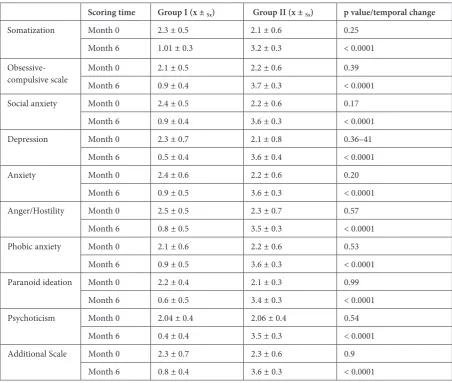
Paranoid ideation was assessed and there was no statistically significant difference between the two groups at the beginning (p = 0. 99) When the scores were reassessed after 6 months, the mea-surement was significantly lower in Group I than in Group II (p < 0.0001) At the beginning, the scores for psychoticism did not significantly dif-fer between the 2 groups (p = 0.54). Months later, these scores were found to be significantly higher in Group II than in Group I (p < 0.0001) (Table 2).
Discussion
A considerable degree of recovery was noted in the group using dienogest. In all the subgroups of psychological parameters – including soma-tization, obsessive-compulsive disorder, phobic anxiety, depression, anger and hostility, para-noid ideation and psychoticism – the differenc-es were found to be statistically significant when comparing the initial month and the 6th month. Among the psychological subgroups whose symp-toms improved to a more notable degree, soma-tization came first, while obsessive-compulsive disorder and social anxiety ranked number two. Comparing all the parameters in the 6th month between the Group I and Group II, the improve-ment of Group I, using dienogest, was found to be higher than in Group II, using MPA. This psy-chological improvement provided by dienogest Table 2. The results of the analysis of the psychiatric symptom and complaint screening test (SCL-90-R) for 9 different symptoms and an additional scale at the start and in the 6th month
Scoring time Group I (x ± Sx) Group II (x ± Sx) p value/temporal change
Somatization Month 0 2.3 ± 0.5 2.1 ± 0.6 0.25 Month 6 1.01 ± 0.3 3.2 ± 0.3 < 0.0001
Obsessive-compulsive scale Month 0 Month 6 2.1 ± 0.50.9 ± 0.4 2.2 ± 0.63.7 ± 0.3 0.39< 0.0001
Social anxiety Month 0 2.4 ± 0.5 2.2 ± 0.6 0.17 Month 6 0.9 ± 0.4 3.6 ± 0.3 < 0.0001 Depression Month 0 2.3 ± 0.7 2.1 ± 0.8 0.36–41
Month 6 0.5 ± 0.4 3.6 ± 0.4 < 0.0001
Anxiety Month 0 2.4 ± 0.6 2.2 ± 0.6 0.20
Month 6 0.9 ± 0.5 3.6 ± 0.3 < 0.0001 Anger/Hostility Month 0 2.5 ± 0.5 2.3 ± 0.7 0.57
Month 6 0.8 ± 0.5 3.5 ± 0.3 < 0.0001 Phobic anxiety Month 0 2.1 ± 0.6 2.2 ± 0.6 0.53
Month 6 0.9 ± 0.5 3.6 ± 0.3 < 0.0001 Paranoid ideation Month 0 2.2 ± 0.4 2.1 ± 0.3 0.99
Month 6 0.6 ± 0.5 3.4 ± 0.3 < 0.0001 Psychoticism Month 0 2.04 ± 0.4 2.06 ± 0.4 0.54
Month 6 0.4 ± 0.4 3.5 ± 0.3 < 0.0001 Additional Scale Month 0 2.3 ± 0.7 2.3 ± 0.6 0.9
Month 6 0.8 ± 0.4 3.6 ± 0.3 < 0.0001
X ± Sx – average ± standard deviation.
is statistically significant (p < 0.0001). With re-gard to the group using MPA, it was determined that the participants’ psychological situation be-came worse in the 6th month in comparison with the initial status, and this decline was statistical-ly significant (p < 0.0001). Although the curative effects of MPA on vasomotor symptoms is the same as the effects of dienogest, the authors note that MPA affects the patient’s mood, sleep, de-pression and other psychological subparameters negatively.
Similar results were found in Schneider’s neurophysiological study: that dienogest pro-vided complete recovery in vasomotor and neu-rovegetative symptoms, and great improvement in postmenopausal women with cognitive func-tions and sleep disorders. The authors concluded that the use of dienogest in continuous combined hormone replacement treatment was specifically indicated for postmenopausal women with dis-orders of alertness and mood [8, 9]. Graser et al. compared 2 mg estradiol valerate and differ-ent dose combinations of dienogest (0.5, 1, 2, 3 and 4 mg). They stated that all of the dienogest doses provided significant recovery in vasomo-tor and psychoneurotic symptoms [10]. Oettel et al. stated that 2 mg estradiol and 2 mg dienogest affected postmenopausal symptoms related to in-somnia, sleep patterns and the patient’s general well-being [11].
Saletu et al. carried out an evaluation of the alertness of patients with postmenopausal syn-drome suffering from insomnia, using EEG map-ping in a double-blind placebo-controlled study. They compared a continuous 2 mg estradiol valer-ate + 2 mg dienogest treatment with single estro-gen therapy, and determined that 2 mg of estradiol valerate improved alertness slightly. The addition of dienogest did not minimize the effect of estro-gen, but rather increased it. This made the com-bination superior to both a placebo and to estra-diol [12]. Saletu et al. also evaluated the quality of sleeping and awakening in 55 patients with insom-nia in a double-blind, trifurcate and placebo-con-trolled study. They stated that estrogen/proges-terone combinations with dienogest significantly improved subjective sleep quality and sleep-related
disorders, and marginally improved the objective quality of sleep and awakening [13].
A multi-center double-blind study compared the use of estradiol valerate 2 mg + dienogest 2 mg, estradiol valerate 2 mg + dienogest 3 mg and es-tradiol valerate 2 mg + norethisteroneacetate (NETA) 1 mg daily throughout a year in 581 post-menopausal women. Their climacteric symptoms had been evaluated and Kupperman index scores were found to be 78.5%, 74.5% and 75% respec-tively [14–16]. Although a number of studies have reported physical side effects (constipation, bloat-ing and breast pain) and psychological side effects (depression, fatigue, irritability) resulting from medroxyprogesterone acetate use, these were not observed in prospective randomized studies [17].
In a prospective study by Kirkham et al. it was observed that there was no significant difference in terms of depression and psychological symp-toms in patients using medroxyprogesterone ace-tate treatment and those using a placebo [17]. In another in vitro study, it was demonstrated that medroxyprogesterone acetate and metabolites in-fluenced memory, learning and other cognitive functions unfavorably through the GABA-ergic system, and could cause neuronal toxicity, this ef-fect was not clearly revealed in in vivo clinical and preclinical studies [18].
In spite of the fact different ideas about the ef-fect of medroxyprogesterone acetate on psycholog-ical symptoms can be found in the literature, the authors of the current article observed that in the group taking MPA (Group II) all the psychological symptoms worsened in the 6th month compared to the start of the treatment. When patients were categorized according to their worst psychologi-cal symptoms, anger and hostility were more com-mon, followed by eating and sleeping disorders.
In brief, the present study showed that the use of dienogest provided significant improvement in all the psychological symptoms investigated, while the use of medroxyprogesterone acetate worsened psychiatric symptoms. However, because of a lack of consensus on this topic in the literature, large prospective randomized studies are required in or-der to research the effect of medroxyprogesterone acetate on psychological symptoms.
References
[1] Zeyneloglu HB: Ergeneli MTreatment of menopausal symptoms. J Drug Treat 1995, 8, 230–232.
[2] Haines JC, Xinq SM, Park KH, Holinka CF, Ausmanas KM: Prevalence of menopausal symptoms in different ethnic groups of Asian women and responsiveness to therapy with three doses of conjugated estrogens/medroxy-progesterone acetate: The Pan-Asia menopause (PAM) study. Maturitas 2005, 52, 264–276.
[3] Nelson HD: Menopause. Lancet 2008, 371, 760–770.
[5] Cohen LS, Soares CN, Poitras JR, Prouty J, Alexander AB, and Shifren JL: Short-term use of estradiol for depres-sion in perimenopausal and postmenoupausal women: A preliminary report. Am J Psyhiatry 2003, 160, 1519–1522.
[6] Dag I: Validity and reliability of symptom checklist for university students (SCL-90-R). Turk Psikiyatri Derg 1991, 2, 5–12.
[7] Aydemir O, Koroglu E: Symptom checklist (SCL–90-R), clinical scales used in psychiatry. Eds.: Aydemir O, Koroglu E, Istanbul 2000, 33–41.
[8] Schneider HP, Rosemeier HP, Schnitker J, Gerbsch S, Turck R: Application and factor analysis of the menopause rating scale (MRS) in a post- marketing surveillance study of Climen. Maturitas 2000, 37, 113–124.
[9] Schneider HP: The role of antiandrogens in hormone replacement therapy. Climacteric 2000, 3, 21–27.
[10] Graser TA, Müler A, Mellinger U, Mück AO, Lippert TH, Oettel M: Continuous-combined treatment of the menopause with combinations of estradiol valerate and diogenest – a dose ranging study. Maturitas 2000, 35, 253–261.
[11] Qettel M, Graser T, Hoffmann H: The preclinical and clinical profile of diogenest A short overview. Drugs of Today 1999, 35, 3–12.
[12] Saletu B, Anderer P, Gruber D, Metka M, Huber J: Hormone replacement therapy and vigilance: double-blind, placebo-controlled EEG-mapping studies with an estrogen-progestogen combination (Climodien, Lafamme) ver-sus estrogen alone in menopausal syndrome patients. Maturitas 2002, 43,165–181.
[13] Saletu B: Insomnia related to postmenopausal syndrome: Sleep laboratory studies on differences between patients and normal controls, and influence of an estrogen-progestogen combination with dienogest versus estrogen alone and placebo. Drugs of Today 2001, 37, 39–62.
[14] Von Schoultz B: Clinical efficacy and safety of combined estradiol valerate and dienogest: a new no-bleed treat-ment. Climacteric 2003, 6, 24–32.
[15] Graser TA, Hoffmann H, Zimmermann, Oettel M: New Oral Preparation for continuous combined hormone replacement therapy in postmenopausal women. Drugs of Today 2001, 37, 17–27.
[16] Wellington K, Perry CM: Estradiol valerate/dienogest. Drugs 2002, 62, 491–504.
[17] Kirkham C, Hahn PM, Van Vugt DA, Carmichael JA, Reid RL: A randomized, double-blind, placebo-controlled, cross-over trial to assess the side effects of medroxyprogesterone acetate in hormone replacement therapy. Obstet Gynecol 1991, 78, 93–97.
[18] Braden BB, Talboom JS, Crain ID, Simard AR, Lukas RJ, Prokai L: Medroxyprogesterone acetate impairs memory and alters the GABA’ergic system in aged surgically menopausal rats. Neurobiol Learn Mem 2010, 93, 444–453.
Address for correspondence:
Emel Kiyak Caglayan
Bozok University Faculty of Medicine Adnan Menderes Bulvarı No. 190 66200 Yozgat
Turkey
Tel: + 90 354 212 70 01
E-mail: [email protected] Conflict of interest: None declared