This is an open access journal, and articles are distributed under the terms of the Creative Commons Attribution-Non Commercial-ShareAlike 4.0 License, which allows others to remix, tweak, and build upon the work non-commercially, as long as appropriate credit is given and the new creations are licensed under the identical terms.
© 2019 Journal of Advanced Pharmacy Education & Research | Published by SPER Publication
89
The long-term effect of smartphone overuse on Cervical
Posture and range of motion in asymptomatic sedentary adults
Sara Mohamed Samir
1*, Ahmed M. Elshinnawy
2, Reda K Abd Elrazik
3, Hanan Hosny M Battesha
4,
Mohamed El sayed Abdelkarem Ali
5, Amr Abo Gazya
61 Lecturer in the Department of Physical Therapy for Musculoskeletal Disorders and their Surgeries, Faculty of Physical Therapy, Cairo, Egypt. 2Lecturer in the Department of Physical Therapy for Neuromuscular Disorders and its Surgery, Faculty of Physical Therapy, Modern University for Technology and Information, Egypt. 3Lecturer in the Department of Physical Therapy for Musculoskeletal Disorders and their Surgeries, Faculty of Physical Therapy, Modern University for Technology and Information, Egypt. 4Lecturer in the Department of Physical Therapy for Neuromuscular Disorders and Its surgery, Faculty of Physical Therapy, Modern University for Technology and Information, Egypt. 5Original work in the Department of Physical Therapy, Helwan University hospital and delegated part at Delta University for science and technology, Egypt. 6Assistant professor in the Department of Physical Therapy for Basic Sciences, Faculty of Physical therapy, Kafrelsheikh University, Egypt.
Correspondence:Sara Mohamed Samir;Lecturer in the Department of Physical Therapy for Musculoskeletal Disorders and their Surgeries, Faculty of Physical Therapy, Cairo, Egypt.
ABSTRACT
Purpose: This study aimed to examine changes in the range of motion (ROM) and cervical posture depending on the duration of using smartphone in sedentary asymptomatic adults. Subjects and Methods: The participants were randomly assigned into 2 groups: group A (those using smartphones for less than 4 h/day, n=200) and group B (those using smartphones for more than 4 h/day, n=200). The cervical posture was determined by measuring the craniovertebral angle (CVA) of all participants using the photographic method. Cervical flexion, extension, rotation (left and right), and side bending (left and right) range of motion (ROM) were measured by using an electromagnetic tracking device (MTD) mounted on a custom headpiece. Results: Significant differences were noted for cervical CVA and ROM between the groups (p < 0.05). Conclusion: The long-term effect of the smartphone overuse could negatively affect cervical posture and range of motion.
Keywords: Smartphone, Cervical Posture, Cervical Range of Motion
Introduction
People are becoming more reliant than ever on smartphones nowadays. Individuals daily use smartphones for various tasks during the day. These tasks include checking social networks, doing some form of work, reading books, watching videos,
media connections, browsing the internet, and other functions.[1] Figures from 2016 showed that most adolescents
aged 14-18 in the US (87%)[2, 3] and 12-15 in the UK (79%)
have a smartphone[3]. Smartphone usage among adults is even
higher, with 95% of adults aged 18-34.[4] In 2015, adult users
spent approximately three hours a day (excluding voice activities) on mobile devices, which was twice the amount spent in 2012. It is expected that significant ownership and use of smartphones will continue to increase in the coming years [5]. In
Egypt, the Egyptian government especially the Ministry of Education had decided to apply the e-learning education and exams in secondary schools as a preparation for its generalization at all levels of education, the majority of universities had many e-learning courses, corresponding to high education.
Normal posture is described as if the line of gravity (LOG) passes anteriorly through the external auditory meatus, the
Access this article online
Website: www.japer.in E-ISSN: 2249-3379
How to cite this article: Sara Mohamed Samir, Ahmed M. Elshinnawy, Reda K Abd Elrazik, Hanan Hosny M Battesha, Mohamed El sayed Abdelkarem Ali, Amr Abo Gazya. The long-term effect of smartphone overuse on Cervical Posture and range of motion in asymptomatic sedentary adults. J Adv Pharm Edu Res 2019;9(4):89-95.
cervical spine bodies, and the thoracic and acromion spine [6].
The external moment provided at a joint by gravity is typically balanced by the internal moment generated by soft tissue structures and muscles around the joint. Furthermore, due to the presence of postural malalignments, which is aggravated due to the altered location of the LOG, in order to balance the external torque produced by gravity, greater internal forces are required [7, 8].
Many investigations have studied the effect of using smartphones on pain in different parts of the body and the correlation between symptom severity and time spent on a smartphone [9-11]. Other investigations have demonstrated that
the excessive use of cell phone can result in deficiencies such as rounded shoulders and forward head posture [12, 13].The angled
weight of the head decreases as the neck bending degree increases, and the head weight reaches about 28 kg with the flexion of 60° [14].
The aim of the present investigation was therefore to evaluate changes in cervical posture and range of motion (ROM) based on the length of using the smartphone.
Different methods are used to evaluate the posture, such as photogrammetry, radiography, plumb line, photography, moire topography, Flexicurve, and an electromagnetic tracking device. Each of these methods can be utilized to detect the presence of abnormal posture [15, 16].
The “Flock of Birds” system is a non-invasive electromagnetic tracking device (MTD) used to analyze spine three-dimensional motion with the results for accuracy in the cervical spine [17-19]
.
The reliability and accuracy of this measurement technique were assessed in order to measure the cervical ROM. The reproducibility of lateral bending, forward flexion, and axial rotation was within 0.85° and for combined movements such as axial rotation in the extended or flexed position, it was 1.7° [20]
.
Subjects and Methods
Design
The randomized experimental design was conducted in the outpatient clinic of the Faculty of Physical Therapy, Modern University for Technology and Information in the period from March 2019 to July 2019. The study was ethically approved by the Institutional Ethical Committee of the Faculty of Physical Therapy, Cairo University, Egypt.
Informed consent was voluntarily obtained from all the subjects prior to participation in accordance with the Code of Ethics of the World Medical Association (Declaration of Helsinki) for experiments involving humans.
Subject Selection:
A total of 400 healthy sedentary subjects, asymptomatic smartphone users, recruited from students of Faculty of Physical Therapy, Modern University for Technology and Information, Giza, Egypt. They were non-athletes with an age range of 20-25 years old and body mass index range of 18.5-25 Kg/m2.
The exclusion criteria were as follows: the experience of a cervical fracture, trauma, or surgery, neurological motion disorders, bone cancer, and having congenital deformities in the cervical spine or upper extremities.
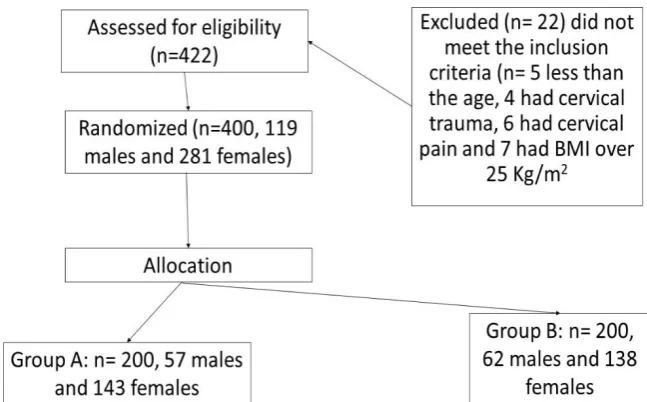
All participants in this study were randomly assigned into 2 groups according to the duration of using smartphone reported by each individual, group (A): 200 volunteers using smartphone less than 4 h/day (3.0±1.0 h), and group (B): 200 volunteers using smartphone for more than 4 h/day (5.5±1.0 h) (figure 1)
Figure 1: Chart describing subjects’ recruitment and allocation
Instrumentation
1. All the participants used Galaxy Note3 (SM-N900S, Samsung Electronics Co., LTD, Seoul, Korea) smartphone to freely surf the internet.
alFOOTs, South Korea), and Adobe Photoshop CS6 (version 13.0). To determine the subjects’ cervical posture
we examined forward head posture (FHP) by using CVA. A lower CVA shows greater FHP. The photographic method for measuring CVA showed good validity and reliability in previous studies (intra-class correlation coefficients ranged from 0.88 to 0.98) [21].
3. Electromagnetic tracking device “Flock of Birds” (SCb2 -S01313, Ascension Technology Corporation, USA) to measure the cervical ROM kinematic measurements. This system is a valid, accurate, and reliable device that measures six-degrees-of-freedom; it consists of a transmitter that generates a pulsed direct current (DC) electromagnetic field, which is measured by one or more receivers simultaneously [22]
Calibration of the electromagnetic tracking
device “Flock of Birds”:
Positioning the device in a workspace of about 1m3 was done
using a stylus. The random error at the stylus tip revealed to be 1.86, 1.98, and 2.54 mm for x-, y- and z-coordinate, respectively. The error caused by the distortion of the magnetic field by metal in the concrete of especially the floor was 20.8, 22.2 and 20.4 mm for the x-, y- and z-coordinate. Leaving out the measurements closest to the floor and calibration decreased this error to 2.07, 2.38, and 2.35 mm, respectively. It was proved that the "Flock of Birds" is useful for cervical kinematic studies [23]
.
Procedures
1. Determination of Cervical posture by measuring the craniovertebral angle:
CVA was examined by using a lateral-view, digital photograph in a standing posture for the subjects. A photograph was taken laterally and the CVA was measured by using Adobe Photoshop CS6 after the laser scanner scanned the image to the PC device. To decrease image distortion, the assessor placed a circular spirit level at the base of the camera to ensure that the camera was positioned perpendicularly to the horizontal. The 7th
cervical vertebra bony landmark and the tragus of the subject’s
ear were marked. This was conducted by asking the subject to extend and flex her/his head three times and then finding the 7th spinous process of the vertebra. The FHP angle between the
line connecting the tragus of ear to 7th cervical vertebra and the
horizontal plane was calculated [24] .
2. Cervical ROM measurement: All of the subjects were seated in a wooden chair, and their shoulders were restrained with straps so that their torso-maintained contact with the backrest of the chair. Their feet were rested flat on the floor and their arms freely rested by their sides. The headpiece was placed on the subject’s
head, 1cm above the ear tips and stabilized in this
position by tightening the positioning pads. The positioning pads reduce the random movements of the headpiece and stabilize the headpiece due to the
subject’s scalp and hair. The transmitter was located 10cm behind the receiver attached to the chair.
The range of motion maneuvers was obtained by asking the subjects to move their head maximally in the following rotational degrees-of-freedom: side bending (left and right), axial rotation (left and right), extension, and flexion. The subjects were instructed to return to their neutral position after the maneuvers and to minimize the coupled motions and were encouraged to do maximum excursion for each maneuver with no excessive effort. The maneuver velocity was gradual and at a normal speed. The examiner monitored the real-time data shown on the computer during the maneuvers in order to ensure the test quality.
Statistical Analysis
The statistical analysis was performed using SPSS program version 25 for Windows (SPSS, Inc., Chicago, IL). Using the Shapiro-Wilk test (parametric data), data were normally distributed. Furthermore, testing for variance homogeneity
revealed no significant difference (P>0.05). Student’s unpaired
t-test was used to compare CVA, neck flexion, extension, side bending (right and left), and rotation (right and left) between the groups. All statistical analyses were significant at the level of
probability less than an equal 0.05 (P ≤ 0.05).
1. General demographic data:
The mean age ± SD (23.17 ± 1.07 and 23.33 ± 0.76 years), weight (69.55 ± 9.58 and 70.33 ± 8.5 Kg), height (175.58 ± 5.76 and 174.33 ± 4.3 Cm) and BMI (22.52 ± 2.65 and 23.09 ± 2.19 Kg/m2) of participants in group A and B respectively
Table 1: General demographic data
Age Weight Height BMI Gender
Number Males Females
Total Sample 23.17± 1.07 69.55± 9.58 175.58± 5.76 22.52± 2.65 400 119= 29.75 % 281= 70.25 %
Group A (Less than 4 hours) 23.33± 0.76 70.33± 8.5 174.33± 4.3 23.09± 2.19 200 57= 28.5 % 143= 71.5 %
Group B (More than 4 hours) 23± 1.31 68.77± 10.64 176.83± 6.76 21.95± 2.97 200 62= 31 % 138= 69 %
t- value 1.204 0.63 1.709 1.691
P-value 0.233 0.531 0.93 0.96
Figure 2:General demographic data
Figure 3:Percentages of males and females in each group
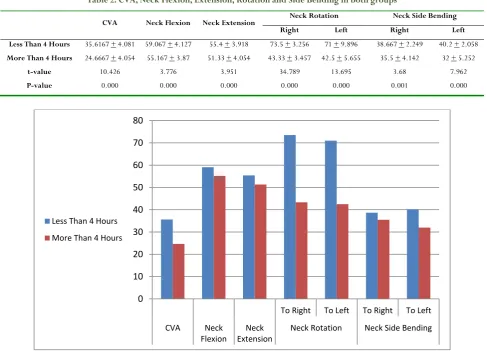
1.CVA: the mean value was35.6167 + 4.081 in group A and 24.6667 + 4.054 in group B. There was a significant difference in CVA between the two groups (t=10.426 and P=0.000).
2.Neck Flexion: The mean value of neck flexionwas59.067 + 4.127 and 55.167 + 3.87 in groups A and B, respectively, which showed a significant difference between the groups (t= 3.776 and P= 0.000).
3.Neck Extension: The mean value was55.4 + 3.918 and 51.33 + 4.054 in groups A and B, respectively, which showed a significant difference between the groups (t= 3.951 and P= 0.000).
4.Neck Rotation:
a.Right neck rotation: The mean value was73.5 + 3.256 in group A while it was 43.33 + 3.457 in group B. There was a
significant difference between the groups (t= 34.789 and P= 0.000).
b.Left neck rotation: The mean value was 71 + 9.896 in group A and 42.5 + 5.655 in group B. There was a significant difference in between the groups (t= 13.695 and P= 0.000)
5.Neck Side Bending:
a.Right neck side bending: The mean value was38.667 + 2.249 in group A while it was 35.5 + 4.142 in group B. There was a significant difference between the groups (t= 3.68 and P= 0.001).
b.Left neck side bending: The mean value was 40.2 + 2.058 in group A and 32 + 5.252 in group B, which were significantly different (t= 7.962 and P= 0.000) (Table 2 and figure 4).
0 20 40 60 80 100 120 140 160 180 200
Group A (Less than 4 hours)
Group B (More than 4 hours) Age
Weight
Height
BMI
Males28.5% Females
71.5% males 31%
Females 69%
Gender
Group A (Less than 4 hours)
Table 2: CVA, Neck Flexion, Extension, Rotation and Side Bending in both groups
CVA Neck Flexion Neck Extension Neck Rotation Neck Side Bending
Right Left Right Left
Less Than 4 Hours 35.6167 + 4.081 59.067 + 4.127 55.4 + 3.918 73.5 + 3.256 71 + 9.896 38.667 + 2.249 40.2 + 2.058
More Than 4 Hours 24.6667 + 4.054 55.167 + 3.87 51.33 + 4.054 43.33 + 3.457 42.5 + 5.655 35.5 + 4.142 32 + 5.252
t-value 10.426 3.776 3.951 34.789 13.695 3.68 7.962
P-value 0.000 0.000 0.000 0.000 0.000 0.001 0.000
Figure 4:CVA, Neck Flexion, Extension, Rotation and Side Bending in both groups
Discussion
The results of the current study revealed that heavy smartphone use resulted in reduced cervical ranges of motion in all directions that are consistent with the results of previous research on heavy computer use. The time spent hunched over a smartphone may asymptomatically damage the person’s
posture. Visual Display Terminal usage can lead to consistent posture in the upper quarter of the body [25]. The loads
compromise cervical-sensitive structures and thereby affect the function of the cervical spine and range of motion (ROM) causing a musculoskeletal imbalance in the upper quarter of the body. However, associations between the physical dimensions of the upper quarters of body and cervical ROM have not been clearly established especially for asymptomatic subjects. There are few investigations regarding the cervical range of motion related to neck pain and posture and the results of those studies were inconclusive [26-28].
The posture people take as they use their smartphone increases the stress on the neck. People use their smartphone not only standing and sitting but also side-lying and lying prone. Furthermore, because of the size of the equipment, people use their smartphone with one hand often with a tilted head; it may cause excessive stress on the related structures due to the excessive use of the smartphone. In addition, the standing
posture may cause less stress on pain-sensitive structures in the cervical spine and protect against such stress [29, 30].
On the same side, if people use a smartphone for a long time, their posture may appear altered. Unlike computers, smartphones have a smaller screen, which probably induces a more slouched position towards a sightline below the level of the eye. Therefore, if video terminals such as a smartphone are used for a long time, they may cause an inappropriate posture, such as slouched posture or forward head posture [31].
Forward head posture (FHP) in contemporary society is a common neck disease caused by long sitting at a desk. Maintaining a constant posture may cause ligaments around the lumbar or neck to be damaged. Moreover, this problem is due to decreased physical activity and muscle fatigue [32]. Ultimately,
excessive use of smartphones can cause a slouched head posture to be maintained for a long time, thus inducing stress on the muscles and skeletal changes. This may cause the C-shaped curve to be lost in the cervical spine and instead begin to curve forward. Such disarrangement may lead to homeostasis that controls metabolites and blood supply in the muscles and can cause the loss of function and extreme pain [33, 34].
Although the functions of smartphones are similar to devices such as televisions and computers, in addition to offering music-related functions, the use of a small screen on a smartphone makes it difficult to maintain a correct position. The normal
0 10 20 30 40 50 60 70 80
To Right To Left To Right To Left
CVA Neck
Flexion
Neck Extension
Neck Rotation Neck Side Bending
Less Than 4 Hours
curvature of the spine is not maintained due to the forward head posture that is adopted when using a smartphone or computer for a long time [35, 36].
Longer smartphone use results in a higher angle of the neck flexion, which may lead to the deformation of neck bone into a C shape and fatigue on the neck and muscles around the shoulder [37]. As a consequence, individuals with minor pain in
the neck have been reported to bend their neck slightly more than those without neck pain while using a smartphone, although the causal relationship could not be identified. In this regard, it has been proved that high levels of smartphone addiction may decrease the ability to recognize the posture of the neck. Such studies suggest that using a smartphone can affect the sensory ability to recognize the position of the neck and thus become a factor causing pain by bending the neck at a higher angle [38].
There was a limitation to this study: the subjects were restricted to young students in their 20s, which makes it difficult to generalize the results to other populations. In conclusion, prolonged overuse of a smartphone negatively affects cervical posture and ROM in asymptomatic sedentary adults. This study suggests that using the smartphone for a short period of time is a method to reduce the late cervical pain, postural problems, and reduced ROM that may influence daily living activities.
References
1. Rainie L. Internet, broadband, and cell phone statistics. Pew Internet & American Life Project. 2010 Jan 5;5:3-8. 2. Emarketer. Teen's ownership of smartphones has surged.
Available from:
https://www.emarketer.com/Article/Teens-Ownership-of-Smartphones-Has-Surged/1014161. 5 Jul 2016. Cited 20 August 2016.
3. Poushter J. Smartphone ownership and internet usage continues to climb in emerging economies. Pew Research Center. 2016 Feb 22;22:1-44.
4. Ofcom. Children and parents: Media use and attitudes report. Available from: https://www.ofcom.org.uk/__data/assets/pdf_file/00 34/93976/Children-Parents-Media-Use-Attitudes-Report-2016.
5. Emarketer. Growth of time spent on mobile devices
slows. Available from:
http://www.emarketer.com/Article/Growth-of-Time-Spent-on-Mobile-Devices-Slows/1013072. 7 Oct 2015. Cited 3 August 2016.
6. Berolo S, Wells RP, Amick III BC. Musculoskeletal symptoms among mobile hand-held device users and their relationship to device use: a preliminary study in a Canadian university population. Applied ergonomics. 2011 Jan 1;42(2):371-8.
7. Al-Khlaiwi T, Meo SA. Association of mobile phone radiation with fatigue, headache, dizziness, tension and sleep disturbance in Saudi population. Saudi medical journal. 2004 Jun 1;25:732-6.
8. Kim GY, Ahn CS, Jeon HW, Lee CR. Effects of the use of smartphones on pain and muscle fatigue in the upper extremity. Journal of physical therapy science. 2012;24(12):1255-8.
9. Kendall FP, McCreary EK, Provance PG, Rodgers M and Romani W. Muscles: Testing and Function, With Posture and Pain. 5th ed. Lippincott Williams & Wilkins; Philadelphia, USA. 2005:95-111.
10. Levangie PK and Norkin CC. Joint Structure and Function: A Comprehensive Analysis 3rd ed., F. A. Davis, USA. 2001:112-44.
11. Bullock-Saxton J. Normal and abnormal postures in the sagittal plane and their relationship to low back pain. Physiotherapy Practice. 1988 Jan 1;4(2):94-104. 12. Alzarea BK, Patil SR. Mobile phone head and neck pain
syndrome: proposal of a new entity. Headache. 2015;251:63.
13. Jung SI, Lee NK, Kang KW, Kim K, Do YL. The effect of smartphone usage time on posture and respiratory function. Journal of physical therapy science. 2016;28(1):186-9.
14. Hansraj KK. Assessment of stresses in the cervical spine caused by posture and position of the head. Surg Technol Int. 2014 Nov;25(25):277-9.
15. Singla D, Veqar Z. Methods of postural assessment used for sports persons. Journal of clinical and diagnostic research: JCDR. 2014 Apr;8(4):LE01.
16. Greenfield B, Catlin PA, Coats PW, Green E, McDonald JJ, North C. Posture in patients with shoulder overuse injuries and healthy individuals. Journal of Orthopaedic & Sports Physical Therapy. 1995 May;21(5):287-95. 17. Assink N, Bergman GJ, Knoester B, Winters JC, Dijkstra
PU. Assessment of the cervical range of motion over time, differences between results of the Flock of Birds and the EDI-320: A comparison between an electromagnetic tracking system and an electronic inclinometer. Manual Therapy. 2008 Oct 1;13(5):450-5. 18. Bergman GJ, Knoester B, Assink N, Dijkstra PU,
Winters JC. Variation in the cervical range of motion
over time measured by the “flock of birds”
electromagnetic tracking system. Spine. 2005 Mar 15;30(6):650-4.
19. Koerhuis CL, Winters JC, Van der Helm FC, Hof AL.
Neck mobility measurement by means of the ‘Flock of Birds’ electromagnetic tracking system. Clinical
Biomechanics. 2003 Jan 1;18(1):14-8.
20. Hof AL, Koerhuis CL, Winters JC. Coupled motions' in cervical spine rotation can be misleading. Comment on V. Feipel, B. Rondelet, J.-P. Le Pallec and M. Rooze. Normal global motion of the cervical spine: an electrogoniometric study. Clin. Biomechanics 1999; 14: 462–470. Clinical Biomechanics. 2001 Jun 1;16(5):455-6.
Archives of physical medicine and rehabilitation. 1997 Nov 1;78(11):1215-23.
22. Koerhuis CL, Winters JC, Van der Helm FC, Hof AL.
Neck mobility measurement by means of the ‘Flock of
Birds’ electromagnetic tracking system. Clinical
Biomechanics. 2003 Jan 1;18(1):14-8.
23. Meskers CG, Fraterman HV, Van der Helm FC,
Vermeulen HM, Rozing PM. Calibration of the “Flock of Birds” electromagnetic tracking device and its application
in shoulder motion studies. Journal of biomechanics. 1999 Jun 1;32(6):629-33.
24. Quek J, Pua YH, Clark RA, Bryant AL. Effects of thoracic kyphosis and forward head posture on cervical range of motion in older adults. Manual therapy. 2013 Feb 1;18(1):65-71.
25. Lee HJ. Neck pain and functioning in daily activities associated with smartphone usage. The Journal of Korean Physical Therapy. 2016 Jun 30;28(3):183-8.
26. Kwon JW, Nam SH, Choi YW, Kim CS. The effect of different head positions in sitting on head/shoulder posture and muscle activity. The Journal of Korean Physical Therapy. 2013;25(4):217-23.
27. Nam KS, Kwon JW. The effects of head position in different sitting postures on muscle activity with/without forward head and rounded shoulder. J Kor Phys Ther; 2014;26(3):140-6.
28. Kong YS, Kim YM, Shim JM. The effect of modified cervical exercise on smartphone users with forward head posture. Journal of physical therapy science. 2017;29(2):328-31.
29. Janwantanakul P, Sitthipornvorakul E, Paksaichol A. Risk factors for the onset of nonspecific low back pain in office workers: a systematic review of prospective cohort studies. Journal of manipulative and physiological therapeutics. 2012 Sep 1;35(7):568-77.
30. Okuro RT, Morcillo AM, Ribeiro O, Gonçalves MÂ, Sakano E, Margosian Conti PB, Ribeiro JD. Mouth
breathing and forward head posture: effects on respiratory biomechanics and exercise capacity in children. Jornal Brasileiro de Pneumologia. 2011 Jul 1;37(4).
31. Berolo S, Wells RP, Amick III BC. Musculoskeletal symptoms among mobile hand-held device users and their relationship to device use: a preliminary study in a Canadian university population. Applied ergonomics. 2011 Jan 1;42(2):371-8.
32. Lee SY, Lee DH, Han SK. The effects of posture on neck flexion angle while using a smartphone according to duration. Korean Society of Physical Medicine. 2016 Aug 31;11(3):35-9.
33. Um SH, Choi SY, Park DH. An empirical study on relationship between physical symptoms and smartphone
usage. Incheon Inha University, Disertation of master’s
degree. 2013.
34. Yoon JO, Kang MH, Kim JS, Oh JS. The effects of gait with use of smartphone on repositioning error and curvature of the lumbar spine. Journal of physical therapy science. 2015;27(8):2507-8.
35. Kim MS. Influence of neck pain on cervical movement in the sagittal plane during smartphone use. Journal of physical therapy science. 2015;27(1):15-7.
36. Young JG, Trudeau M, Odell D, Marinelli K, Dennerlein JT. Touch-screen tablet user configurations and case-supported tilt affect head and neck flexion angles. Work. 2012 Jan 1;41(1):81-91.
37. Lee J, Seo K. The comparison of cervical repositioning errors according to smartphone addiction grades. Journal of physical therapy science. 2014;26(4):595-8.