This is an open access journal, and articles are distributed under the terms of the Creative Commons Attribution-Non Commercial-ShareAlike 4.0 License, which allows others to remix, tweak, and build upon the work non-commercially, as long as appropriate credit is given and the new creations are licensed under the identical terms.
© 2019 Journal of Advanced Pharmacy Education & Research | Published by SPER Publication
118
Light alkanes physisorption and chemisorption on SnO2
pyramid clusters surface as a function of temperature: A DFT
study
Mudar Ahmed Abdulsattar*, Dheyaa A. Nassrullah, Zainab T. Abdulhamied
Ministry of Science and Technology, Baghdad, Iraq.
Correspondence:Mudar Ahmed Abdulsattar, Ministry of Science and Technology, Baghdad, Iraq. Email: [email protected]
ABSTRACT
The results obtained from calculated Gibbs free energy are used to estimate the reaction rate of the physisorption and chemisorption of light alkanes on SnO2 pyramid surface clusters as a function of temperature. The present investigation includes the interaction of alkanes
including methane, ethane, propane, and butane with SnO2 pyramid surface clusters. The results showed that the reaction rates of
physisorbed light alkanes by van der Waals force increase with temperature. However, the physisorption phenomena do not appreciably alter the energy gap that hinders the electrical sensitivity of SnO2 clusters to light alkanes. On the other hand,
chemisorption reactions significantly reduce the energy gap through hydrogen attachment or the replacement of oxygen with hydrogen atoms of alkanes, so that the sensitivity of SnO2 clusters to Alkan gases is possible. A good agreement was found between the trends of
calculated reaction rates and the experimental findings using the Arduino microcontroller.
Keywords: SnO2, gas sensor, methane.
Introduction
Tin dioxide (SnO2) is one of the most used materials in gas
sensing. This material can be used to detect hydrocarbons [1, 2],
carbon dioxide [3], hydrogen [4], nitric oxide [5], etc. The present
work includes the theoretical calculations of the sensitivity of SnO2 nanoclusters to light alkanes. All the first four alkanes, i.e.
methane, ethane, propane, and butane are in the gas phase at standard conditions [6]. Heavier alkanes are liquid at standard
conditions, so they are less important in gas detection. Methane is an ingredient of environmental gases. Methane and other alkanes are mainly used for heating and as a fuel, which can be ignited by the presence of oxygen. They can be distributed as liquids or pressurized gases. As a consequence of their
applications, sensing the existence of these gases in the air is an important operation for safe use and transportation.
SnO2 nanoparticles are anticipated to be superior in their
sensitivity to gases than bulk material because of larger surface area. SnO2 pyramids are experimentally found on SnO2 surfaces
as a result of surface reconstruction [7, 8]. These pyramids are
found stable and able to explain the experimental findings of Indium doped SnO2 nanoclusters [8]. Moreover, the SnO2
pyramids show the exact experimental oxygen deficient stoichiometry of SnO1.8 as in the present investigated cluster
(Sn10O18) [8].
Density functional theory (DFT) application is limited to calculate the interaction of alkanes with SnO2 structures. The
interaction of methane with Sn1-xGexO2 has been described by
Tabata et. al. [9] and the interaction of ethane with SnO 2 (110)
surface has been described by Viitala. Theoretical propane and butane interactions with SnO2 nanoclusters are rarely
encountered in literature.
In the present work, the physisorption and chemisorption of light alkanes on SnO2 pyramid surface clusters as a function of
temperature was theoretically investigated using Gibbs free energy of interaction to obtain the reaction rates. The reactions include van der Waals interaction and several H attachments
Access this article online
Website: www.japer.in E-ISSN: 2249-3379
How to cite this article:Mudar Ahmed Abdulsattar, Dheyaa A. Nassrullah, Zainab T. Abdulhamied. Light alkanes physisorption and chemisorption on SnO2 pyramid clusters surface as a function of temperature: A DFT study. J Adv Pharm Edu Res 2019;9(1):118-124.
and O replacement reactions by alkanes’ H atoms. The results were compared with the trends of experimental findings.
Theory
B3LYP functional is frequently described as one of the successful methods within the framework of density functional theory (DFT) which was used in the present work in combination with the appropriate basis [10]. The best available
basis set for the heavy metal Sn is 3-21g. Other atoms are treated with 6-311G** basis set including O, H, and C atoms. molecular vibrational modes and their convergence were also calculated using the Gaussian 09 program to test the stability of the investigated molecules [11]. To calculate reaction rates,
Gibbs free energy of various reactions as a function of temperature was calculated. Gibbs free energy takes into account thermal corrections of electronic, translational, vibrational, and rotational molecular degrees of freedom. All the molecules, encountered in the present work such as tin dioxide cluster (Sn10O18 and butane as in Fig (1)), methane,
ethane, propane, and butane were first treated separately including structure optimization, stability, and calculating Gibbs free energy. This procedure was also repeated for the reaction products such as Sn10O17H, H2O, ketones, H2, O2, etc. Gibbs
free energy of the reactions was then calculated as a function of temperature. The reaction rates could then be calculated using Gibbs free energy difference between the products and reactants.
Results and Discussion
The following reaction probabilities were investigated in the present work:
1. van der Waals interaction of Sn10O18 cluster with alkanes
(Fig (1)).
2. The attachment of one hydrogen atom to one oxygen atom at the Sn10O18 cluster surface (Fig (2)).
3. The attachment of one hydrogen atom to one tin atom at the Sn10O18 cluster surface (Fig (3)).
4. The replacement of one oxygen atom at the Sn10O18
cluster surface by one hydrogen atoms from the alkane (Fig (4)).
5. The replacement of one oxygen atom at the Sn10O18
cluster surface by two hydrogen atoms from the alkane. 6. The replacement of two oxygen atoms at the Sn10O18
cluster surface by two hydrogen atoms from the alkane. 7. The attachment of two hydrogen atoms from the alkane
to two oxygen atoms at the Sn10O18 cluster surface.
8. The attachment of two hydrogen atoms to one oxygen and one tin atom at the Sn10O18 cluster surface.
9. The attachment of two hydrogen atoms to two tin atoms at the Sn10O18 cluster surface.
Except for the first four probabilities, all other reactions were either unstable or less probable or important than the first four reactions. As an example, in reaction number (5) the final molecule, Sn10O18H2, did not geometrically converge using
optimization routines in Gaussian 09 program, utilized in the present work. The multiple attachments or replacement reactions as in the case of reactions (5-9) were less probable. The discussion is limited to the first four reactions as in Figs (1-4).
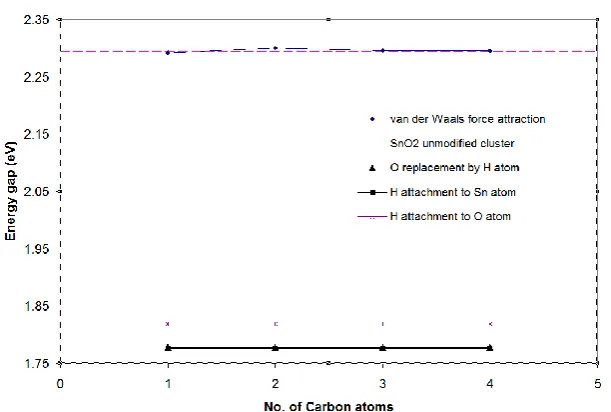
As seen in Table (1) and Fig (5), the formed molecular clusters as a result of alkane reaction with Sn10O18 cluster had different
energy gaps than the original cluster. The physisorption of alkanes did not appreciably change the energy gap of the Sn10O18
cluster (Fig (1) and the second raw of Table (1)). As a result, the change of the electrical resistivity cannot be used to distinguish the existence of alkanes physisorbed on Sn10O18
cluster surface. On the other hand, chemisorption of the H attachment on the surface Sn atom (Sn10O18 cluster surface) had
the largest change in energy gap followed by O replacement by a single H atom. H attachment on the surface O atom (Sn10O18
120 Journal of Advanced Pharmacy Education & Research | Jan-Mar 2019 | Vol 9 | Issue1
Figure 2: Attachment of a single H atom to oxygen atom at the Sn10O18 cluster surface (Sn10O18H).
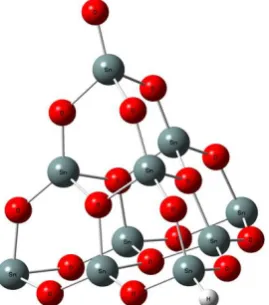
Figure 3: Attachment of a single H atom to a tin atom at the Sn10O18 cluster surface (Sn10O18H).
Figure 5: Energy gap of the formed clusters due to different reaction channels of the gas reactions of alkanes with the original Sn10O18
cluster. The dashed line represents the original gap value of Sn10O18 cluster. O replacement reaction overlaps with H attachment to Sn
atom reaction in their energy gap values (Table(1)).
Reaction rates can be estimated using calculated Gibbs free energy. The reaction rate (k) as a function of temperature (T) is given by equation [11]:
RT G B e hc T k T k / ) (
, (1)
where kB is Boltzmann constant, h is Planck's constant, c is the concentration, ΔG is Gibbs free energy difference (between
products and reactants), and R is the gas constant.
Fig (6) shows Gibbs free energy of the physisorption reaction via van der Waals reaction of alkanes with the Sn10O18 cluster.
The lines in the upper half of Fig (6) represents the attachment reaction of alkanes to the Sn10O18 cluster while the lower half
represents the alkanes’ removal reaction. The figure represents the following reactions:
Sn10O18+Butane= Sn10O18--Butane,
Sn10O18--Butane= Sn10O18+Butane,
Sn10O18+Propane= Sn10O18--Propane,
Sn10O18--Propane= Sn10O18+Propane, (2)
Sn10O18+Ethane= Sn10O18--Ethane,
Sn10O18--Ethane= Sn10O18+Ethane,
Sn10O18+Methane= Sn10O18--Methane,
The two dashes (--) represent a van der Waals bond. Fig (6) shows that all alkanes have nearly the same value of Gibbs free energy for either attachment or removal reactions. According to Eq (1), the negative values of Gibbs free energy (ΔG) have
high values of reaction rates while the positive values of Gibbs free energy have low values of reaction rates. As a result, alkanes’ removal is quite faster than attachment to the Sn10O18
cluster. In all the cases, the electrical sensitivity of Sn10O18
cluster to alkanes throw van der Waals reaction is quite low compared to other reaction channels as can be demonstrated from the energy gaps of Fig (5) and Table (1).
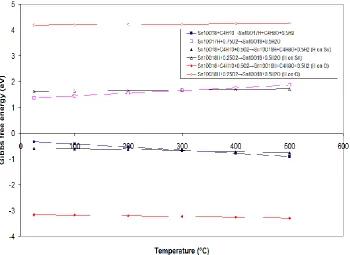
Fig (7) shows Gibbs free energy of chemisorption reactions of the Sn10O18 cluster with butane. The hydrogen attachment
reactions appeared now with a negative sign indicating a high reaction rate. The hydrogen removal reactions appeared with a positive sign indicating a low reaction rate. Most of these reaction rates were stronger than physisorption reactions via van der Waals reaction (absolute value of van der Waals reactions are less than 1 eV). The highest reaction rate was for the H attachment on O surface sites. The Gibbs free energy of this reaction was near -3 eV. The other two chemisorption reactions had values between 0.0 and -1.0 eV depending on temperature. These results showed that H attachment on O surface sites is the dominant reaction channel.
Fig (8) shows the reaction rates of the investigated reactions in Fig (7). Because of the negative sign in Eq (1), the H attachment and O replacement reactions were in the upper half while the H removal reactions were in the lower half of the figure.
Fig (9) shows the experimental detection of butane using an Arduino microcontroller and MQ-2 gas sensor [12-14]. The active
material of the MQ-2 gas sensor is a thin layer of SnO2[15]. We
recall from the introduction that SnO2 pyramids are
experimentally found on SnO2 surfaces as a result of surface
reconstruction [7, 8]. As the gas sensor is exposed to butane, a Table 1: Energy gap of Sn10O18 cluster compared with
different adsorption cases.
Molecule Energy gap (eV)
1 Sn10O18 2.294
122 Journal of Advanced Pharmacy Education & Research | Jan-Mar 2019 | Vol 9 | Issue1
decreases relatively slowly taking more than 300 seconds to reach undetectable gas concentration. This behavior is consistent with the results of Fig (7) and Fig (8) in which Gibbs
free energy of H attachment is negative indicating high reaction rate with respect to the positive Gibbs free energy of H removal that has slow reaction rate.
Figure 6: Gibbs free energy of van der Waals force bonding with light alkanes. The term Sn10O18--Butane means that Sn10O18 cluster is
bonded with butane molecule via van der Waals force.
Figure 8: Chemisorption reaction rates of the Sn10O18 cluster with butane.
Figure 9: Experimental detection of butane using an Arduino microcontroller and MQ-2 gas sensor in an open space. SnO2 surface is the
active material in the sensor.
Conclusions
The results of reaction rates of the physisorption and chemisorption of light alkanes on SnO2 pyramid surface clusters
as a function of temperature showed that the physisorption phenomena have small reaction rates and do not appreciably alter the energy gap that hinders the electrical sensitivity of SnO2 clusters to light alkanes through physisorption. On the
other hand, chemisorption reactions via hydrogen attachment or oxygen replacement by alkanes hydrogen atoms significantly reduce the energy gap with higher reaction rates for the forward reaction and slow reaction rate for the reverse
Arduino microcontroller and MQ-2 gas sensor agrees well with the present reaction rates
.
References
1. Hernández, P. Tarttelin, S. M. V. Hailes, and I. P. Parkin. "Hydrocarbon detection with metal oxide semiconducting gas sensors modified by overlayer or admixture of zeolites Na-A, HY, and H-ZSM-5." Sensors and Actuators B: Chemical 242 (2017): 1281-1295.
124 Journal of Advanced Pharmacy Education & Research | Jan-Mar 2019 | Vol 9 | Issue1
nanoparticles." Materials Research Bulletin 65 (2015): 216-223.
3. Wang, Dandan, Yanping Chen, Zhongxing Liu, Ling Li, Changmin Shi, Hongwei Qin, and Jifan Hu. "CO2-sensing properties and mechanism of nano-SnO2 thick-film sensor." Sensors and Actuators B: Chemical 227 (2016): 73-84.
4. Chen, Yanping, Xiaofeng Wang, Changmin Shi, Ling Li, Hongwei Qin, and Jifan Hu. "Sensing mechanism of SnO2 (1 1 0) surface to H2: density functional theory calculations." Sensors and Actuators B: Chemical 220 (2015): 279-287.
5. Xu, Guoliang, Lin Zhang, Chaozheng He, Dongwei Ma, and Zhansheng Lu. "Adsorption and oxidation of NO on various SnO2 (1 1 0) surfaces A density functional theory study." Sensors and Actuators B: Chemical 221 (2015): 717-722.
6. R. T. Morrison; R. N. Boyd. "Organic Chemistry" (6th ed.). (1992). New Jersey: Prentice Hall. ISBN 0-13-643669-2.
7. Das, Soumen, Dae-Young Kim, Cheol-Min Choi, and Y. B. Hahn. "Structural evolution of SnO2 nanostructure from core–shell faceted pyramids to nanorods and its gas-sensing properties." Journal of Crystal Growth 314, no. 1 (2011): 171-179.
8. Abdulsattar, Mudar Ahmed, Shatha Shammon Batros, and Ali J. Addie. "Indium doped SnO2 nanostructures preparation and properties supported by DFT study." Superlattices and Microstructures 100 (2016): 342-349. 9. Tabata, Kenji, Takashi Kawabe, Yoichi Yamaguchi, Eiji Suzuki, and Tatsuaki Yashima. "Selective oxidation of
methane over Sn1− xGexO2." Journal of Catalysis 231, no. 2 (2005): 430-437.
10. Kujawski, Jacek, Kornelia Czaja, Elżbieta Jodłowska, Katarzyna Dettlaff, Marta Politańska, Justyna Żwawiak, Radosław Kujawski, Tomasz Ratajczak, Marcin K. Chmielewski, and Marek K. Bernard. "Structural and spectroscopic properties of econazole and sulconazole– experimental and theoretical studies." Journal of Molecular Structure 1119 (2016): 250-258.
11. Frisch, M. J., G. W. Trucks, H. B. Schlegel, G. E. Scuseria, M. A. Robb, J. R. Cheeseman, G. Scalmani et al. "Gaussian 09, Revision A. 02. Gaussian Inc., Wallingford, CT." (2009).
12. Al-Haija, Qasem Abu, Hasan Al-Qadeeb, and Abdulmohsen Al-Lwaimi. "Case Study: Monitoring of AIR quality in King Faisal University using a microcontroller and WSN." Procedia Computer Science 21 (2013): 517-521.
13. Järvinen, Topias, Gabriela Simone Lorite, Anne-Riikka Rautio, Koppány Levente Juhász, Ákos Kukovecz, Zoltán Kónya, Krisztian Kordas, and Geza Toth. "Portable cyber-physical system for indoor and outdoor gas sensing." Sensors and Actuators B: Chemical 252 (2017): 983-990.
14. Kanaparthi, Srinivasulu, and Sushmee Badhulika. "Low cost, flexible and biodegradable touch sensor fabricated by solvent-free processing of graphite on cellulose paper." Sensors and Actuators B: Chemical 242 (2017): 857-864.
15. Technical data for MQ-2 gas sensor