Arrigo F.G. Cicero
B–F, Alessandra Reggi
B, D, F, Elisa Tartagni
B, D, F, Elisa Grandi
B, D, F,
Sergio D’Addato
B, D–F, Claudio Borghi
A, D–F, on behalf
of the Brisighella Heart Study Group
Dietary Determinants of Oxidized-Low-Density
Lipoprotein Antibodies in a Sample
of Pharmacologically Untreated Non-Smoker Subjects:
Data from the Brisighella Heart Study*
Dietetyczne wyznaczniki przeciwciał utlenionych lipoprotein
małej gęstości w próbce nieleczonych farmakologicznie
osób niepalących – dane z badania Brisighella Heart Study
Medical and Surgical Sciences Dept., Sant’Orsola-Malpighi University Hospital, Bologna Italy
A – research concept and design; B – collection and/or assembly of data; C – data analysis and interpretation;
D – writing the article; E – critical revision of the article; F – final approval of article; G – other
Abstract
Background. Oxidation makes LDL an immunogenic substrate, stimulating the production of specific autoan-tibodies against oxidized LDL (ox-LDL Ab). The demonstration of ox-LDL Ab presence in serum indicates the existence of a long-term lipid peroxidation in vivo.
Objectives. The aim of the study is to evaluate the influence of a large number of dietary variables on the dosage of ox-LDL Ab in pharmacologically untreated healthy subjects.
Material and Methods. The Brisighella Heart Study (BHS) is a prospective, population-based longitudinal epi-demiological investigation involving 2939 randomly selected adult subjects, resident in the northern Italian rural town of Brisighella. For this study, we analyzed the dietary, clinical and laboratory data of 265 (M: 101, W: 164) pharmacologically untreated non-smoker subjects, evaluating the factors potentially affecting their ox-LDL Ab dosage.
Results. In a multivariate analysis, including age, BMI, hemodynamic and laboratory parameters, the only signifi-cant predictor of log-ox-LDL Ab level was age (HR –0.19; 95%CI –0.115 – –0.104, p = 0.001; adjusted R2 = 0.581). Including in the analysis the considered nutritional variables, the best model predicting the log-ox-LDL Ab level included age (HR –0.11; 95%CI –0.116 – –0.105, p < 0.001), the percentage of kcal derived from lipids (HR –0.12; 95%CI –0.134 – –0.112, p < 0.001), copper (OR 0.77; 95%CI 0.475 – 1.076, p < 0.001) and zinc (HR –0.22; 95%CI –0.282 – –0.163, p < 0.001; adjusted R2 = 0.358).
Conclusions. In this population sample of healthy subjects, the main considered dietary components do not influ-ence the ox-LDL Ab level in a clinically relevant manner (Adv Clin Exp Med 2013, 22, 1, 69–76).
Key words: ox-LDL Ab, dietary habit, nutritional determinants, epidemiology.
Streszczenie
Wprowadzenie. Utlenianie sprawia, że LDL staje się immunogennym substratem, stymulując wydzielanie określonych autoprzeciwciał przeciwko utlenionym LDL (ox-LDL Ab). Pokazanie obecności ox-LDL Ab w surowi-cy krwi oznacza istnienie długotrwałej peroksydacji lipidów w warunkach in vivo.
Cel pracy. Ocena wpływu wielu zmiennych związanych z dietą na wydzielanie ox-LDL-Ab u farmakologicznie nieleczonych zdrowych osób.
Adv Clin Exp Med 2013, 22, 1, 69–76 ISSN 1899–5276
ORIGINAL PAPERS
© Copyright by Wroclaw Medical University
Oxidation of low-density lipoproteins (Ox-LDLs) is a fundamental part of the atherosclerotic process, since they are the Ox-LDLs to stimulate monocytes to infiltrate the intima of blood ves-sels and to promote the transformation of mac-rophages into foam cells [1]. The immune system plays an active role in the atherosclerotic process as well [2]. It is known, in fact, that Ox-LDLs are an immunogenic substrate, thus stimulating the production of specific autoantibodies against oxi-dized LDL (ox-LDL Abs) [3]. The demonstration of the presence of ox-LDL Abs in serum indicates the existence of a long-term lipid peroxidation in vivo, whereas the dosage of ox-LDL describes only the oxidative state of a precise moment, which could be influenced by several factors (diet, smok-ing habits, etc) [4]. Nowadays, the role of these antibodies still remains unclear. On one side, studies suggest that higher levels of ox-LDL Abs due to an increased oxidative state of the body play a proatherogenic role and may correlate with several diseases such as ischemic stroke onset [5], cerebral small vessel disease [6], systemic vasculi-tis [7]and others. Moreover, higher titers of IgG anti-oxLDL have been found in patients with acute coronary syndromes versus controls, particularly in those with unstable clinical complications (cir-culatory insufficiency, malignant arrhythmias, recurring ischemic pain, positive stress-test, need for urgent coronary intervention or sudden car-diac death), indicating the potential role of these antibodies in plaque destabilization [8]. On the other hand, there is mounting evidence that ox-LDL Abs may be protective for the organism, as is suggested by the inverse correlation of their serum level with the severity of coronary stenotic lesions calculated by Gensini scores [9], and particularly by the evidence that passive immunization with immunoglobulin preparations [10] or recombi-nant human antibodies dose-dependently reduce the extent of atherosclerotic plaques [11]. Studying the factors that could affect ox-LDL Abs, a
posi-tive correlation has been demonstrated of Ox-LDL IgGs with smoke, being higher in smokers than in age-matched no-smokers [12], whereas there is a negative correlation between ox-LDL IgG serum level and alpha-tocopherol in patients with phe-nylketonuria, suggesting that alpha-tocopherol may be a protecting factor for LDL from oxida-tive damage, particularly that caused by cigarette smoking [13]. However, there is a lack of epidemi-ological data regarding the correlation between the parameter “ox-LDL IgG serum level” and dietary habits in the healthy population. For this reason the authors carried out a study involving a sample of healthy subjects and they recorded their nutri-tional habits through a seven days questionnaire, with the aim of investigating if there are dietary variables which may correlate with Ox-LDL IgG distribution.
Material and Methods
The Brisighella Heart Study (BHS) is a pro-spective, population-based longitudinal epidemio-logical investigation involving 2939 randomly se-lected subjects (1491 men and 1448 women), aged 14 to 84 years, free from cardiovascular diseases at enrollment, resident in the northern Italian ru-ral town of Brisighella. The study was promoted in 1972 [14] and it is still ongoing. Brisighella was chosen as the site of the study because of the ho-mogeneity of life-style among its residents, with a very low rate of immigration and emigration. In addition, the village was considered a typical example of an agricultural community in the pro-cess of becoming more industrialized. Up to now, BHS has become part of many projects and inter-national studies, such as the WHO European Risk Factors Coordinated Analysis (ERICA, 1986), the Risk Factors and Life Expectancy Project (1990) and the World Health Organization Countrywide Integrated Non-communicable Disease
Interven-Materiał i metody. Brisighella Heart Study (BHS) to prospektywne, populacyjne podłużne epidemiologiczne bada-nie obejmujące 2939 losowo wybranych dorosłych pacjentów, zamieszkujących w małej miejscowości Brisighella na północy Włoch. W tym badaniu autorzy analizowali dietę, dane kliniczne i laboratoryjne 265 (M: 101, K: 164) nieleczonych farmakologicznie niepalących osób, aby ocenić czynniki potencjalnie wpływające na wydzielanie ox-LDL-Ab.
Wyniki. Wg analizy wieloczynnikowej, w tym wieku, BMI i parametrów hemodynamicznych i laboratoryjnych, jedynym znaczącym predyktorem log-ox-LDL Ab był wiek (HR –0,19, 95% CI: –0,115 – 0,104, p = 0,001; dosto-sowane R2 = 0,581). Biorąc pod uwagę zmienne związane z odżywianiem, najlepszym modelem przewidującym log-ox-LDL Ab był wiek (HR –0,11, 95% CI: –0,116 – 0,105, p < 0,001), odsetek kcal pochodzących z lipidów (HR –0,12, 95% CI: –0,134 –0,112, p < 0,001), miedź (OR 0,77, 95% CI 0,475 – 1,076, p < 0,001) i cynk (HR –0,22, 95% CI: –0,282 – 0,163, p < 0,001) (R2 = 0,358 dostosowane).
Wnioski. W badanej próbie populacji osób zdrowych główne wzięte pod uwagę składniki diety nie miały wpływu na stężenie ox-LDL Ab w sposób istotny klinicznie (Adv Clin Exp Med 2013, 22, 1, 69–76).
tion (WHO-CINDI, 1994), and data derived from the BHS has also been included in national surveys to develop new cardiovascular risk algorithms, such as RISCARD 2000 and RISKARD 2005; more recently (2007), it has also been included in the Advanced Diagnostic Support in Lipidology (AD-SL) project [15]. The BHS protocol and its sub-studies have been approved by the Ethical Board of the University of Bologna and all the involved volunteers gave their signed consent to the par-ticipation in the study. The full protocol has been largely described elsewhere [16]. Briefly, all sub-jects were clinically evaluated at baseline and every four years. Throughout the duration of the entire study, all-cause mortality and morbidity, as well as the incidence of the main cardiovascular risk fac-tors, have been recorded. Every three months the study design includes an update of the database with regard to fatal and non-fatal new events (en-coded following the ICD-9) and every four years a complete medical check-up is performed. The standard visit includes an update of familial and personal history (with specific attention to lifestyle habits and pharmacological treatments), a physi-cal check-up (with specific attention to anthropo-metric measurements, blood pressure measuring, heart and breath rate evaluation), a fasting blood sample, and standard electrocardiography. Smok-ing habit was investigated by administration of a questionnaire on previous and actual cigarette consumption (number, years of smoking, years from cessation). Dietary habits were investigated by sampling and decoding a validated Seven Day Questionnaire [17]. This is a free dietary diary where subjects had to write each kind of food con-sumed at each meal and between meals, expressed in term of spoons, cups, parts or grams, depend-ing on the kind of food. A bromatological analysis of the individual diet was carried out by a trained dietitian using validated software for standard Ital-ian foods [17]. Physical activity was evaluated by the Minnesota questionnaire. Common laboratory parameters were dosed with standardized methods by trained personnel. The dosage of ox-LDL IgGs was obtained using a solid-phase ELISA method with a commercially available kit (OLAB, Bio-Medica) [18]. Pre-diluted test sera were incubated at 37°C for 90 minutes in 96-microtiter wells pre-coated with copper-oxidized LDL. After a washing, the wells were incubated with an anti-human IgG antibody conjugated with a specific peroxidase at room temperature for 30 minutes. The wells were washed, tetramethylbenzidine was added, and the wells were incubated at room temperature for 15 minutes in the dark. Color development was stopped by the addition of sulphuric acid. The ab-sorbance at 450 nm was read by a microplate
read-er. Antibody titer was calculated by construction of a standard curve using the standards included in the kit. The unit for ox-LDL Ab is defined by the manufacturer. All the samples have been doubly analyzed. The intra-assay and inter-assay repro-ducibility (coefficients of variation) of the assay was respectively < 5% and < 10%. For this study, the authors analyzed the data sampled in the 2008 BHS population survey, selecting those partici-pants without a history of complications or clinical signs related to atherosclerosis or systemic inflam-matory disease, and excluding pharmacologically treated subjects. The resulting sample included 265 subjects (M: 101, W: 164). The main
charac-Table 1. General, hemodynamic and laboratory character-istics of the enrolled subjects
Tabela 1. Ogólne, hemodynamiczne i laboratoryjne cechy pacjentów włączonych do badania
Variable
(Zmienna) Mean(Średnia) Standard deviation (Odchylenie standardowe) Age – years)
(Wiek – lata) 58.6 13.5
BMI (kg/m2) 27.2 3.9
METS/week 3.7 0.8
SBP (mm Hg) 126.4 18.4
DBP (mm Hg) 73.4 9.9
PP (mm Hg) 52.9 13.7
MAP (mm Hg) 99.9 13.1
TC (mg/dL) 229.9 23.2
LDL-C (mg/dL) 152.5 22.0
HDL-C (mg/dL) 53.8 13.0
TG (mg/dL) 117.7 32.8
non HDL-C (mg/dL) 176.1 25.3 Fasting Plasma Glucose
(mg/dL)
(Stężenie glukozy na czczo (mg/dL))
83.5 12.2
Serum Uric Acid (mg/dL) (Kwas moczowy w surowicy (mg/dl))
6.5 0.9
ox-LDL Ab (mU/mL) 365.7 270.9
teristics of the studied cohort sample are shown in Table 1. Statistical programs available in SPSS for Windows were utilized for this analysis. A full descriptive analysis for the studied variables has been done. The distribution normality of all the considered variables was tested using the appli-cation of the Kolmogorov-Smirnov test. Ox-LDL Ab was then log-transformed because of its strong skewness. Multiple linear regression analysis was used to assess the independent contribution of the dietary components to the level of log trans-formed ox-LDL Ab after adjustment for age, sex, body mass index (BMI), physical activity level, and serum LDL-C. A P level less than 0.05 was consid-ered as significant.
Results
Mean age, BMI, hemodynamic and laboratory characteristics of the enrolled subjects are reported in Table 1. The dietary composition of study par-ticipants is shown in Table 2.
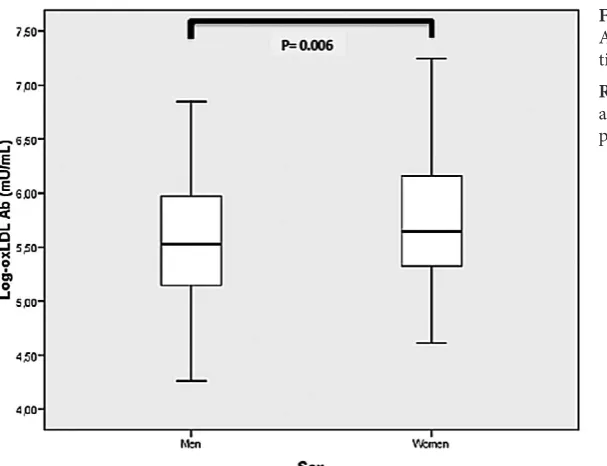
The sex-related distribution of log-ox-LDL Ab level is represented in Figure 1: men have a significantly lower level of Abs than women (p = 0.006). The results of the univariate analy-sis using ox-LDL Ab as dependent variables are resumed in Table 3. In a multivariate analysis, in-cluding age, BMI, hemodynamic and laboratory metabolic parameters (LDL-cholesterol, HDL-cholesterol, Triglycerides, Fasting Plasma Glu-cose, Serum Uric Acid), the only significant pre-dictor of log-ox-LDL Ab level was age (HR –0.19; 95%CI –0.115 – –0.104, p = 0.001; adjusted R2 = 0.581). Repeating the test by sex, the authors confirmed that the only significant predictor of log-ox-LDL Ab level was age (OR –0.11; 95%CI –0.118 – –0.105, p = 0.001) in women (adjusted R2 = 0.324) but not in men (adjusted R2 = 0.217), where the predictors were pulse pressure (PP) (HR –0.20; 95%CI –0.119 – –0.101, p = 0.041) and serum uric acid (HR 0.18; 95%CI 0.101 – 0.253, p = 0.049). Including in the analysis the considered nutritional variables, the best model predicting the log-ox-LDL Ab level included age (HR –0.11; 95%CI –0.116 – –0.105, p < 0.001), the percentage of kcal derived from lipids (HR –0.12; 95%CI –0.134 – –0.112, p < 0.001), copper (HR 0.77; 95%CI 0.475 – 1.076, p < 0.001) and zinc (HR –0.22; 95%CI –0.282 – –0.163, p < 0.001) (adjusted R2 = 0.358). Repeating the test by sex, in men the log-ox-LDL Ab level was only predicted by the current dietary animal lipids content (HR –0.12; 95%CI –0.127 – –0.109, p < 0.001) (adjust-ed R2 = 0.128), while in women the best model predicting the log-ox-LDL Ab level included age
Table 2. Mean dietary composition of the food currently con-sumed by the enrolled subjects
Tabela 2. Średni skład diety obecnie przyjmowanej przez pacjentów włączonych do badania
Mean
(Średnia) Standard deviation (Odchylenie standardowe) Kcal
Kj
% kcal from proteins (% kcal z białka) Animal proteins (g/day) (Białko zwierzęce (g/dzień)) Vegetal proteins (g/day) (Białko roślinne (g/dzień)) % kcal from lipids (% kcal z tłuszczów) Animal lipids (g/day) (Tłuszcze zwierzęce (g/dzień)) Vegetal lipids (g/day) (Tłuszcze roślinne (g/dzień)) % kcal from SFA
(% kcal z n.k.t.) % kcal from MUFA (% kcal z j.n.k.t.) % kcal from PUFA (% kcal z w.n.k.t.) PUFA/SFA
Cholesterol (mg/day) (Cholesterol) % kcal from glucides (% kcal z węglowodanów) Fibers (g/day) (Błonnik (g/dzień)) Alcohol (g/day) (Alkohol (g/dzień)) Water (cl/day) (Woda (cl/dzień)) Calcium (mg/day) (Wapń (mg/dzień)) Phosforus (mg/day) (Fosfor (mg/dzień)) Potassium (mg/day) (Potas (mg/dzień)) Sodium (mg/day) (Sód (mg/dzień)) Iron (mg/day) (Żelazo (mg/dzień)) Zinc (mg/day) (Cynk (mg/dzień)) Copper (mg/day) (Miedź (mg/dzień)) Thiamine (mg/day) (Tiamina (mg/dzień)) Riboflavine (mg/day) (Ryboflawina (mg/dzień)) Niacin (mg/day) (Niacyna (mg/dzień)) Vitamin A (mg/day) (Witamina A (mg/dzień)) Vitamin C (mg/day) (Witamina C (mg/dzień))
2191.7 9133.9 14.1 44.5 28.8 31.9 35.5 36.8 8.6 13.5 3.6 0.4 277.6 50.2 24.5 11.8 652.6 554.6 1106.0 2260.7 1337.1 11.0 5.0 0.9 0.9 1.2 16.9 484.2 66.3 614.0 2644.0 2.4 14.7 9.8 6.7 14.8 15.0 2.4 4.7 1.4 0,2 122.1 7.0 9.5 4.2 203.7 219.5 312.1 645.2 533.2 3.5 1.6 0.3 0.3 0.4 6.3 259.3 48.4
SFA – saturated fatty acids, MUFA – monounsaturated fatty acids, PUFA – polyunsaturated fatty acids.
(HR –0.11; 95%CI –0.119 – –0.107, p < 0.001), soluble fibers (HR 0.11; 95%CI 0.104 – 0.110, p < 0.001), and alcohol intake (HR 0.18; 95%CI 0.102 – 0.114, p < 0.013) (adjusted R2 = 0.182).
Discussion
Considering the whole study sample, the au-thors observed that the only significant predictor of log-ox-LDL Ab level was age, with a negative correlation with the distribution of the parameter, probably explicable considering the natural decline of Ab production going on with age. The same re-sult was also observed by a Spanish study which demonstrated the positive effect of olive oil poly-phenols in promoting Ab production, particularly at higher concentrations of lipid oxidative damage [19]. Repeating the persent analysis by sex, age was confirmed as a predictor in women but not in men, where the only predictors of log-ox-LDL Abs were pulse pressure and serum uric acid. The authors attributed the predictability of age observed only in women to the progressive reduction of estrogen production which exposes women to increasing oxidative stress and to a higher cardiovascular risk going on with age, while in men oxidative stress is not influenced by hormonal changes during their lifetime [20]. In a second stage of the study, the authors added the available nutritional variables to the regression model and the result was that ox-LDL Ab level was seen to be related to the percent-age of kcal derived from lipids, and to the dietary content of copper and zinc. Repeating the analysis by sex, in men the log-ox-LDL Ab level was only predicted by the current dietary animal lipid
con-tent, whereas in women soluble fibers and alcohol intake emerged. Explaining these intersex differ-ences is not easy. The authors assume that the lack of predictability of animal lipid content in women is probably multifactorial. Firstly because they have to consider the influences induced on lipid metabolism by sexual hormones; in fact estrogens are known to modify the lipid pattern, decreasing plasma LDL-C and increasing HDL-cholesterol, reducing in this way the substrates available for oxidation [21]. Secondly, taking into consideration the typical dietetic habits of the examined popula-tion, it became apparent that the diet of men was composed of a much more consistent percentage of animal lipids than women’s, probably to cor-relate with the hard agricultural work which oc-cupies most of them, something which could have influenced the analysis and which could also help us to explain the significant predictability of serum uric acid observed in men. Considering instead the predictability of the alcohol intake highlighted in women, the authors correlated it to the lower ac-tivity of the alcohol dehydrogenase enzyme in this sex compared to men [22], which exposes women to higher oxidative stress and consequently to higher titers of ox-LDL Abs. Instead, the authors found difficult to explain the predictive role of soluble fibers in women but not in men, leading them to think that this could be a fortuitous as-sociation due to the limited size of the two sex-specific investigated groups. To the best of their knowledge, the authors are the first study group to evaluate the possible associations between ox-LDL Ab serum level and nutritional factors in free-liv-ing healthy pharmacologically untreated subjects. In fact, the other few studies which so far have
Fig. 1. Sex-related distribution of ln Anti LDL-ox Ab in the studied popula-tion sample
Table 3. Univariate correlation between ox-LDL Ab levels and the considered dietary variables
Tabela 3. Jednoczynnikowa korelacja między stężeniem ox-LDL Ab a badanymi zmiennymi dietetycznymi
Variable
(Zmienne) beta standard-ized coefficient B 95% Confidence of Intervals(95% przedział ufności) P lower limit upper limit
Kcal –0.321 –0.001 0.000 0.339
% kcal from proteins (% kcal z białek) 0.149 –0.198 0.274 0.748
% kcal from SFA (% kcal z n.k.t) 0.304 –0.010 0.171 0.082
% kcal from MUFA (% kcal z j.n.k.t) 0.016 –0.059 0.063 0.945
% kcal from PUFA (% kcal z w.n.k.t) 0.244 –0.004 0.227 0.059
Cholesterol (mg/day) (Cholesterol (mg/dzień)) –0.011 –0.002 0.001 0.939
% kcal from glucides (% kcal z węglowodanów) 0.889 –0.126 0.286 0.444
Fibers (g/day) (Błonnik (mg/dzień)) –0.218 –0.022 0.051 0.439
Alcohol (g/day) (Alkohol (g/dzień)) 0.942 –0.066 0.365 0.172
Water (cl/day) (Woda (cl/dzień)) –0.576 –0.004 0.000 0.085
Calcium (mg/day) (Wapń (mg/dzień)) –0.311 –0.002 0.000 0.124
Phosforus (mg/day) (Fosfor (mg/dzień)) 0.345 0.000 0.002 0.243
Potassium (mg/day) (Potas (mg/dzień)) 0.253 0.000 0.001 0.371
Sodium (mg/day) (Sód (mg/dzień)) 0.355 0.000 0.001 0.072
Iron (mg/day) (Żelazo (mg/dzień)) –0.526 –0.242 0.052 0.204
Zinc (mg/day) (Cynk (mg/dzień)) –0.549 –0.361 –0.073 0.003
Copper (mg/day) (Miedź (mg/dzień)) –0.749 0.858 2.115 0.000
Thiamine (mg/day) (Tiamina (mg/dzień)) –0.105 –0.957 0.559 0.604
Riboflavine (mg/day) (Ryboflawina (mg/dzień)) 0.771 0.279 2.412 0.014
Niacin (mg/day) (Niacyna (mg/dzień)) –0.058 –0.057 0.046 0.822
Vitamin A (mg/day) (Witamina A (mg/dzień)) –0.036 –0.001 0.001 0.776
Vitamin C (mg/day) (Witamina C (mg/dzień)) –0.003 –0.004 0.004 0.986
focused on the same relationship were all clini-cal trials and did not consider such a large num-ber of dietary components. Di Bari et al. limited their observation to the relationship between ox-LDL Abs and red wine consumption, considering an unselected population. Their demonstration of a significant inverse relationship between ox-LDL Ab titer and daily wine intake, in the absence of any relationship shown with blood lipids, glycated hemoglobin (HbA1c) and smoking habits [23], is in contrast to present finding of a mild significant association between alcohol intake and ox-LDL Ab titer. However in both studies the ORs were very small and probably clinically irrelevant. A previ-ous study, aimed at evaluating the effect of vitamin E supplementation on the levels of
importance of micronutrients in health and nutri-tion in fact is indisputable because of their three major biological roles, as catalyst, structural and regulatory ion, that the authors included zinc mea-surement among the dietary determinants consid-ered in rheir study. Zinc in fact possesses a critical effect in homeostasis, immune function, oxidative stress, apoptosis, and in aging. In different chron-ic diseases, including atherosclerosis, concurrent zinc deficiency may complicate clinical features, adversely affect immunological status, increase oxidative stress, and lead to the generation of in-flammatory cytokines [25]. Moreover, other redox active metals like copper undergo redox cycling re-actions and possess the ability to produce reactive radicals in biological systems. A few studies have already analyzed the relationship between dietary zinc and cardio-metabolic risk, demonstrating for example that its dietary intake is associated with a lower increase in carotid intima-media thickness [26] and with a lower prevalence of atherosclerosis as well [27], or that the imbalance in zinc/copper metabolism may contribute to coronary artery dis-ease risk [28].Moreover it has been demonstrated that the intake of zinc from red meat, but not from other sources, is positively associated with the risk of metabolic syndrome and cardiovascular disease [29]. However, so far no data is available on the relationship between zinc or copper dietary intake and ox-LDL Ab level.
The main deficiency of thes study is the lack of parameters about the subjects’ immune function;
this could help to evaluate if the observed effect is more generically a consequence of the statement that young people have a higher immune reactiv-ity than the elderly. However the OR associated with age is very small, and overall age seems not to be a main determinant of ox-LDL Ab level, when other variables are entered in the regression mod-el. A second limitation is that by subdividing the population sample the authors reduce the power of the calculations: this could limit inferences of the results obtained by the reported sub-analyses. Anyway the impact of dietary variables on ox-LDL Ab level, even if sometimes statistically significant, is relatively scarce, both in the whole enrolled population and in the considered subgroups. On the other hand, the selected healthy patients are representative of a general population sample un-treated with drugs or dietary supplements that could potentially interfere with ox-LDL Ab levels. Undoubtedly, the lack of positive results does not exclude the existence of relations that are possibly detectable in a larger group of subjects. Moreover, this is the first study analyzing a possible corre-lation between anti-ox-LDL IgG serum level and a large number of dietary components in a sample of free-living healthy untreated patients.
In conclusion, in the studied population sample of healthy non-smoker subjects, the main dietary components considered do not influence ox-LDL Ab level, confirming the reliability of the dosage even in the presence of different dietary patterns.
Acknowledgement
The authors particularly acknowledge Marina Giovannini for her support in the Brisighella Heart Study labora-tory activity. They also thank the Faenza public health district and all the General Practitioners of Brisighella for their continuous support of the study.
References
Mitra S, Goyal T, Mehta JL:
[1] Oxidized LDL, LOX-1 and atherosclerosis. Cardiovasc Drugs Ther 2011, 25(5), 419– 429.
Hansson GK, Hermansson A:
[2] The immune system in atherosclerosis. Nat Immunol 2011, 12(3), 204–212.
Steinerová A, Racek J, Stozický F, Zima T, Fialová L, Lapin A:
[3] Antibodies against oxidized LDL – theory and clinical use. Physiol Res 2001, 50(2), 131–141.
Oranje WA, Wolffenbuttel BHR:
[4] Lipid peroxidation and atherosclerosis in type II diabetes. J Lab Clin Med 1999, 134, 19–32.
Cojocaru IM, Cojocaru M, Burcin C:
[5] IgG-autoantibodies against oxidized low-density lipoprotein in ischemic stroke onset. Rom J Intern Med 2006, 44(2), 165–170.
Rouhl RP, van Oostenbrugge RJ, Theunissen RO, Knottnerus IL, Staals J, Henskens LH, Kroon AA, de Leeuw [6]
PW, Lodder J, Tervaert JW, Damoiseaux JG: Autoantibodies against oxidized low-density lipoprotein in cerebral small vessel disease. Stroke 2010, 41(11), 2687–2689.
Swets BP, Brouwer DA, Tervaert JW:
[7] Patients with systemic vasculitis have increased levels of autoantibodies against oxidized LDL. Clin Exp Immunol 2001, 124(1), 163–167.
Laczik R, Szodoray P, Veres K, Szomják E, Csípo I, Sipka S Jr, Shoenfeld Y, Szekanecz Z, Soltész P:
[8] Assessment
of IgG antibodies to oxidized LDL in patients with acute coronary syndrome. Lupus 2011, 20(7), 730–735.
Che J, Li G, Wang W, Li Q, Liu H, Chen K, Liu T:
Nicoletti A, Kaveri S, Caligiuri G, Bariety J, Hansson GK:
[10] Immunoglobulin treatment reduces atherosclerosis in apo E knockout mice. J Clin Invest 1998, 102, 910–918.
Schiopu A, Frendeus B, Jansson B
[11] , Söderberg I, Ljungcrantz I, Araya Z, Shah PK, Carlsson R, Nilsson J, Fredrikson GN: Recombinant antibodies to an oxidized low-density lipoprotein epitope induce rapid regres-sion of atherosclerosis in apobec-1(–/–)/low-density lipoprotein receptor(–/–) mice. J Am Coll Cardiol 2007, 50, 2313–2318.
Liu CS, Lii CK, Ou CC, Tsai CH, Wei YH, Chen HW:
[12] Autoantibody against oxidized low-density lipoproteins may be enhanced by cigarette smoking. Chem Biol Inter 2000, 127 (2), 125–137.
Schulpis KH, Tsakiris S, Karikas GA, Moukas M, Behrakis P:
[13] Effect of diet on plasma total antioxidant status in phenylketonuric patients. Eur J Clin Nutr 2003, 57 (2), 383–387.
Descovich GC, Cavallo G, Mannino G, Lenzi S:
[14] The Brisighella survey: a study of dietary habits. Minerva Med 1983, 74(11), 547–555.
Ardigò D, Bernini F, Borghi C et al. on behalf of the ADSL project investigators:
[15] Advanced diagnostic support
in lipidology project: role for phenotypic and functional evaluation of lipoproteins in dyslipidemias. Clin Lipidol 2010, 5(3), 329–337.
Cicero AFG, Dormi A, D’Addato S, Borghi C on behalf of the Brisighella Heart Study Staff:
[16] From risk factor
assessment to cardiovascular disease risk and mortality modification: the first 40 years of the Brisighella Heart Study. Clin Lipidol 2011, 6(3), 269–276.
Gaddi A, Cicero AF, Wani FO, Dormi A, Pasquarelli V, D’Addato S:
[17] The realization of a project aimed at reduc-ing the plasmatic lipid level in a large Italian population improves the mean calcium daily intake: the Brisighella Study. Eur J Clin Nutr 2001, 55(2), 97–106.
Tatzber F, Esterbauer H:
[18] Autoantibodies to oxidized low density lipoprotein. In: Free Radicals, Lipoprotein Oxidation and Atherosclerosis. Eds.: Bellomo G, Finardi G, Maggi E, Rice-Evance C. London, UK: Richelieu Press: 1995, 245–262.
Castańer O, Fitó M, López-Sabater MC et al. EUROLIVE Study Group:
[19] The effect of olive oil polyphenols on antibodies against oxidized LDL. A randomized clinical trial. Clin Nutr 2011, 30(4), 490–493.
Miller AA, De Silva TM, Jackman KA, Sobey CG:
[20] Effect of gender and sex hormones on vascular oxidative stress. Clin Exp Pharmacol Physiol 2007, 34(10),1037–1043.
Nabulsi AA, Folsom AR, White A, Patsch W, Heiss G, Wu KK, Szklo M:
[21] Association of hormone-replace-ment therapy with various cardiovascular risk factors in postmenopausal women. The Atherosclerosis Risk in Communities Study Investigators. N Engl J Med 1993, 328, 1069–1075.
Frezza M, Di Padova C, Pozzato G, Terpin M, Baraona E, Lieber CS:
[22] High blood alcohol levels in women. The role of decreased gastric alcohol dehydrogenase activity and first pass metabolism. N Engl J Med1990, 322, 95–99.
Di Bari M, Zacchei S, Kritchevsky SB, Kritchevsky SB, Anichini M, Cesaretti S, Chiarlone M, Masotti G, [23]
Marchionni N: Anti-oxidized LDL antibodies and wine consumption: a population-based epidemiological study in Dicomano, Italy. Ann Epidemiol 2003, 13(3), 189–195.
Wen Y, Killalea S, Norris LA, Cooke T, Feely J:
[24] Vitamin E supplementation in hyperlipidaemic patients: effect of increasing doses on in vitro and in vivo low-density lipoprotein oxidation. Eur J Clin Invest 1999, 29(12), 1027–1034.
Chasapis CT, Loutsidou AC, Spiliopoulou CA, Stefanidou ME:
[25] Zinc and human health: an update. Arch Toxicol 2012, 86(4), 521–534.
Yang YJ, Choi BY, Chun BY, Kweon SS, Lee YH, Park PS, Kim MK:
[26] Dietary zinc intake is inversely related to subclinical atherosclerosis measured by carotid intima-media thickness. Br J Nutr 2010, 104(8), 1202–1211.
Islamoglu Y, Evliyaoglu O, Tekbas E, Cil H, Elbey MA, Atilgan Z, Kaya H, Bilik Z, Akyuz A, Alan S:
[27] The
rela-tionship between serum levels of Zn and Cu and severity of coronary atherosclerosis. Biol Trace Elem Res 2011, 144(1–3), 436–444.
Ghayour-Mobarhan M, Taylor A, Kazemi-Bajestani SM, Lanham-New S, Lamb DJ, Vaidya N, Livingstone C, [28]
Wang T, Ferns GA: Serum zinc and copper status in dyslipidaemic patients with and without established coronary artery disease. Clin Lab 2008, 54(9–10), 321–329.
de Oliveira Otto MC, Alonso A, Lee DH, Delclos GL, Bertoni AG, Jiang R, Lima JA, Symanski E, Jacobs DR Jr, [29]
Nettleton JA: Dietary intakes of zinc and heme iron from red meat, but not from other sources, are associated with greater risk of metabolic syndrome and cardiovascular disease. Am J Nutr 2012, 142(3), 526–533.
Address for correspondence:
Arrigo F.G. Cicero
Medical and Surgical Sciences Dept. Sant’Orsola-Malpighi University Hospital
U. O. Medicina Interna Borghi – Via Albertoni, 15 40138 Bologna
Italy
Tel.: +39 05 162 62 24 E-mail: [email protected]
Conflict of interest: None declared