W
OJCIECHB
OLANOWSKI, L
UDMIŁAW
ASZKIEWICZDoctors’ and Nurses’ Opinions About Hospital
Management in Germany and Poland*
Opinie personelu na temat zarządzania szpitalami
w Niemczech i Polsce
Department of Social Medicine, Silesian Piasts University of Medicine in Wrocław, Poland Adv Clin Exp Med 2008, 17, 3, 245–252
ISSN 1230−025X
EDITORIAL
© Copyright by Silesian Piasts University of Medicine in Wrocław
Abstract
Background.All over the world, hospital managers face the difficult task of continually adjusting their institu− tions’ resources to the changing mechanisms of hospital financing and changing patient needs. The few interna− tional comparisons of healthcare workers’ opinions provide valuable hints for managers.
Objectives. The purpose of this study was to find the aspects of hospital management that were evaluated best and worst by doctors and nurses in Germany and Poland. Differences in opinions between the professional groups were sought.
Material and Methods. An anonymous survey was conducted among doctors and nurses in 13 public hospitals in Germany and 9 in Poland in 2004. Comparable groups of doctors (N = 202) and nurses (N = 245) were selected. A synthetic measure of opinions about management was constructed to facilitate group comparisons.
Results. The measure of opinion was supposed to mirror the staff’s general opinions about the management of material resources, human resources, and organization of work. The mean measure in the subgroups was close to the scale’s midpoint. Opinions of German and Polish doctors did not differ significantly. German nurses had sig− nificantly better opinions than their Polish counterparts. Polish doctors were slightly more and German doctors were significantly more negative than nurses. There was no significant difference between the ratings made by doc− tors of both genders in both countries. The ratings of the personnel in hospitals of different size were not signifi− cantly different in the two countries. Ratings made by doctors and nurses with shorter and longer experience were not significantly different in the two countries. The aspects of management rated highest and lowest are listed.
Conclusions.1. The opinions of the medical staff of how Polish and German public hospitals are managed were not strikingly different, although differences occurred in some aspects. The results may also be interpreted as revealing similarities in the professional groups in the two countries. 2. Doctors and nurses evaluated aspects of management from different points of view and the scores from these two groups should thus be treated by man− agers as supplementing each other. 3. This study shows the directions for improving the balance between aspects of management and resources of hospitals. Improving gaps in technical resources of Polish hospitals would be ben− eficial and would also contribute to making public hospitals there a more competitive employer. It is noteworthy that “good assistance of other healthcare professionals” was scored low by Polish nurses and “bureaucratic process− es” was scored low by German nurses (Adv Clin Exp Med 2008, 17, 3, 245–252).
Key words: medical staff, doctors, nurses, management – healthcare, opinions.
Streszczenie
Wprowadzenie.Zespoły kierownicze szpitali na całym świecie stoją przed trudnym zadaniem ciągłego dopaso− wywania zasobów szpitali do zmieniających się mechanizmów finansowania szpitali i potrzeb pacjentów.
Cel pracy.Międzynarodowe porównanie opinii personelu o zarządzaniu szpitalami i znalezienie aspektów zarzą− dzania ocenianych najwyżej i najniżej przez personel lekarski i pielęgniarski w Polsce i w Niemczech.
Materiał i metody.Anonimowe badanie ankietowe było przeprowadzone wśród lekarzy i pielęgniarek w 13 szpi− talach publicznych w Niemczech i 9 w Polsce w 2004 roku. Szpitale podzielono na 3 kategorie według liczby
Assessment of hospital management is not a simple task. In the last decades (in Poland from 1997 on) marketing strategies are employed in the management of healthcare institutions. Numbers of services and financial indicators are used as the main measures of the effectiveness of manage− ment as they are considered the most objective. Attention is also given to the quality of services, although measures of this are not standardized. However, the satisfaction of the medical staff with the organization of their institutions, particularly opinions about management, are rarely dealt with in professional publications.
The present study was aimed at collecting ref− erence material for more profound studies, which is why no reference is made to academic books on the management of human resources and there is no discussion of the results aimed at blaming or praising any strategy of management related to hospital personnel. The intention was first of all to contribute to the understanding of the importance of the acceptance of management strategies and solutions by the staff. Healthcare systems all over the world suffer from being “more often a product of history and self−interest than of a design that matches our clinical resources to patient needs” [1]; hence many changes in managerial practices are needed. This also involves changes in the per− ception of what the scope of management is. Those who would like to explore related topics are encouraged to refer to surveys of hospital man− agers [2, 3] and reports on opinions of medical staff [4, 5].
The present report describes the opinions expressed by physicians and nurses of public hos− pitals in Germany and Poland. Because the gener−
al opinions of the whole groups of personnel were of interest, the survey was directed to staff who had different work experience, specializations, and positions. Hence their points of view and present orientation about all the activities that take place within the hospital varied greatly and could not be treated with equal weight. That is why conclusions cannot be drawn from the collected material with− out thorough consideration. It must be borne in mind that a questionnaire survey is a method of collecting data that is full of traps, but in spite of this, the opinions expressed by the personnel should not be ignored. The authors believe that the material presented here was gained in reliability because attention was given to informing the sur− veyed personnel that the opinions they expressed were to be used only for scientific analyses and would not have any direct personal or financial consequences for the hospital. Therefore it is believed that the results reported here will be valu− able for healthcare system designers and adminis− trators as well as for hospital managers and med− ical staff migrating between the countries.
The objective of this study was to find aspects of management of the hospitals that were evaluat− ed as the best and the worst by the employed doc− tors and nurses in Germany and Poland. Differences in the opinions of the professional groups were sought.
Material and Methods
The questionnaire survey was carried out among doctors and nurses in 13 hospitals in Germany and 9 in Poland in 2004. A form worked łóżek. Wyselekcjonowano podobne strukturą grupy 202 lekarzy i 245 pielęgniarek i porównywano mierniki ich opinii. W celu uproszczenia porównań w podgrupach zbudowano syntetyczny miernik opinii o zarządzaniu.
Wyniki. Zbudowany miernik opinii pracownika o zarządzaniu szpitalem ma odzwierciedlać uogólnione zdanie osoby na temat zarządzania zasobami materialnymi, ludzkimi i organizacją pracy w placówce. Średnia wartość miernika we wszystkich podgrupach była zbliżona do środka skali. Opinie lekarzy polskich i niemieckich nie by− ły istotnie różne, a niemiecki personel pielęgniarski wyraził lepszą opinię o zarządzaniu szpitalami niż polski. Pol− scy lekarze wyrazili nieco gorszą opinię o zarządzaniu niż polskie pielęgniarki, a niemieccy lekarze ocenili zarzą− dzanie istotnie gorzej od niemieckich pielęgniarek. W ocenach lekarzy z obu krajów nie stwierdzono różnic mię− dzy kobietami a mężczyznami. Również średnie mierniki opinii lekarzy w 3 kategoriach wielkości szpitali nie były istotnie różne, zarówno w Polsce jak i w Niemczech. Oceny lekarzy o krótszym i tych o dłuższym stażu pracy nie różniły się istotnie w obu krajach. To samo dotyczyło pielęgniarek. Aspekty zarządzania szpitalami oceniane naj− wyżej i najniżej przez każdą z grup zostały wymienione w artykule.
Wnioski.1. W opiniach personelu polskie i niemieckie szpitale nie są drastycznie różnie zarządzane, chociaż wy− stępują różnice co do poszczególnych aspektów zarządzania. Wyniki można również interpretować jako wykazu− jące podobieństwo grup zawodowych lekarzy i pielęgniarek w obu krajach. 2. Lekarze i pielęgniarki patrzą na za− rządzanie szpitalem z różnych punktów widzenia, dlatego ich opinie powinny być traktowane jako wzajemnie się uzupełniające. 3. Artykuł pokazuje kierunki zmian niezbędnych dla przywrócenia równowagi w ocenach zarządza− nia poszczególnymi zasobami szpitali. Poprawa zasobów technicznych polskich szpitali byłaby wskazana. Przy− czyniłaby się do większej atrakcyjności szpitala jako pracodawcy. Należy zwrócić uwagę na niską ocenę „asy− sty/dostępności innego personelu medycznego” u polskich pielęgniarek i niską ocenę „procesów biurokratycz− nych” u niemieckich pielęgniarek (Adv Clin Exp Med 2008, 17, 3, 245–252).
out in English by an international team of the METE project [6] for evaluating opinions of med− ical personnel was used.
In the search for criteria of rating management it was assumed that attention should be focused on those aspects of management that contribute to an effective treatment of patients and thus, by forming the opinions of patients, create the image of the hos− pital. Material resources, personnel resources, and organization of work were within the scope of inter− est of this study. Thus the questionnaire consisted of nine expressions regarding the management of material resources (3 items) and human resources (3 items) and the organization of work (3 items). The availability of adequate buildings, transport ways, installations, medical equipment, methods of diagnosis and treatment, and the supply and distrib− ution of material resources among wards were cho− sen as indicators of the quality of managing materi− al resources. The presence of adequate qualified staff, the balance of employment among the wards, and the mutual harmony of competencies in person− nel with different functions and specialties were chosen as indicators of the quality of managing human resources. The aspects connected with the
organization of work included adequate internal organization (cooperation between services), rigid bureaucratic processes, and adequate mechanisms of communication, coordination, and integration.
The rating of these aspects of management was carried out using a nine−item questionnaire in the form of sentences. The person questioned expressed his/her opinion by choosing the level of agreement with the sentence on a four−level Likert scale. Factor analysis showed one factor. One item had significantly lower weight but it was not elim− inated from analysis for logical reasons. Answers were collected in public hospitals of various size. For the purpose of this analysis they were grouped into three categories: small (up to 260 beds), medi− um (350–750), and large (900–1500, academic hospitals). Corresponding groups of doctors (N = 202) and nursing personnel (N = 245) were select− ed systematically. The national groups of doctors were similar in number (107 Polish and 95 German), work experience (mean: 10.7 years), and distribution of the length of work experience. The proportions of doctors having managerial respon− sibilities and working in the various specialized wards were similar.
Table 1.Factors considered in the bi−national comparisons
Tabela 1.Czynniki kontrolowane w porównaniach międzynarodowych
Doctors – groups of similar number Nursing personnel – three times more numerous in PL (Lekarze – grupy o podobnej liczebności) (Pielęgniarki – grupa polska trzy razy większa)
Mean length of work experience mean length of work experience Distribution of length of work experience number of beds in the hospital Number of beds in the hospital
Managerial responsibility (position)
low rate values of the measure high rate niskie wartoœci miernika wysokie
doctors (lekarze) nurses (pielêgniarki)
PL GER
0.35 0.40 0.45 0.50 0.55 0.60
means and credibility intervals (95.00% ) œrednia i przedzia³y ufnoœci (95,00% )
CI CI
Fig. 1.Measures of opinion of hospi− tal doctors and nurses about hospital management in Germany and in Poland
The samples of the nursing personnel were different in number (188 Polish and 57 German) and differed in the distribution of work experience, but not in the mean length of work experience (16.1 years). The nurses in both groups worked in wards with different specializations and were selected from hospitals of different sizes.
The measure of general personal opinion about management was calculated in the following way: the scores for each of the nine answers were assigned and added and the sums were scaled to an interval of 0–1, with zero signifying the lowest (most negative) opinion and 1 the most positive.
To ensure the diagnostic value of the construct− ed scale, factor analysis was performed with the elimination of one factor: it explained 46% of the total variance. The number of indicators in the scale was not optimized because such a procedure would diminish the diagnostic scope of the measure.
The mean values of the measure were com− pared between the groups: Polish (PL) vs. German (DE) doctors, PL vs. DE nurses, and all four sub− groups simultaneously. One general comparison (i.e. PL vs. DE medical personnel) was avoided. The first reason was that in both country groups of hospitals there were 3.5 nurses employed per one doctor and the number of answers from nurses were not favorable for a reliable analysis. The sec− ond was that it would be difficult to justify the opinion of nurses being 3.5 times “more impor− tant” than that doctors when interpreting weighted mean values of the measure of opinion.
The aspects of management that were rated the highest and the lowest in Germany and in Poland were found. The proportions of persons who had a positive opinion (higher or lower agreement) were compared.
< 260 beds < 260 ³ó¿ek
350–750 beds 350–750 ³ó¿ek
900–1500 beds 900–1500 ³ó¿ek
size/rank of the hospital wielkoϾ/ranga szpitala 0.30
0.35 0.40 0.45 0.50 0.55 0.60 0.65 0.70
doctors PL (lekarze PL) nurses PL (pielêgniarki PL) means and credibility intervals (95.00% )
œrednia i przedzia³y ufnoœci (95,00% ) CI CI
values of the measure wartoœci miernika
Fig. 2a.Measures of opinion of doctors and nurses in Poland about hospital management in hospitals of different size
Ryc. 2a.Wartości średnie miernika opinii lekarzy i pielęgniarek w Polsce na temat zarządzania szpitalami w szpitalach różnej wielkości
0.30 0.35 0.40 0.45 0.50 0.55 0.60 0.65 0.70
< 260 beds < 260 ³ó¿ek
350–750 beds 350–750 ³ó¿ek
900–1500 beds 900–1500 ³ó¿ek
size/rank of the hospital wielkoϾ/ranga szpitala
values of the measure wartoœci miernika
doctors GER (lekarze GER) nurses GER (pielêgniarki GER) means and credibility intervals (95.00% )
œrednia i przedzia³y ufnoœci (95,00% ) CI
CI Fig. 2b.Measures of opinion of doctors and nurses in Germany about hospital manage− ment in hospitals of different size
Results
The measure of opinion, ranging from 0 to 1, was supposed to mirror the general opinion of the medical personnel about the management of the hospital with regard to the management of materi− al resources, human resources, and work organiza− tion. It cannot be equated with a performance rat− ing of the hospital directors because the resource policy of the founder−institution as well as the directors of the wards also contribute significantly to the image of the hospital. The measure had higher values when the opinions were positive and lower when they were negative. The mean values of the measure in the subgroups were close to the midpoint of the scale. The opinions of the German (mean: 0.44) and Polish doctors (mean: 0.44) were not significantly different (Fig. 1). The German nurses had more positive opinion (mean: 0.54) than the Polish nurses (mean: 0.47, significant dif− ference with the t test, chi squared = 2.37, p = = 0.0181). The Polish doctors (mean: 0.44) were only slightly more negative than the Polish nurses (mean: 0.47), while the German doctors were sig− nificantly more negative than the German nurses
(mean: 0.44, chi squared = 3.6, p= 0.0005). There was no significant difference noted between the ratings made by doctors of both genders, both in Poland and in Germany. Among the nursing per− sonnel in Poland, only 2% of the answers came from men, while in Germany it was 19%. The opinions of the German male and female nursing personnel did not differ significantly.
Ratings of the personnel working in hospitals of different size (in Poland also of different founder−institutions) were not significantly differ− ent both in Germany and in Poland. Similarly, dif− ferences were not noted between the nursing per− sonnel subgroups (Figs. 2a and 2b). Ratings by doctors with shorter work experience (less than 5 years) and those with longer experience were not significantly different in both countries. The same was true of the ratings by the nursing personnel.
Which particular aspects of management were rated highest and which lowest by German and Polish personnel? While the mean value of the general measure of the opinion did not differenti− ate German and Polish doctors, differences were found in the specific aspects (Table 2).
Statistically significant differences in rating
Table 2.Assessment of the particular aspects of hospital management by German (numbers above) and Polish (numbers below) personnel
Tabela 2.Ocena poszczególnych aspektów zarządzania szpitalem przez personel niemiecki (górne liczby) i polski (dolne liczby)
Doctors Nursing personnel
(Lekarze) (Pielęgniarki)
agreement significance agreement significance
(%) of differences (%) of differences
1. Adequacy/balance between population needs and DE: 25 χ2= 5.05 46 χ2= 1.8
the human resources in the hospital PL: 40 p = 0.0237 36 p = 0.17
2. Adequate installations, physical environment, 50 χ2= 3.50 66 χ2= 11.98
and logistics 37 p = 0.06 40 p = 0.0005
3. Adequate technological resources and equipment 55 χ2= 9.16 67 χ2= 13.1
34 p = 0.0025 39 p = 0.0002
4. Adequate internal organization (cooperation 32 χ2= 4.87 47 χ2= 1.78
between services) 47 p = 0.0274 58 p = 0.18
5. Adequate distribution of human resources for the 20 χ2= 3.13 40 χ2= 1.19
services 31 p = 0.076 33 p = 0.27
6. Adequate distribution of the financial resources 25 χ2= 0.54 38 χ2= 1.63
for the services 30 p = 0.46 30 p = 0.28
7. Rigid bureaucratic processes 70 χ2= 2.05 53 χ2= 6.00
60 p = 0.15 71 p = 0.0143
8. Good assistance of other healthcare professionals 58 χ2= 0.43 79 χ2= 21.6
53 p = 0.51 44 p = 0.0000
9. Adequate mechanisms of communication, 38 χ2= 1.94 57 χ2= 0.029
coordination, and integration among professionals 48 p = 0.16 56 p = 0.36 Numbers in the column “agreement” result from adding the proportions of those who expressed high or low support for the sentence.
occurred in three aspects among doctors and in four aspects among nurses (Figs. 3a and 3b, respective− ly). The proportions of those who expressed sup− port (higher or lower) were compared.
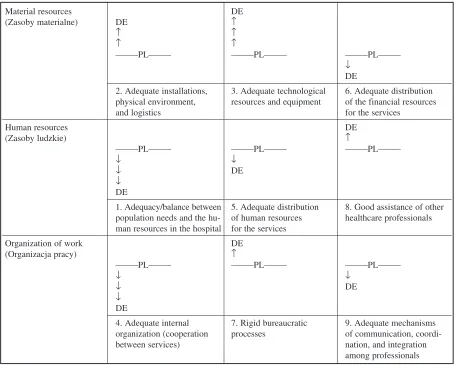
Differences between German and Polish per− sonnel on the specific aspects of management are shown in Figs. 4a and 4b.
Summary of the Results
1. Nursing personnel rated the management of hospitals higher than doctors did. The difference was not large in Poland, but in Germany it was sig− nificant in all three categories of hospital size. The mean ratings in the subgroups were close to the midpoint of the scale.
2. German nursing personnel assessed man− agement in their hospitals significantly more high− ly than do Polish nurses. The higher ratings con− cerned all the particular aspects dealing with mate− rial resources and their distribution and the management of human resources (number of employees, appropriate specialization, balance of
employment among the wards, and mutual support among the personnel of different professions and specializations). However, the aspects connected with organization (adequate internal organization, rigid procedural discipline, internal communica− tion in the hospital, and coordination of activity inside the hospital) were rated lower by German nurses.
3. German and Polish doctors expressed simi− lar general opinions about management, but dif− fered significantly in the specific aspects of evalu− ation. As regards material resources, German doc− tors assessed installations, ways of transport, delivery, medical equipment and medical tech− nologies more highly and the distribution of resources among wards/services somewhat lower. As regards the management of human resources, German doctors significantly less often agreed with statement that their hospital employs an appropriate number of personnel with the neces− sary qualifications. The organization of patient service in the hospital was rated lower by German doctors.
0 20 40 60 80 100
4. Adequate internal organization (cooperation between services) 1. Adequacy/balance between population needs and the human resources in the hospital 3. Adequate technological resources and equipment
%
Fig. 3a.Proportions of doctors who expressed positive opinions on specific aspects of hospital management. Darker columns refer to German personnel, lighter to Polish. Only those aspects in which statis− tically significant differences occurred are shown
Ryc. 3a.Część lekarzy, którzy wyrażali po− zytywne opinie o poszczególnych aspektach zarządzania szpitalem. Ciemniejsze kolumny dotyczą personelu niemieckiego, a jaśniejsze polskiego. Pokazano tylko różnice istotne statystycznie
0 20 40 60 80 100
7. Rigid bureaucratic processes 8. Good assistance of other health care professionals 2. Adequate installations, physical environment and logistics 3. Adequate technological resources and equipment
%
Fig. 3b.Proportions of nursing personnel who expressed positive opinions on specific aspects of hospital management. Darker columns refer to German personnel, lighter to Polish. Only those aspects in which statis− tically significant differences occurred are shown
Fig. 4a.Assessment of specific aspects of management by Polish and German doctors (relative position of the country’s name visualizes the difference between the portion of persons who had a positive opinion on the specific aspect of management) Ryc. 4a.Porównanie oceny aspektów zarządzania przez lekarzy polskich i niemieckich (względna pozycja nazwy kraju obrazuje różnicę odsetka badanych, którzy mieli pozytywne zdanie na temat danego aspektu zarządzania)
Fig. 4b.Assessment of specific aspects of management by Polish and German nursing personnel (relative position of the coun− try’s name visualizes the difference between the portion of persons who had a positive opinion on the specific aspect of management)
Ryc. 4b.Porównanie oceny aspektów zarządzania przez polski i niemiecki personel pielęgniarski (względna pozycja nazwy kraju obrazuje różnicę odsetka badanych, którzy mieli pozytywne zdanie na temat danego aspektu zarządzania)
↑
↑ ↑ DE
↑ ↑ ↑
–––––PL––––– –––––PL––––– –––––PL–––––
2. Adequate installations, 3. Adequate technological 6. Adequate distribution physical environment, resources and equipment of the financial resources
and logistics for the services
Human resources DE DE
(Zasoby ludzkie) ↑ DE ↑
↑ ↑ ↑
–––––PL––––– –––––PL––––– –––––PL–––––
1. Adequacy/balance between 5. Adequate distribution 8. Good assistance of other population needs and the hu− of human resources healthcare professionals man resources in the hospital for the services
Organization of work –––––PL––––– –––––PL––––– –––––PL≈DE–––––
(Organizacja pracy) ↓ ↓
↓ ↓
DE ↓
DE
4. Adequate internal 7. Rigid bureaucratic 9. Adequate mechanisms organization (cooperation processes of communication, coordi−
between services) nation, and integration
among professionals
Material resources DE
(Zasoby materialne) DE ↑
↑ ↑
↑ ↑
–––––PL––––– –––––PL––––– –––––PL–––––
↓
DE
2. Adequate installations, 3. Adequate technological 6. Adequate distribution physical environment, resources and equipment of the financial resources
and logistics for the services
Human resources DE
(Zasoby ludzkie) ↑
–––––PL––––– –––––PL––––– –––––PL–––––
↓ ↓
↓ DE
↓
DE
1. Adequacy/balance between 5. Adequate distribution 8. Good assistance of other population needs and the hu− of human resources healthcare professionals man resources in the hospital for the services
Organization of work DE
(Organizacja pracy) ↑
–––––PL––––– –––––PL––––– –––––PL–––––
↓ ↓
↓ DE
↓
DE
4. Adequate internal 7. Rigid bureaucratic 9. Adequate mechanisms organization (cooperation processes of communication, coordi−
between services) nation, and integration
The authors conclude that the results show that the opinions of employees of Polish and German public hospitals regarding hospital management do not strikingly differ, although differences occur in some aspects. On the other hand, the results may be interpreted as revealing similarities between the professional group of doctors and between the professional group of nurses in the two countries.
Doctors and nurses evaluate aspects of manage− ment from different points of view and thus the scores from these two professional groups should be treated by managers as supplementing each other.
Good and employee−friendly management should assure a balance between the specific aspects and resources in the hospital. This article shows that improving gaps in the technical resources of Polish hospitals would be beneficial. It would also con− tribute to making public hospitals in Poland a more competitive employer. It is also worthy of attention that “good assistance of other healthcare profession− als” was scored low by Polish nurses and “bureau− cratic processes” was scored low by German nurses.
Acknowledgements. The German partner in the international project “Medical Assistance and Therapy in Europe” (METE) was the University of Bonn, Department of International Medical Education and Development, and local activities were led by Prof. Winrich Breipohl. Warm thanks are due the managerial staff of all the 22 hospitals in Germany and Poland that took part in the survey. Their names are not published as it was a condition for their participation in this project.
References
[1] Wasson JH:Why isn’t it better? Ann Fam Med 2004, 2, 292–293.
[2] Blendon RJ, Schoen C, DesRoches CM, Osborn R, Zapert K, Raleigh E:Confronting competing demands to improve quality: a five−country hospital survey. Health Aff 2004, 23, 119–135.
[3] Boczkowski A, Cybart A, Chromińska−Szosland D:Managing staff of heath care units versus health system reform. Zdr Pub 2001, 111(2), 81–87 [in Polish].
[4] Blendon RJ, Schoen C, Donelan K:Physicians’ views on quality of care: a five−country comparison. Health Aff 2001, 20, 233–243.
[5] Bolanowski W, Waszkiewicz L:Opinions of Medical Personnel on Hospital Management. Polish J Environm Studies 2006, 15 (2B, part 1), 94–97. See also neighboring texts.
[6] Magni MV, ed. Education and professional needs [of medical personnel in Europe] – reference material. Printed by University of Perugia, Italy, 2006. See also: www.meteproject.org, the web site of the project “Medical Assistance and Therapy in Europe” (METE).
Address for correspondence:
Wojciech Bolanowski
Department of Social Medicine Silesian Piasts University of Medicine Bujwida 44
50−345 Wroclaw Poland
E−mail: [email protected]
Conflict of interest: None declared