www.theoryofgroups.ir
ISSN (print): 2251-7650, ISSN (on-line): 2251-7669 Vol. 8 No. 1 (2019), pp. 43-50.
c
⃝2019 University of Isfahan
www.ui.ac.ir
DIFFERENCE BASES IN DIHEDRAL GROUPS
TARAS BANAKH AND VOLODYMYR GAVRYLKIV∗
Communicated by Attila Maroti
Abstract. A subsetB of a groupG is called adifference basisof Gif each element g∈ Gcan be
written as the differenceg=ab−1of some elementsa, b∈B. The smallest cardinality|B|of a difference
basisB⊂Gis called thedifference sizeofGand is denoted by ∆[G]. The fractionð[G] := ∆[G]/√|G|
is called thedifference characteristic ofG. We prove that for everyn∈Nthe dihedral groupD2n of
order 2nhas the difference characteristic√2≤ð[D2n]≤√48
586 ≈1.983. Moreover, ifn≥2·10 15
, then ð[D2n]< √4
6 ≈1.633. Also we calculate the difference sizes and characteristics of all dihedral groups
of cardinality≤80.
1. Introduction
A subset B of a groupG is called adifference basisfor a subset A⊂G if each element a∈A can
be written asa=xy−1 for somex, y∈B. The smallest cardinality of a difference basis forAis called the difference size of A and is denoted by ∆[A]. For example, the set {0,1,4,6} is a difference basis
for the interval A= [−6,6]∩Z witnessing that ∆[A]≤4.
The definition of a difference basis B for a set A in a groupG implies that|A| ≤ |B|2 and gives a
lower bound√|A| ≤∆[A]. The fraction
ð[A] := √∆[A]
|A| ≥1 is called thedifference characteristicof A.
MSC(2010): Primary: 05B10; Secondary: 05E15, 20D60.
Keywords: dihedral group, difference basis, difference characteristic. Received: 12 April 2017, Accepted: 08 August 2017.
∗Corresponding author.
http://dx.doi.org/10.22108/ijgt.2017.21612
For a real number xwe put
⌈x⌉= min{n∈Z:n≥x} and⌊x⌋= max{n∈Z:n≤x}.
The following proposition is proved in [3, 1.1].
Proposition 1. Let G be a finite group. Then
(1) 1+
√ 4|G|−3
2 ≤∆[G]≤ ⌈|G|+1
2 ⌉
,
(2) ∆[G]≤∆[H]·∆[G/H]and ð[G]≤ð[H]·ð[G/H] for any normal subgroup H⊂G;
(3) ∆[G]≤ |H|+|G/H| −1 for any subgroup H⊂G.
In [10] Kozma and Lev proved (using the classification of finite simple groups) that each finite group
G has difference characteristicð[G]≤ √4
3 ≈2.3094.
In this paper we shall evaluate the difference characteristics of dihedral groups and prove that each
dihedral group D2n hasð[D2n]≤ √48586 ≈1.983. Moreover, if n≥2·1015, then ð[D2n]< √46 ≈1.633. We recall that the dihedral group D2n is the isometry group of a regular n-gon. The dihedral group D2n contains a normal cyclic subgroup of index 2. A standard model of a cyclic group of ordern is the multiplicative group
Cn={z∈C:zn= 1}
of n-th roots of 1. The groupCn is isomorphic to the additive group of the ringZn=Z/nZ.
Difference bases have applications in the study of structure of superextensions of groups, see [1,3].
A subset B of a groupG is called a basis of Gif each element g∈G can be written as g=abfor
somea, b∈B. Bases in dihedral groups were studied in [7].
Theorem 2. For any numbers n, m∈Nthe dihedral group D2nm has the difference size 2√nm≤∆[D2nm]≤∆[D2n]·∆[Cm]
and the difference characteristic √2≤ð[D2nm]≤ð[D2n]·ð[Cm].
Proof. It is well-known that the dihedral groupD2nm contains a normal cyclic subgroup of ordernm, which can be identified with the cyclic group Cnm. The subgroupCm ⊂Cnm is normal in D2mn and the quotient group D2mn/Cm is isomorphic to D2n. Applying Proposition 1(2), we obtain the upper bounds ∆[D2n]≤∆[D2nm/Cm]·∆[Cm] = ∆[D2n]·∆[Cm] and ð[D2nm]≤ð[D2n]·ð[Cm].
Next, we prove the lower bound 2√nm≤∆[D2nm]. Fix any element s∈D2nm\Cnm and observe that s = s−1 and sxs−1 = x−1 for all x ∈ C
nm. Fix a difference basis D ⊂ D2nm of cardinality
|D|= ∆[D2nm] and writeDas the unionD=A∪sBfor some setsA, B⊂Cnm⊂D2nm. We claim that AB−1=Cnm. Indeed, for anyx∈Cnmwe getxs∈sCnm∩(A∪sB)(A∪sB)−1 =AB−1s−1∪sBA−1 and hence
So, Cnm=AB−1 and hence nm ≤ |A| · |B|. Then ∆[D2nm] =|A|+|B| ≥min{l+k:l, k ∈N, lk≥
nm} ≥2√nm and ð[D2nm] = ∆[√D22nmnm]≥ 2
√ nm √
2nm =
√
2. □
Corollary 3. For any number n∈N the dihedral groupD2n has the difference size 2√n≤∆[D2n]≤2·∆[Cn]
and the difference characteristic √2≤ð[D2n]≤
√
2·ð[Cn].
The difference sizes of finite cyclic groups were evaluated in [2] with the help of the difference sizes
of the order-intervals [1, n]∩Z in the additive group Z of integer numbers. For a natural number
n∈Nby ∆[n] we shall denote the difference size of the order-interval [1, n]∩Zand byð[n] := ∆[√n] n its difference characteristic. The asymptotics of the sequence (ð[n])∞n=1 was studied by R´edei and R´enyi [11], Leech [9] and Golay [8] who eventually proved that
√
2 +34π <
√
2 + max
0<φ<2π
2 sin(φ)
φ+π ≤nlim→∞ð[n] = infn∈Nð[n]≤ð[6166] = 128
√
6166 <ð[6] =
√ 8 3.
In [2] the difference sizes of the order-intervals [1, n]∩Zwere applied to give upper bounds for the
difference sizes of finite cyclic groups.
Proposition 4. For every n∈ N the cyclic group Cn has difference size ∆[Cn]≤ ∆
[ ⌈n−1
2 ⌉ ]
, which
implies that
lim sup n→∞ ð
[Cn]≤ √1
2ninf∈Nð[n]≤ 64 √ 3083 < 2 √ 3.
The following upper bound for the difference sizes of cyclic groups were proved in [2].
Theorem 5. For any n∈N the cyclic groupCn has the difference characteristic:
(1) ð[Cn]≤ð[C4] = 32;
(2) ð[Cn]≤ð[C2] =ð[C8] = √
2 if n̸= 4;
(3) ð[Cn]≤ √12
73 < √
2 if n≥9;
(4) ð[Cn]≤ √24293 < √1273 if n≥9 and n̸= 292; (5) ð[Cn]< √23 if n≥2·1015.
For some special numbersn we have more precise upper bounds for ∆[Cn]. A numberq is called a
prime power ifq=pk for some prime numberp and some k∈N.
The following theorem was derived in [2] from the classical results of Singer [13], Bose, Chowla [4],
[5] and Rusza [12].
Theorem 6. Let p be a prime number andq be a prime power. Then
(1) ∆[Cq2+q+1] =q+ 1;
(2) ∆[Cq2−1]≤q−1 + ∆[Cq−1]≤q−1 +3 2
√
q−1;
The following Table1of difference sizes and characteristics of cyclic groups Cn forn≤100 is taken
from [2].
Table 1. Difference sizes and characteristics of cyclic groupsCn forn≤100.
n ∆[Cn] ð[Cn] n ∆[Cn] ð[Cn] n ∆[Cn] ð[Cn] n ∆[Cn] ð[Cn]
1 1 1 26 6 1.1766... 51 8 1.1202... 76 10 1.1470...
2 2 1.4142... 27 6 1.1547... 52 9 1.2480... 77 10 1.1396...
3 2 1.1547... 28 6 1.1338... 53 9 1.2362... 78 10 1.1322...
4 3 1.5 29 7 1.2998... 54 9 1.2247... 79 10 1.1250...
5 3 1.3416... 30 7 1.2780... 55 9 1.2135... 80 11 1.2298...
6 3 1.2247... 31 6 1.0776... 56 9 1.2026... 81 11 1.2222...
7 3 1.1338... 32 7 1.2374... 57 8 1.0596... 82 11 1.2147...
8 4 1.4142... 33 7 1.2185... 58 9 1.1817... 83 11 1.2074...
9 4 1.3333... 34 7 1.2004... 59 9 1.1717... 84 11 1.2001...
10 4 1.2649... 35 7 1.1832... 60 9 1.1618... 85 11 1.1931...
11 4 1.2060... 36 7 1.1666... 61 9 1.1523... 86 11 1.1861...
12 4 1.1547... 37 7 1.1507... 62 9 1.1430... 87 11 1.1793...
13 4 1.1094... 38 8 1.2977... 63 9 1.1338... 88 11 1.1726...
14 5 1.3363... 39 7 1.1208... 64 9 1.125 89 11 1.1659...
15 5 1.2909... 40 8 1.2649... 65 9 1.1163... 90 11 1.1595...
16 5 1.25 41 8 1.2493... 66 10 1.2309... 91 10 1.0482...
17 5 1.2126... 42 8 1.2344... 67 10 1.2216... 92 11 1.1468...
18 5 1.1785... 43 8 1.2199... 68 10 1.2126... 93 12 1.2443...
19 5 1.1470... 44 8 1.2060... 69 10 1.2038... 94 12 1.2377...
20 6 1.3416... 45 8 1.1925... 70 10 1.1952... 95 12 1.2311...
21 5 1.0910... 46 8 1.1795... 71 10 1.1867... 96 12 1.2247...
22 6 1.2792... 47 8 1.1669... 72 10 1.1785... 97 12 1.2184...
23 6 1.2510... 48 8 1.1547... 73 9 1.0533... 98 12 1.2121...
24 6 1.2247... 49 8 1.1428... 74 10 1.1624... 99 12 1.2060...
Using Theorem6(1), we shall prove that for infinitely many numbersnthe lower and upper bounds
given in Theorem 2 uniquely determine the difference size ∆[D2n] ofD2n.
Theorem 7. If n= 1 +q+q2 for some prime power q, then
∆[D2n] = 2·∆[Cn] =
⌈
2√n⌉=⌈√2|D2n|
⌉
= 2 + 2q.
Proof. By Theorem 6(1), ∆[Cn] = 1 +q. Since
2√q2+q+ 1 = 2√n≤∆[D
2n]≤∆[D2]·∆[Cn] = 2·∆[Cn] = 2 + 2q,
it suffices to check that (2 + 2q)−2√q2+q+ 1<1, which is equivalent to√q2+q+ 1> q+1 2 and
toq2+q+ 1> q2+q+14. □
A bit weaker result holds also for the dihedral groupsD8(q2+q+1).
Proposition 8. If n= 1 +q+q2 for some prime power q, then
4q+ 3≤∆[D8n]≤4q+ 4.
Proof. By Theorem 6(1), ∆[Cn] = 1 +q. Since ∆[D8] = 4 (see Table 2), by Theorem2,
4√q2+q+ 1 = 2√4n≤∆[D
8n]≤∆[D8]·∆[Cn] = 4(1 +q).
To see that 4q+ 3≤∆[D8n]≤4q+ 4, it suffices to check that (4 + 4q)−4 √
q2+q+ 1<2, which is
equivalent to √q2+q+ 1> q+1
2 and to q2+q+ 1> q2+q+ 1
4. □
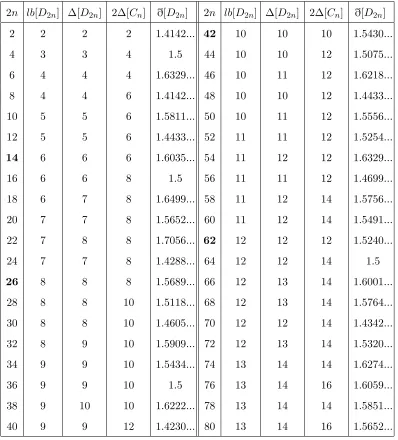
In Table2we present the results of computer calculation of the difference sizes and characteristics of
dihedral groups of order ≤80. In this tablelb[D2n] :=⌈
√
4n⌉is the lower bound given in Theorem2.
With the boldface font we denote the numbers 2n∈ {14,26,42,62}, equal to 2(q2+q+ 1) for a prime powerq. For these numbers we know that ∆[D2n] =lb[D2n] = 2q+ 2. Forq= 2 andn=q2+q+ 1 = 7
the table shows that ∆[D56] = ∆[D8n] = 11 = 4q+ 3, which means that the lower bound 4q+ 3 in
Table 2. Difference sizes and characteristics of dihedral groups D2n for 2n≤80.
2n lb[D2n] ∆[D2n] 2∆[Cn] ð[D2n] 2n lb[D2n] ∆[D2n] 2∆[Cn] ð[D2n]
2 2 2 2 1.4142... 42 10 10 10 1.5430...
4 3 3 4 1.5 44 10 10 12 1.5075...
6 4 4 4 1.6329... 46 10 11 12 1.6218...
8 4 4 6 1.4142... 48 10 10 12 1.4433...
10 5 5 6 1.5811... 50 10 11 12 1.5556...
12 5 5 6 1.4433... 52 11 11 12 1.5254...
14 6 6 6 1.6035... 54 11 12 12 1.6329...
16 6 6 8 1.5 56 11 11 12 1.4699...
18 6 7 8 1.6499... 58 11 12 14 1.5756...
20 7 7 8 1.5652... 60 11 12 14 1.5491...
22 7 8 8 1.7056... 62 12 12 12 1.5240...
24 7 7 8 1.4288... 64 12 12 14 1.5
26 8 8 8 1.5689... 66 12 13 14 1.6001...
28 8 8 10 1.5118... 68 12 13 14 1.5764...
30 8 8 10 1.4605... 70 12 12 14 1.4342...
32 8 9 10 1.5909... 72 12 13 14 1.5320...
34 9 9 10 1.5434... 74 13 14 14 1.6274...
36 9 9 10 1.5 76 13 14 16 1.6059...
38 9 10 10 1.6222... 78 13 14 14 1.5851...
40 9 9 12 1.4230... 80 13 14 16 1.5652...
Theorem 9. For any number n∈N the dihedral groupD2n has the difference characteristic
√
2≤ð[D2n]≤
48
√
586 ≈1.983.
Moreover, if n≥2·1015, then ð[D2n]< √46 ≈1.633.
Proof. By Corollary 3, √2 ≤ ð[D2n] ≤
√
2·ð[Cn]. If n ≥ 9 and n ̸= 292, then ð[Cn] ≤ √24293 by Theorem 5(4), and hence ð[D2n] ≤
√
2·ð[Cn] ≤ √2·√24
293 = 48
√
586. If n = 292, then known values ð[C73] = √973 (given in Table1), ð[D8] = √48 =
√
2 (given in Table 2) and Theorem 2 yield the upper
bound
ð[D2·292] =ð[D8·73]≤ð[D8]·ð[C73] = √
2·√9 73 <
48
√
Analyzing the data from Table 2, one can check thatð[D2n]≤ √48586 ≈1.983 for all n≤8.
If n≥2·1015, thenð[Cn]< √2
3 by Theorem 5(5), and hence ð[D2n]≤
√
2·ð[Cn]< 4
√
6.
□
Question 10. Is supn∈Nð[D2n] =ð[D22] = √822 ≈1.7056?
To answer Question 10affirmatively, it suffices to check that ð[D2n]≤ √822 for all n <1 212 464.
Proposition 11. The inequality ð[D2n]≤
√
2·ð[Cn]≤ √822 holds for alln≥1 212 464.
Proof. It suffices to prove thatð[Cn]≤ √411 for all n≥1 212 464. To derive a contradiction, assume that ð[Cn]> √4
11 for somen≥1 212 464. Let (qk)
∞
k=1 be an increasing enumeration of prime powers.
Letk∈Nbe the unique number such that 12q2k+ 14qk+ 15< n≤12qk2+1+ 14qk+1+ 15. By Corollary
4.9 of [2], ∆[Cn]≤4(qk+1+ 1). The inequalityð[Cn]> √411 implies
4(qk+1+ 1)≥∆[Cn]> 4
√
11
√
n≥ √4 11
√
12q2
k+ 14qk+ 16.
By Theorem 1.9 of [6], if qk ≥ 3275, then qk+1 ≤ qk + 2 lnqk2(qk). On the other hand, using
Wol-framAlpha computational knowledge engine it can be shown that the inequality 1 +x+ 2 lnx2(x) ≤ 1
√
11 √
12x2+ 14x+ 16 holds for all x≥43. This implies thatq
k<3275.
Analyzing the table1 of (maximal gaps between) primes, it can be shows that 11(qk+1 + 1)2 ≤
12qk2+ 14qk+ 16 ifqk≥331. So,qk≤317,qk+1≤331 and 11·(qk+1+ 1)2= 11·3322 = 1 212 464≤n,
which contradicts 4(qk+1+ 1)> √411 √
n. □
References
[1] T. Banakh and V. Gavrylkiv, Algebra in the superextensions of twinic groups,Dissertationes Math.473(2010) pp.
74.
[2] T. Banakh and V. Gavrylkiv, Difference bases in cyclic groups, em J. Algebra Appl. bf 18 (2019) pp. 18.
[3] T. Banakh, V. Gavrylkiv and O. Nykyforchyn, Algebra in superextension of groups, I: zeros and commutativity,
Algebra Discrete Math.,3(2008) 1–29.
[4] R. C. Bose, An affine analogue of Singer’s theorem,J. Indian Math. Soc.,6(1942) 1–15.
[5] R. C. Bose and S. Chowla, Theorems in the additive theory of numbers, Comment. Math. Helv., 37 (1962-63)
141–147.
[6] P. Dusart,Autour de la fonction qui compte le nombre de nombres premiers, Ph.D. Thesis, Univ. de Limoges, 1998.
[7] V. Gavrylkiv, Bases in dihedral and Boolean groups,J. Integer Seq.,20(2017).
[8] M. Golay, Notes on the representation of 1,2, . . . , nby differences,J. Lond. Math. Soc.,4(1972) 729–734.
[9] J. Leech, On the representation of 1,2, . . . , nby differences,J. Lond. Math. Soc.,31(1956) 160–169.
[10] G. Kozma and A. Lev, Bases and decomposition numbers of finite groups,Arch. Math. (Basel),58(1992) 417–424.
[11] L. R´edei and A. R´enyi, On the representation of the numbers 1,2, . . . , N by means of differences,Math. Sbornik
N.S.,24(1949) 385–389.
[12] I. Z. Ruzsa, Solving a linear equation in a set of integers I,Acta Arith.,3(1993) 259–282.
[13] J. Singer, A theorem in finite projective geometry and some applications to number theory, Trans. Amer. Math.
Soc.,43(1938) 377–385.
Taras Banakh
Ivan Franko National University of Lviv (Ukraine), and
Institute of Mathematics, Jan Kochanowski University in Kielce (Poland)
Email: [email protected]
Volodymyr Gavrylkiv
Vasyl Stefanyk Precarpathian National University, Ivano-Frankivsk, Ukraine