in the population sciences published by the Max Planck Institute for Demographic Research Konrad-Zuse Str. 1, D-18057 Rostock · GERMANY www.demographic-research.org
DEMOGRAPHIC RESEARCH
VOLUME 22, ARTICLE 25, PAGES 771-812
PUBLISHED 30 APRIL 2010
http://www.demographic-research.org/Volumes/Vol22/25/ DOI: 10.4054/DemRes.2010.22.25
Research Article
Men’s and women’s migration
in coastal Ghana: An event history analysis
Holly E. Reed
Catherine S. Andrzejewski
Michael J. White
© 2010 Holly E. Reed, Catherine S. Andrzejewski & Michael J. White.
This open-access work is published under the terms of the Creative Commons Attribution NonCommercial License 2.0 Germany, which permits use, reproduction & distribution in any medium for non-commercial purposes, provided the original author(s) and source are given credit.
1 Introduction 772
2 The Ghanaian context 773
3 Theoretical framework and hypotheses 775
3.1 Migration, sex and the life course 775
3.2 Types of migration and previous movers 778
3.3 Previous studies using a life history calendar and event history analysis
780
4 Data and methods 782
4.1 Data 782
4.2 Methods 784
4.3 Outcome measures 786
5 Results 788
5.1 Descriptive statistics 788
5.2 Logistic regression event history analysis of inter-regional migration
793
5.3 Multinomial logit models of migration by place of origin and
destination 796
6 Conclusions 802
References 804
Men’s and women’s migration in coastal Ghana:
An event history analysis
Holly E. Reed1
Catherine S. Andrzejewski2
Michael J. White3
Abstract
This article uses life history calendar (LHC) data from coastal Ghana and event history statistical methods to examine inter-regional migration for men and women, focusing on four specific migration types: rural-urban, rural-rural, urban-urban, and urban-rural. Our analysis is unique because it examines how key determinants of migration— including education, employment, marital status, and childbearing—differ by sex for these four types of migration. We find that women are significantly less mobile than men overall, but that more educated women are more likely to move (particularly to urban areas) than their male counterparts. Moreover, employment in the prior year is less of a deterrent to migration among women. While childbearing has a negative effect on migration, this impact is surprisingly stronger for men than for women, perhaps because women’s search for assistance in childcare promotes migration. Meanwhile, being married or in union appears to have little effect on migration probabilities for either men or women. These results demonstrate the benefits of a LHC approach and suggest that migration research should further examine men’s and women’s mobility as it relates to both human capital and household and family dynamics, particularly in developing settings.
1 Department of Sociology, Queens College, and CUNY Institute for Demographic Research, City University of New York, NY, USA. E-mail: [email protected].
2 Principia International, Chapel Hill, NC, USA.
1. Introduction
The study of sex differences in migration has emerged as a topic of growing interest among researchers over the past two decades. Yet few of these studies have focused on migration within national boundaries, and fewer still have examined moves by both men and women, across the life course, and among a variety of destinations and origins. In addition, female migrants, particularly those who are married and/or have children, are sometimes assumed to have much different reasons for moving compared to their male counterparts. Typically, women are seen as moving for “family” reasons, rather than education- or work-related reasons. Conversely, men’s marital status and childbearing behavior are rarely studied in direct relation to their mobility.
In this paper, we attempt to at least partially remedy some of these gaps in our knowledge of human mobility by analyzing migration patterns between rural and urban areas for both men and women in Ghana. We focus on several major determinants of mobility, including education, employment, marital status, and childbearing, and we compare moves by sex and by origin-destination pairs. We analyze these migration patterns using a rich primary data set that employed a life history calendar (LHC) to collect detailed information about individuals’ migration histories and other social and demographic events. This allows for event history analysis of demographic changes for all adults in the sample on a year-by-year basis. Thus, it gives not only the sequence of migration in relation to other social and demographic changes, but also more precise timing of these events than is generally available from standard census or survey questions about current and past place of residence. Our survey also has the advantage that it includes both men and women as respondents and that it studies migration within and beyond a rapidly urbanizing dynamic coastal region of West Africa, an area of the world which is relatively understudied in the migration literature.
Our research site in coastal Ghana is briefly introduced in Section 2, below. Section 3 then reviews the existing literature and builds on that literature to lay out the theoretical framework and hypotheses for the study. The data and methods used are described in Section 4, and the main results are presented in Section 5. The final section discusses the significance of the results and suggests some new directions for research.
2. The Ghanaian context
Ghana is a particularly valuable place to study migration as it relates to other life cycle processes. First, Ghana is one of the countries on the forefront of the demographic transition in sub-Saharan Africa. Ghanaian fertility and mortality rates have declined dramatically in the last 20 years. According to United Nations projections, the capital city of Accra may reach replacement level fertility within the next ten years (United Nations 2003). Indeed, a recent review of demographic trends in sub-Saharan Africa suggested that Ghana is illustrative of the “classic” pattern of demographic change, where death rates are falling dramatically, fertility rates are also declining, and population growth rates, although still high, are declining (Tabutin and Schoumaker 2004). Although it remains a relatively poor country in comparison to much of the world, Ghana has also done well in terms of achieving many social indicators of development and it remains one of the few countries in Africa that has avoided large-scale conflict since its independence in 1957. Thus Ghana gives us a potential window on how development and demographic change may interact to affect urbanization and migration in other parts of Africa.
Ghana is not only on the forefront of the demographic and development transitions in Africa, but also at the front of the urbanization trend. Important migration routes in West Africa related to nomadic movements and traders have been used for centuries. Due to its central location in the region, Ghana occupies a key crossroads of these routes. In recent years, the migration routes have been supplemented by increasing rural-to-urban migration, as cities in Ghana, such as Accra and Kumasi, became magnets for not only traders, but also young migrants seeking work and educational opportunities (Adepoju 2003, Anarfi et al. 2003).
differentiated in many ways, and understanding the migration patterns between these two areas becomes increasingly important (Tabutin and Schoumaker 2004).
In addition, the coastal region of Ghana is urbanizing especially rapidly. The 2000 census classified 37.5% of the population of Ghana’s Central Region (which, despite its somewhat misleading name, lies along Ghana’s coastline), our study region, as urban (Ghana Statistical Service 2002). The Central Region is the third most urbanized region in Ghana, following neighboring (and also coastal) Greater Accra (87.7% urban— essentially the metropolitan region of Accra, the capital), and the Ashanti region (51.3%) (Ghana Statistical Service 2002).
Historically, both men and women in Ghana have been relatively mobile. The coast and regions just inland have drawn labor, primarily men, to the fishing and logging industries and to the cocoa farms. Larger market towns and cities, including Cape Coast and Elmina (within our study region), and Accra and Kumasi (Ghana’s two largest cities, and both relatively easy traveling distance from our study region) have drawn market traders who may be men, but are more often women.
Female traders have played an important role in Ghanaian, particularly Ashanti, markets for many decades. For a woman to be a market trader is not only seen as highly compatible with her expected role as a mother, but also is a good way to fulfill one of the primary duties of a mother—to provide financially for her children (Clark 1999, 1995). In addition to being responsible for the majority of household work, Ghanaian women are often expected to be employed outside the home in order to help support their families, particularly in female-headed households. These multiple roles of parent and worker give women a measure of autonomy, but at the same time create pressure on women. Extended family networks traditionally have helped to shoulder the burden, but migration and urbanization, along with increasing diversity of household and family types, have led to what some researchers characterize as a family crisis (Oppong 1997, Oppong and Wery 1994). Lloyd and Gage-Brandon (1993) found that the percentage of female-headed households is increasing in Ghana, and that more of these are due to widowhood, divorce, or grandmothers caring for their grandchildren than in the past.
enables mothers to migrate for work. Thus male and female migration rates may not be as divergent as they are in some other parts of the world.
3. Theoretical framework and hypotheses
Research on migration has traditionally been sex-biased, in that men were often the only migrants studied or conceptualized (often because only men were assumed to migrate and therefore the only ones surveyed) (Curran et al. 2006). Although this bias has been somewhat corrected by more recent scholars, much of this newer scholarship is qualitative. Even within the existing quantitative literature, there are still relatively few studies of internal migration (rather than international migration) that focus on sex differences, particularly in the developing world, and few studies in sub-Saharan Africa. Up until recently, many assumptions about internal migration in developing countries, and especially in Africa, were based on empirical evidence from censuses or surveys (like the Demographic and Health Surveys) that did not focus specifically on migration and have limited residential histories. Such surveys and censuses are inadequate for understanding detailed migration patterns and timing and the relationships between migration and other life cycle processes. Migration researchers recognized this inadequacy and, particularly in the last two decades, have begun to remedy it through the collection of detailed migration and life history data in micro-level surveys. Yet attention to sex differences in migration by analysts of these new surveys has still been somewhat limited.
3.1 Migration, sex and the life course
suggests that men’s and women’s migration patterns and determinants are frequently quite different from one another. Yet, due to the relative paucity of comprehensive and life cycle data, there remains little evidence about the determinants of men’s and women’s migration in Africa (Agesa and Agesa 1999, Thadani and Todaro 1984). The comparatively few studies that do exist generally find that women overall are less likely to migrate alone than men, but, with increasing urbanization, they are becoming a more important component of labor migration streams to urban areas (Guilmoto 1998, Chant 1992). Agesa and Agesa (1999) found that men were still more likely than women to move to urban areas in Kenya because of higher wages. In some areas of Africa, women’s mobility is still highly restricted by religious and social norms (see, for example, Guilmoto 1998). In most of Ghana, however, especially the coastal areas of our study, women have a fair amount of autonomy, and female migration for employment, marriage, or family reasons appears to be common. Therefore, we do not expect to find that women are significantly less mobile than men.
One of the most consistent determinants of migration across almost all societies is age. There is generally high mobility among very young children (who are moving with their young adult parents), lower mobility during older childhood, and increasing mobility in the later teen years that typically peaks among those in their twenties and then declines steadily through the oldest ages. This typical age pattern of migration holds across a variety of settings, even though it may shift slightly up and down depending on social and economic changes (Rogers 1984). This pattern is also present in numerous African societies (Guilmoto 1998, Brockerhoff and Eu 1993, Oucho and Gould 1993, Adepoju 1984, Findley 1977). We expect this age pattern to hold for migration in our research setting in Ghana as well, and thus we expect that young adults—both men and women in their twenties—will be more likely to move compared to adults of other ages. We expect that this age pattern will hold for moves to urban areas (from both rural and other urban areas) because of educational and employment opportunities for younger adults. Migration streams to rural areas, however, may be slightly more skewed towards older ages, as the elderly return to rural areas for retirement.
somewhat greater effect on men’s migration than women’s, but we expect the effect to be positive for both sexes.
Employment is also a major determinant of much mobility, particularly since people often move to seek jobs. In general, we expect that those who are employed will be less likely to move than those who are unemployed. However, we know that most urban labor markets are highly sex-segregated, with men and women working in different sectors and occupations (see, for example, Roberts 2002, Chattopadhyay 1998). In much of sub-Saharan Africa, men move to rural or semi-urban areas for mining, logging, or agricultural jobs, and women are much less likely to move for these jobs. In coastal Ghana, logging, cocoa farming, and fishing are leading extractive industries. In urban areas, including many of the cities of Ghana, men may move for coveted (but rare) formal sector employment in government or business, but are much more likely to move for informal jobs as construction workers, taxi and minibus (tro-tro) drivers, street vendors, and the like. Jobs for women in the formal sector are even rarer, and most women move to urban areas for informal employment as domestic workers or as traditional Ghanaian market women and vendors (UN-Habitat 2008).
Agesa (2003) suggests that cultural restrictions prevent Kenyan women from taking advantage of urban employment opportunities the way that men do. Although women in Ghana, particularly in the central coastal region of our study, have significant autonomy and have long maintained a role in migratory streams (often as market women but also for marriage migration), we still expect that men will be more likely to move to urban areas for employment than women. We expect, however, that women might be more likely to move to rural areas than men, and especially move among rural areas, because of family and marriage reasons.
The presence of children can also restrict people’s mobility because of children’s schooling and the difficulty in moving households with a larger family (White and Lindstrom 2005). On the other hand, migrants may be less likely to bear children or may be selective for fewer children than those who do not move. Evidence from Africa supports both of these hypotheses. Brockerhoff and Eu (1993) found across several countries that multiple young children and recent births decreased the likelihood of rural women moving to either rural or urban areas. Chattopadhyay, White, and Debpuur (2006), in research in Ghana, found that selection was operating and that migrants in general had fewer children than non-migrants. Although we will not be able to explicitly test which of these effects is operating, we expect to find that those with more children will be less likely to migrate. We expect that the negative effects of children on migration will be stronger for women than for men, as women are still the primary caregivers in Ghana.
3.2 Types of migration and previous movers
Much of the existing research on migration in less developed countries has focused on rural-urban migration and urbanization. Governments and international organizations express deep concern about rapid urban growth in less developed countries, and the social, economic, and environmental problems associated with this growth (White and Lindstrom 2005). Despite the important (and often overlooked) role of natural increase in urban growth, rural-urban migration, and the rural-urban migrants themselves, receive substantial attention from both policy-makers and demographic researchers. While natural increase still contributes a higher share of urban growth in sub-Saharan Africa, migration to cities remains a major component of urban growth, contributing approximately 40% of all urban growth (Tacoli 2001).
by step migration has also been disputed by some researchers. For example, in Côte d’Ivoire and Togo, small and medium-sized towns receive influxes of migrants from both rural areas and capital cities (Dupont and Dureau 1988). In sub-Saharan Africa, the majority of urban residents live not in megacities, but in small and medium-sized cities (UN-Habitat 2008; White, Mberu, and Collinson 2008). This suggests that, rather than simple step migration up the urban hierarchy, there may be a more complex migratory process occurring. Furthermore, we know that migrants to urban areas maintain ties to their rural communities, and that these ties can be quite resilient, which can in turn lead to chain migration of others from the area (see, for example, Andersson 2001). Circular labor migration, long understood to be quite prevalent in southern Africa, also has become increasingly important in West Africa (UN-Habitat 2008).
In addition to rural-urban and urban-urban migration, rural-rural and urban-rural migration, while less commonly discussed in the literature, also merit attention in research on internal migration in less developed countries. Urban-to-rural migration appears to be more important than previously believed in sub-Saharan Africa (UN-Habitat 2008). Retirement, returning to care for the family or farm, and economic crises (which can hit harder in cities than in rural areas) all contribute to this type of migration flow. The strong link that many Africans retain with their home villages is believed by some authors to contribute to these “reverse” urban-to-rural flows (Beauchemin and Bocquier 2004, Gubry et al. 1996). In Burkina Faso and Côte d’Ivoire, rural migration leveled off and urban migration continued to grow. Typical urban out-migrants are no longer the elderly going home to their villages to retire, but younger adults. Economic recession does not sufficiently explain these trends, which suggest that the rural areas are attractive for youth, and that perhaps parts of West Africa remain dependent on agricultural economies (Beauchemin, Henry, and Schoumaker 2004). There is also evidence that a slowdown in the African urban growth rate in the 1980s and 1990s was led by this return migration to rural areas (Tabutin and Schoumaker 2004, National Research Council 2003, Potts 2000, Bocquier and Traoré 1998, Potts 1995). In general, we expect to find that urban residents are more likely to move than their rural counterparts because they may possess more resources (both economic and social network) to facilitate such moves, and because urbanites are more mobile in general than those living in the countryside.
become quite prevalent in sub-Saharan Africa over the past few decades as people move in search of employment and better services and infrastructure (Porter 2002). Gugler (2008) suggests that although men have dominated these rural-urban migration streams, in some African countries women may be gaining on them as they establish their own urban households or move with their husbands and families, abandoning their rural homes.
There is evidence that those who previously moved (to any type of destination) are more likely to move again—repeat movers (White and Lindstrom 2005). It may be that there is a selection process at work, in which some people are “movers” and others are “stayers”, or it may be that moving once makes it easier for a person to move again. In our Ghanaian study area, we expect to find that previous movers, both male and female, will be more likely to move again.
3.3 Previous studies using a life history calendar and event history analysis
Using life history calendar (LHC) data from men and women who reside in Ghana’s Central Region, our paper explores the determinants of these four different migration streams – rural-rural, rural-urban, urban-urban, and urban-rural – across regional boundaries within the country. Relatively few studies use a LHC instrument to examine migration (see details below on format), and many of these studies examined international migration from the global South northward or internal migration within the global North (see, for example, Fussell and Massey 2004; Curran and Rivero-Fuentes 2003; Davis, Stecklov, and Winters 2002; Rees et al. 2000; Lindstrom 1996; Ortiz 1996; Landale and Ogena 1995; Landale 1994; Donato, Durand, and Massey 1992; Kempeneers 1992; Bonvalet and Lelievre 1990). Only a modest number of studies explored the timing and patterns of migration within countries in Africa, Asia, or Latin America (De Jong 2000; Antoine et al. 1999; Chattopadhyay 1997; Goldstein, White, and Goldstein 1997; Liang and White 1996; White, Moreno and Guo 1995; Root and De Jong 1991; Baydar et al. 1990).
from the household during the five years preceding the survey (Beauchemin and Bocquier 2004; Bocquier and Traoré 1998).
In addition, between 1989 and 2001, several complementary studies on urban integration in capital cities, using a similar life history approach, were conducted for representative samples of the following cities: Dakar, Senegal; Bamako, Mali; Yaoundé, Cameroon; Lomé, Togo, and a nationally representative sample of Burkina Faso (Beauchemin and Bocquier 2004; Bocquier and Traoré 1998). These studies also contain migration histories, although they surveyed both migrants and non-migrants and published analyses focused on employment and social integration or relationships between migration and other variables (e.g., fertility, rainfall) more than migration patterns per se (see, for example, Muhidin and Ledent 2005; Calvès and Schoumaker 2004; Henry, Schoumaker, and Beauchemin 2004; Henry, Boyle, and Lambin 2003; Antoine, Razafindrakoto, and Roubard 2001; Marcoux et al. 1994). Zourkaléini and Piché (2007) found that in Burkina Faso, despite the fact that migrants were at an advantage in the urban labor market compared to native urban residents, only male migrants enjoyed this advantage, not females. Another urban integration survey, again with a migration history but not solely focused on migration, was conducted in Nairobi, Kenya, in 2001. This appears to have been the first survey of this type in an English-speaking sub-Saharan African country (Agwanda et al. 2004).
4. Data and methods
4.1 Data
The data for this paper come from the 2002 Population and Environment (P&E) Survey of the Central Region in Ghana. Central Region is one of ten administrative regions (i.e., provinces) in Ghana. According to the 2000 census, the population of Central Region was about 1.6 million. The research team selected Central Region in order to research migration within an environmentally sensitive coastal region, and because the setting was ideal for a parallel study of human impacts on water quality.
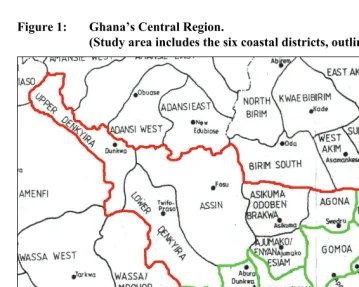
The Ghana P&E Survey is a representative household-based survey administered across 54 primary sampling units (PSUs) stratified by urbanization level and district in the six coastal districts of Central Region: Komenda-Edina-Eguafo-Abirem (KEEA), Cape Coast, Abura-Asebu-Kwamankese, Mfantsiman, Gomoa, and Awutu-Efutu-Senya. The six coastal districts of our study area are shown in Figure 1. These districts together comprise approximately 4% of Ghana’s total population (Ghana Statistical Service 2002). In other words, the survey is representative of this area of Ghana, and includes the entire range of settlement – rural, semi-urban and urban areas.
The survey was designed to examine the relationship between migration, fertility, child health knowledge and behaviors, and environmental attitudes and awareness. The total sample size of individuals in the survey is 2,505; 1,069 men and 1,436 women aged 15 and above were interviewed. Over 90% of identified eligible men and women were interviewed. The sex ratio of the adult respondents in our survey was 0.74 – lower than the corresponding value from the 2000 Census of 0.84 for Central Region adults – reflecting the high temporary and permanent out-migration of men in this area of Ghana.
Figure 1: Ghana’s Central Region.
(Study area includes the six coastal districts, outlined in green.)
Source: Ghana Statistical Service, 1990.
Moreover, information given in the background or birth history sections of the survey (e.g., age at first union, children’s birth dates) was also used to verify the information given for the LHC. Other research has demonstrated the quality of event history data collected using a LHC instrument in this way (Moreno and White 1989).
The descriptive statistics shown in Table 1 and 2 come primarily from the person-year dataset from the LHC. This dataset, containing the 56,414 adult person-person-years contributed by the 2,505 men and women in our survey, is used for our event history analysis. We used sampling weights in Table 1 (descriptive characteristics of the individuals), as well as in the multivariate analyses of the individuals (Tables 3-6) to present results that are representative of the population of this area (the six coastal districts) of Ghana’s Central Region. (We do not use weights for Table 2, which shows descriptive characteristics of the person-years in our dataset.)
As with all studies, there are limitations to our data. We rely on a sample from a single region of Ghana – coastal Central Region – and thus it is not nationally representative. Therefore, the ethnic composition of our dataset is not as diverse as that of the national population as a whole; our sample is about 80% Akan, whereas nationally, the Akan make up about 45-50% of the population. However, there are always tradeoffs in research, and the strength of our dataset is that it includes detailed migration histories for both women and men. Thus, while we do not have the breadth of nationally-representative data, we have the depth of detailed temporal information on migration and related social, demographic and economic characteristics such as education, occupation, type of residence (rural/urban), marriage, etc. Moreover, our survey is representative of this sub-national area of Ghana, a geographically and economically diverse region with a relatively heterogeneous population (nearly half, 43%, of which are lifetime migrants) and diverse settlement patterns (including rural, semi-urban and urban communities). Furthermore, our analyses of this primary dataset suggests both new directions for methods of data collection in larger surveys on migration (e.g., the utility of the LHC) as well as potentially new research questions and hypotheses for similar places in sub-Saharan Africa. Our results are especially pertinent for understanding the relationships among sex, migration, and urbanization in economically growing and environmentally sensitive coastal areas.
4.2 Methods
observing the event (an inter-regional move) within each interval. This model not only accommodates repeated observations on the same individual, but also time-varying covariates, such as type of place of residence (rural vs. urban) from year to year, because for each discrete interval a new value of the covariate can be included (Box-Steffensmeier and Jones 2004, Yamaguchi 1991). Following standard event history analysis procedure, the time-varying independent variables are lagged by one year on the assumption that changes in covariates in the previous year may affect the probability of migrating in the current year. We begin the analysis at age 15 (the age of adulthood) and continue up to the current age (at the time of the survey, 2002) for all adults in our sample. We run models for the entire sample controlling for sex, and for men and women separately. Given what we know about the covariates of residential mobility and migration, annual time intervals seem most appropriate in models of the life cycle. This model should capture the majority of the variation in migration due to changes in the previous year’s characteristics.
Migrations were defined as a move across regions (or, more rarely, into or outside Ghana from abroad) for a duration of at least half a year. For example, a move of seven months would be counted as a migration, whereas a move of just four months was simply a visit, and not documented in the LHC. In designing the survey, a trade-off was made so that there possibly may be slightly less accurate timing, but an entire life history of events was captured for each individual. And, though calendar intervals of one year may be subject to some potential misreporting due to misremembering of sequences or timing by respondents, it is likely that a major life event such as moving across regions will be fairly well reported. In addition, our use of temporal landmarks to improve recall increases the accuracy of reporting.
The event history analysis begins with a simple logit model containing basic demographic and socioeconomic characteristics and then moves to a more complex model incorporating interaction effects and stratified analyses. The model for the analysis for the move by person i in year t is:
( ) li
L l l t ki K k k it
it x z
p p
∑
∑
= − = + + = ⎥ ⎦ ⎤ ⎢ ⎣ ⎡ − 1 ) 1 ( 1 1log α β γ
(1)
also present binomial logistic regression models for any move separately by union status for both men and women (contrasting moves by men in union with men not in union, and the same for women).
The second set of models, focusing on rural-urban moves, relies on multinomial logistic (MNL) regression to capture multiple discrete outcomes, here alternative destinations. These MNL models, expanded on the event history analysis of Equation (1) in the standard way, estimate the probability of moving inter-regionally to a rural area or to an urban area, compared with not moving at all, for two subsets of the sample, rural residents at any time t and urban residents at any time t. Thus, the risk set for the first subset is those who begin a year in a rural area, and for the second subset, those who begin the year in an urban area. We present these models separately for women and men to compare how determinants of various types of moves vary by sex.
In addition to weighting our descriptive statistics of individuals (Table 1), we also weight our regression analyses (Tables 3-6). Differences between weighted and unweighted regression parameter estimates are modest. We use the “svy” procedure in Stata version 9, allowing for adjustment on the basis of stratum and household. Our sampling weights reflect sampling fractions in the EA and nonresponse.
4.3 Outcome measures
This analysis examines two dependent variables related to migration. First, we estimate the probability of migration over time in an event history analysis with a variable that measures whether or not a person moves between regions in a given year. In our analysis, we only examine adult migration, or moves after age 14. Since we employ the discrete time logistic models, we structure our data in person-year format. Individuals contribute person-years on observations while they are at risk of the event, i.e., the move variable. Values of this move variable are set to one in years when a person moves and zero otherwise.
rural residents and urban residents using multinomial logistic regression. For rural residents, those who move to a rural area in another region will be coded one, and those who move to an urban area in another region will be coded two. All others, including non-movers and those who move between rural and urban areas but within the same region, will be the base category of zero. For the urban sub-sample, those who move to a rural area in another region will be coded one, those who move to an urban area will be coded two, and all others (including non-movers and those who move between rural and urban areas but within the same region) will be the base category of zero.
Because the design of the calendar prohibited us from capturing rural-rural and urban-urban moves within the same region, we decided to only estimate moves across regions. (Likewise, for consistency, we do not include rural-urban moves and urban-rural moves within the same region, although we can detect these moves in our data). To be clear, in this paper we examine only the “big” moves – moves across regions. (We recognize that moves within regions could certainly constitute “big” moves, but our focus is on inter-regional migration.) Moreover, these are inter-regional moves recorded over the life course for current residents (in 2002) of our study area, but they are by no means limited to only moves within and without Central Region. Finally, inter-regional moves are likely less common than residential moves within the same region, and as a consequence, our data no doubt underestimate residential mobility. Thus our findings would most likely be amplified if we were able to include all residential moves within and beyond regional boundaries.
In any migration survey, one must contend with potential selection issues. As discussed above, the advantage of this survey is that it includes complete life histories for a randomly drawn sample of the residents of the study area, including those who were born in Central Region, moved away, and returned; those who never moved from the region; and those who moved from other regions into Central Region. Thus, our dataset lacks information on out-migrants – those who were born in Central Region, moved away and never returned, and those who moved in from another region, but then either returned to their region of origin or moved on to a different region before 2002. It is difficult to know precisely to what extent the sample is affected by this selection bias. Our results are potentially affected to the extent that outmigrants (those that left Central Region) differ from current residents in ways not measured by our variables of interest (unmeasured heterogeneity). Alternatively, only migrants from surrounding regions are represented in our data (since, by definition we do not capture non-migrants, or those that never left, in other regions). To the extent that key covariates operate differently for other people, a more comprehensive sample might return slightly different estimates.
that our results are representative of Ghana as a whole, but suggest that the effects of basic socioeconomic characteristics are robust in our models. Moreover, we maintain that our results are useful toward understanding migration processes in other regions, including Ghana and beyond.
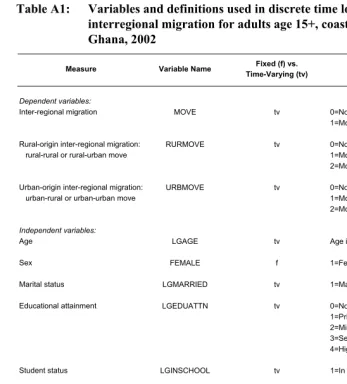
In addition to sex, which is fixed over time, we also include several time-varying independent variables in our main binomial model, including: age, union status, educational attainment (a 5-category ordinal variable, treated as a continuous variable: none or Koranic school (0); primary school (1); middle school or junior secondary school (2); senior secondary school (3); and beyond secondary school (4)), schooling status (in school or not), employment status, number of living children, number of previous inter-regional moves in adulthood, and rural or urban residence. Age squared was not included in our final models due to collinearity problems, although we experimented with other methods of accounting for non-linear age effects, including age group dummies, and a logarithmic age variable. We also include interaction terms for sex and employment and sex and educational attainment. Note that although we tested for duration dependence by running several models with a variable for the number of years since the previous move, this measure was also highly collinear with age and therefore we could not include both in our final models. Appendix Table A1 presents the main variables for our analyses and their coding.
5. Results
5.1 Descriptive statistics
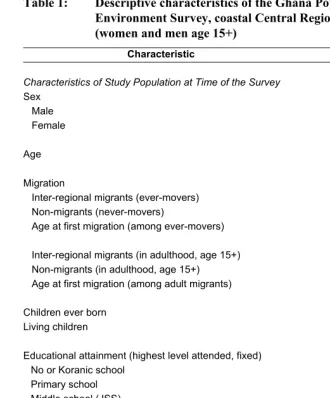
Table 1 displays weighted descriptive characteristics for the individuals – men and women aged 15 and above – in our sample. In contrast to Table 2, which shows descriptive characteristics of the person-years contributed by our study sample, Table 1 shows descriptive characteristics of individuals. The data in Table 1 are weighted for sample selection probability, and thus, because our survey is representative of the study area, Table 1 shows characteristics of the population of the study area shown in Figure 1 – the six coastal districts of Central Region.
This table presents the main independent variables used in our multivariate analysis. Our study area is about 57% women, with an average age at the time of the survey of about 36 years. (Recall that only adults, defined as men and women age 15 and above at the time of the survey (2002), were interviewed.)
for Ghana overall; the 2008 Ghana Demographic and Health Survey reported a current TFR of 4.0 for Ghana in entirety, one of the lowest in sub-Saharan Africa (Ghana Statistical Service, Ghana Health Service and ICF Macro 2009).
Twenty-nine percent of the men and women in our study area have no or only Koranic schooling, while 15% have attended some primary school. The modal educational category is middle school; 37% of our study population has attended middle school. About 12% have attended secondary school, and just 7% have schooling beyond secondary school. About 56% of the population is married or in a consensual union at the time of the survey, which is lower than one might expect for Ghana, although many in our sample may yet enter unions.
Table 1 also shows several measures of migration, our outcome of interest. About 35% of the residents of this area are classified as adult migrants. More specifically, they reported one or more inter-regional moves (of a duration of half of a year or more) in their adult years, from age 15 to their current year (in 2002). The remaining 65% reported that they never moved across regions in their adult years. (Note that about 8% of the sample reported an inter-regional move in childhood, age 0-14, but they are not classified as migrants in this analysis.) Among the migrants, the average age at first migration is about 23 years.
Table 1: Descriptive characteristics of the Ghana Population and Environment Survey, coastal Central Region, Ghana, 2002 (women and men age 15+)
Characteristic N Mean or %
Characteristics of Study Population at Time of the Survey
Sex
Male 1069 42.67
Female 1436 57.33
Age 2505 35.58
Migration
Inter-regional migrants (ever-movers) 1079 43.07
Non-migrants (never-movers) 1426 56.93
Age at first migration (among ever-movers) 1079 17.55
Inter-regional migrants (in adulthood, age 15+) 887 35.39 Non-migrants (in adulthood, age 15+) 1618 64.61 Age at first migration (among adult migrants) 887 22.84
Children ever born 2505 3.19
Living children 2505 2.63
Educational attainment (highest level attended, fixed)
No or Koranic school 732 29.23
Primary school 378 15.11
Middle school (JSS) 938 37.45
Secondary school (SSS) 293 11.68
Beyond secondary school 164 6.53
Marital status
Married/in union 1396 55.71
Not married/in union 1109 44.29
Total (people) 2505 100.00
Source: Ghana Population and Environment Survey, 2002.
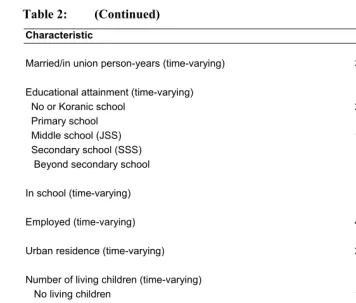
Among those inter-regional moves, we also examine type of move by origin and destination. As shown in Table 2, the majority of both rural- and urban-origin person-years (at time t-1) do not record a move in the subsequent year. Specifically, 98.5% of the rural-origin (i.e. 26,404 of 26,804) and 95.8% of the urban-origin (i.e., 28,371 of 29,610) person-years show no change. Moreover, Table 2 shows that urban residents are more than three times more mobile inter-regionally than rural residents (1,239 urban-origin moves versus 400 rural-origin moves). Both rural and urban residents are also more likely to move to another urban destination than a rural place. For example, among urban residents’ total moves, twice as many are to other urban destinations rather than rural destinations, 847 versus 392.
Table 2: Descriptive characteristics of the person-year data for adult calendar years from age 15 through the time of the survey (2002), Ghana Population and Environment Survey, coastal Central Region, Ghana, 2002 (adult men and women, age 15+)
Characteristic N Mean or %
Characteristics of Individuals
Migration
Inter-regional adult (age 15+) migrants (individuals) 848 33.85
Non-migrants (individuals) 1657 66.15
Number of inter-regional moves (in adulthood, age 15+)
Full sample (N=2,505 individuals) 1639 0.65
Among adult migrants (N=848 individuals) 1639 1.93
Characteristics of Contributed Person-Years
Rural person-years (time t-1) 26804 47.51
No move 26404 46.80
Move to rural destination 154 0.27
Move to urban destination 246 0.44
Urban person-years (time t-1) 29610 52.49
No move 28371 50.29
Move to rural destination 392 0.69
Move to urban destination 847 1.50
Age (time-varying) 32.69
Table 2: (Continued)
Characteristic N Mean or %
Married/in union person-years (time-varying) 35396 62.74
Educational attainment (time-varying)
No or Koranic school 27074 47.99
Primary school 6882 12.20
Middle school (JSS) 16729 29.65
Secondary school (SSS) 3887 6.89
Beyond secondary school 1842 3.27
In school (time-varying) 4498 7.97
Employed (time-varying) 45479 80.62
Urban residence (time-varying) 29449 52.20
Number of living children (time-varying)
No living children 19620 34.78
One living child 7042 12.48
Two living children 6422 11.38
Three living children 5450 9.66
Four or more living children 17880 31.69
Total person-years 56414 100.00
Person-years contributed by migrants 22975 40.73
Source: As for Table 1.
Note: Unweighted values.
5.2 Logistic regression event history analysis of inter-regional migration
Results from the binomial logistic regression models of inter-regional migration for men and women together are shown in Table 3. These models predict the log odds of moving across regions in a given year as a function of both fixed characteristics (sex), and time-varying characteristics as measured in the previous year (age, marital status, education, in school status, employment status, number of living children, number of previous moves, urban residence, and two interaction terms: sex * education and sex * employment).
We estimate two models. Model 1 includes basic demographic and socioeconomic characteristics, including migration experience and urban residence, while Model 2 incorporates interaction effects. Across both models, and consistent with the literature, increasing age is negatively associated with inter-regional migration. (As noted in the methods section, due to multicollinearity, we had to eliminate the age-squared term included in earlier models.) In both models, the odds of moving vary significantly by sex. Controlling for other characteristics, women are significantly less likely to migrate than men. Marriage or consensual union, however, is not significant in either model.
Greater education is significantly associated with higher odds of migrating, but being in school or employed in the previous year are both significantly associated with a lower probability of moving (OR=0.623, p<0.05, and OR=0.430, p<0.001, respectively, in Model 2). These findings are consistent with the literature and our hypotheses. We also examine the effect of cumulative prior fertility on migration. We find that one living child is not a significant influence, but two or more children deter mobility, compared to having no children (the reference group). (Alternative models, results not shown, also examined the effect of a birth or child death in the prior year, but found no effect for either of these covariates.)
migration analyses cannot tap. We exclude birth cohort dummy variables in these models because alternative models with these covariates (results not shown) suggested minimal cohort effects.
Table 3: Effects of sociodemographic characteristics on the probability of inter-regional migration of adults age 15+, coastal Central Region, Ghana, 2002. Discrete time event history logit models
Independent
Variables Model 1 Model 2
OR Std. Err. OR Std. Err.
Age 0.975 *** 0.006 0.976 *** 0.006
Female 0.876 * 0.050 0.595 *** 0.124
Married/in union 1.075 0.096 1.079 0.097
Education 1.261 *** 0.051 1.202 ** 0.065
In school 0.659 + 0.214 0.623 * 0.216
Employed 0.524 ** 0.172 0.430 *** 0.200
Living children
No children (ref.) 1.000 1.000
One child 0.835 0.123 0.828 0.123
Two children 0.594 *** 0.128 0.578 *** 0.133 Three children 0.663 *** 0.100 0.643 *** 0.102 Four+ children 0.588 *** 0.114 0.574 *** 0.121 Number of prior adult moves 1.414 *** 0.052 1.420 *** 0.053
Urban residence 1.665 ** 0.168 1.675 ** 0.168
Female*Education 1.099 * 0.041
Female*Employment 1.434 * 0.143
N (person-years) 53909 53909
Source: As for Table 1.
Notes: OR = Odds Ratio. (ref.) = reference category. +Significant at 0.10 level; *significant at 0.05 level; **significant at 0.01 level; ***significant at 0.001 level.
Figure 2 shows the predicted probabilities of migration for men and women by level of education and urban/rural residence. (Predictions are from Model 2 of Table 3, with other covariates set to the mean or modal values for the sample: aged 35.6 years, married, not in school, employed, three living children, and 0.65 prior moves.) As the figure illustrates, the education gradient is steeper for women, net of all the other characteristics in the model. Note that women with no education are less likely to move compared to similar men, but highly educated women are significantly more likely to move compared to their male counterparts. In other words, increasing education has a larger effect on migration for women than for men – for both rural and urban residents. We also ran a joint test of the pair of interacted variables. In so doing, we test the null hypothesis of no gain in Model 2 over Model 1. The joint test (F(2,35)=7.58, p=0.0018) is highly significant, and so we conclude that the effects of education and employment differ significantly for women as compared to men.
Figure 2: Predicted probability of inter-regional move (by sex, residence and education) from Model 2, Table 3
0.000 0.005 0.010 0.015 0.020 0.025 0.030 0.035 0.040 0.045 0.050
No Education Primary Middle/JSS Secondary Higher
P
ro
b
ab
il
it
y o
f I
n
terreg
io
n
al
Mi
gr
at
io
n
To further explore differences between men and women, we present logistic regression models of inter-regional migration stratified by both sex and marital status in Table 4. The larger and significant odds ratios for education for both unmarried and married women point to the greater influence of education on women’s mobility than men’s. Conversely, the deterrent effect of employment on mobility is larger for men (both unmarried and married) than for women. We also see an effect of childbearing and subsequent family size on mobility in these models. The presence of two or more children significantly reduces predicted mobility for married and unmarried men, and married women. Among unmarried women, in contrast, one or two children increase the odds of moving, but these results are non-significant. One could imagine scenarios in which the need for childcare and the availability of fosterage could compel unmarried women with children to move. Finally, as with the models shown in Table 3 and in Table 4, the positive effect of previous mobility and urban residence on inter-regional migration is fairly consistent across men and women, married and unmarried.
5.3 Multinomial logit models of migration by place of origin and destination
In the second set of analyses, we employ a multinomial logit model to examine two types of inter-regional moves – to rural areas and to urban areas – for each type of place of origin – rural (Table 5) and urban (Table 6). In each table, we show models for men and women separately. In the first set of models (Table 5), we estimate the odds of moving to a rural destination or to an urban destination compared to not moving for the
rural-origin population. In the second set of models (Table 6), we estimate the odds of moving to a rural destination or to an urban destination compared to not moving for the
urban-origin population.
Table 4: Effects of sociodemographic characteristics on the probability of inter-regional migration of adults age 15+, stratified by sex and marital status, coastal Central Region, Ghana, 2002. Discrete time event history logit models
Independent Men
Variables Unmarried/not in union Married/in union
OR Std. Err. OR Std. Err.
Age 0.995 0.013 0.971 ** 0.008
Education 1.153 0.100 1.173 + 0.087
In school 0.703 0.264 0.435 + 0.475
Employed 0.437 *** 0.182 0.316 * 0.470
Living children
No children (ref.) 1.000 1.000
One child 0.713 0.490 0.768 0.161
Two children 0.299 * 0.543 0.582 *** 0.131
Three children 0.271 + 0.764 0.635 * 0.198
Four+ children 0.257 + 0.741 0.559 ** 0.162 Number of prior moves 1.575 *** 0.073 1.368 *** 0.050
Urban residence 1.742 ** 0.202 1.775 0.442
N (person-years) 9353 12561
Independent Women
Variables Unmarried/not in union Married/in union
OR Std. Err. OR Std. Err.
Age 0.964 *** 0.009 0.968 ** 0.009
Education 1.232 * 0.090 1.368 *** 0.061
In school 0.728 0.343 0.598 + 0.262
Employed 0.606 * 0.202 0.623 0.116
Living children
No children (ref.) 1.000 1.000
One child 1.608 0.283 0.661 ** 0.116
Two children 1.400 0.356 0.464 *** 0.177
Three children 0.962 0.481 0.610 ** 0.158
Four+ children 1.144 0.475 0.589 ** 0.186
Number of prior moves 1.392 ** 0.096 1.441 *** 0.068
Urban residence 1.871 ** 0.195 1.436 * 0.174
N (person-years) 10568 21427
Source: As for Table 1.
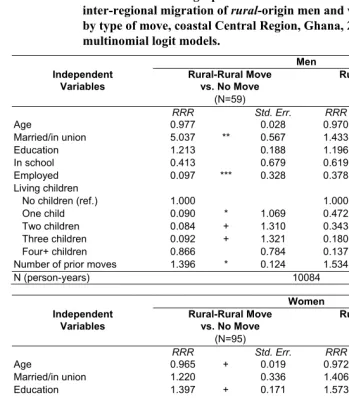
Table 5 displays the multinomial logit regression results for the rural origin
population at time t-1. The first columns of relative risk ratios (RRRs) for men and women are for inter-regional moves to another rural area compared to no move, and the second columns of RRRs for men and women are for inter-regional moves to an urban
area compared to no move. First, looking at rural-rural male and female moves, the effect of age continues to be negative, but is only significant (and marginally significant, RRR=0.965, p<0.10) for women’s rural-rural moves. Moreover, being in a marriage or union at time t-1 is only significant for men’s moves to rural areas. For rural men, being married strongly increases the relative odds of mobility to rural areas (RRR=5.037, p<0.01). Employment in the prior year has a strong deterrent effect on rural men’s mobility to rural areas (RRR=0.097, p<0.001), but it has no significant effect upon rural women’s mobility to rural areas. The incompatibility of parenthood – particularly of two or more children – and mobility shown in Tables 3 and 4 is also demonstrated in our multinomial logit models. For rural men in particular, children appear to deter moves to rural areas; yet this effect is not significant for women (except for two children, and only marginally). Finally, the positive effect of prior moves (of any inter-regional move type) on moves to rural areas is shown for both men and women; those who have moved before are more likely to move again – to both rural and urban destinations. Again, this suggests that there may be some reduced cost to second and higher order moves, or, in line with the migrant selection hypothesis, that some unobserved latent characteristic of certain people causes them to be more likely to move.
With respect to rural-urban moves, the second set of columns for men and women in Table 5, we see that age, marital status and being in school are not significant. Yet education has a particularly strong effect on rural women’s mobility to urban areas. Rural women with more education are significantly more likely to move to urban areas (RRR=1.573, p<0.01), but there is no effect for men. As we noted with respect to Table 3, the positive effect of education on mobility is particularly pronounced for women in our study area. This contrasts with Agesa and Agesa’s (1999) finding in Kenya that women were less likely to move compared to men because of disadvantages in the labor market. In our study area in Ghana, educated women are more likely to move.
Table 5: Effects of sociodemographic characteristics on the competing risks of inter-regional migration of rural-origin men and women (age 15+), by type of move, coastal Central Region, Ghana, 2002. Discrete time multinomial logit models.
Men
Independent Rural-Rural Move Rural-Urban Move Variables vs. No Move vs. No Move
(N=59) (N=134)
RRR Std. Err. RRR Std. Err.
Age 0.977 0.028 0.970 0.024
Married/in union 5.037 ** 0.567 1.433 0.310
Education 1.213 0.188 1.196 0.108
In school 0.413 0.679 0.619 0.332
Employed 0.097 *** 0.328 0.378 ** 0.261
Living children
No children (ref.) 1.000 1.000
One child 0.090 * 1.069 0.472 + 0.419
Two children 0.084 + 1.310 0.343 + 0.607
Three children 0.092 + 1.321 0.180 * 0.631
Four+ children 0.866 0.784 0.137 ** 0.526
Number of prior moves 1.396 * 0.124 1.534 ** 0.112
N (person-years) 10084
Women
Independent Rural-Rural Move Rural-Urban Mo e v Variables vs. No Move vs. No Move
(N=95) (N=112)
RRR Std. Err. RRR Std. Err.
Age 0.965 + 0.019 0.972 0.017
Married/in union 1.220 0.336 1.406 0.446
Education 1.397 + 0.171 1.573 ** 0.141
In school 2.173 0.605 1.016 0.245
Employed 1.790 0.471 0.507 ** 0.241
Living children
No children (ref.) 1.000 1.000
One child 0.964 0.447 0.607 0.519
Two children 0.353 + 0.521 0.224 * 0.654
Three children 0.559 0.674 0.987 0.346
Four+ children 0.759 0.473 0.389 0.571
Number of prior moves 1.832 *** 0.059 1.277 + 0.138
N (person-years) 15562
Source: As for Table 1.
Table 6 shows the multinomial logistic regression results for the urban-origin sub-group, again stratified by sex. The first columns of coefficients for men and women are for inter-regional moves to a rural area compared to no move, and the second columns of coefficients for men and women are for inter-regional moves to an urban area compared to no move. Unlike with rural-origin men and women (Table 5), where the typical age pattern of migration was less evident, age has a negative and significant impact on both types of moves for the urban-origin sub-group; among urbanites, increasing age decreases mobility to both rural and other urban areas. Marriage was influential for rural men moving to rural destinations (Table 5), but is non-significant among urban men and women.
Interestingly, Table 6 illustrates that education, beyond positively influencing mobility per se, as was shown in Tables 3 and 4, clearly influences destination type. Higher educational attainment serves as a strong deterrent to moving to a rural area for urban men (RRR=0.776, p<0.05), but has no significant effect for urban women moving to rural areas. But education significantly promotes mobility to other urban areas for urban men and women (RRR=1.399, p<0.001 and RRR=1.360, p<0.001, respectively). In other words, we show empirically what has long been surmised more anecdotally: those with more education gravitate away from rural areas to urban areas, where employment opportunities are most abundant. The more educated may also move from one urban area to another in search of better work opportunities. We uncover a strong sex differential in destination choice as a function of education, which may be less clear from prior studies. We find that the relative odds of urban over rural destinations are much greater for men than women.
Being employed in the prior year maintains its significant and negative effect on moving to either rural or urban destinations for urban residents (although it is not significant for women’s urban-rural moves). As we have seen throughout this analysis, and which makes intuitive sense, those with jobs tend not to migrate.
Table 6: Effects of sociodemographic characteristics on the competing risks of inter-regional migration of urban-origin men and women (age 15+), by type of move, coastal Central Region, Ghana, 2002. Discrete time multinomial logit models.
Men
Independent Urban-Rural Move Urban-Urban Move Variables vs. No Move vs. No Move
(N=193) (N=440)
RRR Std. Err. RRR Std. Err.
Age 0.981 * 0.008 0.977 * 0.011
Married/in union 1.176 0.229 1.031 0.206
Education 0.776 * 0.115 1.399 *** 0.077
In school 0.567 + 0.281 0.707 0.348
Employed 0.336 *** 0.211 0.596 * 0.245
Living children
No children (ref.) 1.000 1.000
One child 1.137 0.347 0.853 0.283
Two children 1.315 0.357 0.481 * 0.304
Three children 1.322 0.313 0.583 + 0.308
Four+ children 0.589 0.657 0.434 ** 0.298
Number of prior moves 1.408 *** 0.085 1.372 *** 0.066
N (person-years) 11830
Women
Independent Urban-Rural Move Urban-Urban Move Variables vs. No Move vs. No Move
(N=199) (N=407)
RRR Std. Err. RRR Std. Err.
Age 0.975 * 0.011 0.970 ** 0.011
Married/in union 1.035 0.211 0.825 0.224
Education In school
1.166 0.100 1.360 *** 0.078
0.553 0.385 0.520 + 0.374
Employed 0.840 0.178 0.523 ** 0.185
Living children
No children (ref.) 1.000 1.000
One child 0.899 0.398 0.940 0.168
Two children 0.764 0.488 0.790 0.240
Three children 1.075 0.372 0.585 * 0.216
Four+ children 0.740 0.356 0.799 0.246
Number of prior moves 1.258 + 0.132 1.436 *** 0.070
N (person-years) 16433
Source: As for Table 1.
Finally, Table 6 shows that for urban-origin residents, male and female alike, the greater the prior mobility experience (number of prior moves), the more likely a person is to make another move, whether to a rural or an urban destination. This robust result holds throughout all of our models, and seems to confirm that there is some real difference between movers and non-movers. Maybe prior mobility experience reduces the impediment to subsequent moves, or maybe there are two types of people, movers and stayers. Perhaps a combination of both mechanisms operates.
6. Conclusions
What have we learned about female and male migration in Ghana through our event history analysis? First, we see in our study area the conventional age pattern of migration such that migration declines with older ages, although, as we suspected, this pattern is less evident among the rural sub-sample in our study. In contrast to our original hypothesis, we do find in our pooled models (Table 3) that, overall, women are significantly less mobile than men. However, there are added features of these simple sex differences: namely education and employment. The interaction terms in Table 3, Model 2 show us, first, that the impact of education (with respect to mobility) is greater for women than men, and secondly, people who are employed are less likely to move overall, but employed women are more likely to move than employed men. In other words, education is particularly powerful for women’s mobility and employment is not as much of a deterrent on mobility for women as it is for men.
Origin and destination add another layer onto this story of male and female mobility. We know that not only do age and sex influence a person’s mobility, but so do educational attainment and work status. Increasing education is most influential for moves to urban areas among both rural- and urban-origin women. Yet among urban men, education works in reinforcing ways; greater education decreases mobility to rural areas while increasing mobility to other urban areas.
Moreover, and relevant to the literature on Ghanaian women’s work and family roles (e.g., Clark 1999, 1995), we see that childbearing is, as expected, a deterrent on mobility, but, interestingly, not as much a deterrent for women’s mobility as for men’s. Despite that women remain the primary care-givers for children, increasing numbers of children particularly hinder men’s mobility – both rural and urban men, and particularly to urban areas. This finding is especially interesting as few (if any) studies have examined the impact of children on men’s mobility. This apparently paradoxical result may partially arise from the search for child care promoting women’s migration.
Finally, we see that urban experience fosters mobility for both men and women. And prior movers tend to be future movers. Across all our models, we see a consistently positive effect of the number of prior moves (of any type) on additional mobility, whether from rural or urban areas and whether to rural or urban areas. Such a significant and continuing urban effect, beyond simply urbanization accounting, suggests that urban-urban circulation is an important part of the overall mobility scene in developing settings and that once launched through urban-ward migration, people’s mobility careers may likely stay active, but within the urban realm.
References
Adepoju, A. (2003). Migration in West Africa. Development 46(3): 37-41.
doi:10.1177/10116370030463006.
Adepoju, A. (1984). Issues in the study of migration and urbanization in Africa south of the Sahara. In: Morrison, P.A. (ed.). Population movements: Their forms and functions in urbanization and development. Liege: International Union for the Scientific Study of Population (IUSSP): 115-150.
Agesa, R. (2003). Gender differences in the urban to rural wage gap and the prevalence of the male migrant. The Journal of Developing Areas 37(1): 13-34.
doi:10.1353/jda.2004.0002.
Agesa, J. and Agesa, R.U. (1999). Gender differences in the incidence of rural to urban migration: Evidence from Kenya. Journal of Development Studies 35(6): 36-59.
doi:10.1080/00220389908422601.
Agwanda, A.O., Bocquier, P., Khasakhala, A., and Owuor, S. (2004). The effect of economic crisis on youth precariousness in Nairobi: An analysis of itinerary to adulthood of three generations of men and women. Paris: Développement, Institutions et Analyses de Long terme (DIAL). (Document de Travail #DT/2004/04, DIAL).
Anarfi, J., Kwankye, S., Ababio, O., and Tiemoko, R. (2003). Migration from and to Ghana: A background paper. Brighton, UK: Development Research Centre on Migration, Globalisation, and Poverty, University of Sussex (Working Paper C4).
Andersson, J.A. (2001). Reinterpreting the rural-urban connection: Migration practices and sociocultural dispositions of Buhera workers in Harare. Africa 71(1): 82-112. doi:10.3366/afr.2001.71.1.82.
Antoine, P., Bonvalet, C., Courgeau, D., Dureau, F., and Lelièvre, E. (1999). Biographies d’enquêtes: Bilan de 14 collectes biographiques [Survey Biographies: Report of 14 biographical collections]. Paris: INED/IRD/Réseau socio-économie de l’habitat (Groupe de réflexion sur l’approche biographique). Antoine, P., Razafindrakoto, M., and Roubard, F. (2001). Contraints de rester jeunes?
Évolution de l’insertion dans trois capitales africaines: Dakar, Yaoundé, Antananarivo [Constraints of staying young? The evolution of social integration within three African capital cities: Dakar, Yaoundé, Antananarivo]. Autrepart
Baydar, N., White, M., Simkins, C., and Babakol, O. (1990). Effects of agricultural development policies on migration in peninsular Malaysia. Demography 27(1): 97-109. doi:10.2307/2061555.
Beauchemin, C. and Bocquier, P. (2004). Migration and urbanization in Francophone West Africa: An overview of the recent empirical evidence. Urban Studies
41(11): 2245-2272. doi:10.1080/0042098042000268447.
Beauchemin, C., Henry, S., and Schoumaker, B. (2004). Rural-urban migration in West Africa: Toward a reversal? Migration trends and economic conjuncture in Burkina Faso and Côte d’Ivoire. Paper presented at Population Association of America (PAA) annual meeting, Boston, MA, April 1-3, 2004.
Blanc, A.K. and Lloyd, C.B. (1990). Women’s childrearing strategies in relation to fertility and employment in Ghana. New York: Population Council (Research Division Working Paper No. 16).
Bocquier, P. and Traoré, S. (1998). Migration and urbanization in West Africa: Methodological issues in data collection and inference. In: Bilsborrow, R.E. (ed.). Migration, urbanization, and development: New directions and issues. (Proceedings of the Symposium on Internal Migration and Urbanization in Developing Countries, January 22-24, 1996.) New York: United Nations Population Fund and Kluwer Academic Publishers: 249-273.
Bonvalet, C. and Lelievre, E. (1990). Residential mobility in France and in Paris since 1945: The history of a cohort. Population 2: 187-212.
Box-Steffensmeier, J.M. and Jones, B.S. (2004). Event history modeling: A guide for social scientists. Cambridge, UK: Cambridge University Press.
Brockerhoff, M. and Eu, H. (1993). Demographic and socioeconomic determinants of female rural to urban migration in sub-Saharan Africa. International Migration Review 27(3): 557-577. doi:10.2307/2547100.
Calvès, A.E. and Schoumaker, B. (2004). Deteriorating economic context and changing patterns of youth employment in urban Burkina Faso: 1980-2000. World Development 32(8): 1341-1354. doi:10.1016/j.worlddev.2004.03.002.
Cerrutti, M. and Massey, D.S. (2001). On the auspices of female migration from
Mexico to the United States. Demography 38(2): 187-200.
Chant, S. (1992). Towards a framework for the analysis of gender-selective migration. In: Chant, S. (ed.). Gender and migration in developing countries. London: Belhaven Press: 197-206.
Chattopadhyay, A. (1998). Gender, migration, and career trajectories in Malaysia.
Demography 35(3): 335-344. doi:10.2307/3004041.
Chattopadhyay, A. (1997). Family migration and the economic status of women in Malaysia. International Migration Review 31(2): 338-352. doi:10.2307 /2547223.
Chattopadhyay, A., White, M.J., and Debpuur, C. (2006). Migrant fertility in Ghana: Selection versus adaptation and disruption as causal mechanisms. Population Studies 60(2): 189-203. doi:10.1080/00324720600646287.
Clark, G. (1999). Mothering, work and gender in urban Asante ideology and practice.
American Anthropologist 101(4): 717-729. doi:10.1525/aa.1999.101.4.717. Clark, G. (1995). Onions are my husband: Survival and accumulation by West African
market women. Chicago: University of Chicago Press.
Cohen, B. (2006). Urbanization in developing countries: Current trends, future projections, and key challenges for sustainability. Technology in Society 28: 63-80. doi:10.1016/j.techsoc.2005.10.005.
Comoe, E.F. (2005). Femmes et migration en Côte d’Ivoire: Le mythe de l’autonomie.
African Population Studies 20(1): 87-117.
Cordell, D.D., Gregory, J., and Piché, V. (1996). Hoe and wage: A social history of a circular migration system in West Africa. African Modernization and Development Series. Boulder, CO: Westview Press.
Curran, S.R., Garip, F., Chung, C.Y., and Tangchonlatip, K. (2005). Gendered migrant social capital: Evidence from Thailand. Social Forces 84(1): 225-255.
doi:10.1353/sof.2005.0094.
Curran, S.R. and Rivero-Fuentes, E. (2003). Engendering migrant networks: The case of Mexican Migration. Demography 40(2): 289-307. doi:10.1353/dem .2003.0011.
Curran, S.R., Shafer, S., Donato, K.M., and Garip, F. (2006). Mapping gender and migration in sociological scholarship: Is it segregation or integration?
International Migration Review 40(1): 199-223.