AUG-SEPT, 2015, VOL. 2/11 www.srjis.com Page 2692 EFFECTS OF VIDEOS ON ENVIRONMENTAL KNOWLEDGE AND
AWARENESS OF PRIMARY SCHOOL STUDENTS
Sandhya Gihar1, Ph.D & Kajal Sharma2
1Associate Professor,MM College of Education, M M University Campus,Mullana-Ambala
(Haryana), India
2M.Ed. Student, MM College of Education, M M University Campus, Mullana-Ambala (Haryana),
India
Over many centuries, the issue of environmental preservation has been on the top of the agenda of global and international concerns as one of the most important issues at both the national and international levels. As we look around at the area in which we live, we see that our surroundings were originally a natural landscape such as a forest, a river, a mountain, a desert, or a combination of these elements. Most of us live in landscapes that have been heavily modified by human beings, in villages, towns or cities. But even those of us who live in cities get our food supply from surrounding villages and these in turn are dependent on natural landscapes such as forests, grasslands, rivers, seashores, for resources such as water for agriculture, fuel, wood and fish. Thus our daily lives are linked with our surroundings and inevitably affects them. Because of this problem all living and Non – living things are affected and demolished day – by – day. So, it is the need of present scenario to create knowledge and Awareness about the environment. As we know that childhood stage is the base of a human person. If our early stage is safe and perfect then our future will also automatically safe and perfect. We never forget the things which we learn in our childhood stage. In this study investigators have made an attempt to study the knowledge and awareness about the Environment of Primary level students and also find out the effect of videos on the knowledge and awareness of students. The Environmental Knowledge and Awareness Scale (EKAS) was administered on 120 primary school students. Results indicate that videos play a significant role to enhance the environmental knowledge and awareness of primary school students.
Key Words: Environmental Knowledge and Awareness, Videos, Primary Level Students
AUG-SEPT, 2015, VOL. 2/11 www.srjis.com Page 2693 Introduction
Over many centuries, the issue of environmental preservation has been on the top of the agenda of global and international concerns as one of the most important issues at both the national and international levels. As we look around at the area in which we live, we see that our surroundings were originally a natural landscape such as a forest, a river, a mountain, a desert, or a combination of these elements. Most of us live in landscapes that have been heavily modified by human beings, in villages, towns or cities. But even those of us who live in cities get our food supply from surrounding villages and these in turn are dependent on natural landscapes such as forests, grasslands, rivers, seashores, for resources such as water for agriculture, fuel, wood and fish. Thus our daily lives are linked with our surroundings and inevitably affects them. We use water to drink and for other day – to – day activities. We breathe air, we use resources from which food is made and we depend on the community of living plants and animals which form a web of life, of which we are also a part. Everything around us forms our environment and our lives depend on keeping its vital systems as intact as possible.
We all know that our Planet is in great danger. The people of the Earth have wasted and misused natural resources of Earth. Our Government has made many plans for stopping this distortedness of the earth. Because of this problem all living and Non – living things are affected and demolished day – by – day. So, it is the need of present scenario to create knowledge and Awareness about the Environment.
Almost everything that children learn is provided in different ways by the outside world. The natural environment is a significant component in this learning process. Kids learn better when they focus first on local issues and globalize after. In this technological era ICT has great impact on all aspects of life. ICT and specially video combines many kinds of data (images, motion, sounds, text) in a complementary fashion; learning can be adjusted more easily than with other tools to the diverse learning styles and individual learning pace of students. With video, the learner has opportunity for deeper learning by being able to stop,
AUG-SEPT, 2015, VOL. 2/11 www.srjis.com Page 2694 rewind, fast – forward, and replay content as many times as needed.
The use of video is only beginning to meet the needs of today’s and tomorrow learners. Videos can help educators address the challenge of different learning styles and enhance the way in which children and youth access, absorb, interpret, process and use information. While not a panacea for good teaching, video is clearly an essential tool that can have a powerful impact on student retention of information as well as on student engagement. As 21st century learners need to learn to be global citizens and to collaborate with others, learner generated video will be a powerful tool in the hands of students (Greenberg and Zanetis, 2012).
s. As we know that childhood stage is the base of a human person. If our early stage is safe and perfect then our future will also automatically safe and perfect. Because the things which we learn in our childhood stage, never forget in our whole life.
Various studies have been conducted in this direction like Peal (1995) found in his study that the experience of teachers did not play an important role on the environmental awareness.
Attir (2003) conducted a study to compare the environmental awareness of male and female, science and art and rural and urban prospective teachers of Himanchal Pradesh. Dey, Gihar and Saxena (2004) observed no difference between the two genders on overall environmental consciousness. Kukreti and Gihar (2004) study result showed a positive effect of video – intervention on the environmental awareness of science, arts and commerce students. Chuang and Chen (2009), Devi and Singaravelu (2010), Pearson, Dorrian and Litchfield (2011) , Astalin (2011), Jadal (2012) Xu, et. al. (2013) also worked in this direction.
On the basis of above studies it can be said that maximum studies have been conducted on teacher environmental awareness while some on secondary school students. Only few studies have been conducted to know the environmental knowledge and awareness of primary level students. Therefore, to fill the gap in the knowledge there is a great need to conduct further studies in this area especially on primary level students.
Objectives
AUG-SEPT, 2015, VOL. 2/11 www.srjis.com Page 2695 1. To know the level of Environmental knowledge and awareness of primary level students in respect to their gender (male/female).
2. To know the effect of videos on Environmental knowledge and awareness of primary level students in respect to their gender (male/female).
Hypotheses
The present study is based on the following hypotheses:
1. There is no significant difference between Environmental knowledge and awareness of primary level students in respect to their gender (male/female).
2. There is no significant effect of videos on Environmental knowledge and awareness of Male and Female primary level students.
Research Methodology
For present research work, the researchers were used Experimental Method (One group pre- test and post – test Design) type of study.
Sample and Sampling Technique
For the present study, the sample was selected from different Primary level schools. To collect the meaningful data, the researcher has used stratified random sampling technique. In the first phase of sample selection, Ambala district of Haryana State was selected. In the second phase 10 primary level schools were selected out of all primary schools of Ambala district. Then in the third phase, total 120 primary schools students were chosen as a sample on the basis of their gender (male/female).
Tool Used
To collect the data investigators were used Environmental Knowledge and Awareness Scale (EKAS) developed and standardized by Gihar & Sharma (2012). The final draft of Environmental Knowledge and Awareness Scale has 44 items spread over 10 dimensions. These dimensions are:
Part – A: Environmental Knowledge about Pollution
Knowledge about Environment, Knowledge about Air Pollution and its Effect, Knowledge about Water Pollution and its Effect, Knowledge about Land Pollution and its Effect, Knowledge about Noise Pollution and its Effect
AUG-SEPT, 2015, VOL. 2/11 www.srjis.com Page 2696 Remedial Measures of Air Pollution, Remedial Measures of Water Pollution, Remedial Measures of Land Pollution, Remedial Measures of Noise Pollution, Remedial Measures of other Environmental Problems
Besides of above tool following video films were used by the investigator.
Table-1: Details of the Video films on Environmental Component Treated as Video Packages in the Study
S.No Title of Video Film Producing Agency Duration Language
1. Environment Protection Environment 7min 24sec English
(www.youtube.com/watch?v=MEn0oIL3uo o)
Production: Gabriella
Keresxies
2. Environmental Awareness L‟Education 7min 47sec English
www.youtube.com/watch?v=dOJstdm1iOU Environment
3. Science - Environment – Pollution Bodha Guru 10min 48sec Hindi
(https://www.youtube.com/watch?v=9j56H 0Y
rQlA)
4. Save Trees Varun Metha 1min 58 sec English
www.youtube.com/watch?v=gN6w6mGDm PQ
Production
5. Wild Animals Appu Series 2min 30 sec Hindi
https://www.youtube.com/watch?v=yBWp 9hc
eYjE
Table-2: Details of the Coverage of Content Related to Different Aspects of Environmental in the Video films treated as Video in the Study
S.No
Different Environmental Aspects
Video Films and Coverage of Different
AUG-SEPT, 2015, VOL. 2/11 www.srjis.com Page 2697
Film1 Film
2 Film3 Film4 Film5
1. Knowledge about Environment √ √ √ √ _
2. Knowledge about Air Pollution and its √ _ √ _ _
Effect
3. Knowledge Pollution and its about Water √ _ √ _ √
Effect
4.
Knowledge about Land Pollution
and its √ _ √ _ _
Effect
5.
Knowledge about Noise Pollution
and its √ √ √ _ _
Effect
6.
Remedial
Measures of Air Pollution √ _ √ √ _
7.
Remedial Measures of
Water Pollution √ √ √ _ _
8.
Remedial Measures of
Lan
d Pollution √ √ √ _ _
9.
Remedial Measures of
Noi
se Pollution √ _ √ √ _
10.
Remedia l
Measure
s of
othe
r √ _ √ √ _
AUG-SEPT, 2015, VOL. 2/11 www.srjis.com Page 2698 Problems
Statistical Treatment
In order to make the inquiry exact, precise and scientific the collected data were analyzed with the help of Mean, S.D, and ‘t’ test.
Table – 3: Pre – test Mean and S.D Scores of Primary Level Boys and Girls Students on Different Dimensions of Environmental Knowledge and Awareness Scale (Part –
A)
S.N. Dimensions Primary Level
Boys Students (N=59)
Primary Level Girls Students (N=59)
‘t’ value (df 118)
Mean SD Mean SD
1. Environment 3.54 0.81 3.47 0.86 0.43 NS
2. Air Pollution and its
Effect 2.54 0.75 2.68 0.76 1.05 NS
3. Water Pollution and its Effect
3.05 0.87 2.85 1.03 1.13 NS
4. Land Pollution and its Effect
2.91 0.65 3.01 0.76 0.78 NS
5. Noise Pollution and its Effect
3.20 0.78 3.24 0.76 0.30
6. Overall
Environmental Knowledge about Pollution
15.25 2.29 15.27 2.58 0.05 NS
Table-3, depicts that primary level boys and girls students scored more or less similar mean values on the different dimensions of Environmental Knowledge and Awareness Scale (Part – A) like air pollution and its effects, water pollution and its effects, land pollution and its effects and noise pollution and its effects as well as on overall environmental knowledge about pollution. It means sex has no influence on the environmental knowledge of primary level students.
Table –4: Pre – test Mean and S. D Scores of Primary Level Boys and Girls Students on Different Dimensions of Environmental Knowledge and Awareness Scale (Part –
[image:7.612.95.539.240.496.2]AUG-SEPT, 2015, VOL. 2/11 www.srjis.com Page 2699
S.N. Dimensions Primary Level
Boys Students (N=59)
Primary Level Girls Students
(N=61)
‘t’ value (df 118)
Mean SD Mean SD
1. Remedial Measures of Air Pollution
3.20 0.86 2.98 1.13 1.19 NS
2. Remedial Measures of Water Pollution
3.32 0.68 3.39 0.66 0.58 NS
3. Remedial Measures of Land Pollution
3.38 0.78 3.19 0.83 1.30 NS
4. Remedial Measures of
Noise Pollution 3.47 0.65 3.57 0.71 0.79 NS
5. Remedial Measures of other Environmental Problems
5.84 1.17 6.04 1.21 0.92 NS
6. Overall Awareness about
Environmental Protection
19.23 2.48 19.19 2.49 0.08 NS
[image:8.612.91.542.73.354.2]NS: Not Significant
Table 4, reveals that no significant variation exists between the boys and girls primary level students environmental awareness on remedial measures of air pollution, water pollution, land pollution, noise pollution and other environmental problems dimensions as well as overall awareness about environmental protection of Environmental Knowledge and Awareness Scale(EKAS). Table 4.5, further reveals that boys and girls primary level students had scored almost similar mean values on all the dimensions. It means boys and girls are equally aware about their environment.
Table – 5: Pre- test and Post – test Mean and S.D Scores of Primary Level Boys Students on Different Dimensions of Environmental Knowledge and Awareness
Scale (Part – A) S.N. Dimensions Pre-test Scores of Boys Primary Level Students (N=59
Post-test Scores of Boys Primary Level Students (N=59)
‘t’ value (df 116)
Mean SD Mean SD
1. Environment 3.54 0.81 3.93 0.25 3.53*
AUG-SEPT, 2015, VOL. 2/11 www.srjis.com Page 2700 Effect
3. Water Pollution and its Effect
3.05 0.87 3.27 1.04 1.25 NS
4. Land Pollution and its
Effect 2.91 0.65 3.61 0.58 6.17*
5. Noise Pollution and its Effect
3.20 0.78 3.86 0.34 5.96*
6. Overall
Environmental Knowledge about Pollution
11.67 1.45 15.25 2.29 5.38*
*Significant at .01 Level of Significance
An examination of the table-5, infers that the post-test scores of primary level boys students were significantly higher than their pre-test mean scores, except water pollution and its effects dimension. In case of all dimensions i.e. knowledge about air, land, noise pollution and their effects and overall knowledge about environment the post -test mean values of primary level boys’ students were found significantly higher mean values than their pre-test mean values. It means video is an effective determinant of knowledge about environment. Same results are observed in Karpudewan, et.al.(2014) study.
Table –6: Pre – test and Post – test Mean and S.D Scores of Primary Level Girls Students on Different Dimensions of Environmental Knowledge and Awareness Scale
(Part – A) S.N. Dimensions Pre-test Scores of
Girls Primary Level Students (N=61)
Post-test Scores of Girls Primary Level Students (N=61)
‘t’ value (df 118)
Mean SD Mean SD
1. Environment 3.47 0.86 3.85 0.51 2.96*
2. Air Pollution and its Effect
2.68 0.76 3.03 0.54 2.93*
3. Water Pollution and its Effect
2.85 1.03 3.57 0.69 4.53*
4. Land Pollution and its Effect
3.01 0.76 3.65 0.51 5.46*
5. Noise Pollution and
its Effect 3.24 0.76 3.91 0.27 6.48*
6. Overall
Environmental
[image:9.612.98.533.70.234.2]AUG-SEPT, 2015, VOL. 2/11 www.srjis.com Page 2701 Knowledge about
Pollution
*Significant at .01 Level of Significance
In table-6, the comparison between the data of pre – test( before seeing videos) and post-test (after videos) of primary level girls students on knowledge about air, water, land and noise pollution and their effects as well as overall knowledge about environmental pollution reveals a significant variation at .01 level of significance (t=2.96, 2.93, 4.53, 5.46, 6.48, 7.50 respectively p=.01). In all the dimensions like knowledge about air, water, land, noise pollution and their effects and overall knowledge about environmental pollution girls’ students had scored higher mean values after getting videos.
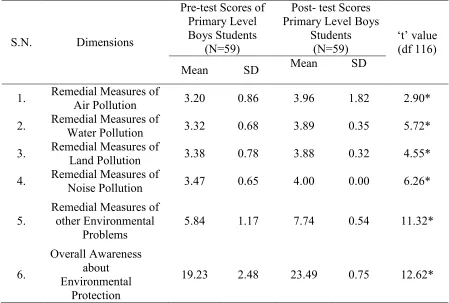
Table –7: Pre – test and Post – test Mean and S.D Scores of Primary Level Boys Students on Different Dimensions of Environmental Knowledge and Awareness Scale
(Part – B)
S.N. Dimensions
Pre-test Scores of Primary Level Boys Students
(N=59)
Post- test Scores Primary Level Boys
Students
(N=59) ‘t’ value (df 116)
Mean SD Mean SD
1. Remedial Measures of Air Pollution 3.20 0.86 3.96 1.82 2.90*
2. Remedial Measures of
Water Pollution 3.32 0.68 3.89 0.35 5.72*
3. Remedial Measures of Land Pollution 3.38 0.78 3.88 0.32 4.55*
4. Remedial Measures of
Noise Pollution 3.47 0.65 4.00 0.00 6.26*
5.
Remedial Measures of other Environmental
Problems
5.84 1.17 7.74 0.54 11.32*
6.
Overall Awareness about Environmental
Protection
19.23 2.48 23.49 0.75 12.62*
*Significant at .01 level of Significance
[image:10.612.92.541.328.631.2]AUG-SEPT, 2015, VOL. 2/11 www.srjis.com Page 2702 environmental problems and as well as overall awareness about environmental protection a significant variation was found at .01 level of significance (t = 2.90, 5.72, 4.55, 5.46, 6.26, 11.32 respectively p=.01). In all the dimensions i.e. awareness about remedial measures of air, water, land, noise pollution and others environmental problems as well as overall awareness about environmental protection boys students had scored higher mean values after getting videos than their pre – test mean scores.
Table – 8: Pre – test and Post – test Mean and S.D Scores of Primary Level Girls Students on Different Dimensions of Environmental Knowledge and Awareness Scale
(Part – B)
S.N. Dimensions
Pre-test Scores of Primary Level Girls
Students (N=61)
Post-test Scores of Primary Level Girls
Students
(N=61) ‘t’ value (df 119)
Mean SD Mean SD
1. Remedial Measures of Air Pollution 2.98 1.13 3.90 0.30 6.14*
2. Remedial Measures of
Water Pollution 3.39 0.66 3.95 0.21 6.31*
3. Remedial Measures of Land Pollution 3.19 0.83 3.86 0.38 5.73*
4. Remedial Measures of
Noise Pollution 3.57 0.71 3.98 0.12 4.44*
5.
Remedial Measures of other Environmental
Problems
6.04 1.21 7.91 0.27 11.78*
6.
Overall Awareness about Environmental
Protection
19.19 2.49 23.62 0.71 13.36*
*Significant at .01 level of Significance
[image:11.612.94.544.258.553.2]AUG-SEPT, 2015, VOL. 2/11 www.srjis.com Page 2703 role to enhance the environmental awareness of girls’ students.
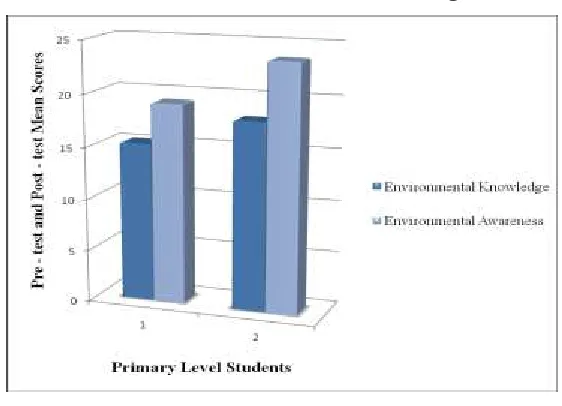
Figure – 1: Bar Graph Showing Pre – test and Post – test Mean Scores of Primary Level Boys Students on Environmental Knowledgeand Awareness
Figure -2: Bar Showing Pre – test and Post – test Mean Scores of Primary Level Girls Students on Environmental Knowledge and Awareness
Main Findings
The first null hypothesis is that “there is no significant difference between Environmental knowledge and awareness of primary level students in respect to their gender (male/female)” partially accepted and partially rejected. The findings related to above hypothesis are as follows:
AUG-SEPT, 2015, VOL. 2/11 www.srjis.com Page 2704 students.
The second null hypothesis is that “there is no significant effect of videos on Environmental knowledge and awareness of male and female primary level students” is partially accepted and partially rejected. The findings related to above hypothesis are as follows:
A significant effect of videos was observed on the environmental awareness of male
and female primary level students. After watching the videos all male and female primary level students environmental knowledge was increased on all the dimensions of Environmental Knowledge and Awareness Scale (Part – A) except only one dimension i.e. knowledge about environment.
Educational Implication
AUG-SEPT, 2015, VOL. 2/11 www.srjis.com Page 2705 permanently in the memory and such topics or themes can be retained for a larger period. References
Astalin, P.K. (2011). A Study of Environmental Awareness among Higher Secondary Students and some Educational Factors affecting it, ZENITH International Journal
of Multidisciplinary Research Vol.1.
Chuang, T. Y. and Chen, W. F. (2009). Effect of Computer-Based Video Games on Children: An Experimental Study,
Educational Technology & Society, Vol. 12, No. 2, pp. 1–10.
Devi, S. J. and Singaravelu, G.(2010). Impact of Eclectic Method in Learning Environmental Education at Primary Level,
EDU TRAKS, Vol.10, No. 10, pp. 29–31.
Dey, B., Gihar, S. and Saxena, M. (2004). Environmental Consciousness Among Prospective Teachers, GYAN–TheJournal of Education, Vol. 1, No. 1, pp. 47–50. Greenberg and Zanetis. (2012). The Impact of Broadcast and Streaming Video in Education,
Cisco System Inc. to Wainhouse Research, LLC.
Jadal, M. M. (2012).Use of Activity Based Joyful Learning Approach in Teaching Environmental Science Subject At Primary Level, Indian Streams Research Journal, Vol.2, No.7, pp. 1 – 5.
Karpudewan, M., Roth, W. & Abdullah, M. (2014). Enhancing Primary School Students' Knowledge about Global Warming and Environmental Attitude Using Climate Change Activities, International Journal of Science Education, Vol. 37, Issue 1, pp. 31-54. DOI:10.1080/09500693.2014.958600
Kukreti, B. R. and Gihar, S. (2004). Effect of Video – Interventions Strategy on the Environment Attitude of Secondary Students, Psycho Lingua, Vol. 34, No. 1, pp. 17 – 22.
Peal, O. G. (1995). An Investigation into the Environmental Awareness and its Enhancement in the Secondary School Teachers, The Progress of Education, Vol. 11, No.12, pp. 256-259.
AUG-SEPT, 2015, VOL. 2/11 www.srjis.com Page 2706 and Facilitating Sustainable Behavior through Video Presentations,
Environmental Education Research, Vol.17, No.6, pp.751-767.