in the population sciences published by the Max Planck Institute for Demographic Research Konrad-Zuse Str. 1, D-18057 Rostock · GERMANY www.demographic-research.org
DEMOGRAPHIC RESEARCH
VOLUME 16, ARTICLE 17, PAGES 519-554
PUBLISHED 26 JUNE 2007
http://www.demographic-research.org/Volumes/Vol16/17/ DOI: 10.4054/DemRes.2007.16.17
Research Article
Meanings and attitudes attached to
cohabitation in Poland:
Qualitative analyses of the slow diffusion of
cohabitation among the young generation
Monika Mynarska
Laura Bernardi
© 2007 Mynarska & Bernardi
2 Cohabitation in Poland – what do we know? 521 3 Cohabitation diffusion – theoretical considerations 527 4 Methodological approach and sampling 530
5 Analysis and findings 531
5.1 The meanings of cohabitation 534 5.2 Attitudes towards cohabitation 536 5.3 Cohabitation vs. marriage 539 5.4 Cohabitation – a dead end 544
6 Summary and discussion 545
7 Acknowledgements 547
References 549
Meanings and attitudes attached to cohabitation in Poland:
Qualitative analyses of the slow diffusion
of cohabitation among the young generation
Monika Mynarska 1
Laura Bernardi 2
Abstract
This study contributes to the understanding of the low level of non-marital cohabitation in Poland at the beginning of the XXI century. We employ an interpretative analysis of semi-structured interviews in order to capture the meanings and attitudes associated to non-marital cohabitation by a selected sample of young Poles. The results indicate that although cohabitation has begun to be interpreted as a testing period leading to marriage, attitudes towards it are still very ambiguous. The idealization of marital commitment hinders the spread of informal unions. Understanding the determinants of low cohabitation in Poland enables us to advance grounded hypotheses on its evolution in the near future and, more generally, to illustrate the ways in which local cultures influence the diffusion of behaviors.
1
Max Planck Institute for Demographic Research, Konrad-Zuse-Str.1, 18057 Rostock, Germany. Telephone: +49 381 2081 249. Fax: +49 381 2081 549. E-mail: [email protected]
1. Introduction
Ever since the 1970s, consensual unions have become an increasingly attractive option for young people in many European countries. Before then, marriage was universal and
took place at a relatively young age. Non-marital cohabitation3 was limited to marginal
sections of society, with informal unions having been a more likely form of living arrangement among people belonging to the lower strata of society (Trost 1978, Villeneuve-Gokalp 1991). Suffice it to mention widows who did not want to lose their pensions (Nazio and Blossfeld 2003) or separated individuals who were not able to re-marry for legal or religious reasons (Haskey 2001). Only in a few cases did non-married cohabitants belong to some avant-garde groups formed in opposition to the establishment, whether identified with the Church or more general with social norms (Lesthaeghe 1995). Preceding the 1960s, though, these groups had been marginal (Kiernan 2002).
The picture has changed in recent years, however. More and more frequently, individuals enter cohabitation at early ages, and increasingly they remain unmarried for the rest of their lives.
The spread of non-marital unions has occurred at different pace across Europe (Carmichael 1995, Kiernan 2000, 2002, Nazio and Blossfeld 2003). In the Nordic countries, such as Sweden and Denmark, consensual unions are currently as common as marital unions. In the Mediterranean region (Greece, Italy, Portugal, Spain), by contrast, the share of cohabitations is substantially lower. Nevertheless, in recent years Southern Europe has witnessed a growth in the number of consensual unions faster than ever before, and demographers now openly discuss whether or not we see an extension of the Nordic Model to the southern European region (e.g., see Rosina 2004, Rosina, Fraboni 2004).
The evolution of cohabitation in Poland, a country that records one of the lowest levels of cohabitation in Europe, is even less clear. According to National Census data, informal unions accounted for 1.3% of all cohabiting unions in 1988; this compares to 1.7% in 1995, a figure that has climbed to a mere 2.2% in 2002 (Slany 2002). The absolute figures still are very low, and although the cohabitation rate has doubled within 14 years, this is not a remarkable development compared to the rapid diffusion of this type of union elsewhere. If we consider cohabitation in Sweden of the 1960s, we observe that in a comparable time period of 14 years, the share of informal unions climbed from 1% in 1960 to 12% in 1974 (Kwak 2005).
3
A simple reading of these trends suggests that in Poland, couples who want to live together also want to marry beforehand, and they seem to adopt alternative living arrangements only very reluctantly. Why do they do so? The question calls for an investigation of a relatively unexplored domain: the cultural meaning of cohabitation and marriage in Poland. This paper breaks the path focusing on the meanings and the attitudes related to cohabitation among young Poles living in the capital city of Warsaw. Meanings and attitudes associated to marriage and cohabitation are in constant dialogical tension, and they can hardly be defined independently from each other. Most often, marriage sets the frame of reference in which the concept of cohabitation is defined and judged against, whether as a prelude to marriage, as an incomplete or improper marriage, or as a form of union which is qualitatively and radically different from marriage.
Caldwell (1982) wrote that in order to understand the nature of fertility decline, it is imperative also to study those societies where fertility remained stable. Paraphrasing Caldwell, we may say that we will never understand the onset of cohabitation increase until we understand the nature of the stable or persistent prevalence of marital unions. Investigating the puzzle of low cohabitation in Poland will improve our comprehension of the diffusion of this living arrangement across Europe. The paper contributes to the ever-evolving definition of the concept of “union”, thus reaching beyond an explanation of the very low rate of cohabiting unions in Poland.
2. Cohabitation in Poland – what do we know?
Official registers and national surveys offer only relatively little and scattered information on cohabitation behavior in Poland. Nevertheless, it is worthwhile to give a brief overview of the little that is known about cohabitation of adult Poles aged 15 years or above who were cohabiting in 2002 (a total of approx. 400 000 individuals, CSO 2003). Generally, the following picture emerges, based on official statistics (Micro Census in 1995 and Census in 2002):
• Cohabitation in Poland is essentially an urban phenomenon: 75% of cohabiting
couples live in cities (CSO 2003).
• Cohabitation is chosen mostly by individuals with a lower socio-economic status
and with a relatively low education (Slany 2002).
• Young people rarely opt for cohabitation as a living arrangement: half of those
living in informal unions are aged 40 or above; only 12% are younger than 25 (CSO 2003). In 1995, the share was 55% and 10%, respectively (Slany 2002).
• Cohabitation is rarely chosen by those entering a first union: only 35% of
most are divorced, separated or widowed. The share of those who stepped out of previous formal relationship is especially high. In case of 57% cohabiting couples at least one partner is divorced or separated (CSO 2003).
• Cohabiting couples mostly do have children: 57% of them did so in 1995,
compared to 56% in 2002. Census data do not allow us to reconstruct whether the children living with a cohabiting couple were born from this couple or whether they were born into a previous relationship i.e., of one of the two partners. This is unfortunate since such information would provide important insights into the formation process of informal unions. In some contexts, having had children in a former relationship may hamper chances on the marriage market to form a new union (Bernhardt and Goldscheider 2001). What we can establish, however, is that children living with cohabiting couples are likely to be disadvantaged in one way or another. On the one hand, many of them experienced the separation of one parent and currently live with a reconstituted family. On the other, if their parents never married, they are likely to face a certain degree of normative sanctioning, given the low level of extra-marital birth in Poland (16% of all births in 2004) and the strong stance of the Catholic Church against extra marital birth.
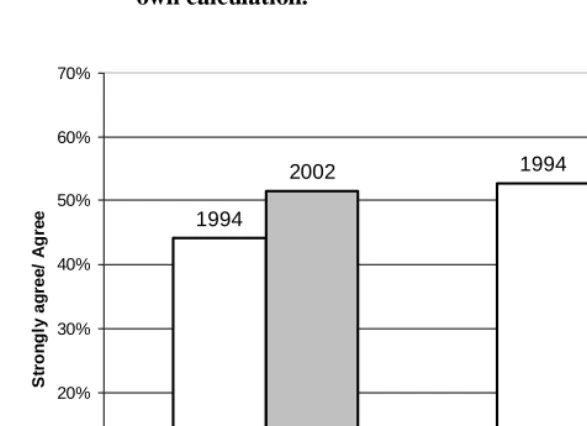
All in all, because cohabitation is associated with the individual characteristics mentioned above, cohabiters often have suffered from a relatively negative societal image. Surprisingly, despite this image non-marital cohabitation is far from being disapproved of if one considers the answers given in attitude surveys on the living arrangements of couples: Approval has been growing with time in all age groups, and remarkably did so particularly among younger people. This is shown in Figures 1 to 3. They report the results of the analysis of the approval gradient for two statements related to cohabitation and presented to respondents in the Family and Changing
Gender Roles Survey4. The two statements are: 1) “It is good when people who intend
to get married live together for some time beforehand” and 2) “A couple can cohabit even if they do not intend to get married”. Figure 1 shows the approval gradient for the two statements in 1994 and 2002. These are the results for all respondents with valid answers, without age differentiation, but the increase is noticeable in all age groups. Figures 2 and 3 illustrate the level of approval in 2002 by respondents’ age. Disapproval of cohabitation is clearly the strongest among the respondents aged above 40.
4
Figure 1: Approval of cohabitation: 1994 and 2002. ISSP 1994, 2002:
own calculation.
1994
1994 2002
2002
0% 10% 20% 30% 40% 50% 60% 70%
It's good if people who intend to marry live together for some time beforehand
A couple can cohabit even if they don't intend to get married
S
tro
n
g
ly
a
g
re
e
/ A
g
re
Figure 2: “It's good when people who intend to marry live together for some time beforehand”: distribution of answers by respondents’ age group.
ISSP 2002: own calculation.
0% 10% 20% 30% 40% 50% 60% 70% 80% 90% 100%
<30 30-40 >40 Age
Disagree / Stongly disagree
Neither
Figure 3: “A couple can cohabit even if they don't intend to get married”: distribution of answers by respondents’ age group. ISSP 2002: own calculation.
0% 10% 20% 30% 40% 50% 60% 70% 80% 90% 100%
<30 30-40 >40 Age
Disagree / Stongly disagree
Neither
The observation that young Poles are more liberal in their evaluation of cohabitation than their older compatriots is consistent with other research conducted in the region by Kwak (2005). Her 1999-2000 survey included several items concerning attitudes towards cohabitation, such as “Informal unions should exist”, “I approve of consensual unions”, “I would like to live in an informal union”, or “I would approve of an informal union of my child”, and the respondents younger than age 40 agreed with these statements more frequently than those aged 40 or over.
The combination of positive attitudes and reluctant behavior we just described shows that young Poles are ambiguous on cohabitation. This ambiguity urges us to gain a deeper understanding of the meanings attached to cohabitation as a form of union, opening up the following questions: How is the significant change in attitudes among younger people related to the still very low prevalence of cohabitating behavior? And why does the majority of cohabiters fall precisely into the age group that most disapproves of cohabitation? The different attitudes of the younger and the older generations towards cohabitation is likely to be due to the different meanings or interpretative schema they attach to this type of living arrangement (see e.g., Manting 1996).
In this paper, we focus on the first issue: the meanings younger generations attribute to cohabitation and marriage. Their behavior will shape union trends in Poland in the near future. In addition, the discrepancy between the attitudes and behavior of the older generation seems more easily interpretable. Research on cohabitation in different contexts has shown that under specific conditions non-marital cohabitation is practiced and tolerated as an alternative to marriage even when not explicitly approved of. In this case, cohabitation is an option to those whose first union ended owing to death or separation or to couples who are economically disadvantaged and cannot afford a “proper wedding” (Trost 1978, Villeneuve-Gokalp 1991, Kiernan 2002). All of the conditions mentioned above confer to cohabitation the characteristic of second-best. If the older generation adapts this interpretation of cohabitation, it is not surprising, then, that cohabitation meets with little approval in principle (even though it occurs for the reasons described above). That the younger generation shows a higher approval rate of cohabitation is at odds with this view, though. Research on other countries shows that cohabitation may be perceived as a testing period for marriage (Thornton 1989, Leridon and Villenueve-Gokalp 1989, Manting 1996, Kiernan 2002). It is increasingly treated as a strategy to get closer to a partner, but without having to give up on personal freedom and independence (Rindfuss and Van den Heuvel 1990, Clarkberg et al. 1995) or as the expression of liberal attitudes and the rejection of the authority identified with parents and the Church (Villenueve-Gokalp 1991, Corijn and Manting 2000).
the context of other countries. Even if the association between cohort of birth, behavior, and meanings attributed to cohabitation be proven to be similar in Poland to other countries the puzzle of low cohabitation among young people, i.e. the very people who approve of it, would be unsolved. If young Poles interpreted cohabitation as a beneficial stage of their relationship, why would they not enter cohabitation more willingly, too, as their mates do elsewhere?
This question is difficult to answer, as existing survey data reports attitudes towards specific behavior at a given point in time. While this information is interesting in itself, it is difficult to use it to make a reliable prediction of behavior and to explain the gap between attitudes and behavior. Attitudes are often nuanced, conditional on specific conditions. Therefore, their impact on behavior varies as circumstances change (Ajzen and Fishbein 1977, Glasman and Albarricin 2006).
This paper aims at tackling the Polish cohabitation-puzzle by presenting the
findings of a qualitative analysis of semi-structured interview data concerning
cohabitation and marriage. We employ a content analysis, focusing on the way in which cohabitation is perceived and evaluated, and we home in on the extent to which it is considered an avoidable, a transitory or a desirable living arrangement by Polish young adults in their twenties and early thirties.
The paper is structured as follows: In the following section we explicit some theoretical considerations relating meanings and attitudes to behavioral diffusion in general and cohabitation behavior in particular. Section 4 describes the data and the methods used, and Section 5 displays the range of meanings and attitudes associated to this form of living arrangement. A discussion of the findings in Section 6 builds on this research case to argue for a comprehensive approach to demographic behavior, the continuity and change of which can be fully understood only if the meanings attributed to alternative life-course choices are also understood.
3. Cohabitation diffusion – theoretical considerations
may mean, such as an alternative life style or a transitory living arrangement (Villeneuve-Gokalp 1991, Kwak 2005).
There seems to be some correlation between the prevalence of cohabiting behavior in a society and the prevalent meanings associated to it. Following Prinz (1995), Kiernan (2002) distinguishes four stages of cohabitation diffusion and the corresponding meaning associated to them. A first stage cohabitation is rare and constitutes either a deviant or an avant-garde behavior, performed by small, select groups. In the second stage, the number of cohabiting couples rises and extends to more socially heterogeneous groups. Cohabitation is treated as a testing period which precedes marriage. In the third stage, a concept of cohabitation as an acceptable alternative to marriage spreads. Cohabitation still implies making a choice in contrast to marriage, and discrimination may exist between the two forms of union from a legal as well as a societal perspective. In the last stage, cohabitation and marriage become equivalent.
The diffusion process increases in speed between the first and second stage. This is the moment at which cohabitation ceases to constitute deviant behavior, performed by a marginal section of the population. Cohabitation starts to gain a new meaning, especially for the young generation, who treats it as a form of “trial marriage”. Kiernan (2002) terms this new phenomenon the ’nubile’ cohabitation.
The spread of any innovative behavior in a society is linked to the diffusion of positive attitudes towards this behavior (Rogers 1995). Cohabitation gains in popularity when a change in its meaning is accompanied by a favorable change in the attitudes towards it. Ideational changes in societies which follow the direction of self orientation, individualism, and de-normativization are ideal conditions for attitudinal changes towards cohabitation and they are the driving force behind the transition from one stage to the next (Lesthaeghe 1983, 1995, van de Kaa 1987, Lesthaeghe and Surkyn 1988).
world-wide, there is evidence that the wedding ceremony maintains an important social function (Bernhardt 2002). Finally, the fourth argument relates to the reduced salience of direct normative pressure by peers. The ideational change leading towards individualistic and secularized societies and values would imply both the liberalization of norms and a certain distance from traditional patterns of union behavior. Cohabitation would not elicit or provoke social sanctioning.
Where does Polish society situate itself with respect to the four stages of cohabitation diffusion? Again, if using only the few sources available that we have presented in the previous section, the answer is hardly clear-cut. On the one hand, if we focus on the socio-demographic characteristics of cohabitants in Poland and on the relative share of non-marital unions, we should conclude that Poland is at the first stage of cohabitation diffusion, with no visible indications of an imminent transition to the next stage, however. On the other hand, the younger section of the population increasingly adapts more favorable attitudes towards cohabitation. We have speculated that these differences may be the result of the diffusion of different meanings attached to non-marital unions, of an ideational change, which would situate Poland at least in the second stage of cohabitation diffusion. Still, in Poland, marital unions do not yet lose terrain in contrast to Southern Europe, where we witness a rate of cohabitation that is rapidly increasing. The ambiguous contingency represented by the current state of cohabitation in Poland entails two alternative consequences in terms of expectations about future trends. One possibility is that the four-stage frame is valid universally and thus also applies to Poland, so that it is just a matter of time until the currently registered approval of cohabitation translates into the predicted boom of non-marital unions. The alternative possibility is that there are local specificities in Polish social and cultural institutions which combine growing approval of the new form of union together with a strong preference for marital unions.
the subjective definition of attitudes and meanings, while postponing to further research an examination of the elements in the social structure and the social organization, which may interact with the analysis on the individual level (Fricke 1997).
4. Methodological approach and sampling
Since the central interest of this paper is to examine the meanings related to a specific behavioral choice, a suitable approach is to use explorative approaches of data collection and analysis (Maxwell 1996). In this specific case, we are dealing with a behavioral choice that is likely to involve multidimensional aspects (as is the case with living arrangements). Choosing a type of union is clearly a complex process in which economics as well as legal, social, and religious dimensions intervene in different manners to produce the final outcome. The need to approach such choice via qualitative research has been acknowledged by demographers (e.g. Carmichael 1995), and stressed with emphasis on Poland, where so far it is a relatively unexplored field (Slany 2002).
We conducted problem-centred interviews (Witzel 2000) that combine methodological openness in data collection with a specific theoretical focus on one or more topics. Our guideline covers six topical areas, providing rich information on the history of the respondents and on his or her current situation. The interview includes (1) a retrospective biographical narrative of the respondent up to the moment of interview and his or her current life situation, (2) the union history and the status of the current relationship, (3) their fertility history and current desires and intentions related to childbearing and parenthood, (4) the experiences of or value-orientations connected to being a parent, (5) the impact of the political and economical transformation of the early 1990s on the respondent’s family and fertility plans, (6) plans and fears related to the future life course development of the respondents. The analysis of this paper mainly draws on information gathered on the respondents’ union history, their current union status and their plans and fears regarding the future development of their life course. These sections of the interview cover questions about the respondent’s attitudes towards cohabitation and marriage. We discuss his or her experiences related to cohabitation, as well as any intentions related to it. However, the analysis concerns the whole interview, for two reasons: First, the open nature of the interview allows respondents to bring up the same topic at different times during the course of the conversation. Second, it enables us to contextualize the meaning attributed to cohabitation within the respondent’s interpretative frame of references.
age of the women ranged from 20 to 30 and that of the men from 20 to 35. Because the aim of the study is to capture the innovative aspects of cohabitation in Poland, i.e., the nubile form of cohabitation, the sample is limited to the group of people most likely to adopt modern attitudes and behaviors. Namely, we interviewed people living in Warsaw, who are thus exposed to the modern and cosmopolitan climate of a capital city. The respondents are also better educated than the population overall, as only two educational subgroups were defined: up to high school exams (mostly secondary education) or higher (studying, Bachelor’s or Master’s Degree). The above characteristics are typical for “early knowers of innovations” (Rogers 1995, pp. 166-7), who are a starting point for the diffusion of any new attitudes and behaviors. Our sample certainly can be regarded as a group more likely to adopt modern behaviors: Among those currently married, the majority has experienced cohabitation (17 of 26). The duration of living together with a partner without being married varied from one to three years. The sample consists of 48 interviews and is described in detail in Appendix 1. While it is not representative of the population of young people in Poland, we are confident that the care we put into trying to diversify its composition guarantees that the content of the collected interviews is a good representation of the range of meanings associated to cohabitation in the age group and the level of education considered. To assure good representation, we conducted interviews with people in various life situations, with different backgrounds and relationship histories. The sample was extended during fieldwork, as the collected material had indicated that couples who cohabit and significantly postpone marriage may add new content to our analyses. By adding more cases, we reached the moment of theoretical saturation (Flick 2002): New interviews brought no or little new knowledge about the topic under investigation and no new meanings of cohabitation emerged.
5. Analysis and findings
cohabitation and marriage (Charmaz 2000). The last step is to recognize the relations between the different concepts and to theorize about the meaning of the different forms of living arrangements, their similarities, and their dissimilarities (Strauss and Corbin 1998, Flick 2002). Figure 4 depicts the network of concepts related to cohabitation and marriage as reconstructed from the interviews in the study.
Cohabitation spreads when people perceive that its advantages outnumber the disadvantages, they develop a positive attitude towards it and evaluate it as an attractive option among other possible behaviors (Rogers 1995). Thus, drawing a complete picture of the meanings of and attitudes towards cohabitation requires considering it together with other available forms of relationships – especially marriage, which is still universal in Poland. In this paper, however, we present only a partial view of the meaning related to marriage, i.e. those aspects of marriage that are specifically paralleled or contrasted with consensual unions. By no means are these covering all opinions related to marital unions expressed during interview.
Figure 4 captures the images of cohabitation and marriage held by men and women at various stages in their relationship development. The core differences in meanings and attitudes that can be attributed to the different characteristics, backgrounds, and experiences of our respondents, will be indicated in the results section. These differences, however, do not change the overall picture, although they are certainly an interesting topic for further investigation.
Before illustrating in details the elements composing Figure 4, note that there are mainly just two meanings associated with cohabitation. To some extent these are evaluated positively and both see cohabitation strictly as a premarital living arrangement (left column in Figure 4). The first meaning perceives cohabitation as a natural step in relationship development and emphasizes how living together before marriage is connected to an increasing commitment and the possibility to spend more time with a partner. The second perception interprets cohabitation as a testing period for marriage, and also in this view it is an interim step in the family formation process. Cohabitation is seen as a temporary arrangement, followed by marriage and childbearing.
The respondents do not regard cohabitation as a possible alternative to marriage. When they talk about life-long cohabitation, they do so contrasting it with living in wedlock. They regard these living arrangements different in many respects (right column in Figure 4). The strongest position expresses a permanent non-marital cohabitation as a “dead end”: It does not (or should not) lead to childbearing and it indicates that the commitment of the partners involved is not increasing.
positive evaluation only as it enhances the commitment, which is eventually officially expressed at the moment of marrying.
Figure 4: Network of concepts related to cohabitation and marriage.
Three paths of relationship development: premarital cohabitation – marriage; direct marriage, continuous cohabitation –
meanings and evaluation of concepts.
Pre-marital cohabitation
Gradual transition Temporary arrangement
Testing
Learn, test, adjust
Role widely recognized not always acknowledged
Rather positive
Similar gains of dating
Next stage
More time together Increasing commitment
Positive
Same gains of marriage
Mar ri a g e C oha bi ta ti on Ma rr ia g e Dating Childbearing Li fe l ong c o ha bi ta ti on Extramarital birth
Deviant / problematic Strong social control
INCR E AS ING C O M M IT M E NT Marriage High commitment Higher stage Responsibility Secure specially for Female
Fulfillment of love
Positive social status Positive Desired Cohabitation Low commitment Lower stage Unstable Insecure specially for Female
Lack of confirmation of love Not defined social status Rather negative Tolerated Pre-marital cohabitation Gradual transition Temporary arrangement Testing
Learn, test, adjust
Role widely recognized not always acknowledged
Rather positive
Similar gains of dating
Next stage
More time together Increasing commitment
Positive
Same gains of marriage
Testing
Learn, test, adjust
Role widely recognized not always acknowledged
Rather positive
Similar gains of dating
Next stage
More time together Increasing commitment
Positive
Same gains of marriage
Mar ri a g e C oha bi ta ti on Mar ri a g e C oha bi ta ti on Ma rr ia g e Ma rr ia g e Dating Childbearing Li fe l ong c o ha bi ta ti on Extramarital birth
Deviant / problematic Strong social control
INCR E AS ING C O M M IT M E NT Marriage High commitment Higher stage Responsibility Secure specially for Female
Fulfillment of love
Positive social status Positive Desired Cohabitation Low commitment Lower stage Unstable Insecure specially for Female
Lack of confirmation of love
Not defined social status
Rather negative
The results, presented in sections 5.1 – 5.4, are structured according to the above map of concepts. First, we present the meanings and attitudes connected to cohabitation as a premarital living arrangement. We make a clear distinction between meanings of and attitudes towards cohabitation, presenting them separately. Meanings are understood as interpretations people have about the aims and roles of any given behavior (Maines 2000, Schwandt 2000). Attitudes, in turn, always include an element of evaluation; they are relatively enduring tendencies to perceive things positively or negatively (Ajzen and Fishbein 1977, 1980, Thurstone 1931). Second, we describe how cohabitation is contrasted with marital union. We conclude showing that cohabitation is approved only as a temporal solution and that marriage is the only desirable way of living.
5.1 The meanings of cohabitation
We present the two main meanings associated to premarital cohabitation by the young Poles we interviewed: cohabitation as a trial period, and as the next step in the development of the relationship.
Testing
It is widely recognized that cohabitation provides partners with the opportunity to learn, test, check, and possibly adjust to each other before the decision to marry is made. The role played by living together without marriage is acknowledged by the respondents still dating, cohabiting, and married after previous cohabitation, but less clearly so by those who married directly.
In the interviews, we frequently find expressions describing cohabitation as the stage of relationship at which partners “learn about their advantages and disadvantages”. It is the time at which “you can get to know each other largely and avoid some conflicts later on”. Avoidance is possible because people adjust to each other, they “learn how to treat each other and other person’s habits”. Frequently, “avoiding conflicts” means separation.
“Only if you live together, you can get to know this person truly and see whether he or she is the right one for the next stage of your life. Or for the rest of your life.” (Female, cohabiting).
Still, separation at this stage of relationship development is not perceived negatively. Our respondents explain:
“The sooner you notice these negative things – the things that trouble you the most – the better. It is better to split up earlier rather than when you have a family already” (Female, in a relationship, but living apart).
However, the opinion that cohabitation provides a good testing ground for a couple is not shared universally. Some respondents acknowledge the trial role of living together prior to marrying, but they believe this is not the only way to test and adjust. In their opinion, people can get to know each other well already while dating; they do so by spending a lot of time together, talking, and being honest with each other. Thus, consensual union is treated as an option “for those couples who don’t see each other very often”.
In a few cases, including also those who did cohabit, our respondents deny the probationary role of premarital living together, giving various reasons. For instance, they claim that “people get to know each other better and better during the whole life course” or that only “marriage provides the real testing ground”. One female respondent (she married after premarital cohabitation) says, ”Perhaps you should begin not from the test but from finding the second half”. This statement would indicate that testing should take place before a couple decides to live together. One male respondent, also married after previous cohabitation, puts it explicitly when talking about the decision to move in with his partner,
“We knew already then, because it was seven years into our relationship, we knew that it is not going to change our relationship (…) we knew each other pretty well and we knew what we want and what we are after”.
If cohabitation is not perceived as a test, what role does it have? Another male respondent explains it clearly, “We didn’t treat this as any kind of test; we simply very strongly wanted to [be together]”.
The next step in the relationship
“difficult to part from each other” and the couple moves in together for good. We find these views among those who experienced premarital cohabitation as well as those still living apart at the time of interview.
Treating cohabitation as the next stage in the relationship development is also reflected in the process, in which the decision for this living arrangement is taken, or rather, “is not taken” because the transition to cohabitation is a long and gradual process for most of the couples. Two quotes from the interviews illustrate this best:
“He was staying at my place for some time, sometimes it was all mixed up and he was staying for so long that I didn’t really know whether he was living with me or not.” (Female, married after cohabitation).
“I really can’t say when it actually happened when we had started to live together (…) we were slowly bringing over our stuff. Firstly, we stayed there for just a few days, then we spent a whole weekend in this flat and for the rest of the week we used to go back to our places, and later on we stayed there permanently.” (Male, married after cohabitation).
The long-lasting transition period is a prevailing model among the interviewees who have ever experienced cohabitation. We notice that this process is ongoing also among the couples still living apart at the time of the interview. Some of the respondents even consider themselves cohabiting, although they spend only a few days during the week in one apartment and one of the partners officially lives with his or her family of origin.
The decision to move together takes the form of “a big step”, mostly for some external reasons, e.g., it arises from an opportunity to cheaply rent or buy a flat, a decision to work abroad together for some time, the necessity to leave the parental home or it arises from a pregnancy.
The notion of cohabitation as a trial period or as a natural step in the relationship development varies among the respondents. For some of them, cohabitation means mostly testing. The others emphasize the aspect of relationship development and argue against the testing role. Yet commonly, the experience of consensual union is a mixture of both: getting closer and probing each other. Let us now present how this living arrangement is evaluated.
5.2 Attitudes towards cohabitation
is good” and it makes for “a super experience”. On the other hand, some of the statements made, though seemingly favorable, are rather peculiar. The respondents talk about premarital cohabitation as “nothing bad” or something they would “not forbid” their children to do (but they would not encourage them to do it). Some respondents are “not completely sure that this is good”. Premarital living together is perceived as advantageous, however, not universally. It “depends on the couple” whether it is a beneficial choice or not. One of the interviewees says, "I suspect that this is the right decision only in 30% of the cases" (Male, married directly, but cohabiting before with another partner).
It is also clear that the respondents evaluate this living arrangement differently, depending on the meaning they attach to it.
The attitudes towards cohabitation as a trial period before marriage are not unanimous. Most of the respondents who acknowledge such function evaluate it positively, saying that “it is important to check first” and that "one needs to know each other and it's good to live together for some time.” Some find this probationary stage necessary and believe that "being together and getting married and only then moving together is nonsense". The lack of a trial period may impact the stability of the future marriage. One of the respondents says,
“It seems to me that these divorces result from the fact that people didn’t really know each other. Well, in sporadic cases people know each other, live with each other and later [it works out]… No, it doesn’t seem to me. I don’t imagine it without living together first” (Male, cohabiting).
From this perspective, premarital cohabitation is advantageous, because it improves the future relationship and lowers the risk of divorce. However, some respondents, mainly those who married directly, mention the negative aspects of this meaning of premarital cohabitation.
“This learning before the wedding leads to the situation when after the wedding it looks like an old marriage. There is no fascination, no surprising each other any more.” (Female, married directly).
The other reason why the probationary period is sometimes evaluated ambivalently is that it may be interpreted as a sign of partners not loving each other strongly enough to marry. The story of one of the respondents is a perfect exemplification here.
we had wanted this, whether it had been fine for us. But with B. [current wife] I didn’t have any kind of objections”. And so they married directly.
When the respondents treat moving together as a natural step in the development of their relationship, their evaluation of this stage is more unequivocal. Here, the main advantage of cohabitation relates to the fact that a couple can spend more time together. Our interviewees talk about these aspects enthusiastically,
“It was generally something wonderful, a very beautiful feeling, and we were always together. In the beginning, it was so cool that basically we did nothing separately. Everything, anything, even stupid vacuuming, both of us held the vacuum cleaner. So it was very romantic.” (Female, married after cohabitation).
”And even when I finish late she will be home earlier and waiting there for me. Super, just great (…) the joy is that even when we are very busy or something, she will cuddle up with me with her back and we will be together. And that’s what it’s all about.” (Male, married after cohabitation).
However, although these factors make cohabitation appealing, the same positive emotions and feelings are connected to living together after marriage. It is not the consensual union itself that is attractive, but the fact that the couple shares living space and is closer to each other.
“There are pros and cons to any arrangement” but even the respondents who are skeptical about the advantages of living together before marriage speak generally in favor of such a choice or they remain neutral in their evaluation. To our surprise, such neutral opinions are expressed also by the respondents who experienced cohabitation. Although for some reasons, men dominate in this group. A few respondents who definitely are against premarital cohabitation are found among those who married directly, but these cases are rare.
Marriage is evaluated positively as “a sign of real love” and as the “fulfillment of the feeling of love”. One of the respondents expresses this very clearly, “If we talk about real love, we talk about marriage”. The word “real”, in fact, is used frequently when this form of union is concerned. “Only after marriage can one talk about a real couple” – marriage constitutes the moment of “forming the real family.” Does this indicate that everything before marriage was not real?
When the interviewees speak about cohabitation as an alternative to marriage, they often did so, using clearly negative expressions, which was not the case for premarital living together. One female respondent who experienced premarital cohabitation gives an example of a couple who has “lived together for six years and they are still not married”, and she concludes, “He simply doesn’t respect the woman”. The interviewees use disrespectful labels for this kind of union. They use words like “concubine” or “concubinage” and they sometimes spontaneously add a comment such as, ”They speak about ‘concubinage’ in police announcements and it sounds dreadful”, “a concubine is an ugly word”. The Polish idiom “to live at a cat’s paw”
(“żyć na kocią łapę”) is used by some of the interviewees. This expression is very
pejorative, similarly to another Polish expression, “to live together with a cycling
license” (“żyć na kartę rowerową”). These idioms describe consensual union as an
insecure and not a serious arrangement.
All in all, cohabitation as an alterative to marriage is acceptable but not desired. One of the respondents asks a rhetorical question,
“Would you like to be with somebody without getting married? I guess you could. You could, but you don’t feel that bond then.” (Male, married directly).
Why do young people want to marry? Why is cohabitation not an attractive alternative to them? The above quote allows us to infer one of the reasons, but in order to understand this better, below we will present the main differences between these two living arrangements, as perceived by the respondents.
5.3 Cohabitation vs. marriage
Commitment
To all respondents, the different levels of commitment, responsibility and stability stand for the biggest difference between formal and informal unions. Cohabitation is perceived as something unstable and insecure. This is the stage at which people are likely to break up “because they have an open gate and they can walk out any time”. They have “no commitments and can separate easily” and this kind of union “falls apart faster” compared to marriage. As one of the respondents explains,
“This relationship, which is not sealed with this paper, is not stable. Because one of the parents could get the impression that he or she is free and not a member of the family. And if any problems arise, it would be easier to blow the relationship out from the inside.” (Male, married after cohabitation).
On the other end, marriage is perceived as “commitment”, “obligation” and as “having new, shared responsibilities”. The respondents frequently elaborate on these aspects. The following quotes are representative of the perceived commitment in marriage, in contrast to the quotes on cohabitation:
“Marriage is cementing [the relationship] additionally. It is as simple as that. This stupid paper is difficult to break. I don’t know. These are my impressions, my feelings. It keeps me in a bit.” (Female, married after cohabitation).
“It only cements it or it shows that these people love each other and they show it with the wedding” (Male, in a relationship, but living apart).
Commitment and binding are clearly desirable for our respondents, because “when one decides for the relationship, it is not to leave any kind of gates open”.
Some male and female interviewees recognize that this issue is more important for women. The binding role of marriage is connected directly to the issue of marital vows, made “in front of people, in front of God, in Church”. When our respondents talk about marriage and wedding, in the vast majority of cases they refer to religious marriage. This brings up another difference between the living arrangements discussed.
Religion – The Catholic Church
themselves to be Catholics, only a few of them say that they are religious or attend mass regularly. All of our Roman Catholic interviewees have experienced premarital sex. Only for two women in our sample does premarital sex constitute some moral dilemma in considering cohabitation (interestingly, both them did live together with the partner, without being married). A strong statement like, “I felt dirty” is found only in one interview. In most cases, this issue is not even mentioned.
However, almost all of our respondents had or want to have a religious wedding and strongly emphasize the importance of marital vows to show the partners’ reciprocal commitment. Civil marriage is not associated in the same way to this idea of commitment because it is dissolvable.
“In my opinion, marriage in church is more binding than the civil one. I don’t know why, but I think that’s the way it is. State marriage… I can go, pay for the divorce, and I’m free, and that’s it. But there is no divorce in Church. And that’s why it is more binding.” (Female, cohabiting).
There are many examples of similar attitudes, shared by the respondents of different backgrounds. In one way, civil marriage is considered similar to cohabitation: It is easy to break it and therefore not desirable.
“When you enter only a state marriage and if something didn’t spark there, something didn’t match and we can’t get along, then you just take a divorce, quick and easy. And the church wedding is a kind of commitment” (Male, married directly).
Interestingly in Italy, a country that has been witnessing the rise of cohabiting unions only since very recently and where cohabitation is seen merely as a transitory step in the couple life-cycle, civil marriage does share some characteristics with cohabiting unions: The transition to first birth seems to be as slow for married couples as it is for cohabitants, provided that the marriage was not a religious marriage
(Bernardi and Gabrielli 2006)5.
Committing oneself officially constitutes the major difference between the two forms of marital union and provides the necessary feeling of security and safety.
5
“This wedding seems to me even more important, it gives such, I don’t know… this vow would be for me… I would feel more secure, kind of safer.” (Female, in a relationship, but living apart).
A second reason to prefer religious marriage is the desire to enter the marital bond through a beautiful, romantic setting, where these qualifications describe invariably the setting of a traditional religious marriage. One of the female respondents says,
“I’m a very romantic person and I always knew that I wanted to have this setting, this white dress, this vow. It’s perhaps the only party in the whole life when you have your closest family and friends together (…) the most beautiful day in my life.” (Female, married after cohabitation).
Some respondents admit explicitly, “We had the Church wedding purely and simply because this setting is really beautiful”.
Being religious seems to move into the background in terms of motivation and it is not a necessary condition to engage in a Church wedding ceremony. In our respondents’ view, a Church wedding is a beautiful ritual that ties a couple securely together. The key aspect here is, in fact, again: commitment. It not only differentiates cohabitation from marriage, but also state marriage from the Church equivalent.
Social perception
Another meaningful distinction between formal and informal unions is made by the way in which they are perceived in society. Note that the Polish language has no proper expression to describe people living in informal union. We have already mentioned some pejorative labels, and the alternatives to them are few. The word “partner” seems strange and people living in consensual unions are frequently called “friends” or even just “acquaintances”. Their status in society is not clear.
Thus, the respondents frequently mention that marriage gives them the right to “call each other husband and wife” and that it “sanctions their relationship in front of the family”.
The following quotes provide good examples:
“It has changed in that respect, that when I go somewhere, I introduce K. as my wife and I can say that. And I don’t introduce her as my girl-friend because people look at that less positively. And this is great, and I feel better for it.” (Male, married after cohabitation).
The different perception of cohabitation and marriage is reflected also by the system of social norms and directives. Although social pressure for relationship legalization does not seem to be very powerful, we record cases when cohabitation was very difficult to realize because parents disapproved or when a partner “moved out a few times, because [he] couldn’t stand the pressure” of the family. Note that this kind of pressure is exerted in the main by the parents of the female partner. This is probably related to the point made previously: marital security appears to be more important for women than for men.
In most cases, however, social pressure is limited to the questions, asked by parents and the family, “Are you planning [to marry], or are you not? Do you want to?”, and the young couples do not perceive this to be a strong determinant in their choices. Nevertheless, social influence becomes strong and more tangible when it comes to childbearing, which brings us to the fourth difference between marriage and cohabitation.
Childbearing
When a child is born out of wedlock, social control does not only mean that “the neighbors start talking”. There are problems at Church, because “the priests say: sorry, first the wedding, then we can talk about baptizing the child”. The parents face everyday troubles. One respondent provides an example of a colleague, who “couldn’t pick up his kid from school. They didn’t let him because he is not the ‘real’ father”. Being non-married parents also means that “this child would be somehow stigmatized one day” in school or in the peer group. People also predict legal problems “in case anything happens”.
is seen as the only approved space for childbearing. This is the last, but substantial difference between formal and informal unions.
5.4 Cohabitation – a dead end
The majority of respondents accept cohabitation, but none of them finds it an attractive option. The differences mentioned above provide clear reasons. Living together on a long-term basis without getting married evidently is perceived as a “dead end”. Time is an important factor to take into account here. Premarital cohabitation is perceived in a relatively positive manner, but when a couple cohabits too long, this living arrangement becomes problematic. When talking about premarital cohabitation, one respondent explains,
“This is fine – let them try. But let’s not treat it as I would be living with her for 5-10 years because it suits me, because I live with her, and I don’t need to get married. It seems to me that it’s a vicious circle here” (Male, married directly).
This situation seems to be a “vicious circle” for two main reasons. First, it indicates that the commitment between the partners is not growing. The reoccurring themes of security, binding, responsibility, commitment, marital vows, and stability are most striking in the discourse concerning cohabitation and marriage. Secondly, it is not an acceptable space for childbearing.
The interviewees acknowledge that family has a different (better) status, when it is based on marriage. Even if (in rare cases) they find cohabitation to give them the same status as marriage, and even if they say that they “do not need this paper”, they still want to marry before having children in order to comply with social norms. One of the interviewees openly says,
“I am not an avant-garde type of person and I would like to live according to the role-models and expectations.” (Female, in a relationship, but living apart).
For the above reasons, cohabitation is always perceived as a temporary
6. Summary and discussion
We set our task to explore the meanings and attitudes related to cohabitation held by young people in Warsaw of the early 2000s, and to investigate the extent to which they contrast those related to marriage. This interest is seated in uncovering the cultural context of the ambiguous picture of cohabitation in Poland, which can be derived from survey data on attitudes and behavior. The relatively diffused approval of cohabitation shows little consistency with the very low rate of cohabiting choices. Moreover, this particular conjuncture of behavior and attitudes places Poland in a peculiar position in relation to the theoretical discussions that reads the diffusion of cohabitation as an innovation diffusion process. Poland does not fit well any of the four stages of the diffusion paradigm discussed in section 3.
Our exploration of the Polish cohabitation-puzzle is based on a purposive sample of respondents, selected with the aim of representing those most receptive to modern attitudes towards cohabitation and most prone to innovations in general. It is a sample of medium to highly educated metropolitan young adults. After having analyzed meanings and attitudes towards cohabitation and the experiences thereof, we conclude that this form of living arrangement is evaluated in a positive way, only if it acts as a premarital arrangement. That means, when it is understood as a test for marriage or as an interim step in the family formation process, allowing for relationship development. The trial role of cohabitation is commonly recognized and accepted, although there is no consensus as to whether the “probationary period” is useful and desirable. The fact that moving in with a partner means spending more time together and requires more involvement is unequivocally evaluated in a positive way. However, these attitudes concern the committing and sharing of time and space with each other. In this sense, then, they apply to cohabitation and marriage to the same extent. Sharing a household is more appealing than courtship without living together, but a cohabitating union does not seem to have any relative advantages over marital union.
The key issue that differentiates marriage and cohabitation and the main reason for which marriage is perceived as a more attractive option is commitment. Loyalty and reciprocal dedication are expected to increase with time and an informal union develops into a formal one accordingly. A perpetuation of the informal union status would mean that the reciprocal commitment is not increasing and that the couple will eventually separate. If instead the relationship is long lasting, a cohabiting union should “naturally” lead to a marital union
in the Swedish context that “sending a signal to others that the relationship is a seriously committed one seems to be the most important aspect of getting married” (Bernhardt 2002, p. 169, emphasis in italic is ours). In Poland, despite some social consideration, the crucial motivation to choose marriage seems to be the personal, individual dimension of commitment, the feeling of being bound together in a secure form of relationship with the partner. This observation is consistent with the fact that contrary to what takes place in Poland, childbearing occurs before marriage and cohabitation is seen as an acceptable ground for childbearing and childrearing in the majority of cases in Sweden (Duvander 1999, Bernhardt 2002). Marriage in Sweden seems to seal a successful relationship and make official an already existing family, while in Poland it rather constitutes the first real serious step to family formation
The tolerance expressed in Polish surveys towards couples who do not marry eventually, should not be interpreted too hastily as a sign of emancipation from an institutionalized life course. Most respondents still find marriage as most desirable for themselves, but they respect personal choices by reducing social pressure. Nevertheless, cohabitation as a life choice lacks social approval and choosing to give birth to a child outside the marriage bond is perceived as problematic, if not a deviant behavior. As we argued above, although the respondents find premarital cohabitation attractive to some extent, wedlock remains the desirable goal and the dreamed living arrangement for a couple.
All things considered, it is very important to clearly differentiate between various meanings of cohabitation and also between tolerance toward consensual unions and their favorable evaluation. These distinctions in surveys would allow us to capture better the phenomenon of cohabitation in future.
Referring back to our theoretical considerations, can we conclude that the second stage of cohabitation diffusion, when living together without marrying is perceived as a premarital stage (Prinz 1995), has already started in Poland, at least in the modern, urban setting? To a certain extent we can provide an answer in the affirmative. Still, even here some aspects of premarital cohabitation happen to be evaluated ambiguously or even negatively. In other words: New denotations of cohabitation emerge but it is not yet clear if the ideational shift (van de Kaa 1987, Lesthaeghe and Surkyn 1988) in Poland is advanced enough to produce a clear change in attitudes. As a result, the new behavior (cohabitation) does not spread rapidly either.
hand, whereas the main features of the ideational shift are growing individualism and a growing desire for independence (Lesthaeghe, Surkyn 1988; van de Kaa 1987, 2001), these trends do not seem to apply to Poland. The highest value expressed by respondents in relation to family formation is represented by a secure, stable family, built on commitment.
Although the evidence shows that the moral recommendations of the Catholic Church are not always explicitly recognized or consciously followed, we did show that the value attributed to marriage, particularly of religious marriage, is deeply internalized. We mentioned the culture of the family, which certainly has its root in the influence of the Church. The internalization of Catholic values is so strong that even those who do not declare themselves to be religious and who are not members of the Church seem to be affected by it. Given this culture of the family and private meaning attributed to marriage and its committing value, the decline of the marital institution in Poland may not coincide with growing individualization and secularization.
However, because young people aim at a stable and happy marriage, they acknowledge that cohabitation acts as a testing ground or even find it natural to live together beforehand. The paths to family formation are changing, incorporating the stage of premarital cohabitation. We conclude that this form of cohabitation will become more common, although marriage will remain a very strong institution at the same time.
Considering the local culture by investigating the socially constructed meanings of non-marital living together enhances our comprehension of the ambiguous picture of cohabitation diffusion in Poland. The approach we took allows us to explain the coexistence of strong support for marriage with approval to live together in an informal union. The study indicates that the shift in attitudes and the higher approval of cohabitation is not always caused by growing individualism, as the Second Demographic Transition model would imply. We suggest that other European countries with strong familistic tradition, for instance Southern Europe, have witnessed (or are still witnessing) the similar process. As behaviors related to marriage and cohabitation are not at all identical across the continent, the cultural aspects and locally constructed meaning of various family forms certainly have to be taken into consideration when aiming to explain these differences.
7. Acknowledgements
References
Ajzen, I., Fishbein, M. (1977). Attitude-behavior relations: A theoretical analysis and review of empirical research. Psychological Bulletin, 84(5), 888-918.
Ajzen, I., Fishbein, M. (1980). Understanding Attitudes and Predicting Social Behavior, Upper Saddle River NJ: Prentice-Hall, Inc.
Bachrach, C., Hindin, M. J., Thomson, E. (2000). The changing shape of ties that bind: an overview and synthesis. In: L. Waite, C. Bachrach, M. Mindin, E. Thomson, A. Thornton (Eds.): Ties that Bind: Perspectives on marriage and cohabitation. New York: Aldine de Gruyter.
Bernardi, L., Gabrielli, G. (2006). Between first and second birth in Italy. In: Atti della XLIII Riunione (Ed) Scientifica, Società Italiana di Statistica, Torino, pp. 139-142.
Bernhardt, E., Goldscheider, F.K. (2001). Men, resources, and family living: The determinants of union and parental Status in the United States and Sweden. Journal of Marriage and the Family, 63(3), 793-803.
Bernhardt, E. (2002). Cohabitation and marriage among young adults in Sweden: Attitudes, expectations and plans. Scandinavian Population Studies, 13, 157-170.
Caldwell, J.C. (1982). The wealth flow theory of fertility decline. In: C. Hoehn, R. Mackensen (Eds.): Determinants of Fertility Trends: theories re-examined. Liege: Ordina Editions.
Caldwell, J.C. (1985). Strengths and limitations of the survey approach for measuring and understanding fertility change: alternative possibilities. In J. Cleland, J. Hobcraft, B. Dinesen (Eds.): Reproductive Change in Developing Countries: insights from the World Fertility Survey. London [et al.]: Oxford University Press.
Carmichael, G. A. (1995). Consensual partnering in the more developed countries. Journal of Australian Population Association, 12 (1), 51-86.
Charmaz, K. (2000). Grounded theory. Objectivist and constructivist methods. In N.K. Denzin, Y. Lincoln (Eds.): The Handbook of Qualitative Research. Thousand Oaks [et al.]: Sage Publications.
Corijn, M., Manting, D. (2000). The choice of living arrangement after leaving the parental home. In: J. de Beer and F. Deven (eds.) Diversity in Family Formation. Netherlands: Kluwert Academic Publishers. pp. 33-58.
CSO (2003). Central Statistical Office (CSO). National Census 2002. Population. State and demographic-social structure. Warsaw: CSO.
CSO (2005). Central Statistical Office (CSO). Statistical yearbook of the Republic of Poland. Warsaw: CSO.
Duvander, A-Z., E. (1999). The transition from cohabitation to marriage. A longitudinal study of the propensity to marry in Sweden in the early 1990s. Journal of Family Issues, 20(5), 698-717.
Flick, U. (2002). An introduction to Qualitative Research. London, Thousand Oaks, New Delhi: Sage Publications.
Fricke, T. (1997). The uses of culture in demographic research: A continuing place for community studies. Population and Development Review, 23(4), 825-832.
Glasman, L. R., Albarracin, D. (2006). Forming attitudes that predict future behavior: A meta-analysis of the attitude-behavior relation. Psychological Bulletin, 132(5), 778-822.
Haskey, J. (2001). Demographic aspects of cohabitation in Great Britain. International Journal of Law, Policy and Family, 15, 51-67.
International Social Survey Program (ISSP) (1994). Family and Changing Gender Roles I. Codebook. Koeln: Zentralarchiv fuer empirische Sozialforschung.
International Social Survey Program (ISSP) (2002). Family and Changing Gender Roles II. Codebook. Koeln: Zentralarchiv fuer empirische Socialforschung.
Kiernan, K. (2000). European perspectives on union formation. In: L. Waite,
C. Bachrach, M. Mindin, E. Thomson, A. Thornton (Eds.): Ties that Bind: perspectives on marriage and cohabitation. New York: Aldine de Gruyter.
Kiernan, K. (2002). Cohabitation in Western Europe: trends, issues and implications In: A. Booth and A. Crouter (Eds.): Just Living Together: implications of cohabitation on families, children and social policy. Lawrence Erlbaum Associates.
Kravdal, O. (1999). Does marriage require a stronger economic underpinning than informal cohabitation? Population Studies, 53 (1), 63-80.
Kwak, A. (2005). Rodzina w dobie przemian. Małżeństwo i kohabitacja. (Family in the
Age of Change. Marriage and Cohabitation). Warsaw: Żak.
Leridon, H., Villenueve-Gokalp, C. (1989). The new couples: number, characteristics and attitudes. Population: An English Selection, 44(1), 203-235.
Lesthaeghe, R. (1983). A century of demographic and cultural change in Western Europe: An exploration of underlying dimensions. Population and Development Review, 9 (3), 411-435.
Lesthaeghe, R. (1995). The second demographic transition in Western countries: an interpretation. In: K.O. Mason and A.M. Jensen (Eds.): Gender and family change in industrialized countries. Oxford, Clarendon Press, pp.17-62.
Lesthaeghe, R, Surkyn, J. (1988). Cultural dynamics and economic theories of fertility change. Population and Development Review, 14 (1), 1-45.
Maines, D. R. (2000). The social construction of meaning. Contemporary Sociology, 29(4), 577-584.
Manting, D. (1996). The changing meaning of cohabitation and marriage. European Sociological Review, 12(1), 53-65.
Martin, C., Thery, I. (2001). The Pacs and marriage and cohabitation in France. International Journal of Law, Policy and Family, 15, 135-158.
Maxwell, J. (1996). Qualitative research design. An interactive approach. Thousand Oaks, London, New Delhi: Sage Publications.
Milles, M.B, Huberman, A.M. (1994). Qualitative data analysis: an expanded sourcebook. Thousand Oaks, CA [et al.]: Sage Publications.
Nazio, T., Blossfeld, H-P. (2003). The diffusion of cohabitation among young women in West Germany, East Germany and Italy. European Journal of Population, 19, 47-82.
Prinz, C. (1995). Cohabiting, Married or Single. England: Avebury.
Rogers, E.M. 1995. Diffusion of Innovations. Fourth Edition. New York, London, et al.: The Free Press.
Rosina, A. (2004). Family Formation and Fertility in Italy. In: G. Dalla Zuanna and G. A. Micheli (Eds.) Strong Family and Low Fertility: A Paradox? Dordrecht/ Boston/ London: Kluwer Academic Publishers.
Rosina, A., Fraboni, R. (2004). Is marriage losing its centrality in Italy? Demographic Research, 11 (6).
Ryan, G. W., Bernard, H. R. (2000). Data management and analysis methods. In N.K. Denzin, Y. Lincoln (Eds.): The handbook of qualitative research. Thousand Oaks [et al.]: Sage Publications.
Schwandt, T. A. (2000). Three epistemological stances for qualitative inquiry. Interpretivism, hermeneutics, and social constructionism. In N.K. Denzin, Y. Lincoln (Eds.): The handbook of qualitative research. Thousand Oaks [et al.]: Sage Publications.
Slany, K. (2002). Alternatywne formy życia małżeńsko-rodzinnego w ponowoczesnym
świecie. (Alternative forms of marital-family settings in the post-modern world).
Krakow: Nomos.
Strauss, A., Corbin, J. (1998). Basics of the Qualitative Research. Techniques and procedures for developing grounded theory. Thousand Oaks: Sage Publications.
Surkyn, J., Lesthaeghe, R. 2004. Value orientation and the Second Demographic Transition in Northern, Western and Southern Europe: An update. In: G. Andersson, G. Neyer (Eds.): Contemporary research on European fertility. Demographic Research, Special Collection 3, Article 3. Available from: http://www.demographic-research.org/
Thornton, A. (1989). Changing attitudes toward family issues in the United States. Journal of Marriage and the Family, 51(4), 873-893.
Thurstone, L. L. (1931). The measurement of social attitudes. Journal of Abnormal Psychology, 26(3), 249-269.
Trost, J. (1978). A renewed social institution: non-marital cohabitation. Acta Sociologica, 21(4), 303-315.
Van de Kaa (1987). Europe’s Second Demographic Transition. Population Bulletin, 42 (1), 1-59.
Van de Kaa (2001). Postmodern fertility preferences: from changing value orientation to new behavior. Population and Development Review, 27, Supplement: Global Fertility Transition, 290-331.