DEMOGRAPHIC RESEARCH
VOLUME 30, ARTICLE 19, PAGES 547
578
PUBLISHED 27 FEBRUARY 2014
http://www.demographic-research.org/Volumes/Vol30/19/ DOI: 10.4054/DemRes.2014.30.19
Research Article
Sibling support and the educational prospects of
young adults in Malawi
Jenny Trinitapoli
Sara Yeatman
Jasmine Fledderjohann
© 2014 Trinitapoli, Yeatman & Fledderjohann.
This open-access work is published under the terms of the Creative Commons Attribution NonCommercial License 2.0 Germany, which permits use, reproduction & distribution in any medium for non-commercial purposes, provided the original author(s) and source are given credit.
1 Introduction 548
2 Background 549
2.1 Sibling research in demography 549 2.2 Sibling relationships in sub-Saharan Africa 550 2.3 Economic transfers within African families 551
3 Data and methods 553
3.1 Sample selection and educational outcomes 554
3.2 Sibling measures 555
3.3 Socio-demographic controls 556
3.4 Study context 557
4 Results 558
4.1 Financial transfers between siblings 558
4.2 Patterned transfers 560
4.3 Siblings, transfers, and educational attainment 563 4.4 School enrollment and retention 566 4.5 Sibling costs and benefits for education 567
5 Discussion 568
6 Acknowledgments 571
Sibling support and the educational prospects of young adults in
Malawi
Jenny Trinitapoli1
Sara Yeatman2
Jasmine Fledderjohann3
Abstract
BACKGROUND
Extended kin networks are an important social and economic resource in Africa. Existing research has focused primarily on intergenerational ties, but much less is known about ―lateral‖ ties, such as those between siblings. In contexts of high adult mortality (i.e., fewer parents and grandparents) sibling interdependencies may assume heightened importance, especially during the transition to adulthood.
OBJECTIVE
In this paper, we extend the resource dilution perspective that dominates research on sibling relationships in early childhood and propose an alternate framework in which siblings represent a source of economic support that contributes positively to educational outcomes at later stages of the life course.
METHODS
We draw upon longitudinal data from young adults (age 1518) in southern Malawi to assess the scope and magnitude of economic transfers among sibship sets. We then explore the relationships between sibship size, net economic transfers between siblings, and four measures of educational progress.
RESULTS
First, exchanges of economic support between siblings are pervasive in the Malawian context and patterned, especially by birth order. Second, economic support from siblings is positively associated with educational attainment, as well as with the odds of being at grade level in school, both contemporaneously and prospectively.
1 Direct correspondence to: Jenny Trinitapoli, The Pennsylvania State University, Department of Sociology, 211 Oswald Tower, University Park, PA 16802-6207, U.S.A. E-Mail: [email protected].
2
CONCLUSIONS
During young-adulthood, economic support from siblings acts as a buffer against the negative association between sibship size and schooling outcomes that has been documented at earlier ages.
COMMENTS
We question the established notion that siblings unilaterally subtract from resource pools, and argue that sibling support may be consequential for a wide range of demographic outcomes in a variety of cultural contexts. Our findings point to the need for additional research on the importance of lateral kinship ties across cultural settings and throughout the life course.
1. Introduction
Across sub-Saharan Africa, patterns of family support vary by country, region, system of descent, and ethnicity. Despite this heterogeneity, it is widely recognized that kin networks represent critical sources of social and economic support. Researchers frequently characterize family systems across the region as sets of intergenerational – or vertical – exchanges. In other words, scholars place heavy emphasis on how grandparents, parents, and children are involved in a series of transfers of both monetary and non-monetary goods and services (Adamchak et al. 1991; Potter and Handcock 2010; Schatz and Ogunmefun 2007). With few exceptions (Mtika 2003; Weinreb 2002, 2006), little is known about ―lateral‖ (i.e., intra-generational) relationships within African families.
2. Background
2.1 Sibling research in demography
Most demographic research on siblings focuses on the relationship between sibling configuration and four key domains: health, educational attainment, family formation, and intellectual development.4 This research is largely focused on sibship size and birth order, and features – implicitly or explicitly – a resource dilution model in which siblings are in competition with one another for limited family resources. In broad strokes, resource dilution perspectives conceptualize the family as an institution that apportions fixed amounts of valuable resources to children (Blake 1981, 1986; Downey 1995; Sutton-Smith and Rosenberg 1970). Like a pie being sliced into pieces, the resources conferred on each child depend on two factors: the total amount of resources available and the number of children among which they must be shared. Though ―resources‖ encompass a great number of assets (e.g., food, parental attention, financial support for education) and apportions may not be equal, from a resource dilution perspective, the presence of many siblings necessarily reduces the amount of resources any one child will receive.
Perhaps the most poignant examples of the resource dilution hypothesis come from demographic research on child survival. Across time and in a wide variety of settings, sibship size and density are consistently and positively related to the risk of infant and child mortality (Knodel and Hermalin 1984; Liddell, Barrett, and Henzi 2003; Ronsmans 1995, 1996). Short birth intervals increase competition between siblings because multiple children need similar resources during roughly the same time period; in contrast, longer birth intervals allow parents to replenish depleted resource pools between births. Resource dilution models acknowledge that the resources that are most critical vary across the life course. While adequate nutrition and parental attention are particularly vital in infancy and early childhood, investments in material resources, such as school supplies, become more important as children age (Downey 2001). The nature of sibling relationships may further diverge from one of simple dilution during the transition to adulthood, as older members of the sibship set leave the natal home and begin establishing their own families, which leads to new patterns of interaction, exchange, and support (Conger and Little 2010; White and Riedmann 1992; White 2001).
The causal versus selective nature of this relationship continues to be debated, but with very few exceptions (Downey and Neubauer 1998; Mueller 1984; Pong 1997)
4
research on sibship size from the West concludes that siblings are fundamentally a set of competitors that engender disadvantages across a host of important outcomes. Children from larger families become sexually active at earlier ages (Bachrach and Horne 1987; Boult and Cunningham 1991; Michael and Tuma 1985; Moore and Hofferth 1980; Panzarine and Santelli 1987), have lower educational achievement (Behrman and Taubman 1986; Downey 1995), and exhibit less healthy lifestyles generally (Hart and Smith 2003; Modin 2002).
2.2 Sibling relationships in sub-Saharan Africa
Findings from research on siblings in sub-Saharan Africa provide some notable exceptions to the arguments about resource dilution. For example, although sibship size tends to be associated with malnutrition in developing countries, this relationship is weak in West Africa, where malleable household boundaries and selective child fostering arrangements are thought to buffer against the negative consequences of large families (Desai 1992). The evidence on education is also mixed: in Ghana, the presence of younger siblings is negatively associated with school enrollment and positively associated with dropping out of school for girls, but not for boys (Lloyd and Gage-Brandon 1994). Another study of seven African countries shows that children with two other school-aged siblings in the household are more likely to be enrolled in school than those without any siblings (Lloyd and Blanc 1996). However, because resource dilution may occur primarily at the high end of the sibship size scale, and because very small families (i.e., less than two children) are uncommon, Lloyd and Blanc (1996) acknowledge that their analytical distinction between zero and two school-aged siblings may not sufficiently capture the effect of sibship size on educational opportunities across the full spectrum of family size.
Sibling relationships are a critical, but historically understudied, dimension of African families. Beginning in early childhood, elder siblings in Africa take on increasingly ―parental‖ responsibilities for younger siblings, and at older ages, siblings often provide direct financial resources for other siblings’ schooling, offer refuge after an ended marriage, and foster siblings—and their children—out of necessity or opportunity (Goody 2005; Shipton 2007; Weinreb 2006). Ethnographic research from African societies provides dozens of examples demonstrating the importance of sibling support at later stages of the life course as well. In societies in which a bridewealth custom is still observed, sibling interdependencies are especially acute for young men, who depend on their sisters to provide the family with the wealth required to facilitate their own marriages (Horne, Dodoo, and Dodoo 2013; Shipton 2007). Shipton’s (2007) analysis of expected maize- lending patterns among the Luo reveals more favorable positioning vis-à-vis sibship sets than through affinal ties. In rural KwaZulu Natal, the economic changes that have destabilized marital relationships have led sibling groups to become an increasingly important source of cooperation, evidenced by a measurable increase in co-residency patterns and cooperative behavior outside of the natal household and compound (Townsend et al. 2002).
2.3 Economic transfers within African families
Across the developing world, economic transfers provide a critical source of insurance for families during times of economic hardship (Cox and Fafchamps 2008; Foster and Rosenzweig 2001) and health crisis (De Weerdt and Fafchamps 2011). Strong reciprocity norms within families ensure that these informal sources of security are available even when state support is not (Cox and Fafchamps 2008). Participation in family transfers also ensures that non-monetary resources, such as food and childcare, are available when needed, as such resources may be fungible in exchanges based on trust and reciprocity (Shipton 2007). Where public safety nets are either underdeveloped or non-existent, these informal systems of support are analogous to insurance policies in the West—citizens pay into them at regular intervals, knowing that they will be covered in the event they ever need to withdraw (Shipton 2007; Smith 2004).
increase in the number of orphans over the past three decades has led to more varied and flexible living arrangements for children but not to any measurable rise in the prevalence of child-headed households (Grant and Yeatman 2012; Hosegood et al. 2007; Monasch and Boerma 2004). This is because most orphans reside with and are cared for by family members—in particular: grandparents, aunts and uncles and older siblings (Hosegood et al. 2007; Monasch and Boerma 2004).
Economic transfers between family members in Malawi are widespread, range in size (Mtika and Doctor 2002; Weinreb 2006), and are often used to cover school fees (Weinreb 2002). Unlike formal forms of exchange, however, family transfers cannot be perfectly enforced; while transfers can distribute risk, they can also create it (Foster and Rosenzweig 2001). Evidence from Malawi establishes that strong reciprocity norms govern exchanges in this context both within families and in communities more broadly, but people also give altruistically even when there is no possibility of reciprocal exchange (Chao and Kohler 2007).
Despite concerns about the pressures the AIDS epidemic has placed on kin-based economic and support systems, the family continues to be the primary institution from which individuals draw both for financial support and care. There is, however, evidence that wealth flows have shifted away from primarily vertical arrangements (i.e., between grandparents, adult children, and grandchildren) and towards configurations that are simultaneously more lateral and more flexible. Where traditional sources of support are unavailable due to death or other obligations, substitutions with non-preferred kin have become common (Weinreb 2002, 2006). In Malawi, siblings are the most common substitutes when parental support is absent (Mtika 2001, 2003; Weinreb 2002) and their contributions are often sizable (Weinreb 2006). This flexibility is further evidenced by the prevalence of ―cyclical triples‖—non-hierarchical transfer structures in which one network partner gives to another, who in turn gives to a third individual in the network—in Malawi. This pattern usually results in an equalization of resources within the family or household, where most individuals receive comparable amounts (Potter and Handcock 2010), pointing to a highly-functional maximization of scarce resources, that elevates the family unit as a whole and places group welfare above individual interests (Cicirelli 1994; Weisner, Bradley, and Kilbride 1997; Weisner 1987).
care, and support in times of need. In Ghana, for example, 75% of college students expected to support at least one sibling (Caldwell 1965). Additionally, in South Africa, Morduch (2000) found a positive association between the presence of older sisters and educational attainment, which he attributed to the fact that older daughters were most likely to be engaged in wage labor that contributed to the economic well-being of the family, allowing younger siblings to postpone employment and further their education (Morduch 2000).
In this paper, we ask: Are siblings always a cost? Or, given what we know about the importance of economic transfers in sub-Saharan Africa, can siblings also be an asset? Using data from young adults in a southern Malawian community, we begin by examining the prevalence and size of economic transfers between siblings to establish a basic understanding the pattern of these exchanges. Then, motivated by research on the importance of education to young adults in Malawi and the hardship many families across sub-Saharan Africa face to pay children’s school fees (Frye 2012), we examine the impact of siblings and the financial transfers they provide for four educational outcomes. We examine educational attainment and school enrollment, which represent the conventional outcomes in this literature. We also examine differences in timely vs. delayed schooling trajectories as indicators of the ability to progress through school without major disruptions. We argue that, by virtue of the financial support they provide, siblings are not always a burden, but are often a benefit for educational attainment, school enrollment, and schooling progress.
3. Data and methods
Data for this study are taken from Waves 1 and 4 of the Tsogolo la Thanzi (TLT) panel study5 from southern Malawi. TLT was designed to study how young people navigate reproduction and union formation in an AIDS epidemic. The first wave of data collection took place between June and August 2009 and contains rich data on sibling relationships. Fifteen hundred female6 and six hundred male respondents were drawn using simple random sampling from a sampling frame of 15 to 25 year olds living in census enumeration areas within 7 kilometers of the town of Balaka, and were followed-up at 4 month intervals. For the purpose of the study’s emphasis on
5
Tsogolo la Thanzi is a research project designed by Jenny Trinitapoli and Sara Yeatman, and funded by grant R01 HD058366 from the National Institute of Child Health and Human Development. Details are available online (http://sites.psu.edu/tltc/).
childbearing, women were oversampled; multivariate analyses use sampling weights to reflect the gender composition of the area’s overall population. The Wave 4 data were collected one year later—between June and August of 2010.
A unique feature of TLT is the use of a centrally located research center for conducting interviews. Respondents were first contacted in their homes and asked to set up a time for an interview. On their assigned day, respondents came to the research center and were interviewed in a private room where their responses could not be overheard by family members or neighbors. The surveys took approximately one and a half hours to complete. Respondents received a 500-kwacha incentive (equivalent to approximately $3.50) at each interview as compensation for their time and travel costs. Refusal at the time of making an appointment, and passive refusal by not showing up at the research center were rare; 96 percent of recruited respondents were successfully interviewed at Wave 1. Eighty-nine percent of W1 respondents were successfully followed-up at W4.
3.1 Sample selection and educational outcomes
To assess the relevance of current sibling support for educational outcomes, we restrict our analytic sample to school-aged young adults—those between the ages of 15 and 18, and we examine four educational outcomes. While none of these outcomes independently paints a definitive picture of the relationship between sibling support and educational prospects, we test for consistency of pattern between sibling support and multiple educational outcomes to bolster our understanding of how siblings influence each other’s educational pathways.
First, we use self-reported highest level of school successfully completed to measure educational attainment in years (range 015, see Table 1). Second, we examine school enrollment at Wave 1, using a binary measure of whether or not the respondent was currently enrolled in school at the time of his or her Wave 1 interview.
level‖ liberally. Using the median educational attainment for currently enrolled respondents at each age (1518), we categorize respondents who are at or above the median level of education for their age as at grade level at Wave 1. For example, respondents who had completed 7 or more years of schooling at age 15 were considered at grade level; 8 years for 16 year olds, and so on. These empirically defined cut-points indicate status at or within two years of the schooling schedule. Similarly, we categorize respondents as ―on-track‖ one year later (at Wave 4) if they have either a) advanced one-year in their studies, b) completed the standard terminal degree (passed the secondary-school exam, called the MSCE), or c) enrolled in tertiary school.
3.2 Sibling measures
Our key independent variables are derived from the sibling roster, administered to all TLT respondents at Wave 1. We use a continuous measure of siblings ever born,7 adjusting outliers (N=18) by recoding respondents with more than 10 siblings (95th percentile) to 10 siblings. In addition to examining the sibship set as a whole, we further characterize respondents based on the number of older vs. younger siblings they have, according to their position in the sibling roster.8
After collecting basic socio-demographic data on all siblings ever born, respondents were asked a series of more detailed questions about the three living siblings with whom they have the closest relationships. We refer to these closest siblings as the ―focal sibship set.‖9 Among other questions, respondents were asked about the amount given to and received from each of these three siblings during the four months prior to the interview. A four-month reference period was used to minimize recall bias, while capturing ―usual‖ transfer behavior. To assess the magnitude of economic transfers with siblings, we sum the total amount given to each of the three siblings and the total amount received from these siblings; the difference between them is our measure of ―net sibling transfers,‖ which we use as a summary measure of the monetary exchange between the respondent and their focal sibship set. For ease of
7 We tested all models using an alternate specification—number of living siblings, which produced substantively identical results across all four outcomes.
8 Although TLT collected data on birth year of siblings, much of these data were missing, as respondents had a hard time recalling, or calculating, the exact years their siblings were born. However, because siblings were listed in the roster from oldest to youngest, and respondents had no trouble relaying the age-order of their sibship set or any other key characteristics (i.e., sex, marital status, and co-residency), we were easily able to categorize siblings as older vs. younger according to their position in the household roster.
9
interpretation, we convert the values reported in Malawian Kwacha to US Dollars, using the conversion rate at the time of data collection (150 MK/USD). Extreme outliers were recoded to the first and 99th percentile, respectively.
3.3 Socio-demographic controls
To account for known structural differences in educational opportunities, we control for a number of socio-demographic confounders, including: gender, age, marital status (never married vs. ever married), and parity. We assess household socioeconomic status using a household goods index generated through principal components analysis.10 Because educational opportunities vary greatly within the catchment area, we use a measure of distance from town center as a proxy for rural or urban residence. Finally, to account for different living arrangements known to be associated with transfer behavior (Mtika 2003; Soldo and Hill 1995) and educational status (i.e. boarding school), we employ a four-category measure of the respondent’s living arrangement: 1) living with parents and siblings, 2) living only with siblings, 3) living only with parents, 4) living independently of parents and siblings. These controls are included in all of our multivariate models.
Although not a focal point of our analyses, we control for two other factors that have received attention in the schooling literature and are relevant to sibling transfers: orphanhood and romantic relationships. A number of longitudinal studies show that orphans (primarily maternal orphans) have worse health and educational outcomes in Tanzania (Ainsworth and Semali 2000; Beegle, De Weerdt, and Dercon 2010), South Africa (Ardington and Leibbrandt 2010; Case and Ardington 2006), and Kenya (Evans and Miguel 2007). We, therefore, control for orphan status as a possible confounder.
Second, romantic relationships are known to disrupt educational trajectories in the region (Grant 2012; Poulin 2007). Therefore, we control for whether the respondent is in a romantic relationship (i.e., not a marriage) at Wave 1. Additionally, in order to compare the possible benefits of sibling support to other forms of economic support, we draw upon a vast literature about economic exchanges within romantic relationships and compare the associations between education and sibling transfers with an analogous measure of support received from romantic partners. While our measures of the two
forms of transfers are not perfectly analogous,11 this enables us to test whether economic support from siblings is different from a common but distinct type of economic support.
3.4 Study context
Balaka, the district capital, is a southern Malawian market town, with 22,000 living in the town boundaries, and an additional 40,000 within the TLT catchment area (National Statistical Office 2008). Of the many tribes in the area, the three largest tribes in and around Balaka are traditionally matrilineal: Yao, Ngoni, and Lomwe. As a result, residence is typically focused around the families of female kin (Zulu 1996).
Since 1994, primary school in Malawi has been free for all students (Stasavage 2005); however, the costs of uniforms and supplies remain, and are considerable for a majority of families (Grant 2008). Nonetheless, the free primary school policy has been credited with measurable progress in approaching gender parity in schooling at the primary level (Grant 2012; Kadzamira and Rose 2003). In secondary school, fees range from 30-200 USD, plus non-tuition expenses. According to the UN, 75% of Malawians subsist on less than 1.25 USD a day (UNDP 2010). Not surprisingly, pervasive poverty presents challenges for families who must find school fees and pay for the materials needed to school their children. There is a substantial gender gap in secondary school, and overall retention is low (Frye 2012; Grant 2012). In 2010, the median years of education completed for 15-24 year olds was 6.1 and 5.9 for men and women respectively (MDHS 2010).
4. Results
4.1 Financial transfers between siblings
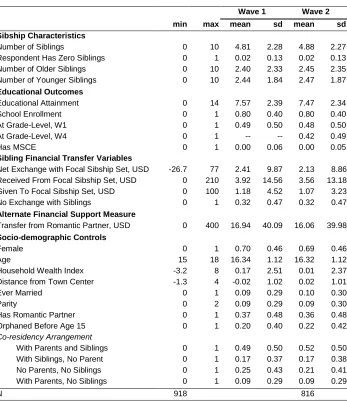
Table 1 provides a descriptive overview of the analytic sample. The mean number of siblings in the sample is just under 5, and only a small percentage of the sample (2%) reports zero siblings. On average, respondents have successfully completed fewer than eight levels of schooling, which is well below the official standards for even the youngest in our sample; at age 15, respondents who started school on time and experienced no interruptions should have completed nine levels. This pattern of interrupted schooling is further reflected in the at-grade-level variables, which reflect the official standards, plus a two-year buffer to account for the fact that schooling interruptions are pervasive in Malawi. While 80% of the sample was currently enrolled in school at Wave 1, a mere 16% reported being at grade level according to the official standards (not shown), and 48% were categorized as at grade level by our less stringent operationalization. Of respondents who were track at Wave 1, 89% were still on-track one year later (not shown). Only 10% of the analytic sample has ever been married; and a similar percentage (8.5) has one or more children (not shown). About 50% of the sample lives with at least one parent and one sibling, while 10% lives only with parents, 17% only with siblings, and 25% (including boarding school students) with neither parents nor siblings.
Table 1: Descriptive overview of analytic sample, Tsogolo la Thanzi, Waves 1 and 4
Wave 1 Wave 2
min max mean sd mean sd
Sibship Characteristics
Number of Siblings 0 10 4.81 2.28 4.88 2.27
Respondent Has Zero Siblings 0 1 0.02 0.13 0.02 0.13
Number of Older Siblings 0 10 2.40 2.33 2.45 2.35
Number of Younger Siblings 0 10 2.44 1.84 2.47 1.87
Educational Outcomes
Educational Attainment 0 14 7.57 2.39 7.47 2.34
School Enrollment 0 1 0.80 0.40 0.80 0.40
At Grade-Level, W1 0 1 0.49 0.50 0.48 0.50
At Grade-Level, W4 0 1 -- -- 0.42 0.49
Has MSCE 0 1 0.00 0.06 0.00 0.05
Sibling Financial Transfer Variables
Net Exchange with Focal Sibship Set, USD -26.7 77 2.41 9.87 2.13 8.86
Received From Focal Sibship Set, USD 0 210 3.92 14.56 3.56 13.18
Given To Focal Sibship Set, USD 0 100 1.18 4.52 1.07 3.23
No Exchange with Siblings 0 1 0.32 0.47 0.32 0.47
Alternate Financial Support Measure
Transfer from Romantic Partner, USD 0 400 16.94 40.09 16.06 39.98
Socio-demographic Controls
Female 0 1 0.70 0.46 0.69 0.46
Age 15 18 16.34 1.12 16.32 1.12
Household Wealth Index -3.2 8 0.17 2.51 0.01 2.37
Distance from Town Center -1.3 4 -0.02 1.02 0.02 1.01
Ever Married 0 1 0.09 0.29 0.10 0.30
Parity 0 2 0.09 0.29 0.09 0.30
Has Romantic Partner 0 1 0.37 0.48 0.36 0.48
Orphaned Before Age 15 0 1 0.20 0.40 0.22 0.42
Co-residency Arrangement
With Parents and Siblings 0 1 0.49 0.50 0.52 0.50
With Siblings, No Parent 0 1 0.17 0.37 0.17 0.38
No Parents, No Siblings 0 1 0.25 0.43 0.21 0.41
With Parents, No Siblings 0 1 0.09 0.29 0.09 0.29
N 918 816
4.2 Patterned transfers
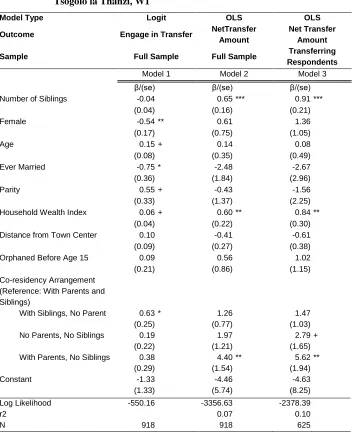
To address questions about how sibling transfers might be patterned at this particular stage of the life course, Table 2 provides the results of three regression models predicting transfer behavior based on basic socio-demographic characteristics. First, Model 1 uses logistic regression to predict the patterns of engaging in any transfers at all (68% of the sample). Second, Model 2 displays correlates of the net amount exchanged for the entire sample, and Model 3 shows correlates of the net amount exchanged, but only for those who exchange in transfers with their siblings (see Model 1).
Model 1 shows that a respondent’s number of siblings is not correlated with the propensity to exchange money but that women and ever-married respondents are less likely to be engaged in economic transfers with siblings. On the other hand, older respondents, respondents with children, those in higher SES households, and those who co-reside with siblings (independent of parents) are more likely to be exchanging money with their siblings. For the models of amount exchanged, the socio-demographic correlates are consistent between the sample (Model 2) and the exchanging subsample (Model 3): respondents with many siblings net more from sibling exchanges than those with few siblings. Patterns by socio-economic status reveal expected results, and differences in the magnitude of exchanges across co-residency arrangements suggest that respondents who live independently from their natal home benefit strongly from sibling exchanges, as do those who live with parents but not with siblings.12
Table 2: Estimates from models predicting transfer behavior and net amount, Tsogolo la Thanzi, W1
Model Type Logit OLS OLS
Outcome Engage in Transfer NetTransfer
Amount
Net Transfer Amount
Sample Full Sample Full Sample Transferring
Respondents
Model 1 Model 2 Model 3
β/(se) β/(se) β/(se)
Number of Siblings -0.04 0.65 *** 0.91 ***
(0.04) (0.16) (0.21)
Female -0.54 ** 0.61 1.36
(0.17) (0.75) (1.05)
Age 0.15 + 0.14 0.08
(0.08) (0.35) (0.49)
Ever Married -0.75 * -2.48 -2.67
(0.36) (1.84) (2.96)
Parity 0.55 + -0.43 -1.56
(0.33) (1.37) (2.25)
Household Wealth Index 0.06 + 0.60 ** 0.84 **
(0.04) (0.22) (0.30)
Distance from Town Center 0.10 -0.41 -0.61
(0.09) (0.27) (0.38)
Orphaned Before Age 15 0.09 0.56 1.02
(0.21) (0.86) (1.15)
Co-residency Arrangement (Reference: With Parents and
Siblings)
With Siblings, No Parent 0.63 * 1.26 1.47
(0.25) (0.77) (1.03)
No Parents, No Siblings 0.19 1.97 2.79 +
(0.22) (1.21) (1.65)
With Parents, No Siblings 0.38 4.40 ** 5.62 **
(0.29) (1.54) (1.94)
Constant -1.33 -4.46 -4.63
(1.33) (5.74) (8.25)
Log Likelihood -550.16 -3356.63 -2378.39
r2 0.07 0.10
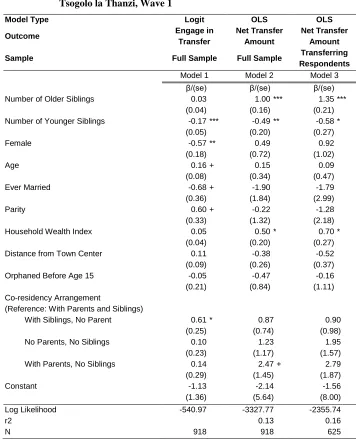
Table 3: Estimates from models predicting transfer behavior and net amount, Tsogolo la Thanzi, Wave 1
Model Type Logit OLS OLS
Outcome Engage in
Transfer
Net Transfer Amount
Net Transfer Amount
Sample Full Sample Full Sample Transferring
Respondents
Model 1 Model 2 Model 3
β/(se) β/(se) β/(se)
Number of Older Siblings 0.03 1.00 *** 1.35 ***
(0.04) (0.16) (0.21)
Number of Younger Siblings -0.17 *** -0.49 ** -0.58 *
(0.05) (0.20) (0.27)
Female -0.57 ** 0.49 0.92
(0.18) (0.72) (1.02)
Age 0.16 + 0.15 0.09
(0.08) (0.34) (0.47)
Ever Married -0.68 + -1.90 -1.79
(0.36) (1.84) (2.99)
Parity 0.60 + -0.22 -1.28
(0.33) (1.32) (2.18)
Household Wealth Index 0.05 0.50 * 0.70 *
(0.04) (0.20) (0.27)
Distance from Town Center 0.11 -0.38 -0.52
(0.09) (0.26) (0.37)
Orphaned Before Age 15 -0.05 -0.47 -0.16
(0.21) (0.84) (1.11)
Co-residency Arrangement
(Reference: With Parents and Siblings)
With Siblings, No Parent 0.61 * 0.87 0.90
(0.25) (0.74) (0.98)
No Parents, No Siblings 0.10 1.23 1.95
(0.23) (1.17) (1.57)
With Parents, No Siblings 0.14 2.47 + 2.79
(0.29) (1.45) (1.87)
Constant -1.13 -2.14 -1.56
(1.36) (5.64) (8.00)
Log Likelihood -540.97 -3327.77 -2355.74
r2
0.13 0.16
In Table 3, we examine the same outcomes, focusing on the differential patterns of transfer according to the composition of the sibship group (i.e., number of older siblings and number of younger siblings). These results conform to our expectations: all socio-demographic patterns are consistent with the findings in Table 2, and sibling support is, indeed, patterned by age and/or birth order. While older siblings have no impact on the propensity to be involved with economic exchanges, controlling for the respondent’s age, the number of younger siblings is negatively associated with the propensity to engage in any economic transfer. Examining net exchanges in Models 2 and 3, we find that older siblings convey financial gains, and younger siblings represent losses, as older siblings tend to support younger ones.
4.3 Siblings, transfers, and educational attainment
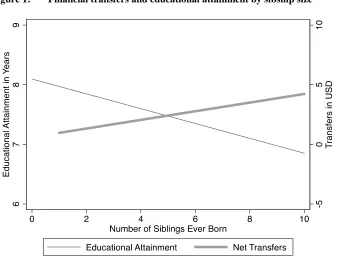
Figure 1: Financial transfers and educational attainment by sibship size
Table 4: Estimates from regression models predicting educational outcomes according to sibship size and sibling economic transfers, Tsogolo la Thanzi, Waves 1 & 4
Outcome Years of Education School Enrollment At Grade Level At Grade Level
Model Type OLS Logit Logit Logit
Analytic Sample Wave 1 Wave 1 Wave 1 Wave 4
Model 1 Model 2 Model 3 Model 4 Model 5 Model 6 Model 7 Model 8
β/(se)
β/(se) β/(se) β/(se) β/(se) β/(se) β/(se) β/(se)
Number of Siblings -0.06 + -0.08 * -0.03
-0.04 -0.06 -0.10 * -0.08 + -0.10 *
(0.03)
(0.03) (0.06) (0.06) (0.04) (0.04) (0.04) (0.04)
Female 0.71 *** 0.70 *** -0.52 *** -0.50 *** -0.10
-0.12 -0.13 -0.15 +
(0.07)
(0.07) (0.13) (0.14) (0.08) (0.09) (0.09) (0.09)
Age 0.67 *** 0.64 *** -0.27
-0.24 0.82 *** 0.79 *** 0.56 ** 0.54 **
(0.13)
(0.13) (0.27) (0.28) (0.17) (0.18) (0.18) (0.18)
Ever Married 0.39 * 0.38 * 0.69 * 0.70 * 0.28
0.26 0.07 0.05
(0.16)
(0.16) (0.35) (0.34) (0.22) (0.22) (0.22) (0.22)
Parity -1.32 *** -1.25 *** -3.69 *** -3.65 *** -1.26 ** -1.20 * -0.77
-0.76
(0.33)
(0.32) (0.76) (0.77) (0.45) (0.48) (0.47) (0.47)
Household Wealth
Index 0.37 *** 0.35 *** 0.20 ** 0.21 ** 0.36 *** 0.35 *** 0.28 *** 0.27 ***
(0.03)
(0.03) (0.07) (0.07) (0.05) (0.05) (0.04) (0.04)
Distance from Town
Center -0.36 *** -0.35 *** -0.25 * -0.25 * -0.45 *** -0.44 *** -0.51 *** -0.50 ***
(0.09)
(0.09) (0.11) (0.11) (0.11) (0.11) (0.12) (0.12)
Orphaned Before
Age 15 -0.38 -0.40 -2.34 *** -2.28 *** -0.52 -0.55 -0.74 + -0.71 +
(0.32)
(0.31) (0.48) (0.49) (0.40) (0.38) (0.43) (0.42)
Co-residency Arrangement
(Reference: With Parents and Siblings)
With Siblings, No
Parent -0.01 -0.04 -0.97 ** -0.99 ** -0.01 -0.08 -0.22 -0.27
(0.21)
(0.21) (0.33) (0.33) (0.25) (0.25) (0.25) (0.25)
No Parents, No
Siblings -0.28 -0.33 + -0.86 * -0.90 * -0.56 * -0.69 ** -0.44 -0.50 +
(0.19)
(0.19) (0.36) (0.39) (0.27) (0.26) (0.30) (0.29)
With Parents, No
Siblings 0.15 0.02 -0.49 -0.51 -0.05 -0.34 -0.26 -0.42
(0.23)
(0.23) (0.44) (0.47) (0.30) (0.33) (0.31) (0.33)
Has Romantic
Partner 0.15 0.04 -0.60 * -0.54 * 0.01 -0.05 0.15 0.11
(0.16)
(0.16) (0.26) (0.27) (0.19) (0.20) (0.20) (0.21)
Net Received from
Romantic Partner 0.00 + -0.00 0.00 0.00
(0.00) (0.00) (0.00) (0.00)
Net Received from
Focal Sibship Set 0.03 *** 0.01 0.07 *** 0.03 *
(0.01) (0.02) (0.02) (0.02)
Constant -4.27 *** -3.97 *** 11.55 *** 11.27 *** 1.57
1.96 1.94 2.29
(1.07)
(1.08) (2.32) (2.36) (1.36) (1.41) (1.38) (1.41)
Log Likelihood -1857. 66 -1845. 94 -274.5 5 -273.7 7 -509.4 3 -493.0 9 -469.3 2 -464.2 6
r2 0.41
0.42
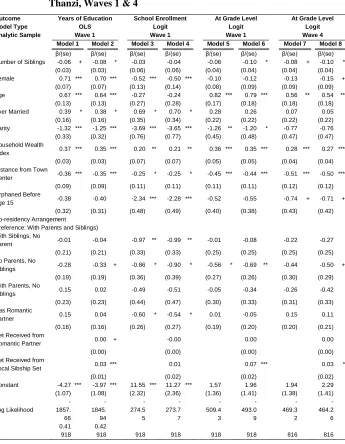
The first two columns of Table 4 summarize the results of OLS regression models predicting educational attainment at Wave 1 net of socio-demographic characteristics. After controlling for key socio-demographic characteristics, Model 1 reveals a weak negative relationship between sibship size and educational attainment. Model 2 includes economic transfers from siblings and romantic partners, both of which are positive and significantly associated with educational attainment. The money respondents receive from their siblings, net of the money they give in return, is positively associated with their years of education. Furthermore, after controlling for transfers between siblings, the negative relationship between sibship size and educational attainment becomes statistically significant at the p<.05 level.
4.4 School enrollment and retention
Because educational attainment has important temporal limitations for our research, we expand our examination of the relationship between siblings and education to consider both school enrollment and roughly at-grade-level schooling status. We take advantage of the panel nature of the TLT study and consider both the cross-sectional and prospective relationship between sibling exchange and being at-grade-level.
As evidenced in Models 3 and 4 of Table 4, the relationship between sibling transfer support and the likelihood of school enrollment is non-significant. Respondents receiving economic support from their siblings are no more likely to be enrolled in school than those who are not. Without controls for economic transfers, sibship size has no association with the likelihood of being in school approximately at grade level at Wave 1 (Model 5); however, when modeled simultaneously with economic transfers across the sibship set (Model 6), we find that sibship size is negatively , and transfers positively, associated with the likelihood of being enrolled at grade level.
4.5 Sibling costs and benefits for education
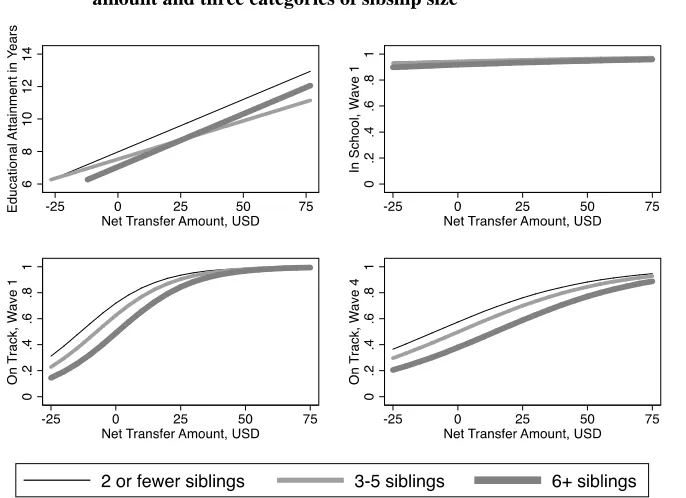
Figure 2: Predicted probability of four educational outcomes by net transfer amount and three categories of sibship size
5. Discussion
Africa (Bray 2009; Robson et al. 2006) and deserves attention from social demographers.
In this paper, we examined one aspect of sibling support—financial transfers within a focal sibship set—among school-aged young adults, and measured its relationship to four educational outcomes. We find that economic exchanges between siblings in southern Malawi are common, sizable (relative to average earnings), and patterned by birth order, household SES, and co-residency arrangements. Furthermore, financial transfers among siblings offset the significant, negative relationship between sibship size and education—a finding that challenges simple portrayals of siblings as competitors for scarce household resources.
Our purpose was not to test the resource dilution hypothesis directly, as others have done, but to establish the limits of its utility by incorporating data on wealth-flows to highlight the dual processes of dilution and enrichment that occur simultaneously within Malawian families. In many parts of the world siblings may, indeed, be subtractive to wellbeing during infancy and youth, compromising everything from survival to nutrition to educational attainment; however, we demonstrate that siblings can contribute positively as well. This observation is consistent with previous research suggesting that broader norms and structures of extended families condition the effect of large sibship sizes for educational attainment (Downey and Neubauer 1998; Lloyd and Blanc 1996; Shavit and Pierce 1991). We find that siblings (especially older siblings) in Malawi provide a resource base that has important implications for young adults’ educational outcomes. This finding is consonant with ethnographic research showing that siblings are a key source of support in terms of livelihoods in South Africa (Townsend et al. 2002) and Kenya (Shipton 2007).
The reality of sibling economic interdependencies is more complex than a simple ―wealth in people‖ argument, in which individuals draw upon expansive kinship networks to secure access to important resources (Smith 2004). In addition to providing support of various forms, siblings represent a set of obligations that may influence the pace at which young adults undertake important life course transitions. In particular, sizable responsibilities for siblings (especially younger ones) may shape the aspirations (e.g., educational goals, family size preferences) and behaviors (e.g., migration, childbearing) of young adults who find themselves in the role of supporting their siblings. In sub-Saharan Africa where kinship networks are strong, individuals are subject to pressure to provide assistance for less fortunate relatives and neighbors (Chabal 2009; Smith 2004), and the consequences for siblings in the provider role may be negative and, in some cases, especially acute.
Our study is limited by some standard challenges in demographic research: we focus on a particular geographic context and a particular stage of the life course, which limits the generalizability of our findings. We measure three of our educational outcomes contemporaneously with sibling exchanges, which limits our ability to firmly establish causal direction. While the use of one prospective outcome strengthens our argument, as with all longitudinal studies, we lost cases (N=102) due to sample attrition—though one-year retention was comparatively high (90%) and attrition did not introduce any discernible bias (see Table 1). Additionally, we focus exclusively on financial transfers in a context where non-monetary exchanges are both common and critical. However, given the monetary expense of school (e.g., fees, uniforms), we believe that financial transfers may indeed be among the most important resources siblings share. Furthermore, we examine benefits from sibling exchanges to educational outcomes in comparison to romantic exchanges, which have been widely researched in the past; this approach is especially useful for establishing the limited importance of contributions from romantic partners—who have been widely acknowledged as providers of material resources at this stage in the life course—for educational attainment.
they make the transition to adulthood. In the balance—at least in Malawi—we suggest that economically supportive siblings represent a much greater benefit than they do burden.
6. Acknowledgments
References
Adamchak, D.J., Wilson, A.O., Nyanguru, A., and Hampson, J. (1991). Elderly Support and Intergenerational Transfer in Zimbabwe: An Analysis by Gender, Marital Status, and Place of Residence. The Gerontologist 31(4): 505–13.
doi:10.1093/geront/31.4.505.
Ainsworth, M. and Semali, I. (2000). The Impact of Adult Deaths on Children’s Health in Northwestern Tanzania. World Bank Development Research Group. Retrieved December 20, 2010 (http://papers.ssrn.com/sol3/papers.cfm? abstract_id=629117). doi:10.1596/1813-9450-2266.
Ardington, C. and Leibbrandt, M. (2010). Orphanhood and Schooling in South Africa: Trends in the Vulnerability of Orphans Between 1993 and 2005. Economic Development and Cultural Change 58(3): 507–36. doi:10.1086/650414.
Argys, L.M., Rees, D.I., Averett, S.L., and Witoonchart, B. (2006). Birth Order and Risky Adolescent Behavior. Economic Inquiry 44(2):215–33.
Bachrach, C. and Hornem, M.C. (1987). Married and Unmarried Couples, United States, 1982. National Center for Health Statistics (U.S.). Retrieved December 20, 2010 (http://stacks.cdc.gov/view/cdc/12866/).
Beegle, K., De Weerdt, J., and Dercon, S. (2010). Orphanhood and Human Capital Destruction: Is There Persistence Into Adulthood? Demography 47(1): 163–80.
doi:10.1353/dem.0.0094.
Behrman, J.R. and Taubman, P. (1986). Birth Order, Schooling, and Earnings. Journal of Labor Economics 4(3): S121–S145. doi:10.1086/298124.
Blake, J. (1981). Family Size and the Quality of Children. Demography 18(4): 421-42.
doi:10.2307/2060941.
Blake, J. (1986). Number of Siblings, Family Background, and the Process of Educational Attainment. Biodemography and Social Biology 33(1-2): 5–21.
doi:10.1080/19485565.1986.9988618.
Boult, B.E. and Cunningham, P.W.. (1991). Black Teenage Pregnancy: An African Perspective. Early Child Development and Care 74(1): 103–7. doi:10.1080/ 0300443910740108.
Caldwell, J.C. (1965). Extended Family Obligations and Education: A Study of an Aspect of Demographic Transition Amongst Ghanaian University Students. Population Studies 19(2): 183–99. doi:10.1080/00324728.1965.10406012. Caldwell, J.C. (1980). Mass Education as a Determinant of the Timing of Fertility
Decline. Population and Development Review 6(2): 225–55. doi:10.2307/1972 729.
Case, A. and Ardington, C. (2006). The Impact of Parental Death on School Outcomes: Longitudinal Evidence From South Africa. Demography 43(3): 401–20.
doi:10.1353/dem.2006.0022.
Chabal, P. (2009). Africa: The Politics of Suffering and Smiling. London: Zed Books. Chao, Li-Wei and Hans Peter Kohler. 2007. The Behavioral Economics of Altruism,
Reciprocity, and Transfers Within Families and Rural Communities: Evidence from Sub-Saharan Africa. PARC Working Papers, University of Pennsylvania. Retrieved September 9, 2012 (http://repository.upenn.edu/parc_working_ papers/9/).
Cicirelli, V.G. (1994). Sibling Relationships in Cross-Cultural Perspective. Journal of Marriage and Family 56(1): 7–20. doi:10.2307/352697.
Cicirelli, V.G. (1995). Sibling Relationships Across the Life Span. New York: Springer.
doi:10.1007/978-1-4757-6509-0.
Conger, K.J. and Little, W.M. (2010). Sibling Relationships During the Transition to Adulthood. Child Development Perspectives 4(2): 87–94. doi:10.1111/j.1750-8606.2010.00123.x.
Cox, D. and Fafchamps, M. (2008). Extended Family and Kinship Networks: Economic Insights and Evolutionary Directions. In: Schultz, T.P. and Strauss, J. (eds.). Handbook of Developmental Economics. New York, NY: Elsevier: 3711–76.
Desai, S. (1992). Children at Risk: The Role of Family Structure in Latin America and West Africa. Population and Development Review 18(4): 689–717.
doi:10.2307/1973760.
Downey, D.B. (2001). Number of Siblings and Intellectual Development: The Resource Dilution Explanation. The American Psychologist 56(6-7): 497–504.
doi:10.1037/0003-066X.56.6-7.497.
Downey, D.B. and Neubauer, S. (1998). Is Resource Dilution Inevitable? The Association Between Number of Siblings and Educational Achievement Across Subgroups. Paper presented at the 93rd Annual Meeting of the American Sociological Association, San Francisco, CA.
Evans, D.K. and Miguel, E. (2007). Orphans and Schooling in Africa: A Longitudinal Analysis. Demography 44(1): 35–57. doi:10.1353/dem.2007.0002.
Foster, A.D. and Rosenzweig, M.R. (2001). Imperfect Commitment, Altruism, and The Family: Evidence from Transfer Behavior in Low-Income Rural Areas. The Review of Economics and Statistics 83(3): 389–407. doi:10.1162/003465 30152480054.
Frye, M. (2012). Bright Futures in Malawi’s New Dawn: Educational Aspirations as Assertions of Identity. American Journal of Sociology 117(6): 1565–1624.
doi:10.1086/664542.
Goody, E.N. (2005). Contexts of Kinship: An Essay in the Family Sociology of the Gonja of Northern Ghana. Cambridge: Cambridge University Press.
Grant, M.J. (2008). Children’s School Participation and HIV/AIDS in Rural Malawi: The Role of Parental Knowledge and Perceptions. Demographic Research 19(45): 1603–34. doi:10.4054/DemRes.2008.19.45.
Grant, M.J. (2012). Girls’ Schooling and the Perceived Threat of Adolescent Sexual Activity in Rural Malawi. Culture, Health & Sexuality 14(1): 73–86.
doi:10.1080/13691058.2011.624641.
Grant, M.J. and Hallman, K.K. (2008). Pregnancy-related School Dropout and Prior School Performance in KwaZulu-Natal, South Africa. Studies in Family Planning 39(4): 369–82. doi:10.1111/j.1728-4465.2008.00181.x.
Grant, M.J. and Yeatman, S. (2012). The Relationship Between Orphanhood and Child Fostering in sub-Saharan Africa, 1990s–2000s. Population Studies 66(3): 279-295. doi:10.1080/00324728.2012.681682.
Hart, C.L. and Smith, G.D. (2003). Relation Between Number of Siblings and Adult Mortality and Stroke Risk: 25 Year Follow up of Men in the Collaborative Study. Journal of Epidemiology and Community Health 57(5): 385–91.
doi:10.1136/jech.57.5.385.
Hosegood, V., Preston-Whyte, V., Busza, J., Moitse, S., and Timaeus, I.M. (2007). Revealing the Full Extent of Households’ Experiences of HIV and AIDS in Rural South Africa. Social Science & Medicine 65(6): 1249–59. doi:10.1016/ j.socscimed.2007.05.002.
Kadzamira, E. and Rose, P. (2003). Can Free Primary Education Meet the Needs of the Poor?: Evidence from Malawi. International Journal of Educational Development 23(5): 501–16. doi:10.1016/S0738-0593(03)00026-9.
Knodel, J. and Hermalin, A.I.. (1984). Effects of Birth Rank, Maternal Age, Birth Interval, and Sibship Size on Infant and Child Mortality: Evidence from 18th and 19th Century Reproductive Histories. American Journal of Public Health 74(10): 1098–1106. doi:10.2105/AJPH.74.10.1098.
Liddell, C., Barrett, L., and Henzi, P. (2003). Parental Investment in Schooling: Evidence from a Subsistence Farming Community in South Africa. International Journal of Psychology 38(1): 54–63. doi:10.1080/00207590244000232.
Lloyd, C.B. and Blanc, A.K. (1996). Children’s Schooling in sub-Saharan Africa: The Role of Fathers, Mothers, and Others. Population and Development Review 22(2): 265–98. doi:10.2307/2137435.
Lloyd, C.B. and Gage-Brandon, A.J. (1994). High Fertility and Children’s Schooling in Ghana: Sex Differences in Parental Contributions and Educational Outcomes. Population Studies 48(2): 293–306. doi:10.1080/0032472031000147806. MDHS. (2010). Malawi Demographic and Health Survey. Retrieved (Available at
http://www.measuredhs.com/).
Michael, R.T. and Tuma, N.B. (1985). Entry into Marriage and Parenthood by Young Men and Women: The Influence of Family Background. Demography 22(4): 515–44. doi:10.2307/2061586.
Milne, F. and Judge, D. (2009). Birth Order Influences Reproductive Measures in Australians. Human Nature 20(3): 294–316.
Modin, B. (2002). Birth Order and Mortality: a Life-long Follow-up of 14,200 Boys and Girls Born in Early 20th Century Sweden. Social Science & Medicine 54(7): 1051–64. doi:10.1016/S0277-9536(01)00080-6.
Moore, K.A. and Hofferth, S.L. (1980). Factors Affecting Early Family Formation: A Path Model. Population and Environment 3(1): 73–98.
doi:10.1007/BF01253071.
Morduch, J. (2000). Sibling Rivalry in Africa. The American Economic Review 90(2): 405–9. doi:10.1257/aer.90.2.405.
Mtika, M.M. (2001). The AIDS Epidemic in Malawi and Its Threat to Household Food Security. Human Organization 60(2): 178–88.
Mtika, M.M. (2003). Family Transfers in a Subsistence Economy and Under a High Incidence of HIV/AIDS: The Case of Rural Malawi. Journal of Contemporary African Studies 21(1): 69–92. doi:10.1080/02589000305453.
Mtika, M.M. and Doctor, H.V. (2002). Matriliny, Patriliny, and Wealth Flow Variations in Rural Malawi. African Sociological Review 6(2): 71–97.
doi:10.4314/asr.v6i2.23215.
Mueller, E. (1984). Income, Aspirations, and Fertility in Rural Areas of Less Developed Countries. In: Schutjer, W.A. and Stokes, C.S. (eds.). Rural Development and Human Fertility. New York: Macmillan Publishing Company: 121–50.
National Statistical Office. (2008). Malawi Population and Housing Census Final Report. Lilongwe, Malawi: National Statistics Office. Retrieved (http:// www.nsomalawi.mw/index.php/2008-population-and-housing-census.html). Oheneba-Sakyi, Y. and Takyi, B.K. (2006). African Families at the Turn of the 21st
Century. Westport, CT: Greenwood Publishing Group.
Panzarine, S. and Santelli, J. (1987). Risk Factors for Early Sexual Activity and Early Unplanned Pregnancy. Maryland Medical Journal 36(11): 927–31.
Peters, P.E., Kambewa, D., and Walker, P.A. (2008). The Effects of Increasing Rates of HIV/AIDS-Related Illness and Death on Rural Families in Zomba District, Malawi: A Longitudinal Study. RENEWAL Working Paper. Retrieved September 9, 2012 (http://www.geography.uoregon.edu/walker/Research/ Peters%20Kambewa%20Walker%202008%20Effects%20of%20HIV-AIDS%20 in%20Malawi.pdf).
Potter, G.E. and Handcock, M.S. (2010). A Description of Within-Family Resource Exchange Networks in a Malawian Village. Demographic Research 23(6): 117-52. doi:10.4054/DemRes.2010.23.6.
Poulin, M.J. (2007). Sex, Money, and Premarital Relationships in Southern Malawi. Social Science & Medicine 65(11): 2383–93. doi:10.1016/j.socscimed.2007. 05.030.
Robson, E., Ansell, N., Huber, U.S., Gould, W.T.S., and van Blerk, L. (2006). Young Caregivers in the Context of the HIV/AIDS Pandemic in sub-Saharan Africa. Population, Space and Place 12(2): 93–111. doi:10.1002/psp.392.
Ronsmans, C. (1995). Patterns of Clustering of Child Mortality in a Rural Area of Senegal. Population Studies 49(3): 443–61. doi:10.1080/0032472031000148 766.
Ronsmans, C. (1996). Birth Spacing and Child Survival in Rural Senegal. International Journal of Epidemiology 25(5): 989–97. doi:10.1093/ije/25.5.989.
Schatz, E. and Ogunmefun, C. (2007). Caring and Contributing: The Role of Older Women in Rural South African Multi-Generational Households in the HIV/AIDS Era. World Development 35(8): 1390–1403.
doi:10.1016/j.worlddev.2007.04.004.
Shavit, Y. and Pierce, J.L. (1991). Sibship Size and Educational Attainment in Nuclear and Extended Families: Arabs and Jews in Israel. American Sociological Review 56(3): 321-330. doi:10.2307/2096107.
Shipton, P.M. (2007). The Nature of Entrustment: Intimacy, Exchange, and the Sacred in Africa. New Haven, CT: Yale University Press.
Smith, D.J. (2004). Contradictions in Nigeria’s Fertility Transition: The Burdens and Benefits of Having People. Population and Development Review 30(2): 221–38.
doi:10.1111/j.1728-4457.2004.011_1.x.
Soldo, B.J. and Hill, M.S. (1995). Family Structure and Transfer Measures in the Health and Retirement Study: Background and Overview. The Journal of Human Resources 30: S108–S137. doi:10.2307/146280.
Stasavage, D. (2005). Democracy and Education Spending in Africa. American Journal of Political Science 49(2): 343–58. doi:10.1111/j.0092-5853.2005.00127.x. Sulloway, F.J. (1997). Born to Rebel: Birth Order, Family Dynamics, and Creative
Sutton-Smith, B. and Rosenberg, B.G. (1970). The Sibling. Oxford, England: Holt, Rinehart and Winston..
Townsend, N., Madhavan, S., Tollman, S., Garenne, M., and Kahn, K. (2002). Children’s Residence Patterns and Educational Attainment in Rural South Africa, 1997. Population Studies 56(2): 215–25. doi:10.1080/00324720215925. UNDP. (2010). Preventing Crisis, Enabling Recovery: 2010 Annual Report. Retrieved
June 25, 2011 (http://www.undp.org/content/undp/en/home/librarypage/crisis- prevention-and-recovery/preventing-crisis-enabling-recovery-2010-annual-report.html).
De Weerdt, J. and Fafchamps, M. (2011). Social Identity and the Formation of Health Insurance Networks. Journal of Development Studies 47(8): 1152–77.
doi:10.1080/00220388.2010.527952.
Weinreb, A.A. (2002). Lateral and Vertical Intergenerational Exchange in Rural Malawi. Journal of Cross-Cultural Gerontology 17(2): 101–38.
doi:10.1023/A:1015834300553.
Weinreb, A.A. (2006). Substitution and Substitutability: The Effects of Kin Availability on Intergenerational Transfers in Malawi. In: Gauthier, A.H., Chu, C., and Tuljapurkar, S. (eds.). Allocating Public and Private Resources Across Generations: Riding the Age Waves. Springer-Verlag Publishers: 13–38.
Weisner, T.S. (1987). Socialization for Parenthood in Sibling Caretaking Societies. In: Lancaster, J.B., Altmann, J., Rossi, A.S., and Sherrod, L.R. (eds.). Parenting across the life span. Retrieved September 9, 2012 (http://tweisner.com/ yahoo_site_admin/assets/docs/Weisner_19871_Socialization_for_parenthood_si bling_caretaking_F13.231164857.pdf): 237–70.
Weisner, T.S., Bradley, C., and Kilbride, P.L. (1997). African Families and the Crisis of Social Change. Westport, CT: Greenwood Publishing Group.
White, L. (2001). Sibling Relationships over the Life Course: A Panel Analysis. Journal of Marriage and Family 63(2): 555–68. doi:10.1111/j.1741-3737.2001.00555.x.
White, L.K. and Riedmann, A. (1992). Ties Among Adult Siblings. Social Forces 71(1): 85–102. doi:10.2307/2579967.