University of New Orleans University of New Orleans
ScholarWorks@UNO
ScholarWorks@UNO
University of New Orleans Theses and
Dissertations Dissertations and Theses
8-6-2009
Face-Work Within Blogs: The Use and Modification of Real World
Face-Work Within Blogs: The Use and Modification of Real World
Rituals Within a Virtual Setting
Rituals Within a Virtual Setting
Matthew LeBlanc
University of New Orleans
Follow this and additional works at: https://scholarworks.uno.edu/td
Recommended Citation Recommended Citation
LeBlanc, Matthew, "Face-Work Within Blogs: The Use and Modification of Real World Rituals Within a Virtual Setting" (2009). University of New Orleans Theses and Dissertations. 982.
https://scholarworks.uno.edu/td/982
Face-Work Within Blogs: The Use and Modification of Real World Rituals Within a Virtual Setting
A Thesis
Submitted to the Graduate Faculty of the University of New Orleans
in partial fulfillment of the requirements for the degree of
Master of Arts in Sociology
by
Matthew LeBlanc
B.A. University of New Orleans, 2007
DEDICATION
I would like to dedicate this thesis to my mother. Her constant belief in me and
support of my dreams has helped to keep me centered and guide me along the long
ACKNOWLEDGEMENT
I would like to acknowledge my thesis committee: Vern Baxter, Ph.D.; D’lane
Compton, Ph.D.; and David Allen, Ph.D. Their support and constructive criticism helped
make this thesis what it is today.
I would also like to thank my friends Danilo Levi, Ph.D.; Joseph Su, Ph.D.; and
TABLE OF CONTENTS
List of Tables ... vi
Abstract ... vii
Introduction ... 1
Literature Review ... 4
On Face-Work ... 4
“On Face-Work” Applied to Blogging ... 12
Theories of Postmodern Self Presentation ... 16
Self Presentation in Computer Mediated Communication ... 22
Methods ... 28
Findings ... 33
Discussion ... 36
Unique Forms of Correction ... 52
Conclusion ... 53
Bibliography ... 58
LIST OF TABLES
ABSTRACT
In his Essay “On Face-Work” Erving Goffman identifies the rules for a number of
face-to-face interaction rituals. Among these rituals are two ways of correcting
participants within an interaction. The first correction ritual, the interchange, allows
offending interactants a chance to save face. The second ritual, the points making
game, is a way for interactants to cause other participants to lose face. This thesis
analyzes the content of a random sample of blogs to see if the rituals described above
are employed in online interaction, specifically looking at blogs and how the context of
the rituals is modified, including whether and how they are modified. It was found that
the ritual of the interchange was modified. The ritual of the points making game though
left unmodified occurred with greater frequency.
Introduction
Erving Goffman is widely known for his observations on human interaction.
Goffman (1959) relied primarily on observations, not formal scientific method, when
analyzing people and their interactions. By thoroughly examining his own observations,
Goffman was able to see what others did not. After making observations about a
particular arena of discourse, Goffman (1959) would move to a different arena and
make observations about what new forms of ordered interaction took place there.
In his essay “On Face-work” Goffman (1967) observes a number of rituals
associated with the way people present their “selves” to others. These rituals take the
form of politeness, apologies, compliments, and corrections. Every participant in a
social interaction attempts to convey a self that is found acceptable by all participants
involved. This is done by either expressing character qualities that are viewed as
respectable, or by hiding character qualities viewed as offensive. Of the rituals
examined by Goffman, two are examined in this thesis. These two rituals are two
different ways to correct persons within the social interaction. The first ritual is known
as the interchange, and it is a positive form of correction that allows people to maintain
social standing for their “selves” within a given interaction. The second ritual is more
like a game where participants try to cause the loss of social standing for other’s
“selves” by making points during a social encounter.
New technology has expanded and sped up communication so much that many
argue that time and space are compressed. This compression has allowed for self
away from each other. The greatest example of this new technology is the internet.
The internet makes possible a multitude of communication tools, including the blog.
Blogs are web pages where specific topics are discussed. What is discussed is
based on the blogger’s choice. The subject of blogs can take almost any form and can
cover any subject from text, to video, music, art, or audio broadcasts. However, blogs
are not one sided. After bloggers make a post, the readers/viewers are given the option
to comment on whatever was read, said, heard, or watched. These comments can be
whatever the commenter wants to post. Some comments are complimentary, and
some are confrontational.
Here, however, is where this researcher sees a problem. Does communication,
which is mediated by a computer, follow the same rules as communication that occurs
face? It is important to remember that the rituals Goffman identified for
face-to-face interactions were used during social interaction as a whole, not just
communication. Without the variable of physical presence, interaction becomes
limited. It would also not be unreasonable to speculate that this lack of physical
presence would lead to an increase in anonymity. Due to these limitations of the
medium, most online interactions take the form of written communication. For this
reason corrective communications within blogs were studied.
Using Goffman’s observational technique, blogs were observed and the
correction techniques used by the blogging community were examined. This study
addressed two questions. First, do the correction rituals of the interchange and points
making game that Goffman (1967) identifies in “On Face-Work” mirror the rituals
the same as what is expected drawing from face-to-face examples; and to what extent
Literature Review
“On Face-Work”
The first step in answering these research questions is to understand how
Goffman saw the world of social interaction. Goffman was interested in correcting what
he viewed to be flaws within the symbolic interactionist’s school of thought. Like Mead,
Goffman (1959) thought that there was no one overarching society that influenced
people; instead, individuals gained their concepts of self within the different interactions
engaged in during everyday life. Whether an aspect of self is presented or hidden is
based on the context of a discourse; who is part of the discourse; and, finally, what is
expected from everyone in the discourse.
Goffman is most widely remembered for his book Presentation of Self in
Everyday Life (1959). In this work Goffman likens the interaction process to a stage
production. People are actors playing roles dictated by their situation. Different
situations and settings demand different role performances. Any given person plays a
number of roles as he or she progresses through the day. Each of these roles presents
a self the social actor wants the audience, be it an individual or a group, to see. Though
Goffman is able to catalogue numerous roles as well as multiple situations in which
these roles are played, he does not make clear what the rituals are that go into playing
these roles. This is important because identifying people as social actors was the first
step in identifying the rituals used in performing their roles.
When Goffman wrote Interaction Ritual (1967) he catalogued the ritual actions
that occur in face-to-face encounters. The first essay in this book, “On Face-Work,” is
identified by Goffman are those of the line and face. These two aspects of ritual are the
foundation of social interaction. They dictate the atmosphere of every encounter, and
more importantly, the role that interaction participants will play in any given encounter.
Goffman (1967: p5) states that a line is “…a pattern of verbal and nonverbal acts
by which he expresses his view of the situation and through this his evaluation of the
participants, especially himself.” This is the outward presentation of self. Each
individual has his or her own personal feelings, emotions, ideas, ideals, likes and
dislikes, and in every conceivable social encounter, a person must choose to express or
hide these representations of self in light of expectations and reactions of others. The
combinations of expressed and hidden representations of self are lines, and the line a
person takes can and often does change from social encounter to social encounter.
Lines change because the person presenting the line will try to express his or her line
so that it conforms to the expectations of the group evaluating the presenter.
For Goffman (1967: p5) face is “…defined as the positive social value a person
effectively claims for himself by the line others assume he has taken during a particular
contact.” In this respect face and status are almost interchangeable. The only
difference is that face also entails the rights and responsibilities associated with the
status. The higher the status, the more face-work is needed to maintain the status.
Hence, the less status a person has, the less face-work will be needed, and the closer
an individual’s line follows group expectations the less face-work is needed.
The line an individual takes is of primary importance in social interactions.
The reasons for this is because lines are evaluated based on the expectations of others
entirely consistent with his or her line then that person is said to be in wrong face. If,
however, the face a person shows is completely inconsistent with his or her line, then
that person is said to be out of face. When people are either in wrong face or out of
face, then face-work is needed (Goffman 1967).
It can be argued that simply viewing other people’s interactions is a form of social
participation. Goffman (1967: p15) accounts for this argument when he discusses a
basic form of face-work called the avoidance process. Not participating, not expressing
a line is the first way to engage in the avoidance process. The next way to engage in
the avoidance process is to avoid topics of conversation that might contradict an already
established line and, therefore, threaten an existing face.
It must be understood that face maintenance, or face-work, is not something an
actor does by himself (1967: pp.27-31). Instead, face-work is a process in which all
actors within a given interaction are expected to participate. There are ritual techniques
that allow actors to aid each other in maintaining or gaining face. One technique is
known as thecorrective process, and it follows steps known as theinterchange (1967:
pp.19-23).
The use of the corrective process is necessary:
“When participants in an undertaking or encounter fail to prevent the occurrence of an event that is expressively incompatible with the
judgments of social worth that are being maintained, and when the event is of the kind that is difficult to overlook, then the participants are likely to give it accredited status as an incident—to ratify it as a threat that
This means that when a person has done something or failed to do something and has
been found in wrong face or out of face, and that action or inaction is too grievous to
ignore, then that line must be corrected.
There are four steps that can be taken during the interchange: challenge,
offering, acceptance and thanks. However, two of these steps, offering and
acceptance, are necessary if face is to be saved. If this seems odd, think of the
offering “Excuse me,” and the acceptance “Of course.” (1967: p20)
The challenge step occurs when a participant calls attention to an action or
inaction that causes a person to be found in wrong face or out of face. This step is only
necessary when the offending individual is not aware of his or her offense, or not aware
that his or her offense is grievous enough to require an offering. (1967: p20)
The offering step occurs when an individual, usually the offender, becomes
aware of an offense and takes action to try and “re-establish the expressive order
(1967: p20).” Understand that if a person recognizes an offense which requires an
offering it is possible that he or she can initiate an offering before a challenge is made.
In face-to-face encounters offerings take many forms. Sometimes people claim
that threatening actions or inactions were only meant jokingly, or happened accidentally.
Sometimes people will offer an apology or some form of physical reparation.
Sometimes a person will claim that he or she was not acting of his or her own accord.
Sometimes a person will claim that any actions or inactions that threaten his or her face
were intentional and that the others within the encounter mistakenly gave the offender
Once an acceptable offering has been made acceptance can happen. To end
the interchange, the offending party conveys some form of gratitude to the challengers.
This last step is known as thanks (1967: p22). It is important to remember that even
though these steps are something all parties involved are expected to participate in
graciously, some situations dictate a departure from the model. Sometimes challengers
will not accept an offering, viewing it as weak or disingenuous. Sometimes offenders
will give multiple offerings in hopes of demonstrating how sincere his or her regret is.
Sometimes offenders will ignore the challenge and continue with offending actions or
inactions. The consequences of this last tactic can sometimes be dire, and can take the
form of violent reprisal (1967: p23).
There are also ritual techniques that participants can use that can cause others
to lose face, or that can initiate a situation where an individual is setup in a strategic
position to gain face. This is known as aggressive face-work, and it begins: “When a
person treats face-work not as something he need be prepared to perform, but rather as
something that others can be counted on to perform or accept…” (1967: p24) In these
situations, face-to-face encounters cease to be a practice in maintaining the expressive
order, and instead become an arena where a game is played. Like most games, this
game is won by scoring more points than the competition.
The rules to the previously mentioned game are simple. Step one is to try and
exploit any and all contradictions found between an adversary’s line and face; this is
how a participant makes points and wins the game. Step two is to keep one’s
adversaries from finding a contradiction between your line and face; this denies your
played for fun as a game, sometimes known as “busting chops,” or it can be held
amongst enemies where it is treated as a serious competition. It should be known that
whether making points is treated as a game or as a competition it is usually agreed
upon by all parties involved. In fact, if an individual attempts to make points in a
situation where the other participants of the encounter are not interested in making
points, than he or she runs the risk of losing face in that encounter.
How a person goes about hiding and exploiting contradictions between line and
face vary from encounter to encounter. However, the most common method is to
introduce favorable facts about oneself and unfavorable facts about the opposition. To
this end, it is almost a requirement that an audience is present. If the player, or points
maker, can force his or her adversaries into a situation where they have no satisfactory
response to the accusations, then a point is made, and the match is won. If, however,
one’s adversaries can successfully deflect an accusation and then deliver one of their
own, then they gain the points. In this way a person always takes a risk by initiating a
points making competition. (1967: p25)
The most important thing to know about face, however, is how emotions play a
part in face-work rituals. When people are maintaining face they feel pride in how
others view them and interact with them. (1967: p6) When people are in wrong face, or
out of face, they feel shame and embarrassment at how others view and interact with
them. (1967: p8) To engage in social interactions is to risk great rewards or
punishments. As Goffman says: “…While his social face can be his most personal
possession and the center of his security and pleasure, it is only on loan to him from
(1967: p10) To fully understand how important pride and shame are to social
interaction a few articles that discuss the real world applications of face maintenance
were examined.
David Luckenbill and Daniel Doyle (1989) analyze both structural models of
violence and cultural models of violence to explain why violence is prevalent in minority
subcultures. The cultural model of violence views violence as a product of conformity to
distinctive cultural norms. The structural model sees violence as a product of structural
discontinuity; most notably the uneven distribution of resources. (1989: p420) Analyzing
the structural model first, Luckenbill and Doyle (1989: p423) note that there is a ritual,
similar to Goffman’s interchange, which initiates violent disputes. The first step is the
naming. This is where one person sees the outcome of another person’s actions as
being harmful to the observer. The second step is the claiming. This is where the
injured party expresses grievance and demands reparation. Notice how this step is
almost identical to Goffman’s challenge. The final step is the dispute. This is where the
harm doer rejects the victim’s claim. At this point in the structural model is where violent
reprisal by the injured party is a distinct possibility. Next, Luckenbill and Doyle (1989:
pp.426-427) apply this ritual to the cultural model to find out when violence will be the
most likely response to the dispute. They found that violence was the most likely
outcome when the properties of the self are harmed. In other words when someone
causes another to lose face, violence is a likely response. When the harm is done in
front of people, and it is done by people of equal status, aggressive responses are more
likely. This study makes it clear that face is something that is guarded with extreme
The next article takes Goffman’s ritual to the classroom of a college campus. In
this article Shane Sharp and Gregory Krodsmeier (2008) offer a demonstration teachers
can use to show students “the power of face-work and tact in influencing and structuring
their own individual behavior.” These instructors devised this demonstration for the
class when Goffman’s “On Face-Work” was discussed. The instructor came to class
with the front of his shirt pulled an inch out of his front pant’s zipper. He then taught the
class as normal for about thirty minutes before asking if any of the students had noticed
the shirt hanging out of the zipper. Everyone admitted that they had seen the shirt. He
then began asking why they did not speak up. He then began relating their responses
to Goffman’s essay. Students who were embarrassed to admit they had noticed the
faux pas were attempting to save their own face by ignoring the source of their own
embarrassment. He explained that the students felt personally embarrassed by the
situation because of emotional identification (2008: p361). Students who did not want to
embarrass the instructor by pointing out the faux pas were attempting to save the
instructor’s face by employing a face saving strategy known as tactful blindness (2008:
p361). The one student out of all the classes that broached the subject before the
instructor had chance to broach it himself was also shown to be feeling emotional
identification due to her intense blushing and nervous laughter (2008: p362).
Gilmore and Warren (2007) take this argument one step closer to showing that
emotion will play a part in blog discourse, by demonstrating the role emotions played for
teachers conducting classes online. They analyzed the role intimacy, play, and
shame/pride played in the online classroom. For shame/pride they used Goffman’s
discussions online because the nature of the medium alleviated many of the students
concerns about embarrassment. However, they also found that students had a greater
emotional attachment to what they said since what they said was an online
representation of their face. They also noticed how classes would often bring out a
paradoxical mix of pride and shame from the teachers. The teachers felt pride in their
student’s capabilities; however, they felt shame that they had underestimated their
students going into the class. This article demonstrates that online interactions can
elicit emotions just as face-to-face interactions do.
These three articles make it clear that face and face-work are emotionally
charged. Whether in a poor neighborhood, a college classroom, or an online
classroom, threats to face are met by extreme emotional responses. It is clear that real
world settings demand that face is maintained so that self can be protected. This
project, however, is interested in seeing if face-work is done on blogs. To that end it is
important that the reader understands what blogs are and what aspects of Goffman’s
findings can be applied to them.
“On Face-Work” Applied to Blogging
The first question asked is, “How does someone express a line in the
Blogosphere?” There are a couple of answers to this question. First, someone can
express a line by being an active member in a particular blog community. In this way a
person’s likes and dislikes are shown to the world by his or her posts and/or comments.
The second way a person can express his or her line is by creating a profile, if such a
individual as that person wishes to share with the community. Also, an individual is not
required to use the same profile from blog to blog. In this way an individual is allowed to
alter his or her line from online encounter to online encounter.
Goffman (1967: p7) cautions that face is not something that is part of a person’s
body but is instead part of the flow of events. This means that a person must participate
in ongoing events. Members of the blogosphere are given a face when they are actively
blogging. Blogging is now defined as posting to one’s own blog or commenting on
another person’s blog. When people blog they are including themselves in a computer
mediated social gathering. By doing this they establish a line and are given a face by
the members of their blogging community. However, like in face-to-face social
situations, once a person is given a face he or she is expected to engage in face-work
to maintain his or her face.
Bloggers engage in the avoidance process by refusing to blog. Any given blog
can be viewed by countless numbers of people. However, it is only after a person
comments on a post that he or she is given existence within the ritual order. Once a
blogger has started an interaction, he or she abandons the avoidance process and
should be expected to participate in other forms of face-work when necessary.
This study is concerned with how much of the face-work ritual behavior is
mirrored in blogging exchanges. It must be recognized what cannot be mirrored due to
the medium. To aid in this undertaking interaction participants were identified. There
were two types of participants. The blogger is the person who maintains the blog and
them. Either of these types of participants can take the role of challenger and either of
these types of participants can make an offering.
Another bit of information that must be remembered is that the steps of the
interchange, in face-to-face encounters, do not always take the form of words. Body
language in the form of smiles, frowns, shrugs, and hand gestures can represent a step
in the interchange. Audible clues such as grunts, groans, laughs, and “tsk” can work as
a step of the interchange. Examples could be found where a form of touch or smell was
a step in the interchange. Face-to-face correction does not need to take the form of
words. Most blogs, however, require words in order for any interaction to occur.
There are a number of types of blogs, the most common of which are written
blogs. There are, however, vlogs (video blogs), photologs (photography blogs), artlogs
(art blogs), and Podcasts (audio blogs). It is possible that something seen or heard in
one of these alternative types of blogs could elicit a challenge. If it is speculated that
Goffman’s rules apply to blogs, then one would expect the challenge and any further
steps of the interchange would take the form of typed words. This being the case, it is
expected that most face threatening actions take the form of typed words on blogs, and
that the steps of the interchange are also typed.
As was discussed with the corrective process, this study is interested in
discovering whether or not Goffman’s corrective rituals apply to blogs. As with the
corrective process it is important to identify what aspects of the points making game
cannot be mirrored in blogs due to the medium. First it should be noted that points
making in face-to-face encounters is relatively brief. In fact the length of an encounter is
opponent. This act can take a few seconds at best and a minute or two at worst.
However, the comment threads of blogs can last for days. With this information it is
speculated that it is possible for a points making game or competition to go on much
longer on a blog than in real life.
Goffman points out that the recipient of a points making accusation can reverse
the situation and make a point. Goffman also explains that it is possible that the original
points maker could then counter the reversal. However, Goffman warns that, though
multiple levels of reversal are possible, it is rare that reversals escalate past level three;
except in staged encounters. As long as a blog post is active, however, there are few
limitations to the amount of time commenters or bloggers can take in crafting a
response to other commenters. Taking this into account it is speculated that one might
see many levels of reversals that might not have been possible in face-to-face
communication.
Another difference that should be acknowledged is that, like in the corrective
process, it is improbable that that physical and audible context clues will be available to
dictate the frame of the situation. As Goffman (1967: pp.27-31) explained, the choice to
make points is usually agreed upon by all involved participants. This is done either
through direct verbal statement or indirect contextual clues. It can be assumed that,
without the benefit of contextual clues, many blogs might contain a mix of both the
interchange and points making competitions.
It should also be known that many blogs have a “Terms of Service Agreement,”
which would allow the blogger or blog administrator to remove any commenter who
very strict, and are primarily in place to keep commenters from using language that
other blog viewers might find offensive. It can be speculated that these Terms of
Service, would not stop points making from occurring, but would keep it on a more
friendly and/or civil level.
The important role face-work plays in face-to-face interactions, as well as the
extent to which emotions play a part in these encounters has been examined. It has
also been noted how the structure of blogs allows for the use of face-work within this
virtual setting. It is now possible to make this first hypothesis. It is hypothesized that
the face-to-face rituals of the interchange and the points making game will occur within
blogs.
It should be noted that this hypothesis comes from an overarching theory that
says it is possible for an individual to present self in a medium that is not face-to-face.
This theory is not a new one. Many theorists have studied not only the effects of
technology on the presentation of self; but the effect of technology on the formation of
self as well. To understand effects of technology on the formulation and presentation of
self this study examined the writings of some other Sociologists and Social
Psychologists. These theorists and researchers discuss not only the impact modern
technology has had on the formulation and the presentation of self, but also the benefits
and drawbacks of using such technology.
Theories of Postmodern Self Presentation
Gergen (1991) conjectures that the accessibility of contemporary technology is a
bombarded with all this input, with no way to truly escape it while being part of the social
world. Since we cannot escape it, we will find ourselves saturated with new ideas and
new ways to live. This saturation will cause dissolution of the self. Gergen (1991: p6)
thinks that “emerging technologies saturate us with the voices of humankind--both
harmonious and alien.” This saturation forces us to constantly reevaluate our inner
selves and try to incorporate the new information into our self construction. Gergen
calls this constant reevaluation Multiphrenia.
“Multiphrenia is the splitting of the individual into a multiplicity of self-investment.”
He states, “As one’s potentials are expanded by the technologies, so one increasingly
employs the technologies for self-expression; yet as the technologies are further
utilized, so do they add to the repertoire of potentials” (1991: pp.73-74). In other words,
technology creates a snowball effect. The more a person uses technology the more
potential selves a person uncovers; these selves require more use of technology to
understand them better.
The first component is the “Vertigo of the Valued” (1991: p74). This component
sees the goals and values of others becoming our goals and values. The more others
we incorporate into ourselves, the more of these values appear until we are
overwhelmed by conflicting value systems, as well as being overwhelmed by the
responsibilities we have to these newly formed relationships. The second component is
“The Expansion of Inadequacy” (1991: p.76). As with the “Vertigo of the Valued,” “The
Expansion of Inadequacy” comes when we incorporate others into ourselves. These
other’s values become our values, and when we are unable to live up to the myriad of
Component is “Rationality in Recession.” “What is rational in one relationship is
questionable or absurd from the standpoints of another” (1991: p 77).
At first glance this description of self formulation sounds the same as the way
Goffman views the creation of self. Remember, Goffman thought that self was created
and redefined as an individual found themselves in different situations. Gergen thinks
that as new situations present themselves, due to technological influence, individuals
gain new aspects of self. The difference between Goffman and Gergen is that Gergen
does not account for agency. Individuals have the ability to pick and choose which value
systems they wish to subscribe to; if there is a value system that makes us feel
inadequate, we may very well spurn it for a value system that makes us feel good.
Gergen fails to acknowledge people’s ability to build relationships with people whose
rationality appeals to them, while rejecting relationships with people whose rationality
does not.
When Goffman (1959) discusses front and backstage behavior in Presentation
of Self in Everyday Life, he talks about how people will change behavior depending on
who is watching them. Just encountering and observing a different value system is not
enough to change the self. One must also choose to incorporate those values into his
or her life. It is entirely possible for individuals to see other people’s goals and values
as unimportant. It is also possible for individuals to see other people as unimportant or
unworthy of their time. Blogs are good technological examples of the many different
viewpoints that can be presented on the internet. It takes an active effort to traverse the
afternoon reading blogs that do not mirror his or her own value system; however, there
is no guarantee that these readings will change that person’s point of view.
Gergen ends his book on a hopeful note. He believes that the saturation of the
self will lead to a globalized self. In his words: “For as such technologies become
increasingly effective, we become increasingly populated with the identities of others,
and come increasingly to recognize the extent of our relational embeddings. As this
occurs, the separation between self and other becomes diminished, and warfare
becomes a nonsensical proposition” (Gergen 1999). This sounds like a very pleasant
future. However, after reading the introduction to the 2000 edition of the book it was
found that there was a dark side of human connection Gergen failed to anticipate, but
has since observed. The idea of agency and picking value systems has come back to
torment Gergen. People are using technologies to cement relationships with likeminded
people and then attack those that do not agree with them. Though this is an unpleasant
turn of events, it does give insight into what might be witnessed on blogs. The
formation and expression of an in-group/out-group mentality amongst some bloggers
and commenters might be observed.
Gubrium and Holstein (2000) take a different approach to the construction of self.
Gubrium and Holstein see these various forms of input and accessibility as
opportunities for self construction. Even though the stream of input is continuous,
people are able to pick and choose what going concerns fit their lives and selves. The
phrase going concerns was originally coined by Everett Hughes. (1984) Going
concerns are “a ways of characterizing relatively stable, routinized ongoing patterns of
Gubrium and Holstein postulate that self is fluid and that people may create false
selves that surface to deal with unavoidable situations that their true self would find
unpleasant. This sounds almost identical to Goffman’s Ideas on front stage and
backstage behavior. Gubrium and Holstein warn that if we find ourselves in situations
that force our false self to the surface often enough, we may very well lose sight of our
real self. Even though this sounds similar to Gergen’s argument, it is different in that
these unavoidable situations cause individuals to choose to suppress their real selves.
If there is a choice, than there is personal agency.
Gubrium and Holstein assume, like Gergen, that there are almost unlimited
sources of self creation. However, unlike Gergen, they do not see these sources as an
unavoidable barrage, but instead as a buffet from which we choose going concerns that
best represent our true selves. Therefore, the technologies which Gergen sees as
people’s greatest problem, Gubrium and Holstein see as people’s greatest opportunity.
Finally, Wynn and Katz (1997) examine postmodern psychoanalytical writings
regarding the internet. They found a number of problems with the postmodern
psychoanalytical, the first being that it was not grounded in accepted theory. They do
not think that the internet radically alters the social basis of identity. (1997: p298)
However, they do recognize the possibility of variations of social bases of identity in
online communication, and they also see variations on the constraints of social
interaction. They acknowledge how the internet causes a shift in public and private
boundaries, but they warn that before we examine new technologies we need to realize
that technology is a social construct (1997: pp.306-307). Also, when analyzing self
panopticon (1997: pp.310-312). Behavior on the internet will be modified to account for
people feeling that they are being watched.
To support their argument, Wynn and Katz examine personal web pages. They
found that the links people made to other web pages gave great insight to people’s
selves. They even identified how the ambiguity of the public/private boundary often
found people sharing what others might consider to be too much about themselves.
Finally, they found that the fundamental flaw of postmodern psychoanalytical writings is
that these writings believe people desire to escape their physical selves. Instead, Wynn
and Katz see the internet as a tool with which people try to present their physical selves
to a virtual audience (1997: p324).
New technologies, especially the internet, enable individuals to understand the
most prevalent aspects of self, in other words what their line is. This is done by
exposing people to new and/or different ideas, ideologies, thoughts and beliefs. People
are also able to learn how best to present a face appropriate with a chosen line. This
should not be taken as technology determining behavior. Instead, all technology,
especially the internet, should be looked at as a catalog of thoughts and beliefs from
which anyone who has access to the technology can create a line. However, if this
study is going to continue with the hypothesis that the rituals observed by Goffman are
applicable to blogs then it is important to examine how Goffman has influenced
Self Presentation in Computer Mediated Communication
Bellamy and Hanewicz (1999) “assessed the degree to which emotion
management factors constrain hostile types of communication within electronic chat
room settings.” This study is direct in its observation of social norms within the setting
of chat rooms, mainly flaming behavior. Flaming is a form of aggressive face-work.
Bellamy and Hanewicz gave a questionnaire to one hundred and fourteen
undergraduate and graduate students.
“Overall, the results indicate that flaming behavior is reduced when people define the chat room situation as having normative standards of conduct. However, the correlation is stronger for males more so than females and for low sociable users more so than high sociable users. Significant differences are revealed among the relationships between the emotion management factors and flaming. For both high and low Locus of Control groups, shame and guilt are shown as factors that control flaming
interactions in predicted ways, but it is more pronounced for externals on the guilt factor as is the inverse relationship between pride and flaming” (Bellamy & Hanewicz 1999).
Flamers are attempting to make points by driving away anyone who opposes
them. Bellamy and Hanewicz found that when rules defined flaming as being against its
norms the people were less likely to flame others. This tells us that even online people
have a sense of self that they wish to protect by subscribing to normative behavior.
Also, since shame and guilt were two factors able to control flaming behavior in both
high and low locus of control groups, it can once again be supported that people have
invested interest in protecting their self image displayed online.
Papacharissi (2002: p643) uses Goffman’s theory in her analysis of "how
individuals use personal home pages to present themselves online and analyzes the
homepages. She determined that individuals used the tools available in webpage
design to present self and form a community. She also found that, depending on the
webpage provider, individuals had more or less restrictions to self presentation. Some
webpage providers provide many tools which users can utilize. These tools enable self
expression, which assists in self presentation.
Self presentation is the combined activity of taking a line and claiming and/or
being given face for that line. The more tools people have at their disposal the greater
ability they have to maintain face and conduct face-work. Home pages are visual tools
of line taking and face claiming.
Morand and Ocker (2003) use politeness theory to analyze computer mediated
communication. Though politeness theory was not conceived of by Goffman it is still
firmly rooted in his theories of self presentation and face-work. After analyzing the role
politeness theory plays in computer mediated communication they went on to analyze
the effect the dramaturgical perspective plays in computer mediated communication.
They developed eight propositions and two sub-propositions which they applied to
computer mediated communication. The last thing to note about this article is that the
researchers believe that, as computer mediated communication becomes more
normative, we will see normative routines of politeness develop. Here are some of the
propositions.
Proposition 1: The exposure of face, the commission of Face Threatening Act ’s (FTA’s), and the employment of linguistic politeness routines used to redress FTA’s, will occur quite frequently in Computer Mediated Communication (CMC) (2003: p5).
Proposition 1a: The specific form of FTA’s (e.g.: interruptions, intrusions) will differ in CMC interaction (2003: p5).
If Proposition 1a is correct, then modifications made to the interchange and points
making game will be observed.
Proposition 2: Individuals in CMC modes are aware of and motivated by dramaturgical concerns (e.g.: aware of desire to appear competent, interesting, considerate to others, and of phrasing messages in such a way as to preserve relational harmony) (2003: p5).
If Proposition 2 is correct, then the use of face-work on blogs will be observed.
Proposition 6: Positive politeness shares significant commonality with the following relational ties used in CMC research: friendship, group cohesion, solidarity, and intimacy (2003: p7).
If Proposition 6 is correct, then in-groups will play a large role in the attitudes of
commenters and bloggers
Proposition 8: Flaming derives from both senders’ intent and receivers’ misattribution due to CMC leanness (2003: p7).
If Proposition 8 is correct, then both types of correction, interchange and points making,
will be used against the same individuals.
Bortree (2005: p25) also used Goffman’s ideas to examine “…two aspects of
teen girls’ blog use: (1) challenges and hazards of conducting interpersonal
communication in a mass medium; and (2) self-presentation strategies used to
negotiate a dual audience.” She observed the progression of forty blogs, conducted an
in-depth analysis of six of the girls who were part of the larger community, and
interviewed thirteen bloggers. She found that:
“Blogging appears to be a useful creative tool for teens to use in
image that will afford them more access to friendship groups. However, the balance they must keep between intimate sharing to maintain close relationships and making inflated claims to impress a larger group of teens may put them at a greater risk of alienating one of the two, or possibly both, groups.” (2005: p38)
These small groups are able to form around shared lines. Because these groups share
similar lines they create an emotional interest in protecting each other’s face and
maintaining the ritual order.
Brignall and Valey (2005) examined previous writings about social interaction
and the effects of the internet. They also examined the statistics of online activity from
2000 to 2002 to support their finding that the internet is gaining in popularity and
becoming an important communication tool. They discuss age as an important factor in
online interaction, as well as the limitations previously discussed, namely the lack of
social context cues. They cite social interaction theories, including those of Goffman, to
stress that face-to-face contact is necessary to develop social skills. Finally they
theorize that “children of the internet generation” (2005: p343) might not be learning
relevant social skills and might be violating interaction norms in online interaction
because online these interaction norms are not the societal norm. However, they also
speculate that online interaction might now be considered a new form of role-play. If
this is true, then online interaction might be a new element in the development of the
self. The thought that children might not be developing normative social skills could be
important if an excess of disruptive behavior on blogs, that would interest children and
adolescents, is found.
Jeanne M. Brett et al. (2007) examined online dispute resolution and the
face plays in resolving disputes. Then they examine how giving and taking face
modifies dispute resolution and creates six hypothesizes based on the literature. They
hypothesized that expressing positive emotions, giving a causal explanation, offering
suggestions for resolution, and showing firmness of one’s position would increase the
likelihood of resolution. They also hypothesized that expressing negative emotion and
giving commands would decrease the likelihood of resolution.
Brett et al. conducted an experiment to test the six hypotheses, with a sample
three hundred and eighty-six eBay disputes. They used the Linguistic Inquiry Word
Count (LIWC) program to analyze the positive or negative connotation of words within
response pages, and finally created control variables. They found that showing positive
emotion and offering suggestions for resolution did not help resolve online disputes.
However, offering causal explanations, showing firmness in one’s position were shown
to increase the likelihood of resolution. Also, showing negative emotion and issuing
commands lowered the likelihood of resolution. If offering a causal explanation is
similar to making an offering in an interchange it makes sense that this tactic aided in
conflict resolution. However, the difference in findings when examining how expressing
positive and negative emotions play in online dispute management should be kept in
mind when analyzing corrections within blogs.
Watanabe (2007) created an online Bulletin Board System; also known as a BBS
or forum, and a blog dealing with spirituality. They administered a Spirituality
Psychological Test to understand the motivations of posters. They found that people’s
beliefs that were negatively symbiotic, that is to say people who were not interested in
intolerant posts. They also found that people who were interested in understanding and
implementing positive self-change retreated from the BBS to the safety of the blog.
Within the blog people felt they could better express themselves in the form of a
monologue because they could delete intolerant comments made by others. A final
note of interest is that the researchers found the intolerant posts made to the BBS
beneficial because they added diversity and helped combat the polarization of views.
What is interesting about these findings is the author’s view blogs as monologues. The
ability to leave comments should see blogs framed as dialogues. However, this
different viewpoint should be kept in mind when analyzing the data, since it predicts
fewer and shorter interactions online. Also, the power of the blogger to delete posts
needs to be recognized as a new aspect of communication unique to the internet.
This literature review has identified differing schools of thought regarding
technology’s impact on the formation and presentation of self. One school of thought
sees technology as harmful to the self. This school of thought sees self formed and
presented online as being shallow compared to self formed and presented in
face-to-face encounters. The second school of thought sees technology as beneficial to the
self. This school of thought sees self formed and presented online as having more
options than a self formed and presented in face-to-face encounters. Regardless of
which view is more accurate, these readings allow for a second hypothesis. It is
hypothesized that the rituals of the interchange and the points making game will be
modified in online use. This hypothesis creates two research questions. First, how are
correction rituals modified for use within blogs? Second, why are correction rituals
Methods
Blogs allow the blogger to speak and interact with a group. Anyone can join this
group simply by reading the blog. People will read blogs that capture their interests.
Because people are intimately familiar with their own line, they will be able to spot when
a blogger or fellow commenter is out of face or in wrong face. How corrections on blogs
are formed and implemented is what this study will analyze.
To start, correction must first be defined. This task would have been much
easier had Goffman provided a definition of correction. Sadly, Goffman only provided a
definition of when correction was necessary, as was pointed out earlier. However,
starting with when a correction is necessary a definition can be built. Correction, a form
of face-work, is necessary when the face a person possesses does not match the line
he or she has taken for himself or herself.
This last statement is problematic because typically members of a blogging
community are strangers in real life and know nothing of each other except that they
share the same interest in blog genres. This little bit of knowledge, however, does allow
people to make the assumption that any participant in a blog interaction should have
knowledge of the topic being discussed. It is difficult to talk about something one does
not know about without looking foolish. Most people do not want to look foolish.
For the purposes of this study; Correction is a challenge or accusation made
by one blog participant to another, indicating disagreement with the other.
Deciding whether a correction is a challenge, the first step in the interchange; or an
accusation, the first step in a points making competition, depends on the context of the
“Content analysis is a research tool used to determine the presence of certain words or
concepts within texts or sets of texts” (Palmquist 1993). The for selecting content
analysis is because by reading through blog entries and comments and looking for
posts which match the definition of correction stated above is an effective way to
evaluate the extent of face-work on blogs.
The type of content analysis used in this thesis is relational analysis (Palmquist,
1993). Examination of specific words or phrases within blog entries and comments is
not the focus of this thesis, so conceptual analysis is not used. What this thesis
examines is how corrective threads relate, either positively or negatively, to blog posts.
Relational analysis investigates how an idea or statement relates to the whole text.
Corrections that attempt to use theinterchange have a positive relation to the person
being addressed since they attempt to negate or lessen the loss of face. Corrections
designed to makepoints have a negative relation to the person being addressed since
they attempt to heighten the loss of face.
The study began by randomizing the blogs that would be investigated. Two
websites were used. The first one, http://www.wikio.com, lists the most referenced
blogs for each month. This website categorizes blogs into groups such as business,
entertainment, sports, politics, and so on. Blogs were sampled from the four categories
of business, film, sports, and politics. These categories are generalizeable in that each
category is followed by individuals of different sex, gender, sexual preference, race,
age, and class. The second website is https://www.blogger.com, a web community that
allows users to create their own personal blog. It is from this group that the fifth
The top ten blogs in each of the five categories were randomized, using the
randomizer program found at www.randomizer.org/index.htm. The study examined
these blogs for a week, selecting random posts. The study data were collected from
these posts. Each post was sampled over a five-day time period to allow commenters to
make comments. Every week for ten weeks the blogs were randomized again. Five
blogs sampled a week and one post sampled from each blog for five days totaled
twenty-five posts every week. After two and one half months it was expected that two
hundred and fifty posts would be collected.
At the end of the five day period, each post was copied and saved verbatim.
This study limited the data analyzed to five pages of text, including the post itself. To
aid in this goal all advertisements, hyperlinks, and pictures were deleted from the copied
versions so that only the post and comments remained. If the post was more than five
pages, the study allowed up to five pages of comments beyond the number of pages
the post takes up. If a post did not change after a day the study allowed five pages of
comments for each day the post remained. Five days of comments resulted in
hundreds of pages of text. Had the above described limitations not been added there
would have been more comments than was feasible to examine in this study.
Each post and accompanying comments were read and analyzed. If the post
has no comments, it was marked as such and logged for overall analysis. If a post has
comments but no corrections it was logged for an overall analysis. If a post has
corrective comments, they were logged and counted. Data was sought that used the
interchange process (or a variation of it), or that used the points making process. There
however, there are clues, which will indicate the process used within the comment.
These clues are described below.
A correction which includes a compliment, or is simply a polite or neutral
explanation of that which is being corrected, is part of the interchange. A correction that
uses a qualifier to take power from and soften the blow of a correction is part of the
interchange. A correction which includes an insult is part of the pointsmaking process.
A comment can also be pointsmaking without directly insulting the speaker by simply
discrediting the individual being addressed.
This process logged what form of correction was being used: the interchange
process and the points making process. If the interchange is used, the step being
observed was logged. If someone was observed making points then the accusation or
level of reversal was logged. The screen name of the person making the step/points, as
well as the screen name of the person who was challenged or accused was also
logged. This is important because the definition of correction requires one blog
participant to address another. Both hard copies and digital copies of all blog posts are
being kept for future reference and analysis.
The next step was to code the data and enter them into a database. This
database includes: the screen names of the speakers, where this data were obtained,
and what type of correction these data represented. This database will be extensive
since any one post could have dozens of people making corrections, as well as dozens
of different correction threads.
Coding was kept simple for each type of correction so as not to corrupt the data
based on which part of the interchange was observed. The number “1” represents the
face saving correction also known as the challenge. The number “2” represents the
offering given by the corrected party. The number “3” represents the acceptance of the
offering. The number “4” represents the thanks given by the corrected party. Since this
is an interchange, it is possible for an individual to enact more than one step of the
ritual. For situations such as these the code represents each part of the interchange the
individual enacts. For example, “2, 4” means a person gave an offering as well as
thanks.
For points making comments, the data was coded as “Reversal #.” “Reversal #”
of 0 indicates an accusation, the first points making correction within a thread. Any
“Reversal #” of 1 or greater indicates subsequent counter accusations, which occurred
within a thread.
The database was analyzed to answer some statistical questions. How many
corrections use the interchange? How many corrections use the points making
process? How are the two types of corrections distributed within and across the
genres? The findings gave a better understanding of whether interaction processes
Findings
A total of two hundred twenty-four blog posts were coded. Of those two hundred
twenty-four posts twenty-eight (13%) had no comments, one hundred twenty (53%) had
comments but none that fit the definition of correction, and seventy-six (34%) had either
an interchange correction or a points making correction. Within those seventy-six posts,
one hundred eighty-five comments were identified which were part of either the
interchange or points making correction ritual. The one hundred eighty-five corrections
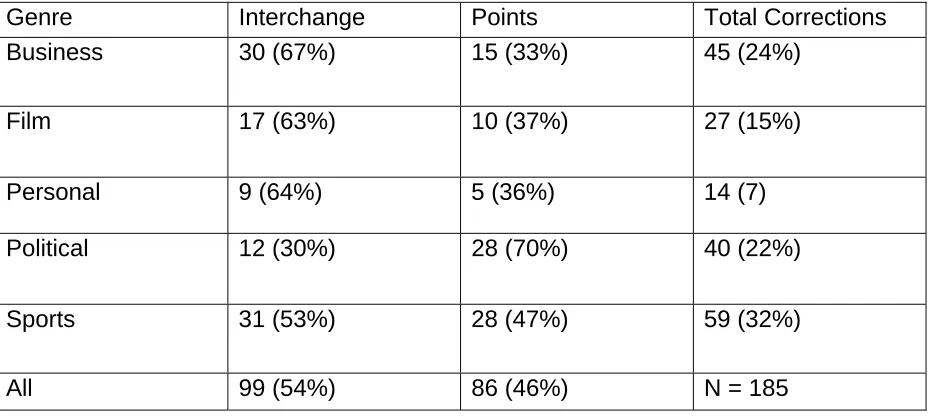
were sorted into two categories: interchange and points. Ninety-nine (54%) of the
corrections were part of an interchange and eighty-six (46%) of the corrections were
part of the points making game. (See Table 1)
It is here that support is found for the first hypothesis. Having observed
ninety-nine examples of the interchange, and eighty-six examples of the points making game,
it can be said that Goffman’s rituals of the interchange and points making game do
occur within blogs.
The data were next examined to determine how the steps of the interchange
were distributed and how many reversals of the points making game could be observed.
This examination of the data is important because it is these data that indicate how the
rituals were modified for online use. Challenge made up ninety-five of the ninety-nine
observed correction steps in an interchange. Seven observations were made of
offerings and one observation of thanks, with no observations of acceptance. It should
be noted that on three occasions an offering was given in conjunction with a challenge,
and that on one occasion the thanks was given in tandem with an offering. Of the
observations were of the initial accusation while eleven of the observations were of a
first step reversal. There were no examples of counter reversals or higher.
It is here that support is found for the second hypothesis. It is also here that the
first research question is answered. The interchange has changed from a four step
ritual to primarily a one step ritual consisting only of the challenge. Although a few
examples of offering and thanks were observed, no examples of acceptance were
found. It was also noted that the points making game occurred about 46% of the time.
Even though the points making occurrences were less than the observed interchange
occurrences, there are still more than would be expected since points making violates
the expressive order. Goffman states that maintaining the expressive order is
normative procedure. That being said, however, it must be noted that no points making
reversals were seen after the first reversal. This is consistent with Goffman’s findings.
With the second hypothesis addressed and the first research question
answered, this study could examine why the observed ritual modifications happened.
To accomplish this task an in-depth analysis of how corrections were distributed within
and between genres, as well as a qualitative analysis was needed. At this point, it
should be noted that the data gathered only provides a partial explanation of why the
rituals are modified. These explanations that follow in the discussion section are based
on the observations of the researcher. These are preliminary findings that invite further
Table 1: Distribution by Blog Genre and Overall Distribution of Corrections
Genre Interchange Points Total Corrections
Business 30 (67%) 15 (33%) 45 (24%)
Film 17 (63%) 10 (37%) 27 (15%)
Personal 9 (64%) 5 (36%) 14 (7)
Political 12 (30%) 28 (70%) 40 (22%)
Sports 31 (53%) 28 (47%) 59 (32%)
Discussion
To answer the second research question, the distribution of corrections between
genres was examined. The sports blogs had the most corrections with fifty-nine (32%).
It was followed by business blogs, with forty-five (24%) corrections; politics blogs, with
forty (22%) corrections; and film blogs, with twenty-seven (15%) corrections. Finally,
personal blogs only accounted for fourteen (8%) corrections.
Of the fifty-nine corrections observed in sports blogs, thirty-one (53%) were part
of an interchange and twenty-eight (47%) were part of the points making game. Of the
forty-five corrections observed in business blogs, thirty (67%) were part of the
interchange and fifteen (33%) were part of the points making game. Of the forty
corrections observed in political blogs, twelve (30%) were part of the interchange and
twenty-eight (70%) were part of the points making game. Of the twenty-seven
corrections observed in film blogs, seventeen (63%) were part of the interchange and
ten (37%) were part of the points making game. Finally, of the fourteen corrections
observed in personal blogs, nine (64%) were part of the interchange and five (36%)
were part of the points making game. The significance of these numbers is that
interchange corrections make up the majority of corrections in all genres save sports
and politics.
Sports blogs had the most corrections. The distribution of corrections on sports
blogs (53% interchange; 47% points) is very similar to the total distribution of
corrections (54% interchange 46% points). There are a number of possible
explanations for these findings. First, it is possible that factual information such as
corrections. Since it is possible for anyone to make a mistake, it is in the best interest of
all parties involved to help someone who has made a statistical or factual error save
face since the commenter’s next post might also contain an error.
Sports blog commenter, starz31 corrects another commenter, enterkrod, whose
original comment, said this about the Mets interest in signing Michael Young:
“might as well look into it..but why would we look into a shortstop role unless he would move to 2nd base?”
starz31 responds with:
“enterkrod: Young has played in over 300 games at 2B from his early years in Texas (some guy named Arod was playing SS at the time)
He’d be a great fit as a 2B and in our lineup, but unless they were taking a discount b/c of his contract, it wouldn’t be worth what we’d have to give up.”
enterkrod ends the interchange with:
“ohhhh ok..i would look into it..but im not gonna give up anything good to take him on”
Though enterkrod is correct in stating that Young is currently a short stop, he has put
himself in wrong face by failing to know the fact that Young played second base at the
beginning of his career. Failing to know this fact before making a comment places
starz31 in the position of having to correct enterkrod. This is one of the seven
situations where the challenged individual made an offering. The “ohhhh ok…”
indicates a realization of the challenged error. The sentence “…i would look into it..” is
the offering where enterkrod shows agreement with starz31 as well as the post which
he had previously questioned. The rest of the statement is meant to show expertise in
In the following example commenter, exick corrects a blogger, Kevin Arnovitz,
who made a mistake when making this rule based statement:
“The league has upheld Rasheed Wallace's two most recent technical [sic] fouls, which means the current count is at 10. When and if Wallace hits 16, he'll be suspended one game. Each subsequent T will cost him another game”
exick caught the mistake and made this challenge:
“On Rasheed's technicals, unless the league recently changed the rules, he will be suspended for one game for every other technical he receives starting with the 16th, not each subsequent one.”
This challenge leaves an opening for an offering because exick uses the qualifying
statement: …unless the league recently changed the rules…” This gives the blogger an
opportunity to admit fault and make amends. However, no offering was observed for
this interchange.
Second, sports fans have opinions that are often based on a favorite team and/or
player. In posts and comments where the team’s and/or the player’s abilities are
discussed and compared, there is a good chance that heated disagreement and points
making might occur. What will become more obvious as other genres are investigated
is that when there is an obvious situation of “in-group/out-group” discussion, there is a
good opportunity for points to be made. Also, since statistics are widely available in
sports, people will often back up their points making accusations with a statistical
argument.
Commenter, Twins GM, accuses another commenter, CubbyFan23, of making
this invalid opinionated quote about the Royals signing Willie Bloomquist: