39 G. Rattan and N. Singh Parihar / Journal of Chemical and Petroleum Engineering, 51 (1), June 2017 / 39-45
Viscosity Index Improver for Engine Oils:
An Experimental Study
Gaurav Rattan* and Nitu Singh Parihar
Dr. S.S. Bhatnagar University Institute of Chemical Engineering and Technology, Panjab University, Chandigarh, India
(Received 2015.10.11, Accepted 2017.06.17)
Abstract
Engine oils are widely used for lubrication purposes in automobile and related industries. Viscosity Index (VI) improver has found its largest commercial applications as additives to engine oils. Examples are pow-er stepow-ering fluid, aircraft piston engine oils, modpow-ern intpow-ernal-combus- internal-combus-tion engines, turbine engine oils (stainternal-combus-tionary and aircraft), and indus-trial gear oils. Viscosity Index improvers are added in the lube oils to reach the desired Viscosity Index (VI). The enhancement of VI of lube oils (Servoneum 100, Servopress 68, Servomesh SP 220, and Servocut 335) by the addition of viscosity index improvers (Methylmethacry-late (MMA), Polybutadiene rubber (PBR), and Polyisoprene-cis) has been studied. VI of blended oils, made from the lube oils (Servoneum 100, Servopress 68, Servomesh SP 220, and Servocut 335) by the ad-dition of MMA, PBR, and Polyisoprene-cis, has shown the potential to reach the maximum value. It has been found that the occurrence of maximum VI depends on the lube oil used and the type and concentra-tion of viscosity index improver.
Keywords
Lube oil;Methylmethacrylate; Polybutadiene rubber; Polyisoprene-cis; VI improvers; Viscosity index.
Introduction
1 * Corresponding Author. Tel./Fax: +918288071498E-mail: [email protected] (G. Rattan)
1. Introduction
he exponential rise of vehicles on roads has led to the simplicity in transportation, commutation, and several other means. For the smooth operations of these vehicles, the wear and tear of the engines should be minimum or negligible. Maintenance of these engines depends upon several factors, such as use of good fuels, proper lubrication, and time to time maintenance. With advancement in technology, the engine modification should be adopted properly. The fact
40 G. Rattan and N. Singh Parihar / Journal of Chemical and Petroleum Engineering, 51 (1), June 2017 / 39-45
could be blended with the lube oils to change some specific properties. One of the important parameters is viscosity index [4]. Viscosity of liq-uids is much greater than that of gases at the same temperature. It is an essential requirement that the engine lube oil must have low enough viscosity at low temperature and high enough viscosity at high temperature for the smooth op-eration of engine. Therefore, the viscosity chang-es with temperature must be minimum. The comparison of kinematic viscosity of the fluid to that of two reference fluids at 40⁰C and 100⁰C is generally adopted. Viscosity index improvers can be regarded as the key to high performance of multi-grade oil [6, 8]. They are generally oil-soluble polymers. The addition of these oil-soluble polymers can enhance the viscosity of the oil. Oils containing VI improver can achieve viscosity dex up to 150 [5]. The viscosity of engine oils in-creases with increase in temperature because engine oils include additives developed to reduce changes in viscosity [1]. As the number of poly-mers increases with the increase in concentration of VI improvers (polymers), the viscosity index of the oil also increases.
Ahmed et al. [5]reported that effectiveness of the prepared compounds became pronounced by in-creasing either the molecular weight of copoly-mer (140,000-236,000) or alkyl chain length (C8 -C12). The preparation of copolymers was evaluat-ed as VI improvers for lube oils (SAE 30). Estrifi-cation of acrylic acid was performed with alkyl chain length alcohols (octyl, decyl, octadecyl, tetradecyl, and hexadecyl) (C8 to C16) and con-firmed by FTIR spectrometry. Then, copolymers were tested for solubility and molecular weight was determined by Gel Permeation Chromatog-raphy.
The viscosity index is determined according to the ASTMD-2270-87 formula:
𝑉𝑉𝑉𝑉 = 100 × [(𝐿𝐿 − 𝑈𝑈) (𝐿𝐿 − 𝐻𝐻)⁄ ] (1) Values of L and H are obtained from the tables of ASTM D-2270-87, where the basic kinematic vis-cosity at 100⁰C is equal to or more than 2cSt and less than 70cSt. When the basic kinematic viscosi-ty at 100⁰C is above 70cSt, the values of L and H
are calculated as follows:
𝐿𝐿 = 0.8353 𝑌𝑌2 + 14.67 𝑌𝑌 − 216 (2)
𝐻𝐻 = 0.1684 𝑌𝑌2 + 11.85 𝑌𝑌 − 97 (3)
If the measured viscosity at 100⁰C is not listed in the tables, within the range of 2–70cSt, the corre-sponding values of L and H can be obtained by linear interpolation. When the calculated VI is above 100cSt, it has to be recalculated as follows
𝑌𝑌𝑌𝑌 = 𝐻𝐻 𝑈𝑈⁄ (4)
𝑌𝑌 = (log 𝐻𝐻 − log 𝑈𝑈) log 𝑌𝑌⁄ (5)
𝑉𝑉𝑉𝑉 = [ (𝑒𝑒𝑁𝑁) − 1] (0.00715) + 100⁄ (6) Ghosh et al. [11]used the polymethacrylate, ole-fin copolymer, and hydrogenated styrene-isoprene copolymer as viscosity modifiers in lub-ricants with polymer concentrations of 0.5 to 4%w/w in five high-viscosity indices and one medium-viscosity index using Bosch injector shear rig and ASTM D-3945 method. The effect of mineral oil (base stock) viscosity and its composi-tion were studied. It was found that there was no correlation between shear stability index values based on kinematic viscosities and those based on high temperature, high shear viscosities.
2
.
Experimental Section
2.1. Material
The lube oils (Servoneum 100, Servocut 335, Ser-vopress 68, and Servomesh SP 220) were ob-tained from Indian Oil Corporation Limited, Pani-pat, and viscosity index improvers (PBR, MMA, and Polyisoprene-cis) were obtained from Sigma, Loba Chemie, and Aldrich, respectively.
2.2. Method
con-41 G. Rattan and N. Singh Parihar / Journal of Chemical and Petroleum Engineering, 51 (1), June 2017 / 39-45
could be blended with the lube oils to change some specific properties. One of the important parameters is viscosity index [4]. Viscosity of liq-uids is much greater than that of gases at the same temperature. It is an essential requirement that the engine lube oil must have low enough viscosity at low temperature and high enough viscosity at high temperature for the smooth op-eration of engine. Therefore, the viscosity chang-es with temperature must be minimum. The comparison of kinematic viscosity of the fluid to that of two reference fluids at 40⁰C and 100⁰C is generally adopted. Viscosity index improvers can be regarded as the key to high performance of multi-grade oil [6, 8]. They are generally oil-soluble polymers. The addition of these oil-soluble polymers can enhance the viscosity of the oil. Oils containing VI improver can achieve viscosity dex up to 150 [5]. The viscosity of engine oils in-creases with increase in temperature because engine oils include additives developed to reduce changes in viscosity [1]. As the number of poly-mers increases with the increase in concentration of VI improvers (polymers), the viscosity index of the oil also increases.
Ahmed et al. [5]reported that effectiveness of the prepared compounds became pronounced by in-creasing either the molecular weight of copoly-mer (140,000-236,000) or alkyl chain length (C8 -C12). The preparation of copolymers was evaluat-ed as VI improvers for lube oils (SAE 30). Estrifi-cation of acrylic acid was performed with alkyl chain length alcohols (octyl, decyl, octadecyl, tetradecyl, and hexadecyl) (C8 to C16) and con-firmed by FTIR spectrometry. Then, copolymers were tested for solubility and molecular weight was determined by Gel Permeation Chromatog-raphy.
The viscosity index is determined according to the ASTMD-2270-87 formula:
𝑉𝑉𝑉𝑉 = 100 × [(𝐿𝐿 − 𝑈𝑈) (𝐿𝐿 − 𝐻𝐻)⁄ ] (1) Values of L and H are obtained from the tables of ASTM D-2270-87, where the basic kinematic vis-cosity at 100⁰C is equal to or more than 2cSt and less than 70cSt. When the basic kinematic viscosi-ty at 100⁰C is above 70cSt, the values of L and H
are calculated as follows:
𝐿𝐿 = 0.8353 𝑌𝑌2 + 14.67 𝑌𝑌 − 216 (2)
𝐻𝐻 = 0.1684 𝑌𝑌2 + 11.85 𝑌𝑌 − 97 (3)
If the measured viscosity at 100⁰C is not listed in the tables, within the range of 2–70cSt, the corre-sponding values of L and H can be obtained by linear interpolation. When the calculated VI is above 100cSt, it has to be recalculated as follows
𝑌𝑌𝑌𝑌 = 𝐻𝐻 𝑈𝑈⁄ (4)
𝑌𝑌 = (log 𝐻𝐻 − log 𝑈𝑈) log 𝑌𝑌⁄ (5)
𝑉𝑉𝑉𝑉 = [ (𝑒𝑒𝑁𝑁) − 1] (0.00715) + 100⁄ (6) Ghosh et al. [11]used the polymethacrylate, ole-fin copolymer, and hydrogenated styrene-isoprene copolymer as viscosity modifiers in lub-ricants with polymer concentrations of 0.5 to 4%w/w in five high-viscosity indices and one medium-viscosity index using Bosch injector shear rig and ASTM D-3945 method. The effect of mineral oil (base stock) viscosity and its composi-tion were studied. It was found that there was no correlation between shear stability index values based on kinematic viscosities and those based on high temperature, high shear viscosities.
2
.
Experimental Section
2.1. Material
The lube oils (Servoneum 100, Servocut 335, Ser-vopress 68, and Servomesh SP 220) were ob-tained from Indian Oil Corporation Limited, Pani-pat, and viscosity index improvers (PBR, MMA, and Polyisoprene-cis) were obtained from Sigma, Loba Chemie, and Aldrich, respectively.
2.2. Method
200ml of lube oil was put in a glass beaker. Elec-trically operated magnetic stirrer produced by Heidolph, Germany, was used for blending the lube oil at 500rpm and 30⁰C in order to avoid foaming. The viscosity index improver was then added to the lube oil by taking necessary precau-tions. Each sample was blended for about 1h, which was enough for proper sample formation. After blending, the prepared sample oil was test-ed for the kinematic viscosity measurement at 40⁰C and 100⁰C, which were determined by Red-wood viscometer no. 1 [13]. For each kinematic viscosity measurement, the sample oil was kept at constant temperature for 30min in order to attain the thermodynamic equilibrium. The tem-perature of the sample oil was maintained
con-stant with the help of K – type controller. The flow time was measured with electronic stop-watch with precision of ±0.1sec. The efflux time was repeated at least 3 times for each concentra-tion. The uncertainty of values was within ±0.005mm2/s. The kinematic viscosities were measured by using calibrated Redwood viscome-ter no. 1. The calibration was done using standard oils whose kinematic viscosities were reported in literature.
2.3. Equations [12]
When the temperature attains the standard tem-peratures (i.e., 40⁰C & 100⁰C), the orifice of the viscometer is unsealed and the efflux time is not-ed for 50mL of the sample. This efflux time is put into Eq. 7 and the kinematic viscosity is calculated as
ʋ
in mm²/s:ʋ = 𝐴𝐴𝐴𝐴 − 𝐵𝐵 𝐴𝐴⁄ (7) where, A is instrument calibration constant, B is instrumental type constant depending on the ca-pillary diameter, and t is an efflux time in sec-onds.
Viscosity index is calculated by the following equations. When the kinematic viscosity is above 70mm²/s at 100°C, the values of
ʋ
𝐿𝐿,ʋ
𝐷𝐷, andʋ
𝐻𝐻are calculated as follows:
ʋ𝐿𝐿= 0.8353 ʋ𝑌𝑌2 + 14.67 ʋ𝑌𝑌− 216 (8)
ʋ𝐷𝐷= 0.6669 ʋ𝑌𝑌2 + 2.82 ʋ𝑌𝑌− 119 (9)
ʋ𝐻𝐻= 0.1684 ʋ𝑌𝑌2 + 2.82 ʋ𝑌𝑌− 97 (10) where
ʋ
𝑌𝑌 is the kinematic viscosity in mm²/s at100°C for the petroleum product whose viscosity index is to be calculated,
ʋ
𝐻𝐻 is the kinematicvis-cosity in mm²/s at 40°C of a petroleum product of viscosity index 100 having the same kinematic viscosity at 100°C as the petroleum product whose viscosity index is to be calculated, and
ʋ
𝐿𝐿is the kinematic viscosity in mm²/s at 40°C of a petroleum product of viscosity index zero (0) having the same kinematic viscosity at 100°C as the petroleum product whose viscosity index is to be calculated. By using values of
ʋ
𝐿𝐿,ʋ
𝐷𝐷, andʋ
𝐻𝐻,the viscosity index of the petroleum product is calculated as follows:
𝑉𝑉𝑉𝑉 = 100 × [(ʋ𝐿𝐿− ʋ𝑈𝑈) (ʋ⁄ 𝐿𝐿− ʋ𝐻𝐻)] (11)
where
ʋ
𝑈𝑈 is the kinematic viscosity in mm²/s at40°C of the petroleum product whose viscosity index is to be calculated.
For petroleum products of viscosity index 100 or greater, VI is calculated by the following equation:
𝑉𝑉𝑉𝑉 = [ (𝑒𝑒𝑁𝑁) − 1] 0.00715⁄ + 100 (12) Where N is the power required to raise the kine-matic viscosity of the oil at 100°C to make it equal to the ratios of the
ʋ
𝐻𝐻 andʋ
𝑈𝑈 kinematicviscosi-ties at 40°C.
𝑁𝑁 = (log ʋ𝐻𝐻− log ʋ𝑈𝑈) log ʋ⁄ 𝑌𝑌 (13) Similarly,
ʋ
𝑈𝑈 andʋ
𝑌𝑌 are the measured kinematicviscosities at 40°C and 100°C, respectively, for the liquid whose viscosity index has to be found, while
ʋ
𝐻𝐻 is the kinematic viscosity at 40°C for aliquid of viscosity index 100, which has the same kinematic viscosity at 100°C as the liquid whose viscosity index has to be found.
3
.
Results and Discussions
3.1. Effect of concentration of VI improver on
VI of blended oil
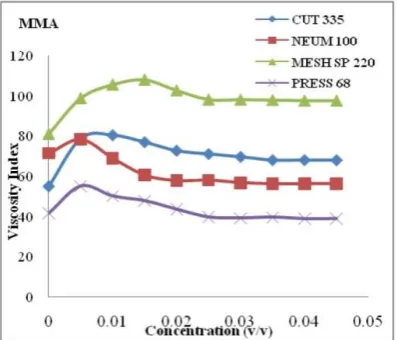
Figure 1. Variation of viscosity index of lube oils Servocut
335, Servoneum 100, Servomesh SP 220, and Servopress 68 with concentration of MMA
42 G. Rattan and N. Singh Parihar / Journal of Chemical and Petroleum Engineering, 51 (1), June 2017 / 39-45
of MMA and PBR expressed in v/v % and Polyiso-prene-cis in w/w %.
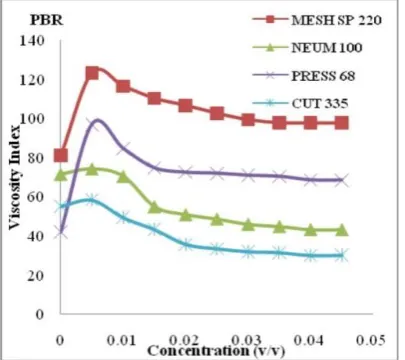
Figure 2. Variation of viscosity index of lube oils
Servo-mesh SP 220, Servoneum 100, Servopress 68, and Ser-vocut 335 with concentration of PBR
These figures depict the effectiveness of MMA/PBR/Polyisoprene-cis for different lube
oils. The concentrations of
MMA/PBR/Polyisoprene-cis vary in the range of 0 to 4.5v/v%. From this figure, it can be seen that
VI of the blended oil made from lube oil Servocut 335 and MMA/PBR/Polyisoprene-cis reaches the maximum with increase in the concentration of MMA/PBR/Polyisoprene-cis. The similar curves are obtained for lube oils Servoneum 100, Servo-mesh SP 220, and Servopress 68. It can be seen from these figures that the maximum VI is ob-tained at different concentrations of MMA/PBR/Polyisoprene-cis. These concentra-tions are 1, 0.5, 1.5, and 0.5 v/v% for MMA; 0.5, 0.5, 0.5, and 0.5 v/v% for PBR; and 0.5, 0.5, 1, and 0.5 wt./wt.% for Polyisoprene-cis for lube oils Servocut 335, Servoneum 100, Servomesh SP 220, and Servopress 68, respectively. The maxi-mum possible VIs of blended oils Servocut 335, Servoneum 100, Servomesh SP 220, and Servo-press 68 by addition of MMA, PBR, and Polyiso-prene-cis are 80, 78, 108, and 55; 58, 74, 123, and 97; and 72, 78, 113, and 100, respectively. These figures are helpful in selecting the lube oil for producing multi-grade engine oils of desired vis-cosity index by the addition of MMA, PBR, and Polyisoprene-cis.
Figs. 4 and 5 are plots of VI,
(ʋ
𝐿𝐿− ʋ
𝑈𝑈)
and(ʋ
𝐿𝐿− ʋ
𝐻𝐻)
, for lube oil Servomesh SP 220 versusconcentrations of PBR and MMA. It can be seen from the figures that with increase in the concen-tration of VI improver,
(ʋ
𝐿𝐿− ʋ
𝑈𝑈)
first increasesand then decreases, but
(ʋ
𝐿𝐿− ʋ
𝐻𝐻)
increasesmonotonically. By definition, VI is the ratio of
(ʋ
𝐿𝐿− ʋ
𝑈𝑈)
to(ʋ
𝐿𝐿− ʋ
𝐻𝐻)
. Therefore, VI ofblended oils reaches maxima with increase in the concentration of VI improver.
Figure 3. Variation of viscosity index of lube oils
Servo-mesh SP 220, Servoneum 100, Servopress 68, and Ser-vocut 335 with concentration of Polyisoprene-cis
Figure 4. Variation of viscosity index and kinematic
43 G. Rattan and N. Singh Parihar / Journal of Chemical and Petroleum Engineering, 51 (1), June 2017 / 39-45
Figure 5. Variation of viscosity index and kinematic
vis-cosity of lube oil Servomesh SP 220 with concentration of MMA
3.2. Effect of concentration of VI improver on kinematic viscosity of blended oil
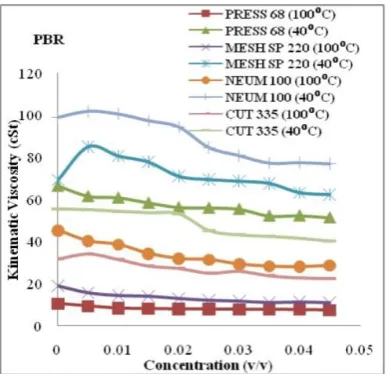
Fig. 6 is a plot of kinematic viscosity of blended oils, made from lube oils Servocut 335, Servo-neum 100, Servomesh SP 220, and Servopress 68
by addition of PBR at 40⁰C and 100⁰C versus co
n-centration of PBR. This figure indicates that the kinematic viscosity of blended oils decreases with increase in the concentration of PBR. It also indi-cates that the rate of change of kinematic viscosi-ty of a blended oil, made from a lube oil by
addi-tion of PBR, at 40⁰C with concentraaddi-tion of PBR is
higher than its value at 100⁰C.
Figure 6. Variation of kinematic viscosity of lube oils
vocut 335, Servoneum 100, Servomesh SP 220, and
Ser-vopress 68 with concentration of PBR at 40 and 100⁰C
Figure 7. Variation of kinematic viscosity of lube oils
vocut 335, Servoneum 100, Servomesh SP 220, and
Ser-vopress 68 with concentration of MMA at 40 and 100⁰C
Fig. 7 is a plot of kinematic viscosity of blended oils, made from lube oils Servocut 335, Servo-neum 100, Servomesh SP 220, and Servopress 68
by addition of MMA, at 40⁰C and 100⁰C, versus concentration of MMA. This figure indicates that the kinematic viscosity of blended oils decreases with increase in the concentration of MMA. It also indicates that the rate of change of kinematic vis-cosity of a blended oil, made from a lube oil by
addition of MMA, at 40⁰C with concentration of
MMA is higher than its value at 100⁰C.
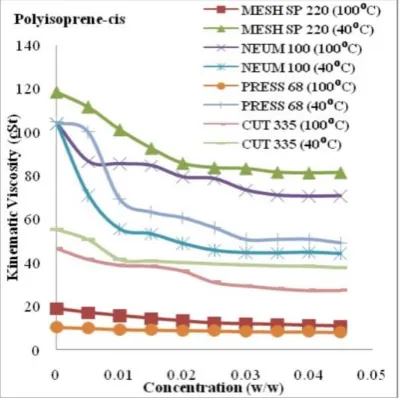
Fig. 8 is a plot of kinematic viscosity of blended oils, made from lube oils Servocut 335, Servo-neum 100, Servomesh SP 220, and Servopress 68 by addition of Polyisoprene-cis, at 40⁰C and
100⁰C versus concentration of Polyisoprene-cis.
This figure indicates that the kinematic viscosity of blended oils decreases with increase in the concentration of Polyisoprene-cis.
It also indicates that the rate of change of kine-matic viscosity of a blended oil, made from a lube oil by addition of Polyisoprene-cis, at 40⁰C with
concentration of Polyisoprene-cis is higher than
its value at 100⁰C. Hence, the difference in
kine-matic viscosities of blended oil at 40⁰C and 100⁰C
increases with increase in the concentrations of MMA, PBR, and Polyisoprene-cis for all lube oils.
The variation of the kinematic viscosity at 100⁰C
44 G. Rattan and N. Singh Parihar / Journal of Chemical and Petroleum Engineering, 51 (1), June 2017 / 39-45
Figure 8. Variation of kinematic viscosity of lube oils
vocut 335, Servoneum 100, Servomesh SP 220, and Ser-vopress 68 with concentration of Polyisoprene-cis at 40
and 100⁰C
4
.
Conclusions
The conclusions drawn from the research study are as follows:
1. The maximum VIs of blended oils made from Servocut 335, Servoneum 100, Servomesh SP 220, and Servopress 68 were found to be 80, 78, 108, and 55 at 1, 0.5, 1.5, and 0.5v/v% of MMA, respectively.
2. The maximum VIs of blended oils made from Servocut 335, Servoneum 100, Servomesh SP 220, and Servopress 68 were found to be 58, 74, 123, and 97 at 0.5, 0.5, 0.5, and 0.5v/v% of PBR, respectively.
3. The maximum VIs of blended oils made from Servocut 335, Servoneum 100, Servomesh SP 220, and Servopress 68 were found to be 72, 78, 113, and 100 at 0.5, 0.5, 1, and 0.5w/w% of Polyisoprene-cis, respectively.
4. The difference in the kinematic viscosities of blended oils at 40⁰C and 100⁰C is found to i n-crease with inn-crease in the concentrations of MMA, PBR, and Polyisoprene-cis for all lube oils.
5. VI of blended oils, made from the lube oils Servoneum 100, Servopress 68, Servomesh SP 220, and Servocut 335 with these particular VI
improvers, i.e., MMA, PBR, and Polyisoprene-cis, has not been considered so far.
Acknowledgement
The authors would like to thank Technical Educa-tion Quality Improvement Programme (TEQIP-II) for their financial support and The Almighty.
References
1. Ramasamy, U.S., Lichter, S. and Martini, A. (2016). “Effect of Molecular-Scale Features on the Polymer Coil Size of Model Viscosity Index Improvers.” Tribol Lett, Vol. 62, pp. 23.
2. Covitch, M.J. and Trickett, K.J. (2015). “How Polymers Behave as Viscosity Index Improvers in Lubricating Oils.” Petroleum Science and Technology, Vol. 5.
3. Upadhyay, U. Dey, K. and Ghosh, P. (2014). “Multifunctional additives performance of liq-uid crystal blended deodecylacrylate in lube oil.” Indian Journal of Chemical Technology, Vol. 21, pp. 244-248.
4. Ghosh, P. and Das, M. (2014). “Study of the i n-fluence of some polymeric additives as viscosi-ty index improvers and pour point depres-sants – Synthesis and characterization.” Jour-nal of Petroleum Science and Engineering, Vol. 119, pp. 79-84.
5. Mohamad, S.A., Ahmed, N.S., Hassanein, S.M. and Rashad. A.M. (2012). “Investigation of po l-yacrylates copolymers as lube oil viscosity in-dex improvers.” Journal of Petroleum Science and Engineering, Vol. 100, pp. 173–177. 6. Nassar, A.M. and Ahmed, N.S. (2010). “Study
the Influence of Some Polymeric Additives as Viscosity Index Improvers, Pour Point Depres-sants and DisperDepres-sants for Lube Oil.” Petroleum Science and Technology, Vol. 28.
7. Mohammed, A.H.A.K. and Shehab, A. K.-Rubai. (2008). “Viscosity Index Improvement of L u-bricating Oil Fraction (SAE – 30).” Petroleum Science and Technology, Vol. 9, pp. 51-57. 8. Fan, J., Muller, M., Stohr, T. and Spikes, H.A.
(2007). “Reduction of Friction by Functiona l-ised Viscosity Index Improvers.” Springer, Vol. 28.
45 G. Rattan and N. Singh Parihar / Journal of Chemical and Petroleum Engineering, 51 (1), June 2017 / 39-45
Figure 8. Variation of kinematic viscosity of lube oils
vocut 335, Servoneum 100, Servomesh SP 220, and Ser-vopress 68 with concentration of Polyisoprene-cis at 40
and 100⁰C
4
.
Conclusions
The conclusions drawn from the research study are as follows:
1. The maximum VIs of blended oils made from Servocut 335, Servoneum 100, Servomesh SP 220, and Servopress 68 were found to be 80, 78, 108, and 55 at 1, 0.5, 1.5, and 0.5v/v% of MMA, respectively.
2. The maximum VIs of blended oils made from Servocut 335, Servoneum 100, Servomesh SP 220, and Servopress 68 were found to be 58, 74, 123, and 97 at 0.5, 0.5, 0.5, and 0.5v/v% of PBR, respectively.
3. The maximum VIs of blended oils made from Servocut 335, Servoneum 100, Servomesh SP 220, and Servopress 68 were found to be 72, 78, 113, and 100 at 0.5, 0.5, 1, and 0.5w/w% of Polyisoprene-cis, respectively.
4. The difference in the kinematic viscosities of blended oils at 40⁰C and 100⁰C is found to i n-crease with inn-crease in the concentrations of MMA, PBR, and Polyisoprene-cis for all lube oils.
5. VI of blended oils, made from the lube oils Servoneum 100, Servopress 68, Servomesh SP 220, and Servocut 335 with these particular VI
improvers, i.e., MMA, PBR, and Polyisoprene-cis, has not been considered so far.
Acknowledgement
The authors would like to thank Technical Educa-tion Quality Improvement Programme (TEQIP-II) for their financial support and The Almighty.
References
1. Ramasamy, U.S., Lichter, S. and Martini, A. (2016). “Effect of Molecular-Scale Features on the Polymer Coil Size of Model Viscosity Index Improvers.” Tribol Lett, Vol. 62, pp. 23.
2. Covitch, M.J. and Trickett, K.J. (2015). “How Polymers Behave as Viscosity Index Improvers in Lubricating Oils.” Petroleum Science and Technology, Vol. 5.
3. Upadhyay, U. Dey, K. and Ghosh, P. (2014). “Multifunctional additives performance of liq-uid crystal blended deodecylacrylate in lube oil.” Indian Journal of Chemical Technology, Vol. 21, pp. 244-248.
4. Ghosh, P. and Das, M. (2014). “Study of the i n-fluence of some polymeric additives as viscosi-ty index improvers and pour point depres-sants – Synthesis and characterization.” Jour-nal of Petroleum Science and Engineering, Vol. 119, pp. 79-84.
5. Mohamad, S.A., Ahmed, N.S., Hassanein, S.M. and Rashad. A.M. (2012). “Investigation of po l-yacrylates copolymers as lube oil viscosity in-dex improvers.” Journal of Petroleum Science and Engineering, Vol. 100, pp. 173–177.
6. Nassar, A.M. and Ahmed, N.S. (2010). “Study the Influence of Some Polymeric Additives as Viscosity Index Improvers, Pour Point Depres-sants and DisperDepres-sants for Lube Oil.” Petroleum Science and Technology, Vol. 28.
7. Mohammed, A.H.A.K. and Shehab, A. K.-Rubai. (2008). “Viscosity Index Improvement of L u-bricating Oil Fraction (SAE – 30).” Petroleum Science and Technology, Vol. 9, pp. 51-57. 8. Fan, J., Muller, M., Stohr, T. and Spikes, H.A.
(2007). “Reduction of Friction by Functiona l-ised Viscosity Index Improvers.” Springer, Vol. 28.
9. Tanveer, S. and Prasad, R. (2006). “Enhanc e-ment of viscosity index of mineral base oils.”
Indian Journal of Chemical Technology, Vol. 13, pp. 398-403.
10. Nassar, A.M., Ahmed, N.S., Kamal, R.S., Abdel Azim, A.A.A. and Nagdy, E.I. (2005). “Prepara-tion and Evalua“Prepara-tion of Acrylate Polymers as Viscosity Index Improvers for Lube Oil.” Petro-leum Science and Technology, Vol. 23, pp. 537-546.
11. Ghosh, P., Pantar, A.V., Rao, U.S. and Sarma, A.S. (1998). “Shear stability of polymers used as viscosity modifiers in lubricating oils.” Indi-an Journal of Chemical Technology, Vol. 5, pp. 309-314.
12. IS: l448 (P: 56) 1980 (Indian Standards on Viscosity Index Calculation).