F. Toutounian and D. Hezari
Abstract
For solving large sparse non-Hermitian positive definite linear equations, Bai et al. proposed the Hermitian and skew-Hermitian splitting methods (HSS). They re-cently generalized this technique to the normal and skew-Hermitian splitting meth-ods (NSS). In this paper, we present an accelerated normal and skew-Hermitian splitting methods (ANSS) which involve two parameters for the NSS iteration. We theoretically study the convergence properties of the ANSS method. Moreover, the contraction factor of the ANSS iteration is derived. Numerical examples illustrating the effectiveness of ANSS iteration are presented.
Keywords: Non-Hermitian matrix; Normal matrix; Hermitian matrix; Skew-Hermitian matrix; Splitting iteration method.
1 Introduction
Many problems in scientific computation give rise to solving the linear system
Ax=b, (1)
withA∈Cn×na large non-Hermitian positive definite matrix andx, b∈Cn. We observe that the coefficient matrixAnaturally possesses the Hermitian/skew-Hermitian (HS) splitting
A=H+S,
where
H =1 2(A+A
∗) and S = 1
2(A−A
∗),
withA∗ being the conjugate transpose ofA. Bai et al. [2] presented the HSS iteration method: Given an initial guess x(0) ∈Cn, fork = 0,1,2, . . ., until
F. Toutounian
Department of Applied Mathematics, Faculty of Mathematical Sciences, Ferdowsi Univer-sity of Mashhad, Mashhad, Iran. e-mail: [email protected]
Davood Hezari
Department of Applied Mathematics, Faculty of Mathematical Sciences, Ferdowsi Univer-sity of Mashhad, Mashhad, Iran. e-mail: hezari [email protected]
31
Accelerated normal and
{x(k)}converges, compute
(αI+H)x(k+12)= (αI−S)x(k)+b,
(αI+S)x(k+1)= (αI−H)x(k+12)+b, (2)
where α is a given positive constant. They have also proved that for any positiveα, the HSS method converges unconditionally to the unique solution of the system of linear equations.
Moreover, based on the HS splitting, Li et al. [5] presented the asymmet-ric Hermitian/skew-Hermitian splitting (AHSS) iteration method: Given an initial guess x(0)∈Cn, fork= 0,1,2, . . ., until {x(k)} converges, compute
(αI+H)x(k+12)= (αI−S)x(k)+b,
(βI+S)x(k+1)= (βI−H)x(k+12)+b, (3)
where αis a given nonnegative constant andβ is a given positive constant. They proved that if the coefficient matrix A is positive definite (Hermitian or non-Hermitian) the AHSS iteration converges to the unique solution of linear system (1) with any given nonnegativeα, ifβ is restricted to an appropriate region.
Bai et al. [1] recently generalized the HS splitting to the normal/skew-Hermitian (NS) splitting
A=N+S, (4)
where N ∈ Cn×n is a normal matrix and S ∈ Cn×n is a skew-Hermitian matrix, and obtained the following normal/skew-Hermitian splitting (NSS) method to iteratively compute a reliable and accurate approximate solution for the system of linear equations (1):
The NSS iteration method:Given an initial guessx(0)∈Cn. Fork= 0,1,2. . . until{x(k)} converges, compute
(αI+N)x(k+12)= (αI−S)x(k)+b,
(αI+S)x(k+1)= (αI−N)x(k+12)+b, (5)
where α is a given positive constant. They have also proved that for any positiveαthe NSS method converges unconditionally to the unique solution of the system of linear equations.
skew-Hermitian, but it is not dependent on the eigenvectors of the matricesN, S andA.
The organization of this paper is as follows. In section 2, we establish the ANSS iteration and study its convergence properties. Numerical experiments are presented in section 3 to show the effectiveness of our method. Finally, in section 4, some concluding remarks are given.
2 The ANSS Method
Throughout the paper, the non-Hermitian matrix A∈Cn×n ( i.e. A=A∗) is positive definite if its Hermitian part is Hermitian positive definite.
Based on the NSS iteration (5), in this paper we present a new approach to solve the system of linear equations (1), called the ANSS iteration, and it is as follows.
The ANSS iteration method: Given an initial guess x(0) ∈ Cn, for k = 0,1,2. . . until{x(k)}converges, compute
(αI+N)x(k+12)= (αI−S)x(k)+b,
(βI+S)x(k+1)= (βI−N)x(k+12)+b, (6)
whereαis a given nonnegative constant andβ is a given positive constant. The ANSS iteration alternates between the normal matrix N and the skew-Hermitian matrixS. In fact, we can reverse the roles of the matricesN andS in the above ANSS iteration so that we may first solve the system of linear equations with coefficient matrixβI+S and then solve the system of linear equations with coefficient matrixαI+N.
Note that both αI+N and βI+S are normal matrices. Therefore, the linear systems with the coefficient matrices αI +N and βI +S may be solved accurately and efficiently by some Krylov subspace iteration methods, e.g. GMRES. It is known that the GMRES method naturally reduces to an iterative process of the three-term recurrence. See [4, 3] for other iteration methods about solving large sparse normal system of linear equations.
In matrix-vector form, the ANSS iteration method can be equivalently rewritten as
x(k+1)=M(α, β)x(k)+G(α, β)b, k= 0,1,2, . . . , (7)
where
M(α, β) = (βI+S)−1(βI−N)(αI+N)−1(αI−S) (8)
and
Here, M(α, β) is the iteration matrix of the ANSS iteration. In fact, (7) may also result from the splitting
A=B(α, β)−C(α, β)
of the coefficient matrixA, with ⎧
⎪ ⎪ ⎪ ⎨ ⎪ ⎪ ⎪ ⎩
B(α, β) = 1
α+β(αI+N)(βI+S)
C(α, β) = 1
α+β(βI−N)(αI−S).
(9)
Obviously
M(α, β) =B(α, β)−1C(α, β) and G(α, β) =B(α, β)−1.
To study the convergence properties of the ANSS iteration and derive the upper bound of the contraction factor, we first represent the following lem-mas.
Lemma 2.1.Let α be a nonnegative constant and β be a positive constant. If (γ, η)∈Ω, whereΩ= [γmin, γmax]×[ηmin, ηmax], γmin >0 and ηmin≥0, then
f(α, β)≡ max
(γ,η)∈Ω (β
−γ)2+η2
(α+γ)2+η2
= ⎧ ⎪ ⎪ ⎪ ⎪ ⎨ ⎪ ⎪ ⎪ ⎪ ⎩
max
γmin≤γ≤β−2α
(β
−γ)2+η2 min
(α+γ)2+ηmin2
for γmin≤ β−α 2
max
γmin≤γ≤γmax
(β
−γ)2+η2 max
(α+γ)2+ηmax2
for β−α
2 ≤γmin.
(10)
Proof. Let us define the functiong(η) by
g(η) = (β−γ)2+η2 (α+γ)2+η2.
Differentiation gives
g(η) = 2η(α+β)(α−β+ 2γ)
[(α+γ)2+η2]2 .
Since (α+β)>0, it follows that the functiong(η) is an increasing function
ifγ≥β−α
2 and is a decreasing function ifγ≤ β−α
If β−α
2 ≤ γmin, then for all γ satisfying γmin ≤ γ ≤ γmax, we have β−α
2 ≤ γ. So, for γmin ≤ γ ≤ γmax, the function g(η) is an increasing function, and
f(α, β) = max
γmin≤γ≤γmax
(β
−γ)2+η2 max
(α+γ)2+ηmax2
if γmin≤ β−α
2 . (11)
If γmin ≤ β−α
2 , then, by using β +α > 0, for all γ satisfying γmin ≤ β−α
2 ≤γ,we obtain (β−γ)
2≤(α+γ)2, which implies that
(β−γ)2+η2
(α+γ)2+η2 ≤1.
Similarly, for allγsatisfyingγmin≤γ≤ β−α
2 , we obtain (β−γ)
2≥(α+γ)2
and
(β−γ)2+η2
(α+γ)2+η2 ≥1. Therefore,
f(α, β) = max
γmin≤γ≤β−2α,ηmin≤η≤ηmax
(β−γ)2 +η2 (α+γ)2+η2
, if γmin≤ β−α 2
From the fact that, for γmin ≤γ≤ β−α
2 , the function g(η) is a decreasing function, we can conclude that
f(α, β) = max
γmin≤γ≤β−2α
(β
−γ)2+η2 min
(α+γ)2+ηmin2
, if γmin≤ β−α
2 (12)
Therefore (11) and (12) immediately result relation (10).
Lemma 2.2.Let α be a nonnegative constant and β be a positive constant. If β−α
2 ≤γmin, where0< γmin, then
max
γmin≤γ≤γmax
(β−γ)2+η2max (α+γ)2+η2max
= max
(β−γmin)2+η2max (α+γmin)2+η2max,
(β−γmax)2+ηmax2 (α+γmax)2+ηmax2
(13)
Proof. Let us define the functiong(γ) by
g(γ) =(β−γ)2+ηmax2
(α+γ)2+η2max.
g(γ) =−2(α+β)
−γ2+ (β−α)γ+βα+η2 max
[(α+γ)2+ηmax2 ]2 .
The smallest root ofg(γ) is negative and is not in the interval [γmin, γmax]. The largest root ofg(γ) is
γ1= (β−α) +
(β−α)2+ 4(βα+η2 max)
2 .
By simple computation, we can show that this root is a minimum point for the functiong(γ). Hence (13) holds and the proof of Lemma is completed.
Lemma 2.3.Let α be a nonnegative constant and β be a positive constant. If 0< γmin≤β−α
2 , then
f(α, β) = max
γmin≤γ≤β−2α
(β
−γ)2+η2 min
(α+γ)2+η2min
= (β−γmin)2+η2min (α+γmin)2+ηmin2 .
Proof. Let us define the functionh(γ) by
h(γ) = (β−γ)2+η2min
(α+γ)2+ηmin2 .
Differentiation gives
h(γ) = −2(α+β)
(β−γ)(α+γ) +ηmin2 [(α+γ)2+η2min]2
Since (α+β) > 0 and γ ≤ β, for all γ satisfying γmin ≤ γ ≤ γmax and γ≤β−α
2 , we haveh
(γ)<0. Thus
f(α, β) =(β−γmin)2+ηmin2 (α+γmin)2+η2min.
The following theorem describes the convergence property of the ANSS iteration.
δ(α, β)≡ max
σj∈σ(S)
α2+σ2
j
β2+σ2
j
max
γj+iηj∈λ(N)
(β−γj)2+ηj2
(α+γj)2+η2j (14)
where λ(N) is the spectral set of N and σ(S) is the singular-value set of
S. Let γmin and γmax, ηmin and ηmax be the lower and the upper bound of the real, the absolute values of the imaginary parts of the eigenvalues of the matrix N, respectively, and σmin,σmax be the lower and the upper bound of the singular-value set of the matrix S, respectively. Then δ(α, β)<1 if one of the following conditions holds:
(a) Any given parameterαandβ satisfies
max
α(γ2
min+ηmax2 )
2αγmin+γmin2 +ηmax2 ,
α(γ2
max+ηmax2 )
2αγmax+γmax2 +η2max
< β≤α+ 2γmin
(b) Any given parameterαandβ satisfies
α+ 2γmin< β
if σmax≤√γmin+ηmin+ 2γminα. (c) Any given parameterαandβ satisfies
α+ 2γmin< β≤ α(γmin2 +ηmin2 −σ2max)−2σmax2 γmin
γ2
min+ηmin2 −σ2max+ 2αγmin
if σmax≥√γmin+ηmin+ 2γminα.
Proof. By the similarity invariance of the matrix spectrum, we have
ρ(M(α, β)) =ρ((βI−N)(αI+N)−1(αI−S)(βI+S)−1)
≤ (βI−N)(αI+N)−12(αI−S)(βI+S)−12.
LettingQ(α, β) = (αI−S)(βI+S)−1 and noting thatS∗=−S, we have Q(α, β)∗Q(α, β) =(αI−S)(βI+S)−1 ∗(αI−S)(βI+S)−1
= (βI−S)−1(αI+S)(αI−S)(βI+S)−1
= (αI−S)(βI+S)−1(βI−S)−1(αI+S) =Q(α, β)Q(α, β)∗
That is to say,Q(α, β) is a normal matrix. Therefore, there exists a unitary matrixU ∈Cn×nand a complex diagonal matrixq = diag(˜λ1,λ˜2, . . . ,˜λn)∈ Cn×n such that Q(α, β) = U∗
Q(α, β)x= ˜λx (αI−S)(βI+S)−1x= ˜λx (βI+S)−1(αI−S)x= ˜λx
(αI−S)x= ˜λ(βI+S)x
If ˜λ=−1, then
Sx= α− ˜ λβ
1 + ˜λ x (15)
If ˜λ=−1, then
(α+β)x= 0.
Since α+β > 0, it implies x = 0, and this contradicts the definition of eigenvector. Therefore ˜λ=−1 can not be an eigenvalue ofQ(α, β).
From (15), α−λβ˜
1 + ˜λ is an eigenvalue ofSandxis an associated eigenvector. Since S is a skew-Hermitian matrix, its eigenvalues are pure imaginary and thus of the formiτj,j= 1, . . . , n, whereτj∈R, So
˜
λj =α−iτj β+iτj,
whereiτj is an eigenvalue of S. Therefore
Q(α, β)2=U∗∧qU2= ∧q2= max
σj∈σ(S)
α2+σ2
j
β2+σ2
j
. (16)
Because N is a normal matrix, there exists a unitary matrix V ∈Cn×n and a complex diagonal matrix N = diag(λ1, λ2, . . . , λn) ∈ Cn×n such that N =V∗NV.Hence, we have
(αI+N)−1(βI−N)2= max
λj∈λ(N)
|β−λj | |α+λj |
= max
λj=γj+iηj∈λ(N)
(β−γj)2+η2j
(α+γj)2+η2j (17)
Now, from (16) and (17), we see that
ρ(M(α, β))≤ max
σj∈σ(S)
α2+σ2
j
β2+σ2
j
max
λj=γj+iηj∈λ(N)
(β−γj)2+ηj2 (α+γj)2+ηj2.
To prove (a), we note that, if β−α
2 ≤γmin, then β−α≤2γ forγmin≤ γ ≤γmax. By using 0 <(β+α), we obtain (β−γ)2 ≤(α+γ)2. Thus, by Lemma 2.1, we have
f(α, β) = max
γmin≤γ≤γmax
(β−γ)2 +ηmax2 (α+γ)2+ηmax2
≤1, for β−α
2 ≤γmin (18)
Moreover, ifβ > α, then max
σj∈σ(S)
α2+σ2
j
β2+σ2
j
<1, and therefore
(i) if α < β≤α+ 2γmin then δ(α, β)<1.
Ifβ ≤α, then max
σj∈σ(S)
α2+σ2
j
β2+σ2
j
≤αβ. By using (18), we have
δ(α, β)≤ αβ max
γmin≤γ≤γmax
(β−γ)2+η2 max
(α+γ)2+η2max.
So, in order to have the bound δ(α, β) < 1, the following inequality must hold
max
γmin≤γ≤γmax
(β−γ)2 +ηmax2 (α+γ)2+η2max
< β2
α2. (19)
By using the results of Lemma 2.2, the following inequalities must hold
(β−γmin)2+ηmax2 (α+γmin)2+η2max <
β2
α2 and
(β−γmax)2+η2max (α+γmax)2+η2max <
β2
α2 (20)
By simple computation, we can show that, forα+β >0, these two inequalities hold ifβ satisfies the following inequalities.
α(γ2
min+ηmax2 )
2αγmin+γmin2 +ηmax2 < β and
α(γ2
max+ηmax2 )
2αγmax+γmax2 +ηmax2 < β.
Therefore
(ii) if max
α(γ2
min+η2max)
2αγmin+γmin2 +η2max,
α(γ2
max+η2max)
2αγmax+γmax2 +η2max
< β ≤ α
thenδ(α, β)<1.
Combining (i) and (ii), we have
(iii) if max
α(γ2
min+ηmax2 )
2αγmin+γmin2 +ηmax2 ,
α(γ2
max+ηmax2 )
2αγmax+γmax2 +ηmax2
To prove parts (b) and (c), we note that, ifγmin≤ β−α
2 , by Lemmas 2.1 and 2.3, we have
f(α, β) = max
γmin≤γ≤β−2α
(β
−γ)2+η2 min
(α+γ)2+η2min
=(β−γmin)2+ηmin2 (α+γmin)2+ηmin2 ≥1,
since (α+γmin)≤(β−γmin). On the other hand,
max
σj∈σ(S)
α2+σ2
j
β2+σ2
j =
α2+σ2
max
β2+σ2
max
<1,
sinceα < β. So, the relation
δ(α, β) =
α2+σ2 max
β2+σ2
max
(β−γmin)2+ηmax2 (α+γmin)2+ηmax2 <1
will hold ifαandβ satisfy the following inequality,
(β−γmin)2+η2max (α+γmin)2+η2max <
β2+σ2 max
α2+σ2 max
. (21)
Forα+β >0, this inequality is equivalent to
0<(β−α)(γmin2 +η2min−σmax2 + 2αγmin) + 2γmin(α2+σmax2 ). (22)
Since (β−α)>0, (22) holds ifσmax≤γmin2 +ηmin2 + 2αγmin. Thus
(iv) ifσmax≤γmin2 +η2min+ 2αγmin andα+ 2γmin≤β, then δ(α, β)<1.
Ifσmax>γmin2 +ηmin2 + 2αγmin, then (22) holds ifβ satisfies the following inequality
β < α(γmin2 +η2min−σ2max+ 2αγmin)−2γmin(α2+σmax2 )
γ2
min+ηmin2 −σ2max+ 2αγmin .
Thus
(v) ifσmax>γmin2 +ηmin2 + 2αγmin and
α+ 2γmin≤β≤ α(γmin2 +ηmin2 −σ2max+ 2αγmin)−2γmin(α2+σ2max)
γ2
min+ηmin2 −σ2max+ 2αγmin
then δ(α, β)≤1.
Theorem 2.1 mainly discusses the available β for a convergent ANSS it-eration for any given nonnegative α. It also shows that the choice of β is dependent on the choice of α, the spectrum of the matrix N, the singular-values ofS, but is not dependent on the spectrum ofA. Notice that
α+ 2γmin− α(γmin2 +ηmax2 )
2αγmin+γmin2 +ηmax2
= 2αγ
2
min+ 2γ3min+ 2γminη2max+ 2α2γmin
2αγmin+γmin2 +ηmax2 >0
and
α+ 2γmin− α(γ2max+ηmax2 )
2αγmax+γmax2 +ηmax2
=2αγminγmax+ 2γminγmax2 + 2γminη2max+ 2α2γmax 2αγmax+γmax2 +ηmax2 >0,
we remark that for any given nonnegative α the available β always exists. The bound δ(α, β) of the convergence rate depends on the spectrum of N and S and the choice of αand β. Moreover, δ(α, β) is also an upper bound of the contraction factor of the ANSS iteration.
3 Numerical Example
In this section, we give a numerical example to illustrate the effectiveness of ANSS iteration.
We consider the differential equation
−u+qu=f,
on the inteval [0,1], with the constant coefficient q and the homogeneous boundary condition. When the finite difference discretization, for example, the centered difference is applied to the above equation, we get the system of linear equations (1) with the coefficient matrix
A= tridiag(−1−qh
2 ,2,−1 + qh
2 )
where the equidistant step-sizeh= 1
n+ 1 is used.
LetH =12(A+A∗) andS0= 12(A−A∗) be Hermitian and skew-Hermitian parts of A, respectively. We consider a NS splitting
where
N =H+icI and S=S0−icI
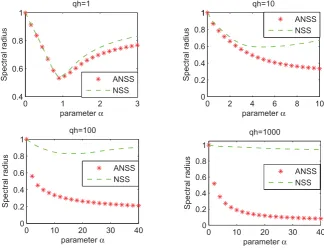
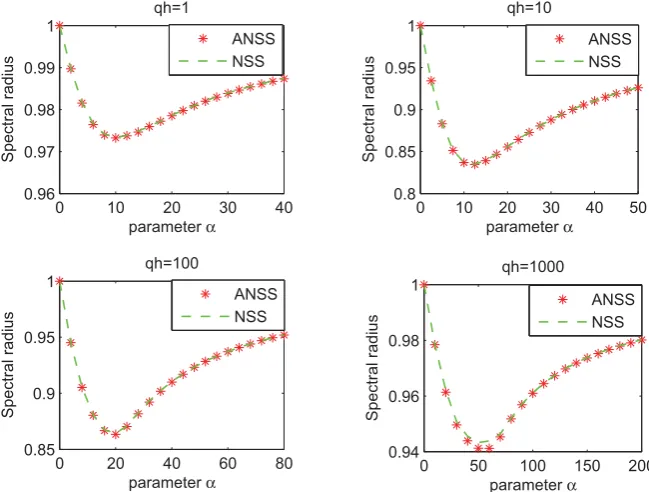
and c is a real number. We test the spectral radius of the iteration matrix M(α, β) (8) with different values ofqh. All the tested matrices are 64×64.
In Figs. 1 and 2, we show the spectral radius of the iteration matrix of the ANSS method and the NSS method with different values of α. ANSS represents the spectral radius of the iteration matrix of the ANSS method, where parameterβ is tested to be the optimal one, and NSS represents that of the NSS method.
0 1 2 3
0.4 0.6 0.8 1
parameterα
Spectral radius
qh=1
0 2 4 6 8 10
0 0.2 0.4 0.6 0.8 1 1
parameterα
Spectral radius
qh=10
0 10 20 30 40
0 0.2 0.4 0.6 0.8 1
parameterα
Spectral radius
qh=100
0 10 20 30 40
0 0.2 0.4 0.6 0.8 1
parameterα
Spectral radius
qh=1000
ANSS NSS ANSS
NSS
ANSS NSS
ANSS NSS
Fig. 1: Spectral radius of iteration matrices of ANSS and NSS methods for c=.1
0 10 20 30 40 0.96
0.97 0.98 0.99 1
parameterα
Spectral radius
qh=1
ANSS NSS
0 10 20 30 40 50
0.8 0.85 0.9 0.95 1
parameterα
Spectral radius
qh=10
ANSS NSS
0 20 40 60 80
0.85 0.9 0.95 1
parameterα
Spectral radius
qh=100
ANSS NSS
0 50 100 150 200
0.94 0.96 0.98 1
parameterα
Spectral radius
qh=1000
ANSS NSS
Fig. 2: Spectral radius of iteration matrices of ANSS and NSS methods for c= 10
4 Conclusion
In this paper, we have introduced two constants for the NSS iteration and presented a different approach to solve the system of linear equations (1), called ANSS method.
Acknowledgment
The authors wish to thank the referee for valuable comments and suggestions.
References
1. Bai, Z-Z. and Golub, G.H. and Ng, M.K.,On successive-overrelaxation acceleration of the Hermitian and skew-Hermitian splitting iterations, Numer. Linear. Algebra. Appl.,14(2007) 319-335.
2. Bai, Z-Z., Golub, G.H. and Ng, M.K.,Hermitian and skew-Hermitian splitting methods for non-Hermitian positive definite linear systems, SIAM J. Matrix. Anal. Appl.,24 (2003) 603-626.
3. Huhtanen, M.,Aspects of nonnormality for iterative methods, Linear Algebra Appl.,
394(2005) 119-144.
4. Huhtanen, M.,A Hermitain Lanczos method for normal matrices., SIAM J. Matrix. Anal. Appl.,23(2002) 1092-1108.