Iranian Journal of Numerical Analysis and Optimization Vol. 5, No. 2, (2015), pp 95-117
An adaptive nonmonotone trust region
method for unconstrained optimization
problems based on a simple
subproblem
Z. Saeidian and M.R. Peyghami∗
Abstract
Using a simple quadratic model in the trust region subproblem, a new adaptive nonmonotone trust region method is proposed for solving uncon-strained optimization problems. In our method, based on a slight modifica-tion of the proposed approach in (J. Optim. Theory Appl. 158(2):626-635, 2013), a new scalar approximation of the Hessian at the current point is provided. Our new proposed method is equipped with a new adaptive rule for updating the radius and an appropriate nonmonotone technique. Under some suitable and standard assumptions, the local and global convergence properties of the new algorithm as well as its convergence rate are investi-gated. Finally, the practical performance of the new proposed algorithm is verified on some test problems and compared with some existing algorithms in the literature.
Keywords: Trust region methods; Adaptive radius; Nonmonotone
tech-nique; Scalar approximation of the Hessian; Global convergence.
1 Introduction
In this paper, we deal with the following unconstrained optimization problem:
min
x∈Rnf(x) (1)
wheref :Rn→Ris a twice continuously differentiable function. Two popu-lar classes of optimization techniques for solving (1) are line search and trust
∗Corresponding author
Received 20 December 2014; revised 18 April 2015; accepted 27 July 2015 Z. Saeidian
Faculty of Mathematics, K.N. Toosi University of Technology, Tehran, Iran. E-mail : [email protected]
M.R. Peyghami
Scientific Computations in OPtimization and Systems Engineering (SCOPE), K.N. Toosi University of Technology, Tehran, Iran. E-mail: [email protected]
region methods; see, e.g., [9,17,18]. Line search methods refer to a procedure in which one moves along a (descent) direction as long as a sufficient reduc-tion in the objective is achieved. On the other hand, in the classical trust region methods, a trial step is computed by minimizing a (quadratic) model of the objective function at the current point over a region around this point. Then, using the so-called trust region ratio, the trial step is accepted/rejected and the new point as well as the radius is updated accordingly. It has been shown that trust region methods have appropriate global and local conver-gence properties. These methods have been widely studied in the literature; see, e.g., [9, 12, 17, 19, 24, 25].
Here, let us briefly describe one step of the classical trust region method. Givenxk, the trial stepdk is computed by solving the following subproblem:
minqk(d) =gTkd+ 1 2d
TB
kd s.t.∥d∥ ≤∆k, (2)
wheregk =∇f(xk),Bk is an×nsymmetric matrix which is∇2f(xk) or its approximation, ∆k>0 is the so-called trust region radius, and∥.∥ refers to the Euclidean norm. Due to the so-called trust region ratio
rk =
f(xk)−f(xk+dk) qk(0)−qk(dk)
, (3)
one decides whether the trial step is accepted or rejected; given µ ∈(0,1), ifrk≥µ, then the trial step is accepted and the new point is introduced by xk+1 =xk+dk. Otherwise, the trial step is rejected and the current point remains unchanged for the next iteration. In both cases, the trust region radius is updated appropriately.
In the monotone trust region methods, the sequence of the objective val-ues is monotonically decreasing. This may cause slow convergence rate in some problems. In order to overcome this disadvantage, the concept of non-monotone strategies have been introduced in the framework of trust region methods, see, e.g., [13, 14]. A nonmonotone line search method was first proposed by Chamberlain et al. in [8]. Grippo et al. in [13] introduced a nonmonotone technique for Newton’s method and developed it for uncon-strained optimization in [14]. Nevertheless many advantages of the Grippo’s technique, it suffers from some drawbacks [2, 3, 27]. In order to overcome these difficulties, recently, Ahookhosh and Amini in [2] and Ahookhosh et al. in [3] proposed a new nonmonotone term as below:
Rk =ϵkfℓ(k)+ (1−ϵk)fk, (4)
where fk =f(xk), ϵk ∈ [ϵmin, ϵmax] ⊂ [0,1] and fℓ(k) is the Grippo’s
non-monotone term which is defined by
fℓ(k)= max 0≤j≤M(k)
An adaptive nonmonotone trust region method for unconstrained ... 97 where M(0) = 0 and, fork≥1,M(k) = min{k, M}, for given positive inte-ger M. They employed (4) in the trust region ratio (3) and suggested non-monotone trust region methods which are globally convergent. The reported numerical results on test problems confirm the efficiency and robustness of these methods in practice too.
The radius updating strategy is a crucial point in trust region methods [1, 21, 28]. In the classical trust region methods, this parameter is simply enlarged, shrunk or stayed unchanged based on the magnitude of rk. Sev-eral strategies have been introduced in the literature for radius updating and initial radius choosing; see e.g. [11, 21–23, 29]. Zhang et al. in [29] proposed the radius update according to ∆k = cp∥gk∥∥Bˆk−1∥, where c ∈ (0,1), p is a nonnegative integer and ˆBk = Bk+iI is a positive definite matrix, for some i ∈ N. Although, Zhang’s method uses more information of the ob-jective function for updating the radius, it requires an estimation of∥Bˆk−1∥, which is costly. To reduce the computational cost of Zhang’s updating rule, a simple adaptive rule was proposed by Shi and Wang in [23] according to ∆k =cp ∥
gk∥3
gT
kBˆkgk
, where c∈(0,1), ˆBk is a positive definite matrix and pis a
nonnegative integer. Despite Zhang’s method that only updates the radius based on the current point information, some updating rules based on the information of the last two iterates have been introduced; see, e.g., [15,29,30]. Among them, Li [15] proposed an adaptive trust region method in which the radius is updated according to ∆k = ∥
dk−1∥
∥yk−1∥∥gk∥, where yk−1 = gk−gk−1 anddk−1=xk−xk−1.
The advantages of nonmonotone and adaptive techniques have been simulta-neously employed in the framework of trust region methods. Using the adap-tive strategy proposed in [15], Sang et al. in [20] introduced a nonmonotone adaptive trust region method based on a simple subproblem for large-scale unconstrained optimization problems which makes full use of information in the last two iterates. The idea of simple subproblem is originated from the fact that solving the subproblem (2) is costly especially whenBk is a large-scale and dense matrix. Therefore, the skills of the quasi-Newton method is used for correctingBkby a real diagonal matrix ∆Bk−1fromBk−1. Recently,
Zhou et al. in [30] constructed a simple subproblem according to the modifi-cation of the secant condition of Wei in [26] and introduced a nonmonotone adaptive trust region method based on the simple subproblem. Later, Biglari and Solimanpur in [7] proposed another simple subproblem with some supe-rior properties to that of [30] in which the approximation of the Hessian at the current pointxk is computed by
ˆ
γk:=γ(xk) =
4(fk−1−fk) + 3gTkdk−1+gTk−1dk−1 dT
k−1dk−1
. (6)
approach is equipped with the nonmonotone technique as proposed in [2, 3], and uses a slight modification of the secant condition in [7] for constructing an approximation of the Hessian at the current point. Moreover, a modified version of the adaptive strategy in [20] is employed in the framework of the proposed algorithm. It is worth mentioning that the scalar approximation of the Hessian based on modified secant condition in [6] has superior to the standard Barzilai-Borwein method and its modifications. Under some stan-dard assumptions, the global convergence property, as well as its superlinear convergence rate, is established. Numerical results show the efficiency of the proposed approach in practice comparing with some existing methods in the literature.
The rest of the paper is organized as follows: In Section 2, we present the structure of the new nonmonotone adaptive trust region method in details. The global convergence property, as well as its rate of convergence, is estab-lished in Section 3. Preliminary numerical results of applying the proposed algorithm on some test problems are given in Section 4. Finally, we end up the paper by some concluding remarks in Section 5.
2 The new algorithm
In this section, we propose a new adaptive nonmonotone trust region method for solving unconstrained optimization problems. Our algorithm combines the nonmonotone technique as proposed in [2] with an improved scalar ap-proximation of the Hessian according to the modified secant equation as proposed in [6].
Let us describe one step of our new algorithm here: For givenxk, the trial step dk is computed by (approximately) solving the following simple subproblem:
minqk(d) =gkTd+1 2d
Tγ(x
k)d s.t.∥d∥ ≤∆k, (7)
where γk := γ(xk) is a scalar approximation of the Hessian matrix. Since ˆ
γk, as defined by (6), may become negative in some iterations, we slightly modify (6) and defineγk as below:
γk=
4(fk−1−fk) + (3 +ηk)gkTdk−1+gTk−1dk−1 dT
k−1dk−1
, (8)
whereηk is computed by:
ηk=
{
4(fk−fk−1)−3gT
kdk−1−gT
k−1dk−1+δ
gkTdk−1 , if ˆγk<0,
An adaptive nonmonotone trust region method for unconstrained ... 99 where δ is a small positive number. By this definition, it is obviously seen that γk >0. Now, usingdk, the nonmonotone ratio is computed by:
rk=
Rk−f(xk+dk) P redk
, (9)
where Rk is defined by (4) and P redk = qk(0) −qk(dk). For given µ ∈ (0,1), the trial step is accepted whenever rk ≥ µ; otherwise it is rejected. In both cases, the radius is adaptively updated according to
∆k = min
{
νk∥ gk∥
γk ,∆max }
, where ∆max > 0 is a threshold value for the
radii andνk+1 is updated by:
νk+1=
σ0νk, rk < µ1,
νk, µ1≤rk ≤µ2,
min{σ1νk, νmax}, rk > µ2,
(10)
where 0< σ0 <1 < σ1, 0< µ1 < µ2 ≤1 and νmax >0 are given numbers.
By the way, the new point is given by xk+1 = xk +dk as long as rk ≥µ; otherwise, we setxk+1=xk.
The procedure of the new proposed nonmonotone trust region algorithm is outlined in Algorithm 1:
Algorithm 1: A new nonmonotone adaptive trust region algorithm
Input: x0∈Rn, 0< µ < µ1< µ2≤1, 0< σ0<1< σ1, 0< ϵmin< ϵmax<
1,ϵ, ε, M, νmax,∆max>0, 0< θ1< θ2 andδ >0.
Step 0: Set k = 0, γ0 := γ(x0) = 1, g0 = g(x0), ν0 = 1 and ∆0 =
min
{
ν0∥g0γ ∥
0 ,∆max
}
.
Step 1: If ∥gk∥ ≤ε,ThenStop.
Step 2: Determinedk by solving (7) and computerk using (9).
Step 3: If rk < µ,Thenset ∆k=σ0∆k, and goto Step 2.
Step 4: Setxk+1=xk+dk.
Step 5: Compute γk+1 using (8). If γk+1 ≤ ϵ, Then set γk+1 = θ1. If
γk+1≥1ϵ,Thenset γk+1=θ2.
Step 6: Update νk+1 using (10) and set ∆k+1 = min
{
νk+1∥
gk+1∥ γk+1 ,∆max
}
Remark 1. Step 5 of Algorithm 1 implies that γk is a bounded positive number for allk. More precisely, we have min{ϵ, θ1} ≤γk ≤max
{1
ϵ, θ2
}
.
Remark 2. The subproblem (7) can be easily solved by using the following
procedure [20]: Let ωk = γgkk. If ∥ωk∥ ≤ ∆k, then we set the trial step as
dk =−ωk. Otherwise, we chooseα∈(0,1) so that∥αωk∥= ∆k. It can be easily verified that α= ∆k
∥ωk∥. In this case, we setdk=−αωk =−
∆k
∥ωk∥ωk =
− ∆k
∥gk∥gk.
Remark 3. From Remark 2, one can easily see that, for all k, there
ex-ists a positive constantκso that∥dk∥ ≤κ∥gk∥.
3 Convergence analysis
In this section, our aim is to analyze the local and global convergence prop-erties of Algorithm 1. For this purpose, the following assumption is imposed on the problem:
A1. The set Ω ={x ∈Rn|f(x) ≤f(x0)} is a closed and bounded set and f(x) is a twice continuously differentiable function over Ω. Moreover, ∇f(x) is a Lipschitz continuous function over Ω.
Lemma 1. Assume thatdk is a solution of the problem (7). Then, one has:
P redk:=qk(0)−qk(dk)≥ 1
2∥gk∥min
{
∆k,∥gk∥ γk
}
. (11)
Proof. We proceed the proof in the following two possible cases fordk:
Case I. ∥ −gk
γk∥ ≤∆k, and therefore,dk=−
gk
γk: In this case one can easily
obtain the following relations:
qk(0)−qk(dk) =qk(0)−qk
(
−gk γk
)
=−gkT
(
−gk γk
)
−1 2
(
−gk γk
)T γk
(
−gk γk
)
= ∥gk∥
2
γk −
1 2
∥gk∥2 γk
= ∥gk∥
2
2γk ≥ 1
2∥gk∥min
{
∆k,∥gk∥ γk
}
.
Case II. ∥ −gk
γk∥>∆k, and therefore,dk =−
∆k
An adaptive nonmonotone trust region method for unconstrained ... 101 qk(0)−qk(dk) =qk(0)−qk
(
− ∆k ∥gk∥gk
)
=−gTk
(
− ∆k ∥gk∥gk
)
−1 2
(
− ∆k ∥gk∥gk
)T γk
(
− ∆k ∥gk∥gk
)
= ∆k∥gk∥ − 1 2γk∆
2
k>∆k∥gk∥ − 1
2∆k∥gk∥
= 1
2∆k∥gk∥ ≥ 1
2∥gk∥min
{
∆k, ∥gk∥
γk
}
,
where the first inequality is obtained from the fact thatγk∆k<∥gk∥.
Considering the above mentioned cases, the proof is completed. 2
Lemma 2. Let dk be computed by the procedure as mentioned in Remark 2.
Then, for all k, one has:
|f(xk)−f(xk+dk)−P redk| ≤O(∥dk∥2), (12)
whereP redk is defined by (11).
Proof. Using Taylor’s expansion and the fact thatγk is bounded due to Re-mark 1, one can easily conclude the result. 2
The following lemma states some appealing properties of the sequences
{
fℓ(k)
}
and {Rk}, which are defined by (5) and (4), respectively. One can find its proof in [2].
Lemma 3. Suppose that Assumption A1 holds and the sequence {xk} is
generated by Algorithm 1. Then, the following statements hold:
i) For allk, we havefk ≤Rk ≤fℓ(k).
ii) The sequence{fℓ(k)}is a decreasing and convergent sequence.
iii) limk→∞fℓ(k)= limk→∞fk.
iv) limk→∞Rk= limk→∞fk.
Lemma 4. Let Assumption A1 hold and the sequence{xk} be generated by
Algorithm 1. Assume that there exists a constantζ∈(0,1)so that∥gk∥> ζ, for allk. Then, for anyk, there exists a nonnegative integerpso thatxk+p+1 is a successful iteration point, i.e., rk+p+1> µ.
Proof. Suppose that, on the contrary, there exists an iteration kso that, for all nonnegative integerp, the pointxk+p+1is an unsuccessful iteration point,
i.e.,
rk+p< µ, p= 0,1,2, . . . . (13)
∆k+p+1 ≤σ
p+1 0 ∆k.
This inequality together with the definition of ∆k imply that:
lim
p→∞∆k+p+1= 0. (14)
Therefore, from Lemma 1, Remark 1 and (12), we have
f(xk+p)−f(xk+p+dk+p) P redk+p
−1=f(xk+p)−f(xk+p+dk+p)−P redk+p P redk+p
≤ O(∥dk+p∥2) 1
2∥gk+p∥min{∆k+p, ∥gk+p∥
γk+p }
≤ O(∥∆k+p∥2) 1
2ζmin
{
∆k+p,max{ζ1
ϵ,θ2}
}.
This implies that f(xk+p)−f(xk+p+dk+p)
P redk+p −1
→ 0, as p → ∞. Thus, for sufficiently large p, using Lemma 3, we have
rk+p=
Rk+p−f(xk+p+dk+p)
P redk+p ≥
f(xk+p)−f(xk+p+dk+p)
P redk+p →
1,
which contradictsrk+p< µ. This completes the proof of the lemma. 2 Lemma 4 implies that the inner loop in Steps 2–3 of Algorithm 1 will be terminated after finite number of iterations, and therefore, Algorithm 1 is well-defined.
The following theorem provides the global convergence property of Algo-rithm 1 under some suitable and standard assumptions.
Theorem 1. Suppose that Assumption A1 holds and {xk} is the sequence
generated by Algorithm 1. Then, Algorithm 1 either stops at a stationary point or
lim inf
k→∞ ∥gk∥= 0. (15)
Proof. Suppose that Algorithm 1 does not stop at a stationary point. We show that (15) holds for the infinite sequence {xk}. Assume that, on the contrary, there exists a positive constantζ so that
∥gk∥> ζ >0, ∀k. (16)
An adaptive nonmonotone trust region method for unconstrained ... 103 Rk−fk+1 ≥µP redk ≥
1
2µ∥gk∥min
{
∆k, ∥gk∥
γk
}
≥ 1 2µζmin
{
∆k, ζ
max{1ϵ, θ2
} }
≥0. (17)
By taking limit from both sides of this inequality, as k → ∞, and using Lemma 3, we conclude that
∆k =νk∥ gk∥
γk →
0. (18)
Now, using Remark 1 and (16), (18) implies that
νk −→0. (19)
Therefore, from (16) and Lemmas 1 and 2, we have
f(xk)−f(xk+dk) P redk
−1=f(xk)−f(xk+dk)−P redk P redk
≤ O
(
∥dk∥2) 1
2∥gk∥min
{
∆k,∥ gk∥
γk }
≤ O
(
∆2
k
)
1 2ζmin
{
∆k, ζ max{1
ϵ,θ2}
} k→∞ −→ 0,
which implies that
rk=
Rk−f(xk+dk)
P redk ≥
f(xk)−f(xk+dk)
P redk −→
1. (20)
This shows that, for sufficiently largek, we have successful iterations. There-fore, there exists a positive constant ν∗ so that, for sufficiently large k, νk≥ν∗. This contradicts (19). 2
Under some extra assumptions on the problem and using the same proof line of Theorem 3.7 in [30], one can construct the superlinear convergence rate of the sequence{xk}, generated by Algorithm 1, to its limit pointx∗.
4 Numerical results
• NATRM: Algorithm 2.1 in [30];
• NATRA: Algorithm 2.1 in [30] in which the nonmonotone term in com-puting the trust region ratiork is replaced byRk, as given by (4);
• FATRM: Algorithm 1 in which the nonmonotone term in computing the trust region ratiork is replaced byfℓ(k), as given by (5);
All the algorithms are implemented in MATLAB 7.10.0 (R2010a) environ-ment on a PC with CPU 2.0 GHz and 4GB RAM memory and double pre-cision format. The following parameters are considered in the relevant algo-rithms:
µ= 0.1, µ1= 0.25, µ2= 0.75, ϵmin= 10−6, ϵmax= 106,∆max= 100, M = 10, σ0=c2= 0.5, σ1=c1= 4, νmax=σ14, ν0= 0.25, ε=ϵ= 10−6, δ= 10−6.
Moreover, in Step 5 of Algorithm 1, if γk+1 ≤ ϵ, then we set θ1 = ϵ; if γk+1 > 1ϵ, then we set θ2 = 1ϵ. The simple subproblem at each iteration
is solved by the procedure as mentioned in Remark 2. All the algorithms are being stopped either ∥gk∥ ≤ 10−6, or the number of iterations and/or
function evaluations exceeds 50000. In the latter case, we declare that the algorithm is failed. The considered test problems are those in [30] as well as some large-scale problems taken from [16] and [4]. We have also utilized the advantages of the performance profile of Dolan and Mor´e in [10] to compare the performances of considered algorithms.
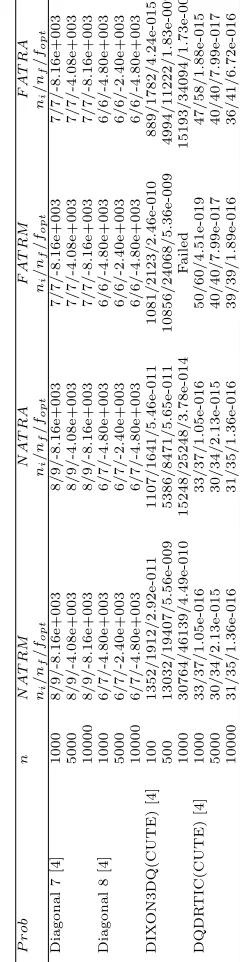
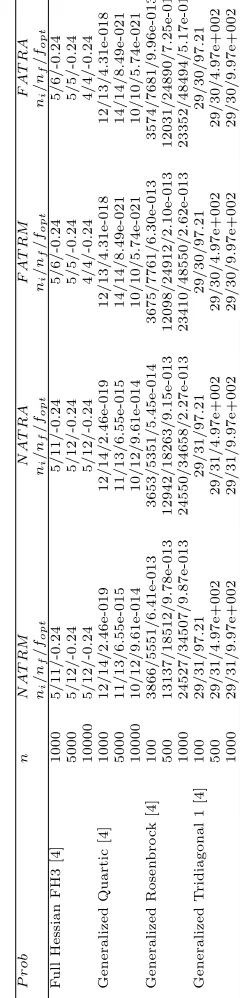
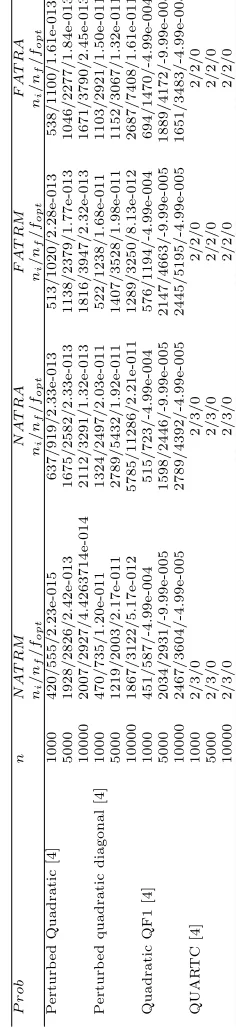
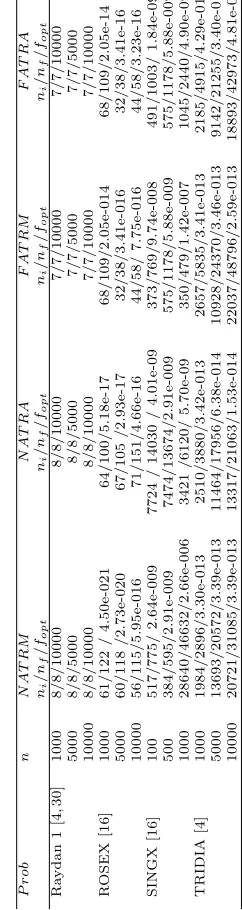
Numerical results are given in Table 1. In this table, P rob stands for the problem name, and ni, nf and fopt denote the number of iterations, the number of function evaluations and the optimum value of the objective func-tion, respectively. It should be noted that the number of gradient evaluations are almost the same asni.
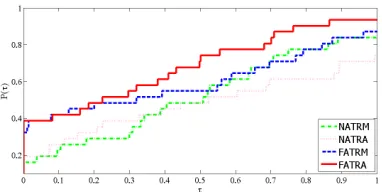
Figures 1 and 2 show the performance profiles of the results in Table 1 based on the number of iterations and function evaluations, respectively. At a glance to Figure 1, we can find out that, in terms ofni, FATRA solves all the considered test problems successfully, while the other algorithms have at least one failure in their runs. Moreover, FATRA and FATRM algorithms solve roughly 67% and 61% of the problems at the lowest value ofni, respectively. This percentage for NATRM and NATRA algorithms are 49% and 47%, respectively. Figure 2 is drawn based on nf of the results in Table 1. From this figure, it is revealed that FATRA solves all the problems successfully while FATRM has one failure in its run. Moreover, NATRM and NATRA algorithms solve roughly 96% and 98% of the test problems successfully. On the other hand, FATRA and FATRM algorithms solve about 58% and 60% of test problems in the lowest value ofnf while these percentages for NATRM and NATRA algorithms are about 34% and 22%.
Figure 1: Performance profile of considered algorithms based onni
Figure 2: Performance profile of considered algorithms based onnf
Figure 3: Performance profile of considered algorithms based on CPU time
5 Conclusion
An adaptive nonmonotone trust region method for unconstrained ... 115 is established under some standard assumptions. Numerical results on some large-scale test problems confirm the efficiency and effectiveness of the new proposed algorithm in comparison with some other existing algorithms in the literature.
Acknowledgment: The authors would like to thank the Research
Coun-cil of K. N. Toosi University of Technology and the SCOPE research center for supporting this work. The authors also would like to appreciate D. Ataee Tarzanagh for his helpful and constructive comments.
References
1. Ahookhosh, M. and Amini, K.A nonmonotone trust region method with adaptive radius for unconstrained optimization, Comput. Math. Appl. 60(2010) 411–422.
2. Ahookhosh, M. and Amini, K. An efficient nonmonotone trust-region method for unconstrained optimization, Numer. Algorithms 59(2011) 523–540.
3. Ahookhosh, M., Amini, K. and Peyghami, M.R.A nonmonotone trust-region line search method for large- scale unconstrained optimization, Appl. Math. Model. 36(2012) 478–487.
4. Andrei, N.An unconstrained optimization test functions collection, Adv. Model. Optim. 10(1)(2008) 147–161.
5. Ataee Tarzanagh, D., Peyghami, M. R. and Mesgarani, H.A new non-monotone trust region method for unconstrained optimization equipped by an efficient adaptive radius, Optim. Methods Softw. 29(4)(2014) 819– 836.
6. Biglari, F., Hassan, M. and Leong, W. J.New quasi-Newton methods via higher order tensor models, J. Comput. Appl. Math. 235(2011) 2412– 2422.
7. Biglari, F. and Solimanpur, M.Scaling on the Spectral Gradient Method, J. Optim. Theory Appl. 158(2)(2013) 626–635.
8. Chamberlain, R. M., Powell, M. J. D., Lemarechal, C. and Pedersen, H. C.The watchdog technique for forcing convergence in algorithm for constrained optimization, Math. Program. Stud. 16(1982) 1–17.
10. Dolan, E. and Mor´e, J. J. Benchmarking optimization software with performance profiles, Math. Program. 91(2002) 201–213.
11. Fan, J. Y. and Yuan, Y. X. A new trust region algorithm with trust region radius converging to zero, Proceedings of the 5th International Conference on Optimization, Techniques and Applications, 2001.
12. Gertz, E. M.A quasi-Newton trust-region method, Math. Program. Ser. A. 100(3)(2004) 447–470.
13. Grippo, L., Lampariello, F. and Lucidi, S.A nonmonotone line search technique for Newton’s method, SIAM J. Numer. Anal. 23(1986) 707– 716.
14. Grippo, L., Lampariello, F. and Lucidi, S.A truncated Newton method with nonmonotone line-search for unconstrained optimization, J. Optim. Theory Appl. 60(1989) 401–419.
15. Li, G. D. A trust region method with automatic determination of the trust region radius, Chinese J. Engry. Math. 23(2006) 843–848.
16. Mor´e, J. J., Garbow, B. S. and Hilstron, K. E. Testing unconstrained optimization software, ACM Tran. Math. Software 7(1981) 17–41.
17. Nocedal, J. and Wright, S. J. Numerical Optimization, Springer, New York, 2006.
18. Nocedal, J. and Yuan, Y.Combining trust region and line search tech-niques, In: Y. Yuan (ed.), Advanced in Nonlinear Programming, Kluwer Academic, Dordrecht, 153–175, 1996.
19. Powell, M. J. D. On the global convergence of trust region algorithms for unconstrained optimization, Math. Program. 29(1984) 297–303.
20. Sang, Z. and Sun, Q.A self-adaptive trust region method with line search based on a simple subproblem model, J. Appl. Math. Comput. 232(2009) 514–522.
21. Sartenaer, A.Automatic determination of an initial trust region in non-linear programming, SIAM J. Sci. Comput. 18(6)(1997) 1788–1803.
22. Shi, Z. and Guo, J.A new trust region method for unconstrained opti-mization, J. Comput. Appl. Math. 213(2008) 509–520.
23. Shi, Z. J. and Wang, H. Q. A new self-adaptive trust region method for unconstrained optimization, Technical Report, College of Operations Research and Management, Qufu Normal University, 2004.
An adaptive nonmonotone trust region method for unconstrained ... 117 25. Toint, Ph. L.Non-monotone trust-region algorithm for nonlinear opti-mization subject to convex constraints, Math. Program. 77(1997) 69–94.
26. Wei, Z., Li, G. and Qi, L.New quasi-Newton methods for unconstrained optimization problems, Appl. Math. Comput. 175(2006) 1156–1188.
27. Zhang, H. C. and Hager, W. W. A nonmonotone line search tech-nique and its application to unconstrained optimization, SIAM J. Optim. 14(2004) 1043–1056.
28. Zhang, X. S., Zhang, J. L. and Liao, L. Z. A nonmonotone adaptive trust region method and its convergence, Int. J. Comput. Math. Appl. 45(2003) 1469–1477.
29. Zhang, X. S., Zhang, J. L. and Liao, L. Z. An adaptive trust region method and its convergence, Sci. China 45(2002) 620–631.
هدﺎﺳ ﻪﻟﺎﺴﻣﺮﯾز ﮏﯾ سﺎﺳا ﺮﺑ ﺪﯿﻘﻣﺎﻧ یزﺎﺳ ﻪﻨﯿﻬﺑ ﻞﯾﺎﺴﻣ یاﺮﺑ اﻮﻨﮑﯾﺎﻧ ﯽﻘﻓو دﺎﻤﺘﻋا ﻪﯿﺣﺎﻧ شور ﮏﯾ
۲,۱ﯽﻣﺎﻐﯿﭘ ﺎﺿرﺪﻤﺤﻣ و۱ﯽﯾﺮﻃ نﺎﯾﺪﯿﻌﺳ ﺐﻨﯾز
ﯽﺿﺎﯾر هﺪﮑﺸﻧاد ،ﯽﺳﻮﻃ ﻦﯾﺪﻟا ﺮﯿﺼﻧ ﻪﺟاﻮﺧ ﯽﺘﻌﻨﺻ هﺎﮕﺸﻧاد۱
ﻪﻧﺎﻣﺎﺳ ﯽﺳﺪﻨﻬﻣ و یزﺎﺳ ﻪﻨﯿﻬﺑ رد ﯽﻤﻠﻋ تﺎﺒﺳﺎﺤﻣ ﯽﺸﻫوﮋﭘ ﺰﮐﺮﻣ ،ﯽﺳﻮﻃ ﻦﯾﺪﻟا ﺮﯿﺼﻧ ﻪﺟاﻮﺧ ﯽﺘﻌﻨﺻ هﺎﮕﺸﻧاد۲
ﯽﻘﻓو دﺎﻤﺘﻋا ﻪﯿﺣﺎﻧ شور ﮏﯾ ،دﺎﻤﺘﻋا ﻪﯿﺣﺎﻧ ﻪﻟﺎﺴﻣﺮﯾز رد هدﺎﺳ مود ﻪﺟرد لﺪﻣ ﮏﯾ یﺮﯿﮔرﺎﮑﺑ ﺎﺑ : هﺪﯿﮑﭼ ﯽﯾﺰﺟ حﻼﺻا لﺎﻤﻋا ﺎﺑ ،شور ﻦﯾا رد .دﻮﺸ-ﯿﻣ دﺎﻬﻨﺸﯿﭘ ﺪﯿﻘﻣﺎﻧ یزﺎﺴ-ﻬﻨﯿﻬﺑ ﻞﯾﺎﺴﻣ ﻞﺣ یاﺮﺑ اﻮﻨﮑﯾﺎﻧ ﺐﯾﺮﻘﺗ ﮏﯾ ( J. Optim. Theory Appl. ١۵٨ (٢) ۶٢۶-۶٣۵ ، ٢٠١٣ ) رد یدﺎﻬﻨﺸﯿﭘ شور یور ﺪﯾﺪﺟ ﯽﻘﻓو شور ﮏﯾ ﻪﺑ یدﺎﻬﻨﺸﯿﭘ شور .ددﺮﮕ--ﯿﻣ ﻪﯾارا ﯽﻠﻌﻓ ﻪﻄﻘﻧ رد ﻦﯿﺴﻫ ﺲﯾﺮﺗﺎﻣ زا ﺪﯾﺪﺟ ﺮﻟﺎﮑﺳا دراﺪﻧﺎﺘﺳا تﺎﯿﺿﺮﻓ ﯽﺧﺮﺑ ﺖﺤﺗ .ﺖﺳا هﺪﺷ ﺰﻬﺠﻣ اﻮﻨﮑﯾﺎﻧ ﮏﯿﻨﮑﺗ ﮏﯾ و دﺎﻤﺘﻋا ﻪﯿﺣﺎﻧ عﺎﻌﺷ مﺎﮕﻨﻬﺑ یاﺮﺑ ﯽﺳرﺮﺑ نآ ﯽﯾاﺮﮕﻤﻫ خﺮﻧ هاﺮﻤﻫ ﻪﺑ یدﺎﻬﻨﺸﯿﭘ ﻢﺘﯾرﻮﮕﻟا ﯽﻌﺿﻮﻣ و یﺮﺳاﺮﺳ ﯽﯾاﺮﮕﻤﻫ صاﻮﺧ ،ﺐﺳﺎﻨﻣ و ﻪﺘﻓﺮﮔ راﺮﻗ ﯽﺳرﺮﺑ درﻮﻣ ﯽﻧﻮﻣزآ ﻞﯾﺎﺴﻣ ﯽﺧﺮﺑ یور یدﺎﻬﻨﺸﯿﭘ ﻢﺘﯾرﻮﮕﻟا ﯽﻠﻤﻋ دﺮﮑﻠﻤﻋ ،نﺎﯾﺎﭘ رد .ﺪﻧﻮﺸ-ﯿﻣ .ﺪﻧﺮﯿﮕ-ﯿﻣ راﺮﻗ ﻪﺴﯾﺎﻘﻣ درﻮﻣ عﻮﺿﻮﻣ تﺎﯿﺑدا رد دﻮﺟﻮﻣ یﺎﻬ-ﻤﺘﯾرﻮﮕﻟا ﯽﺧﺮﺑ ﺎﺑ ﻞﺻﺎﺣ ﺞﯾﺎﺘﻧ و