INTRODUCTION
Nordic combined (NC) is a winter sport divided into two portions: ski jumping (SJ) and cross country ski racing, which diff er in their optimum biomechanics, physiology, and body parameters (Burke, 2007). There are fewer studies on NC than on SJ, and the scientifi c literature related to kinematic analyses of basic jump phases in NC is limited (Janura, Lehnert, Elfmark, & Vaverka, 1999). While some studies on NC have been published in the biomechanical literature (Jošt & Pusto-vrh, 1995), others have been published as part of the literature on muscle physiology and lower limb strength (Bösl, Schwirtz, Rott, & Großgebauer, 2007; Ereline, 2006; Pääsuke, Ereline, & Gapeyeva, 2001).
The body movement of the competitor at the jump-ing hill edge (take off and early fl ight) is considered the most important factor for good jump execution (Schwa-meder, 2008). At the end of the take off , the ski jumper engages in a forward rotating body angular momentum, which serves to retain the necessary velocity and the
best initial conditions for execution of the early fl ight position (Schwameder, Müller, Lindenhofer, DeMonte, Potthast, Brüggemann, Virmavirta, Isolehto, & Komi, 2005).
The kinematics of the execution of the ski jump pha ses have been analyzed by several investigators. For example, Janura, Elfmark, Seidl, and Vaverka (2001) found that in NC the best juniors compared to the worst juniors had the center of mass (CoM) more for-ward behind the edge of the hill and took the flight po sition earlier, with more eff ective aerodynamic con-ditions (smaller drag force). Vaverka, Janura, Elfmark, McPherson, and Puumala (1996) determined that there is a small relationship between the take off kinematic parameters and the length of a jump, which contribu tes to the large diff erences among the competitors. The investigators found, however, a larger correlation bet-ween the measured angular parameters of the trunk and lower extremities and the length of a jump during a fl ight (r = .81). Brüggemann, DeMonte, Komi, Iso-lehto, Müller, Pott hast, Schwameder, and Virmavirta
ANALYSIS OF THE BEGINNING OF THE EARLY FLIGHT PHASE OF THE SKI JUMP
IN ATHLETES WITH DIFFERENT PERFORMANCE LEVELS
Miroslav Janura, Lee Cabell*, Zdeněk Svoboda, Milan Elfmark, Eva Janurová**
Faculty of Physical Culture, Palacký University, Olomouc, Czech Republic
* School of Graduate Medical Education – Seton Hall University, South Orange, New Jersey, U.S.A. ** Faculty of Mining and Geology, Technical University of Ostrava, Ostrava, Czech Republic
Submitted in September, 2011 BACKGROUND: Obtaining a long jumping distance is necessary in order to succeed among the best competitors in the Nordic combined. The body movement during the take off and early fl ight is considered to be the most important factor for length of the jump.
OBJECTIVE: The purpose of this study was to assess the technique of the start of the early fl ight phase among three groups of Nordic combined competitors representing diff erent performance levels, and to compare them with a group of ski jumpers.
METHODS: Thirty competitors from both sport disciplines (Nordic combined and ski jumping), who performed ski jumps using an HS–134 m jumping hill during the 2009 Nordic World Ski Championships in Liberec, were divided into three subgroups based on jump length. Two dimensional kinematic data were collected for the lower extremities, the trunk, and the skis of the competitors.
RESULTS: The elite Nordic combined group showed a greater in-run velocity than did the two other performance groups (p < .05). The center of mass of the elite ski jumpers is shifted more forward in the section 0–5 m behind the jumping hill edge in comparison with the elite Nordic combined competitors (p < .05). The mediocre-level ski jump-ers exhibited higher knee extension angular velocity in this phase of the jump in comparison with the mediocre-level Nordic combined competitors (p < .05).
CONCLUSIONS: The results indicated that ski jumping competitors took a better aerodynamic position in the section 0–5 m behind the edge of the jumping hill. The Nordic combined competitors used a higher average in run velocity to achieve ski jump length comparable to those of ski jumpers.
(2002) found only small diff erences in competitors’ CoM velocities between the best and poor competitors, but did fi nd statistically signifi cant diff erences between the above-noted groups in knee angular velocity and so mersault angle at take off . Jošt, Čoh, Pustovrh, and Ulaga (2000) concluded that the best SJs had a large knee angle extension on and behind the hill’s edge as well as a tendency for a more pronounced transfer of the hip and the CoM in the anterior direction.
The high requirements of the body at take off (maxi-mum take off force during a short time period) and the complexity of the movement structure result in a high variability of the execution, not only between groups, but also within groups within given performance levels (Janura, Svoboda, & Uhlář, 2007; Vaverka, Janura, Elf-mark, Salinger, & McPherson, 1997). Thus, it is neces-sary to consider these diff erences in the comparison of the ski jump execution of the competitors at diff erent performance levels (Arndt, Brügemann, Virmavirta, & Komi, 1995; Schmölzer & Müller, 2005).
The purpose of this study was to assess the execution of the start of the early fl ight phase in the NC among three groups of competitors, representing diff erent skill levels, and to compare them with a group of ski jumpers.
METHODS
A total of 48 male NC competitors jumped off the large HS–134 m hill (starting gate 37) during the 2009 Nordic World Ski Championships in Liberec, the Czech Republic. Of the 48 analyzed competitors, 30 were selec ted based on the length of the jump (LJ) and were divided into three groups: (1) elite (E; n = 10, LJ 121–136 m), (2) mediocre (M; n = 10, LJ 114–118 m), and (3) poor (P; n = 10, LJ 101–111 m). In addition, of the 72 male ski jumpers participating on the same jumping hill (starting gate 24) the day before, 30 were chosen and divided according the same rules into three groups: (1) elite (E; n = 10, LJ 128.5–130 m), (2) mediocre (M; n = 10, LJ 115.5–117 m), and (3) poor (P; n = 10, LJ 97–105.5 m).
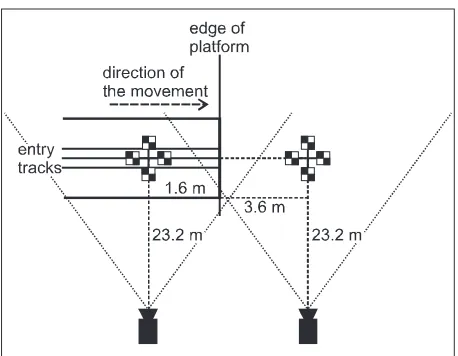
Video image data were obtained from two digital video cameras (50 Hz, Sony DCR-TRV 900, Sony, Tokyo, Japan), which were located perpendicular to the sagittal plane of the SJs’ movement at early fl ight (Fig. 1). Because the conditions on the jumping hill did not facilitate the taking of a three dimensional (3D) measurement, we opted for a 2D kinematic analysis in the sagittal plane. The image space was calibrated by a 1 m arm cross-calibration frame placed in the plane of the movement at the beginning and at the end of the observed section. The length of a recorded sector was 7 m, and the frame had a resolution of 640 × 480 pixels, i.e., a shift of the cursor by 1 pixel resulting in a linear
resolution of 0.011 m. The accuracy of the body angu-lar values had been quantifi ed in a previous study, in which the magnitude of error for the recorded sector of appro xi mately 1.4 m was .51%, and the absolute error was .22%, respectively (Janura & Vaverka, 1997).
Fig. 1
The cameras’ setup
The data were manually digitized (APAS, Ariel Dy-namics, Inc., Trabuco Canyon, USA) by an experienced researcher. The origin of the global coordinate system was placed in the middle of the in-run tracks at the jump ing hill edge. We assumed a symmetrical jump skier’s body position in the sagittal plane. A seven link bilateral model was created based on nine points – the tip and tail of the ski, ankle, knee, hip, top of the head, shoulder, elbow, and wrist. The model included the fol-lowing segments: foot and shank, thigh, trunk and head, arm, forearm, and jump ski. Data on the segments’ rela-tive mass (Karas, Otáhal, & Sušanka, 1990) were added to the relative mass of the jump skis and ski jumping equipment for the calculation of the CoM.
Two way ANOVA (independent variables are the dis-cipline and performance level) with a Fisher’s post-hoc test were performed (Statistica, Version 8.0, Stat-Soft, Inc., Tulsa, USA). The desired power of the test was .80 (Ellis, 2010) for the diff erences in the variables noted in the study. P-values of less than .05 were deemed to be signifi cant throughout.
RESULTS
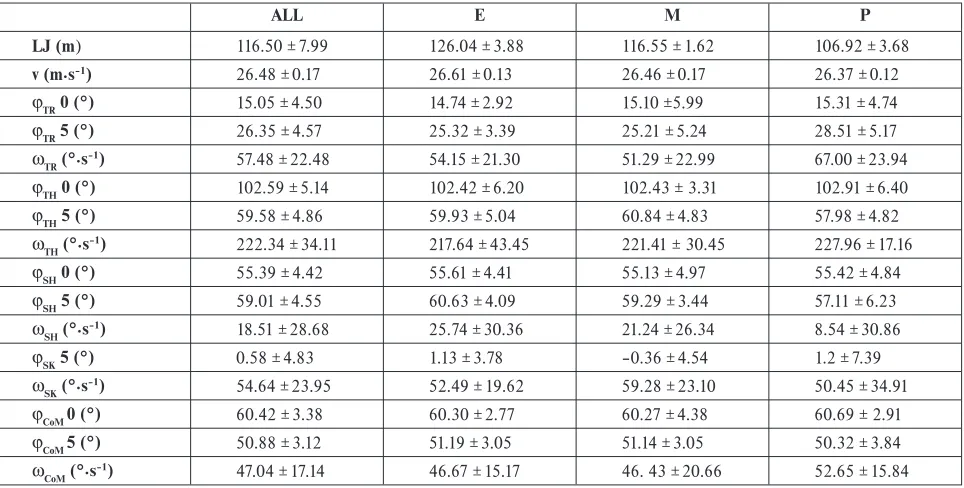
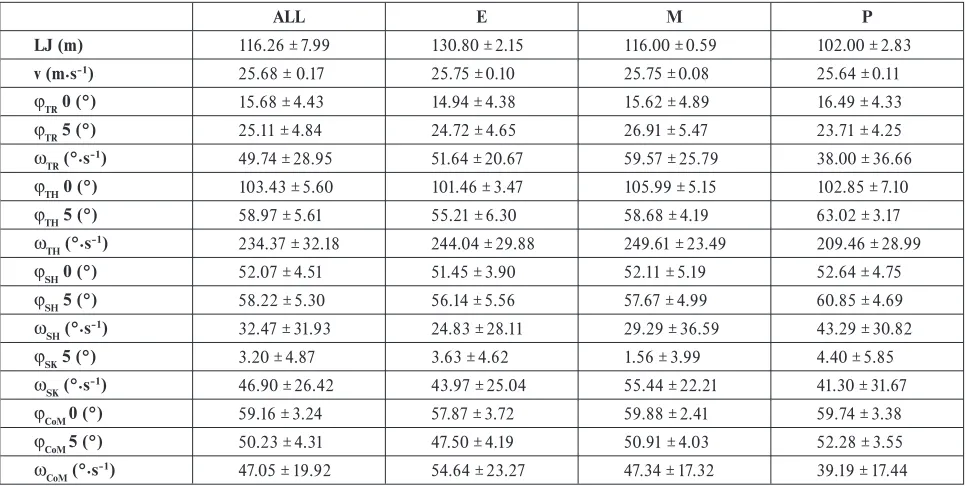
The results of the dependent parameters for the NC and SJ groups in the section from the edge of the jumping hill to 5 m behind the edge are presented in TABLES 1 and 2.
Fig. 2
Measured angle parameters
SK CoM
CoM
TR
TH
SH
horizontal
Legend: CoM – center of mass, TR – trunk angle to horizontal, TH – thigh angle to the horizontal, SH – shank angle to horizontal, SK – ski angle to horizontal, CoM – angle between CoM and ankle connection and horizontal
TABLE 1
Observed parameters of the NC competitors on the edge and 5 m behind the jumping hill edge
ALL E M P
LJ (m) 116.50 ± 7.99 126.04 ± 3.88 116.55 ± 1.62 106.92 ± 3.68
v (m.s–1) 26.48 ± 0.17 26.61 ± 0.13 26.46 ± 0.17 26.37 ± 0.12
ϕTR 0 (°) 15.05 ± 4.50 14.74 ± 2.92 15.10 ±5.99 15.31 ± 4.74
ϕTR 5 (°) 26.35 ± 4.57 25.32 ± 3.39 25.21 ± 5.24 28.51 ± 5.17
ωTR (°.s
–1) 57.48 ± 22.48 54.15 ± 21.30 51.29 ± 22.99 67.00 ± 23.94
ϕTH 0 (°) 102.59 ± 5.14 102.42 ± 6.20 102.43 ± 3.31 102.91 ± 6.40
ϕTH 5 (°) 59.58 ± 4.86 59.93 ± 5.04 60.84 ± 4.83 57.98 ± 4.82
ωTH (°.s
–1) 222.34 ± 34.11 217.64 ± 43.45 221.41 ± 30.45 227.96 ± 17.16
ϕSH 0 (°) 55.39 ± 4.42 55.61 ± 4.41 55.13 ± 4.97 55.42 ± 4.84
ϕSH 5 (°) 59.01 ± 4.55 60.63 ± 4.09 59.29 ± 3.44 57.11 ± 6.23
ωSH (°.s–1) 18.51 ± 28.68 25.74 ± 30.36 21.24 ± 26.34 8.54 ± 30.86
ϕSK 5 (°) 0.58 ± 4.83 1.13 ± 3.78 –0.36 ± 4.54 1.2 ± 7.39
ωSK (°.s
–1) 54.64 ± 23.95 52.49 ± 19.62 59.28 ± 23.10 50.45 ± 34.91
ϕCoM 0 (°) 60.42 ± 3.38 60.30 ± 2.77 60.27 ± 4.38 60.69 ± 2.91
ϕCoM 5 (°) 50.88 ± 3.12 51.19 ± 3.05 51.14 ± 3.05 50.32 ± 3.84
ωCoM (°.s
–1) 47.04 ± 17.14 46.67 ± 15.17 46. 43 ± 20.66 52.65 ± 15.84
Legend: LJ – length of jump, v – in-run velocity, TR – trunk angle to horizontal, TH – thigh angle to the horizontal, SH – shank angle to horizontal, SK – ski angle to horizontal, CoM – angle between CoM and ankle connection and horizontal, !TR – trunk angular velocity, !TH – thigh angular velocity, !SH – shank angular velocity, !SK – ski angular velocity, !CoM – CoM angular velocity, 0 – jumping hill edge,
Comparison of the NC competitors with diff erent perform-ance levels
With the exception of the average in run velocity, we did not fi nd any signifi cant diff erences among the diff erent level groups. Specifi cally, group E had a higher average in run velocity than did group P (p < .01) or group M (p < .05).
TABLE 2
Observed parameters of the SJ competitors on the edge and 5 m behind the jumping hill edge
ALL E M P
LJ (m) 116.26 ± 7.99 130.80 ± 2.15 116.00 ± 0.59 102.00 ± 2.83
v (m.s–1) 25.68 ± 0.17 25.75 ± 0.10 25.75 ± 0.08 25.64 ± 0.11
ϕTR 0 (°) 15.68 ± 4.43 14.94 ± 4.38 15.62 ± 4.89 16.49 ± 4.33
ϕTR 5 (°) 25.11 ± 4.84 24.72 ± 4.65 26.91 ± 5.47 23.71 ± 4.25
ωTR (°.s
–1) 49.74 ± 28.95 51.64 ± 20.67 59.57 ± 25.79 38.00 ± 36.66
ϕTH 0 (°) 103.43 ± 5.60 101.46 ± 3.47 105.99 ± 5.15 102.85 ± 7.10
ϕTH 5 (°) 58.97 ± 5.61 55.21 ± 6.30 58.68 ± 4.19 63.02 ± 3.17
ωTH (°.s
–1) 234.37 ± 32.18 244.04 ± 29.88 249.61 ± 23.49 209.46 ± 28.99
ϕSH 0 (°) 52.07 ± 4.51 51.45 ± 3.90 52.11 ± 5.19 52.64 ± 4.75
ϕSH 5 (°) 58.22 ± 5.30 56.14 ± 5.56 57.67 ± 4.99 60.85 ± 4.69
ωSH (°.s–1) 32.47 ± 31.93 24.83 ± 28.11 29.29 ± 36.59 43.29 ± 30.82
ϕSK 5 (°) 3.20 ± 4.87 3.63 ± 4.62 1.56 ± 3.99 4.40 ± 5.85
ωSK (°.s
–1) 46.90 ± 26.42 43.97 ± 25.04 55.44 ± 22.21 41.30 ± 31.67
ϕCoM 0 (°) 59.16 ± 3.24 57.87 ± 3.72 59.88 ± 2.41 59.74 ± 3.38
ϕCoM 5 (°) 50.23 ± 4.31 47.50 ± 4.19 50.91 ± 4.03 52.28 ± 3.55
ωCoM (°.s
–1) 47.05 ± 19.92 54.64 ± 23.27 47.34 ± 17.32 39.19 ± 17.44
Legend: LJ – length of jump, v – in-run velocity, TR – trunk angle to horizontal, TH – thigh angle to the horizontal, SH – shank angle to horizontal, SK – ski angle to horizontal, CoM – angle between CoM and ankle connection and horizontal, !TR – trunk angular velocity, !TH – thigh angular velocity, !SH – shank angular velocity, !SK – ski angular velocity, !CoM – CoM angular velocity, 0 – jumping hill edge,
5 – m behind the jumping hill edge, E – elite, M – mediocre, P – poor
Comparison of the NC and SJ competitors
The average in-run velocity was higher in NC group (p < .01). The SJ group experienced a smaller shank angle to the horizontal (p < .05) at the edge of the hill and a higher knee extension angular velocity (p < .05) 5 m behind the edge of the hill when compared to the NC group. A comparison of the observed NC and SJ groups is presented in Fig. 3.
Fig. 3
Group E – ski jumpers had a smaller shank angle to the horizontal (p < .05), smaller CoM angle (p < .01), and larger magnitude of the knee extension angular ve-locity characterized by the shift of the thigh anteriorly (p < .05) in the section 0–5 m behind the edge.
Group M – the SJ group exhibited a faster knee ex-tension angular velocity (p < .01) in the section between 0 and 5 m behind the hill’s edge.
Group P – the signifi cant diff erences were not found between NC and SJ groups.
DISCUSSION
Comparison of the NC competitors of diff erent perform-ance levels
With the exception of the magnitude of the in-run velocity, which was larger among the E competitors, we did not fi nd any signifi cant diff erences in angular and linear parameters. This lack of a signifi cant diff erence might have been caused by the elite level athletes’ cor-rect in-run body position, which is one of the factors that maximize the in-run velocity (Komi, Nelson, & Pulli, 1974; Vaverka, 1987). The signifi cant infl uence of the in-run velocity on the length of jump was found in the fi nal round of the 2006 Olympic ski jumping com-petition in Torino, Italy (Virmavirta, Isolehto, Komi, Schwameder, Pigozzi, & Massazza, 2009). Dissimilari-ties in the execution of the jump at the early fl ight phase were found among the jumpers with similar lengths of jumps; therefore, it is necessary to study individual dif-ferences within these groups. The correlations between the measured body parameters and the length of each jump suggest the optimal solution for each jumper (Virmavirta, Isolehto, Komi, Brüggemann, Müller, & Schwameder, 2005).
Comparison of the NC competitors and the SJ group The SJ group had a smaller ankle angle to the hori-zontal at the jumping hill edge, which might have given the ski jumpers a better body position, minimizing air resistance, for the following rotation and fl ight body po-sition. This group also exhibited higher explosiveness in the knee joint, supported by the higher knee extension angular velocity 5 m behind the edge of the hill, which is comparable to the fi ndings of Arndt et al. (1995), who reported similar results as measured at the jumping hill edge. Janura et al. (1999), in contrast, conducted a study with the Czech Republicʼs teams to compare competi-tors in diff erent age categories and found that the SJ group had a large ankle angle to the horizontal along with a small knee extension of the angular velocity at the jumping hill edge. Their fi ndings, however, might have been infl uenced by diff erences in performance between groups at varying levels.
In run velocity is the key parameter for comparing both ski jumping disciplines. The NC competitors, with high average in run velocities, showed body movement patterns similar to those observed in SJ groups. This higher in-run velocity eliminates diff erences between both disciplines in training methods and in somatic pa-rameters of competitors.
The fact that the NC competitors had a higher in-run velocity provided them with the potential to jump as far as the SJ group could. Smaller ankle angle to the hori-zontal by ski jumpers moved the shank more anteriorly and provided the opportunity for a better aerodynamic ski jumping body position. The higher knee extension of the angular velocity executed by the SJ group could have been caused by the fact that ski jumpers concentrate on muscular strength and explosive power training more than Nordic Combined skiiers, who focus on endurance training, which decreases muscle explosiveness (Bösl et al., 2007; Shephard & Astrand, 1992; Zatsiorsky, 1995). Therefore, it is necessary to utilize a set of internal pre-conditions for competitors in ski jumping analyses (e.g. anthropometric segment parameters and morphological entries).
Limitations
The ski jump events in NC and SJ were held on diff erent days, but the weather conditions were compa-rable, i.e., the air temperature (between 1 °C and 2 °C), snow temperature (–8 °C in both events), wind velocity (0.2–2.7 m.s–1 vs. 0.3–2.5 m.s–1), and wind direction.
A possible negative infl uence of the external conditions was also eliminated by the fact that the competitors, who were, over the long term, characterized by good per for mance, were excluded from the measurement when they jumped badly.
In run velocity was signifi cantly infl uenced by a dif-ferent starting gate in the NC (gate 37) and SJ (gate 24) events.
CONCLUSIONS
•" Among the NC groups no signifi cant diff erences
were found, with the exception of the average in run velocity. The in run velocity of the elite competitors was signifi cantly higher than in both other groups.
•" Ski jumpers took a better aerodynamic position in
Section 0–5 m behind the edge of the jumping hill, characterized by a large shift of the shank and center of mass anteriorly.
•" In order to compensate for their muscular power and
ACKNOWLEDGEMENT
The study has been supported by the research grant from the Ministry of Education, Youth and Sports of the Czech Republic (No. MSM 6198959221) “Physical Activity and Inactivity of the Inhabitants of the Czech Republic in the Context of Behavioral Changes”.
REFERENCES
Arndt, A., Brügemann, G.-P., Virmavirta, M., & Komi, P. V. (1995). Techniques used by Olympic ski jumpers in the transition from take off to early fl ight. Journal of Applied Biomechanics, 11(2), 224–237. Bösl, P., Schwirtz, A., Rott F., & Großgebauer, J.
(2007). Comparison of lower limb strength between athletes in ski jumping and Nordic combined. In V. Linnamo, P. V. Komi, & E. Müller (Eds.), Science and Nordic Skiing (pp. 183–190). Oxford: Meyer & Meyer Sport Ltd.
Brüggemann, G.-P., DeMonte, G., Komi, P. V., Iso leh-to, J., Müller, E., Potthast, W., Schwameder, H., & Virmavirta, M. (2002). Biomechanical analysis of the take off , the early and the mid fl ight phases in ski jump ing during the Salt Lake City Winter Games. Medicine & Science in Sports & Exercise, 34(5), 123. Burke, L. (2007). Practical sports nutrition. Champaign,
IL: Human Kinetics.
Ellis, P. D. (2010). The essential guide to eff ect sizes: An introduction to statistical power, meta-analysis and the interpretation of research results. Cambridge: Cam-bridge University Press.
Ereline, J. (2006). Contractile properties of human skel-etal muscles: Association with sports training, fatigue and post-tetanic potentiation. Doctoral dissertation, Tartu, Tartu University.
Janura, M., Elfmark, M., Seidl, V., & Vaverka, F. (2001). Analýza skoku na lyžích závodníků v severské kom-binaci – MSJ Štrbské Pleso 2000. In H. Válková & Z. Hanelová (Eds.), Pohyb a zdraví: sborník z 2. mezi-národní konference (pp. 218–221). Olomouc: Univer-zita Palackého.
Janura, M., Lehnert, M., Elfmark, M., & Vaverka, F. (1999). A comparison of the take off and the transi-tion phase of the ski jumping between the group of the ski jumpers and the competitors in Nordic com-bined. Acta Universitatis Palackianae Olomucensis. Gym nica, 29(2), 7–13.
Janura, M., Svoboda, Z., & Uhlář, R. (2007). A com-parison of ski jump execution in a group of the best jumpers. In V. Linnamo, P. V. Komi, & E. Müller (Eds.), Science and Nordic skiing (pp. 205–214). Ox-ford: Meyer & Meyer Sport Ltd.
Janura, M., & Vaverka, F. (1997). Hodnocení systému pro analýzu videozáznamu I. (přesnost vyhodnoce-ných dat). Telesná výchova a šport, 7(3), 28–31. Jošt, B., Čoh, M., Pustovrh, J., & Ulaga, M. (2000).
Ana-lysis of the selected kinematic variables of the take off in ski jumps and their correlation with the length in the fi nals of the world cup at Planica in 1999. In M. Čoh & B. Jošt (Eds.), Biomechanical characteris-tics of technique in certain chosen sports (pp. 58–71). Ljubljana: University of Ljubljana.
Jošt, B., & Pustovrh, J. (1995). Nordijsko smučanje. Ljubl jana: University of Ljubljana.
Karas, V., Otáhal, S., & Sušanka, P. (1990). Biomechani-ka tělesných cvičení. Praha: SPN.
Komi, P. V., Nelson, R. C., & Pulli, M. (1974). Biomecha-nics of ski jumping. Studies in Sport Physical Educa-tion and Health,5, 1–53.
Pääsuke, M., Ereline, J., & Gapeyeva, H. (2001). Knee extension strength and vertical jumping performance in Nordic combined athletes. Journal of Sport Medi-cine and Physical Fitness, 41(3), 354–361.
Schmölzer, B., & Müller, W. (2005). Individual fl ight styles in ski jumping: Results obtained during Olym-pic Games competitions. Journal of Biomechanics, 38(5), 1055–1065.
Schwameder, H. (2008). Biomechanics research in ski jumping – 1991–2006. Sports Biomechanics, 7(1), 114–136.
Schwameder, H., Müller, E., Lindenhofer, E., DeMonte, G., Potthast, W., Brüggemann, P., Virmavirta, M., Isolehto, J., & Komi, P. (2005). Kinematic cha rac-te ristics of the early flight phase in ski jumping. In E. Müller, D. Bacharach, R. Klika, S. Lindin-ger, & H. Schwameder (Eds.), Science and skiing III (pp. 381–391). Oxford: Meyer & Meyer Sport. Shephard, R. J., & Astrand, P. O. (1992). Endurance in
sport.Champaign, IL: Human Kinetics.
Vaverka, F. (1987). Biomechanika skoku na lyžích. Olo-mouc: Univerzita Palackého.
Vaverka, F., Janura, M., Elfmark, M., McPherson, M., & Puumala, R. (1996). A general versus individual model of ski jumping technique. In J. M. C. S. Abrantes (Ed.), Proceedings of the XIV ISBS Symposium (pp. 293–296). Funchal-Madeira: Edicoes FMH.
Vaverka, F., Janura, M., Elfmark, M., Salinger, J., & McPherson, M. (1997). Inter and intra-individual vari ability of the ski jumper’s take off . In E. Müller, H. Schwameder, E. Kornexl, & C. Raschner (Eds.), Science and skiing (pp. 61–71). London: E & FN Spo.
Virmavirta, M., Isolehto, J., Komi, P. V., Schwameder, H., Pigozzi, F., & Massazza, G. (2009). Take off ana lysis of the Olympic ski jumping competition (HS–106m). Journal of Biomechanics, 42(8), 1095–1101.
Zatsiorsky, V. M. (1995). Science and practice of strength training. Champaign, IL: Human Kinetics.
ANALÝZA FÁZE PŘECHODU DO LETU VE SKOKU NA LYŽÍCH U SKUPIN ZÁVODNÍKŮ
S RŮZNOU VÝKONNOSTÍ (Souhrn anglického textu)
VÝCHODISKA: Dosažení kvalitního výkonu ve sko-ku na lyžích je nezbytným předpokladem pro výsledné umístění v závodech severské kombinace. Za rozhodu-jící pro provedení skoku na lyžích bývá označována fáze od razu a následného přechodu do letu. Kinematická ana lýza těchto fází skoku pro skokany na lyžích byla pro vedena mnoha autory. Pro závodníky v severské kom-binaci je počet výstupů minimální.
Vysoké požadavky na provedení pohybu v odrazové fázi skoku (maximální síla odrazu, extrémně krátký čas realizace) způsobují, při různých antropomotorických parametrech skokanů, vysokou interindividuální varia-bilitu provedení nejen mezi závodníky s různou výkon-ností, ale i uvnitř skupin se srovnatelnou délkou skoku. CÍLE: Cílem studie bylo porovnat provedení zahá-jení přechodové fáze skoku mezi skupinami závodníků v severské kombinaci s různou výkonností. Určit rozdíly v provedení této fáze skoku mezi závodníky v severské kombinaci a ve skoku na lyžích.
METODIKA: Odrazová a přechodová fáze skoku na můstku HS–134 m při závodech MS v klasickém lyžo-vání v Liberci v r. 2009 byla zaznamenána s využitím tří kamer (50 Hz). Kamery byly umístěny tak, že jejich optic ké osy byly kolmé na rovinu pohybu závodníků. Vy brané body na těle a na lyžích závodníků byly vyhod-noceny manuálně. Ze souřadnic těchto bodů jsme určili základní úhlové a rychlostní charakteristiky pro polohu segmentů a lyží. Ze všech startujících závodníků v se-verské kombinaci jsme vybrali a porovnali skupiny, kte-ré dosáhly nejlepší (B), průměrné (M) a nejkratší (P) délky skoku.
VÝSLEDKY: Nájezdová rychlost byla při porovnání skupiny závodníků severské kombinace (NC) a skoku na lyžích (SJ) významně vyšší u skupiny NC (p # 0,01).
Skupina SJ měla na hraně můstku větší posun těla do-předu (p # 0,05). Velikost úhlové rychlosti v kolenním
kloubu v úseku 0 až 5 m za hranou můstku byla vyšší u skupiny SJ (p # 0,05).
Při porovnání skupin nejlepších závodníků v obou disciplínách byl nalezen rozdíl v poloze bérců na hraně můstku i v celém úseku za hranou. Skupina SJ se
vyzna-čovala větším posunem dolních končetin dopředu (hra-na, p # 0,05; 5 m za hranou, p # 0,01), úhlová rychlost
v kolenním kloubu byla vyšší. V tomto parametru jsme také zjistili rozdíl mezi skupinami závodníků s průměr-nou výkonností, s větší úhlovou rychlostí u skupiny SJ (p # 0,05).
ZÁVĚRY: Závodníci ve skoku na lyžích mají ve sle-dovaném úseku za hranou můstku výhodnější aerody-namickou polohu těla, s výraznějším posunem těžiště dopředu. Závodníci v severské kombinaci dosahují srov-natelnou délku skoku se skokany na lyžích, při význam-ně vyšší nájezdové rychlosti.
Klíčová slova: biomechanika, skok na lyžích, severská kom-binace, sportovní výkon, kinematická analýza.
Prof . RNDr. Miroslav Janura, Dr
.
Education and previous work experience
1992–1996 – Ph.D. study program at Faculty of Physi-cal Culture.
Foreign study visits $ 1995 Lakehead University,
Thun-der Bay, Canada; 1996 Faculty of Sport, University of Ljubljana, Slovenia; 1998 Faculdade Motricidade Hu-mana Lisabon, Portugal; 2003 Strathclyde University, Glasgow.
First-line publication
Janura, M., Cabell, L., Elfmark, M., & Vaverka, F. (2010). Kinematic characteristics of the ski jump inrun: A 10 year longitudinal study. Journal of Ap-plied Biomechanics, 26(2), 196–204.
Janura, M., Dvořáková, T., Peham, Ch., Svoboda, Z., & Elfmark, M. (2010). The infl uence of walking speed on equine back motion in relation to hippotherapy. Veterinary Medicine Austria,97, 87–91.
Janura, M., Cabell, L., Svoboda, Z., Elfmark, M., & Zahálka, F. (2011). Kinematic analysis of the take off and start of the early fl ight phase on a large hill (HS–134 m) during the 2009 Nordic World Ski Championships. Journal of Human Kinetics, 27(1), 5–16.
Palacký University, Olomouc Faculty of Physical Culture tř. Míru 115