EFFECT OF REGULAR TRAINING ON BODY COMPOSITION
AND PHYSICAL PERFORMANCE IN YOUNG CROSS-COUNTRY SKIERS:
AS COMPARED WITH NORMAL CONTROLS
Růžena Randáková
Faculty of Physical Education and Sport, Charles University, Prague, Czech Republic
Submitted in July, 2004
The aim of this study was to determine body composition parameters and level of physical performance together with evaluation of changes in body composition and in the level of physical performance under the influence of regu-lar training performed during a preparatory training period in a group of young cross-country skiers (both genders), pupils of sport primary school, and the participants of ski-clubs between the ages of 12–15 years (n = 81), as compared with normal controls (n = 49). The multi-frequency BIA method (B. I. A. 2000M, Data Input, Germany) was used for determination of body composition. The level of physical performance was estimated through basic motor tests. Results from the present study indicate the positive effect of systematic regular training performed through the special cross-country skiing sport primary school. Firstly for cultivation of young elite cross-country skiers, resp. sport talents for high performance, and secondly as a factor influencing the body composition and the level of physical perform-ance in children and youth with regular physical activity via ultra physical education lessons. Regular cross-country skiing training seems to be favorably influenced by BC related to physical performance in children and youth. Hence, regular training functions also as a means of prevention of overweight or obesity-affected health and psychological, social, economic and other complications in youth, as in those of adult age. The results from this study can provide valuable feedback affecting the improving of training preparation of the followed subjects as well as the enriching of the sport primary school programme in general. In addition, it can be used to observe how childrens’ bodies respond to special and specific training stimuli in relation to changes in body composition, let us say in the distribution of body liquid and changes in muscle mass as well as in connection with the differences of physiological profile. This study is a part of the longitudinal study of young cross-country skiers in the Sport Research Centre, the Faculty of Physical Education and Sport, Charles University in Prague.
Keywords: Body composition, physical performance, children and youth, cross-country skiing, Bioelectric impedance method (BIA), regular training.
INTRODUCTION
Regular training (RT) generally results in a decrease in fatness and an increase in fat free mass (FFM). Hence, RT is an important factor in the regulation of body weight. The increase in FFM observed in youth regularly trained over several years seems to suggest a much greater increase than that expected with normal growth and maturation (Malina & Bouchard, 1991).
RT for sport of young athletes has the potential to influence body composition favorably, by means of in-creasing the bone mineral and skeletal muscle tissue, and by decreasing fatness (Maffulli et al., 2001). The magnitude of changes in body composition with RT var-ies with the type, intensity, and duration of the program (Malina & Bouchard, 1991).
Although body composition, as well as its age-related changes, has a strong genetic predisposition, it is also influenced by enviromental factors. The primary
influ-ences are nutrition, disease, and physical activity (Bunc et al., 2000b).
At present, the studies of body composition are fo-cusing their attention on changes in body composition during growth, maturation and aging, changes under the influence of physical exercise and sport training, and in addition the connection with obesity and its treatment. Determination of body composition is a common part of the evaluation of dietary habits and the level of physi-cal performance in the athletic population. Greater body fatness can be affected by endurance performance, and the higher values of fat free mass can be an advantage in strength and power activities. Body composition is one of the most important indicators of the development level within ontogenesis, health, fitness, and physical performance, as well as nutrition (Pařízková, 1998).
of body fat is desirable in order to optimize physical performance in sports requiring jumping and running. A large degree of muscle mass enhances performance in strength and power activities. For years, exercise scien-tists and sports medicine professionals have examined the physiological profiles of elite athletes. Typically, ath-letes and physically active individuals are leaner than sedentary individuals, regardless of gender. However, female athletes have a relatively greater measure of body fat than male athletes in a given sport, and the average body fatness depends on the type of sport and the ath-lete’s position (Heyward & Stolarczyk, 1996).
Determination of body composition, especially concerning body fat, total body water and according to up-to-date research, even intracellular and extracellular water, and the amount of oxygen processed by muscle cells – the cells which are preferentially performing mus-cle activity, is an important part of most of the evalu-ation of so-called health fitness on the one hand, and the assessment of nutrition and an individual’s state of health on the other hand (Bouchard et al., 1994; Han-nan et al., 1995).
The determination of body composition provides useful information on predisposition for physical per-formance (Bunc et al., 2000b).
Periodic body composition measurements can be used to assess the effectiveness of exercise (Bouchard et al., 1994) and to monitor changes in body composi-tion associated with the state of growth and matura-tion of an individual (Bouchard et al., 1994; Heyward & Stolarczyk, 1996), and to classify the level of body fatness in children.
Research shows that fatter children have a stronger tendency to be obese as adults (Heyward & Stolarczyk, 1996).
In the last decade, the use of bioelectric impedance and conductivity methods for the prediction of body composition has grown rapidly. Bioelectric impedance is now regarded as either a substitute or supplement to convential anthropometry in field studies (Roche et al., 1996). The bioelectric impedance method is based on the different properties of tissues, body fat and espe-cially body water (Lukaski et al., 1987). Measuring by the BIA apparatus of the total impedance (by means of variable frequency) can be used to assess not only body fat percentage (fat mass – FM), fat free mass (FFM) and total body water (TBW), but also to assess body cell mass (BCM), which is the sum total of cells able to use oxygen, cells rich in calcium, and cells able to oxidate sugars. Besides BCM, it is possible to determine also ex-tracellular mass (ECM), which is a part of FFM outside the cells, and in addition the value of ratio ECM/BCM. Ratio ECM/BCM is always, in healthy individuals, lower than 1, and the lower this number, the higher the amount of mass which can be used for physical – sport activities (Deurenberg et al., 1995). The above presented
factors can be used not only to describe changes in body liquid distribution, but mostly for the purpose of the early interception of changes in the muscle mass struc-ture (Bunc et al., 2000b; Spirduso, 1995).
Body composition is the most important anthro-pometry indicator in cross-country skiers. The rate of body fat in elite cross-country skiers is 5–10% of the body mass in males and, let us say, 16–22% in females. Male cross-country skiers have as their somatotype the ectomorphic mesomorph, while female skiers are of the endomorphic mesomorph type. Cross-country skiing is a sport discipline which focuses mostly on the pre-sea-son “dry” preparatory training period. Training tools such as running, roller-skiing, cycling, swimming, canoe-ing, etc. are used for the development of endurance and strength performance. About 20% of the total volume of the training load is the training intensity which is called “the developing intensity”. Training should be focused on building up one’s musles. Above all, development of upper body muscles is necessary for cross-country ski-ing, esp. for the requirements of the skating technique (Havlíčková, 1993).
Physical activity, however, is only one of the factors that may influence growth and maturation. An indi-vidual’s growth and maturation status also influences physical performance. Obviously, growth and matura-tion status and physical performance are related. The characteristics of the performer affect the physical per-formance (Malina & Bouchard, 1991).
Adolescence is a key phase in the physical devel-opment of children. The processes of maturation and growth which take place during adolescence have profound influence on performance (Maffulli et al., 2001).
In the adult population a dose-response relationship between increased physical activity and the reduction of total adiposity is found (Ross & Janssen, 2001). Knowl-edge about the same in children and youth is, neverthe-less, less clear (Heggebø, 2003).
The aim of this study was to determine body compo-sition parameters and a level of physical performance. The purpose of presented study was also to determine differences in body composition parameters and in the level of physical performance under the influence of regular training performed during the preparatory train-ing period of a group of young cross-country skiers in comparison with non-athletes.
MATERIAL AND METHODS
young regularly trained cross-country skiers (CC-skiers), pupils of Sport primary school with a specialization to cross-country skiing (CC-skiing) in Vimperk, and the participants of ski-clubs SKSV (Skiklub Šumava), SOSY (Sokol Stachy) a LIPT (Libín Prachatice) (athletes), in comparison with non-athletes.
By the term non-athletes we understand partici-pants with the similar chronological age like athletes and they take regular physical activity only as a part of their P. E. lessons at school. On the contrary, the ath-letes trained during the preparatory period four times per week at average and during their training camp two times per day. One training block lasted at least 1 hour. The athletes have passed minimally 1 year of regular training before this testing took place.
The total of 131 participants aged 12 to 15 years (55 girls and 76 boys), out of that 82 CC-skiers (ath-letes) – 32 girls and 50 boys, and 49 normal controls (non-athletes) – 23 girls and 26 boys, were included in this study.
Anthropometry – body mass (BM) was assessed to the nearest 100 gram on an electronic digital scale. Height was measured to the nearest millimeter using a wall-mounted stadiometer. Body mass index (BMI) was calculated as body mass (kg) divided by squared height (m2).
Multi-frequency BIA method (B. I. A. 2000M, Data Input, Germany) was used for the determination of body composition in the field conditions.
The level of physical performance was estimated through the basic motor tests including the handgrip by using a dynamometer. The basic motor tests were sit and reach, standing broad jump, bent arm hang, shut-tle run 4 × 10 m, five-jump, sit-ups 60 seconds, pull-up 4 metres (climbing).
Values are reported as mean ±SD. For comparison of the groups of non-athletes and athletes, the unpaired two-sample assuming variances t-test was used. For evaluation of changes after observed period (pre-, post-), the paired two-sample for means t-test was used. A p-value < 0.05 was considered statistically significant. We used the pre-dictive equations for boys and girls investigated by Bunc et al. (2000a) to calculate the relative amount of body fat.
RESULTS AND DISCUSSION
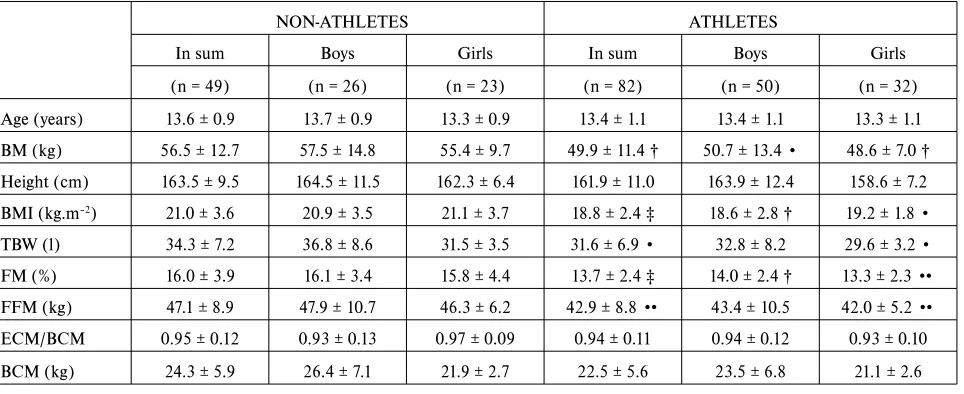
The athletes have expressively lower total body mass (BM), lower height and body mass index (BMI), great-er pgreat-ercentage of fat free mass (FFM), body cell mass (BCM) (absolute values), and better predispositions to physical performance (the lower value of ratio ECM/ BCM) in comparison with non-athletes (TABLE 1).
As it is apparent, the athletes have markedly less relative fatness to non-athletes of the similar chrono-logical age and gender. Thus observed athletes have sig-nificantly lower FM (–2.3% – p < 0.001) in comparison with non-athletes (TABLE 1).
TABLE 1
Characteristics of the study population – anthropometry and body composition parametres
NON-ATHLETES ATHLETES
In sum Boys Girls In sum Boys Girls
(n = 49) (n = 26) (n = 23) (n = 82) (n = 50) (n = 32)
Age (years) 13.6 ± 0.9 13.7 ± 0.9 13.3 ± 0.9 13.4 ± 1.1 13.4 ± 1.1 13.3 ± 1.1
BM (kg) 56.5 ± 12.7 57.5 ± 14.8 55.4 ± 9.7 49.9 ± 11.4 † 50.7 ± 13.4 • 48.6 ± 7.0 † Height (cm) 163.5 ± 9.5 164.5 ± 11.5 162.3 ± 6.4 161.9 ± 11.0 163.9 ± 12.4 158.6 ± 7.2
BMI (kg.m–2) 21.0 ± 3.6 20.9 ± 3.5 21.1 ± 3.7 18.8 ± 2.4 ‡ 18.6 ± 2.8 † 19.2 ± 1.8 • TBW (l) 34.3 ± 7.2 36.8 ± 8.6 31.5 ± 3.5 31.6 ± 6.9 • 32.8 ± 8.2 29.6 ± 3.2 •
FM (%) 16.0 ± 3.9 16.1 ± 3.4 15.8 ± 4.4 13.7 ± 2.4 ‡ 14.0 ± 2.4 † 13.3 ± 2.3 •• FFM (kg) 47.1 ± 8.9 47.9 ± 10.7 46.3 ± 6.2 42.9 ± 8.8 •• 43.4 ± 10.5 42.0 ± 5.2 ••
ECM/BCM 0.95 ± 0.12 0.93 ± 0.13 0.97 ± 0.09 0.94 ± 0.11 0.94 ± 0.12 0.93 ± 0.10
BCM (kg) 24.3 ± 5.9 26.4 ± 7.1 21.9 ± 2.7 22.5 ± 5.6 23.5 ± 6.8 21.1 ± 2.6
Values are reported as mean ±SD.
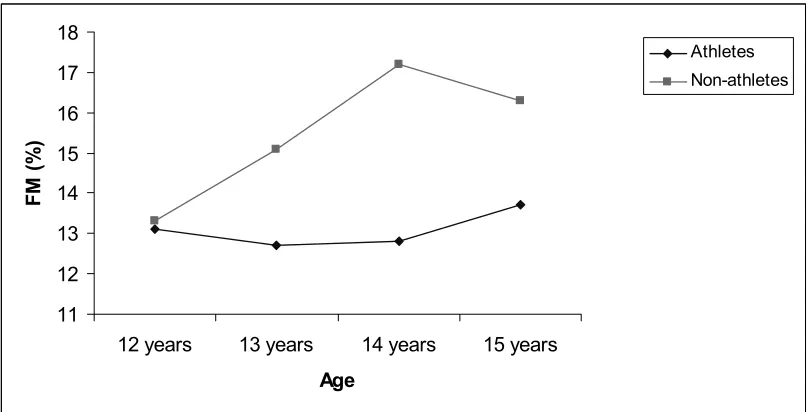
The results show age – related increase in FM. The changes of FM with the increasing age are expressively greater in non-athletes, and also the differences of FM in non-athletes to athletes increased with increasing age (except the age of 15) (Fig. 1).
Achieved results confirm formerly founded facts that the fatness increases markedly at the age of 12 (Bunc et
al., 2000b), see Fig. 1. This may be caused by increased inactivity related to negative dietary intake in children and youth and it affected by their negative energy bal-ance. At present, this is a typical tendency in population of children and youth.
Fig. 1
Age-related increase in FM – fat mass (%) together with comparison of FM % according to age between athletes and non-athletes
11 12 13 14 15 16 17 18
12 years 13 years 14 years 15 years
Age
F
M
(
%
)
Athletes Non-athletes
As far as the comparison of anthropometry and body composition parameters between athletes and non-ath-letes is concerned, that represents both genders, how-ever, there seem to be more marked differences between athletes and non-athletes girls than boys. These results suggest that the regular training (RT), let us say regular physical activity, can be probably more important for girls than boys, and has more potential to influence body composition favorably, by means of increasing FFM, resp. BCM, and by decreasing fatness. Furthermore, it is probably related to the physical fitness levels increas-ing in girls generally. Athletes girls tend to have espe-cially lower FM (–2.5% – p < 0.01), lower ECM/BCM (–0.04), and greater BCM (+2.9%) in comparison with non-athletes girls than boys (TABLE 1).
In addition we can recognize that some of tested athletes have a high level of predisposition to physical performance (ECM/BCM = 0.69) and a low level of FM measured by BIA method and calculated through the predictive equations (e. g. FM = 9.1% in girls, FM = 11.2% in boys).
TABLE 2
Achieved level of physical performance of the study population measured through the basic motor tests
NON-ATHLETES ATHLETES
In sum Boys Girls In sum Boys Girls
(n = 49) (n = 26) (n = 23) (n = 82) (n = 50) (n = 32)
Standing broad jump (cm) 166 ± 32 183 ± 32 148 ± 22 187 ± 20 ‡ 190 ± 19 181 ± 18 ‡
Sit-ups 60 seconds (number) 31 ± 9 35 ± 9 28 ± 7 41 ± 8 ‡ 41 ± 8 † 41 ± 7 ‡
Shuttle run 4 × 10 m (s) 12.2 ± 1.0 11.8 ± 1.0 12.7 ± 0.9 11.5 ± 0.6 ‡ 11.3 ± 0.5 † 11.7 ± 0.6 ‡
Bent arm hang (s) 10.7 ± 12.5 16.0 ± 12.5 4.9 ± 5.0 23.2 ± 13.1 ‡ 24.8 ± 13.1 • 21.0 ± 12.4 ‡
Sit and reach (cm) 24.7 ± 6.3 22.5 ± 6.3 27.2 ± 6.0 25.3 ± 7.5 21.4 ± 6.1 • 31.3 ± 5.9
Handgrip (kp) – R 28.0 ± 9.0 31.3 ± 9.0 24.4 ± 4.2 29.0 ± 8.5 30.9 ± 9.7 25.7 ± 4.7 Handgrip (kp) – L 27.7 ± 8.9 31.2 ± 8.9 23.7 ± 3.8 27.9 ± 8.4 30.2 ± 9.4 24.4 ± 4.4
Five-jump (m) 8.7 ± 1.2 9.3 ± 1.2 8.1 ± 0.7 9.4 ± 1.0 ‡ 9.7 ± 1.0 9.1 ± 0.8 ‡
Climb 4 m (s) 12.8 ± 10.4 7.6 ± 10.4 19.7 ± 12.6 7.3 ± 3.6 ‡ 7.1 ± 3.9 7.6 ± 2.9 ‡
Values are reported as mean ±SD.
• p < 0. 05; •• p < 0.01; † p < 0.005; ‡ p < 0.001 for differences between non-athletes and athletes (in sum, boys and girls) – unpaired two-sample assuming variances t-test; handgrip – R (right hand); handgrip – L (left hand)
We have found a significant increase of BM by 1.7 kg (p < 0.001), height by 1.8 cm (p < 0.001), FM by 0.6% (p < 0.05), FFM by 1.2 kg (p < 0.001), ECM/BCM by 2.1% in athletes (TABLE 3), together with increase of BCM by 1.3%, and significant increase of FFM by 2.8% (p < 0.001). Especially, athletes girls have significant in-crease of FM by 1.2% as well as significant inin-crease of BM by 2.0 kg and significant increase of BMI by 0.4 kg.m–2 (TABLE 3), which can be probably associated with the growth and maturation state and natural development. As far as the changes of body composition in non-athletes are concerned, achieved results show a down-grade of predisposition for physical performance (ECM/BCM = 0.03–3.2%) and a stagnancy or even in girls a decline (see below) of muscle mass increase (BCM = 0.1 kg, 0.4%), together with significant increase of FM by 0.4% (p < 0.001). This tendency represents both genders, however, the non-athletes girls tend to have more marked increase of FM by 0.6%, and above all BCM decrease by 0.4 kg than boys (TABLE 3).
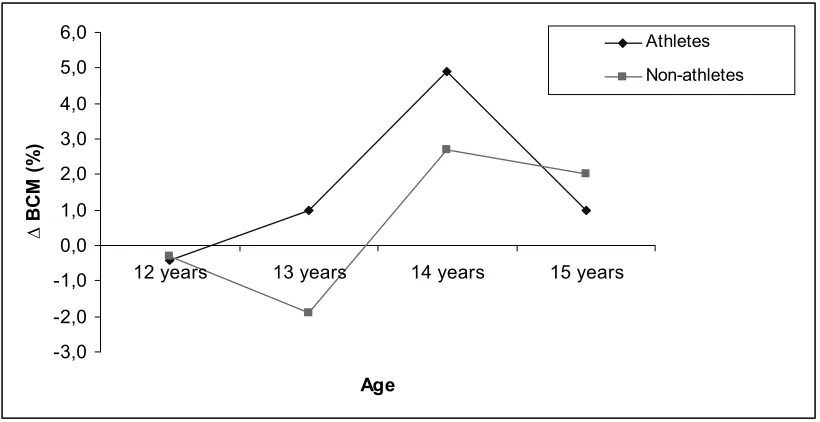
Both non-athletes and athletes girls tend to have markedly greater increase of FM than boys. Boys generally tend to have greater increase in BCM (develop-ment of muscle mass) (TABLE 3).
TABLE 3
Differences in anthropometry and body composition parameters achieved after six-month period in followed athletes and non-athletes
NON-ATHLETES ATHLETES
In sum Boys Girls In sum Boys Girls
(n = 49) (n = 26) (n = 23) (n = 82) (n = 50) (n = 32)
BM (kg) 1.7 ‡ 2.2 ‡ 1.2 † 1.7 ‡ 1.5 ‡ 2.0 ‡
Height (cm) 1.9 ‡ 2.4 ‡ 1.3 ‡ 1.8 ‡ 2.0 ‡ 1.5 ‡
BMI (kg.m–2) 0.1 ‡ 0.2 0.1 0.2 0.1 0.4 ‡
TBW (l) 0.5 • 1.4 • –0.3 0.7 1.1 • 0.1
FM (%) 0.4 ‡ 0.2 0.6 • 0.6 • 0.2 1.2 ‡
FFM (kg) 1.2 ‡ 1.6 ‡ 0.7 • 1.2 ‡ 1.2 ‡ 1.1 ‡
ECM/BCM 0.03 0.04 0.02 0.02 0.02 0.02
BCM (kg) 0.1 0.6 –0.4 0.3 0.5 0.1
Values are reported as mean.
• p < 0.05; •• p < 0.01; † p < 0.005; ‡ p < 0.001 for evaluation of changes after followed period (pre-, post-) in sum, boys and girls – paired two-sample for means t-test; BM = body mass; BMI = body mass index; TBW = total body water; FM = fat mass; FFM = fat free mass; ECM/BCM = ratio of extracellular mass and body cell mass; BCM = body cell mass; BCM – body cell mass
Fig. 2
Percentage differences in body cell mass (BCM) achieved after six-month period in athletes as compared to non-athletes
-3,0 -2,0 -1,0 0,0 1,0 2,0 3,0 4,0 5,0 6,0
12 years 13 years 14 years 15 years
Age
B
C
M
(
%
)
Athletes
Non-athletes
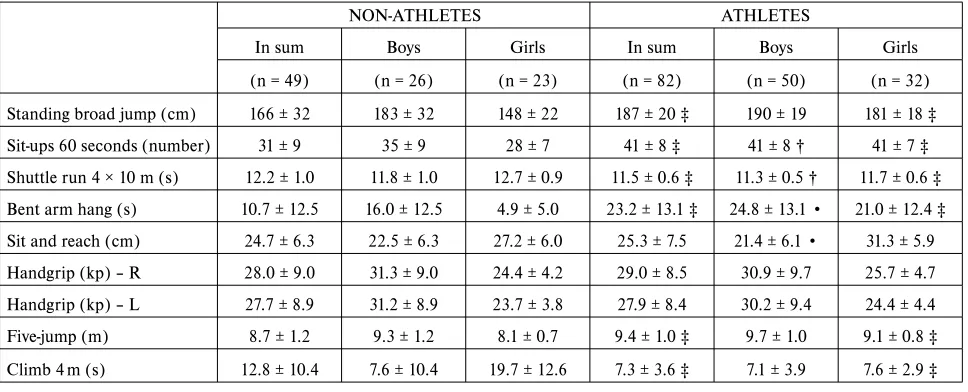
As for physical performance differences after the observed period, we have found a significant increase in the level of physical performance in every motor tests except for a decrease of sit-ups and five-jump perform-ance together with stagnancy or increase of climbing in athletes (both genders) (TABLE 4). Achieved results can be probably caused by type, duration and intensity of the performed training load. Athletes have not that significant increase in physical performance (as
important for the age observed. In addition, it can be associated also with the basic motor tests which have not been able to involve the special training stimuli of cross-country skiing.
The decline of strength performance as well as speed parameters is apparent in non-athletes. That represents both genders, however, non-athletes girls have more markedly negative differences in the level of physical performance after the observed period than boys as
compared to athletes (TABLE 4). Non-athletes boys tend to have the same or similar differences, even or greater increase in the level of physical performance determined after the observed period than athletes boys, which can be associated, as presented above, with differ-ent age and thus growth and maturation state related to markedly greater increase of BM and height in non-ath-letes boys (TABLE 3) as well as the effect of special and specific focusing of the training load in athletes boys.
TABLE 4
Differences in the level of physical performance measured through the basic motor tests achieved after six-month period in followed athletes and non-athletes
NON-ATHLETES ATHLETES
In sum Boys Girls In sum Boys Girls
(n = 49) (n = 26) (n = 23) (n = 82) (n = 50) (n = 32)
Standing broad jump (cm) 11 † 15 •• 6 6 ‡ 7 † 4
Sit-ups 60 seconds (number) –2 • –1 –5 † –1 • –1 –2 •
Shuttle run 4 × 10 m (s) –0.1 –0.1 –0.1 –0.1 –0.2 • 0.0
Bent arm hang (s) –0.4 –1.3 –0.6 1.2 0.7 1.9
Sit and reach (cm) 1.8 ‡ 2.1 † 1.5 • 1.0 ‡ 0.6 1.7 ‡
Handgrip (kp) – R 1.5 •• 2.2 •• 0.6 2.1 ‡ 2.5 ‡ 1.5
Handgrip (kp) – L 2.3 ‡ 3.0 ‡ 1.5 • 2.1 ‡ 2.9 ‡ 1.0 •
Five-jump (m) –0.3 • –0.2 –0.4 •• –0.3 ‡ –0.2 † –0.4
Climb 4 m (s) 3.3 • –0.1 7.2 • 0.2 –0.1 –0.7
Values are reported as mean.
• p < 0.05; •• p < 0.01; † p < 0.005; ‡ p < 0.001 for evaluation of changes after followed period (pre-, post-) in sum, boys and girls – paired two-sample for means t-test; handgrip – R (right hand); handgrip – L (left hand)
The lower percentage of FM in athletes, as com-pared to non-athletes (especially in girls) (TABLE 1), can be associated with regular training and besides with the type of training load which is generally specialized to endurance in cross-country skiers. The increase of FM observed in youth regularly trained after followed period can be probably associated above all with natural development.
CONCLUSIONS
The regular training was found to favorably improve the body composition by means of decreasing fatness, increasing BCM as well as the greater increase in BCM, related to the level of physical performance.
Results from this study indicate a positive effect of the regular systematic training performed at special (CC-skiing) sport primary school. It concerns firstly the development of young athletes in high
perform-ance system, and secondly it is a factor that helps to sustain a sufficient amount of physical activity. We can generalize that it positively influences body composition and physical performance in children and youth. That is a very important today, because as has been often stated, presently there is a tendency to decreased the physical activity levels; consequently the physical fitness levels of school-aged children are falling whilst the obes-ity levels have in general increased.
According the above presented facts and formerly mentioned findings, regular training can also be used as the prevention of overweight or obesity and thereby affected health and psychical, social and economic com-plications of youth as well as of adults.
of physical performance as well as greater increments in strength performance in athletes, as compared to non-athletes.
The observed age period (especially between the ages of 12 and 13) seems to be generally critical to increasing prevalence of overweight or obesity.
As far as the above presented findings in non-ath-letes are concerned, significant increase in FM together with indicated trend towards stagnancy or declining of BCM and downgrading of the predispositions to physi-cal performance, are probably caused by the progressive inactivity affecting negative energy balance. The results of body composition and physical performance in non-athletes indicate that it is inevitable to increase a physi-cal activity level, especially in girls.
This study has been made in cooperation with for-merly mentioned Sport Research Centre, Faculty of Physical Education and Sport, Charles University in Prague, ZŠ T. G. M. Vimperk, ZŠ Zdíkov, and ski-clubs SKSV, SOSY, LIPT.
The present study is a part of the long-term observa-tion of young cross-country skiers, and it is concerned about their body composition and physical perform-ance, and will be a part of my disertation thesis, which is in preparation.
The results and conclusions can be used for valu-able feedback resulting in the improving of training pro-gramme in the athletes tested, and to enrich the training system of sport primary schools with a specialization to cross-country skiing, as well as to solve the problems how children and youth bodies respond to specific and special training stimuli concerning body composition and physiological profile. By the way, there still remains the question of to what degree and how it is best to train them.
REFERENCES
Boreham, C., & Riddoch, C. (2001). The physical activ-ity, fitness and health of children. J. Sports Sci., 19, 915–929.
Bouchard, C., Shephard, R. J., & Stephens, T. (1994). Physical activity, fitness, and health. Champaign: Hu-man Kinetics.
Bunc, V., Dlouhá, R., Moravcová, J., Novák, I., Hoš-ková, Z., & ČermáHoš-ková, M. (2000). Estimation of body composition by multifrequency bioimpedance measurement in children. Ann. N. Y. Acad. Sci., 904, 203–204.
Bunc, V., Horčic, J., & Dostálová, J. (2000). Školní mládež v konci dvacátého století. [Závěrečná zpráva grantu MŠMT ČR VS 97 131], Univerzita Karlova, Fakulta tělesné výchovy a sportu, Praha.
Deurenberg, P. et al. (1995). Multi-frequency impedance for prediction of extracellular water and total body water. Brit. J. Nutr., 73, 349–358.
Hannan, W. J. et al. (1995). Comparison of bio-imped-ance spectroscopy and multi-frequency bioimped-ance analysis for the assessment of extracellular and total body water in surgical patients. Clin. Sci., 89, 651–658.
Havlíčková, L. et al. (1993). Fyziologie tělesné zátěže II.: speciální část – 1. díl. Praha: Karolinum.
Heggebø, L. K. (2003). European Youth Heart study-The Norwegian Par: A cross-sectional study of physical ac-tivity, cardiorespiratory fitness, obesity and blood pres-sure in children and youth. Dissertation thesis, The Norwegian University of Sport and Physical Educa-tion, Department of Sports Medicine, Oslo. Heyward, V. H., & Stolarczyk, L. M. (1996). Applied
Body Composition Assessment. Champaign: Human Kinetics.
Lukaski, H. C. (1987). Methods for the assessment of body composition: traditional and new. Am. J. Clin. Nutr., 46, 437–456.
Maffulli, N., Chan, K. M., Macdonald, R., Malina, R. M., & Parker, A. W. (2001). Sports Medicine for Specific Ages and Abilities. London: Churchill Livingstone. Malina, R. M., & Bouchard, C. (1991). Growth,
Matura-tion, and Physical Activity. Champaign: Human Ki-netics.
Pařízková, J. (1998). Složení těla, metody měření a vy-užití ve výzkumu a lékařské praxi. Med. Sport. Boh. Slov., 7(1), 1–6.
Roche, A. F., Heymsfield, S. B., & Lochman, T. G. (1996). Human body composition. Champaign: Hu-man Kinetics.
Ross, R., & Janssen, I. (2001). Physical activity, total and regional obesity: dose-response considerations. Med. Sci. Sports Exerc., 33, 521–527.
Spirduso, W. W. (1995). Physical dimensions of aging. Champaign: Human Kinetics.
This study was supported by the grant of the Czech Ministry of Education No. MSM 115100001.
VLIV PRAVIDELNÉHO TRÉNINKU NA TĚLESNÉ SLOŽENÍ MLADÝCH LYŽAŘŮ BĚŽCŮ
VE VZTAHU K MOTORICKÉ VÝKONNOSTI V POROVNÁNÍ S NORMÁLNÍ POPULACÍ
(Souhrn anglického textu)
motoric-ké výkonnosti v závislosti na pravidelném tréninkovém zatížení aplikovaném v rámci šestiměsíčního tréninko-vého programu přípravném období, tzv. „suché přípra-vy“, ročního tréninkového cyklu 2003/2004 u skupiny mladých lyžařů běžců, žáků sportovních tříd při ZŠ T. G. Masaryka ve Vimperku a členů lyžařských oddílů Ski-klub Šumava, Libín Prachatice a Sokol Stachy ve věku 12–15 let (n = 81), v porovnání s normální popula-cí (n = 49). Byla provedena dvě měření tělesného složení a motorické výkonnosti, na začátku a konci přípravného období (duben a říjen), tedy podruhé po šestiměsíčním tréninkovém programu. Metodou pro stanovení tělesné-ho složení byla multifrekvenční bioimpedanční analýza (BIA), zařízení B. I. A. 2000-M, Data Input, Germany měřící celkovou impedanci při použití proměnlivé frek-vence. Úroveň motorické výkonnosti byla posuzována na základě výsledků základních motorických testů. Z výsledků vyplývá, že systematický trénink realizova-ný v prostředí sportovních tříd má evidentně pozitivní dopad, a to nejen v systému přípravy dětí a mládeže pro vrcholový sport, ale především z hlediska vlivu pravidel-ného pohybového zatížení aplikovapravidel-ného nad rámec škol-ních osnov na tělesné složení a motorickou výkonnost dospívajícího organismu. Pravidelný trénink tak může z hlediska tělesného složení působit také jako prevence vzniku nadváhy, případně obezity a s tím souvisejících dalších zdravotních rizik v dospělosti. Výsledky této stu-die mohou být především hodnotnou zpětnou vazbou vedoucí ke zkvalitnění tréninkové přípravy sledovaných jedinců a k obohacení programu lyžařských sportovních tříd obecně. Stejně tak mohou přispět k řešení problema-tiky reakce dětského a dospívajícího organismu na spe-ciální a specifickou tréninkovou zátěž z hlediska změn tělesného složení, resp. distribuce tělesných tekutin a změn ve struktuře svalové hmoty, a z hlediska změn fyziologického profilu. Studie je součástí dlouhodobého sledování mladých lyžařů běžců v Laboratoři sportovní motoriky FTVS UK v Praze.
Klíčová slova: tělesné složení, motorická výkonnost, děti a mládež, běh na lyžích, bioimpedanční analýza (BIA), pravidelný trénink.
Růžena Randáková, Mgr.
Education and previous work experience
She is a graduate of the two-branch study of physical education and biology, and has also specialized in the training of cross-country skiing at the Faculty of Physical Education and Sport, Charles University in Prague. Scientific orientation
She is mostly interested in topics concerned with physi-cal development in children and youth, the responses of children and youth to training stimuli, the effects of regular training on body composition, physiological pro-file, and level of physical performance in young athletes, above all in young cross-country skiers, and additionally in comparison with non-athletes.
First line publications
Kinkorová, I., & Randáková, R. (2004). Physical profile in young cross-country skiers from 10 to 16 years old. Acta Universitatis Palackianae Olomucensis. Gymnica, 34(2), 31–36.
Randáková, R. (2004). The influence of regular training on body composition in relation to physical perform-ance in Czech young cross-country skiers in compari-son with non-athletes. In Ch. Raschner, A. Niederkofler, C. Patterson, & H. P. Platzer (Eds.), Young Researcher Seminar Innsbruck 2004 (p. 22). Innsbruck: The Organ-ising Committee of the Winter Universiade Innsbruck/ Seefelf 2005 (ISOC 2005) and the Institute for Sport Science of the University of Innsbruck.
Randáková, R., & Bunc, V. (2004). Differences in the physiological and anthropometrical profiles of pubes-cent regularly trained cross-country skiers. In E. van Praagh, J. Coudert, N. Fellmann, & P. Duché (Eds.), 9th Annual Congress European College of Sport Science, Clernomt-Ferrand, France (p. 298). Clermont-Ferrand: Université de Clermont-Ferrand.
Randáková, R., Bunc, V., Kalous, J., & Slaba, R. (2003). Differences in body composition and physical perform-ance depending on training load in youhg cross-country skiers. In 8th annual Congress of the European College of Sport Science. Salzburg: Institute of Sport Science, University of Salzburg.
Randáková, R., Bunc, V., & Slaba, R. (2003). Influence of physical training on body composition parameters and level of physical performance in young cross-coun-try skiers. In F. Vaverka (Ed.), Movement and Health, (pp. 235–238). Olomouc: Palacký University.
Charles University
Faculty of Physical Education and Sport
Sport Research Centre José Martího 31