_____________________________________________________________________________________________________
*Corresponding author: E-mail: [email protected];
22(4): 1-10, 2018; Article no.CSIJ.41105 ISSN: 2456-706X
(Past name: American Chemical Science Journal, Past ISSN: 2249-0205)
Synthesis and Encapsulation of
bis
-eugenol in a
Mesoporous Solid Material: Enhancement of the
Antioxidant Activity of a Natural Compound from
Clove Oil
Vanina A. Guntero
1,2, Cristián A. Ferretti
1,3, Pedro M. Mancini
1and María N. Kneeteman
1*1IQAL (UNL-CONICET), Laboratorio Fester-QUIMICA ORGANICA (FIQ), Santiago del Estero 2829,
Santa Fe, Argentina.
2
UTN Facultad Regional San Francisco, Av. de la Universidad 501, San Francisco, Argentina.
3INCAPE (UNL-CONICET), Colectora Ruta Nac. 168, Km 0, Paraje El Pozo, Santa Fe, Argentina.
Authors’ contributions
This work was carried out in collaboration between all authors. Author VAG performed the experimental analysis and wrote the first draft of the manuscript. Author CAF designed the study, wrote the protocol and wrote the first draft of the manuscript. Authors PMM and MNK managed the analyses of the study and reviewed the final manuscript. All authors read and approved the final manuscript.
Article Information
DOI: 10.9734/CSJI/2018/41105
Editor(s):
(1) Francisco Marquez-Linares, Department of Chemistry, Nanomaterials Research Group, School of Science and Technology, University of Turabo, USA.
Reviewers:
(1) Fahim Shaltout, Benha University, Egypt. (2) Julian Cruz-Olivares, Autonomous University of State of Mexico, Mexico. Complete Peer review History:http://www.sciencedomain.org/review-history/24442
Received 13th February 2018 Accepted 19th April 2018 Published 4th May 2018
ABSTRACT
In the present work, microwave extraction conditions to recover high eugenol content in the crude extract from clove were investigated. The effect of factors like temperature, stirring, time, liquid: Solid ratio and solutions of solvent were evaluated with Taguchi’s method. The eugenol content was determined by gas chromatography. From the isolated eugenol, the bis-phenol was synthesized by the dimerization of eugenol. The encapsulation of bis-eugenol on the mesoporous silica was carried out by a microwave assisted process. Previously, mesoporous silica SBA-15 was prepared by hydrothermal synthesis using Pluronic P123 triblock copolymer as a surfactant. The bis-eugenol
encapsulated in SBA-15 was characterized by physicochemical techniques. The results indicated that the encapsulation of bis-eugenol in the pores of silica occurred through weak interactions of an electrostatic nature without producing chemical changes in the antioxidant property. The antioxidative activity of eugenol, bis-eugenol and bis-eugenol/SBA-15 system was examined by phosphomolybdenum assay. Among these materials, a remarkably high antioxidant activity was found in bis-eugenol encapsulated in SBA-15. These resultas suggest the possibility of applying this system as an antioxidant active packaging in the future.
Keywords: Antioxidant activity; encapsulation; mesoporous material; clove oil.
1. INTRODUCTION
Aromatic plants and their essential oils have been used since antiquity in flavor and fragrances, as condiments or spices, as medicinal, as antimicrobial/insecticidal agents, and to repel insects or protect stored products [1]. Essential oils are aromatic and volatile oil liquids extracted from different parts of plants (leaves, seeds, roots, fruits) by different methods [2,3]. These natural products have received increasing attention in the chemical, food and pharmaceutical industries because they can have a wide range of applications and can also replace several synthetic compounds [4,5,6]. For this reason, it is desirable to use natural compounds which have a decreased risk of side effects if compared to the synthetic components of drugs [7].
Vegetal species produce a diversity of secondary metabolites, which have multiple functions throughout the plant life cycle [8]. Many of these natural compounds are present in essential oils, as a complex mixture of components with low molecular weight [9] especially phenolic compounds from essential oils, such as acid-phenols and their esters, which have antioxidant properties. The antioxidant activity of aromatic plants is very attractive because in foods rich in unsaturated lipids they prevent or slow down the process of rancidity. This effect is important not only in terms of preservation but also because of their important health benefits. Antioxidants act as free radical stabilizing agents inhibiting the peroxidation lipid. This process is involved in the development of several common diseases, which include atherosclerosis and neurodegenerative disorders such as the Alzheimer's disease [10,11]. The antioxidant activity of phenolic compounds depends on the chemical structure, in particular, in the electron delocalization on the aromatic ring [12,13].
Clove (Syzygium aromaticum) is an important aromatic spice. Clove has a light yellow or brown colour, it produces a pleasant aroma, and has a
wide spectrum of medicinal properties [14]. In fact, extracts from clove have antibacterial, antifungal, insecticidal, analgesic, anticoagula-tion, anti-inflammation and antioxidant properties and is used as a flavouring agent and antimicrobial material in some industries such as pharmacy, fragrance, cosmetics and food [15,16,17]. Its major constituent is eugenol as well as eugenyl acetate, α-humulene, and β-caryophyllene. Eugenol (4-allyl-2-methoxy-phenol) is a naturally phenolic compound widely used in food, pharmaceutical, cosmetics and active packaging applications, due to its effective antimicrobial and antioxidant properties [18,19,20,21]. However, most plant-derived bioactive compounds, including eugenol, are highly volatile, unstable, and sensitive to oxygen, light and heat during processing, utilization and storage.
employing a special set of orthogonal arrays which examines a huge quantity of variables [26].
Several studies have recently shown that encapsulation has become a technique of increasing interest since it offers numerous benefits, including ease of handling, enhanced stability, protection against oxidation, retention of volatile ingredients, taste masking, controlled release, consecutive delivery of multiple active ingredients, change in flavour character, long-lasting organoleptic perception, reduced toxic side effects, improved water solubility of hydrophobic ingredients, and enhanced bioavailability and efficacy revealed [27]. Microencapsulation allows getting microparticles with a size between 1-1000 µm comprising an active agent embedded in a natural or synthetic material. Microcapsules are composed of two parts, namely the core and the shell. The core (the internal part) contains the active agent, while the shell (the external part) protects the core from the outer environment. Encapsulation can be achieved by a wide range of methods or techniques, providing isolation, entrapment, protection or controlled release of sensitive or reactive materials from/across the surrounding matter. There are numerous industrial applications of microencapsulation and the microencapsulation technology has been extensively used in various food processing fields [28,29,30]. This technology can embed compounds and protect these ingredients against deterioration, volatile losses, or premature interaction with other ingredients [14]. In special, different research groups have investigated the utilization of essential oils or antioxidant agents encapsulation using different materials, such as chitosan nanoparticles [31,32], jelly-alginates complex microparticles [33], casein micelles [34] and β-cyclodextrin [27].
Another material that presents potential applications is mesoporous silica, such as SBA-15. This silica is a suitable inorganic support due to its uniform wide channels that can immobilize organic molecules. Its stability leads to better dispersion, biocompatibility and subsequent functionalization to obtain a useful system to be applied in the field of food, medical and cosmetics industries [35,36,37]. The specific surfaces of SBA can be used to provide sites for the adsorption and diffusion of targets and enhance the local concentration [38]. In fact, the possibility of using siliceous ordered mesoporous materials for controlled delivery systems has been reported for a wide range of drugs [39].
Previous investigations were based on supporting enzymes on ordered mesoporous solids [40] other studies used ordered mesoporous silica materials which are special for the architecture of fluorescence chemosensors to detect Pb2+ [41] and this material is employed in osseous regeneration technologies [42].
The aim of this study was to assay the antioxidant activity of eugenol and its related compounds. The bis-eugenol (BE) was synthesized by oxidative coupling from eugenol isolated from clove and then encapsulated in SBA-15 by hydrothermal conditions. The focus was on the evaluation of the antioxidant activity of this novel bis-eugenol/SBA-15 system compared with the antioxidant activity of eugenol and bis-eugenol.
2. MATERIALS AND METHODS
2.1 Eugenol Extraction from Clove
Commercial clove was dried at 40ºC and ground in a mortar. A microwave-assisted extractor (Anton Parr Monowave 300) equipped with 30 ml vessel was utilized to perform microwave assisted extraction. Sample extractions were carried out by manipulating the control panel for the adjustment of the parameters studied. The experiment was designed by 5-level L25 Taguchi´s orthogonal array. In the Taguchi statistical design, the introduced orthogonal arrays can supply efficient and suitable possibility to perform the practical tests with the minimum number of examinations [43]. Temperature, stirring, time, solution of ethanol and liquid:solid ratio were selected as important factors affecting the yield of essential oil and of eugenol. The controlling parameters and their levels were temperature (30-70ºC), stirring (240-1200 rpm), time (5-25 min), solution of ethanol (20-100%) and liquid:solid ratio (7-16 ml/mg). Analysis of
variance was used for statistical analysis of the results to investigate which factors have the greatest influence on the optimum
conditions.
(%) = (mass of EO )/( mass clove) 100 (1)
(%) =
(mass of eugenol )/( mass of EO) 100 (2)
Eugenol was extracted from clove essential oil according to [45] dried under anhydrous sodium sulphate. After filtration, the solvent was evaporated. The eugenol obtained was stored at 4 °C until use.
2.2 Synthesis of bis-eugenol and SBA-15
The BE was synthesized by the oxidative coupling of eugenol [46]. Eugenol (3 g, 18.27 mmol) was dissolved in acetone (60 ml) and distilled water (30 ml), then ammonium hydroxide 28% (40 ml) was added. The mixture was stirred until a yellow colour developed. Afterwards, a saturated solution of potassium ferricyanide was added dropwise for 5 hours. The mixture was then stirred for 12 hours, previous addition of ammonium hydroxide 28% (40 ml). The reaction was neutralized with diluted hydrochloric acid. The solid was filtered and recrystallized with ethanol absolute.
Mesoporous silica SBA-15 (SBA) was prepared by using Pluronic P123 triblock copolymer surfactant as a template in acid media according to the literature [47]. Polyethylene glycol acts as modifier and tetraethyl orthosilicate (TEOS) acts as source of silica. First, Pluronic P123 (4 g) was dissolved at room temperature in a 3.1 M aqueous hydrochloric acid solution (350 mL). Then, polyethylene glycol 400 (10 g) was added and the resulting solution was slowly stirred at 35ºC until the solution became clear. TEOS (22.5 mL) was then added to the solution and the resulting mixture was vigorously stirred at 40 °C for 24 h. Subsequently, the content was transferred to a microwave oven and kept at 100ºC for 12 h under static conditions. The resultant product was filtered, washed with water, and dried overnight at 80ºC. Finally, the surfactant was removed by calcination at 550ºC for 5 h in air.
2.3 Encapsulation of BE in SBA-15
The BE-SBA preparation was performed using an Anton Paar Monowave 300. BE (0.15 g) was placed in a vial, and SBA-15 (1.5 g) was added. Then, a solution of ethanol:water (50:50, v/v) (18 mL) was added to the mixture. The mixture was placed in a microwave oven. The reaction was carried out at 70ºC (with a controllable power
system), 1200 rpm, for 20 min. After a slow cooling of the mixture, the resulting material was dried at 80ºC for 5 h.
2.4 Characterization of Materials
1H NMR spectra were recorded using a
Bruker DPX-300 (300 MHz) spectrometer. Nitrogen adsorption-desorption isotherms were
measured at −196ºC on a NOVA-1000
Quantachrome. Prior to testing, the samples were treated at 100ºC in the degassing port of the adsorption analyser. Specific surface areas were evaluated using the Brunauer, Emmett and Teller (BET) method, while pore size distributions were calculated using the Barret-Joyner-Halenda (BJH) algorithm on the adsorption branches of the isotherms.
FTIR tests were performed on a Shimadzu FTIR Prestige-21 spectrophotometer in the region from 4000 to 1000 cm-1. The samples were mixed with KBr (1% wt) and then pressed. The UV absorption measurements were carried out on a Perkin Elmer Lambda 20 spectrophotometer.
Fluorescence studies were performed on a Perkin Elmer F7000 spectrofluorometer.
Spectrofluorometric spectra were performed from a suspension of the sample in ethanol:water (50:50, v/v) and then brought into a quartz cell for measurement.
2.5 Encapsulation Efficiency of BE
The BE encapsulated in SBA-15 was removed using a mix of acetone:DMSO (50:50, v/v). For this purpose, 0.1 g of BE-SBA was mixed with 20 ml of the solvents at 500 rpm for 20 min and then sonicated during 30 min. After this procedure, the suspension was filtered out and the amount of BE was determined by UV spectrophotometry using a calibration curve obtained from standard solutions of BE (λ= 282 nm). The encapsulation efficiency (EE) of BE was calculated by the equation (3):
(%) =
(amount of BE encapsulated)/( initial BE amount) 100 (3)
The percentage of carbon in the BE-SBA samples was analysed by EA to verify the EE of BE in the SBA.
2.6 Antioxidant Activity
phosphomolybdenum method [48]. BE was dissolved in a mix DMSO:ethanol (1:99, v/v) at 100 mg/ml, and free SBA and BE-SBA were dissolved in the same mix solvents, which contained approximately 100 mg/ml BE in the particles. Then, the samples were filtered and diluted with the same solvent to obtain solutions of known concentration. An aliquot of 1 ml of sample solution was combined in a tube with 9 ml of reagent solution composed of 0.6 M sulfuric acid, 28 mM sodium phosphate, and 4 mM ammonium molybdate. The tubes were capped and incubated at 95ºC for 90 min. After the samples had cooled to room temperature, the absorbance of the aqueous solution was measured at 695 nm against a blank. The control solution contained 1.0 ml of reagent solution and the appropriate volume of the same solvent used for the sample. It was incubated
under the same conditions as the rest of the samples. Similar tests were carried out
with a solution of butylhydroxytoluene (BHT)
antioxidant. Antioxidant activity was expressed as inhibition (I) calculated by equation
(4):
(%) = 1 − −
− 100 (4)
where AS is initial absorbance, As90 is the absorbance of the sample at 90 min, Ac is initial
absorbance of the negative control and Ac90 is the absorbance of the negative control at
90 min.
3. RESULTS AND DISCUSSION
3.1 Extraction of Essential Oil from Clove
We studied the extraction of EO assisted by microwave, in which different factors were evaluated independently. The highest yield of EO (Y = 45-52 %) was obtained at 50ºC, 750 rpm of stirring rate, 15 min of extraction, with a solution of ethanol of 40 wt. % in water and a liquid:solid ratio of 7 mL/mg. Under these conditions the yields of eugenol were between 35 and 48 %. The eugenol was isolated in the usual form. The
rest of the constituents are those that are classical for this essential oil.
Considering the yield of the process as (mass of eugenol/mass of clove) %, the extraction assisted by microwave presented values of 16-25 %. In conclusion, the extraction assisted by microwave has technological advantages as it implies less extraction time and therefore lower energy consumption.
3.2 Characterization of Materials
The eugenol obtained from clove essential oil was a light yellow liquid with a strong-clove smell. The BE synthesized was a brown solid with a yield of 80 %. The characteristic bands presented in the 1H RMN spectrum were: (acetone-d6, 300 MHz) d (ppm): 6.82 (s, 2H, HAr); 6.72 (s, 2H, HAr); 6.01 (m, 2H, HC); 5.11 (d, 2H, HC=C); 5.02 (d, 2H, HC=C); 3.87 (s, 6H, -CH3); 3.35 (d, 4H, -CH2-). The main bands identified by IR were: (KBr, cm-1): 3530 (OH); 2885 (=CH); 2880 (-CH2-); 2850 (-OCH3); 1665 (C=C); 1620 (C=CAr); 1470 (C=CAr); 1370 (C=CAr).
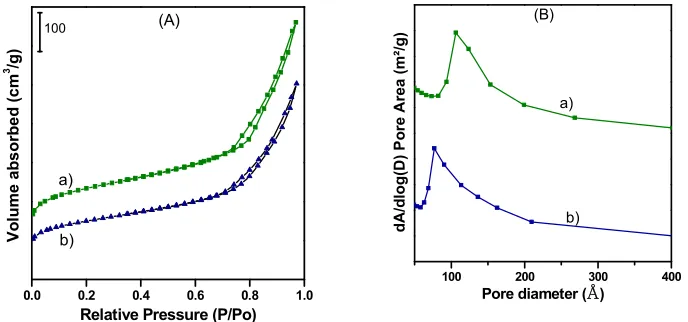
The N2 adsorption/desorption isotherms of SBA-15 and BE-SBA were determined to study their textural properties. Results are reported in Table 1. The values of the specific surface area, pore volume and pore diameter of SBA-15 agree with those reported in the literature [35,47].
Samples showed N2 adsorption/desorption curves corresponding to type IV isotherms with H1 hysteresis loop at a relative pressure from 0.65 to 0.96, Fig. 1(A). The encapsulation of BE into SBA-15 caused a reduction of specific surface area and a slight increase of average pore diameter, while the pore volume remained almost unchanged, Fig. 1(B). Considering the molecular diameter of BE previously calculated by DFT [49] it is possible to understand that this molecule can be easily located within the pores of the SBA-15. Thus, the changes of textural parameters can be interpreted as BE molecules within the pores of silica reducing the adsorption of nitrogen.
Table 1.Textural properties of materials
Sample Specific Surface Area (m2/g) Pore Volume (cm2/g) Average Pore Diameter(Å)
SBA-15 420 0.77 83
Fig. 1.(A) Nitrogen adsorption-desorption isotherms and (B) Pore size distribution of: a) SBA-15, b) BE-SBA
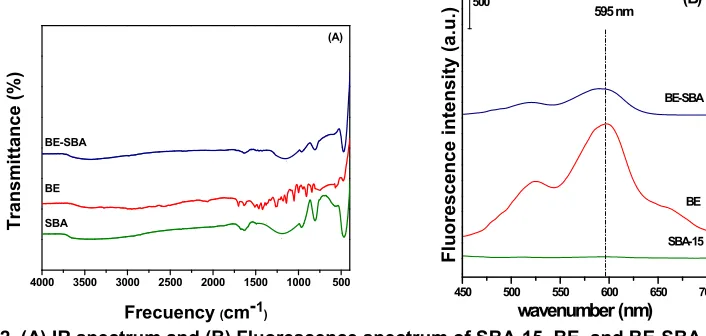
The FTIR spectra of SBA-15, BE, and BE-SBA is shown in Fig. 2(A). The characteristic bands reported in BE characterization were obtained from BE spectrum. In the spectrum of SBA-15, a peak near 1635 cm-1 is observed, mainly resulting from the bending vibration of the H2O absorbed. The typical Si-O-Si bands appear in the OH bending region as three peaks: one broad and strong peak centred at 1033 cm-1; two narrow and relatively weak peaks near 805 and 463 cm-1, which are associated with the condensed silica network. Silanol groups of SBA-15 give the characteristic band at 964 cm-1, but the encapsulation of BE produces the reduction of the intensity of the main bands of silica (spectrum of BE-SBA), which indicates a strong interaction between silanol groups of mesoporous silica with molecules of BE present in the SBA-15 pores.
To assess the interaction between BE and SBA-15, a study of fluorescence spectroscopy was carried out. The fluorescence spectrum of BE-SBA is shown in Fig. 2(B). Mesoporous silica SBA-15 itself showed no fluorescence, whereas BE presented an excitation band at 595 nm (under emission wavelength at 420 nm). The luminance phenomenon of BE is caused by the π electron conjugate system present in these molecules. The composite of BE-SBA gives a sensitive fluorescence response, under the same wavelength as the free BE. In these cases, the fluorescence of BE-SBA appears at a definite excitation length owing to the fluorescent of bis -eugenol molecules encapsulated in the mesoporous silica. However, the fluorescence
intensity of the hybrid material of SBA decreases due to the lower amount of BE present in the suspension in the sample. In conclusion, the results suggest weak interactions of electrostatic nature (hydrogen bond) that connect BE molecules with Si-OH groups present on the porous wall of SBA-15. These interactions do not cause chemical changes in BE.
The BE content of BE-SBA, obtained by extraction with acetone:DMSO and quantified by UV spectroscopy, was 9.07 wt. %. Considering that the initial BE used was of 9.98 wt. %. These results indicate an encapsulation efficiency of 90.88 %. The percentage of carbon in BE-SBA was analysed by elemental analysis to calculate the amount of BE encapsulated in SBA-15 and in this way, verify the result obtained by extraction and analysis by UV. The carbon amount in the BE-SBA was 7.8 wt. %, which corresponds to a BE content of 10.61 wt. %. These results verify the amount of BE obtained by UV assay. Since the content of BE in this procedure is obtained by calculations, it is common to obtain higher amounts of BE than those reported by theoretical and experimental calculations [50].
3.3 Antioxidant Activity
Evaluation of the antioxidant activity of samples using the phosphomolybdenum method at two levels of molar concentration was carried out. The results are presented in Table 2. SBA-15 showed no antioxidant activity. On the other hand, the other samples presented antioxidant properties. Regardless of the concentration of
0.0 0.2 0.4 0.6 0.8 1.0
b)
Vo
lume ab
s
orb
e
d
(c
m
3 /g
)
Relative Pressure (P/Po) 100
a)
(A)
100 200 300 400
b)
dA/d
log(D)
P
o
re A
rea
(m²/g)
4000 3500 3000 2500 2000 1500 1000 500 BE-SBA
BE
T
ransmit
tance (%
)
Frecuency (cm-1)
SBA
(A)
450 500 550 600 650 700
Fluorescence
intensity (a.u.)
(B) 500
BE BE-SBA
wavenumber (nm) 595 nm
SBA-15
Fig. 2. (A) IR spectrum and (B) Fluorescence spectrum of SBA-15, BE, and BE-SBA
the free compound, antioxidant potency decreased in the order: BHT > BE > Eugenol. The inhibitory effect of dimerized eugenol is higher than that of monomeric eugenol [12]. At the same level of concentration, BE encapsulated in SBA presented higher antioxidant activity than that of free bis-eugenol. This was attributed to the increase in the solubility of BE in the BE-SBA system, as a result of their interaction with mesoporous silica [27].
Table 2. Antioxidant activity of samples by the phosphomolybdenum method
Sample Concentration
2 mM 8 mM
Eugenol 6.1 11.0
BE 13.7 38.4
BE-SBA 19.0 42.2
BHT 12.3 34.5
4. CONCLUSIONS
The experimental results reported in this paper show that the extraction assisted by microwave proposes an efficient time saving and quality control strategy to obtain eugenol. From eugenol separated from essential clove oil, it was possible to synthesize a dimer bis-eugenol with high yield. The SBA-15 obtained by hydrothermal procedure is a mesoporous material with an excellent capacity for encapsulating bis-eugenol. The encapsulation methodology used in this work, i.e. encapsulation assisted by microwave, was an efficient procedure for embedding bis -eugenol in mesoporous silica SBA-15. The physicochemical characterization of bis-eugenol
supported in SBA-15 showed a satisfactory encapsulation. The encapsulation of BE in SBA-15 increased the performance as antioxidant of
bis-eugenol. A remarkable characteristic of this system is that the encapsulated BE presented a higher antioxidant activity than that of the free eugenol. This property could be used in the different applications.
COMPETING INTERESTS
Authors have declared that no competing interests exist.
REFERENCES
1. Batish DR, Singh HP, Kohli RK, Kaur S. Eucalyptus essential oil as a natural pesticide. For. Ecol. Manage. 2008;256: 2166–2174.
2. Burt S. Essential oils: Their antibacterial properties and potential applications in foods-a review. Int. J. Food Microbiol. 2004;94:223–253.
3. Ali B, Al-Wabel NA, Shams S, Ahamad A, Khan SA, Anwar F. Essential oils used in aromatherapy: A systemic review. Asian Pac. J. Trop. Biomed. 2015;5(8):1–11. 4. Yahya A, Yunus RM. Influence of sample
preparation and extraction time on chemical composition of steam distillation derived patchouli oil. Procedia Eng. 2013; 53:1–6.
5. Linde GA, Colauto NB, Albertó E, Gazim ZC. Quimiotipos, extracción, composición y aplicaciones del aceite esencial de lippia alba. Rev. Bras. Pl. 2016;18:191–200. 6. Gutierrez J, Barry-Ryan C, Bourke P. The
combinations and interactions with food ingredients. Int. J. Food Microbiol. 2008; 124:91–97.
7. Filiptsova OV, Gazzavi-Rogozina LV, Timoshyna IA, Naboka OI, Ye VD, Ochkur AV. The essential oil of rosemary and its effect on the human image and numerical short-term memory. Egypt. J. Basic Appl. Sci. 2017;4(2):107–111.
8. Zhang H, Yang X, Wang Y. Microwave assisted extraction of secondary metabolites from plants: Current status and future directions. Trends Food Sci. Technol. 2011;22(12):672–688.
9. Calo JR, Crandall PG, O'Bryan CA, Ricke SC. Essential oils as antimicrobials in food systems– a review. Food Control. 2015; 54:111–119.
10. Pastene E, Gómez M, Speisky H, Núñez-Vergara L. A system for detection of volatile antioxidant commonly emitted from spices and medicinal. Quim. Nova. 2009; 32(2):482–487.
11. Takao T, Kitatani F, Watanabe N, Yagi A, Sakata K. A simple screening method for antioxidants and isolation of several antioxidants produced by marine bacteria from fish and shellfish. Biosci. Biotechnol. Biochem. 2014;58(10):1780–1783.
12. Ogata M, Hoshi M, Shiro U, Toyoshige E. Antioxidant activity of eugenol and related monomeric and dimeric compounds. Chem. Pharm. Bull. 2000;48(10):1467– 1469.
13. Kavoosi G, Derakhshan M, Salehi M, Rahmati L. Microencapsulation of zataria essential oil in agar, alginate and carrageenan. Innov. Food Sci. Emerg. Technol. 2018;45:418–425.
14. Wang YF, Jia JX, Tian YQ, Shu X, Ren XJ, Guan Y, Yan ZY. Antifungal effects of clove oil microcapsule on meat products. LWT-Food Sci. Technol. 2018;89:604–609. 15. Nikoui V, Ostadhadi S, Bakhtiarian A, Abbasi-Goujani E, Habibian-Dehkordi S, Rezaei-Roshan M, Foroohandeh M, Giorgi M. The anti-inflammatory and antipyretic effects of clove oil in healthy dogs after surgery. Biochem. Pharmacol. 2017; 5(2):52–57.
16. Suresh D, Udayabhanu, Nagabhushana H, Sharma SC. Clove extract mediated facile green reduction of graphene oxide, its dye elimination and antioxidant properties. Mater. Lett. 2015;142:4–6.
17. Li J, Kong X, Li X, Yang Y, Zhang J. Genotoxic evaluation of aspirin eugenol
ester using the Ames test and the mouse bone marrow micronucleus assay. FOOD Chem. Toxicol. 2013;62:805–809.
18. Chakraborty SP, Mahapatra SK, Sahu SK, Pramanik P, Roy S. Antioxidative effect of folate-modified chitosan nanoparticles. Asian Pac. J. Trop. Biomed. 2011;29–38. 19. Ito M, Murakami K, Yoshino M. Antioxidant
action of eugenol compounds: Role of metal ion in the inhibition of lipid peroxidation. Food Chem. Toxicol. 2005; 43:461–466.
20. Mahapatra SK, Chakraborty SP, Majumdar S. Eugenol protects nicotine-induced superoxide mediated oxidative damage in murine peritoneal macrophages in vitro. Eur. J. Pharmacol. 2009;623:132–140. 21. Shahavi MH, Hosseini M, Jahanshahi M,
Meyer RL, Darzi GN. Evaluation of critical parameters for preparation of stable clove oil nanoemulsion. Arab. J. Chem; 2015. 22. Li Y, Skouroumounis GK, Elsey GM,
Taylor DK. Microwave-assistance provides very rapid and efficient extraction of grape seed polyphenols. Food Chem. 2011; 129(2):570–576.
23. Liang H, Wang W, Xu J, Zhang Q, Shen Z, Zeng Z, Li Q. Optimization of ionic liquid-based microwave-assisted extraction technique for curcuminoids from Curcuma longa L. Food Bioprod. Process. 2017; 104(18):57–65.
24. Mandal V, Mandal SC. Design and performance evaluation of a microwave based low carbon yielding extraction technique for naturally occurring bioactive triterpenoid: Oleanolic acid. Biochem. Eng. J. 2010;50:63–70.
25. Wang W, Meng B, Lu X, Liu Y, Tao S. Extraction of polycyclic aromatic hydro-carbons and organochlorine pesticides from soils: A comparison between Soxhlet extraction, microwave-assisted extraction and accelerated solvent extraction techniques. Analytica Chimica Acta. 2017; 2:211–222.
26. Kohli HP, Gupta S, Chakraborty M. Extraction of ethylparaben by emulsion liquid membrane: Statistical analysis of operating parameters. Colloids Surfaces A. 2018;539:371–381.
27. Jirovetz L, Buchbauer G, Stoilova I, Stoyanova A, Krastanov A, Schmidt E.
Chemical composition and antioxidant properties of clove leaf
28. El Asbahani A, Miladi K, Badri W, Sala M, Ait Addi EH, Casabianca H, El Mousadik A, Hartmann D, Jilale A, Renaud FNR, Elaissari A. Essential oils: From extraction to encapsulation. Int. J. Pharm. 2015;483: 220–243.
29. Martins IM, Barreiro MF, Coelho M, Rodrigues AE. Microencapsulation of essential oils with biodegradable polymeric carriers for cosmetic applications. Chem. Eng. J. 2014;245:191–200.
30. Gouin S. Micro-encapsulation: Industrial appraisal of existing technologies and trends. Trends Anal. Chem. 2004;15:330– 347.
31. Woranuch S, Yoksan R. Eugenol-loaded chitosan nanoparticles: I. Thermal stability
improvement of eugenol through
encapsulation. Carbohydr. Polym. 2011; 73(3):311–315.
32. Almeida RR, Damasceno ETS, Barbosa de Carvalho SY, Senra de Carvalho G, Gontijo LAP, Guimaraes LGL. Chitosan nanogels condensed to ferulic acid for the essential oil of Lippia origanoides Kunth encapsulation. Carbohydr. Polym. 2018; 188:268–275.
33. Shinde U, Nagarsenker M. Micro-encapsulation of Eugenol by Gelatin-Sodium Alginate Complex Coacervation. Indian J. pharm Sci. 2011;73(3):311-315. 34. Wijayanto A, Putri YRP, Hermansyah H,
Sahlan M. Encapsulation of eugenol from clove oil using casein micelle for solid preparation. AIP Conf. Proc. 2017;1817. 35. Stanzione M, Gargiulo N, Caputo D,
Liguori B, Cerruti P, Amendola E, Lavorgna M, Buonocore GG. Peculiarities of vanillin release from amino-functionalized mesoporous silica embedded into biodegradable composites. Eur. Polym. J. 2017;89:88–100.
36. Goscianska J, Olejnik A, Nowak I. APTES-functionalized mesoporous silica as a vehicle for antipyrine – adsorption and release studies. Colloids Surfaces A Physicochem. Eng. Asp. 2017;533:187– 196.
37. Kizzire DG, Dey S, Mayanovic RA, Sakidja R, Landskron K, Mandal M, Wang Z, Benamara M. Studies of the mechanical and extreme hydrothermal properties of
periodic mesoporous silica and
aluminosilica materials. Microporous Mesoporous Mater. 2017;252:69–78.
38. Cai-Hua Z, Gui-Juan L, Jia-Hai W. Application of nanopore and porous materials for heavy metal ion detection. Chinese J. Anal. Chem. 2014;42(4):607– 615.
39. Balas F, Manzano M, Horcajada P, Vallet-Regí M. Confinement and controlled release of bis-phosphonates on ordered mesoporous silica-based materials. Am. Chem. Soc. 2006;128:8116–8117.
40. Yiu HPP, Wright PA. Enzymes supported on ordered mesoporous solids: A special case of an inorganic – organic hybrid. J. Mater. Chem. 2005;15:3690–3700.
41. Wang J, Chu S, Kong F, Luo L, Wang Y, Zou Z. Designing a smart fluorescence chemosensor within the tailored channel of mesoporous material for sensitively monitoring toxic heavy metal ions Pb (II). Sensors Actuators B. Chem. 2010;150(1): 25–35.
42. Manzano M, Vallet-Regí M. New
developments in ordered mesoporous materials for drug delivery. J. Mater. Chem. 2010;20:5593–5604.
43. Asadi Z, Norouzbeigi R. Optimization of colloidal nanosilica production from
expanded perlite using Taguchi design of experiments. Ceram. Int. 2017;43(14):
11318–11323.
44. Guntero VA, Mancini PM, Kneeteman MN. Introducing organic chemistry students to the extraction of natural products found in vegetal species. World J. Chem. Educ. 2017;5(4):142–147.
45. Lee KG, Shibamoto T. Antioxidant property of aroma extract isolated from clove buds [Syzygium aromaticum (L.) Merr. et Perry]. 2001;74:443–448.
46. Farias Dias A. An improved high yield synthesis of dehydrodieugenol.
Phytochem. Lett. 1988;27(9):3008– 3009.
47. Wang A, Ji Y, Yin H, Liu S. Synthesis of different-sized SBA-15 nanoparticles and their fluoride release performances from poly (methyl methacrylate) dental restorative resin. New J. Chem. 2016;40: 9781–9787.
49. Ogata M, Hoshi M, Shimotohno K, Shiro U,
Toyoshige E. Antioxidant activity of magnolol, honokiol, and related
phenolic compounds. JAOCS. 1997; 74(5):557–562.
50. Wang J, Huang L, Xue M, Liu L, Wang Y, Gao L, Zhu J, Zou Z. Developing a novel
fluorescence chemosensor by self-assembly of Bis-Schiff base within the channel of mesoporous SBA-15 for sensitive detecting of Hg2+ ions. Appl. Surf. Sci. 2008;254:5329–5335.
_________________________________________________________________________________
© 2018 Guntero et al.; This is an Open Access article distributed under the terms of the Creative Commons Attribution License (http://creativecommons.org/licenses/by/4.0), which permits unrestricted use, distribution, and reproduction in any medium, provided the original work is properly cited.
Peer-review history: