Type A Personality and Procrastination
Samantha DiMeglio
William Paterson UniversityAbstract
Previous research suggests Type A personality, workload, stress, and procrastination are related. The more Type A traits a person demonstrated the more workload they took on (Sato et al., 1998). Kausar (2010) found a positive correlation between perceived workload and stress. Further, Veresova (2013) found that higher perceived stress levels predicted greater procrastination. Therefore, I hypothesized a positive correlation between Type A traits and procrastination because of increased perceived workload and stress. Survey results supported a positive correlation between Type A traits and higher levels of perceived workload, perceived stress, and passive procrastination. Two mediation analyses showed that workload mediated the relationship between personality and stress, and stress mediated the relationship between workload and passive procrastination. These relationships helped support the claim that Type A personality lead to increased procrastination through increased perceived workload and stress.
Key Words:
type a personality, personality, workload, stress levels, procrastination
Procrastination has been defined as knowingly avoiding a task that has to be completed within a designated amount of time (Senecal, Koestler, & Vallerand, 1995, as cited in Renn, Allen, Fedor, & Davis, 2005). Research suggests that a procrastination tendency depends on, “Complex cognitive, affective, and behavioral processes” (Anderson, 2003, as cited in Renn, et al., 2005, p. 662). For example, conscientiousness, neuroticism, locus of control, generalized self-efficacy, and low self-esteem have been researched as contributors to a person’s procrastination tendency (Renn, et al., 2005). Although these traits have been linked to procrastination, no one has investigated the relationship between Type A personality and procrastination. Therefore, the main focus of this study is to test this relationship and how perceived workload and stress effect that relationship.
Type A Personality & Workload
Type A behavior has been characterized by competitiveness, ambition, aggression, impatience, and vigorous speech (McLeod, 2011). In contrast, individuals with Type B personality have been described as relaxed, tolerant, and non-competitive (McLeod, 2011).
have a hyperactive sympathetic nervous system (Kamada, et al., 1992). To further this link between Type A personality and workload Kamata et al. (1992) recruited 19, 21-year-old, male students to participate in their study. Each participant was prescreened to ensure no personal history of cardiovascular disease and agreed not to drink caffeinated beverages the morning of the experiment. Once this was determined, they used the Japanese version of the Structured Interview (Monou et al. 1990; Monou et al. 1991, as cited in Kamada, et al., 1992) to separate the students into two groups based on their personalities. On the day of the experiment, participants were hooked up to an electrocardiogram (ECG) to monitor heart rate, a strain-gauge to measure respiration, and an electroencephalogram (EEG) to monitor brain waves (Kamada et al., 1992). Once this was completed, participants spent 10 minutes resting while their baseline blood pressure was recorded. Then, they were asked to complete a math assignment, after-which their blood pressure was measured again. The final step was to measure participants’ heart rate after 30 minutes of rest. The results show no significant difference between the blood pressure and respiratory rate of people with Type A personalities and those with Type B. However, the two personalities differ on heart rate variability. People with Type A personalities demonstrated a larger variation between their high frequency (parasympathetic nervous system) and their low frequency (sympathetic nervous system) heart rate. Meaning that heart rate variability is a workload sensitive factor that can be used to differentiate between people with Type A personalities and Type B. This difference in heart rate variability suggests a biological distinction between individuals with Type A personality and those with Type B (Kamada et al., 1992).
This cardiovascular reactivity was further researched by Sato, Kamada, Miyake, Akatsu, Kumashirto, and Kume (1998) such that cardiovascular reactivity was determined by significant increase in heart rate compared to individual baselines (participants starting heart rate). In addition, perceived mental workload
was examined using the NASA task load index. It was hypothesized that women with Type A personalities would experience both a higher average reactivity (heart rate) and perceived workload compared to those with Type B. To test this, participants were prescreened for history of cardiovascular disease and smoking habits. After which, each woman’s personality type was determined before completing three complex tracing tasks to induce irritability. Subsequently, participants’ heart rates and workloads were continuously monitored. Finally, each participant’s heart rate was averaged and compared to their baseline. Results show that women with Type A personalities had both an increased heart rate at the beginning of the experiment and a decreased heart rate at the end when compared to those of Type B. This suggests that women with Type A personality have an increased cardiovascular sensitivity compared to those with Type B. Finally, workload questionnaires revealed that women with Type A personalities also experience a higher subjective workload than those with Type B (Sato et al., 1998).
significance between individuals with Type A and Type B personalities. As the trials continued, mental demand, physical demand, performance, effort, and frustration levels increased in people with Type A personalities. The factor most useful in differentiating between people with Type A personalities and those with Type B was frustration level. This difference between groups resonated early on during the experiment through participants’ heart rate. For example, individuals with Type A personality experienced a faster and earlier jump in heart rate when completing the computerized task. Further, no significant difference in temporal demand existed between the two personalities. Overall, women with a Type A personality experienced higher frustration levels, mental workload, and heart rate than those with Type B personalities (Sato et al., 1999). These biological (heart rate) and perceptual (perceived workload) differences between Type A personality and Type B beg the question, if having a Type A personality makes a person susceptible to an increased mental workload, what, in turn, might this workload affect?
Workload & Stress
To investigate the consequences of an increased workload, Kausar (2010) recruited 150 students to test its relationship with perceived stress. To do so, each student’s weekly perceived stress levels were assessed on a four point Likert scale using the question, “Would you please share with us your feelings of stress regarding academic loads: How much stress do you feel due to your studies?” (Kausar, 2010, p. 37). In addition, workload was studied through the amount of time each student spent both in class and studying. Results show a positive relationship between workload and stress such that, as student’s workloads increased, so did their perceived stress levels (Kausar, 2010). These findings suggest that an individual who has a Type A personality may be susceptible to increased stress levels.
To further analyze this relationship between personality and stress, Fichera and Andreassi (1998) assessed the cardiovascular reactivity of women with Type A personalities, where cardiovascular reactivity was determined
by a significant increase in either blood pressure or heart rate when compared to individual baselines. To test this, participants were prescreened based on their responses to a health questionnaire. Participants needed to be free of caffeine, drugs, cigarettes, medication, hypertension, heart disease, and respiratory illnesses. Subsequently, each woman completed both the Jenkins Activity Survey, to assess her personality, and a hostility measure. After which, each participant was hooked up to vital sign monitors, and a baseline was obtained. Furthermore, each participant completed both a reaction time and IQ assessment. Since these tasks are time sensitive, they were chosen in hopes of producing a physiological stress response. While participants were completing these tasks, their heart rate and blood pressure were closely monitored. Finally, these vital signs were compared to each participant’s baseline. Results show that both women with higher levels of hostility and women with Type A personalities have a higher average blood pressure while stressed (Fichera & Andreassi, 1998).
a hierarchical regression analysis was performed. In doing so, the direction of the relationship is demonstrated by the scores of each controlled variable. The data showed a positive relationship between Type A behavior and workload such that the more Type A a person was, the more workload they reported. Further, Type A behavior was positively related to burnout. Such that the more Type A a person is, the more likely they are to experience higher levels of work engagement and burnout (Hallberg, et al., 2007). Therefore, the more Type A a person is, the more workload, stress, and burnout they experience (Kausar, 2010; Hallberg, et al., 2007). With this, one may ask what happens if these levels increase too much? Workload & Procrastination
This question, what happens if perceived workload becomes unbearable, is the focus of the DeArmond, Matthews, and Bunk (2013) study. To test this, they assessed the relationship between workload and procrastination with psychological detachment and fatigue as potential mediators. In order to assess these relationships, four hypothesizes were proposed. The first hypothesis suggests a negative relationship between workload and procrastination, meaning that the more workload a person takes on, the less likely they are to procrastinate. This relationship is also assumed for psychological detachment and fatigue. Results from three online surveys showed a negative relationship between workload and psychological detachment, such that as workload increases, detachment decreases. A similar relationship was shown between psychological detachment and fatigue suggesting that as psychological detachment decreases, fatigue increases. However, a positive correlation was found between fatigue and procrastination, such that as fatigue increased so did procrastination. These findings, that higher workload is positively correlated with procrastination, fatigue, and psychological detachment, support the claim that the higher a person’s workload, the more likely they are to procrastinate (DeArmond, et al., 2013).
Stress & Procrastination
It has been suggested that the more workload a person has, the more stress they experience (Kausar, 2010). Therefore, the relationship between stress and procrastination has also been evaluated. In order to study this relationship between stress and procrastination, Veresova (2013) recruited 194 primary school teachers to complete a series of three questionnaires. First, participant stress was measured in relation to the four dimensions of health (cognitive, emotional, physical, and social) where a high score demonstrates significant levels of stress. The second measure surveyed the teacher’s ability to cope with their stress. For example, reflective coping, strategic planner, preventative coping, support seeker, and avoidance coping were measured. The final survey was a 20-item procrastination measure with a corresponding five point Likert scale where the higher a participant score, the higher their tendency to procrastinate. Results showed that teachers who had high levels of cognitive, emotional, and social stress also demonstrated a tendency to procrastinate. In addition, when coping with that stress, the teachers who were classified as procrastinators preferred avoidance techniques. Conversely, teachers who did not procrastinate used proactive coping strategies. Therefore, procrastination tendencies rely on individual stress levels and coping abilities (Veresova, 2013).
the semester, procrastinators reported higher levels of stress and illness than those who did not procrastinate. Unfortunately, the exact point at which procrastination starts to effect health and stress levels could not be determined. In addition, students who procrastinated scored lower on their term paper. In sum, procrastination may be beneficial early in the semester, but it can result in negative effects (such as increased stress levels and increased health issues) down the road (Tice & Baumeister, 1997).
Previous literature suggests that the achievement striving and competitive nature of Type A personality leaves an individual susceptible to a higher mental workload (Hallberg, et al., 2007), causing them to experience a higher level of stress (Kausar, 2010). Also, both high stress levels and mental workload have been tied to procrastination (Tice, & Baumeister, 1997; DeArmond, et al., 2013). All of this information led me to predict that a person with Type A personality would demonstrate a higher tendency to procrastinate compared to those with a Type B personality. Therefore, I designed a study to measure each of these characteristics in individuals with Type A personality along with their procrastination outcomes.
Study 1
The previous literature connects Type A personality with an increased workload, an increased workload with increased stress, and increased stress with procrastination. Therefore, I suggest that the more Type A a person is, the more likely they are to procrastinate because of their increased workload and stress levels.
Method
Participants
In order to test this link between Type A personality and procrastination, 135 undergraduates from William Paterson University were recruited. Any student can log into the university’s SONA system and participate. However, some professors provide course credit to general psychology students for participating in research.
Materials
The materials used to carry out this study were entirely computer based. The online questionnaire utilized William Paterson University’s Qualtrics account.
MMPI-2 Type A Scale (Kawachi, et al., 1998). This measure assessed a participant’s personality traits through 19 true or false questions (e.g. I get very irritable when people I depend on don’t get their work done on time). Participants were questioned about their sense of time urgency, whether or not they have a competitive nature, and their tendency to be hostile in various situations. Participants who scored low on the scale are categorized has having a Type A personality (Kawachi et al., 1998). However, to keep consistent with the other measures, this scale was reverse coded. Therefore, a high score indicated that a participant had a Type A personality.
Workload Demands (Armstrong-Stassen, 2005). This measure assessed an individual’s perceived workload. The measure consists of four questions on a five point Likert scale (e.g. I feel I’m working too hard on my job). For this measure, a high score indicates a high workload demand (Armstrong-Stassen, 2005).
PSS-10 (Cohen, & Williamson, 1988). The Perceived Stress Scale asked participants to think about their stress levels during the past month and answer a series of 10 questions on a five point Likert scale (e.g. In the past month, how often have you felt nervous and ‘stressed’?). For this measure, a high score indicated a high level of stress (Cohen, & Williamson, 1988).
Procrastination Scale (Tuckman, 1991). This measure originally consisted of 72 questions. However, Tuckman made a shorter, accurate version of the measure, which consisted of 16 questions on a four point Likert scale (e.g. I needlessly delay finishing jobs, even when they are important). For this measure, scores below 40 indicated a tendency to procrastinate (Tuckman 1991).
Procedure
system, they were directed to click a hyperlink, which would take them to the Qualtrics site. Once on this site, participants were presented with an informed consent where they could either check a box providing their consent to participate and continue to the survey, or they could close the window to exit. If they chose to participate, the five-part survey was loaded. The five parts of this survey were in a fixed order, but the questions within those sections were randomized. Therefore, students were first asked about basic demographics (e.g. gender). Then, the MMPI-2 Type A Scale loaded where they were asked 19 questions to determine if they have a Type A or Type B personality. Next, they completed the Workload Demands measure, which consisted of four questions to determine how much work the person has. After, the PSS-10 evaluated their perceived stress level through 10 questions. Finally, the procrastination scale asked 16 questions to determine whether or not the person procrastinates. Once this was completed, the participant was able to close the external link.
Results
An initial analysis showed a positive correlation between Type A personality and workload (r(147)=.299, p<.001). This supports the hypothesized relationship between Type A personality and workload, such that the more Type A a person is, the higher their perceived workload. In addition, workload and stress were positively correlated (r(146)=.341, p<.001). Therefore, the more workload an individual takes on, the higher their perceived stress is. Further, the relationship between stress and procrastination demonstrated a positive correlation (r(145)=.364, p<.001) meaning that the more stress a person perceives him/herself to be under, the more likely he/she is to procrastinate. In addition, analyses also showed a positive correlation between Type A personality and procrastination (r(145)=.256, p=.002), such that the more Type A a person is, the more likely they are to procrastinate (see Table 1).
Table 1. Correlation table showing significant relationships between all four variables.
1 2 3
1. Workload
2. Stress .422***
3. Personality .379*** .404***
4. Procrastination .378*** .449*** .328***
These results support my original hypothesis that the more Type A a person is, the higher their reported workload, stress, and procrastination tendency. Since my hypothesis involves a causal link between variables (more Type A personality leads to perceiving a higher workload, higher workload leads to higher stress, and higher stress causes higher procrastination), I decided to investigate further by conducting a mediation analysis. This analysis will test whether there is support for the proposed causal chain.
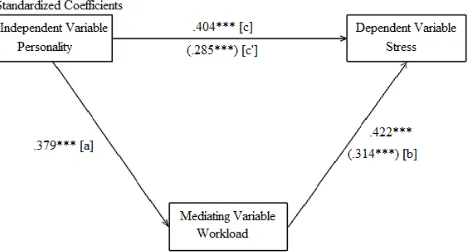
The first mediation shows that perceived workload effectively mediates the relationship between personality and perceived stress, such that the more Type A a person was, the more likely they were to take on a higher workload which predicted higher stress. That is, the relationship between personality and perceived stress diminishes once perceived workload is controlled for (correlation between personality and perceived stress: r(133)=.404 vs. correlation between personality and perceived stress after controlling for perceived workload: r(133)=.285; Sobel test: 2.97, p=.002) (see Figure 1 below). Figure 1. Workload mediates the relationship between personality and stress.
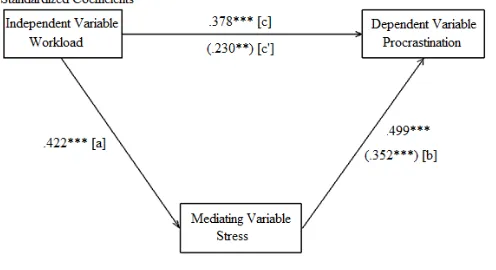
The second mediation shows the relationship between workload and procrastination as it is mediated by stress. Therefore, the higher a person’s perceived workload, the higher their perceived stress level, which predicted an increase in procrastination. This can be seen as the relationship between workload and procrastination decreases once controlled for perceived stress (correlation between perceived workload and procrastination: r(133)=.378 vs. correlation between perceived workload and procrastination after controlling for perceived stress: r(133)=.230; Sobel test: 3.40, p<.001) (see Figure 2 below).
Figure 2. Stress mediates the relationship between workload and procrastination.
*p < .05, ** p < .01, ***p < .001
Discussion
These results suggest that the more Type A a person is, the more workload they are likely to take on. Further, the higher their workload, the more stress they perceive themselves to be under. In addition, this increased level of stress predicts an increased tendency to procrastinate.
Study 2
In the literature, active and passive procrastination are both discussed (Corkin, Yu, & Lindt, 2011). Since study one examined each variables’ relationship to passive procrastination, the natural follow up question is does the type of procrastination matter? Therefore, in this study I will test whether these
previously determined relationships hold true when examining active procrastination.
high level of stress would be related to passive procrastination (Chu & Choi, 2005). Therefore, this follow up study aims to determine if individuals with Type A personality are prone to passive procrastination tendencies because of their increased perceived workload and stress levels.
Method
The procedure and measures from Study 1 were replicated, with minor changes. First, the second study consisted of 143 undergraduate students instead of 135. Then, two additional measures of procrastination were used determine if passive procrastination, and/or active procrastination, positively correlates with Type A personality. These measures include:
Active Procrastination. Developed by Chu and Choi (2005) the Academic Procrastination scale improved upon an original scale. The new Active Procrastination scale consisted of 12 items (e.g. I tend to work better under pressure) on a seven point Likert scale. High scores (above a 4.33) indicated a tendency for active procrastination (Chu & Choi, 2005).
Academic Procrastination or passive procrastination. This measure consisted of six items (e.g. I tend to leave things until the last minute) assessed on a seven point Likert scale ranging from not true at all to very true. High scores (above a 4.33) indicated a high tendency for passive procrastination (Chu & Choi, 2005).
Results
The results of this study confirmed the relationships discovered in the initial study. Once again, the more Type A an individual was the more perceived workload they reported (r(147)=.341, p<.001). Further, the higher their perceived workload, the more perceived stress they experienced (r(146)=.299, p<.001). Then, the higher their perceived stress level, the more likely they were to procrastinate (r(145)=.364, p<.001). Each of these relationships was replicated with the original procrastination measure in the first study.
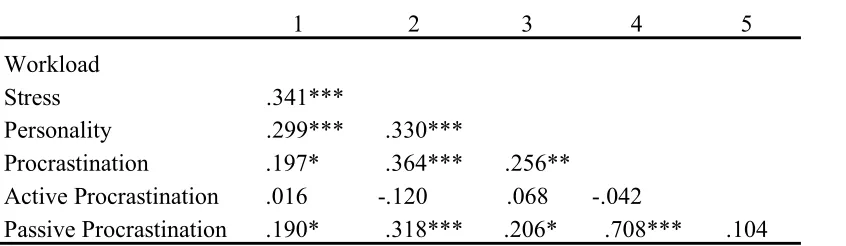
Further, the second study showed that personality was related to passive procrastination (r(141)=.206, p=.014), as were perceived workload (r(147)=.299, p<.001) and perceived stress (r(146)=.330, p<.001). However, none of these variables correlated with active procrastination (rs<|-.120|), ps>152; see Table 2.
To investigate whether the relationship between personality and perceived stress levels may be affected by a person’s perceived workload, a mediation analysis was conducted. Results showed that the relationship was mediated by perceived workload. Therefore, the more Type A a person is, the higher perceived workload which in turn predicts higher levels of perceived stress. This is seen through a decrease in the relationship between personality and perceived stress once controlled for perceived workload (correlation between personality and perceived stress: r(147)=.330 vs. correlation between personality and perceived stress after controlling for perceived workload: r(147)=.251; Sobel test: 2.52, p=.001; see Figure 3 below.
1 2 3 4 5
1. Workload
2. Stress .341***
3. Personality .299*** .330***
4. Procrastination .197* .364*** .256**
5. Active Procrastination .016 -.120 .068 -.042
6. Passive Procrastination .190* .318*** .206* .708*** .104
Figure 3. Workload mediates the relationship between personality and stress.
*p < .05, ** p < .01, ***p < .001
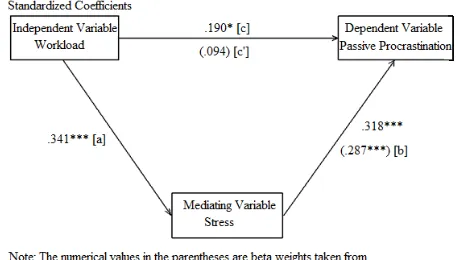
A second mediation between perceived workload and passive procrastination was conducted to test whether or not perceived stress levels effect the relationship. Results showed that the relationship between perceived workload and passive procrastination was mediated by perceived stress. Therefore, the higher a person’s perceived workload, the higher their perceived stress level, which predicts an increase in passive procrastination. This can be seen as the relationship between perceived workload and passive procrastination decreases when controlled for perceived stress (correlation between perceived workload and passive procrastination: r(141)=.190 vs. correlation between perceived workload and procrastination after controlling for perceived stress: r(141)=.094; Sobel test: 2.64, p=.008) (see Figure 4).
Figure 4. Stress mediates the relationship between workload and passive procrastination.
*p < .05, ** p < .01, ***p < .001
Discussion
These results suggest that the more Type A personality, a person is, the more perceived workload they report. Further, the higher their perceived workload, the more stress they feel they are under. This increased level of perceived stress predicts an increased tendency to
passively procrastinate.
General Discussion
The purpose of this study was to investigate the link between Type A personality and procrastination through workload and stress. My results not only suggest this link exists, but they were supported through three main findings. First, the more Type A a person is, the higher their perceived mental workload is. Second, the higher their perceived workload, the more perceived stress they reported. Third, the higher their perceived stress level, the more likely they were to passively procrastinate. These findings were further supported through two mediation analyses. First, a statistical analysis showed that workload mediates the relationship between personality and stress. Second, stress mediates the relationship between workload and passive procrastination. Each of these findings provides support for the hypothesis that the more Type A a person is, the more likely they are to passively procrastinate because of their increased perceived workload and stress levels.
these findings, it can be said that they support this original link between Type A personality and passive procrastination through perceived workload and stress.
Unfortunately, there were some limitations to this study. First, because of the structure of undergraduate courses, study one was conducted during the entire fall 2014 semester while study 2 was conducted only during the first half of the spring 2015 semester. This time frame may not have allowed actual procrastinators, who would have waited until the last half of the semester, to complete the second study. In addition, the nature of each study, relying on self-report measures, could have affected the results. For example, a subject may not have known their behavior is defined as procrastination.
Conclusion
Future studies could make use of these criticisms and measure each variable differently and at different times to see if the relationships change. Further, it would be fascinating to analyze these relationships in an experimental setting. For example, manipulating an individual’s workload and/or stress to see the effects it has on procrastination would be an interesting way to expand upon the current study’s findings.
Regardless of these limitations, understanding the connection between personality type and procrastination is important for anyone trying to alter their procrastination tendency. For example, Knaus (1973) suggests that people are unsuccessful in changing their procrastination tendency because of their intense rationalization, meaning that the urge to procrastinate is aided by thoughts such as, “I still have time I can do it later” (Knaus, 1973). Therefore, Knaus (1973) suggests reversing these thoughts to overcome procrastination. However, while I agree that reversing these thoughts may help eliminate procrastination, I suggest more information is needed. For example, understanding the relationship between Type A personality, workload, stress, and procrastination may be
more beneficial in preventing procrastination. Therefore, knowing that personality type can increase workload, stress, and procrastination may allow an individual with Type A personality to decrease their workload and stress levels which may help them decrease procrastination more than reversing their thought patterns.
References
Armstrong-Stassen, M. (2005). Coping with downsizing: A comparison of executive-level and middle managers. International Journal of Stress Management, 12(2), 117-141.
Chu, A. H. C., & Choi, J. N. (2005). Rethinking procrastination: Positive effects of “active” procrastination behavior on attitudes and performance. Journal of Social Psychology, 145(3), 245-264.
Cohen, S., & Williamson, G. M., (1988). Perceived stress in a probability sample of the United States. In Spacapan, S., & Oskamp, S. (Eds.), The social psychology of health (31-67). Newbury Park, CA: Sage.
Corkin, D. M., Yu, S. L., & Lindt, S. F. (2011). Comparing active delay and procrastination from a self-regulated learning perspective.
Learning & Individual Differences, 21(5),
602-606.
DeArmond, S., Matthews, R. A., & Bunk, J. (2013). Workload and procrastination: The roles of psychological detachment and fatigue.
International Journal of Stress Management.
Fichera, L. V., & Andreassi, J. L. (1998). Stress and personality as factors in women’s cardiovascular reactivity. International Journal
of Psychophysiology, 28(2), 143-155.
Hallberg, U. E., Johansson, G., & Schaufeli, W. B. (2007). Type A behavior and work situation: Associations with burnout and work engagement. Scandinavian Journal of Psychology, 48(2), 135-142.
Kausar, R. (2010). Perceived stress, academic workloads and use of coping strategies by university students. Journal of Behavioral Sciences, 20(1), 31-45.
during mental workload. Psychosomatic Medicine, 54(4), 462-470.
Kawachi, I., Sparrow, D., Kubzansky, L. D., Spiro, A., Vokonas, P. S., & Weiss, S. T. (1998). Prospective study of a self-report Type A scale and risk of coronary heart disease. Circulation, 98(5), 405-412.
Knaus, W. J. (1973). Overcoming procrastination. Rational Living, 8(2), 2-7.
McLeod, S. A. (2011). Type A Personality. Retrieved from http://simplypsychology.org/ personality-a.html
Renn, R. W., Allen, D. G., Fedor, D. B., & Davis, W. D. (2005). The roles of personality and self-defeating behaviors in self-management failure. Journal of Management, 31(5), 659-679.
Sato, N., Kamada, T., Miyake, S., Akatsu, J., Kumashirto, M., & Kume, Y. (1998). Power spectral analysis of heart rate variability in Type A females during a psychomotor task. Journal of Psychosomatic Research, 45(2), 159-169.
Sato, N., Kamada, T., Miyake, S., Akatsu, J., Kumashiro, M., & Kume, Y. (1999). Subjective mental workload in Type A women.
International Journal of Industrial Ergonomics, 24(3), 331-336.
Tice, D. M., & Baumeister, R. F. (1997). Longitudinal study of procrastination, performance, stress, and health: The costs and benefits of dawdling. Psychological Science, 8(6), 454-458.
Tuckman, B. W. (1991). The development and concurrent validity of the procrastination scale. Educational and Psychological Measurement, 51(2), 473-480.