Zahra Alam Mehrjerdi ¹*, Farbod Tasnim ², Linda Farahani ²
1. Neurocognitive Laboratory, Iranian National Center for Addiction Studies (INCAS), Tehran University of Medical Sciences, Tehran, Iran.
2. Department of Psychostimulant Use Treatment Program, Rojan Psychiatric Center, Tehran, Iran
* Corresponding Author: Zahra Alam Mehrjerdi, MA.,
Neurocognitive laboratory of Iranian National Center for Addiction Studies (INCAS), Tehran University of Medical Sciences.
Introduction: Coping responses are complex dynamic behavioral reactions that involve reciprocal influences between emotion and cognition but cognitive studies in Iran have less emphasized coping responses of methamphetamine dependent individuals to distressing situations. To address this aim, the current study was designed to investigate the coping responses of a group of methamphetamine dependent women in comparison with a group of healthy women.
Methods: 80 women with mean age 24(SD=6.8) years who met DSM.IV-TR criteria for methamphetamine dependence were recruited from the department of psychostimulant use treatment program of Rojan psychiatric center and 4 other local clinics in Tehran, Iran and were matched with a sample of 80 non-drug taking women. First, demographics and details of substance use were completed based on items elicited from Addiction Severity Index (ASI), then the Persian version of Billings and Moos Coping Checklist was completed by participants in each group. Data was further analyzed by performing independent sample t-test and logistic regression model in SPSS.v.16.0.
Results: The study findings indicated that the methamphetamine dependent group applied less problem-solving response and had lower reliance on seeking social support and cognitive evaluation compared with the controls. In addition, the methamphetamine dependent group applied significantly more emotional and physical control oriented responses compared with the controls.
Discussion: The study results yielded that coping responses of the methamphetamine dependent group were less problem-focused strategies which show an impaired aspect of cognitive functioning which is subject to clinical and treatment implications. Study in the context of identifying aspects that are fundamental to understanding the neural mechanisms underlying emotion-cognition interactions in the paradigm of coping responses is discussed.
A B S T R A C T
Article info:
Received: 10 August 2010
First Revision: 15 September 2010
Accepted: 25 October 2010
Key Words:
Methamphetamine, Emotion,
Winter 2011, Volume 2, Number 2
Basic and Clinical
1. Introduction
ognitive control of emotion is one of the important cognitive aspects of human functioning. Conscious cognitive process-es aimed at regulating emotions can act on the emotion-eliciting stimulus or upon the emotional response. According to Garnefski and col-leagues (2001), the former reflects a problem-focused strategy, whereas the latter represents an emotion-fo-cused regulatory strategy (Garnefski et al., 2001). Cop-ing responses can act as strategies to control the nega-tive effects of a distressing condition and can regulate affect. This transactional process consists of both cog-nition and behavioral aspects (Endler & Parker, 1999; Lazarus & Folkman, 1984).
Coping responses in human individuals have strong underlying neural mechanisms. Some studies shed light on the brain regions that distinguish adaptive ver-sus maladaptive coping responses and show the neural bases of emotion regulation using functional magnetic resonance imaging (fMRI).
Fox example; in a study on the neural bases of coping strategies, 16 participants were asked to focus on nega-tive autobiographical memories using cogninega-tive strate-gies designed to facilitate (feel strategy) versus under-mine (analyze and accept strategies) rumination. In this study, left prefrontal activity was observed during the implementation of all three strategies. Second, activity in a network of regions involved in self-referential pro-cessing and emotion, including subgenual anterior cin-gulate cortex and medial prefrontal cortex, was highest in response to the feel strategy and lowest for the accept strategy. This pattern of activation showed participants’ self-reports of negative affect when engaging in each strategy (Kross et al., 2009).
Some neuroimaging studies of non-drug taking healthy individuals using conscious cognitive strategies to regu-late affect have generally showed the inhibitory role of lateral and dorsal regions of the prefrontal cortex and dorsal anterior cingulate cortex in modulating neural ac-tivity in emotional appraisal systems (Beauregard et al., 2001; Mathews et al, 2004).
Coping responses are cognitive strategies that are clas-sified in to 3 main categories including problem-focused strategies, emotion-focused strategies, and avoidance-focused strategies (Endler & Parker, 1994; 1999).
C
control the negative effects of a stressful situation. Emo-Problem-focused coping is a strategy to resolve or tion-focused coping is more emotion-oriented while in avoidance-focused coping, an individual engages in an indirect activity such as social diversion which is not in relation with the stressful situation (Endler & Park-er, 1990; Lazarus & Folkman, 1984). Most coping re-sponses are not either adaptive rere-sponses or avoidance responses (Roth & Cohen 1986; Suls & Fletcher, 1985) but drug abuse is an example of a temporary coping re-sponse that provides short-term relief from distress but leaves the source of the distress without change; thus, it is basically maladaptive (Wills & Shiffman, 1985). Tension reduction models suggest that some individu-als use drugs to decrease negative affect (i.e., to cope) (Cox & Klinger, 1988) and a number of studies support this model, particularly for drugs such as marijuana and alcohol abuse (Kaplan et al., 1986; Cooper et al., 1995). Coping responses that a drug dependent individual ap-plies to deal with a distressing situation may be a mod-erator in subsequent drug abuse.From the theoretical model of learning, drug depen-dent individuals develop maladaptive coping skills in dealing with distressing situations (Collier & Mar-latt, 1995; Swift, 1997), and self-medicate to cope with stress (Lyden et al., 1995).
Understanding the reciprocal interactions between emotion and cognition in the paradigm of coping re-sponses is critical for understanding fundamentals of healthy functioning, as well as changes associated with methamphetamine dependence. An important aspect in this context concerns the role of group differences in emotion-cognition responses, and group variations in vulnerability to distress. Within the realm of healthy emotional responses, some individuals may tend to be more emotionally responsive, while others can regulate better their emotions. Understanding the role of differ-ences between non-drug taking group and methamphet-amine dependent group can provide insights into some cognitive and emotional factors that may influence the susceptibility to methamphetamine use, in which unbal-anced interactions between emotion and cognition may lead to chronic methamphetamine dependence.
80 women who met DSM.IV.TR criteria (American Psychiatric Association, 2000) for methamphetamine dependence within the past 6 months and were in the waiting list to enter treatment with the Matrix Model were recruited through referrals from the department of psychostimulant use treatment program of Rojan psychiatric center and through poster presentation in 4 other local clinics in Tehran, Iran. Participants were compensated with retail vouchers for study participa-tion. All participants who met our physician’ medical approval on methamphetamine urine screening test en-tered the study.
All participants were also required to maintain absti-nence from alcohol, and all other drugs of abuse except nicotine as confirmed by urine drug screening on the study day. Inclusion criteria were female gender, being in the 18-50 age range, and current route of smoking administration of methamphetamine. Exclusion criteria were poly substance use, a history of or current physi-cal disorder, affective disorders, bipolar disorder, psy-chotic disorders and positive history of intravenous use of drug. The methamphetamine dependent group was matched with 80 healthy not drug-taking female par-ticipants based on gender, age, education, employment, income and scio-economic status and they reported no history of physical, psychiatric or affective disorders, no history or current drug and alcohol use. The writ-ten consent form was obtained from each participant. The protocol of the study was approved by the insti-tutional review board of Tehran University of Medical Sciences.
2.2. Study Design
After giving informed consent, potential participants were screened using the MINI International Neuropsy-chiatric Interview (Sheenhan et al., 1998), a structured interview based on the DSM-IV for assessment of psy-chiatric and substance use symptoms. Demographics and details of substance use were completed based on items elicited from Addiction Severity Index (ASI) (McLellan et al., 1992).
The Persian version of Billings and Moos Coping Checklist (1984) which has been revised by Hosseini Ghadamgahi (1997) in Iran was administered in this study. It includes 32 questions and measures using
cop-(r=0.79) and in the present study, the reliability of this questionnaire via test-retest within 2 weeks was quite acceptable (r=0.83).
2.3. Data analysis
Data was analyzed by performing independent sample t-test and logistic regression model in SPSS.v.16.0.
3. Results
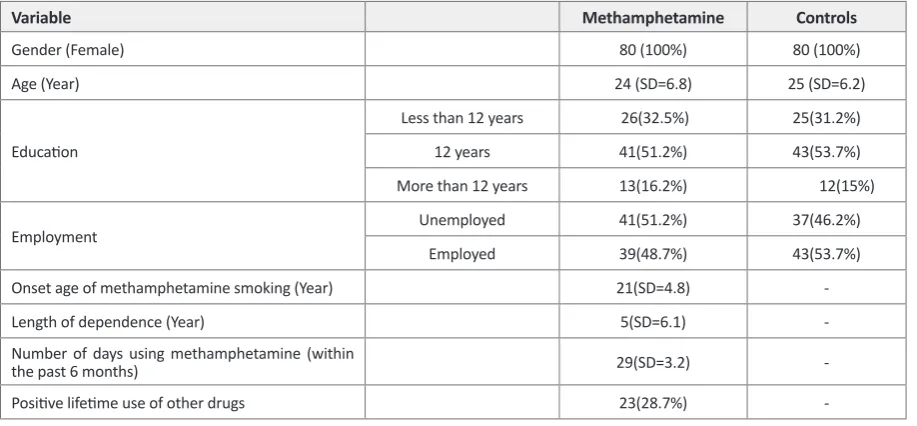
Participants were between 22 to 32 years of age. No participant was poly substance user at the onset of our study. Almost half of the sample had 12 years of educa-tion while the remaining had primary and high school education or were university students respectively. On-set age of methamphetamine smoking was 21(SD=4.8) years and the length of methamphetamine dependence was 5(SD=6.1) years indicating long years of metham-phetamine abuse and dependence in the methamphet-amine group while the healthy group reported no his-tory of drug use (See Table1).
Data analysis by performing independent sample t-test showed that in some subscales of the Billings and Moos Coping Checklist including problem solving responses (5.15±1.8), seeking social support (4.37±2.6) and cog-nitive evaluation (10.51±2.1), the methamphetamine dependent group received lower scores compared with the controls but the scores received by the methamphet-amine dependent group in responses related to emotion control (15.14±4.8), and physical control (6.23±4.9) were significantly higher compared with the scores re-ceived by the controls.
Winter 2011, Volume 2, Number 2
Basic and Clinical
Variable Methamphetamine Controls
Gender (Female) 80 (100%) 80 (100%)
Age (Year) 24 (SD=6.8) 25 (SD=6.2)
Education
Less than 12 years 26(32.5%) 25(31.2%)
12 years 41(51.2%) 43(53.7%)
More than 12 years 13(16.2%) 12(15%)
Employment Unemployed 41(51.2%) 37(46.2%)
Employed 39(48.7%) 43(53.7%)
Onset age of methamphetamine smoking (Year) 21(SD=4.8)
-Length of dependence (Year) 5(SD=6.1)
-Number of days using methamphetamine (within
the past 6 months) 29(SD=3.2)
-Positive lifetime use of other drugs 23(28.7%)
-Table 1. Demographic characteristics of participants (n=160)
Variable β Standard Error p value Ratio
Problem solving 0.73 0.12 0.001 2.10
Cognitive evaluation 0.33 0.08 0.002 1.31
Social support 0.39 0.09 0.001 1.42
Emotional control -.066 0.06 0.001 0.67
Physical control -.041 0.08 0.001 0.61
Table 3. Logistic regression analysis of the coping responses of the 2 groups (n=160)
Variable Subscales Methamphetamine Controls p value
Mean SD Mean SD
Coping responses
Problem solving 5.15 1.8 6.49 1.3 0.000
Cognitive evaluation 10.51 2.1 12.13 2.2 0.001
Social support 4.37 2.6 6.78 1.8 0.001
Emotional control 15.14 4.8 10.52 2.6 0.00
Physical control 6.23 4.9 2.41 1.8 0.001
Table 2. Demographic characteristics of participants (n=160)
4. Discussion
The findings from this study indicate that the metham-phetamine dependent group self-reported applying less problem-focused coping responses and reported seek-ing less social support in distressseek-ing situations. In ad-dition, when compared with the controls, the
ficult situations. This notion would facilitate their path-ways to continue methamphetamine use as an emotional coping response rather seeking a problem-focused cop-ing response.
The current study findings are consistent with the be-liefs of some clinicians with a social learning orientation who revealed that individuals who had abuse pattern of drinking were different from healthy drinkers in coping with everyday problems and in their beliefs about alco-hol (Abrams & Niaura, 1987).
In addition, our study findings are consistent with a part of the study of Pelissier and colleagues (2006) on a sample of 1,189 male and 300 female offenders. They revealed that the female participants reported less self-efficacy to remain abstinent in high-risk situations, and had more escaping from distressing situations as com-pared with the male participants.
The importance of problem-focused coping response to difficult situations is the contribution that this con-cern may have in the reliance on drug abuse as an emo-tional response, and subsequently to the enhancement and maintenance of drug abuse problem among drug us-ing individuals (Cooper et al., 1992).
The current study emphasizes necessity for teaching appropriate problem-focused coping responses to our methamphetamine dependent participants. In fact, giv-en that the ability to cope with difficult situations may be a moderator in drug abuse, teaching adaptive ways of coping with stress in drug dependent individuals is a necessity (Collier & Marlatt, 1995; Swift, 1997).
Stress-coping models in addiction studies have also emphasized the importance of effective coping re-sponses as a mediator of the effects of stress. For ex-ample, studies have revealed that positive coping skills enhancement basically improve the ability of drug users to control drug craving and to remain abstinent despite severe distressing circumstances (Brown et al., 2001; Rask et al., 2006). Alternatively, coping responses as-sociated with negative emotions are asas-sociated with re-lapse phenomena (Weaver et al., 2000).
Ample evidence has also linked negative emotions, stress, and ineffective coping to drug dependence,
re-tal conditions. The capacity to effectively implement emotion regulation strategies is important for cognitive functioning and health. These findings are considered in the context of related concepts of emotion perception and emotion generation, with discussion of the likely cognitive neuropsychological contributions to emotion regulation and the implications for psychiatric disor-ders.
There were several recognized limitations when com-pleting this study. The first limitation was that the sam-ple size was small and the study had a cross-sectional design. Only one type of coping questionnaire was uti-lized in this study. Subjects were studied from only a limited number of psychostimulant use treatment cen-ters. Because there were not comparisons from multiple treatment centers from various parts of Tehran, the sam-ple was not representative of the general methamphet-amine dependent population in Tehran. The subjects in this study were methamphetamine dependent women who were seeking treatment; however, there are many methamphetamine dependent women who do not seek treatment, so our study results may not be applied to the female methamphetamine dependent general popula-tion in Tehran.
To sum up, from a cognitive perspective, initial per-ceptual processing of emotionally important situations is critical in the generation of emotional responses within both central and autonomic nervous systems and thus influences higher order cortical processing. Aberra-tion in early perceptual or autonomic responding during initial stages of emotion processing has the potential to disrupt efficient emotion regulation and may manifest in applying impaired coping responses in methamphet-amine dependent individuals. Future research within a social cognitive neuroscience framework is necessary to elucidate specific abnormalities in the neural mecha-nisms of emotion regulation that support psychological processes of methamphetamine dependence.
References
Abbott, F.V., Melzack, R., Leber, B.F., (1982). Morphine
an-algesia and tolerance in the tail-flick and formalin tests:
Winter 2011, Volume 2, Number 2
Basic and Clinical
Ahmadiani, A., Hosseiny, J., Semnanian, S., Javan, M., Saeedi, F., Kamalinejad, M., (2000). Antinociceptive and
anti-in-flammatory effects of Elaeagnus angustifolia fruit extract. J
Ethnopharmacol 72, 287-92.
Alishiri, G.H., Ahmadiani, A., Bayat, N., Kamalinejad, M., Salimzadeh, A., Saremi, S., Miri, S.M., Nodeh, A., (2007). Evaluation of the effects Elaeagnus angustifolia fruit extract in patients with knee osteoarthritis: a double-blind com-pletely randomized placebo clinical trial. Kowsar Medical J 12, 39-57.
Chandrasekharan, N.V., Simmons, D.L., (2004). The cyclooxy-genases. Genome Biol 5, 241-353.
Coderre, T.J., Abbott, F.V., Melzack, R., (1984). Effects of
pe-ripheral antisympathetic treatments in the tail-flick, forma -lin and autotomy tests. Pain 18, 13-23.
Coutaux, A., Adam, F., Willer, J.C., Le Bars, D., (2005). Hyper-algesia and allodynia: peripheral mechanisms. Joint Bone Spine 72, 359-71.
Dembinska-Migas, W., Gill, S., (1973). Flavonoids in leaves of Elaeagnus angustifolia L. Pol J Pharmacol Pharm 25, 599-606.
Dubuisson, D., Dennis, S.G., (1977). The formalin test: a quan-titative study of the analgesic effects of morphine, mepe-ridine, and brain stem stimulation in rats and cats. Pain 4, 161-74.
Fereidoni, M., Ahmadiani, A., Semnanian, S., Javan, M. (2000). An accurate and simple method for measurment of paw edema. J Pharmcological and Toxicological Methods 43, 11-14.
Ferreira, S.H., (1980). Peripheral analgesia: mechanism of the analgesic action of aspirin-like drugs and opiate-antago-nists. Br J Clin Pharmacol 10 Suppl 2, 237S-245S.
Ferreira, S.H., Lorenzetti, B.B., Correa, F.M., (1978). Central and peripheral antialgesic action of aspirin-like drugs. Eur J Pharmacol 53, 39-48.
Ferreira, S.H., Nakamura, M., (1979). I - Prostaglandin hyper-algesia, a cAMP/Ca2+ dependent process. Prostaglandins 18, 179-90.
Hunskaar, S., Hole, K., (1987). The formalin test in mice:
disso-ciation between inflammatory and non-inflammatory pain.
Pain 30, 103-14.
Kavirajan, H., (2009). Memantine: a comprehensive review of
safety and efficacy. Expert Opin Drug Saf 8, 89-109.
Millan, M.J., (1999). The induction of pain: an integrative re-view. Prog Neurobiol 57, 1-164.
O’Brien, C.P., (2001). Drug addiction and drug abuse. In: Hardman, J.G., Limbird, L.E., Goodman, Gilman, A., (Eds.) Goodman and Gilman The Pharmacological Basis of Thera-peutics. McGraw-Hill, New York. pp. 621-42.
Ramezani, M., Hosseinzadeh, H., Daneshmand, N., (2001). Antinociceptive effect of Elaeagnus angustifolia fruit seeds in mice. Fitoterapia 72, 255-62.
Simmons, D.L., Botting, R.M., Hla, T., (2004). Cyclooxygenase isozymes: the biology of prostaglandin synthesis and inhibi-tion. Pharmacol Rev 56, 387-437.
Simmons, D.L., Wagner, D., Westover, K., (2000).
Nonsteroi-dal anti-inflammatory drugs, acetaminophen, cyclooxygen -ase 2, and fever. Clin Infect Dis 31 Suppl 5, S211-8.
Vargaftig, B.B., Ferreira, S.H., (1981). Blockade of the inflam -matory effects of platelet-activating factor by cyclo-oxygen-ase inhibitors. Braz J Med Biol Res 14, 187-9.